The honest answer is that a week of diving in Indonesia costs anywhere from about 1,000 to 8,000 US dollars per person, and that range is so wide it is almost useless without breaking it apart. So this guide breaks it apart. If you are trying to work out what an Indonesia liveaboard should cost, what the quoted price does and does not cover, and whether the cheap option in your browser tab is a bargain or a warning, the numbers below are the ones that matter.
We field this question more than any other, usually in the form of a one-line email asking for a price. It is a reasonable question with an annoying answer, because two boats sailing the same route in the same week can differ by a factor of five, and the difference is not always visible in the photographs. Prices here are given in US dollars, since that is how almost everyone shopping for scuba diving in Indonesia compares options, with rupiah shown alongside the headline figures because that is the currency you will actually be quoted and charged in.
The short answer, by boat category
Indonesian liveaboards sort roughly into three tiers, plus private charter. The per-night figure is the most useful comparison unit, because itinerary lengths vary so much that trip totals are not directly comparable.
| Tier | Per person, per night | Typical 7 nights | What you are buying |
|---|---|---|---|
| Budget | $150 to $300 (Rp 2,715,000 to Rp 5,430,000) | $1,050 to $2,100 | Shared or basic cabins, larger groups, professional but no-frills diving |
| Mid-range | $300 to $600 (Rp 5,430,000 to Rp 10,860,000) | $2,100 to $4,200 | Private en-suite cabins, smaller dive groups, nitrox usually available, camera space |
| Luxury | $600 to $1,200+ (Rp 10,860,000 to Rp 21,720,000+) | $4,200 to $8,400+ | Spacious cabins, high crew-to-guest ratio, full camera room, premium food and service |
| Private charter | From roughly $3,000 per day for the whole vessel | Varies widely | Exclusive use, custom route, your own group |
Those bands are soft at the edges. A handful of mid-range boats sell master cabins at luxury prices, and one or two luxury boats discount hard on shoulder-season departures to avoid sailing half empty. Treat the tiers as a starting point for comparison rather than a rule.
A useful sanity check: for most divers, the sensible answer lands in the mid-range band on a five to seven night itinerary, which in practice means a boat-and-fees total somewhere around $2,000 to $3,500. Below that you are trading comfort or crew numbers for price. Above it you are buying space, service and food rather than better diving, which is a perfectly rational thing to buy but worth naming honestly.
Why the same week costs five times as much on a different boat
Four things drive most of the variation, and none of them are marketing.
The first is space per guest. This is the single biggest cost lever on a boat. A vessel carrying 24 guests spreads its fuel, crew wages, provisioning and permits across 24 fares. The same hull configured for 12 guests spreads the identical costs across half as many people, and the fare has to roughly double for the economics to work. When you pay more, a large part of what you are buying is simply the absence of other guests.
The second is crew ratio. A boat with one dive guide to four guests costs meaningfully more to run than one with a guide to eight, and the difference shows up on every dive: smaller groups, less waiting, more attention if something goes wrong. On a current-heavy site this stops being a comfort question and becomes a safety one.
The third is where the boat goes. Remote itineraries burn more fuel, carry more provisions, and cannot restock mid-trip. This is why the Banda Sea and Triton Bay tend to cost more per night than a Komodo loop out of Labuan Bajo, even on the same vessel. Distance is expensive.
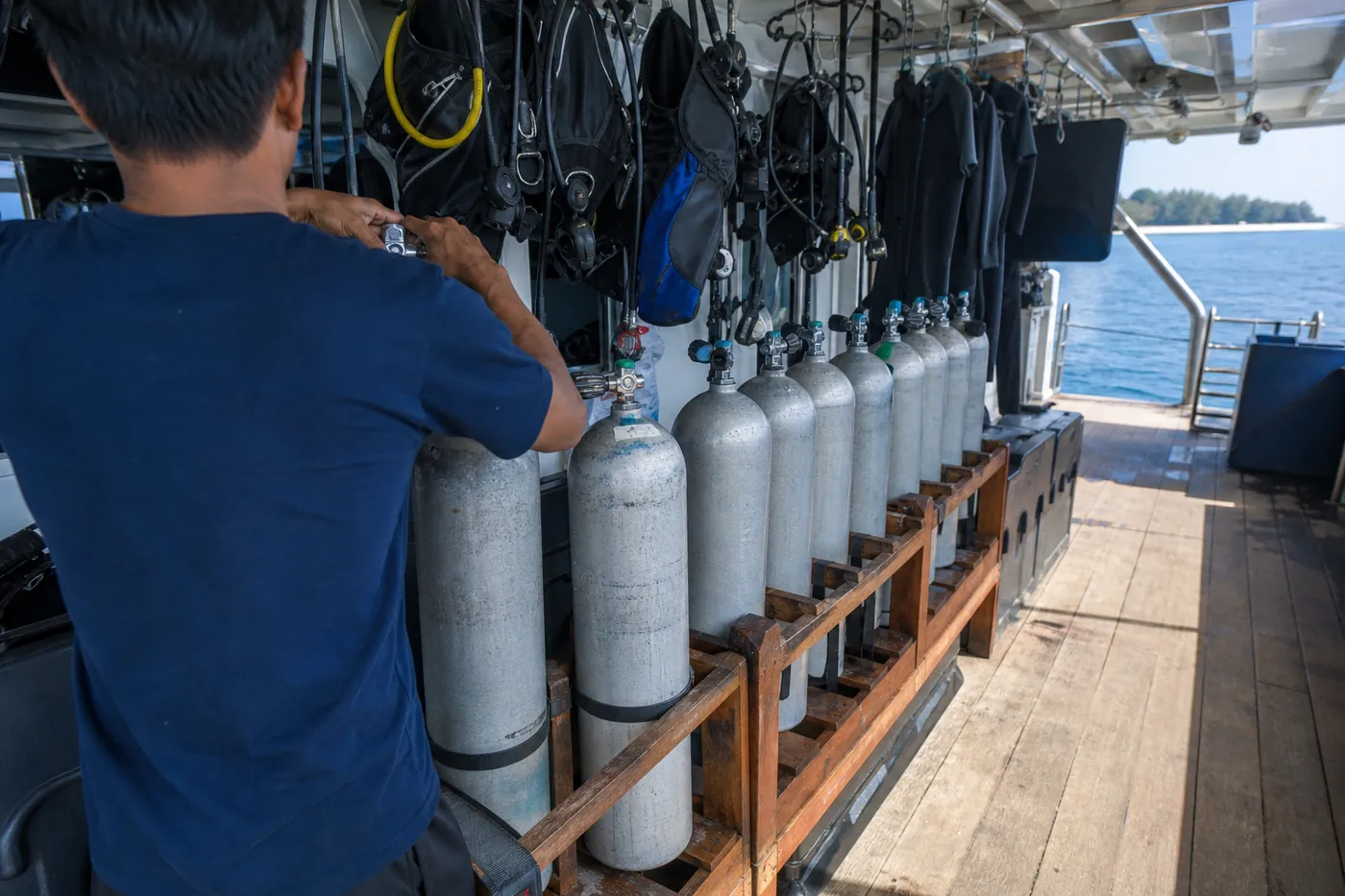
The fourth is the age and quality of the equipment you cannot see. Compressors, filters, tanks, tenders, engines, oxygen kits, life rafts and navigation gear all have real replacement costs and real maintenance schedules. A boat that defers that maintenance can undercut a boat that does not, and you will not spot the difference from the deck photographs. This is the part of the price that is genuinely worth paying, and we come back to it below.
What the headline price normally covers
Most Indonesian liveaboards quote a fare that is close to all-inclusive once you are on board. In the great majority of cases you can expect the quoted price to cover your cabin, all meals and snacks, soft drinks, tea and coffee, three to four dives a day with tanks and weights, guiding, and the tender operations that get you to the sites. Land excursions that form part of the itinerary, such as a Komodo dragon trek or a village visit, are usually included too.
That is genuinely good value compared with a resort holiday where you pay per dive. It is also the reason the sticker shock is misleading: a $2,800 week on a boat covers accommodation, all food, and roughly 20 dives, which is not the same product as $2,800 of hotel nights.
What the price almost never covers
This is where budgets go wrong. The extras are individually small and collectively significant, and on a remote itinerary you cannot decline them once you are aboard. Allow 15 to 25 per cent on top of the boat fare for the items below, more if you need to rent a full set of gear.
| Item | Typical cost | Notes |
|---|---|---|
| Park and government fees | $17 per day (Komodo) to about $94 (Raja Ampat) | Almost always excluded, cash on arrival. See below |
| Nitrox | $100 to $150 per trip, or free for certified divers on some boats | Ask whether it is per trip or per tank |
| Full equipment rental | $25 to $40 per day | Roughly $175 to $280 across a week |
| Crew tips | 5 to 10 per cent of the fare | Not obligatory, but genuinely expected |
| Domestic flights | $50 to $150 (Labuan Bajo), $200 to $400+ (Sorong) | Rarely included in any quote |
| Pre and post hotel nights | $30 to $200+ per night | You will need at least one at each end |
| Alcohol | Varies, often a bar tab | Beer and wine are usually charged |
| Dive insurance | $50 to $120 per year | Increasingly mandatory rather than optional |
| Single supplement | Often 30 to 100 per cent of a fare | Waived on some boats if you share |
Two of those deserve individual attention because they catch people out most often. If you are travelling alone, the single supplement can be the largest single line item after the fare itself, and it varies enormously between operators, so it is worth asking early rather than assuming; our guide to solo liveaboard diving in Indonesia covers how different boats handle cabin sharing. And on nitrox, the pricing model matters more than the headline: whether nitrox is worth paying for depends heavily on whether the boat charges per trip or per fill.
Park fees, the line item everyone forgets
Indonesian marine park fees are set by government, changed without much notice, and almost never included in a boat fare. They are also not trivial, and they work completely differently in the two headline destinations.
In Raja Ampat, as of 2026, foreign visitors pay two separate charges. There is a marine park entry permit of IDR 700,000, which funds conservation and patrols and is valid for twelve months from issue, so a second trip inside the year does not require paying again. On top of that sits a visitor entry ticket of IDR 1,000,000, levied by the regency government for tourism infrastructure and charged per visit. That comes to IDR 1,700,000 per person, roughly $94, and children under twelve are exempt from the regency levy. This went up substantially in early 2026, so older guides quoting around $100 total or less are out of date on the detail even where the total looks similar.
Komodo works per day rather than per trip. A foreign diver should budget in the region of IDR 300,000 a day, which breaks down as an entrance fee of about IDR 250,000, a diver surcharge of IDR 25,000 and a harbour fee of IDR 25,000. Call it $17 a day, so a four-day park itinerary runs somewhere near $65 to $70. Ranger fees for dragon trekking are charged per group rather than per person, so they get cheaper the more of you there are. Komodo also operates a daily visitor quota with advance booking through the government platform, which is a scheduling constraint as much as a cost one.
Because these figures move, treat any published number, including this one, as indicative. Ask your operator to confirm the current amount in writing at the time you book, and bring cash, since card payment at the point of collection is unreliable at best.
Komodo and Raja Ampat are not the same price
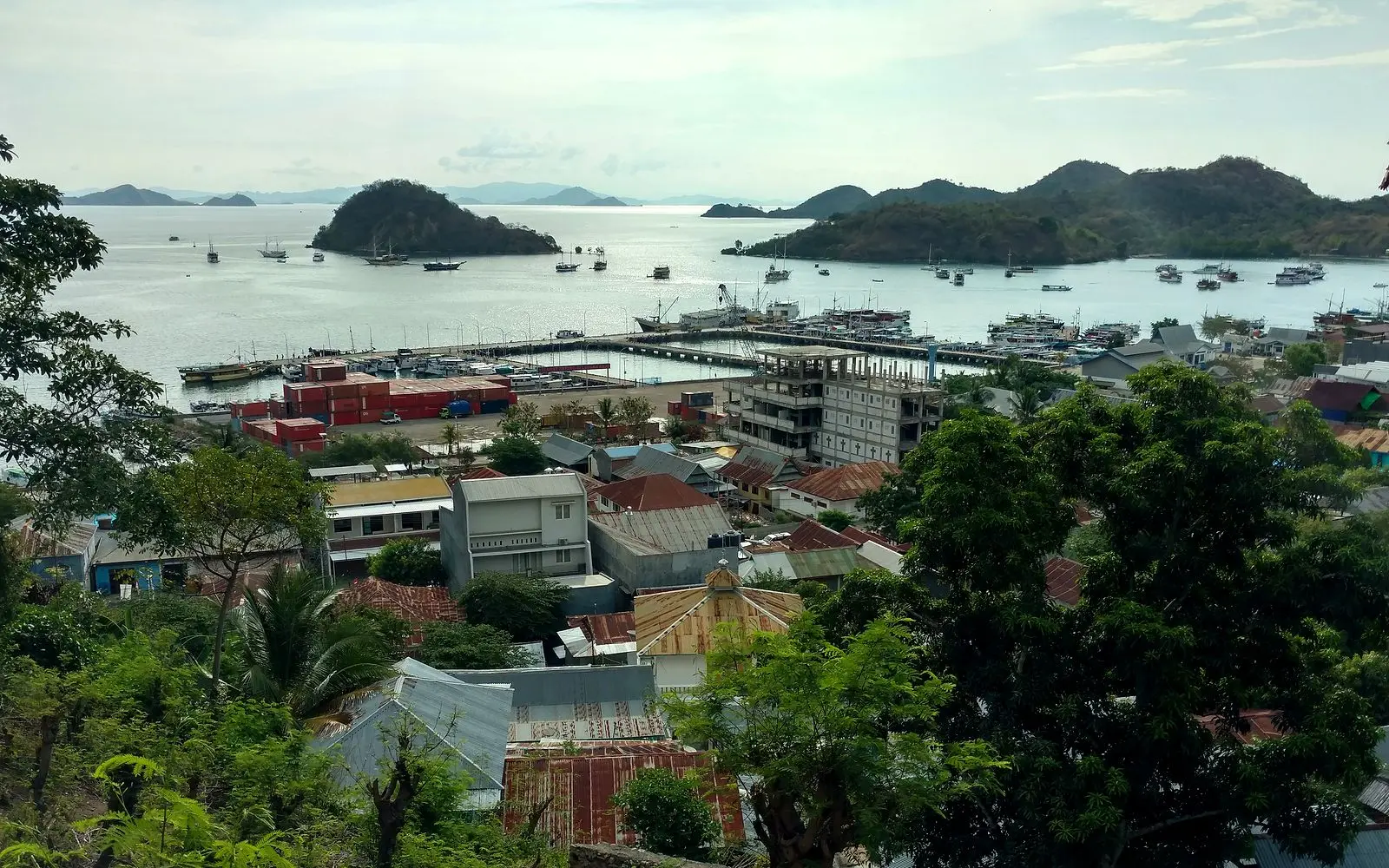
The destination changes the number more than most people expect. At the budget and mid-range tiers, Raja Ampat typically runs 30 to 40 per cent above Komodo for comparable accommodation, and the reason is pure logistics. Komodo boats operate out of Labuan Bajo, an hour's flight from Bali, with short transfers and easy restocking. Raja Ampat boats work from Sorong, which is a long way from anywhere, and then sail substantial distances between the Dampier Strait and the southern sites around Misool.
| 7 nights, per person | Komodo | Raja Ampat |
|---|---|---|
| Budget | $500 to $1,200 | $800 to $1,500 |
| Mid-range | $1,800 to $4,000 | $2,500 to $5,000 |
| Luxury | $5,000 to $14,000 | $5,000 to $14,000 |
Notice that the gap closes at the top. At the luxury end the two destinations converge, because the vessels are frequently the same vessels: the larger phinisi and premium boats reposition seasonally between Komodo, Raja Ampat and the Banda Sea, and they price on cabin and service rather than on region. If you are choosing between the two on cost grounds rather than diving grounds, the comparison of Raja Ampat versus Komodo goes into the diving differences in detail, and the practical logistics are covered in our guides to getting to Labuan Bajo and getting to Raja Ampat.
The remoter routes sit above both. Banda Sea crossings, the Forgotten Islands and Triton Bay carry a premium of their own because of distance and the number of sailing days involved, and they usually run on longer itineraries of ten nights or more, which raises the trip total even where the per-night rate is similar.
Season moves the price, sometimes a lot
Indonesian liveaboard pricing is seasonal in a way that rewards flexibility. Peak departures, broadly July through September in Komodo and the December to March window in Raja Ampat, sell out first and discount least. Shoulder dates can be 15 to 30 per cent cheaper on the same boat in the same cabin, and the diving is frequently just as good, occasionally better.
The catch is that some of the cheapest dates are cheap because the conditions are genuinely worse. Komodo in the January and February wet season and Raja Ampat during the strongest winds are discounted for a reason. Working out which cheap dates are bargains and which are traps is the entire point of our month-by-month guides to the best time to visit Komodo and the best time to visit Raja Ampat, alongside the broader picture of Indonesia liveaboard seasons.
Book six to twelve months out for peak season on a popular boat, particularly if you want a specific cabin. Last-minute discounts do exist and can be excellent, but they are a strategy for people who can travel on three weeks' notice, not a plan.
Tipping, which is a real cost and not a rounding error
The convention across Indonesian liveaboards is 5 to 10 per cent of the trip price, pooled among the crew. On a $3,000 week that is $150 to $300, which is not a trivial addition, and it is worth building into the budget rather than discovering at the end of the trip when you are trying to work out how much cash you should have brought. Crews on these boats are typically 12 to 20 people for a dozen guests, most of whom you never see, and the pool is usually split across all of them. Our guide to tipping on an Indonesia liveaboard covers the mechanics, including how much cash to bring and in what denominations.
Why the cheapest boat is cheap
This is the section we would want a friend to read before booking. Nobody in this industry is running a charity, so when a boat is 40 per cent below the going rate for its size and route, that discount has come from somewhere specific.
Sometimes it is entirely benign. A new boat building a reputation discounts to fill its first season. An operator with a repositioning leg would rather sail with paying guests than empty. A boat with a genuinely spartan interior can run cheaply because it never pretended to be comfortable in the first place, and there is nothing wrong with that if you only came to dive.
But the cost savings that should worry you are the invisible ones. Deferred compressor servicing and old filters mean questionable air quality, which you cannot taste until it is bad. Skeleton crewing means fewer eyes on the water. No oxygen kit worth the name, no serviced life raft, no working radar for night passages, no realistic evacuation plan for a site that is 200 kilometres from the nearest hyperbaric chamber. An engine that has been nursed rather than repaired. Guides paid so poorly that the experienced ones have all left. None of that shows up in the photographs, and all of it shows up in the price.
We had a couple last year who had booked the cheapest Komodo option they could find for their first liveaboard, cancelled after reading the reviews more carefully, and came to us asking, more or less, whether we could match the price. We could not, and we said so. They rebooked mid-range for roughly 60 per cent more, and the email afterwards said the thing that mattered was not the food or the cabin but that the guides ran the current-heavy sites properly and called one dive off when the conditions did not look right. That decision is what the extra money bought. It is invisible right up to the moment it is not.
Three realistic total budgets
Here is what the arithmetic looks like once everything is added up, excluding international flights, which vary too much by origin to be useful in an example.
A budget-conscious diver doing seven nights in Komodo might pay around $1,100 for the fare, $70 in park fees, $200 to rent a full set of gear, $90 in tips, $120 for the return flight from Bali and $80 for two hotel nights either side. That is roughly $1,660 all in, or about Rp 30,000,000. It buys a shared cabin and around 20 dives, which per dive is remarkable value by almost any standard.
A mid-range diver doing the same week with their own gear looks quite different: perhaps $2,800 for the fare, $70 in park fees, $130 for nitrox, $220 in tips, $120 in flights and $200 for better hotel nights. That comes to about $3,540, or roughly Rp 64,000,000, for a private en-suite cabin and smaller dive groups.
The same mid-range week in Raja Ampat is the expensive version of the same trip. Say $3,600 for the fare, $94 in park and regency fees, $130 for nitrox, $290 in tips, $350 for flights to Sorong and $250 in hotels, landing near $4,715, or about Rp 85,000,000. Nothing in that list is unusual. It is simply what remoteness costs.

How to compare two quotes without getting fooled
Most of the confusion in liveaboard pricing comes from comparing numbers that are not measuring the same thing. Before you decide one boat is better value than another, get straight answers to these:
- Guests and guides. How many guests at full capacity, and how many dive guides? A guide-to-guest ratio of one to four is a different product from one to eight, at any price.
- Dives, not days. How many dives are actually scheduled, including night dives? A "7 night" trip can mean 18 dives or 24.
- Nitrox terms. Included, per trip, or per tank? And is there a membrane system on board or are they decanting?
- Park fees. Included or extra, and what is the current figure in writing?
- Cabin specifics. Which deck, en-suite or shared bathroom, and is there a single supplement?
- Safety kit. Oxygen, first aid, life raft servicing date, radar, satellite communications, tender count, and the evacuation plan for the specific route.
- Insurance requirements. Does the operator require dive insurance, and does yours cover the depths and the remoteness involved?
- Cancellation and deposit terms. How much up front, and what happens if you cancel four months out, or if they cancel on you?
An operator who answers all eight without hedging is telling you something useful about how they run the boat. One who is vague about safety equipment is telling you something too.
Where you can genuinely save money
There are sensible economies and there are false ones. Travelling in shoulder season, bringing your own mask, fins and computer rather than renting the lot, choosing a shorter itinerary on a better boat instead of a long one on a weak boat, and booking early enough to get the cabin you want at the published rate are all real savings. So is choosing Komodo over Raja Ampat for a first trip, since the diving is superb and the logistics cost a fraction as much. Which pieces are worth owning first, and which are cheaper to keep renting, is covered in our guide to what scuba gear to buy first.
Filling a boat with friends is the underrated one. Group rates and full-charter pricing frequently work out well below the per-cabin rate once you have eight or ten people, and you get to set the itinerary. If there are enough of you, a luxury liveaboard charter can land close to mid-range per-person pricing.
The false economy is renting gear you will use every day for a week, which at $25 to $40 daily quickly exceeds what decent kit costs to own. Our Indonesia liveaboard packing list covers what is worth carrying and what is not worth the baggage allowance.
What about non-divers, children and first-timers?
Non-diving partners and snorkellers usually travel at a reduced rate, and children are frequently discounted where the park itself offers a reduced entrance fee. This changes the family arithmetic considerably, since a cabin with two adults and two children is not four full fares. The specifics differ by operator, so ask rather than assume, and see our guides to Indonesia liveaboards for non-divers and snorkellers and family liveaboard trips in Indonesia.
If this is your first liveaboard, resist the temptation to solve the price problem by buying the cheapest week available. A first trip on a well-run mid-range boat is far more likely to turn into a second trip than a bargain week where the guiding was thin and the air tasted of oil. Our guide to Indonesia liveaboards for beginners and the practical first-time liveaboard guide both cover what to expect before you commit the money.
The number to hold in your head
If you take one figure away, make it this: budget the boat fare plus 20 per cent, then add flights. For most divers on most Indonesian itineraries that lands close enough to the true total to plan around, and it prevents the most common budgeting error, which is treating an all-inclusive fare as though it were actually all-inclusive.
Beyond that, the useful mental shift is away from the nightly rate and towards cost per dive with a competent guide on a properly maintained boat. On that measure Indonesia remains one of the best-value diving destinations on earth, which is precisely why the fleet has grown the way it has, and why it pays to know what separates the boats within it. If you want the fares and available dates for specific vessels and routes rather than market ranges, contact us and we will send them.