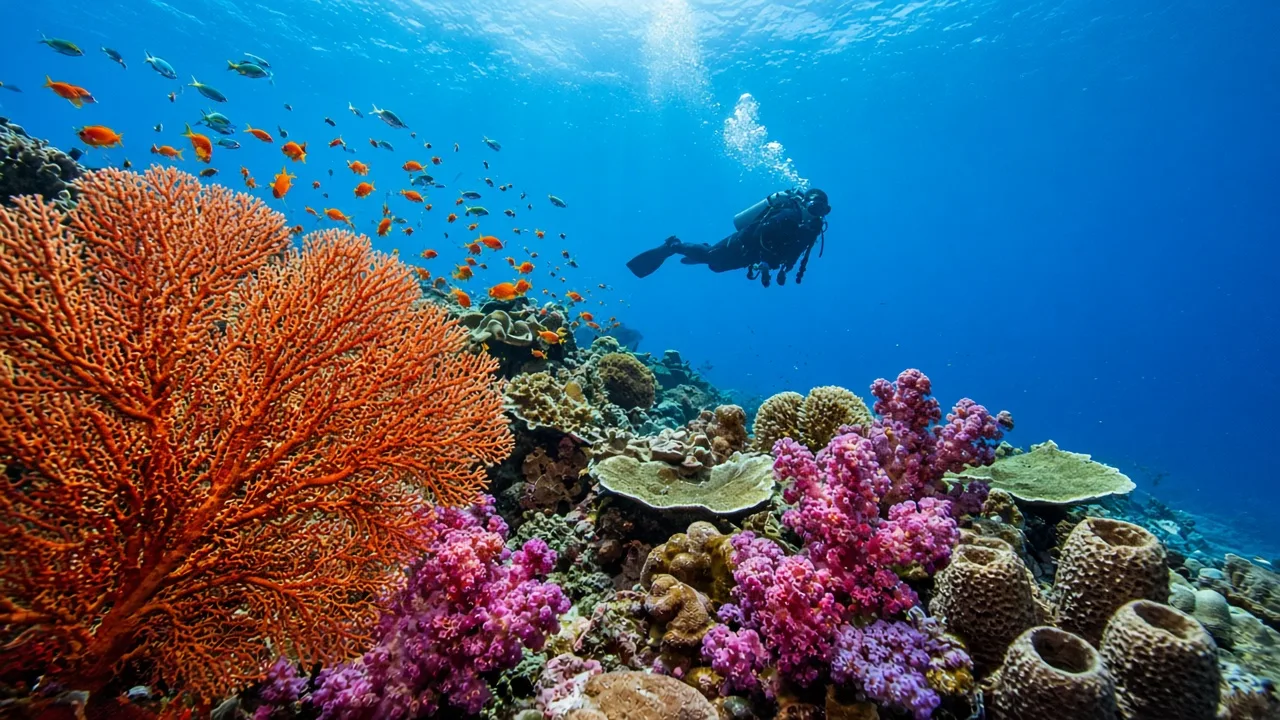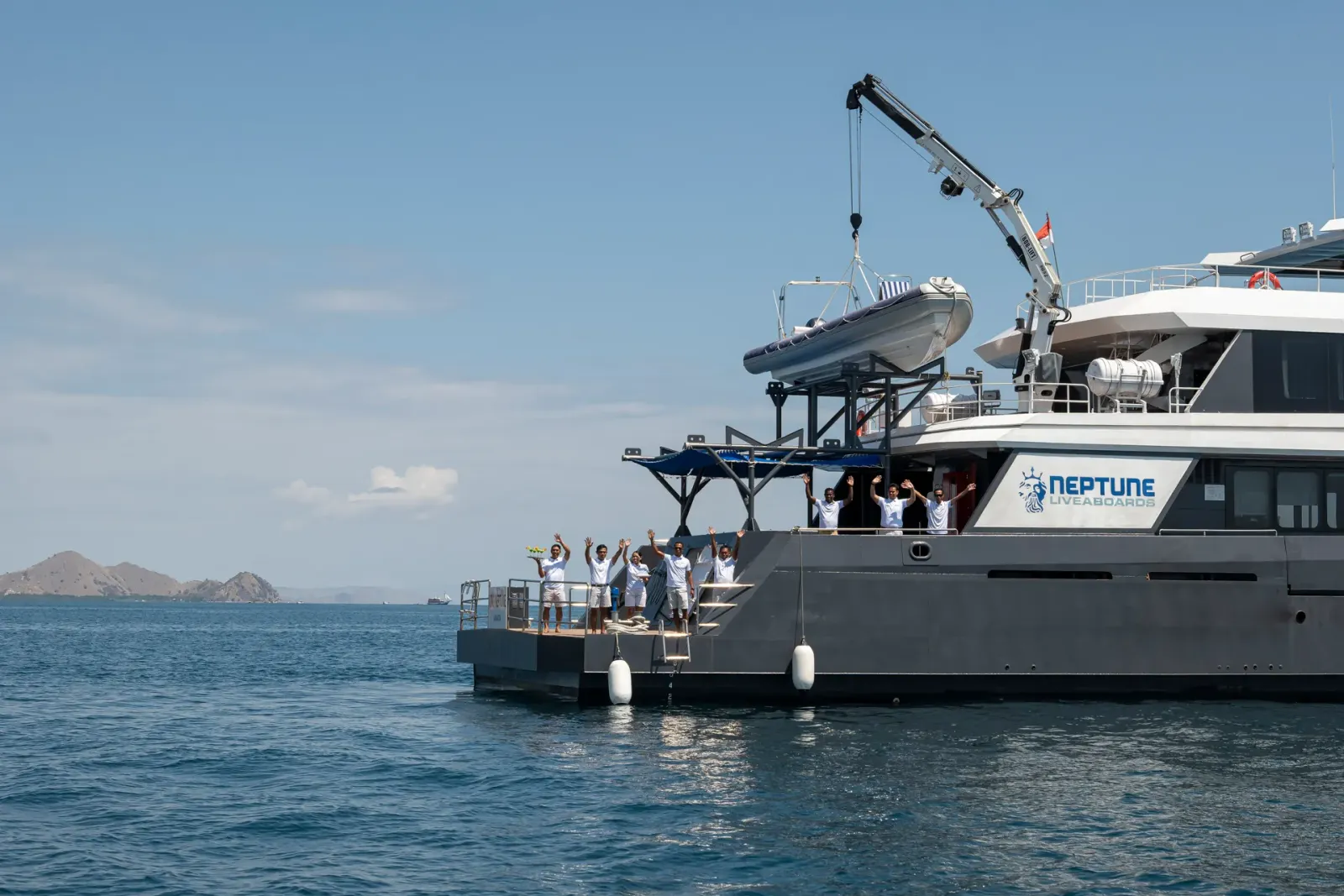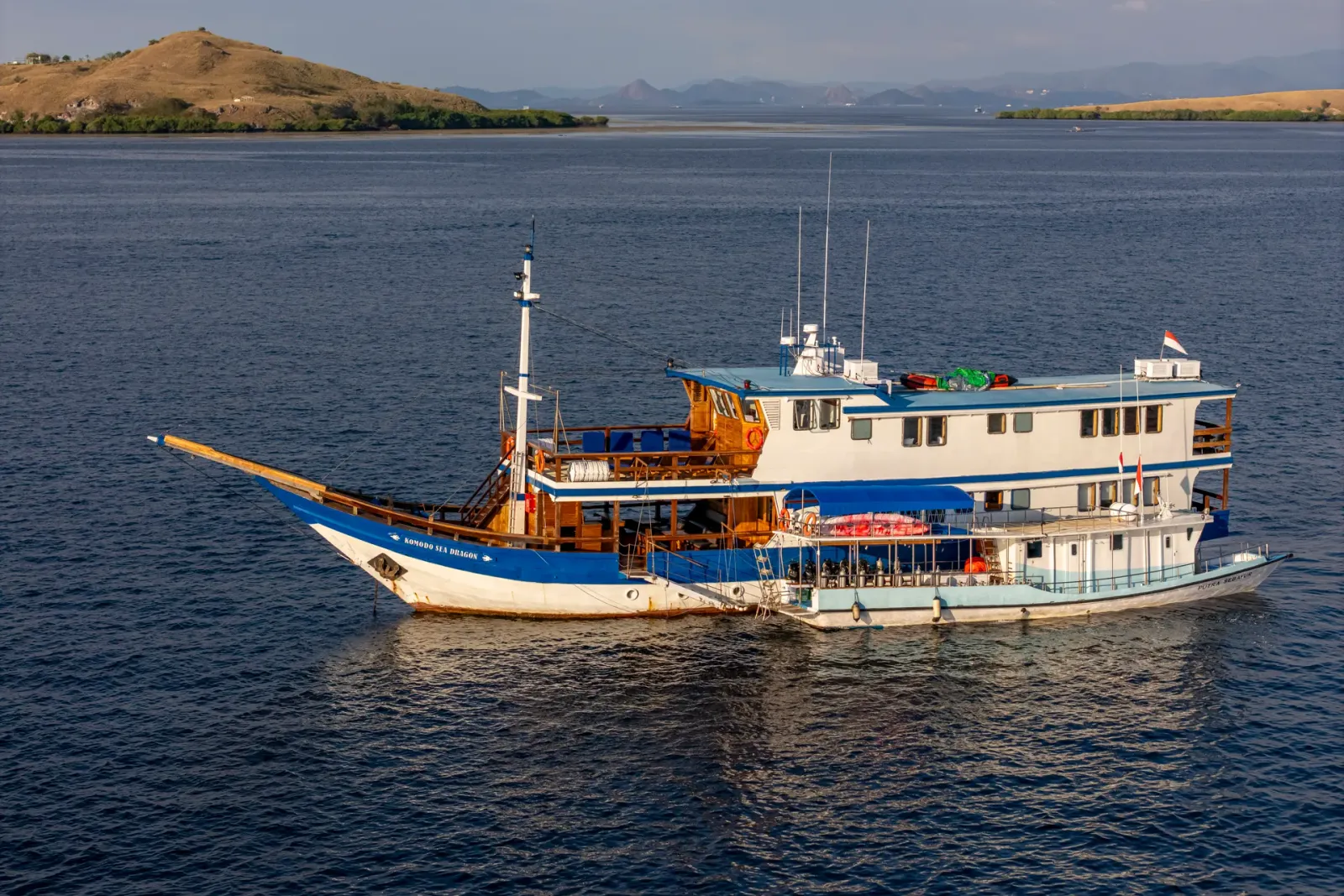
Somewhere around the third enquiry each week, we get the same nervous opening line: "Is this actually doable with children?" The parents asking have usually done a resort holiday in Bali, the kids can swim, and someone in the family has seen a video of Komodo dragons. What they want to know is whether an Indonesia liveaboard is a genuine family holiday or a diver's trip that children merely survive. The short answer is that it is one of the best family trips you can do in Southeast Asia, provided you pick the right route, the right boat, and the right week. The long answer is this article.
A liveaboard solves the problem that sinks most family itineraries: logistics. Nobody repacks a suitcase for seven days. Nobody queues for a ferry with a bored nine-year-old. The boat moves overnight while everyone sleeps, and each morning there is a new bay, a new beach, a new reef within a two-minute dinghy ride. Families who want the whole vessel to themselves usually end up looking at a Komodo yacht charter, where the schedule bends entirely around the children rather than the other way round. But plenty of families join scheduled departures too, and do it well. We have carried kids as young as eight and grandparents in their late seventies on the same trip, sometimes in the same cabin group.
Is a liveaboard actually a good holiday for kids?
Honestly, it depends on the child. We would not put a toddler on one. A liveaboard is a working boat with ladders, moving tenders, hot compressors, and open rails, and the crew cannot childproof it. From roughly age eight upward, the calculation flips completely. The boat becomes a floating adventure camp: snorkelling with turtles before breakfast, a dragon trek after lunch, deck jumping at anchor, squid lights off the stern at night. In most years the guests who cry at disembarkation are not the adults.
The structure helps more than parents expect. Days on a dive boat run to a rhythm: wake, eat, water, rest, eat, water, excursion, eat, sleep. Children thrive inside that rhythm in a way that surprises families used to negotiating every hour of a land holiday. Screens lose the argument by day two, partly because signal is patchy east of Labuan Bajo and partly because there is a reef fifteen metres away. We have watched a twelve-year-old who allegedly could not be separated from an iPad spend forty minutes hanging off the swim platform watching a school of batfish under the hull.
There are trade-offs, and it is fair to name them. Cabins are compact, so a family of five needs to think about layout before booking. A rough crossing can put a sensitive stomach in a bunk for an afternoon, which is why route choice matters and why we point nervous families to our guide on preventing seasickness on a liveaboard. And a child who genuinely hates the water will not be converted by a boat, no matter how beautiful the anchorage.
Age rules across the Indonesian fleet, and what they really mean
Most Indonesian liveaboards set a minimum age of ten for scheduled mixed-group departures. A smaller number, ours included on selected trips, accept children from eight when a parent supervises and the child sticks to snorkelling. Full-boat charters are different again: with no other guests to consider, operators will usually take younger children on a charter, though eight remains a sensible floor for anything beyond a calm-season Komodo route.
The diving side has its own age ladder, set by the training agencies rather than the boats. It is worth knowing before you promise anything to an excited child:
- Age 8: pool-style introductory experiences only (PADI Bubblemaker and similar), in shallow, confined water. Some boats can run these off a beach on calm days; many cannot. Ask first.
- Age 10: Junior Open Water certification becomes possible, with a 12-metre depth limit for 10 and 11-year-olds diving with an instructor or certified parent.
- Age 12: the depth limit for junior divers rises to 18 metres, which covers the majority of good Komodo and Raja Ampat sites.
- Age 15: the junior designation drops away, and a teenager holds the same Open Water card an adult would.
Notice what that ladder implies: a family with a ten-year-old and a thirteen-year-old can realistically have both children certified and diving, on suitable sites, within the same trip. It also implies the opposite. If your youngest is six, book the beach resort this year and the boat in two years. We have talked families out of premature bookings more than once, and nobody has ever regretted the wait.
Komodo with kids: dragons, pink sand, and mantas at the surface
If we could only recommend one Indonesian route for a family, it would be Komodo, and it would not be close. The park compresses an absurd amount of child-friendly spectacle into a small area. Flights into Labuan Bajo are short hops from Bali. Crossings between anchorages are mostly under two hours. And the headline attractions work at the surface, which matters enormously when half your party is snorkelling rather than diving.
Start with the obvious one. Komodo dragons are real, enormous, and visibly prehistoric, and children respond to them the way adults respond to whales. The ranger-guided walks on Rinca and Komodo islands are flat, short (the family loop runs about 45 minutes to an hour), and genuinely safe when everyone follows instructions. Rangers carry forked staffs, keep the group together, and know where the big males rest in the shade. A word of caution we repeat on every briefing: dragons are wild predators, not zoo exhibits, and children must stay inside the group. The rangers take this seriously and so do we.
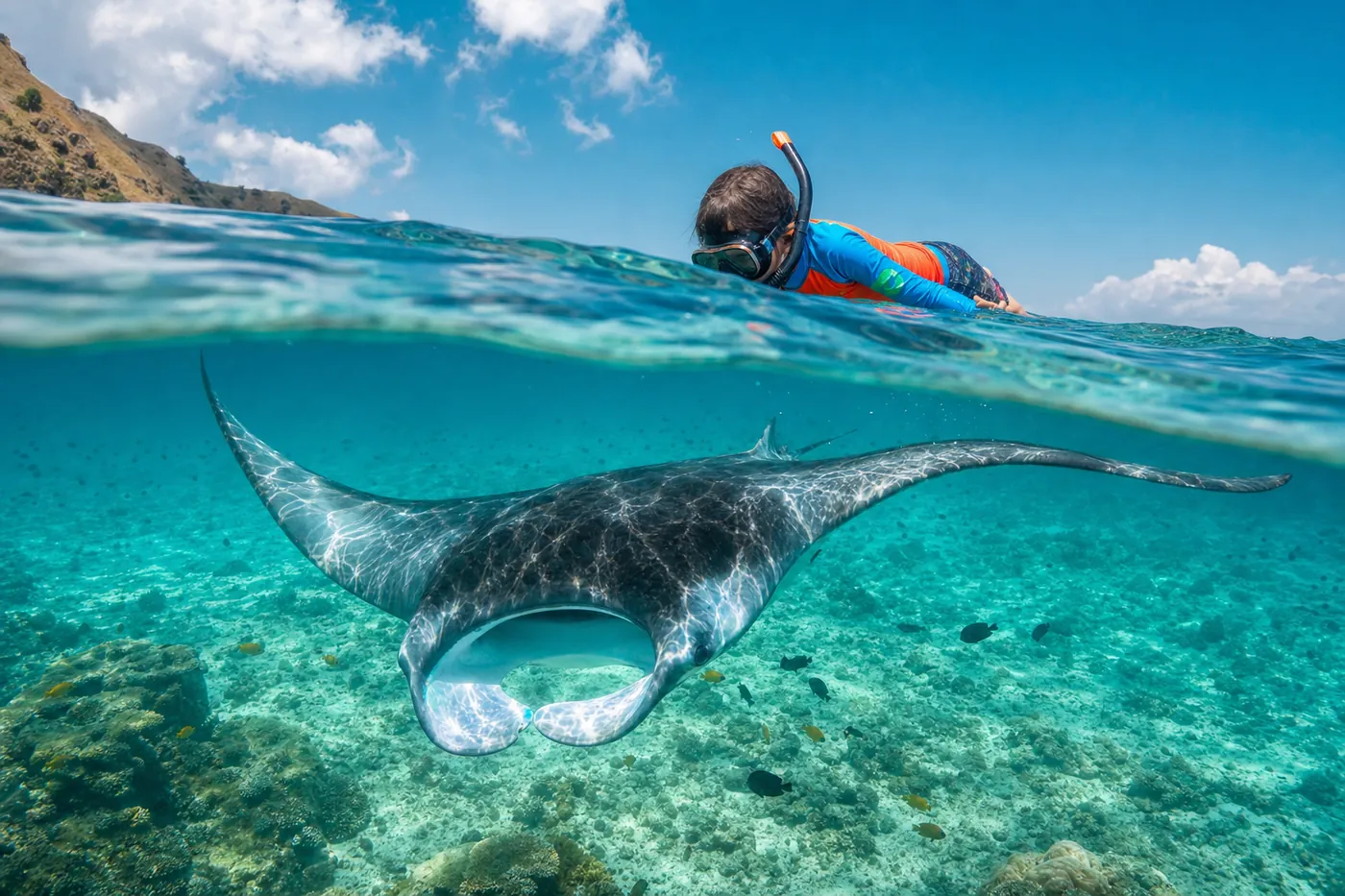
Then the water. Karang Makassar, better known as Manta Point, is one of very few places on earth where a snorkelling child has an excellent chance of floating above a feeding manta ray with a four-metre wingspan. The mantas come up to within a metre of the surface on feeding passes, so the encounter is not a distant shadow but a full, close, wide-eyed event. Pink Beach offers exactly what the name promises, sand blushed by crushed red coral, with a shallow reef beginning a few kicks from shore. Padar Island's viewpoint walk, done at 5:30 in the morning before the heat, gives the family the most famous photograph in Flores. Teenagers grumble on the way up and post the picture before the boat has weighed anchor.
Timing matters more with children than with a boatload of divers who will tolerate anything for hammerheads. The dry season, roughly May through October, gives Komodo its calmest seas and most reliable sunshine, and July and August coincide neatly with school holidays. The trade-off is that everyone else knows this too, so the marquee sites see more boats. June and September are, give or take, the sweet spot: settled weather, thinner crowds, and manta activity still dependable. The difference is not subtle either. In the shoulder weeks it is perfectly possible to have Manta Point to yourselves for an hour on a weekday morning, which simply does not happen in early August.
Raja Ampat with kids: the aquarium option for older children
Raja Ampat is the better destination for marine life, and the harder one for families. Both things are true, and the honest comparison matters. The journey is longer: most itineraries start from Sorong in West Papua, which means a domestic flight from Jakarta or Makassar on top of the international leg, and children arrive tired. Itineraries run longer too, typically seven to ten nights against Komodo's four to six. And the best diving skews deeper and more current-exposed than a junior diver's limits comfortably cover.
For the right family, though, it is astonishing. The lagoon snorkelling in the Fam and Wayag island groups is the best either of us has seen anywhere: still, clear, shallow water over coral gardens so dense you cannot see sand, with juvenile blacktip reef sharks patrolling the shallows like wind-up toys. A twelve-year-old with a mask does not need a certification card to have the best water hour of their life there. The Piaynemo viewpoint walk, up a wooden staircase to a panorama of cone karst islands, is short enough for any fit child. Village visits in Arborek introduce kids to Papuan school children who are usually far more interested in the visitors than the visitors expect.
Our rule of thumb, refined over enough trips to trust it: Raja Ampat works beautifully for families whose youngest is twelve or older, who have either dived before or snorkel confidently, and who can commit to the longer itinerary. The season also inverts: Raja Ampat's calm window runs roughly October to April, which suits Christmas and Easter holidays rather than the long summer break. Families comparing the two routes side by side may find our Raja Ampat versus Komodo comparison useful, though it is written for divers first.
Which boat setup actually works for a family
Boat choice decides more of the trip's success than route choice, in our experience. Three configurations come up again and again.
Scheduled departure, family joins as regular guests. The cheapest option and a good one for families with teenagers who behave like junior adults. The risk is social: a family of four on a boat of twelve serious divers changes the trip for everyone, and some operators quietly discourage it. Ask the operator directly how many other non-divers or juniors are booked on the departure. A boat with two families aboard is a very different, and usually happier, animal than a boat with one.
Cabin-cluster booking. Booking two or three adjacent cabins on a scheduled trip, ideally a lower-deck pair for the kids next to the parents' cabin. Most phinisi layouts make this easy, and it costs nothing beyond the berths themselves. If the boat has a triple or a bunk cabin, say so at enquiry; those cabins are scarce and go first in school-holiday weeks.
Full charter. The premium option, and for groups of eight or more it often costs less per head than people assume, especially outside peak weeks. The whole schedule bends to the family: shorter snorkel sessions for younger kids, a beach afternoon instead of a third dive, dinner an hour early. Multi-generation groups, two sets of grandparents, assorted cousins, one shared birthday, are the classic charter demographic, and roughly half the family enquiries we see for luxury liveaboard trips end up as charters once the per-person maths is done for a group of ten.
A day on board with children: how the rhythm actually runs
Parents picture long empty hours at sea and pack accordingly: card games, novels, contingency screens. Then the trip starts and most of it goes unused. Here is a fairly typical Komodo family day, taken more or less directly from one of our June logs.
The boat wakes at 6:30. Divers brief at 7:00 and are in the water by 7:30; the snorkelling half of the family goes out on the second tender to the same reef, accompanied by a crew member whose only job that hour is the surface group. Everyone converges on breakfast at 9:00 with competing wildlife claims, the eleven-year-old insisting the turtle at the surface beat the divers' turtle at eighteen metres. Mid-morning is the second water session, then the boat repositions over lunch. The early afternoon slot, roughly 13:30 to 15:00, is the quietest window for non-divers, and it is when the kids nap, fish off the stern with a handline borrowed from the crew, or help the chef fold dumplings, an activity that started as a one-off favour on one trip and is now effectively on the menu because children request it.
Late afternoon brings the excursion: a dragon walk, Padar at golden hour, or a beach landing with a football. Sunset happens on the top deck with fruit and fried bananas. Dinner at 19:00, and by 20:30 the squid lights are on at the stern and whatever children are still awake are watching needlefish hunt in the light pool. Lights out is not enforced by parents. The sea does it.
Two structural notes worth knowing. First, crew ratios on Indonesian boats are generous, commonly around one crew member per guest, and Indonesian crews are, as a broad cultural rule, wonderful with children; more than one of our deckhands has spent an entire crossing teaching knots to a nine-year-old. Second, the kitchen is more flexible than parents fear. Plain rice, noodles, grilled chicken, and pancakes are effectively always available, and a fussy eater flagged on the booking form will not go hungry. Bring any specific snacks the child cannot live without, because there is no shop between Labuan Bajo and the next Labuan Bajo.
Safety on board: the questions that matter more than the brochure
Every operator will tell you they are family-friendly. A few questions separate the ones who mean it. Ask how many crew go out with a snorkel group, and whether a dedicated guide stays with the surface party while divers are down. Ask whether the boat carries child-sized wetsuits, masks, and fins, and in what sizes; "we have small sizes" sometimes means one battered size-34 fin set. Ask about the tender boarding process, because getting an eight-year-old from a moving dinghy to a dive platform in light chop is a technique, not an accident. Ask where the oxygen kit and first-aid station are, and when the crew last drilled with them.

On our boats the rules for junior guests are short and non-negotiable: life jackets in the tender every time, no exceptions for confident swimmers; a named crew member per surface group; kids never in the water without an adult, even at anchor in a flat lagoon; and rash guards or wetsuits for every water session, since the Indonesian sun at midday is a genuine hazard and sunscreen alone loses that fight. None of this is onerous in practice. Children treat the rules as part of the game within a day.
The honest risk picture is worth stating plainly, because anxious parents deserve better than reassurance-speak. The statistically significant hazards for children on these trips are sunburn, dehydration, and scraped shins on coral, in that order. The dramatic hazards parents imagine, sharks, dragons, deep water, are managed to near-zero by rangers, guides, and rules refined over thousands of departures. The dragons in particular are worth being calm about. The ranger-to-visitor ratios on Komodo and Rinca exist precisely because the animals are wild, the instruction to stay with the group is enforced rather than suggested, and food of any kind is kept off the trail for the obvious reason. Follow the ranger and the risk is genuinely negligible.
Junior certification on the boat: how it works and when to do it beforehand
A liveaboard can be a spectacular place to learn to dive, and a bad place to discover you hate it. The distinction drives our standard advice. If the child has never breathed off a regulator, do a pool try-dive at home first; almost every city has a dive shop that runs them, and it costs less than a tender fuel surcharge. If the child loved the pool session, the eLearning theory for Junior Open Water can be finished at home (plan on 8 to 12 hours, ideally not the week of departure), leaving the confined-water skills and the four certification dives for the boat.
On the boat itself, the course takes roughly four days, woven around the normal schedule. Calm, shallow sites, and Komodo's central anchorages have several perfect ones, host the skills sessions, and the certification dives graduate to easy reef slopes. One parent often certifies alongside the child, which we quietly encourage: the shared card is worth more than the individual ones, and the depth rules for young juniors require a certified adult buddy anyway. Flag the course at the enquiry stage, not at the dock. Instructor capacity is the binding constraint, and a boat with one instructor and fourteen certified divers cannot conjure a second one mid-route.
One more scheduling note that catches families out: flying after diving. The guidance is a minimum of 18 hours after repeated dives before getting on a plane, and a sensible operator builds the final day as a no-dive day with a dragon walk or a beach morning instead. If your itinerary has the family diving on the last afternoon and flying out of Labuan Bajo the next morning at 8:00, something is wrong with the plan, and you should query it. Our guide on flying after diving covers the details.
What a family trip costs, honestly
Prices move with season, boat class, and route, so treat these as 2026 planning ranges rather than quotes. On a scheduled Komodo departure, mid-range boats run roughly USD 250 to 450 per person per night, with luxury phinisi in the USD 500 to 900 band. Children occupying a berth pay for the berth, though many operators discount junior guests by 10 to 25 per cent and snorkel-only guests by a similar margin; it never hurts to ask, and school-holiday weeks discount least. Raja Ampat runs 15 to 30 per cent dearer per night than the equivalent Komodo boat, and the longer itineraries compound that.
Park and marine fees are levied per person regardless of age in most cases, and they are not trivial: budget a few hundred dollars per head for Komodo depending on season and current regulation (the rates have moved several times in recent years), and roughly USD 100 to 150 for the Raja Ampat marine tag. Some boats fold fees into the headline price, others invoice them separately, and the difference makes naive price comparisons misleading. Get the all-in number in writing.
A worked example from our own enquiries file, lightly rounded: a family of four (two adults, kids aged 11 and 14) on a five-night mid-range Komodo departure in late June came to a little over USD 7,000 all-in, including fees, junior discounts, equipment, and the 14-year-old's Junior Open Water course. The same family pricing an eight-berth charter for a week with another family of four found the per-head cost landed within about 15 per cent of the scheduled-trip figure, with the whole boat to themselves. That second sum is the one that surprises people, and it is why we always suggest large family groups at least look at the charter maths before defaulting to scheduled berths.
Packing for children: the short list that actually matters
Full packing guidance lives in our Indonesia liveaboard packing list, so here we will only flag the child-specific items that families most often miss. Two rash guards per child, not one, because one is always wet. A properly fitting mask bought and pool-tested at home; an ill-fitting rental mask has ended more junior snorkel careers than fear ever has. Reef-safe sunscreen in quantity, plus a wide-brim hat that survives wind. Seasickness tablets in child doses, cleared with your doctor beforehand, even if the child has never been seasick, because the first crossing is not the moment to find out. A cheap waterproof camera turns a reluctant snorkeller into a documentary director, usually within an hour. And a headlamp per child, nominally for night walks on deck, actually because children simply love headlamps.
Leave behind: drones without permits (the parks restrict them), expensive white clothing, and any illusion that the laundry situation is sophisticated. Boats can rinse and dry, not launder.
Common mistakes families make, from the enquiry file
After enough seasons the same handful of errors keep resurfacing, so consider this the shortcut past them. Booking the longest, most remote itinerary for a first family trip is the classic: the Banda Sea crossing is magnificent and utterly wrong for a nine-year-old, and we decline those bookings when they appear. Promising a child they will dive before checking the age and instructor logistics is another; the disappointment is avoidable with one email. Treating the youngest child's abilities as an afterthought, planning the trip around the fifteen-year-old diver while the eight-year-old gets whatever is left, reliably produces one miserable child and therefore one miserable family. Underestimating the sun is almost universal among northern European families in particular; the burn on day one taxes the whole week. And skipping travel insurance that explicitly covers diving and remote evacuation is the mistake nobody notices until the one trip in a thousand where it matters enormously.
None of these are exotic failures. They are ordinary planning gaps, and a ten-minute conversation with the operator at enquiry stage closes every one of them. That conversation is, frankly, the best single test of an operator: the ones who ask about your children's ages, swimming ability, and temperament before quoting are the ones who will look after them at sea.
The trip they will still talk about at thirty
We keep a folder of follow-up emails from family trips, and a pattern runs through it. The parents write about the logistics that worked and the crew who charmed everyone. The kids, when they write or are quoted, remember specifics: the manta that eclipsed the sun, the dragon that yawned, the chef who taught them dumplings, the night the sea glowed. A liveaboard hands children a week of genuine competence and wild encounters, no queues, no screens winning by default, and hands parents a holiday where the moving and the cooking and the entertaining are somebody else's job.
If a family trip is taking shape in your head, send us the ages and the school-holiday window and we will tell you honestly which route and boat fit, including when the honest answer is "wait a year." The dragons are not going anywhere, and the mantas, in most years, are exactly where we left them.