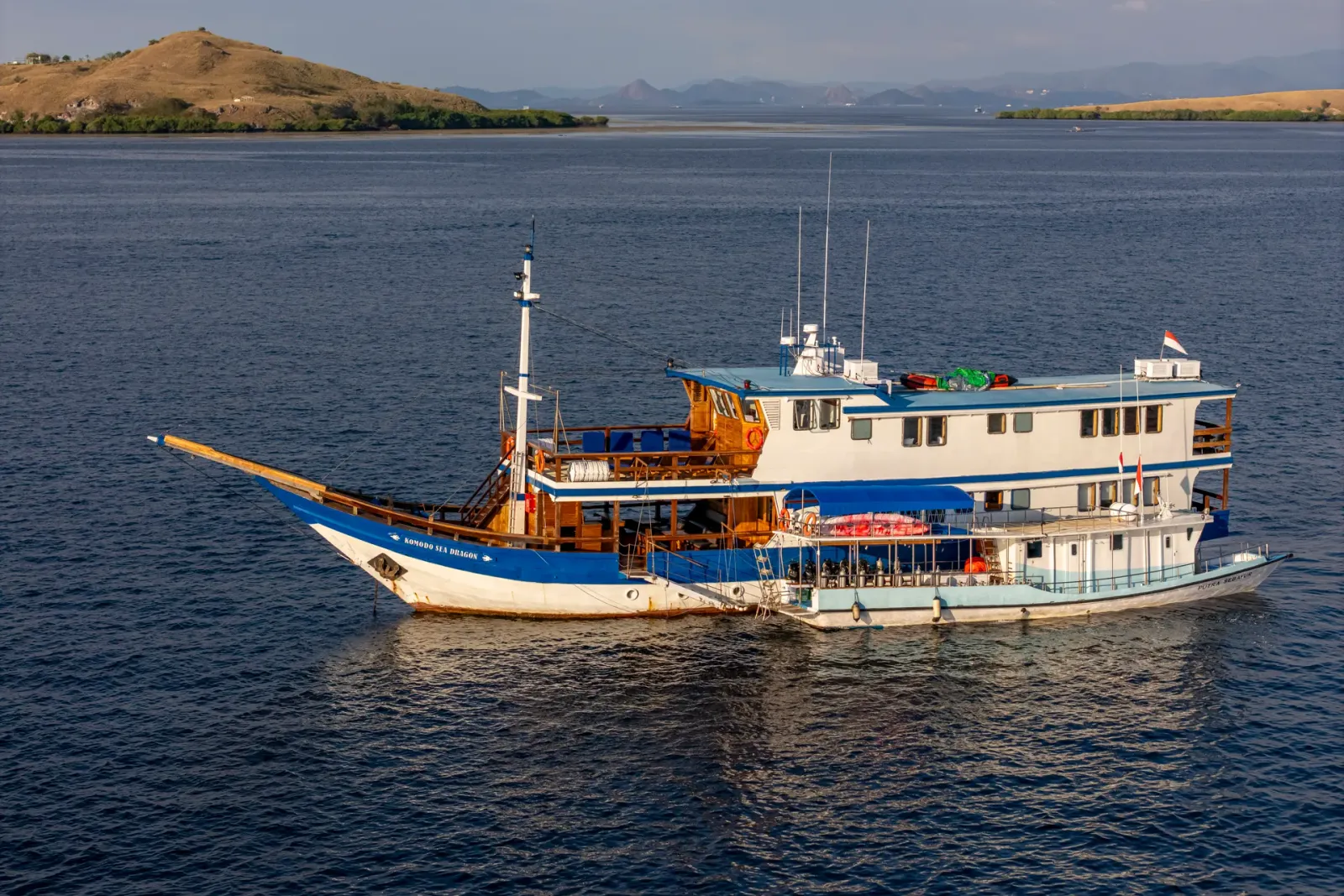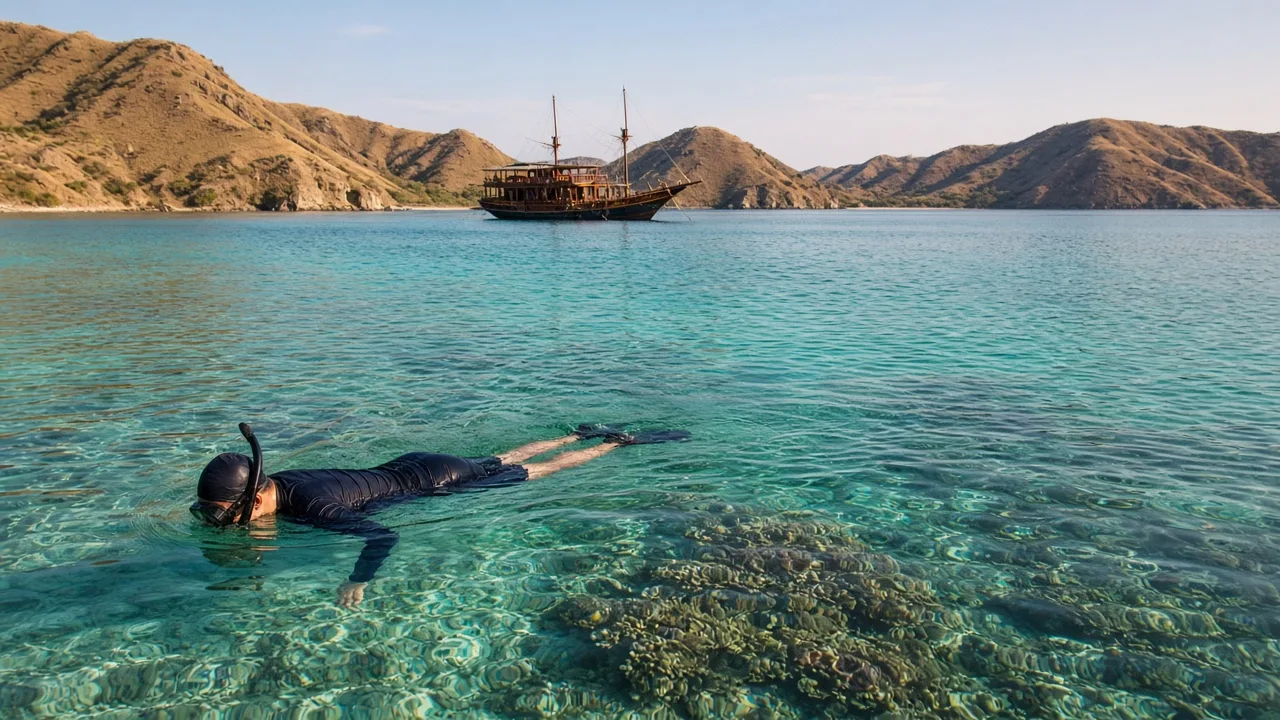
Raja Ampat's remoteness is the whole point. The reason the reefs of Raja Ampat look the way they do, and the reason a cleaning station there can hold more fish species than the entire Caribbean, is that the archipelago sits off the far western tip of New Guinea, a long way from anywhere with a runway longer than a village. Getting there is not difficult, but it is a journey with stages, and travellers who understand the stages before booking flights save themselves money, a night in an airport chair, and in the worst cases a missed boat. This guide walks the whole route: the international gateways, the domestic flight to Sorong, the harbour transfer, and what happens next depending on whether you are joining a liveaboard or heading to a land-based stay.
One reassurance before the details. If you are booked on a liveaboard, most of this logistics chain is not your problem: the boat meets you in Sorong, and everything beyond the airport is handled. The ferry timetables, speedboat negotiations and island transfers that fill travel forums apply to land-based trips, not to diving Raja Ampat from a boat that boards a ten-minute drive from the airport. We include the land-based logistics anyway, partly because many guests bolt a few homestay nights onto a cruise, and partly because knowing what you are skipping is its own argument for the liveaboard.
The short version
Every journey to Raja Ampat runs through Sorong, a working port city on the West Papuan mainland with the region's only full-sized airport, Domine Eduard Osok (code SOQ). There are no international flights into Sorong at the time of writing, despite the airport's formal upgrade to international status in 2025, so the route is always: international flight into an Indonesian hub, domestic flight to Sorong, then onward by water. For liveaboard guests, "onward by water" means stepping onto the boat at Sorong harbour. For land-based guests it usually means a two-hour public ferry to Waisai, the small capital of Raja Ampat on Waigeo Island, followed by a boat transfer to your island. Door to door from Europe or the Americas, plan on 24 to 36 hours of travel; from Southeast Asian hubs like Singapore or Kuala Lumpur, it is comfortably done in under a day if the connections line up.
Step 1: get to an Indonesian hub
Three hubs matter, and your choice shapes the rest of the itinerary. Jakarta (CGK) is the workhorse: the widest choice of international arrivals and the most Sorong departures, including the overnight options that make the connection painless. Bali / Denpasar (DPS) is the pleasant one: if you are combining Raja Ampat with time in Bali anyway (and many guests do), Garuda has operated a direct Bali to Sorong service in recent seasons, though frequencies change often enough that we would not book non-refundable plans around it without checking current schedules. Makassar (UPG), in South Sulawesi, is the connector most Western travellers have never heard of and the one that often wins on price and timing: it sits roughly halfway, the flight to Sorong is around two hours, and many Jakarta and Bali departures route through it anyway. Manado (MDC) also appears on some routings from North Sulawesi.
The practical advice: search fares to Sorong from your home airport and let the aggregator pick the hub, but sanity-check the connection times yourself. An hour and a half between an international arrival in Jakarta and a domestic departure is tight once immigration queues are involved; three hours is comfortable. If your itinerary arrives late in the evening, an airport hotel night in Jakarta beats a 4 a.m. connection for anything but the hardiest travellers, and the morning flights to Sorong are the useful ones anyway, as we will get to.
Two origin-specific companions to this guide go deeper on the long-haul end of the journey, which is where most of the real difficulty sits. If you are flying from North America, our guide to getting to Raja Ampat from the USA covers West Coast and East Coast routings, the overnight decision and the date line. If you are travelling from Southeast Asia, getting to Raja Ampat from Singapore covers the Jakarta and Makassar options and how short a trip can sensibly be. And if you are still orienting yourself on the map, where Raja Ampat is explains the geography behind every one of these routings.
Step 2: the domestic flight to Sorong
Sorong is far. Not obscure, just far. The Jakarta flight covers roughly 2,900 kilometres and takes about four and a half hours, most of it over the Java Sea, Sulawesi and the Seram Sea, and crosses two time zones: Sorong runs on Indonesia Eastern Time (WIT), two hours ahead of Jakarta and one hour ahead of Bali. Airlines on the route in recent seasons include Garuda Indonesia, Batik Air, Citilink and Lion Air, and the schedule pattern is quite stable: a cluster of overnight and early-morning departures from Jakarta timed to land in Sorong between roughly 06:00 and 09:00 local, which suits both the ferry and most liveaboard boarding times.
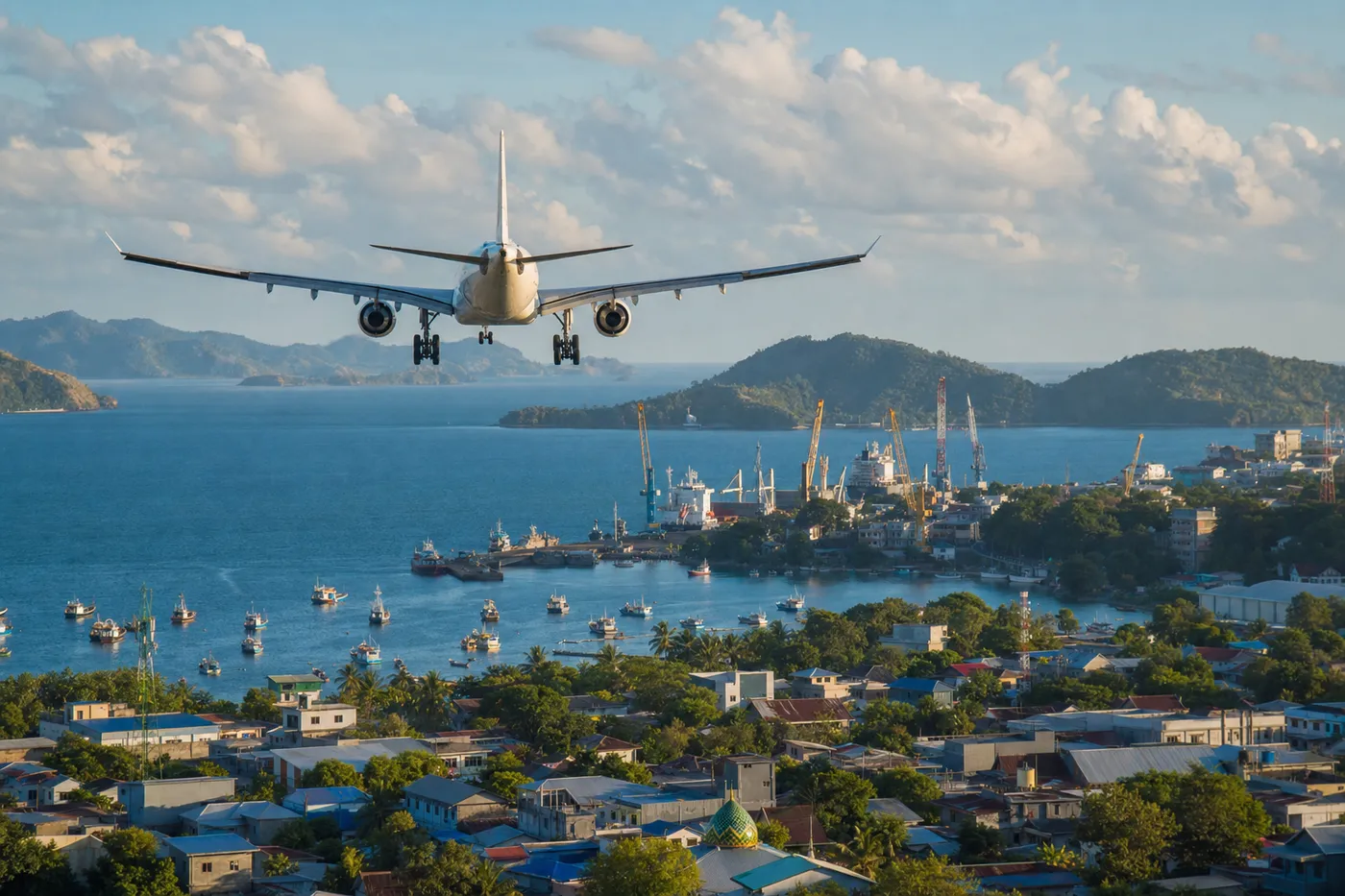
The overnight Garuda from Jakarta deserves a specific mention, because it is the flight we recommend to most of our guests. It leaves Jakarta around midnight, lands in Sorong shortly after sunrise, and turns the awkward long domestic leg into something you sleep through. Guests who instead book a midday Jakarta departure land in Sorong in the evening, after the last ferry has gone and after most liveaboards have boarded, which forces a hotel night in Sorong. That is not a disaster (Sorong has a handful of decent business hotels, the Swiss-Belhotel and Aston being the usual picks), but it is an avoidable one.
Fares move around, but for planning purposes the Jakarta to Sorong leg usually costs somewhere between Rp 2,000,000 and Rp 4,500,000 one way depending on season, airline and how late you book. December, January, and the July to August European holiday window are the expensive months; they are also peak Raja Ampat season, so book the domestic leg as soon as your trip dates are fixed. One more warning born of experience: check the baggage allowance on the exact fare class you buy. Some domestic economy fares include only 20 kilograms, and a dive bag with regulators, a wetsuit and a camera rig gets there quickly. Paying for extra weight online in advance costs a fraction of the airport counter price.
Step 3: landing in Sorong
Domine Eduard Osok Airport is small, functional and quick. There is one main terminal, bags come out fast, and the exit puts you straight into a scrum of taxi drivers who are less aggressive than their counterparts in Jakarta. The airport sits inside the city, roughly 8 kilometres from the harbour district, and this is one of the very few places in your journey where everything is close together: airport to harbour is a 10 to 20 minute drive.
Transport options, with rough 2026 prices: the fixed-price airport taxis (usually an Avanza or Innova) charge around Rp 100,000 to Rp 150,000 to the harbour, no bargaining required or possible. Ride-hailing apps (Gojek, Grab, Maxim) work in Sorong and cost roughly half that, around Rp 50,000 to Rp 60,000, though drivers sometimes cannot pick up inside the airport gate and will message you to walk to the road. If your liveaboard includes an airport pickup, and ours do, you will be met at arrivals with a sign and none of this applies. There is an ATM cluster and a couple of coffee stands in the terminal; grab cash here if you are continuing by public ferry, because the harbour ticket counters are cash only.
A word on Sorong itself, because travellers sometimes panic when they research it: it is a port and oil town, not a tourist destination, and no one pretends otherwise. But it does its job. If you end up with a half day there, the fish market near the harbour is genuinely worth a wander, and the warungs along the waterfront serve some of the best grilled fish in Indonesia for a few tens of thousands of rupiah.
Joining a liveaboard: the easy branch
If you are boarding a liveaboard, your journey effectively ends at Sorong. Boats board either directly at one of Sorong's harbours or via a short tender ride from a jetty, and the operator will tell you exactly where and when. Our own Raja Ampat departures board in the afternoon of day one, which pairs neatly with the morning flight arrivals: guests land between 06:00 and 09:00, get collected, have a relaxed breakfast and perhaps a shower at a day-use hotel room, and step aboard with the paperwork already done. From that point the boat does the travelling, overnight and between dives, and the Dampier Strait sites are typically reached within hours of departure.
This is the honest comparison worth making before you plan a land-based trip: a liveaboard removes the ferry timetable, the Waisai jetty confusion, the speedboat price negotiation and every single inter-island transfer, and replaces them with a cabin that moves while you sleep. The central sites of the Dampier Strait are reachable from land-based stays; the outlying regions mostly are not. Misool's ridges and the far northern islands around Wayag are liveaboard territory, plain and simple, because they sit several hours of open water from anywhere with a bed. If your goal is the full spread of the archipelago rather than one neighbourhood of it, the routing decision makes itself. Timing your trip matters as much as the logistics, and we cover that separately in our guide to the best time to visit Raja Ampat.
Land-based travel: the ferry to Waisai
Heading to a homestay or resort instead? Then your next stop after the airport is Pelabuhan Rakyat, Sorong's public harbour, for the ferry to Waisai on Waigeo Island. The crossing takes about two hours on the express boats. The schedule has been stable for years in its general shape, though exact times drift: there is an afternoon sailing around 14:00 every day, and additional 09:00 morning sailings on certain days of the week, with Sunday reliably having both. Two operators, Express Bahari and Fajar Indah, share the route. Tickets are bought at the harbour counters shortly before departure, cash only, and cost roughly Rp 100,000 to Rp 250,000 one way depending on operator and class. The VIP cabin costs more and mostly buys you air conditioning and a softer seat; on a two-hour crossing it is a coin flip whether it is worth it.
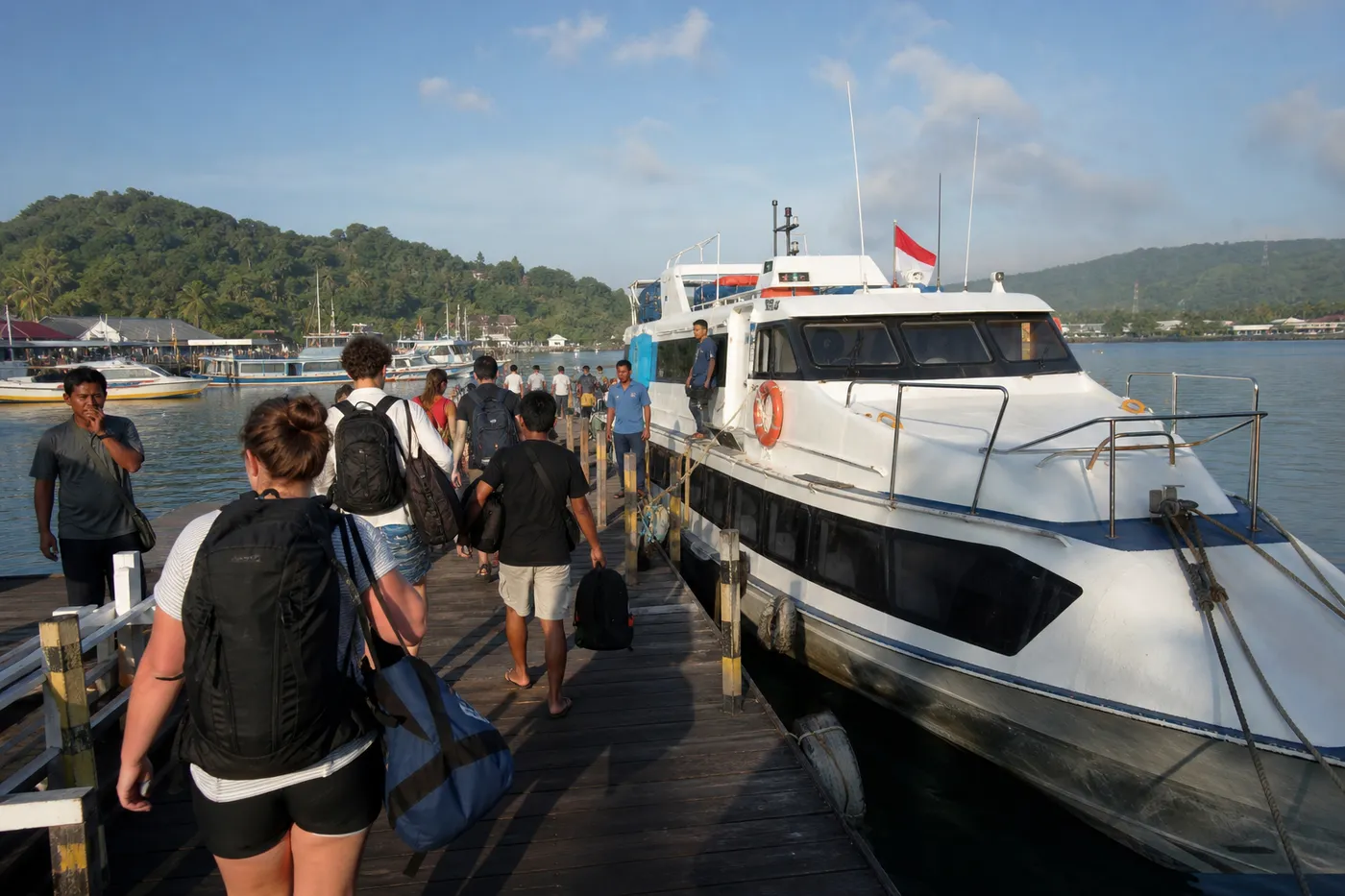
Arrive at the harbour an hour early. That is not cautious padding, it is how the queue actually works: ticket counter first, then a separate counter for the boarding pass, then a wait that is either sociable or sweaty depending on the season. Morning-flight arrivals connect comfortably to the 14:00 ferry with hours to spare. Evening arrivals have missed it and will need a night in Sorong.
There is also a flying option that surprises people: Susi Air runs light aircraft between Sorong and Marinda Airport near Waisai, the only scheduled flights into Raja Ampat proper. The planes are small, the baggage allowance is a strict 15 kilograms, and availability is thin, so for divers with gear it is rarely practical. It exists, and that is about the most enthusiastic thing we can say about it for our guests.
Waisai and beyond
Waisai is a small administrative town, and for most visitors it is a jetty rather than a destination. Almost every homestay and resort in the central islands (Kri, Mansuar, Arborek, Gam) collects guests from Waisai harbour by boat, arranged when you book. Confirm your pickup point precisely: there is more than one jetty, and the ferry drop is not always where your homestay boat waits. If you need to arrange your own speedboat, expect the price to be quoted per boat rather than per person, and expect it to feel expensive; fuel out here costs what it costs. Waisai is also where land-based visitors handle the Raja Ampat environmental services card, the marine park entry fee that helps fund conservation and community programmes across the regency. Liveaboard guests normally have this arranged by the operator as part of the trip paperwork.
What the ground journey costs
Flight prices swing too much to tabulate honestly, but the on-the-ground legs in Sorong and Waisai are refreshingly predictable. These figures are what guests reported paying through the 2025 to 2026 season, give or take the usual drift:
| Leg | Typical cost (IDR) | Notes |
|---|---|---|
| Airport taxi to Sorong harbour | Rp 100,000-150,000 | Fixed price, 10-20 min |
| Ride-hailing app, same route | Rp 50,000-60,000 | Pickup may be outside the gate |
| Ferry Sorong-Waisai, economy | Rp 100,000-215,000 | Cash only, buy at the counter |
| Ferry Sorong-Waisai, VIP | Rp 215,000-250,000 | Air-con, softer seats |
| Waisai harbour to town or Saporkren | Rp 100,000-200,000 | Per car, agree before boarding |
Private speedboat charters between islands are the wild card, quoted per boat and heavily dependent on distance and fuel prices; a Waisai to Kri transfer arranged through a homestay is usually far cheaper than the same distance chartered independently at the jetty. The pattern to internalise is that everything scheduled is cheap and everything bespoke is not. Liveaboard guests can skip this table entirely, which is rather the point.
Sample itineraries that actually work
Abstract advice only goes so far, so here are three routings we have seen work smoothly, over and over, for real guests.
From Europe, joining a liveaboard. Evening departure from Europe, arriving Jakarta the following evening. Overnight flight Jakarta to Sorong departing around midnight, landing shortly after 06:00 WIT. Liveaboard pickup at the airport, boarding in the afternoon, first dive the next morning. Total elapsed time around 30 hours, of which a decent chunk is spent asleep on the long legs. On the return, board a morning Sorong departure and you can make the same-day evening flights out of Jakarta, but remember the no-fly interval after diving; we schedule the final dives of our itineraries so that guests flying the next morning are comfortably clear of the 18 to 24 hour window.
From Southeast Asia, short trip. Morning flight Singapore or Kuala Lumpur to Jakarta, afternoon connection to Makassar, evening hop Makassar to Sorong, or the direct overnight from Jakarta. Either way you are in Sorong the next morning having left home after breakfast. This is why Raja Ampat works surprisingly well for divers based in Asia: the journey that looks intimidating on a map is really two medium flights and a taxi.
Bali plus Raja Ampat. A week in Bali, then the direct Denpasar to Sorong flight when it is operating, or Denpasar to Makassar to Sorong when it is not. Landing in the morning either way. This pairing has quietly become one of our most common guest itineraries, and it makes sense: you burn off the jet lag somewhere with beaches and coffee before the diving starts, and the domestic legs are shorter.
Practical details that save trips
A handful of small things cause a large share of the problems we see, so in no particular order. Build in a buffer day. Indonesian domestic aviation is better than its reputation, but delays and same-day cancellations happen, usually in the rainy months. Arriving in Sorong a day before a liveaboard departure is the single best insurance you can buy, and the boat will not wait for a missed flight. Carry cash. ATMs exist in Sorong and Waisai but not beyond, and card acceptance in the islands is close to zero. Check your passport validity, six months beyond arrival, standard Indonesia rules, and note that most nationalities can use the e-VOA online before travel rather than queueing on arrival in Jakarta. Pack the regulators in hand luggage. Checked dive bags almost always arrive, but "almost" is doing heavy lifting in a place where the replacement regulator is 2,900 kilometres away. Reconfirm the domestic flight 48 hours out, because schedule changes on the Sorong routes are usually communicated by email to whichever address the booking agent used, which is not always yours.
It is worth spelling out how these failures actually unfold, because they are rarely exotic. The common version starts with a self-booked itinerary landing in Jakarta in the evening with a ninety-minute connection to the last Sorong flight of the night. Immigration takes an hour. The connection is gone, and because the Sorong route is thin, the next available seat can be two days later rather than two hours. From that point the trip is decided entirely by whether there was a buffer day in the plan. With one, you reroute via Makassar the following morning and reach the boat jet-lagged but on time. Without one, you are watching your liveaboard leave without you and arguing with an insurer about whether a missed connection on separate tickets is covered. This is the whole reason we nag people about the buffer day, and it is the cheapest insurance in the entire trip.
The journey home
The return leg gets less attention and causes more missed flights. Two constraints stack up on the way out. First, the ferry: land-based guests coming from Waisai are tied to the morning or afternoon sailing, and only the morning boat reliably connects to same-day flights out of Sorong. Second, the no-fly interval: after a week of repetitive diving, the standard guidance is to wait at least 18 hours before flying, and most operators, ourselves included, plan itineraries around 24 to be conservative. In practice that means your last dive is on the penultimate full day, the final day is topside (which in Raja Ampat usually means a karst viewpoint hike or a village visit, hardly a punishment), and you fly out of Sorong the morning after disembarking. Guests who try to compress this, booking a Sorong departure for the same afternoon they step off the boat, are gambling with both the timetable and their own physiology. Give the return two clear steps and it takes care of itself.
So how hard is it, really?
Less hard than its reputation. The journey to Raja Ampat is long, but it is a solved problem: fly to a hub, take the well-served domestic route to Sorong, and let the boat or the ferry handle the water. The travellers who struggle are nearly always the ones who compressed the connections or arrived on the wrong side of the ferry and boarding times, and both mistakes are cheap to avoid at the booking stage. Weigh the effort against what waits at the other end: the richest reefs on the planet, mantas at Blue Magic, the karst labyrinth of Wayag, and mornings where the first sound you hear is a tender being loaded rather than traffic. We have never once heard a guest say the journey was not worth it. Tired, occasionally. Regretful, never.