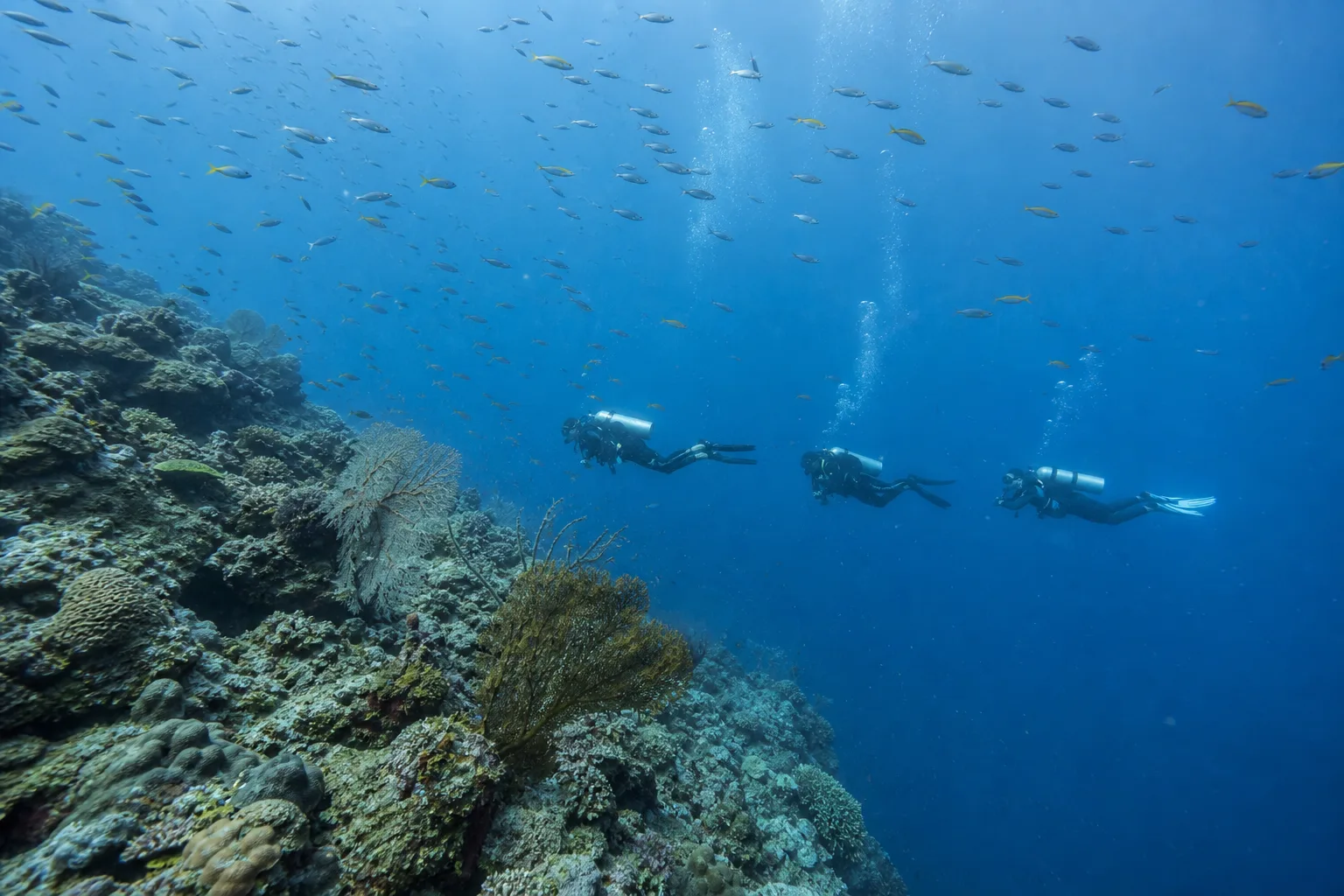
It is almost always asked in a whisper, on the second-to-last evening, usually by one guest who has been quietly appointed by the others: what should we give the crew? Nobody wants to insult sixteen people who have just spent a week feeding them, filling their tanks and hauling them out of the water. Nobody wants to overpay by triple either. And the advice online contradicts itself so thoroughly that a careful person can research this for an hour and arrive less certain than when they started. This guide gives the numbers we actually see on our Indonesia liveaboard departures, and explains why the two competing rules of thumb disagree.
The short version is below, and if that is all you need, take it and go enjoy your trip. The rest of this covers who is actually in the tip pool (it is a lot more people than you met), why rupiah is often more useful to the crew than dollars, the ATM problem that catches out generous guests every season, and what to do in the awkward cases: a trip that went badly, a guide who transformed your week, a family of five, a private charter. None of it is complicated once someone in the industry sets it out plainly, which is rarer than it should be in scuba diving in Indonesia.
How Much to Tip on an Indonesia Liveaboard
The standard tip on an Indonesia liveaboard is USD 15 to 25 per guest per day, given as cash at the end of the trip and pooled among the entire crew. On a seven-night trip that is roughly USD 105 to 175 per person. Tip toward the upper end if the crew was excellent, which on a good boat they usually are.
Figures verified July 2026.
That figure is the anchor, and it holds across most of the market. Here is how it works out over the trip lengths we actually run.
| Trip length | Modest (USD 15/day) | Standard (USD 20/day) | Generous (USD 25/day) |
|---|---|---|---|
| 4 nights | 60 | 80 | 100 |
| 6 nights | 90 | 120 | 150 |
| 7 nights | 105 | 140 | 175 |
| 10 nights | 150 | 200 | 250 |
| 12 nights | 180 | 240 | 300 |
Those are per person, not per cabin. A couple sharing a cabin on a seven-night trip should be thinking about USD 210 to 350 between them, not USD 140.
The percentage method, and where it falls apart
You will also see tipping advice expressed as a percentage of the trip price: 5 to 10 per cent is the most commonly quoted band, though we have seen operators suggest 10 to 15 and even 10 to 20. On a budget or mid-range boat the two methods agree closely enough that the argument does not matter. Twenty dollars a day on a boat charging USD 250 per day is 8 per cent. On a boat charging USD 400 it is 5 per cent. Fine either way.
The methods come apart at the top of the market, and nobody seems willing to say so. On a genuine luxury vessel at USD 900 per person per day, 10 per cent is USD 90 per guest per day, or USD 630 for the week. The flat convention says USD 140. That is a four-and-a-half-fold difference in what a guest is being told to hand over, for a week in which the crew did exactly the same work.
Our position, and we will defend it: the per-day figure is the better anchor, because what you are tipping for does not scale with your cabin grade. The guest in the upper-deck suite and the guest in the lower-deck twin dive the same sites with the same guides, eat the same food cooked by the same chef, and have their tanks filled by the same compressor operator. The suite costs more because of the room, the woodwork and the space, none of which the deckhand built. Paying quadruple because your cabin has a bathtub is not generosity so much as a category error.
Where the percentage view has a fair point is at the very bottom. On a cheap short trip, USD 15 per day can end up looking thin against a crew that worked just as hard, and rounding up is the decent move. Treat the percentage as a sanity check rather than the primary calculation: if your per-day arithmetic lands under about 4 per cent of what you paid, consider nudging it up.
Is tipping actually expected, or genuinely optional?
Both, uncomfortably. No reputable Indonesian operator will add a service charge to your bill, chase you for a tip, or treat you differently for giving less. Nothing bad happens if you tip nothing. It is not a surcharge and it is not a contractual obligation, and any operator who implies otherwise is running things badly.
But it is genuinely customary, it is budgeted for by most guests, and it forms a meaningful part of what the crew take home from a season. Tipping is not deeply rooted in Indonesian culture generally, and you should not tip your way around Jakarta the way you would around New York. The dive industry is the exception, because it inherited the convention from an international clientele decades ago and it has stuck. The practical answer: budget for it as a real line item alongside park fees and nitrox, the same way you would budget for a checked bag.
Who You Are Actually Tipping
Most guests, asked to picture the crew, will name their dive guide, the cruise director and possibly the chef, because those are the people who talk to them. The tip pool is considerably larger than that, and understanding its size is the single thing that most changes how people think about the number.
The crew list on a typical phinisi
A liveaboard carrying sixteen guests will typically run sixteen to twenty crew. Roughly speaking, more people work on the boat than travel on it. The roster looks something like this:
- Captain and first mate. Reading weather and tide, choosing anchorages, making the call on whether the southern crossing runs today.
- Engineer. Keeping generators, watermakers and compressors alive in salt air, generally at hours nobody else is awake for.
- Cruise director. The person who makes the trip feel effortless, which is mostly a matter of absorbing problems before guests notice them.
- Three or four dive guides. Briefings, in-water guiding, finding the pygmy seahorse, and quietly shepherding the nervous diver in the group.
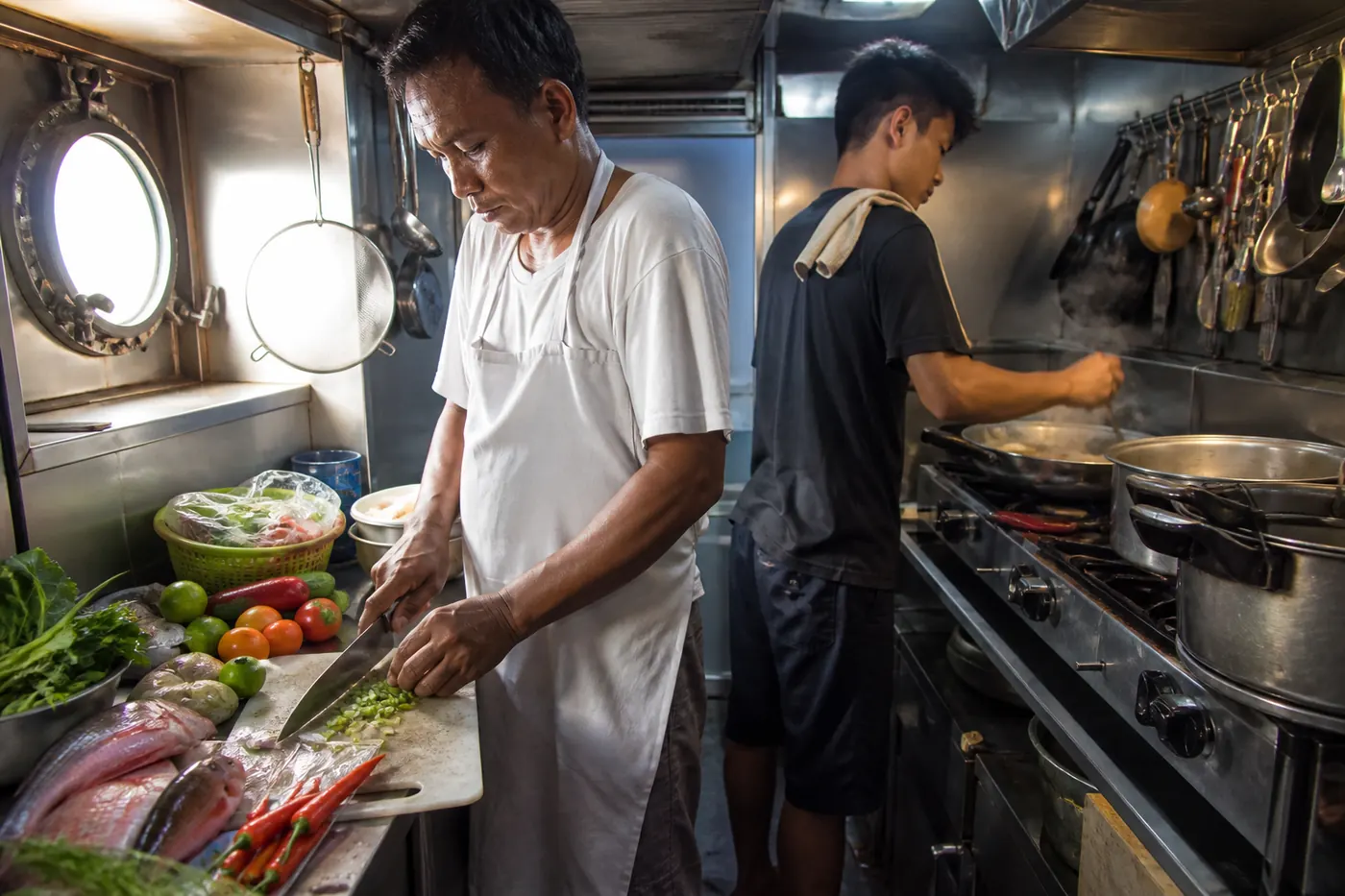
- Chef and galley team. Four meals a day plus snacks, cooked in a moving kitchen, for a fortnight at a stretch, with no supermarket.
- Stewards. Cabins, laundry, the towel that appears the moment you surface.
- Deckhands and tender drivers. Lifting your kit, driving you to sites, pulling you back into a bucking tender in swell.
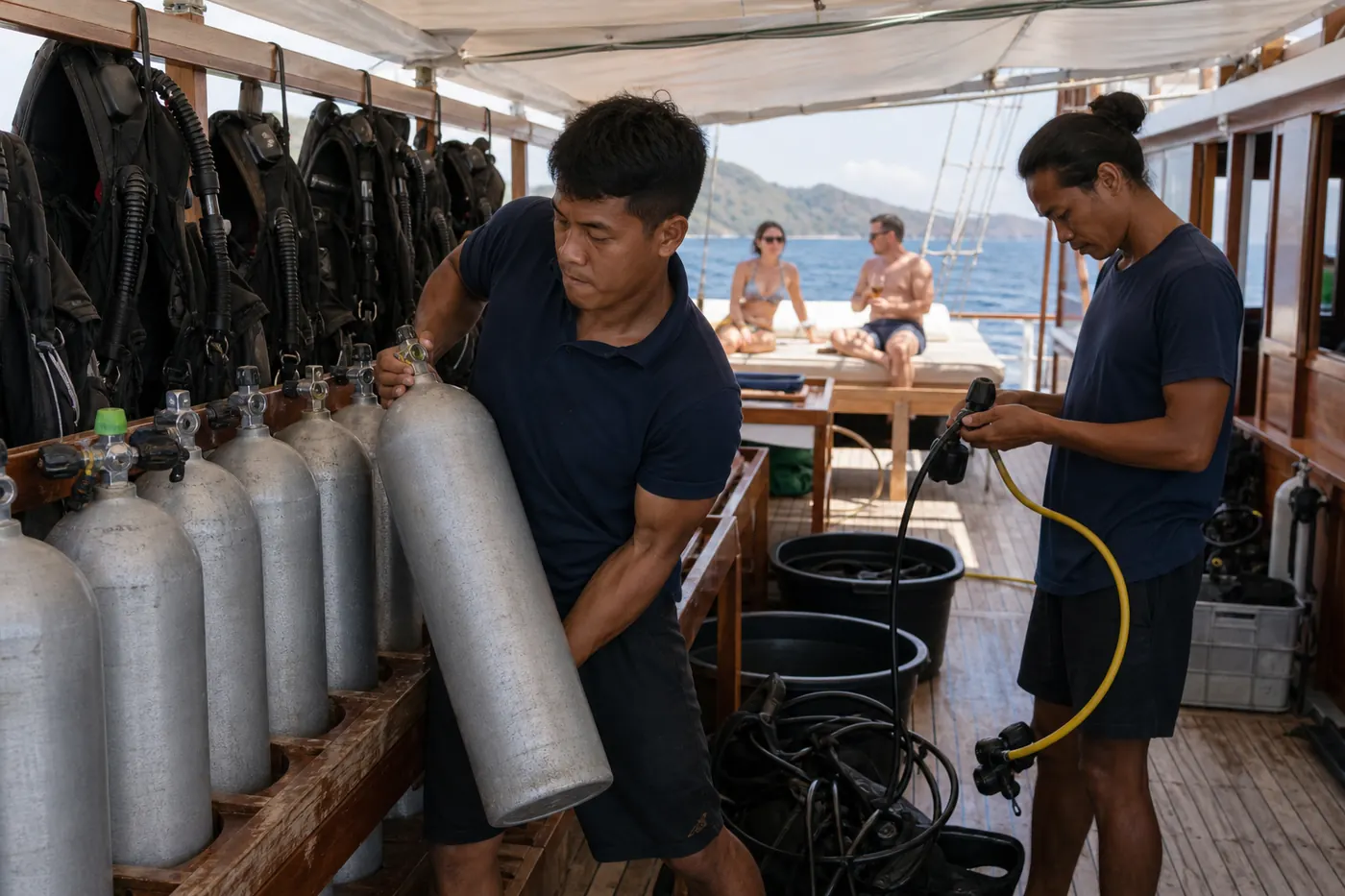
- Compressor operator. Filling tanks, often through the middle of the night before a dawn dive.
The people you never see are doing most of the physical work. Your tank does not fill itself between dives; someone does that while you are eating cake on the sundeck. The tender is not waiting at the surface by accident. When guests learn that the pool has eighteen names in it, the arithmetic reframes quickly: USD 140 from one guest sounds generous until you divide it, at which point it is under eight dollars per crew member for a week of your holiday.
How the pool gets divided
Practice varies, and it is a fair question to ask your operator directly. The two common systems:
Equal split. Everything in the box is divided evenly across every crew member on that trip, from captain to junior deckhand. Simple, transparent, and popular with crews because it treats the invisible roles the same as the visible ones.
Weighted split. Shares are allocated by role and seniority, so a cruise director or head guide receives a larger share than a first-season deckhand. Defensible, and closer to how the salary structure works anyway, but it depends entirely on the captain applying it fairly.
What matters more than which system is that the tip actually reaches everyone. This is the reason the communal box exists, and the reason we and most established Indonesian operators steer guests toward it rather than toward handing cash directly to the two people they happened to like most. Direct tipping concentrates the money on the guides and the cruise director, who are already the best-paid and most tipped members of the crew, and leaves out the engineer who kept the compressor running. If you use one channel, use the box.
A note on why this matters more here than in Europe
We will not make a sob story of this, because the crews we work with are skilled professionals who would rather be described as such. But the honest context is that a deckhand's wage on an Indonesian liveaboard is a fraction of what a comparable job pays in the Red Sea or the Caribbean, and the tip pool is not a rounding error on top of a good salary. It is a substantial part of what a crew member takes home across a season, and it is the part that varies with how well they did their job. That is exactly what a tip is supposed to be, and it works properly here in a way it often does not elsewhere.
The Practical Side: Cash, Currency and Etiquette
This section is the practical one, and it is where generous guests most often come unstuck. Every season we watch someone who fully intended to tip well arrive at the last evening with the equivalent of thirty dollars in their wallet, because they assumed there would be a cash machine somewhere. There is not.
There are no ATMs once you leave port
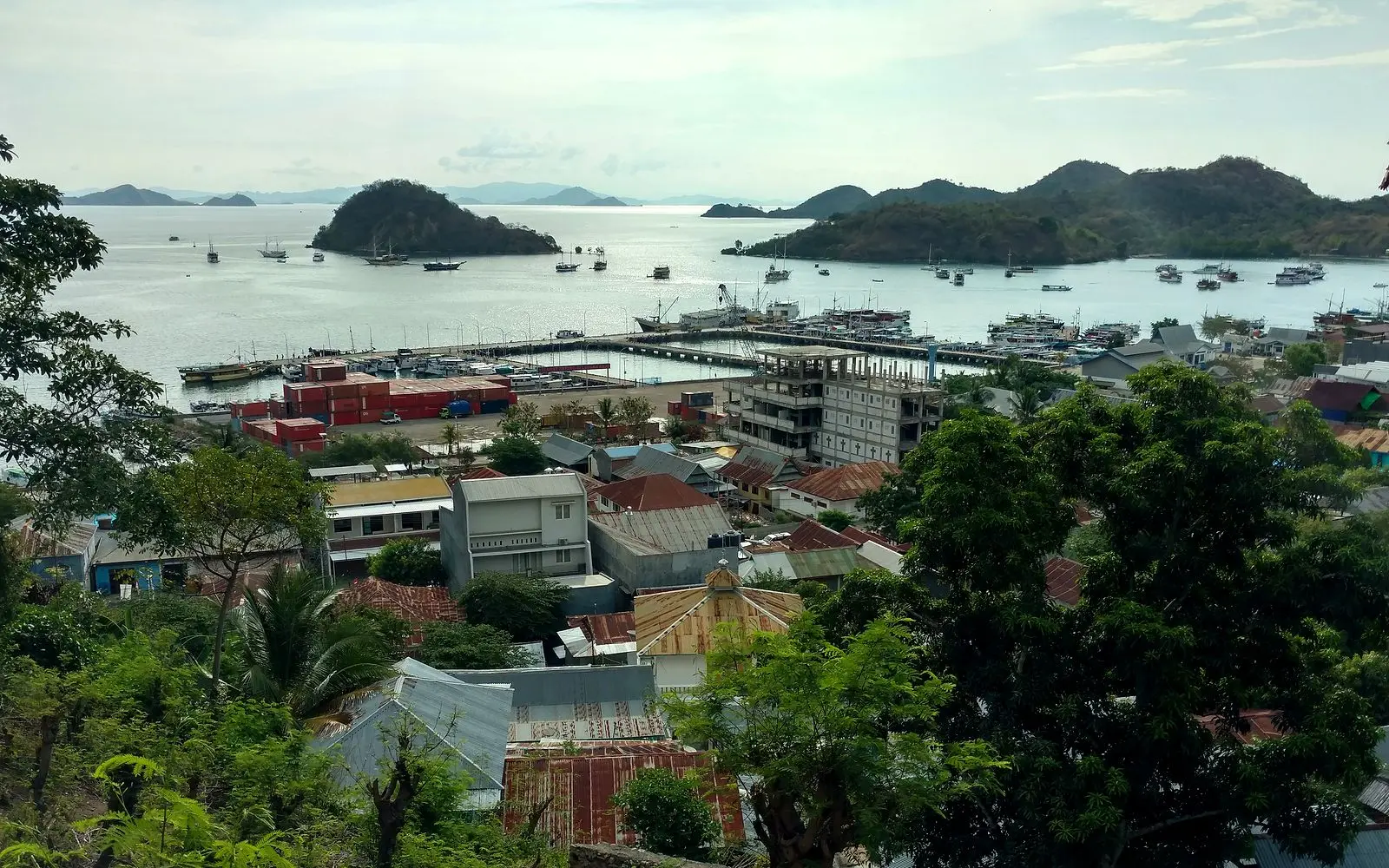
Say it plainly: after your boat leaves Labuan Bajo or Sorong, you will not see another cash machine until you come back. Not on Komodo, not on Rinca, not in Misool, not anywhere in Raja Ampat that a liveaboard visits. The villages sell carved dragons and cold drinks for cash in small notes, and that is the extent of the financial system between you and disembarkation. Whatever cash you intend to tip with has to be in your bag before you board.
Withdraw it in town, not at the airport. Airport machines face every arriving flight at once and empty accordingly, and the branch-attached machines in town are the ones where staff can retrieve your card if the machine swallows it. Indonesian ATMs typically cap a single withdrawal somewhere between IDR 1,250,000 and 2,500,000, roughly USD 75 to 150 depending on whether the machine stocks 50,000 or 100,000 notes. You can usually withdraw repeatedly, but each transaction triggers your bank's foreign fee, so four small withdrawals to assemble a tip can quietly cost you twenty dollars in charges. Take the larger ceiling where you can find it, and do it a day early rather than an hour before boarding, because machines here run out of cash at weekends and public holidays with complete serenity.
One more habit: decline dynamic currency conversion. If the screen offers to bill you in your home currency, refuse and take rupiah. The machine's exchange rate is reliably worse than your bank's.
Rupiah or US dollars?
Both are accepted everywhere in the Indonesian liveaboard industry, and there is no wrong answer. But there is a more useful one, and it is rupiah.
Rupiah can be spent immediately, by everyone, without a trip to a bank. Dollars have to be changed, which means a crew member on shore leave in Labuan Bajo standing at a money changer accepting whatever spread is offered that day, and Indonesian changers are notoriously fussy about foreign notes. If you do tip in dollars, the notes must be recent series, crisp, unfolded and unmarked. A creased twenty with a biro mark on it is worth meaningfully less to the person you just handed it to, and in the worst case is refused outright. This is not fussiness on their part; it is how the currency market works here.
Practical guidance: if you are already carrying clean dollars, USD 20 and USD 10 notes are ideal, because they let you land on your intended figure without needing change. If you are withdrawing locally anyway, rupiah at the day's rate is the kinder choice. Mid-2026 the rate has been sitting around IDR 16,000 to 16,500 per US dollar, so a USD 140 tip is roughly IDR 2,250,000. Do not agonise over the last few thousand rupiah; round to a clean note.
Can you put the tip on a card?
Increasingly, yes, and it is worth asking at booking rather than assuming. A growing number of Indonesian operators will let you add gratuities to your final onboard bill and settle by card, which removes the cash problem entirely. Two things to check before relying on it. First, card payments in Indonesia commonly carry a 2 to 3 per cent processing surcharge, and on a tip that is a real if modest cost. Second, ask how and when the money reaches the crew, because a tip that arrives through a payment processor and a bank account is only as good as the operator's diligence in distributing it.
Cash remains the default, and it remains what most crews prefer, for the straightforward reason that it arrives immediately and in full.
Timing: when to hand it over
The convention is the last evening of the cruise, not the morning of disembarkation. Mornings are chaos: bags, transfers, flights, and a crew already turning the boat around for the next group. The final evening is when the trip is being toasted, when the crew are usually presented to the guests, and when the tip box appears in the lounge or saloon. Some boats put an envelope in each cabin on that last night; if yours does, that is your cue.
Do it privately, and without ceremony
Put it in the box. There is no need to hand anything to the captain personally, make a speech, or let anyone see the amount. Indonesian crews are unfailingly gracious about tips and will thank you warmly for any of them, which means the social feedback tells you nothing about whether you gave a normal amount. Guests occasionally get competitive about this in front of each other, which helps nobody and embarrasses the crew.
Tipping one person individually
Entirely acceptable, and common, provided it is in addition to the pool rather than instead of it. If a guide spent three dives helping your partner rebuild their confidence after a bad experience, or a steward looked after a seasick child for two days, an extra note handed over discreetly at the end is a normal and appreciated thing to do. Do it quietly and away from the other crew, and keep the main contribution going to the box.
If the trip genuinely went badly
Withholding the tip at the end is the least effective response available to you, because it punishes eighteen people for a problem that was usually one person's or one decision's, and it does so after the point at which anything could have been fixed. If something is wrong, say so during the trip, to the cruise director, plainly and early. Almost everything guests are unhappy about on a liveaboard is fixable on day two and unfixable on day seven.
If, after that, the service was genuinely poor, tip at the lower end rather than nothing, and tell the operator why in writing afterwards. That combination actually changes things. A silent zero at the end of the week is read by the crew as a cultural quirk or a guest who ran out of cash, and the message does not reach anyone who can act on it.
The Awkward Cases
Couples, families and children
The per-day figure is per guest, so a couple doubles it. Children are the genuine grey area, and our practical answer is to count a child who dives or snorkels as a full guest, and a small child who mostly eats and gets looked after as roughly half. Families often find the total startling when they multiply it by five, and it is fair to say that a family group's per-head tip can reasonably sit at the lower end of the band. A family of five tipping USD 15 per person per day is contributing USD 525 across a week, which is a substantial pool contribution by any measure.
Solo travellers paying a single supplement
Tip as one guest. You paid extra for the cabin, not for extra service, and the supplement went to the boat rather than the crew. This comes up often enough on our solo liveaboard trips that it is worth stating: the single supplement has no bearing on what you tip.
Short trips and long ones
Very short trips deserve rounding up. On a three-night Komodo trip the per-day arithmetic gives USD 45 to 75, which feels thin for a crew that did the full job of setting up, running and turning around a trip. Round to a clean USD 80 to 100 and you are in the right territory. Long expeditions work the other way: on a fourteen-night Banda Sea crossing the flat rate produces USD 210 to 350, and there is no need to inflate it further. The daily figure is doing its job.
Private charters
A full-boat charter is the one case where the percentage approach earns its keep, because the crew is servicing your group exclusively and the per-guest maths gets strange when you have chartered a sixteen-berth boat for eight people. The convention we see is 5 to 10 per cent of the charter price, contributed by the group as a whole and organised by whoever booked it. Agree it among yourselves before the last night; charters are where the awkward whispered conversation is most likely to happen, because nobody wants to be the one who names a number.
When park fees and extras have already emptied your wallet
Worth planning for. Park fees, nitrox, equipment rental and the odd bar bill are usually settled in cash or on the final bill at the end of the trip, and they land at exactly the same moment as the tip. Add up all four before you travel rather than discovering the total on the last evening. Raja Ampat's fees in particular rose sharply in 2026, and guests who budgeted for the old numbers have been caught short.
Quick Answers Before You Board
One reassurance before the summary, because this is what guests are usually anxious about: nobody on the boat is counting and judging. The amount matters and the crew depend on it, but the gap between a fair tip and a slightly larger one is much smaller than people fear. A sensible contribution to the box, and the basic courtesy of learning a few names, puts you comfortably in the category of guests a crew is glad to see come back.
If you are packing and want the whole thing in one paragraph: budget USD 20 per person per day, which is USD 140 each for a week. Withdraw the cash in Labuan Bajo or Sorong before boarding, because there are no machines at sea. Rupiah is more useful to the crew than dollars, and if you do bring dollars they need to be clean and uncreased. Put it in the communal box on the final evening rather than handing it to individuals, add something extra and discreet for anyone who made your trip, and say something during the week rather than at the end if things are going wrong.
If you want to know exactly how our own boats handle the tip pool, what is included in your fare and what is not, and what the park fees will add on your specific dates, just ask us. We would rather give you a straight number in advance than have you working it out with a calculator on the last evening of your holiday. Our guide to your first liveaboard covers the wider set of things nobody tells you before your first trip, and the Indonesia packing list covers how much cash to bring for everything else.