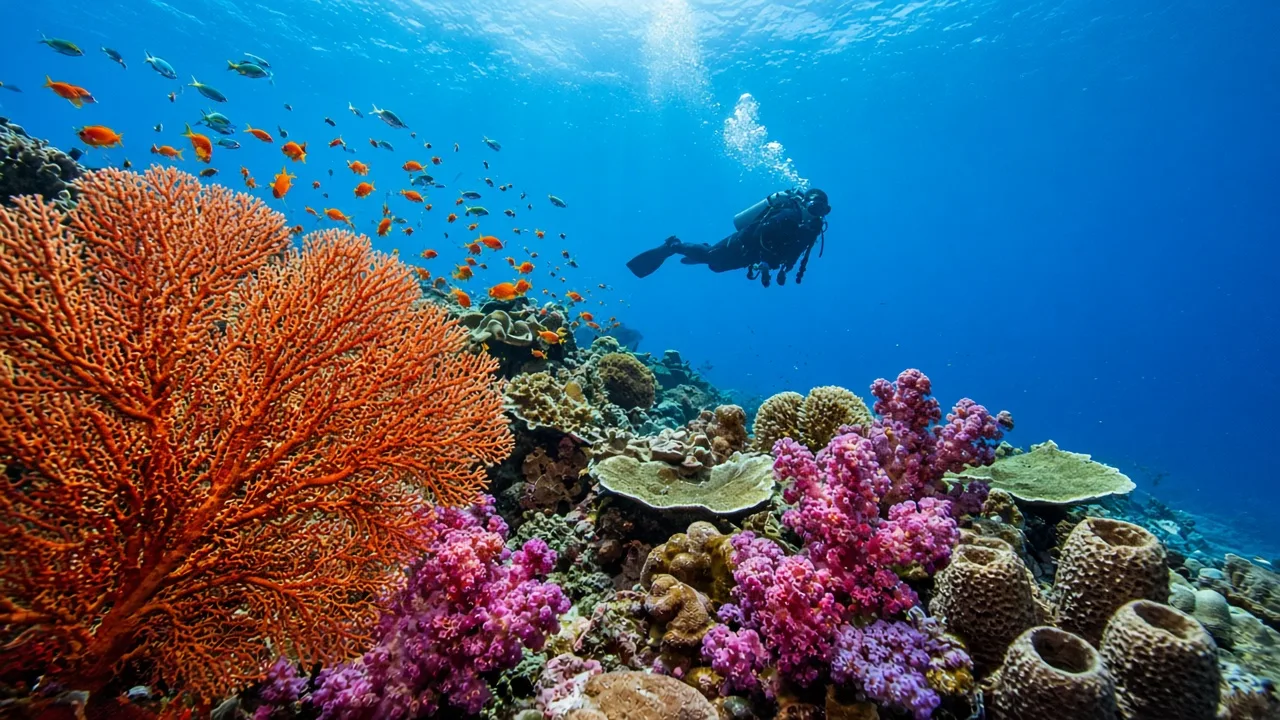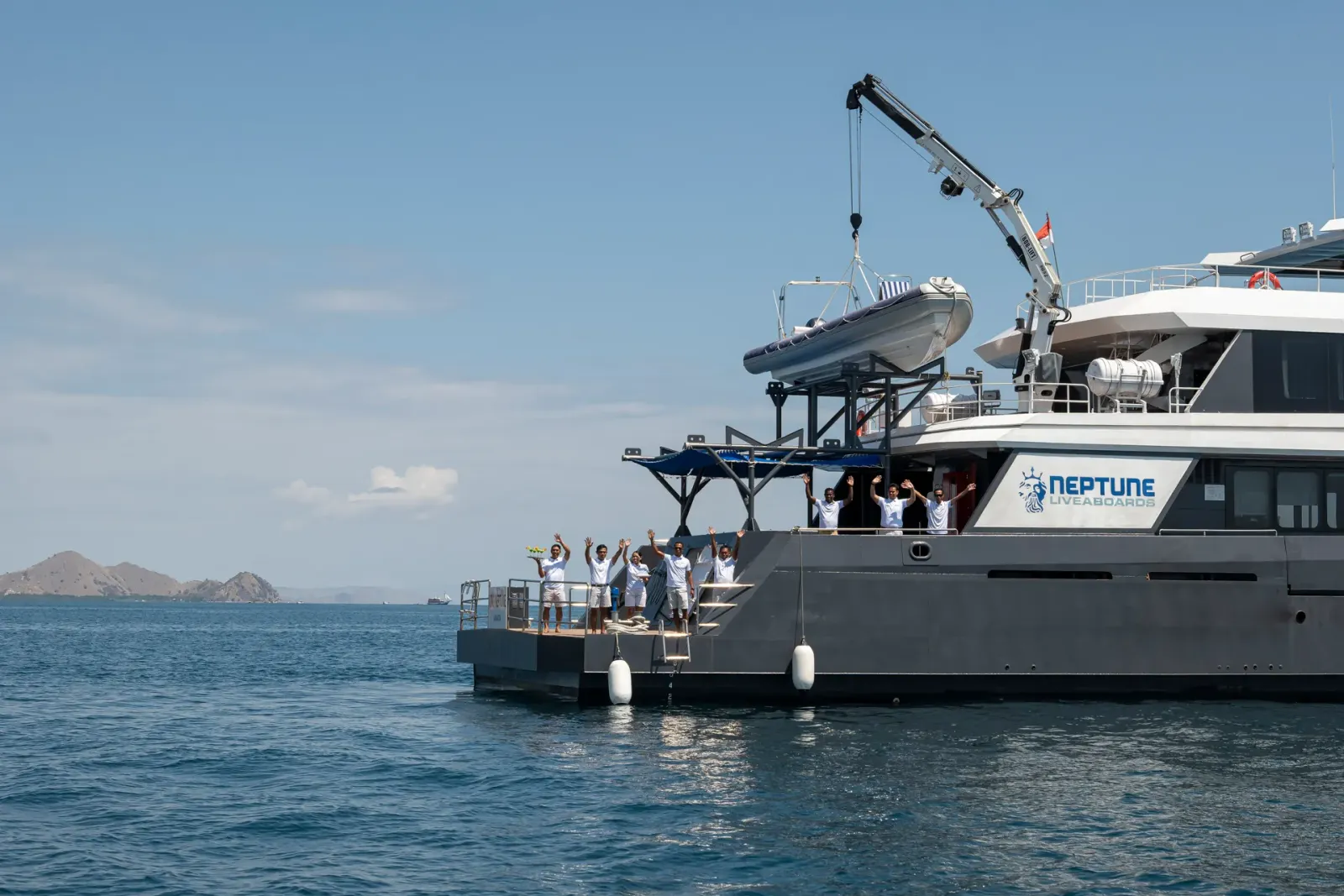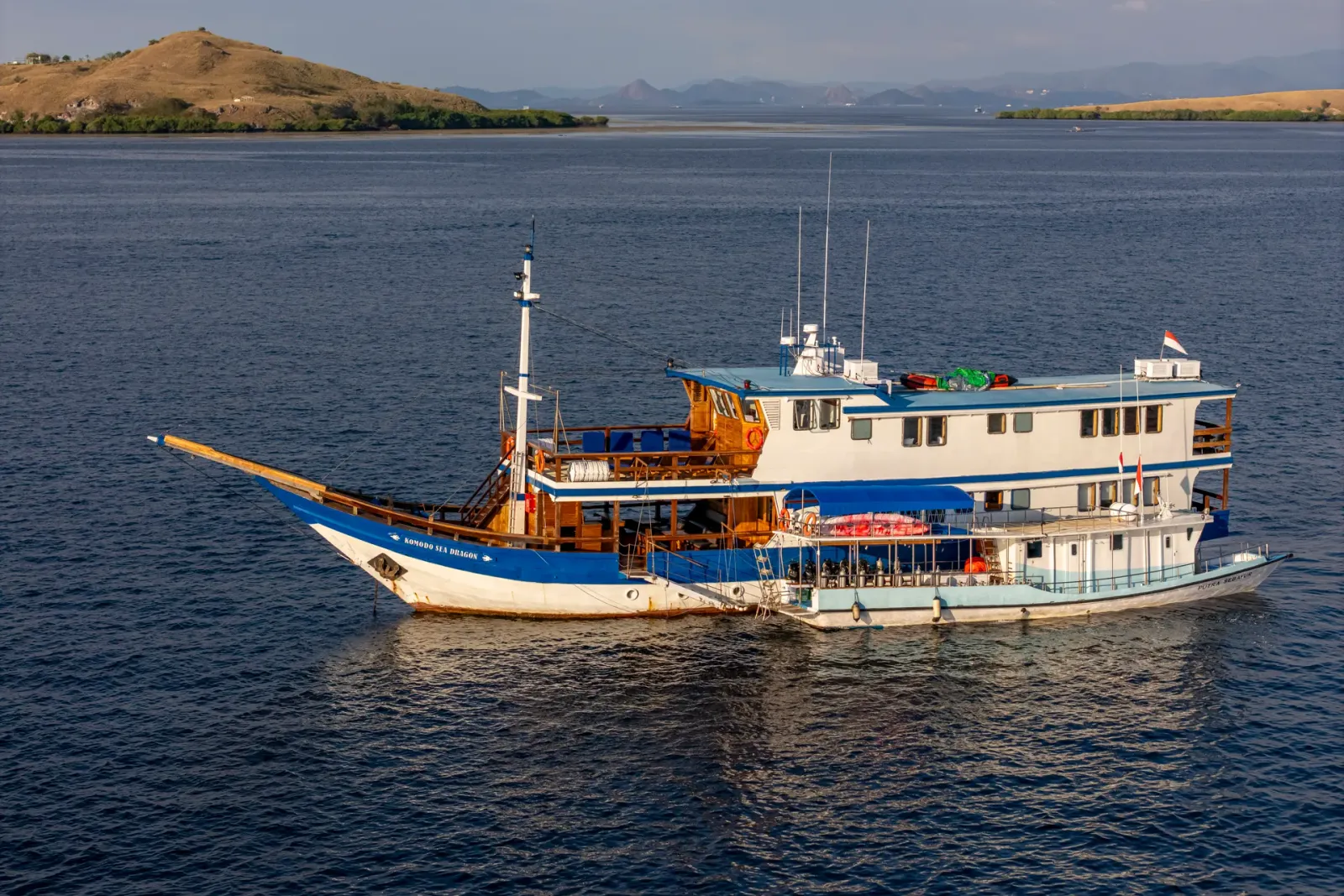
Getting to Labuan Bajo is the part of a Komodo trip that surprises people. The diving is famous, the dragons are famous, the pink beach is on every Indonesia listicle. The airport is not. It's a small regional terminal on the western tip of Flores called Komodo Airport (IATA code LBJ), and unless you live in Bali or Jakarta, reaching it takes two flights and a transfer. Almost every Komodo guest we host arrives slightly confused about which airline to book, what the 7-kilogram baggage rule actually means at the gate, where the harbour is in relation to the airport, and how the boarding-day logistics actually unfold. This guide is the operator-side answer to all of it.
Labuan Bajo itself is a small port town with a single main street, three or four good hotels, a strip of dive shops, and a working harbour that fills with phinisi liveaboards every dry season. It sits on the tip of West Manggarai regency in Flores, looking west across the strait toward Komodo and Rinca islands. The town has grown fast in the last six years (Komodo Airport got a Boeing-737-capable runway in 2018, the Komodo National Park entry process moved to a digital ticket in 2022, and a wave of new hotels opened in 2023 and 2024) but it's still small enough that you can walk the harbour-front in fifteen minutes and recognise faces by your second day.
The good news: once you understand the four routes that actually work, the trip is not complicated. The bad news: Indonesian domestic flight schedules change without much notice, the 7-kilogram cabin baggage rule is enforced selectively (which makes packing harder, not easier), and the Komodo National Park fee structure has shifted three times since 2022. The information that's online from 2023 or earlier is often wrong by 2026. We update this guide each season based on what our incoming guests actually experience.
Where Labuan Bajo is and why getting there matters
Labuan Bajo sits at the western edge of the island of Flores, in the East Nusa Tenggara province of Indonesia. The town is the gateway to Komodo National Park, which lies a short boat ride west across the Sape Strait. There is no road or ferry that connects Labuan Bajo directly to Bali; the journey is by air, and the airport on the Labuan Bajo side is Komodo Airport (LBJ), about ten minutes by car from the harbour where the liveaboards moor.
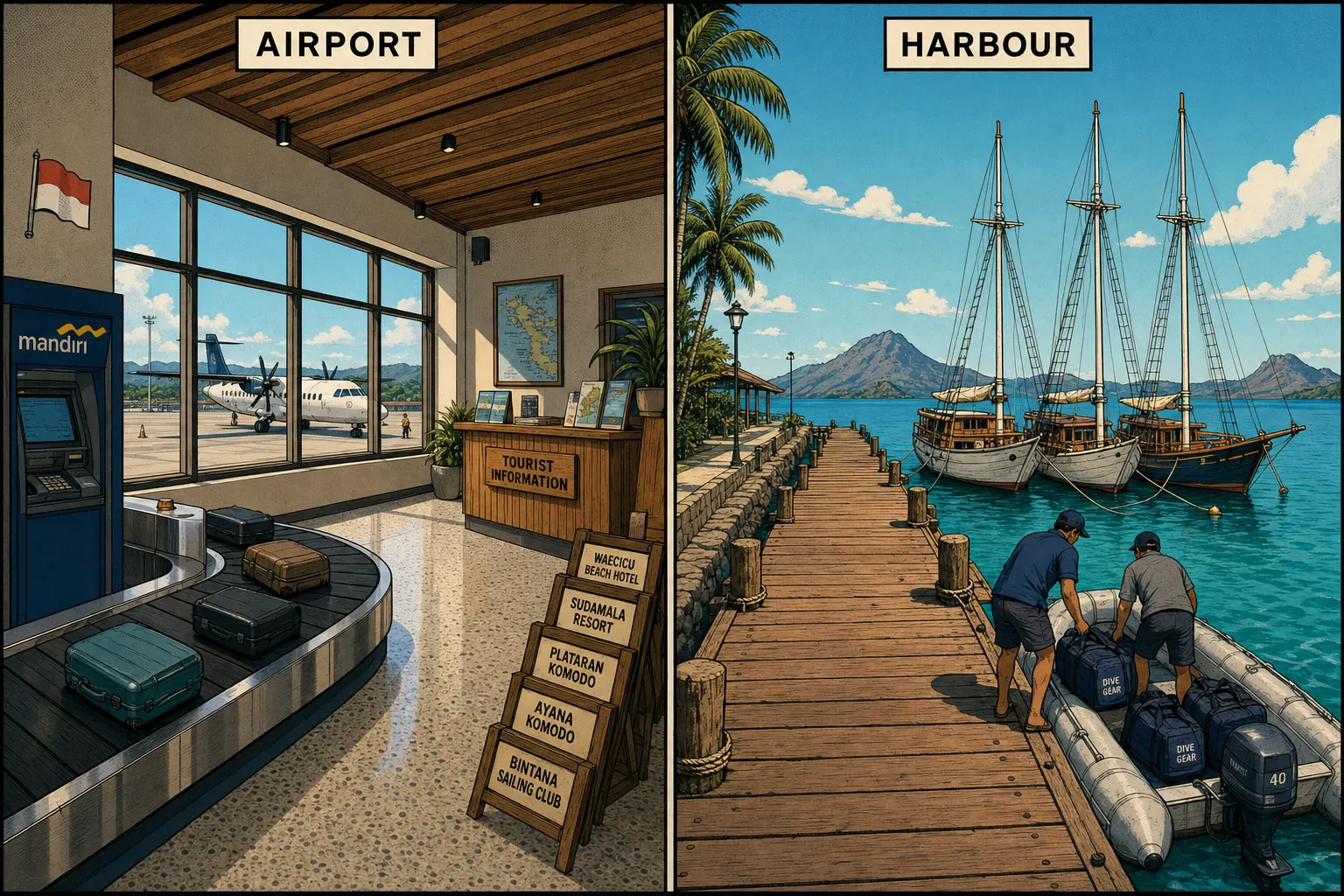
The airport is small. Two boarding gates, one baggage carousel, no jet bridges (you walk across the tarmac to your aircraft), no international flights. Every flight in or out of LBJ is a domestic Indonesian connection. The terminal itself is air-conditioned and clean, with a coffee kiosk, two small souvenir shops, and a tourist information desk that's actually useful. There's a single ATM in the arrivals area (Bank Mandiri) that occasionally runs out of cash on busy weekend mornings, so we recommend drawing rupiah in Bali or Jakarta before flying in.
The single biggest thing to know about getting to Labuan Bajo is that there is no direct international flight. If you're flying from Europe, North America, Australia, or anywhere outside Indonesia, you'll connect at Bali (Ngurah Rai International Airport, DPS) or Jakarta (Soekarno-Hatta International Airport, CGK), and take a domestic flight from there. The international leg is straightforward. The domestic leg is where most travel mistakes happen. We'll cover both, in order.
The four routes that actually work
There are four practical ways to get to Labuan Bajo from outside Indonesia, ranked from most common to most niche.
The first is via Bali. You fly into Denpasar (DPS), spend a night or two in Bali (or transit straight through if you have a tight schedule), and take a one-hour domestic flight to LBJ. This is the most common route by a wide margin and the route we recommend for first-time visitors. Bali is comfortable, easy, has plenty of hotels at every price point, and the DPS-to-LBJ flight runs four to seven times a day depending on the season. About eighty percent of our incoming guests use this route.
The second is via Jakarta. You fly into Jakarta (CGK) on your international leg, spend a night in or near the airport, and take a direct two-and-a-half-hour Garuda flight to LBJ. This is faster overall than via Bali, slightly more expensive, and works particularly well for guests coming from East Asia (Hong Kong, Tokyo, Seoul) or Europe via the Middle East. Jakarta is less pleasant as a transit city than Bali (more traffic, less to do near the airport, and the smog can be heavy), but if you're prioritising a fast straight-through trip rather than a Bali holiday, Jakarta can save you a day.
The third is via Singapore or Kuala Lumpur. You fly into one of these international hubs (which often has more direct connections from Europe and North America than Bali or Jakarta do), spend a night or transit straight through, then connect to either DPS or CGK on a separate ticket and onto LBJ. This is the route we see most often from European long-haul travellers who got a good Singapore Airlines or Malaysia Airlines fare. The total travel time is usually similar to the Bali or Jakarta routes, sometimes shorter from continental Europe.
The fourth is the slow overland-and-sea route. There is a road-and-ferry route from Bali to Lombok to Sumbawa to Flores that ends up in Labuan Bajo after about two and a half days. Almost nobody uses this for a liveaboard trip; it's a backpacker route, not a flight alternative. We mention it for completeness but if you're trying to get to a boat that sails on Tuesday, fly.
From Bali (DPS): the most common route
The Bali route is the default for a reason. Denpasar's Ngurah Rai International Airport (DPS) is the most internationally connected airport in eastern Indonesia, with direct flights from twenty-plus international destinations and an active domestic network into every Indonesian island worth visiting. The DPS-to-LBJ flight is the workhorse of every Komodo liveaboard schedule.
The flight itself takes about one hour fifteen minutes in the air, plus the standard domestic check-in and boarding window. Three to four airlines operate the route year-round: Garuda Indonesia (the flag carrier, more reliable, more expensive), Batik Air (mid-range, decent on-time record), Lion Air (low-cost, less reliable, watch the baggage rules carefully), and Wings Air (Lion's regional ATR turboprop subsidiary, smaller aircraft, more frequent). Garuda and Batik fly Boeing 737s; Lion mixes 737s and ATR-72s; Wings flies only ATR-72s.
Schedule-wise, you can expect five to seven daily flights in the dry-season peak (June through September), three to five in the shoulder months, and two to three in the wet-season trough (December and January). Morning departures from DPS are the most reliable; afternoon flights are more likely to be delayed or cancelled because Komodo Airport's afternoon weather (sea breeze, thermals, occasional thunderstorms) makes landings harder. We strongly recommend booking the morning flight (typically 06:30, 07:00, or 09:00 from DPS) for the day your cruise boards, and arriving in Bali at least one full day before that.
The 2026 ticket prices for DPS-to-LBJ one-way sit in the range of 1.2 to 2.5 million rupiah for economy on Garuda or Batik, and 700,000 to 1.5 million on Lion or Wings. For a return ticket booked four to eight weeks ahead, expect 2.5 to 4.5 million rupiah on Garuda. Same-day or next-day bookings on busy dates (school holidays, Idul Fitri, Christmas-New Year) can double these prices. Buy the ticket as soon as your cruise dates are confirmed.
One scheduling tip from running the route weekly: do not book the absolute earliest flight on cruise-boarding day if you can avoid it. The 06:30 from DPS requires a 04:30 wake-up in your Bali hotel, the airport security line at that hour is unpredictable, and any delay rolls the whole day. The 07:00 or 09:00 is a safer bet. Boarding-day boats typically expect guests at the harbour by 11:00 or 12:00, which means a flight that lands at 09:30 or 10:00 has just enough buffer.
From Jakarta (CGK): direct, faster, more expensive
Jakarta-to-Labuan Bajo is the second-most-common route. Garuda Indonesia operates a direct flight from Jakarta's Soekarno-Hatta International Airport (CGK) to LBJ once or twice daily, with a flight time of about two and a half hours. The route runs Boeing 737s in both directions, with reasonable on-time performance (85 to 90 percent in the dry season, lower in the wet season).
The Jakarta route works best for guests connecting from East Asia (Hong Kong, Singapore, Tokyo, Seoul, Taipei) or Europe via the Middle East (Doha, Dubai, Abu Dhabi). For these origins, Jakarta is often the natural stopover and the LBJ flight slots cleanly into a same-day or next-day connection. Garuda is also part of the SkyTeam alliance, which makes mileage redemption possible for some travellers.
The trade-off versus the Bali route is comfort. Jakarta is hot, crowded, and not pleasant for a layover; the airport is large and modern but the city traffic outside is brutal. If you're going to spend a night in Jakarta to catch the morning LBJ flight, stay at one of the on-airport or near-airport hotels (the Jakarta Airport Hotel inside Terminal 2, the Sheraton Grand Jakarta Gandaria City for a quieter overnight, or the FM7 Resort which is a short shuttle from the airport) rather than venturing into the city.
The 2026 ticket prices for CGK-to-LBJ one-way sit at 1.8 to 3.5 million rupiah on Garuda for economy, with business class at 5.5 to 8 million. Same-day pricing is similar to the Bali route's spread.
One detail that catches Jakarta-routed guests: the domestic departure is from Terminal 3 at CGK (where Garuda's domestic flights operate), not the international terminal you arrived at. The transfer between terminals takes 30 to 60 minutes depending on traffic and shuttle frequency, so plan a two-hour minimum connection if you're doing a same-day arrival-and-onward.
From Singapore, Kuala Lumpur, and other international hubs
If your home airport has a better fare to Singapore (SIN) or Kuala Lumpur (KUL) than to Bali or Jakarta, the indirect routing can save you money or time, particularly from continental Europe. The pattern is: long-haul leg to SIN or KUL, short-haul connection (1 hour to Bali or 2.5 hours to Jakarta), then domestic to LBJ.
Singapore Airlines, Singapore-based budget carriers (Scoot, Jetstar Asia), AirAsia, and Malaysia Airlines all run frequent Bali and Jakarta connections from SIN and KUL. Lion Air also runs Singapore-DPS and Kuala Lumpur-DPS routes. Total travel time from London or Frankfurt via Singapore is typically 18 to 22 hours; via Bali direct (where available) is 17 to 20 hours. The convenience saving from doing it via Singapore is mostly the airline service quality on the long-haul leg.
One trap with the Singapore or Kuala Lumpur routing: book the international and domestic legs as separate tickets unless you're using a single airline's through-fare (Singapore Airlines code-shares with Garuda, for example). Mixed-carrier separate-ticket bookings have no protection if the international leg is delayed; you'll re-buy the missed domestic flight at full walk-up price. Build a one-night buffer in Singapore or Bali rather than running tight connections across separate tickets.
From Australia, Qantas, Jetstar, and Garuda all operate direct Sydney-DPS, Melbourne-DPS, and Perth-DPS flights, with Brisbane and Darwin adding seasonal service. From New Zealand, the typical pattern is Auckland to Singapore or Sydney, then onward.
From the United States and Canada, there is no direct flight to either Bali or Jakarta. The standard routings are Los Angeles or San Francisco via Tokyo, Hong Kong, Taipei, or Seoul, with Singapore Airlines and EVA Air being the fare-watchers' favourites. Total travel time from the US west coast is typically 24 to 30 hours door-to-door. From the US east coast, add another 5 hours.
From Europe, the most common routings are via Doha (Qatar Airways, often the price leader to Bali), Dubai (Emirates), Singapore (Singapore Airlines), and Hong Kong (Cathay Pacific). Qatar Airways' Doha-to-Denpasar service is a favourite among European Komodo travellers because the Doha layover is comfortable and the fare is often the most competitive.
Which Indonesian domestic airline to actually book
The four airlines that fly to LBJ (Garuda, Batik, Lion, Wings) are not equivalent, and the right choice depends on your tolerance for delay and your dive-bag situation. Here's the operator-side honest assessment after running guests through this route every week of every dry season.
Garuda Indonesia is the safest choice. It's the national flag carrier, the most expensive of the four, and the most likely to actually take off on time. The cabin baggage allowance is more generous and more consistently honoured (officially 7 kg but regularly waived to 9 or 10 kg for paying customers without complaint). Garuda check-in counters at DPS and CGK are quick. The aircraft are usually new-generation 737s with overhead bins large enough for a backpack with a camera. If your dive bag is heavy, Garuda is the airline you book.
Batik Air is the mid-range alternative. It's owned by Lion Air Group but operates with better service standards than the parent brand. On-time performance is decent. Cabin baggage allowance is 7 kg, enforced more strictly than Garuda but less aggressively than Lion. Batik's DPS-to-LBJ schedule is reasonable. We use Batik for guests who want to save 30 to 40 percent versus Garuda without dropping into the lottery of low-cost carriers.
Lion Air is the low-cost option and the one we steer most guests away from. The on-time performance is the worst of the four (we've seen mid-day flights cancelled and rolled to next morning with no compensation), the cabin baggage allowance is enforced strictly with weighing scales at the gate, and the customer service for delays is minimal. The savings versus Garuda are real (typically 30 to 50 percent on the same route) but the risk of trip-disruption is meaningfully higher. Use Lion only if your travel timing is flexible and your dive bag is well within weight limits.
Wings Air, Lion's regional ATR-72 turboprop subsidiary, runs a separate set of LBJ flights. The aircraft is smaller (72 seats, no first-class), the flight time is similar to the 737s (because LBJ's runway constrains the approach speed), and the baggage rules are even tighter than Lion's mainline. We've had guests refused boarding for a 9-kilogram cabin bag on Wings. Photographers should avoid Wings entirely; the overhead bin space cannot accommodate a serious camera kit.
Booking-wise, we recommend booking Garuda or Batik through their own websites or through a Bali-based travel agent if you want a paper PNR (passenger name record) and easier rebooking. Online travel agents like Traveloka and Tiket.com are popular in Indonesia and offer marginally better fares, but the rebooking experience when something goes wrong is harder. For the cruise-boarding day specifically, where any flight delay can ruin the trip, we recommend booking direct with the airline.
Domestic baggage rules: the 7-kilogram reality
The 7-kilogram cabin baggage limit on Indonesian domestic flights is the single most common surprise for first-time visitors. International airlines typically allow 7 to 10 kg in cabin baggage, weighed with the personal item; Indonesian domestic flights weigh just the main bag at the check-in counter (sometimes), at the gate (always for low-cost carriers), or both. The personal item (a small backpack, a camera bag, a laptop sleeve) is officially weighed too but is usually not actually weighed in practice.
The checked baggage allowance varies by airline and ticket class, and is meaningfully different across the four carriers. Garuda economy includes 20 kilograms in the hold by default. Batik economy includes 20 kg. Lion Air's standard economy fare includes only the cabin baggage; checked baggage is sold as an add-on at 5 kg, 15 kg, 20 kg, or higher tiers. Wings Air similarly sells checked baggage as an add-on. For dive trips, where you're typically carrying a 25 to 30 kilogram dive bag plus a 7 to 10 kilogram cabin item, this matters enormously.
Our standard advice: book Garuda or Batik for cruise-boarding day, with at least 30 kg of checked baggage allowance. For Lion or Wings, pre-purchase the 25 or 30 kg add-on at booking time (it's significantly cheaper than buying at the airport check-in, where the price doubles). Photographers should also pre-purchase an oversized-baggage tag if their dive bag is over 158 cm in linear dimensions (length plus width plus height); the standard hold-baggage rule rejects bags over this size.
One workaround for the 7-kilogram cabin rule that we've seen work consistently: split the cabin bag into a small backpack and a smaller "personal item" pouch. The backpack with the camera body, lenses, and dive computer is the official cabin bag (under 7 kg). The pouch with the housing, strobes, and one lens travels as the personal item (officially counted, rarely weighed). Lion Air's gate agents have weighed both on busy days; Garuda almost never does. This isn't bulletproof but it's the difference between getting your camera kit on the plane and watching it go in the hold.
If you're refused boarding for an overweight cabin bag, the only solution is to check it. If your camera kit cannot be checked safely (housings, glass dome ports), the only solution is to pay the at-airport overweight fee, which is roughly 30 to 40 thousand rupiah per kilogram on Lion and 25 to 35 thousand on Garuda. For a 5-kilogram overage, that's around 200,000 rupiah or 13 US dollars. Worth it if your alternative is checking a 5,000 dollar camera kit.
For our guests on Neptune Liveaboards, we send a pre-trip email about ten days before sailing that includes the latest baggage rules for each of the four carriers, the pre-purchase links for add-on baggage on Lion and Wings, and the contact for our Bali ground partner who can rebook a missed connection if anything goes wrong.
Inside Komodo Airport (LBJ): what to expect on arrival
Komodo Airport (IATA: LBJ, ICAO: WATO) is small, modern by Indonesian regional standards, and clean. The runway is 2,250 metres, sufficient for a Boeing 737-800 or 737-900 but not a wide-body, and the terminal building was rebuilt and expanded in 2018. The arrivals process for a domestic flight from Bali or Jakarta takes ten to fifteen minutes from wheels-down to taxi-rank, assuming nothing exotic in your luggage.
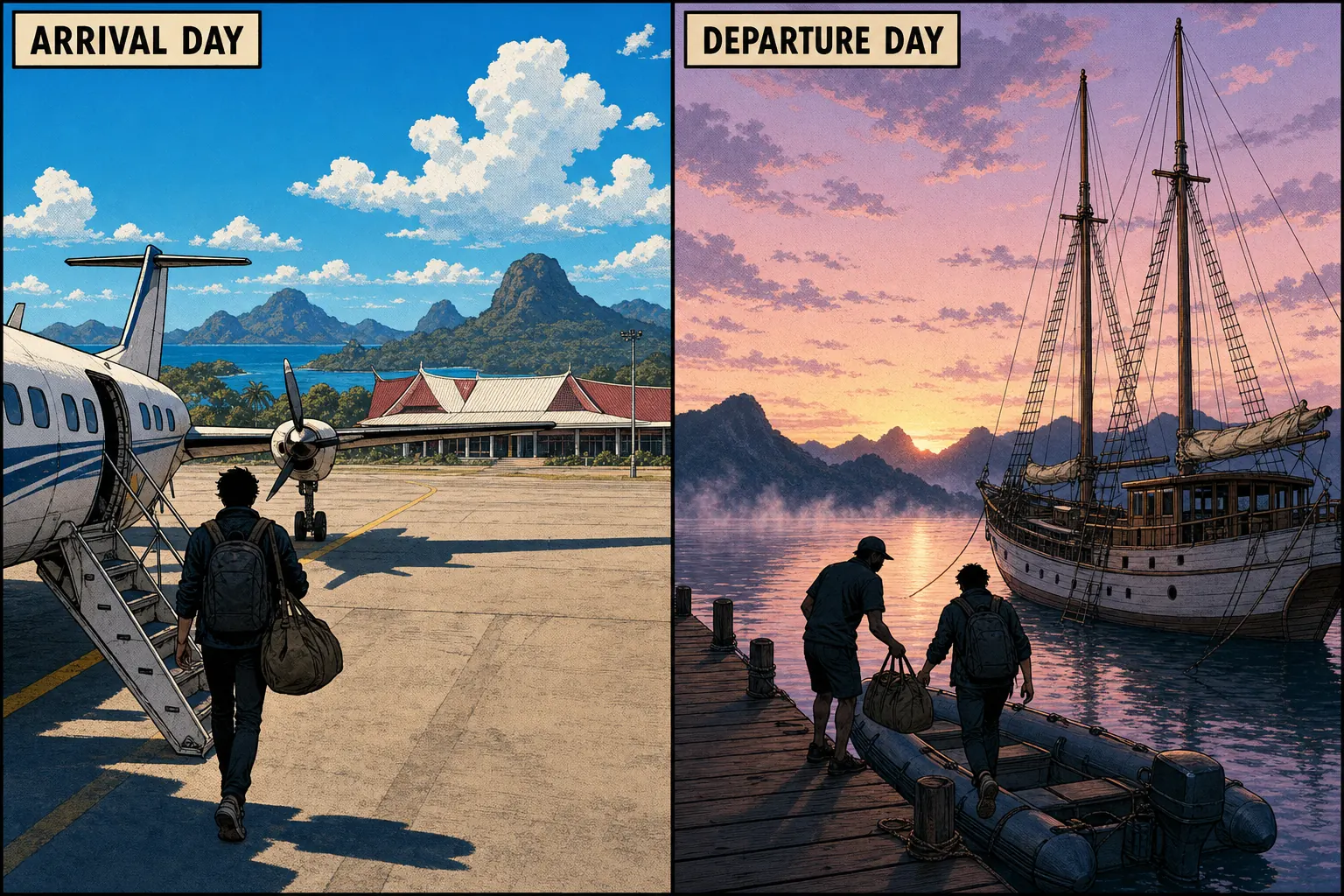
The arrival sequence: aircraft taxi to the apron and stop. You disembark via airstairs (no jet bridges) and walk across the tarmac, about a hundred metres, to the terminal entry. There's no immigration on a domestic flight. You enter the terminal directly into the baggage hall, which has one carousel. Bags arrive in 10 to 20 minutes; we've never seen a Komodo flight take longer than half an hour for baggage. Kiosks near the baggage area sell local SIM cards, though our guide to Indonesian SIM cards and eSIMs explains why buying in Bali or Jakarta is usually the easier option.
Past the baggage hall is the arrivals lobby. There's a tourist information desk on the right (genuinely useful, English-speaking), an ATM (Bank Mandiri, sometimes empty by mid-afternoon on busy days), a small café and convenience shop, and a row of desks for the major hotels and tour operators offering meet-and-greet pickups. To the left of the arrivals exit is the taxi rank.
If your operator (us or any reputable Komodo cruise) is meeting you at the airport, the standard is for a driver to be inside the arrivals hall holding a sign with your name. The driver typically arrives 30 minutes before your scheduled landing time and waits up to 90 minutes after if your flight is delayed. The driver will help with your bags and walk you to the operator's vehicle in the airport car park.
For Neptune Liveaboards specifically, every guest with a confirmed cruise gets a complimentary airport pickup unless you've explicitly asked us not to send one. The driver carries a sign with your name and the boat's name (Neptune One, King Neptune, or Komodo Sea Dragon). We text the driver's mobile number to your booking phone the day before arrival.
If your flight lands late and you've missed the operator pickup window, the alternative is a metered taxi from the rank outside the arrivals hall. A taxi to the harbour is around 100,000 rupiah (six dollars) and a taxi to a Labuan Bajo town hotel is 50,000 to 80,000 rupiah. The drivers expect rupiah, not US dollars; bring small bills.
From airport to harbour or hotel
The drive from Komodo Airport (LBJ) to the Labuan Bajo harbour is short. Ten kilometres, about 15 minutes in normal traffic, sometimes 25 minutes if a wedding procession or a market is blocking the main road. The route runs west along the coast on a winding road, passing through the eastern outskirts of Labuan Bajo town and arriving at the public harbour at the western end. There's no toll, no border, no airport fee.
If you're staying at a hotel in town the night before boarding, the same drive is the same length but ends at the hotel rather than the harbour. The town is small; almost every hotel is within five minutes of either the airport or the harbour, and many are walkable from each other.
The road can be dusty and bumpy; expect a regional-Indonesia driving experience rather than a smooth airport-shuttle ride. The driver will drive a little faster than you might be comfortable with by Western standards. The tip rate for the airport-to-harbour transfer is 20 to 50 thousand rupiah (one to three US dollars); operators typically include the driver tip in their cruise package, but a small extra tip handed directly is appreciated and entirely optional.
Where to stay if you arrive a night early
We strongly recommend arriving in Labuan Bajo at least the night before your cruise. The 7am or 9am domestic flight on cruise-boarding day is the highest-risk leg of the trip and the one most likely to be delayed; spending the night before in town reduces that risk to near zero. Most cruise operators (us included) do not refund or rebook a missed-boarding-day flight as a guest's responsibility, so the night-before buffer is the cheapest insurance available. If you have two or three spare days at the front of the trip, the land excursion worth making is Wae Rebo, a mountain village five hours inland, and it is far better done before a cruise than after, because the village sits well above the altitude limit that applies once you have been diving.
Labuan Bajo's hotel scene has expanded significantly since 2023. There are now three rough tiers: budget guesthouses (300,000 to 700,000 rupiah a night), mid-range hotels (700,000 to 1.5 million rupiah), and luxury resorts (1.5 to 5+ million rupiah). All are within ten minutes of the harbour.
For luxury, we routinely recommend the Plataran Komodo Resort and Spa (a quiet beachfront set 20 minutes outside town), the AYANA Komodo Waecicu Beach (a large international-brand resort 30 minutes north of town with a private jetty), or the recently-opened Six Senses Resorts (private villa standard, set out of town). These all run 3 to 5 million rupiah a night for a base room and rise to 8 to 12 million for a villa.
For mid-range, the Sudamala Komodo Seraya, the Bayview Gardens Hotel, and the Komodo Resort Diving Club all sit in or near Labuan Bajo town and offer reliable air-conditioned rooms with breakfast for 700,000 to 1.4 million rupiah. The Bayview is particularly convenient for cruise boarding because it's a five-minute walk from the harbour.
For budget, the Cocogreen Hotel, the La Boheme Bajo, and several smaller guesthouses on Jalan Soekarno Hatta offer clean, air-conditioned rooms with breakfast for 350,000 to 700,000 rupiah. These are basic but adequate for one or two nights pre- or post-cruise.
We'd recommend reserving the night-before hotel as soon as the cruise is confirmed. Labuan Bajo fills up during the dry season peak (June to September), and walk-in availability in August is essentially nil at the mid- and luxury tiers.
How boarding works at the harbour
The Labuan Bajo public harbour sits at the western end of the town's main street, with a long concrete jetty stretching out into the bay. There are usually six to twelve liveaboards moored in the bay at any time during the dry season, with smaller day-trip boats clustered closer to shore. The bay is calm by Indonesian standards, with the western horizon framed by Komodo and Rinca islands across the strait.
The boarding process for a liveaboard cruise typically goes like this. Your operator's driver drops you at the jetty between 11am and 1pm on cruise-boarding day. There's a small open-sided welcome area at the head of the jetty where the cruise crew checks you in: a brief form to confirm your name, passport, and dietary preferences, plus a swap of your luggage to the boat tender. The crew handles the bags from there.
You'll then take a short tender ride out to your liveaboard, usually 5 to 15 minutes depending on where in the bay it's moored. The tender is the boat's small inflatable or hard-bottom dinghy; you'll be on it again every dive day, so don't be surprised by the routine. There's no port tax or harbour fee charged to passengers; everything is handled by the operator.
Once aboard, the standard sequence is: cabin assignment, brief tour, lunch, safety briefing, then departure into the channel. The first dive of the cruise is usually a check-out dive at a calm site near Labuan Bajo (sometimes called Sebayur or Tatawa) to confirm weighting, BCD setup, and air consumption. The full Komodo schedule starts the next morning.
For Neptune Liveaboards, the cruise-boarding window is 11am to 12:30pm at the public harbour. We send the exact pickup time and location in the pre-trip email about a week before sailing, and we have a Bali ground partner who can rebook your domestic flight if anything goes wrong on the way to Labuan Bajo. The boat does not depart without you (we wait up to two hours for delayed guests on cruise-boarding day, then make a contingency plan in coordination with the captain).
Komodo National Park fees and where they get paid
Komodo National Park charges a daily entry fee for international visitors, plus separate fees for the dragon-walking ranger services and for several specific dive sites within the park. The fee structure has changed multiple times since 2022 and is likely to change again. Here's the 2026 picture and where each piece is paid.
The standard international visitor entry fee is around 290,000 rupiah per person per day on weekdays and 370,000 rupiah per person per day on weekends and Indonesian public holidays. This is paid as a daily ticket, so a 4-day Komodo cruise pays the daily rate four times. The fee covers entry to the park and most dive sites within it.
There's a separate ranger fee for the Komodo dragon walks on Rinca and Komodo Island, around 80,000 rupiah per group per ranger, with one ranger required per four guests. Trekking a longer route on Rinca adds a small surcharge.
The fees are paid in rupiah by the cruise operator on your behalf and either included in the cruise price (most operators, including us) or itemised as a separate cash settlement at boarding (some budget operators). Confirm with your operator before you board so you know whether to budget for the fees in cash. For a 4-day Komodo cruise on Neptune Liveaboards, all park fees are included in the cruise price; we settle directly with the park rangers and the guest doesn't see the line item.
One detail worth noting: there have been periodic discussions in the Indonesian government about a higher annual-membership fee structure for Komodo, including a much-discussed but unimplemented 14 million rupiah annual rate proposed in 2022. As of mid-2026, this has not been implemented. The current daily rate structure described above is what's actually charged. We'll update this guide if anything changes.
Departure day: leaving Labuan Bajo cleanly
The departure day from Labuan Bajo is the mirror of the arrival, but with one important rule: do not book the same-day connecting international flight. The standard cruise-end disembark window is 8am to 10am at the harbour, which gives you a ten-or-eleven AM domestic flight option. But if your DPS-to-international leg leaves at 6 or 7pm the same day from Bali, you have very little buffer for any cascading delay.
The risk specifically is: cruise disembarks late (it happens, weather, last-night anchoring decisions, immigration formality). You miss the LBJ-to-DPS morning flight and rebook for early afternoon. The afternoon flight is delayed by Komodo's afternoon weather. You arrive in Bali at 6pm. Your international flight is closing for boarding at 6:30pm. You miss it.
Our standard recommendation is: if you've arrived a night early in Bali, you should also stay a night after the cruise in Bali. This second overnight is the cheapest insurance for the international leg. Plenty of guests use the post-cruise Bali night to do a spa day, a beach lunch, or a topside Bali tour before flying home; the overnight is usually a feature, not a bug. The same logic applies at the Flores end, where the no-fly wait hands you most of a day whether you wanted one or not, and our guide to things to do in Labuan Bajo covers which excursions suit that day and which two you should move to the front of the trip.
If a same-day departure is genuinely necessary (we discourage it but understand the calendar reality), choose the earliest possible LBJ-to-DPS morning flight (typically 09:00 or 10:30) and pick a Bali international departure no earlier than 10pm. Garuda's late-evening departures from DPS to Singapore, Hong Kong, and Tokyo are the safest connection windows.
Common screw-ups we see every season
The five mistakes we see most often:
First, booking the cruise-boarding day's domestic flight as a same-day arrival from outside Indonesia. The international leg lands in Bali at 4am or 6am, the LBJ flight at 9am, the cruise boards at 11am. Any one delay cascades. We've watched a guest sleep in Bali airport for a 2am arrival, take the 7am LBJ flight, and arrive at the cruise at 10:55am, sleep-deprived and cranky for the entire week. Always plan a buffer night in Bali or Jakarta before the LBJ flight.
Second, choosing the cheapest Lion Air flight on cruise-boarding day. The fare savings versus Garuda are 200 to 400 thousand rupiah; the cost of a missed cruise (rebook fees, lost cruise day, replacement flight at walk-up rates) can be 10 to 20 million rupiah. Pay the Garuda premium on the day that matters.
Third, packing dive gear over the cabin baggage limit and assuming you'll talk your way past the gate. Lion Air's gate agents have weighed bags consistently for two seasons. If you're over the limit, you'll either pay an at-airport overweight fee or check the bag, and the latter risks dive-mask or dive-computer damage. Pre-purchase the heavier-luggage tier at booking.
Fourth, not bringing rupiah cash. The single ATM in Komodo Airport has run dry on multiple occasions. The operator pickup driver expects a tip in rupiah. The taxi rank works in rupiah only. Even at hotels and dive shops, rupiah is preferred and the US-dollar exchange rate offered locally is usually 5 to 10 percent worse than the bank rate. Draw a few million rupiah at a major-bank ATM in Bali or Jakarta before the LBJ flight.
Fifth, missing the same-day-departure trap on the back end. Same as above for the cruise-end day: build a Bali night between the cruise and your international flight. The post-cruise massage on Sanur beach is a pleasant way to spend that day, and the alternative is a stress fracture about whether you'll make the international gate.
Your pre-departure travel checklist
The night before you leave home, run through this list:
- Passport: at least six months valid from the day after your cruise ends, with at least two blank pages. e-VOA confirmation printed and saved to phone.
- International leg ticket and seat assignment confirmed; check-in opens 24 hours before departure for most carriers.
- Domestic LBJ leg ticket booked through Garuda, Batik, or pre-purchased baggage tier on Lion or Wings.
- One full night booked in Bali or Jakarta before the LBJ flight on cruise-boarding day, in writing and pre-paid.
- One full night booked in Bali or Jakarta after the cruise-end day, before the international leg home.
- Cruise booking confirmation, operator emergency contact, and pre-trip email saved offline on phone.
- DAN or DiveAssure dive insurance certificate, printed and saved to phone.
- Travel insurance certificate (separate from dive insurance) covering trip cancellation and medical evacuation.
- Rupiah cash plan: 50 USD equivalent in small denominations for incidentals, with a backup card and bank-travel-notification in place.
- Carry-on packed with the night-one essentials in case the checked bag is delayed, including dive computer and prescription medication.
If you can tick all ten of these the night before, the trip from your front door to the boat at Labuan Bajo is genuinely simple. Most guests who follow the buffer-night rule have a smooth start and never need the contingency plans we describe above.
Where to go from here
If you haven't booked yet, our Komodo dive sites guide and Komodo liveaboard itineraries guide are the natural next reads, and the seasons guide tells you which Komodo months match which conditions. If you're already booked with us, our packing list covers what to bring once you've sorted the flights, and our first-time liveaboard primer covers the on-board rhythm. For the comparison-shopping reader weighing Komodo against the other Indonesian regions, our Raja Ampat vs Komodo guide is the natural decision-making companion.
Once you've sorted the airport, the airline, the baggage rules, the hotel, and the harbour transfer, the rest of the Komodo trip is the easy part. Our team in Labuan Bajo and our Bali ground partner are reachable for any in-transit trouble; if you'd like our help building the travel itinerary around a specific cruise date, we're a message away.