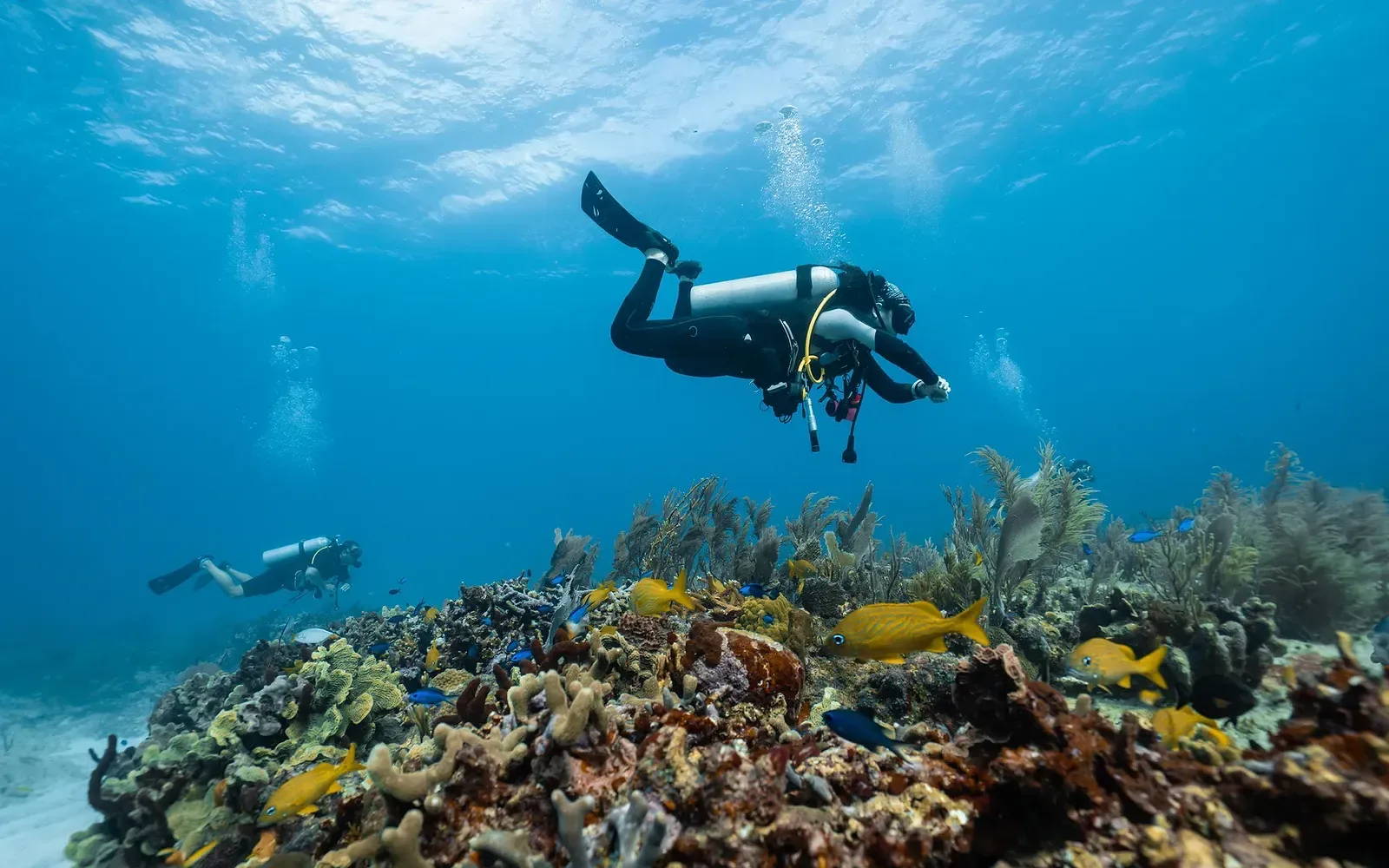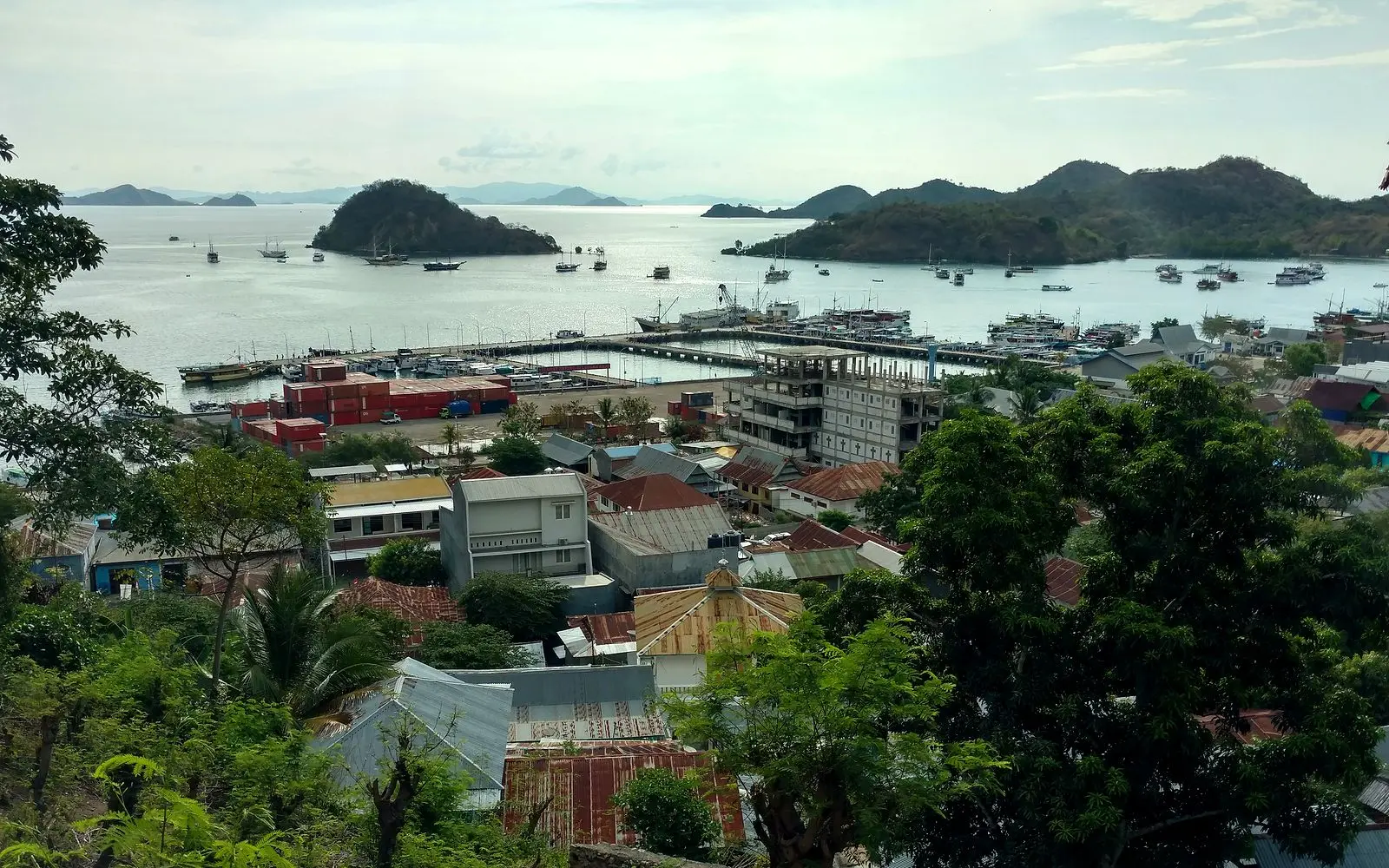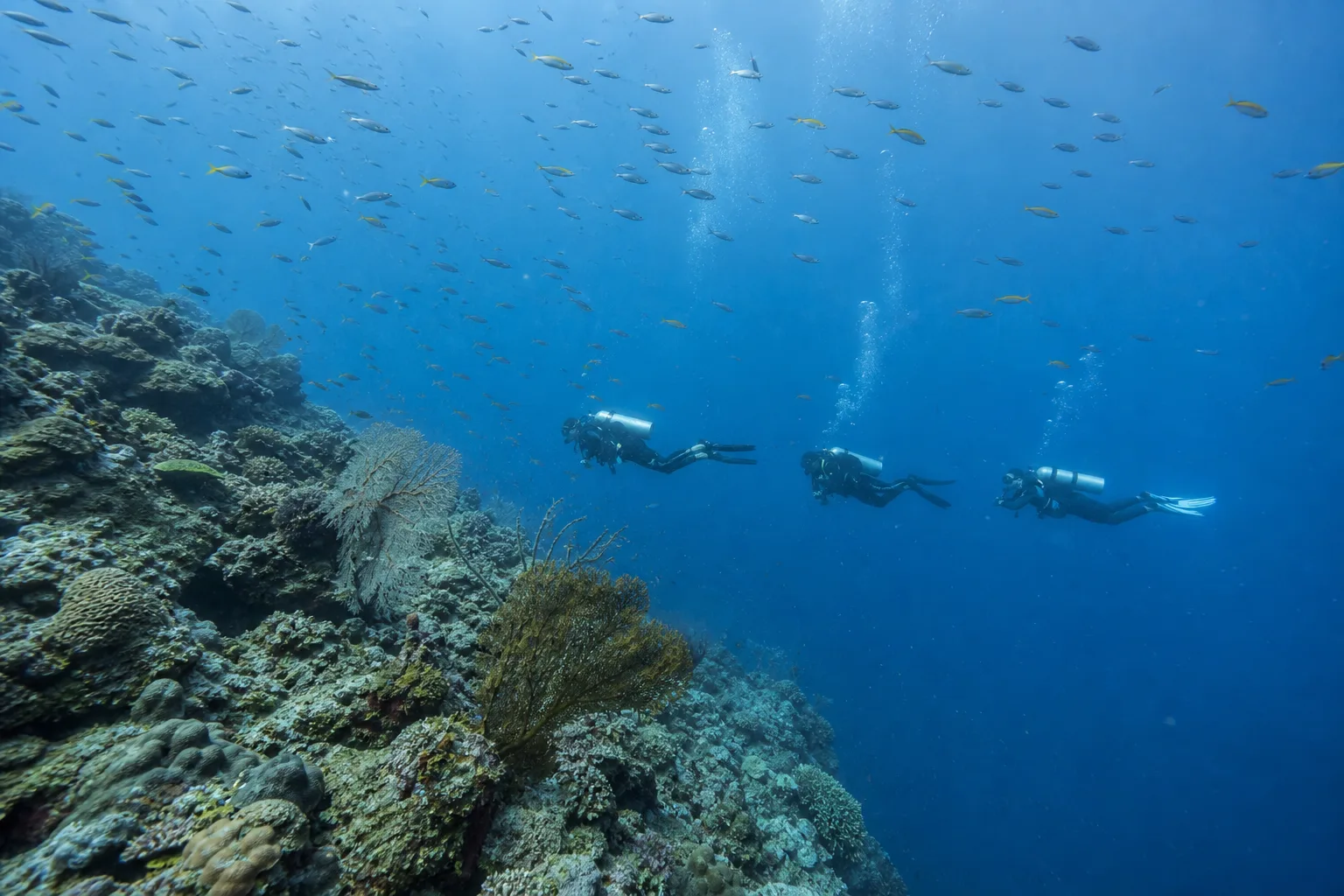
It is the question we field more than almost any other: I have just qualified, or I have twenty dives in a logbook, can I really do a liveaboard? The short answer is yes, and the longer answer is the reason this article runs to several thousand words. A liveaboard is simply a boat you sleep on so you can dive remote reefs that day boats cannot reach, and plenty of those reefs are gentle, shallow and forgiving. The trick is matching the boat, the itinerary and the timing to where you actually are as a diver, rather than where the brochure photos suggest you should be. We run liveaboard trips across Indonesia, and a meaningful share of the people on board each season are on their first or second multi-day dive trip. They tend to have a wonderful time. They also tend to ask the same handful of nervous questions beforehand, which is what we are going to work through here.
Indonesia is, in many ways, an ideal place to grow as a new diver, and in a few specific ways it can punish people who arrive underprepared. The same archipelago that holds the calm, bath-warm shallows of north Komodo also holds the ripping channels of the central straits, and a brochure rarely spells out which is which. Our guide to scuba diving in Indonesia covers the regions in the round; this piece is narrower and more honest. It is about what certification you genuinely need, how many dives operators actually want to see in your logbook, what you can and cannot learn on the boat itself, the skills worth sharpening before you fly, and which itineraries reward a beginner rather than rattle one.
Here is the short version. If you hold an entry-level certification (PADI Open Water, SSI Open Water Diver or the equivalent) and you are honest about your experience when you book, there is a liveaboard itinerary in Indonesia that will suit you. The work is in the matching. Get that right and a first liveaboard becomes the trip that turns a casual holiday diver into someone who plans the rest of their travelling life around the water.
The honest answer: yes, but the itinerary has to fit you
Let us deal with the fear first, because it is usually the same one. New divers picture a liveaboard as an elite environment full of people with four hundred logged dives and twin cylinders, and they assume they will be the weak link who holds everyone up or, worse, gets into trouble. In fifteen years of running these trips, that picture has almost never matched reality. A typical Indonesian liveaboard carries a spread of experience, from people on dive number fifteen to instructors on a busman's holiday, and a good operation is built precisely to absorb that range. Guides split groups by experience. Briefings assume nothing. The dive deck runs on a rhythm that gives nervous divers time.
What is true, and what the marketing tends to soften, is that "a liveaboard in Indonesia" is not one product. It is dozens. A 7-night round-trip out of Labuan Bajo that stays in the sheltered northern and central sites of Komodo is a genuinely beginner-appropriate trip. A 12-night Forgotten Islands crossing with open-ocean pinnacles, surge and long surface intervals between distant sites is not, no matter how confident you feel after your check dive. Both get sold as "Indonesia liveaboards". The skill, and the thing a decent operator should do for you at the booking stage, is steering you toward the first and away from the second until your logbook catches up.
So the honest answer has two halves. Yes, a beginner can do an Indonesian liveaboard, and many should, because there is no faster way to build real competence than three or four guided dives a day for a week on varied, well-briefed sites. And no, a beginner should not do just any Indonesian liveaboard, because the hardest itineraries in this country are genuinely demanding and the remoteness that makes them special also makes them unforgiving. The rest of this guide is about staying on the right side of that line.
What certification and how many dives you actually need
Start with the paperwork, because it is the part people overthink. The baseline for almost every Indonesian liveaboard is an entry-level open-water certification from any recognised agency: PADI Open Water Diver, SSI Open Water Diver, NAUI, CMAS, SDI, the card does not much matter as long as it is a genuine autonomous-diver qualification rather than a one-day resort "experience". That certification, in theory, qualifies you to dive to 18 metres with a buddy. In Indonesia, that single card opens a surprising number of doors, and it firmly closes a few others. The card is only half the paperwork, though. Every guest also completes a medical questionnaire, and if you tick anything on it you will need a doctor's clearance before you dive, so it is worth reading our guide to fitness to dive and the medical questionnaire well before you book flights.
The number that matters more than the card is the one operators rarely print but almost always ask: how many dives have you actually logged, and when was the last one? There is a world of difference between a diver who finished their Open Water course last month with nine logged dives and a diver with the same card but eighty dives over four years. Recency is the quiet variable here. A skill set decays when it is not used, and a diver who has not been wet in three years is, functionally, closer to a beginner than their logbook suggests, regardless of the certification level on the card.
As a rough working guide, and these are our numbers rather than any agency's rule, this is how we think about it:
- Open Water, fewer than 25 dives: very welcome on the gentler itineraries (north and central Komodo, Bali's calmer sites, the sheltered parts of the Dampier Strait), ideally with a refresher or a guided check dive on day one. Avoid the current-heavy and remote routes for now.
- Open Water or Advanced, 25 to 50 dives: comfortable on most mainstream Komodo and Raja Ampat itineraries, with guides managing site selection around the tides. This is the sweet spot where a liveaboard accelerates you fastest.
- Advanced with 50-plus dives and recent experience: the remote and current-driven routes (southern Komodo's big-animal sites, the Banda Sea, Triton Bay's outer pinnacles) come into range, assuming the recency is there.
Notice that Advanced Open Water keeps appearing. It is not strictly required for most beginner-friendly trips, but it earns its place for two practical reasons. It lifts your depth limit to 30 metres, which matters because some of Indonesia's best structure sits between 18 and 30 metres, and a hard 18-metre ceiling can leave you hovering above the action while your group descends. And the AOW course bundles short, guided experiences in the exact skills Indonesia demands: a deep dive, a navigation dive, and usually drift and buoyancy work. You can do that course at home before the trip, or, as we will see, on the boat itself.
Can you learn to dive on the liveaboard itself?
This one needs a careful answer, because the honest version is "technically sometimes, but usually you should not, and here is why". A full open-water certification involves confined-water skill sessions (mask clears, regulator recovery, controlled emergency ascents) that are taught in calm, shallow, controlled conditions, plus four open-water training dives. A liveaboard moving between remote reefs is, almost by definition, not a calm controlled classroom. The boat is on a schedule, the sites are chosen for their diving rather than their suitability for a first-ever descent, and the surface conditions can change between the morning and the afternoon.
There are boats that will run an Open Water course on board, and a handful of Indonesian itineraries built around a shallow, sheltered home base can do it well. But for most people, the better path is to arrive already certified. Do your Open Water course at home, in a pool and a local quarry or bay, where the pressure is off and you can repeat a skill without burning a dive slot the whole group is waiting on. Then arrive in Indonesia with the basics behind you and spend the trip diving rather than studying. If you are tight on time, a sensible middle road is the referral: complete the classroom and confined-water portions at home, then finish your four open-water training dives in the first days of a calm, beginner-appropriate trip, by prior arrangement with the operator. That only works on the right itinerary, so it has to be agreed before you book, never sprung on the crew at embarkation.
What a liveaboard does brilliantly is the opposite problem: taking someone who is already certified but rusty or tentative and making them genuinely competent. Three or four dives a day, the same buddy, the same guide reading your air and your trim, gentle sites early and more interesting ones as your confidence builds. That is a near-perfect learning environment, and it is why we are so relaxed about new divers joining the right trips. The growth over seven days is remarkable to watch.
The courses worth doing onboard
Once you are certified, a liveaboard becomes one of the best places in the world to add to your training, because the diving is already happening and an instructor is usually already on board. You are not carving out a separate course day; you are folding the training into dives you would be doing anyway. A few are worth singling out.
Advanced Open Water is the obvious one. Over five dives it raises your limit to 30 metres and walks you through deep, navigation, and a choice of "adventure" dives that, on an Indonesian boat, naturally include drift and buoyancy. Most operators can certify it across the first half of a week without you ever feeling like you are in school. If you do one course on your first liveaboard, make it this.
Enriched Air Nitrox deserves its own section below, because for a beginner doing repetitive daily diving it is arguably more valuable than any other single qualification. Peak Performance Buoyancy is short, unglamorous and quietly transformative; nothing improves a new diver's air consumption, photographs and reef-safety more than sorting out trim and weighting. Deep and Drift specialties make obvious sense in Indonesian water. And if you are heading somewhere with night diving, like the macro-rich muck sites, a guided Night specialty turns an intimidating idea into a highlight.
A short menu of what most of our trips can certify in-water, depending on the instructor on that departure:
- Advanced Open Water (5 dives) for the depth limit and the core skills.
- Enriched Air Nitrox (largely theory plus analysis practice) for longer, safer repetitive days.
- Peak Performance Buoyancy (2 dives) for the single biggest competence jump.
- Deep, Drift and Night specialties, which map directly onto how Indonesia actually dives.
Why Nitrox is the beginner's quiet advantage
People assume enriched air, breathing a blend with more oxygen and less nitrogen than the 21 per cent in normal air, is a technical-diving thing, the preserve of people in drysuits. On a liveaboard it is the opposite: it is the beginner's friend, and here is the plain-English reason. A liveaboard packs in repetitive diving, often four dives a day for a week. Every dive loads a little more nitrogen into your tissues, and your no-decompression limits shrink across the day as that load accumulates. Nitrox slows that accumulation, which means longer allowable bottom times on repeat dives, shorter surface intervals, and, the part beginners feel most, noticeably less of that wrung-out tiredness by dive three or four. If the underlying nitrogen arithmetic is new to you, our guide to decompression sickness on a liveaboard explains it from first principles.
That last point is not a marketing line. Plenty of divers, ourselves included on long trips, report feeling fresher in the evenings on enriched air. The certification is mostly a half-day of theory plus learning to analyse your own cylinder, and once you have it the gas is usually available on board for a modest per-tank or per-trip fee. For a beginner who tires quickly, sucks down air faster than the veterans, and wants to maximise the bottom time they do get, it is close to a no-brainer. Just remember the trade-off they teach you: enriched air lowers your maximum depth because of oxygen exposure, so on a 32 per cent blend you are typically capped around 30 metres anyway, which, conveniently, is exactly where a sensible new diver wants to be.
The four skills to sharpen before you fly
You do not need to be an expert before your first liveaboard. You do need four things to be roughly in order, because they are the difference between a relaxed week and a stressful one. None of them is exotic. All of them improve fast with a little focused attention in the weeks before you travel, ideally on a refresher dive or two at home.
Buoyancy and trim. This is the master skill, the one that quietly fixes everything else. A diver who hovers level and motionless uses less air, damages no coral, stays off the bottom in a current, and looks calm because they are calm. If you do one thing before a liveaboard, book a buoyancy-focused refresher and sort out your weighting. Most new divers are carrying two or three kilos more lead than they need, which forces them to add air to the jacket, which makes them bob, which makes them clumsy. Strip the excess and the whole picture settles.
Equalisation. Indonesia involves a lot of descents, often on a negative entry where you drop straight down to get out of surface current. If your ears are slow, you become the diver the group waits for halfway down the line, and that pressure makes equalising harder still. The fix is technique and practice, not brute force, and we have written about it in detail in our piece on how to descend without your ears hurting. Read it before you go, practise the gentle pre-pressurising it describes, and never push through pain. What actually goes wrong when an ear will not clear, and why forcing it is the worst of the available options, is explained in our guide to barotrauma in scuba diving.
Air consumption. New divers breathe through their gas quickly. That is normal, it is mostly nerves and over-finning, and it improves on its own as you relax. You can hurry it along by slowing down, breathing deliberately, and fixing your buoyancy so you are not constantly working. Do not be embarrassed about being first to the safety stop; a good guide plans for the highest air consumer in the group and nobody blinks.
Comfort with the descent line and the negative entry. A lot of Indonesian diving starts with a backroll and an immediate descent rather than a leisurely surface swim. It feels abrupt the first time. Tell your guide you are new to it, ask to go early in the group, and within a few dives it becomes second nature. Briefings here are detailed for a reason; listen to the entry plan and the lost-buddy procedure every single time, even when it feels repetitive.
The current question: why Indonesia is not the Maldives
Here is the thing the glossy photos never mention. The reason Indonesian reefs are so absurdly alive, the reason the soft coral is dense and the fish stack up in clouds, is current. Nutrient-rich water moving through channels and over pinnacles is what feeds the whole system. Current is the feature, not the bug. But for a new diver it is also the single most intimidating part of diving here, and pretending otherwise does nobody any favours.
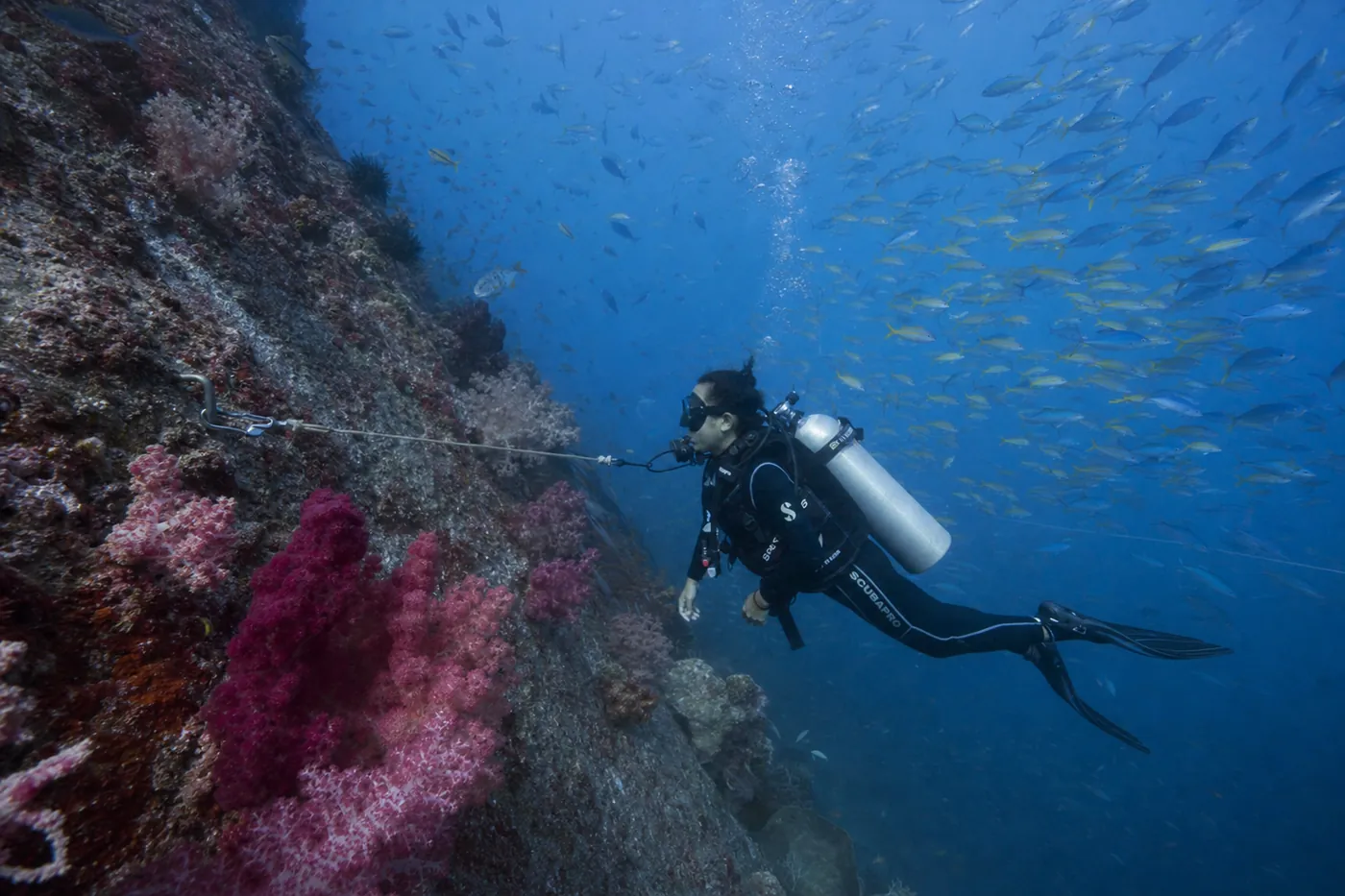
The good news is that current is manageable and, once you trust it, genuinely fun; drifting along a wall while the reef streams past is one of diving's great sensations. The skill is not fighting it. New divers instinctively try to swim against current and exhaust themselves in minutes. The technique is to go with it, use reef hooks where the guide suggests them, tuck into the lee of structure, and let the boat pick you up downstream. A reef hook, a simple stainless hook on a short line that you set into dead rock (never living coral) so you can hang in the flow hands-free, is worth buying and practising with.
What this means in practice for a beginner is timing and site selection, both of which are the guide's job to manage. Channels are dived on slack or gentle tides for newer groups. The screaming drift sites get scheduled for the experienced divers or skipped entirely. This is exactly why the itinerary match matters so much, and why honesty at booking pays off: a guide who knows you have twenty dives will build a completely different week than one who assumes you have two hundred. Our comparison of Raja Ampat versus Komodo goes into how the two flagship regions differ on exactly this point, because their currents have quite different characters.
The most beginner-friendly itineraries in Indonesia
So where should a newer diver actually go? Some regions are forgiving, others are emphatically not, and the difference is rarely about the diving being "better" so much as calmer, shallower and closer together.
Northern and central Komodo is our standard recommendation for a first liveaboard. The sites around the north of the park, the gentle slopes and bommies that sit out of the main tidal race, offer warm water, good visibility, easy profiles and a parade of reef life, with the option to build toward the more current-driven southern sites later in the week only if the group is ready. It is also logistically simple, a short hop from Labuan Bajo, which keeps the surface crossings tame. Our overview of scuba diving in Komodo and the wider Komodo destination guide lay out the sites in detail, and a fair number of them are squarely beginner territory.
Bali and its calmer fringes work well as a gentle introduction, and the sheltered house reefs and slopes around the island, including the famously easy Menjangan wall, suit a tentative diver finding their feet. The Bali destination guide covers the lay of the land.
The sheltered parts of the Dampier Strait in Raja Ampat can absolutely suit an intermediate beginner with a good guide, even though Raja Ampat as a whole has a more advanced reputation. The trick is that the region is huge and varied; plenty of its sites are gentle reef slopes, and a thoughtful operator builds a mixed itinerary that keeps a newer diver on the friendlier reefs. The Raja Ampat destination guide is the place to start, and our best dive sites in Raja Ampat rundown flags which are gentle and which are not.
And the ones to save for later, honestly: the Banda Sea and the Forgotten Islands, with their long open-ocean crossings and exposed pinnacles; southern Komodo's big-animal current sites; and the outer reaches of Triton Bay. These are extraordinary, and they will still be there when you have fifty or sixty dives behind you. Going too remote too soon is the most common way a beginner has a hard week, and it is entirely avoidable. The wider Indonesia liveaboard seasons guide helps you line up the calmest conditions for whichever region you choose.
Choosing a beginner-friendly boat
The boat matters as much as the region, and not in the way most people assume. A beginner does not need the most luxurious vessel; they need the one that runs its dive operation in a way that gives newer divers room. A few things separate a beginner-friendly boat from one that merely says it welcomes everyone.
Guide-to-diver ratio is the first. A boat that runs small guided groups, four to six divers per guide rather than eight or ten, can split by experience and give a nervous diver genuine attention. Ask the number directly. Group size overall matters too: a 16-guest boat with three guides will look after a beginner better than a 24-guest boat with the same three. Then there is the dive deck itself. Camera tables, a tender that takes you to the site so you are not doing long surface swims, attentive crew who help you kit up and do your buddy checks; none of this is glamorous, but it is what lowers the cognitive load on someone still finding diving effortful. Our own boats, King Neptune, Neptune One and Komodo Sea Dragon, are run this way deliberately, with nitrox and instructors on board so the courses above are available in-water.
One more thing to weigh: a boat with an instructor on staff, not just divemaster guides, means you can add the Advanced or Nitrox course mid-trip rather than wishing you had arranged it. If you think you might want to certify something onboard, confirm there is a teaching instructor on your specific departure before you book, because it varies by trip.
How a dive day builds up for a nervous beginner
It helps to know the shape of a day, because the unknown is half the anxiety. A good operator front-loads the gentle stuff. The first dive of the trip is almost always a relaxed check dive on an easy site: shallow, no current, a chance for the guide to watch your weighting and trim and for you to remember which hose is which. Nobody is judging. The guide is gathering the information they need to plan your week.
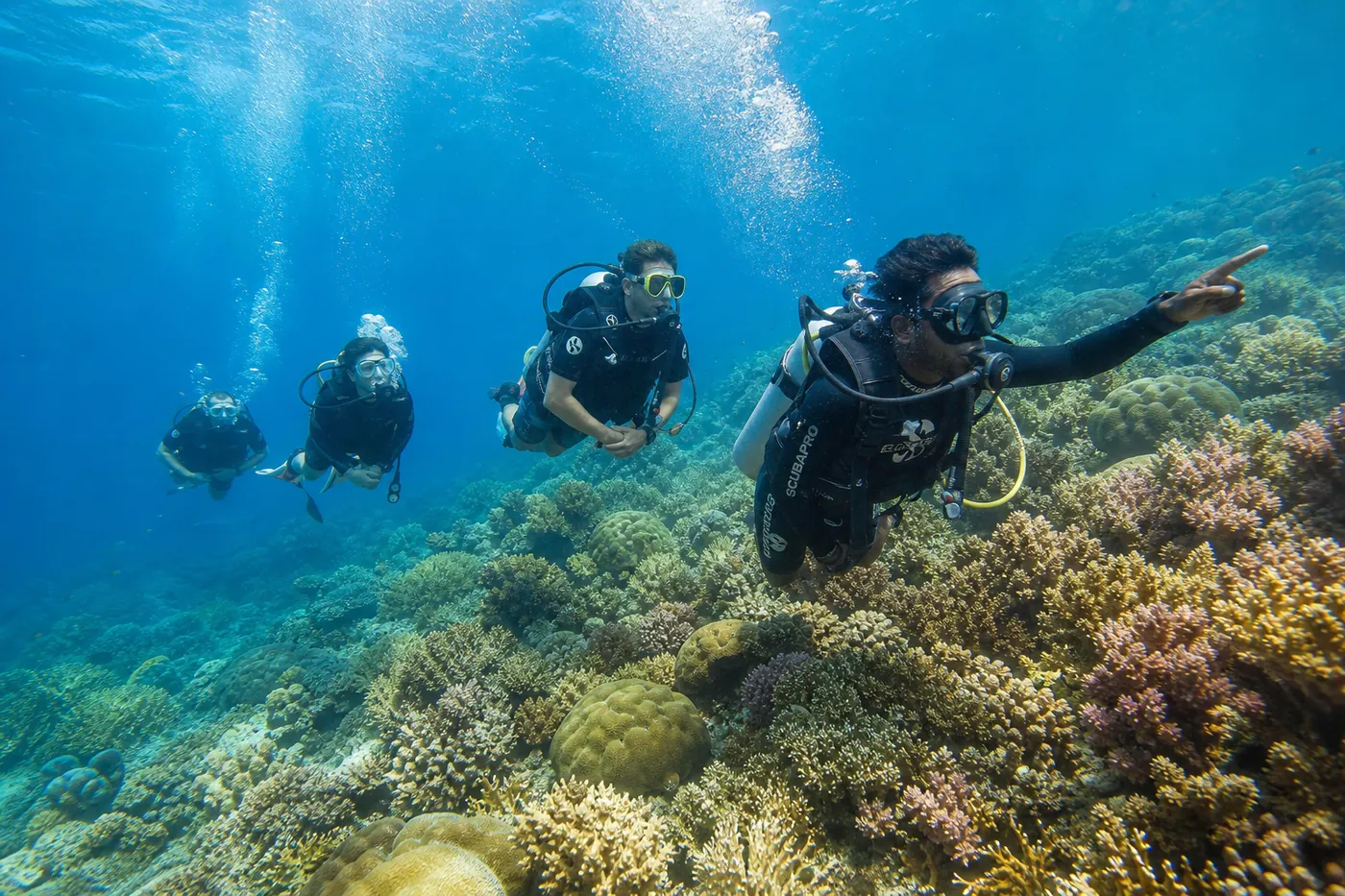
From there a typical day runs to three day dives plus an optional night dive, spaced by surface intervals with food and a nap. The crew calls the schedule around the tides, so the order of sites shifts to keep currents manageable. As a newer diver you will often be put in the first group down and the first up, which is not a demotion; it is the guide managing air and giving you the calmest water. By day three or four most beginners have visibly relaxed, their air lasts longer, and the guide starts offering slightly more ambitious sites. That progression, from tentative to capable inside a week, is the whole reason a liveaboard is such a good engine for new divers. If you want the broader picture of trip logistics beyond the diving, our first time on a liveaboard guide covers cabins, food and the daily routine, and the Indonesia liveaboard packing list covers what to bring.
Common beginner mistakes
Some errors recur often enough that we mention them on nearly every welcome briefing. None is fatal to a good trip, but each is easy to avoid once you know it.
Overstating your experience to seem like less of a hassle. This is the big one, and it is exactly backwards. Telling the operator you have forty dives when you have twelve does not make you a better guest; it puts you on sites and in groups that do not suit you, which is how a lovely week turns stressful. Guides build better trips for honest divers. Say where you actually are.
Over-weighting. We mentioned it above and it bears repeating, because it is the most common single fault we see. Carrying too much lead wrecks your buoyancy, your air and your enjoyment. Do a proper weight check on the first dive and trust the guide when they suggest dropping a kilo or two.
Skipping the refresher. If it has been more than six months or a year since your last dive, do a refresher before the trip rather than treating the check dive as one. The check dive is for fine-tuning, not for relearning skills you have forgotten, and a remote site is the wrong place to discover your mask clear has gone rusty.
Booking the most remote, dramatic itinerary first. The Banda Sea and the far-flung pinnacles are spectacular, and they will reward you far more after you have a season of diving behind you. Start gentle. There is no prize for going hard early, and the easy regions are extraordinary in their own right.
Treating the macro dives as filler. New divers often arrive fixated on big animals and underrate the slow, shallow critter dives. Those muck and reef sites are some of the easiest, calmest diving in Indonesia, perfect for building confidence, and they hold some of the strangest creatures on earth. Our guide to macro diving in Indonesia makes the case better than we can here.
What actually happens to nervous beginners
The pattern is consistent enough to describe with confidence. Newly qualified divers turn up at the dock visibly anxious, often with fewer than fifteen logged dives between two of them, and often having nearly cancelled because a forum thread convinced them Indonesia was too advanced for beginners. They go in the first group with the most patient guide, on a shallow slope with no current, and the first dive resolves most of the fear inside forty minutes. By midweek the white-knuckle grip on the descent line is gone. By the last day it is not unusual for the newest diver on the boat to be the one spotting the pygmy seahorse the guide swam straight past, hovering off the fan with better trim than people carrying ten times the logbook. None of that requires unusual talent. It requires the trip to be matched to the diver, the progression to be gentle, and nobody to be overfaced.
How to book and what to ask
If you are a newer diver weighing a first liveaboard, the booking conversation matters more than for any veteran. The right operator will ask about your experience before you have to volunteer it, and will steer you toward the trip that fits rather than the one with the highest price tag. Beyond the usual cabin and food questions, here is what is worth pinning down:
- Be honest about your exact number of logged dives and when you last dived, and ask whether this specific itinerary suits that level.
- Ask the guide-to-diver ratio and whether groups are split by experience.
- Confirm there is a teaching instructor on your departure if you want to add Advanced, Nitrox or Buoyancy onboard.
- Ask whether nitrox is available and what it costs, given how much it helps on repetitive days.
- Ask how the first check dive works and whether the early sites are chosen for newer divers.
- Ask what the plan is if conditions turn, so you know currents and remote sites will be managed around the group.
A good operator answers all of that without hesitation. To start that conversation you can get in touch with our reservations team, who genuinely would rather put you on the right trip than oversell you a hard one. For the wider decision about regions and timing, our Indonesia liveaboard diving guide works through the choices, and once you are ready to look at boats, the liveaboard fleet across Indonesia is the place to compare. The water is warmer, calmer and more forgiving than the forums would have you believe. Pick the right week, be honest about where you are, and a first liveaboard in Indonesia is about the best thing a new diver can do for their diving.