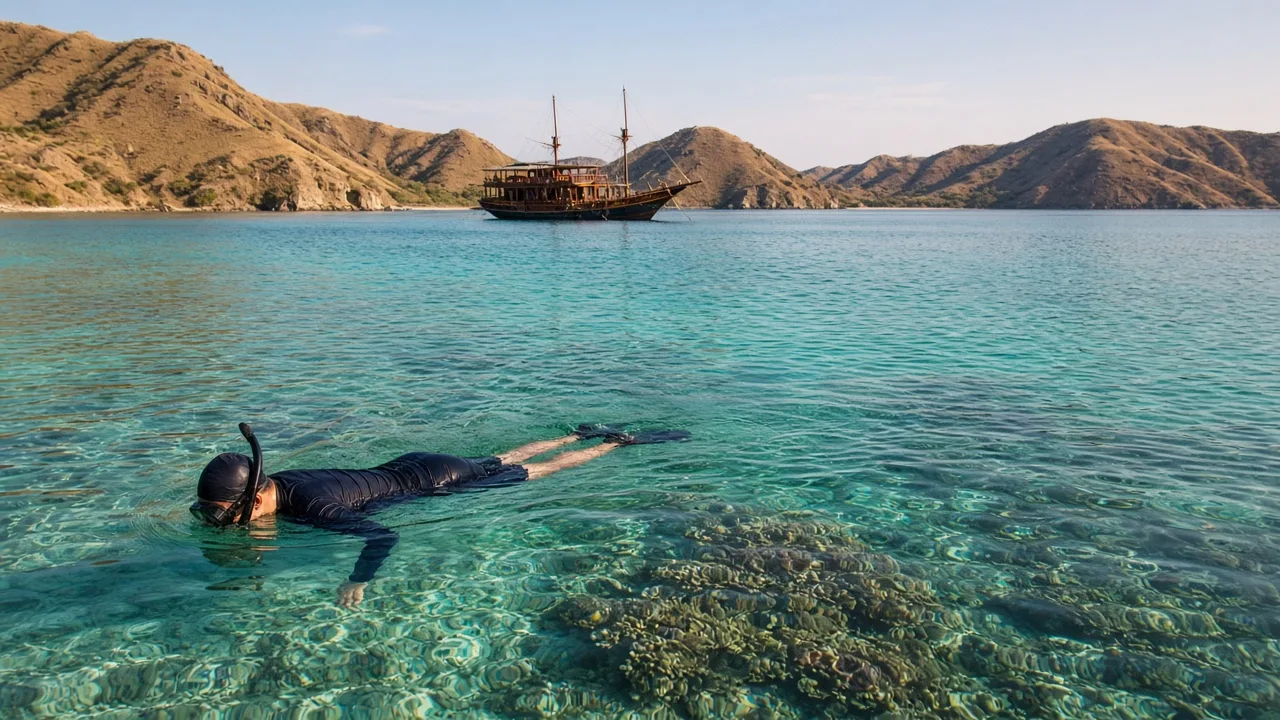
Somewhere between your certification card arriving and your first proper dive trip, you will start looking at gear. And you will immediately find that every guide on the internet gives you the same list in the same order, usually with an affiliate link attached. Some of that advice is sound. Quite a lot of it is written for a diver whose future looks nothing like yours, which matters if what you are actually planning is an Indonesia liveaboard rather than a season of weekends at a local quarry.
We watch several hundred divers a year unpack on our dive decks, and the pattern is consistent: the people who bought in the right order are comfortable from day one, and the people who bought a full kit before they knew what kind of diver they were are the ones paying excess baggage fees to carry equipment they could have rented. So this is the buying order we would actually give a friend who was getting into diving in Indonesia, including the parts where the honest answer is that you should not buy anything at all yet.
Why the standard buying order does not fit a travelling diver
The advice you will find almost everywhere runs like this: mask, snorkel, boots and fins first, then a dive computer after ten or fifteen dives, then a wetsuit, then a BCD and regulator once you have thirty or so dives behind you.
It is not bad advice. It is just advice written for a particular diver: someone who dives locally, in cool water, most weekends, and drives to the dive site. For that person the wetsuit really does belong near the top, because rental suits in cold water are miserable and they are diving every fortnight. And the weight of their kit is irrelevant, because it lives in the boot of a car.
What changes when your diving is travel
If your diving is going to be one or two warm-water trips a year, three things flip.
- Baggage becomes a hard constraint. Not an annoyance, a constraint. It is the thing that decides whether owning a BCD is an asset or a liability, and it is almost never mentioned in the standard advice because the standard advice assumes a car.
- The wetsuit drops a long way down the list. Water in Komodo and Raja Ampat sits around 27 to 29 degrees for most of the year. A rental 3 mm that fits approximately is genuinely fine. Compare that with a rental 7 mm in cold water, where an approximate fit is a ruined dive.
- Rental quality is much better than people expect. Reputable operators here maintain and replace their BCDs and regulators, because the gear is used daily and failures are visible. The rental kit on a good boat is usually newer than the equivalent kit in a club store.
Two things do not change. Your mask is still first, for exactly the reasons everyone says. And your dive computer is more important on a liveaboard than it is anywhere else, so if anything it moves up rather than down.
The two orders side by side
| Stage | Standard advice | For a travelling diver |
|---|---|---|
| 1 | Mask, snorkel, boots, fins | Mask (and a snorkel, which costs very little) |
| 2 | Dive computer | Dive computer, plus an SMB and spool |
| 3 | Wetsuit | Fins, once you know what you like |
| 4 | Fins | Exposure protection, if rental fit keeps disappointing you |
| 5 | BCD and regulator | BCD and regulator, and possibly never |
That last line is not a joke, and we will come back to it. Plenty of perfectly good divers who travel twice a year have never owned a BCD, and they are not missing out on anything except baggage charges.
Buy first: a mask that actually fits your face
Everyone agrees on this and everyone is right. It is also the cheapest meaningful upgrade you will ever make, which is a rare combination.
The reason is simple. A mask seals against the specific shape of your face, and rental masks are sized for a statistical average that does not exist. A mask that leaks does not just let water in. It occupies your attention for the whole dive, so you spend a fifty minute encounter with mantas clearing your mask instead of watching them, and your air consumption goes up because low-level irritation and shallow breathing travel together.
How to choose one, in about five minutes
Go to a shop, ignore the branding, and do the suction test on everything they have in your rough price bracket. Hold the mask to your face without the strap, breathe in gently through your nose, and let go. It should stay put on its own. If it slides, gaps at the temples, or sits on the bridge of your nose uncomfortably, it is the wrong mask no matter how good the reviews are.
Then a few specifics that genuinely matter:
- Low volume beats high volume. Less air inside means less effort to clear and a closer field of view. High-volume masks feel open and airy on land and are a nuisance in the water.
- Tempered glass, not plastic. This is a safety item and it is standard on anything sold as a diving mask. If the packaging does not say tempered, it is a snorkelling toy.
- Silicone skirt, and colour is a real decision. Clear skirts let in more light and feel less enclosed, which suits people who find masks claustrophobic. Black skirts cut glare and are what most underwater photographers use.
- If you wear glasses, sort it now. Most mainstream masks take prescription lenses for a modest cost, and it is transformative. Divers who cannot read their own computer are a surprisingly common sight.
Expect to pay somewhere around 60 to 150 US dollars in 2026, and note that the expensive end buys you a slightly nicer skirt and buckles rather than a better seal. Fit is not a function of price. Buy a spare mask strap at the same time, because straps perish and it is the one component that fails without warning.
The snorkel, briefly
Buy a simple one, spend very little, and clip it in your BCD pocket rather than mounting it on your mask strap where it catches current and drags your mask sideways. On a liveaboard you will use it more than you expect, because the surface intervals in Raja Ampat and Komodo are often over reef worth looking at, and there is usually a jetty or a bay to swim.
Buy second: a dive computer, and the safety item nobody mentions
This is where our advice diverges most sharply from the generic list, which tends to park the computer behind the wetsuit and the fins. On a liveaboard it belongs immediately after the mask, and there are three reasons.
The first is that you will be doing three or four dives a day for a week, which is a very different decompression picture from two dives on a Saturday. Your tissue loading builds across days, and the device tracking it should be one whose conservatism setting you chose and whose display you can read without thinking.
The second is continuity. A rental computer knows nothing about the dives you did yesterday on a different rental computer. Owning one means your profile history is continuous across the whole trip, and across your diving life.
The third is that on the boats where nitrox is available, and it is on ours, a computer that handles nitrox is what lets you use it. Our piece on whether nitrox is worth it goes into when that matters, but the short version is that on a repetitive-dive week it usually does.
What to look for, and what to ignore
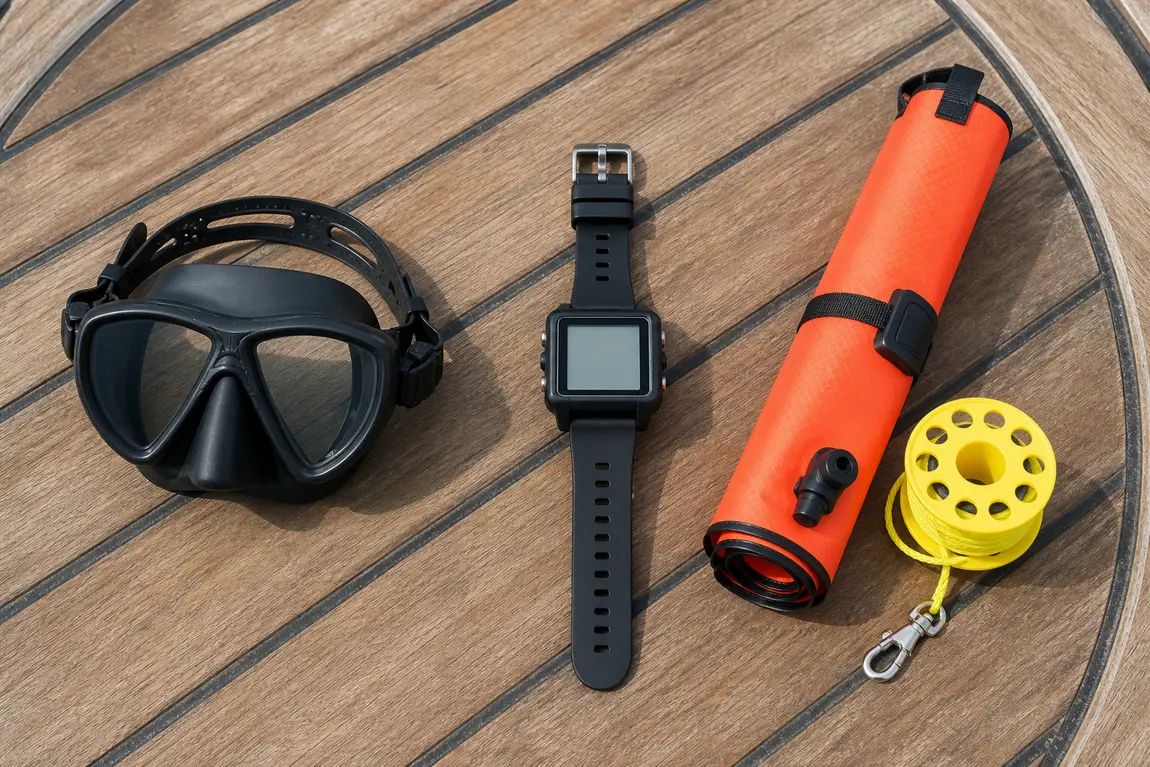
Entry-level wrist computers start around 200 to 400 dollars and are genuinely good now. What you want is a large readable display, nitrox capability, a sensible menu you can navigate without the manual, and a battery arrangement you understand, whether that is user-replaceable or rechargeable. What you can comfortably ignore at this stage is air integration, which is a pleasant luxury rather than a safety feature, and technical modes for diving you are not doing.
One genuinely useful habit: set it up and do a few dives with it at home before the trip. Arriving at the boat with a computer still in its box, and learning its alarm tones at thirty metres in current, is a preventable kind of stress.
The surface marker buoy, which is not optional here
Almost no beginner gear guide puts an SMB in the first purchases, and for the diving we run that is a mistake. Most Indonesian guides expect you to carry a buoy and a finger spool on any current dive in Komodo and on most Raja Ampat sites, because drift dives end with you surfacing away from the boat and a tall orange bag is how the tender finds you.
It costs very little, around 40 to 80 dollars for a decent bag and spool together, weighs almost nothing, and it is the piece of kit most likely to matter on a bad day. Practise deploying it at home until it is boring. Our guide to diving in currents covers where it fits in the wider skill set.
Buy later, or not at all: fins, exposure suits, BCDs and regulators
Here is where the baggage arithmetic starts making your decisions for you, so it is worth doing the sums before you do the shopping.
The Indonesian baggage problem, in numbers
Getting to a liveaboard here almost always involves a domestic flight, to Labuan Bajo for Komodo or Sorong for Raja Ampat, and the allowances on those flights are tighter than the international leg that got you to Jakarta or Bali. Garuda and Batik include checked baggage in economy, in the region of 20 kg with heavier allowances on some fares. Lion Air and Wings Air standard economy fares include cabin baggage only, with checked allowance sold as an add-on in tiers. Cabin allowance is officially 7 kg and enforcement varies from indifferent to scales-at-the-gate.
Now weigh a dive kit against that.
| Item | Rough weight | Rentable on a good boat? |
|---|---|---|
| Mask and snorkel | 0.5 kg | Yes, but fit is a lottery |
| Dive computer | 0.1 kg | Sometimes, and history is not yours |
| SMB and spool | 0.3 kg | Sometimes |
| Fins and boots | 2.5 to 3 kg | Yes, readily |
| 3 mm wetsuit | 1.5 to 2 kg | Yes, readily |
| BCD | 2.5 to 3.5 kg | Yes, readily |
| Regulator set | 2 to 2.5 kg | Yes, readily |
The first three items together come to under a kilogram. Everything below them comes to somewhere between 8 and 11 kg, plus the bag to carry it, on an allowance that might be 20 kg total for a week that also requires clothes. That is the whole argument in one table. The gear that most improves your diving is nearly weightless, and the gear that eats your allowance is the gear that rents well.
If you do end up flying with a full kit, book Garuda or Batik for boarding day with a generous checked allowance, and pre-purchase any Lion or Wings add-on at booking rather than at the airport counter, where the price roughly doubles. Our guide on getting to Labuan Bajo has the carrier-by-carrier detail.
Fins: buy them, but later than you think
Fins are worth owning eventually, because they affect how hard your legs work and, in current, that is not a small thing. But they are bulky, they rent perfectly well, and, more importantly, most new divers do not yet know what they want. Kicking style takes a while to settle, and a fin that suits a strong frog kick is not the fin that suits someone still finding their trim.
So dive a season in rentals, notice what you like and what leaves your calves burning, then buy. Open-heel fins with boots are the more versatile choice and the boots are useful on Indonesian jetties and rubble beaches. Full-foot fins are lighter to travel with and fine in warm water. Somewhere in the 60 to 240 dollar range covers everything most recreational divers need.
Exposure protection: only if rental fit keeps failing you
In water at 27 to 29 degrees, a rental 3 mm that is roughly your size does the job, and this is why the wetsuit sits much lower on our list than on a generic one. Buy your own when one of two things becomes true: rental suits consistently do not fit you, which is common for taller, shorter or otherwise non-average builds, or you get genuinely cold across a week of repetitive diving, which happens to more people than admit it.
South Komodo is the exception worth knowing about. It runs colder, dropping to around 22 degrees in the August season, and a 3 mm there is not enough for most people. If your itinerary goes south, that is an argument for a 5 mm or a hooded vest, rented or owned.
BCD and regulator: the ones to delay, possibly forever
These are the expensive items, the heavy items and the ones that need servicing, which is a genuine complication when you dive abroad and your local shop is the only place that knows your regulator.
They are also the items where rental quality is highest, because they are life-support equipment that reputable operators maintain on a schedule and replace when worn. If you are diving one or two trips a year, the honest calculation is that the rental fee across several years will cost less than the purchase, the servicing and the excess baggage combined, and you will not have carried anything.
The point at which owning starts to make sense is when you are diving often enough that familiarity compounds: the same setup every time, hoses where you expect them, weight pockets you can find blind. For most people that is somewhere past three or four trips a year, or when local diving becomes a regular part of life. If you get there, buy travel-weight versions rather than the heaviest option, because the choice you make in the shop is a choice you carry through every airport afterwards.
What it costs, and where to start depending on the diver you are
Buying in stages is not a compromise, it is the point. Each purchase teaches you something about what you want next, which is exactly what buying a complete package upfront prevents.
The stages, with realistic 2026 prices
| Stage | What | Rough cost | When |
|---|---|---|---|
| 1 | Mask, spare strap, simple snorkel | 90 to 200 USD | Before or during your course |
| 2 | Dive computer, SMB and spool | 250 to 500 USD | Before your first dive trip |
| 3 | Fins, boots | 90 to 300 USD | After a season in rentals |
| 4 | Exposure protection | 150 to 400 USD | Only when rental fit or warmth keeps failing |
| 5 | BCD and regulator | 800 to 1,500 USD | Past three or four trips a year, if ever |
Prices move and vary a lot by market, so treat these as the shape of the thing rather than quotes. For context, a complete new recreational kit bought all at once generally lands somewhere between about 1,700 dollars at the budget end and 3,000 or so mid-range, which is precisely the number that makes people hesitate. Stages one and two together, which is the part that genuinely changes your diving, come in under 700.
Three divers, three sensible answers
If you are newly certified with a trip booked. Buy the mask and the computer, add an SMB and spool, and rent everything else. That is under a kilogram in your bag and roughly 400 to 700 dollars, and it covers every part of the kit where ownership genuinely improves the dive. Turn up, use the boat's BCD and regulator, and spend the week finding out what kind of diver you are. Our guide for newer divers covers what else to expect on that first trip.
If you dive one or two warm-water trips a year. The same three items, plus fins and probably a wetsuit once you have been let down by rental sizing a couple of times. Resist the BCD and regulator. The maths does not work in your favour and you will feel it every time you check in.
If diving is becoming a serious part of your life. Build towards the full kit, but buy travel-weight and buy in the order above rather than as a package. Get your regulator serviced on a schedule you control and learn to do a proper pre-trip check on it, because a regulator you own is a regulator you are responsible for.
A few things worth knowing before you spend
- Try before you buy, especially masks and fins. Online prices are tempting and fit is not something a review can tell you. A shop that lets you get wet in something first is worth paying a little more to.
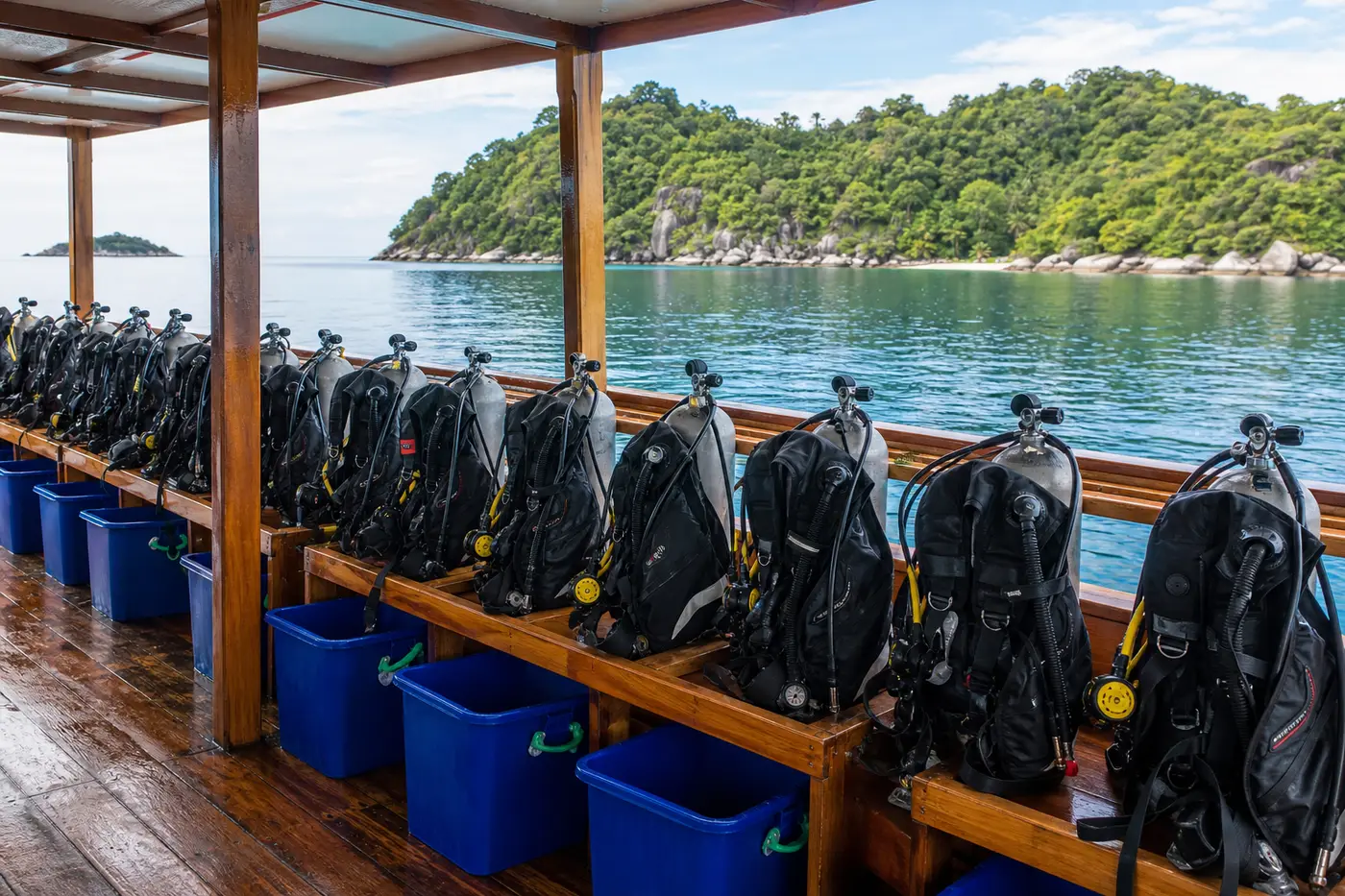
- Check what your boat already provides. On our itineraries, tanks, weights and reef hooks are on board, so there is no reason to buy or carry those. Ask any operator the same question before you shop, because the answer varies.
- Servicing is part of the cost. A regulator needs periodic attention, and that is an ongoing commitment rather than a one-off purchase. It is a genuine reason to delay buying one.
- Do not buy a full package because it is discounted. Package deals are priced to move BCDs and regulators, which are the two items you are least likely to need early.
- Insurance is not gear, but buy it anyway. Dive-specific cover with evacuation matters far more than any equipment purchase, particularly on remote itineraries where help is a long way off.
The short version
Buy a mask that seals on your face. Buy a dive computer you can read and a surface marker you can deploy. That is the part that changes your diving, it costs a few hundred dollars, and it weighs less than a kilogram. Everything after that can wait until you have enough dives behind you to know what you actually want, and some of it can wait forever. When you are ready to think about the trip itself rather than the shopping, our Indonesia liveaboard packing list picks up where this leaves off.