Every November the boats that spend October in the Banda Sea have to get back to Raja Ampat for the season there, and they dive the whole way. The route runs east from Ambon through the Banda Islands and Koon, puts in at Kaimana in West Papua, then turns north through Triton Bay, the Fakfak coast and Misool before finishing in Sorong. On our schedule it is two ten-night legs, sold separately, with a short turnaround in Kaimana between them.
If you have looked at a Banda Sea liveaboard and wondered what happens when the season ends, this is it. A repositioning trip sounds like an afterthought, but this one passes through four regions that normally need four separate trips and a lot of flights, and two of them, Koon and the Fakfak coast, see very few dive boats at all.
Everything below comes from our published schedule and fares, checked in November 2026. Where we describe the route, read it as the usual shape of the trip rather than a timetable: the captain and cruise director choose the sites day by day from wind, tide and what they find, and on a crossing this long that flexibility is the point.
What is a Banda Sea to Raja Ampat liveaboard?
A Banda Sea to Raja Ampat liveaboard is a one-way dive cruise from Ambon to Sorong, sailed after the Banda season, diving the regions between.
- Banda Islands and Manuk
- Koon's current-swept reef
- Triton Bay whale sharks
- Fakfak coast and Misool
It sits between a dedicated Banda Sea trip and a Raja Ampat round trip, and covers parts of both plus the rarely dived coast in between.
You will find it as:
- Two ten-night November legs on Neptune One
- The same two legs on King Neptune in 2028
- The route into the Raja Ampat liveaboard season
In short: it is how the boats get from the Banda Sea back to Raja Ampat, with diving all the way.
Via Triton Bay vs a direct Sorong to Ambon crossing: what is the difference?
Both trips join the Banda Sea and Raja Ampat. They run at opposite ends of the year, in opposite directions, and they are not the same trip turned around.
The November route, east and north
At the end of the Banda season the boats leave Ambon heading east, not north. The first leg works through the Banda Islands, Manuk and Koon and finishes in Kaimana, on the south coast of the Bird's Head of New Guinea. The second leg starts there, dives Triton Bay, follows the Fakfak coast, crosses to Misool and ends in Sorong. Twenty nights of sailing in total, split in two.
The March and April crossing, south
Going the other way, at the end of the Raja Ampat season, the boats sail more or less directly from Sorong to Ambon through Misool, in ten or eleven nights. King Neptune runs it on 25 March 2027 and 24 March 2028, and Neptune One on 12 April 2027. It is a single trip rather than two, it skips Triton Bay and the Fakfak coast, and it arrives in the Banda Sea before the main Banda season, which usually starts around September.
The practical difference is time and scope. The November route takes twice as long because it takes the long way round, and that detour is exactly where Triton Bay sits. If you want whale sharks at the fishing platforms and the soft coral walls of the Bird's Head as well as the Banda Sea, November is the only way to get them on one booking. If you want the shortest one-way trip between Raja Ampat and the Banda Sea, the spring crossing is the one.
One more variation is worth knowing about. In 2027, King Neptune does not take the Triton Bay route at all: it leaves Ambon for Ternate on 25 October, spends a week in Halmahera, and reaches Sorong from the north on 28 November. Both boats end up in Raja Ampat for December either way.
Leg one: Ambon to Kaimana
The first leg is the Banda Sea half of the trip. The order is set by the map; the time spent at each stop is not, and it moves with the wind more than anything else.
Ambon and the sail south
You board in Ambon, usually in the afternoon, and the boat sails overnight to the Banda Islands, a little over 200 kilometres to the southeast. Ambon Bay itself is known for muck diving, but on a crossing the first full day is normally spent in Banda rather than at the start.
The central Banda Islands
Banda is a small group of volcanic islands around a sheltered anchorage, with the cone of Gunung Api standing over the old spice port of Banda Neira. The diving here is the gentle end of the trip. Lava Flow, on the slope where Gunung Api's 1988 eruption reached the sea, is now covered in hard coral that regrew in a few decades, a standard case study in reef recovery; Hatta, Ai and Run have steep walls with clear water, big schools of fish and, on some days, dogtooth tuna and eagle rays off the points. There is usually time ashore for the Dutch forts and nutmeg plantations that made these islands the most valuable real estate in the world in the seventeenth century.
Manuk and the outlying reefs
Manuk is a smoking volcanic island well south of Banda, and its reefs hold one of the densest concentrations of banded sea kraits you will see anywhere, often dozens on a single dive. The kraits are venomous but uninterested in divers, and our guide to diving Manuk island explains how the dives run. Manuk and the outlying atolls, Lucipara among them, are also where schooling hammerheads are seen in the Banda season. By late October and November the odds are lower than in late September and early October, so treat a hammerhead as a bonus on this leg rather than the reason to book it. Which of these sites the boat reaches depends on sea state, because they sit in open water a long way from shelter. Our list of the best dive sites in the Banda Sea covers the rest of the region.
Koon
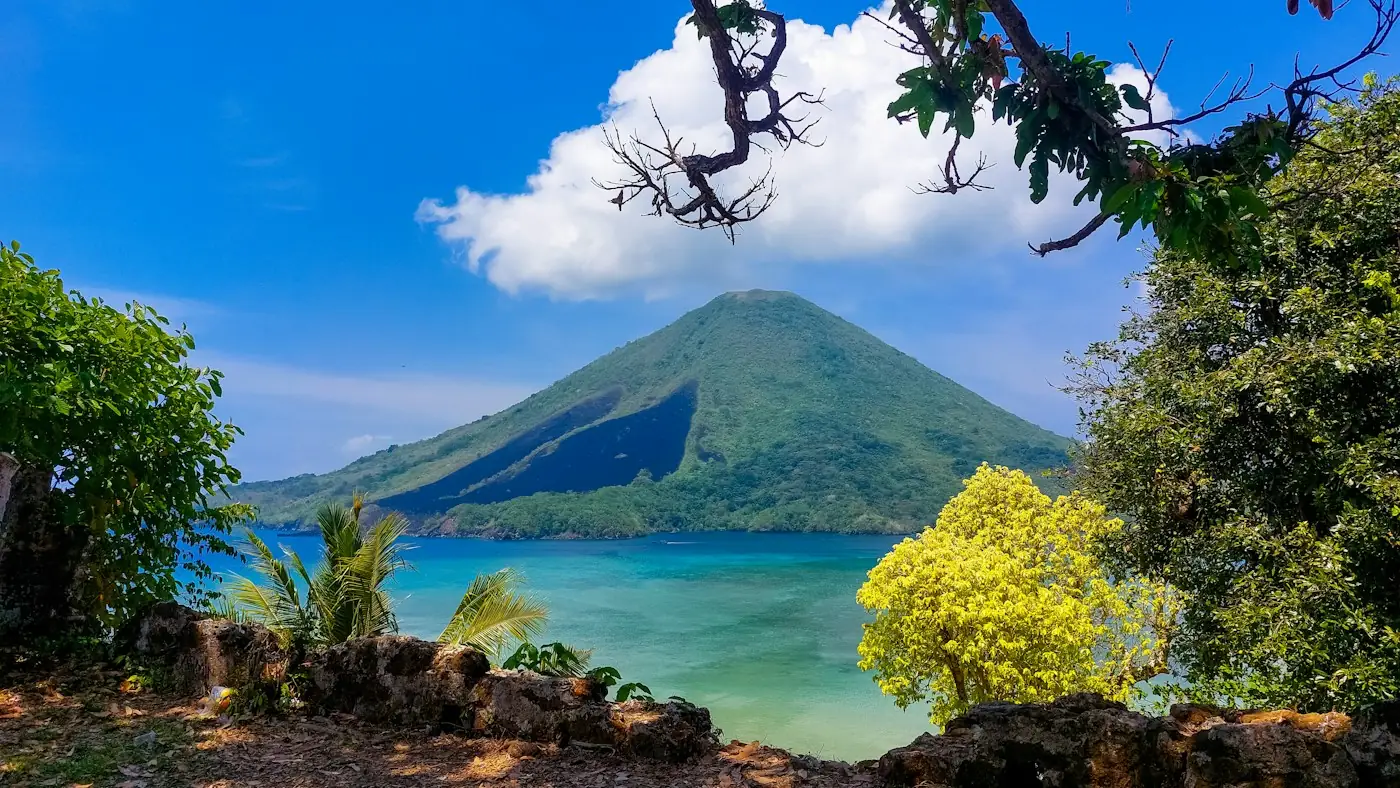
Koon is a small island off the southeastern tip of Seram, roughly on the way from Banda to New Guinea, and it is famous among crossing boats for one site, usually called Too Many Fish. The reef is shaped like an arrowhead, and when the tide runs, currents from both sides meet at the point and pile up fish: fusiliers, snapper, batfish, jacks, barracuda and the reef sharks and trevally that feed on them. On the wrong tide it is a hard dive, and on slack water the schools spread out and the magic fades, so the guides time it carefully. Expect a strong drift and a reef hook.
The sail to Kaimana
From Koon the boat heads east, roughly 270 kilometres, to Kaimana, a small town on the south coast of the Bird's Head peninsula of New Guinea. Most of that distance is covered at night. Leg one ends in Kaimana after ten nights; guests leaving here fly out from Kaimana airport (KNG), and guests continuing stay on board.
Leg two: Kaimana to Sorong
The second leg is the Papuan half, and the change from the first is immediate. The water is greener near the coast, the walls are covered in soft coral rather than hard, and the big open-water crossings of the Banda Sea give way to bays, channels and limestone islands.
Triton Bay
Triton Bay lies a few hours' sail southeast of Kaimana, inside the Kaimana Marine Protected Area, and it is the reason this route exists in the form it does. Three things draw people here. At the bagan fishing platforms around Namatota, whale sharks come in to feed on the fishermen's catch, most reliably between November and February, which is exactly when the boat arrives. Around Aiduma and Dramai, walls such as Larry's Heaven are covered in soft coral and sea fans, and colour is what the bay is best known for. And on the night dives the bay has an epaulette shark species found only in this part of New Guinea, the small "walking" sharks that move across the reef on their fins. Our Triton Bay diving guide covers the sites in detail, so we will not repeat them here.
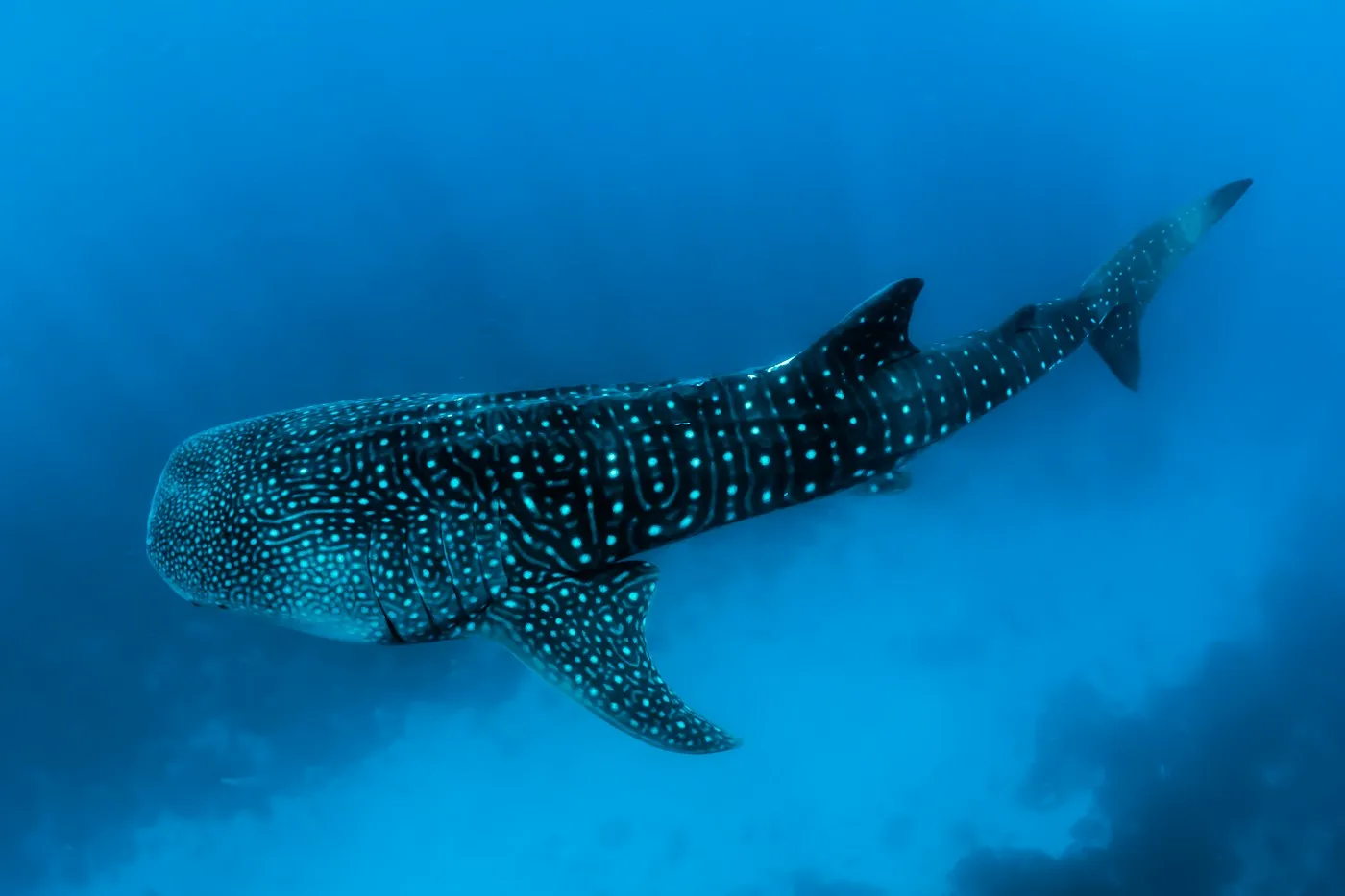
The whale shark encounter depends on the fishermen. The platforms belong to them, and whether sharks are around on a given morning depends on their night's catch. Most crossings plan more than one attempt to allow for that. If whale sharks are your main goal, our page on where to see whale sharks in Indonesia compares Triton Bay with Saleh Bay and Cenderawasih Bay.
The Fakfak coast
Between Triton Bay and Misool, the boat follows the Fakfak coast, the least-dived part of the whole route. This is limestone country: the Pisang Islands and Karas have reefs that few dive boats visit, and the coastline holds ancient rock paintings on the cliffs and Kiti-Kiti, a waterfall that drops straight into the sea. The diving is mixed, with sheltered coral reefs, offshore points with schooling fish and plenty of macro life, and how many days it gets depends on the weather and on how the Triton Bay days went.
Misool
From the Fakfak coast the boat crosses north to Misool, the southern end of Raja Ampat and, for many divers, the best of it. November is the very start of the Misool season, when the southeast trade winds have eased and the reefs are quiet. Expect the soft coral pinnacles of Boo and Fiabacet, the manta cleaning station at Magic Mountain and Daram's colour-saturated walls. Our Misool diving guide goes deeper.
Central Raja Ampat and Sorong
The last day or two usually take in central Raja Ampat, around the Dampier Strait, before the boat reaches Sorong. The strait has stronger current than Misool and some of Raja Ampat's best-known points, Cape Kri among them. The final dives fall the day before arrival, leaving the usual gap before flying.
How a Banda Sea to Raja Ampat crossing works
Day to day it runs like any liveaboard, with dives, meals and briefings, but there are more night sails and a few long passages where the boat covers ground instead of diving.
1. Boarding in Ambon
You are collected from Ambon's Pattimura airport or your hotel as part of the group transfer included in the fare. The first afternoon goes to cabins, the safety briefing and kit set-up, and the boat sails for Banda that night.
2. The Banda days
Banda and Manuk come first. The guides use the sheltered Banda sites to see how everyone dives before the open-water sites and Koon, which is the strongest current of the first leg.
3. Kaimana
Leg one ends in Kaimana. If you booked both legs, you stay on board through the turnaround of about two days while one group leaves and the next arrives; ask us what those days include when you book. If you booked one leg, this is where you fly out or fly in.
4. Triton Bay, Fakfak and Misool
Leg two opens with Triton Bay and the whale shark platforms, follows the Fakfak coast and crosses to Misool. Currents are gentler than in Banda and Koon at most sites, and the diving shifts towards soft coral, macro and photography.
5. Into Sorong
The final dives are in central Raja Ampat the day before arrival. The boat reaches Sorong in the morning, and the group transfer takes you to the airport or a hotel.
A worked example
Take Neptune One in 2027. Leg one leaves Ambon on 6 November and reaches Kaimana on 16 November, ten nights, from USD 5,000 per person in a Deluxe Suite or USD 5,500 in a Deluxe Sea View cabin; when we checked in November 2026 two Deluxe Suite places and four Sea View places were left, and the balcony cabins had sold out. Leg two leaves Kaimana on 18 November and reaches Sorong on 28 November, also ten nights, from USD 5,000; only the Deluxe Suites were still available. Booked back to back, that is 22 nights on board between Ambon and Sorong, from USD 10,000 per person before fees. The fare includes up to four guided dives a day, tanks and weights, all meals, soft drinks and the group transfers. Nitrox is extra on Neptune One, and the park, port and local fees along the route are confirmed when you book.
Why the crossing runs in November
The timing is set by three seasons that happen to line up. The Banda Sea's season runs roughly from September to early November, in the calm between the southeast trade winds and the northwest monsoon; after that the open-water sites become harder to reach and the boats move on. Triton Bay's diving window opens around October, and its whale sharks are most reliable from November to February. And Misool, the first part of Raja Ampat on the way north, opens around mid-November, once the trade winds that make the southern crossings rough have eased.
So a boat leaving Ambon in late October or early November catches the tail of the Banda season, arrives in Triton Bay as the whale shark months begin and reaches Misool just as it opens. That is why the route exists in this form, and why it runs only once a year.
November is still a transition month, and that has two consequences. The sea between Banda and Koon can be lumpy, with longer swells than in mid-October, so anyone prone to seasickness should bring what works for them. And rain showers become more frequent towards the end of the month on the Papuan coast, usually in short bursts rather than whole days.
Water temperature changes less than on most crossings. These are typical November ranges; any given week can differ, and thermoclines can drop a degree or two on the deeper Banda walls.
| Region | Typical water temperature | Main draw in November |
|---|---|---|
| Banda Islands and Manuk | About 27 to 29°C | Walls, sea kraits, a chance of hammerheads |
| Koon | About 28 to 29°C | Schooling fish in strong current |
| Triton Bay | About 27 to 30°C | Whale sharks, soft coral walls |
| Fakfak coast and Misool | About 28 to 30°C | Remote reefs, mantas, soft coral pinnacles |
A 3 mm full suit is enough for most divers. If you feel the cold after twenty nights of repeat diving, and many people do, bring a hooded vest as well.
Banda Sea to Raja Ampat departures and prices
Here is every departure on this route on our schedule, with the published fares per person in November 2026. On King Neptune the lowest fare belongs to the Sea View Single Cabin, built for one person, so we show the shared fare for two people as well.
| Departure | Leg | Nights | Fare per person |
|---|---|---|---|
| Neptune One, 6 November 2027 | Ambon to Kaimana | 10 | USD 5,000 to 5,500 |
| Neptune One, 18 November 2027 | Kaimana to Sorong | 10 | USD 5,000 |
| King Neptune, 25 October 2028 | Ambon to Kaimana | 10 | USD 7,000 shared, 4,900 single |
| Neptune One, 29 October 2028 | Ambon to Kaimana | 10 | USD 5,150 to 6,150 |
| King Neptune, 6 November 2028 | Kaimana to Sorong | 10 | USD 7,000 shared, 4,900 single |
| Neptune One, 10 November 2028 | Kaimana to Sorong | 10 | USD 5,150 to 6,150 |
King Neptune's November 2026 leg from Kaimana to Sorong is under way as we write, and its seven-night January 2027 trip on the same stretch is full. Ranges show the cheapest and dearest cabin still on sale; on the 2027 Neptune One legs, the more expensive cabins have already gone.
Per night, these legs cost no more than the trips at either end, and a little less than the short ones. Neptune One's 2027 legs work out at USD 500 a night, the same as its ten-night Raja Ampat trips that December and below the roughly USD 521 a night of its seven-night Banda Sea and Raja Ampat trips. In 2028 the pattern holds, about USD 515 a night against 537 for a seven-night trip. King Neptune's 2028 legs come to USD 700 a night for a shared main-deck cabin, against about USD 775 for its eight-night Banda Sea trips. You pay for more nights in total, but not more per night.
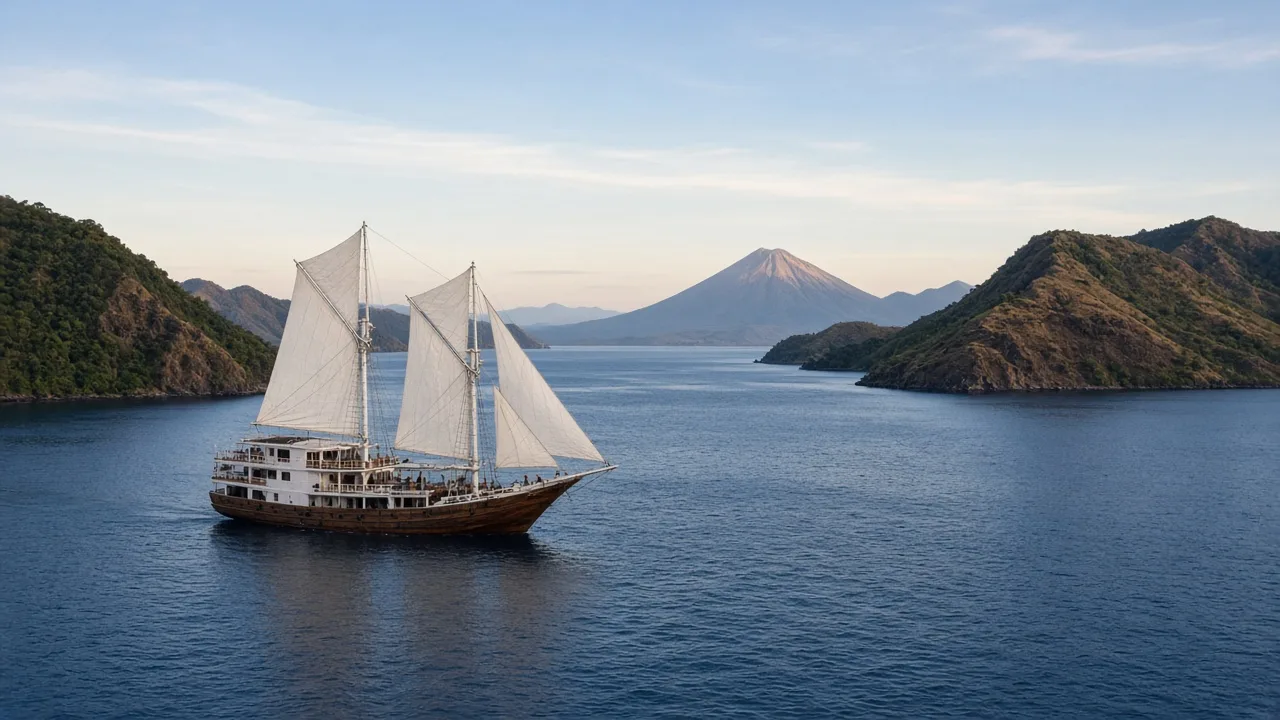
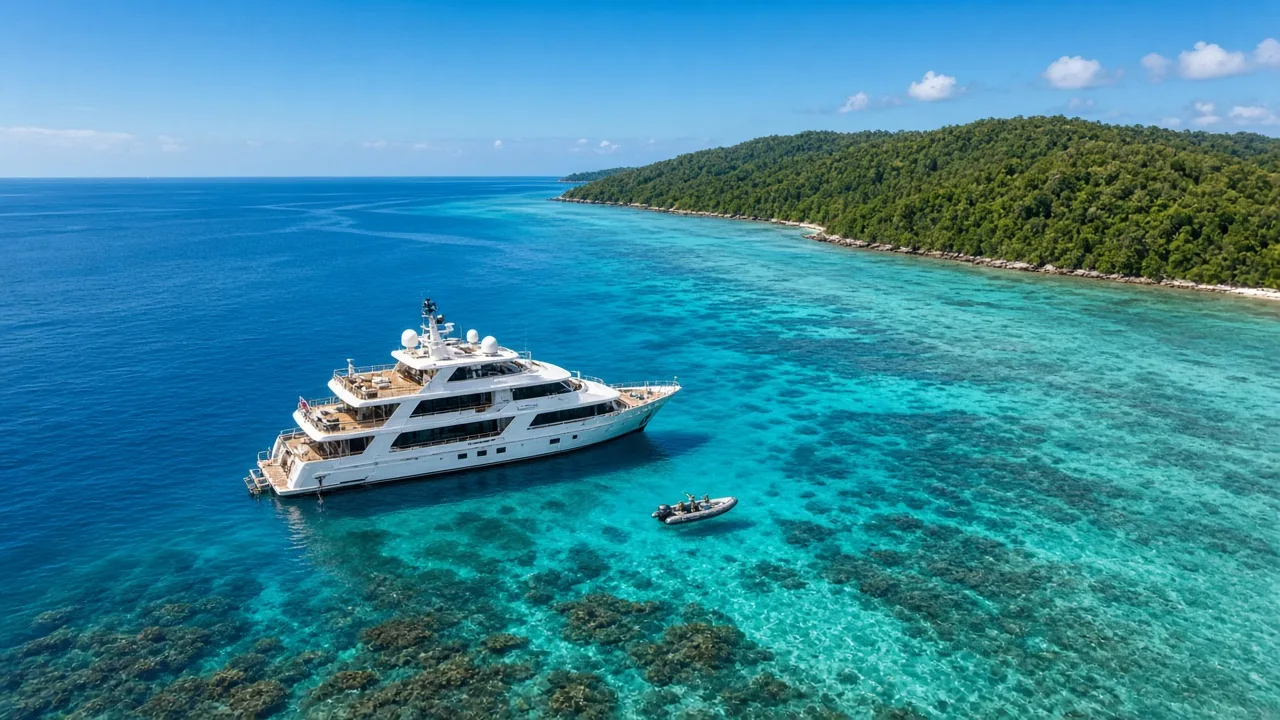
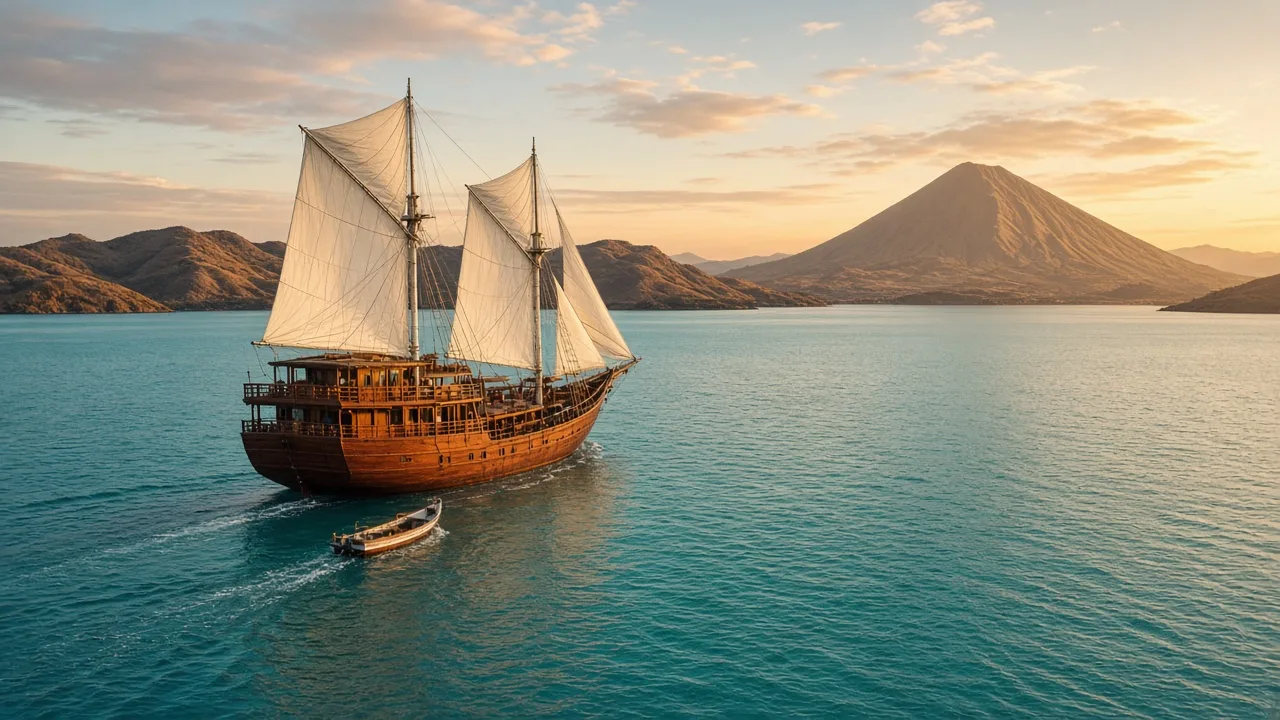
The difference between the boats is mostly size and inclusions. King Neptune is the newer boat, 46 metres long and launched in 2026, with ten cabins for 20 guests, a crew of 22 and nitrox refills included. Neptune One is a 39-metre phinisi with eight cabins for 16 guests, and nitrox costs extra. Both include up to four guided dives a day, meals, soft drinks and the group transfers.
Outside the fare on either boat: park, port and local fees in the Banda Sea, Triton Bay and Raja Ampat, charged at cost and confirmed when you book; a fuel surcharge on some departures; rental gear; alcohol; and crew tips. On Neptune One, add nitrox if you use it.
One leg or both?
Most people book one leg, and that is a perfectly good way to do it. Each is a complete trip with its own character, and Kaimana works as a start or end point even though it is small.
Leg one suits divers who want the Banda Sea with a little more than the usual Banda loop. You get Banda, Manuk and the outlying reefs, then Koon, which most Banda trips never reach, and you fly home from Kaimana. Leg two suits divers who want Raja Ampat with an unusual beginning: whale sharks and soft coral in Triton Bay, the empty Fakfak coast, then Misool in its first weeks of the season. Of the two, leg two has the gentler diving and is the easier choice if you are less sure of yourself in current.
Booking both gives you the whole route, 22 nights between Ambon and Sorong, and saves the flights in and out of Kaimana in the middle. You stay on board through the turnaround. It is a long time at sea, though, and it suits people who already know they like liveaboard life; three weeks of four dives a day is a different thing from one. If you are not sure, start with one leg and come back for the other a year later. Ask us about cabin availability on both legs at the same time, because on the 2027 Neptune One departures some cabin types have already sold out on one leg and not the other.
Kaimana itself is a quiet town with a small airport. The main connection is a Wings Air turboprop to Sorong of about an hour and twenty minutes, and onward from Sorong to Makassar, Jakarta or Manado. Connections to Ambon are less direct. Schedules change from season to season, so check them before you commit to a leg that starts or ends there, and plan a night in Sorong or Kaimana on the way.
What to check before you book a Banda Sea to Raja Ampat liveaboard
These are the questions we would put to any operator on this route, ourselves included. Several only matter on a one-way expedition.
1. Whether the route is one trip or two
Some operators sell Ambon to Sorong as a single trip; on our schedule it is two. Check what you are buying, and what happens in the middle if you book both.
2. How many days go to each region
Ask how the days are split between Banda, Koon, Triton Bay, the Fakfak coast and Misool. A route that spends four days in Triton Bay is a different trip from one that spends two.
3. The whale shark plan
The encounter depends on the bagan fishermen and their catch. Ask how many attempts the plan allows, and whether the boat has a working arrangement with the platforms.
4. The hammerhead question
Be wary of any November itinerary that sells hammerheads as a certainty. They are possible but less likely than earlier in the Banda season.
5. Current and your logbook
Koon and some Banda sites run strong current. We recommend Advanced Open Water or equivalent and recent drift experience, particularly for leg one.
6. The fees for the whole route
The route passes through several protected areas, each with its own charges. Ask for the total per person for your leg, or for both.
7. Your flights at Kaimana
If your leg starts or ends there, check the current Kaimana schedule before you book anything else, and leave a buffer day.
Who this crossing is for, and who it is not for
Both boats run the route, and the choice is mostly budget. The Neptune One liveaboard is the lower fare, from USD 5,000 a leg in 2027; the King Neptune liveaboard runs its legs in 2028, with more space, single cabins and nitrox included. Either way, the route suits:
- Divers who know the Banda Sea or Raja Ampat and want what lies between.
- Photographers after whale sharks, soft coral walls and Misool's colour on one trip.
- Divers with time who would rather sail than fly between regions.
- Anyone who likes remote sites and a quiet boat schedule.
It is not for everyone. If this would be your first liveaboard, a ten-night expedition through open water is a big first step, and a seven-night Raja Ampat or Komodo trip is a better way to find out whether you like the life. If you are uneasy in current, leg one in particular will push you. If you get badly seasick, the open-water passages around Banda and Koon in November are not the place to test remedies. And if you need to be reachable by phone, much of this route has no mobile signal at all; the Starlink connection on board handles messages, with limited data.
Getting to Ambon and home from Sorong
Ambon's Pattimura airport (AMQ) has direct flights from Jakarta and Makassar, and connections from Bali through either. Arrive at least a day early. On a one-way trip a missed boarding cannot be made up the next morning, because the boat is gone.
Sorong's Domine Eduard Osok airport (SOQ) is the gateway to Raja Ampat, with direct flights to Jakarta, Makassar and Manado. The boat arrives in the morning, and the airport is a short drive from the harbour. Our guide on how to get to Raja Ampat covers the Sorong flights in more detail, and it works just as well in reverse.
Leave a night in Jakarta, Makassar or Bali before any long-haul flight. Domestic schedules in eastern Indonesia change often, and the 18 to 24 hours that dive medicine guidance recommends before flying are easier to respect with a buffer. Make sure your insurance covers diving at the depths you plan and medical evacuation from a remote area, because most of this route is a long way from a recompression chamber.
Key takeaways
- A one-way dive cruise from Ambon to Sorong that follows the boats from the end of the Banda season to the start of Raja Ampat's.
- Two ten-night legs: Ambon to Kaimana via Banda, Manuk and Koon, then Kaimana to Sorong via Triton Bay, Fakfak and Misool.
- Neptune One sails both legs in November 2027 from USD 5,000 each; King Neptune sails them in 2028 from USD 7,000 shared.
- Triton Bay's whale sharks are most reliable from November to February; Banda's hammerheads are a bonus by then, not a promise.
- Book both legs and you stay on board in Kaimana, 22 nights in all; book one and you fly via Sorong.
- Fees along the route, nitrox on Neptune One and crew tips are extra, confirmed when you book.