Last updated: June 2026.
The most common question we get from prospective solo travellers is, in different words, the same question: "Will I be the only one?" The answer is no. On a typical seven-night liveaboard in Indonesia, between a quarter and a third of the divers booked are travelling solo. Some are veteran solo travellers who chose the format on purpose. Some are there because their partner does not dive. Some are there because the friend they were going to come with backed out at the last minute. Some are recently single, travelling alone for the first time, and quietly anxious about it. We see all of these on every trip.
This guide is the operator's-side answer to what it is actually like to do a liveaboard alone in Indonesia: what cabin sharing really means, who you end up diving with, how the social dynamics work, what the cost difference is, and what makes the format unusually friendly to solo travel compared with hotel-and-resort holidays. It also covers the specifics that people sometimes hesitate to ask: solo female travel in a Muslim-majority country, what to do about a dive buddy, what crew composition looks like, and the small set of mistakes solo travellers make that you can easily avoid. The format is well suited to going alone, but the format also rewards a few specific decisions made before you book.
If you read nothing else, the headline is this. A liveaboard is structurally one of the better solo holidays you can book, because the social problem (how to spend evenings, how to meet people, how to fill long days) is solved by the format. You wake up, dive, eat with a small group, dive, eat, dive, eat, and sleep. The boat is small enough that everyone knows each other's names by day two. The evenings are not a problem to solve. The trip is long enough for real friendships to form. And, if you do not feel like socialising on a particular night, you have your own cabin (or your bunk in a shared one) and nobody minds.
Why a liveaboard is structurally good for solo travel
Most holidays solve the lodging and transport problems and leave the social problem unsolved. You arrive at a hotel, the staff give you a key, and you are on your own to find dinner, find conversation, and fill a week of days you booked because you wanted a break. Solo travellers in resort settings often find themselves eating dinner alone for six nights and going to bed early. The diving is fine. The rest is lonely.
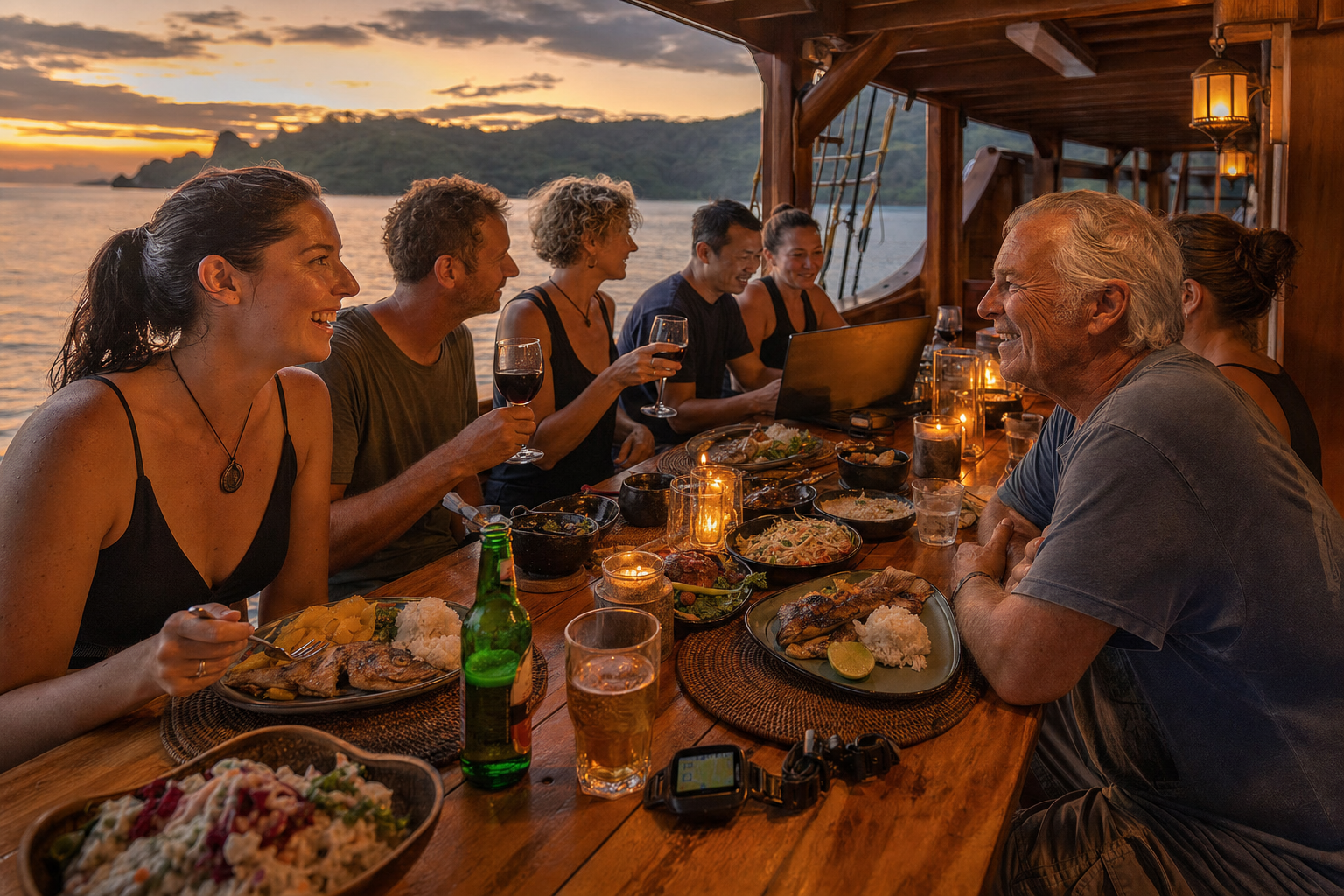
A liveaboard solves the social problem by accident, as a side effect of the operating model. There is one boat, twelve to twenty-four guests, and a fixed schedule. You eat at the same table as the same people three times a day for a week. You dive in the same group of four to six divers led by the same guide, on the same boat, into the same water, two to four times a day. You watch the sunrise from the same dive deck. You watch the sunset from the same upper deck. By dinner on day two, you know everyone's name, where they're from, what they do for a living, and what they came hoping to see.
The math of the social structure
It comes down to numbers. A typical seven-night Komodo trip on a small-group boat carries fourteen to sixteen guests. Of those, two to four are couples (so two to four units of two), and the rest are a mix of solo travellers, friend pairs, and small groups. That means there are typically eight to twelve individual people who sat down at dinner not knowing each other. By the end of the trip, they will have shared roughly twenty meals, completed roughly twenty dives together, and spent forty to fifty hours in shared social space. The result is a small intentional community for a week. Solo travellers are not the exception in this format; they are part of how the format works.
Why the diving is the social glue
Every meal opens with the same conversation: what did you see on the last dive. Every meal closes with what we are going to see on the next one. The diving generates a constant supply of shared experience to talk about, which is the single most reliable conversational lubricant in human history. You do not need to make small talk; you have been on the same dive an hour ago, you both saw the same wobbegong shark, and now you have something specific to compare notes about. Photographers compare images. Non-photographers compare what they saw with the naked eye that the photographers missed. The whole boat ends up paying attention to who saw what, and the social hierarchy organises itself around dive enthusiasm rather than around who is there as a couple and who is solo.
The downtime question
Liveaboards have generous downtime built in: you cannot dive after dinner, you usually cannot dive before sunrise, and the surface intervals between dives are forty-five to ninety minutes long. That downtime would be a problem in a hotel setting; on a boat, it is the social glue. People sit on the upper deck and read; people drift between conversations; people nap. Nobody needs to commit to socialising for the whole afternoon; you can wander up to the deck for thirty minutes, talk to whoever is there, and wander away when you want to. Solo travellers find this rhythm very comfortable, because there is always someone around to chat with, but there is no obligation to be on.
The cabin question, single supplement vs sharing
The most concrete decision a solo traveller makes when booking a liveaboard is what to do about the cabin. The boats are not designed around solo travellers; cabins typically sleep two. So you have two choices: pay a single supplement to keep the cabin alone, or share with a same-sex roommate the operator finds for you.
What single supplement actually means
A single supplement is the surcharge on the per-person trip price that lets you have the cabin to yourself. It is not arbitrary; it covers the room revenue the operator is foregoing by not selling the second bed. On a typical Indonesian liveaboard, the supplement runs between fifty and one hundred per cent of the single-occupancy price, depending on the boat and the season. On a low-season trip with empty cabins, the supplement is negotiable and sometimes waived. On a peak-season trip with a waitlist, it is rarely flexible.
If you absolutely want privacy, pay the supplement. If you are flexible, ask the operator whether they have a sole-occupancy waiver if no one books the second bed. Some operators (us included) will, on a per-trip basis, drop or reduce the supplement for solo travellers when the trip is not selling out, on the principle that we would rather have the cabin filled by a happy solo guest at a fair price than not at all. The way to get this offer is to ask, ideally three to four months out from the trip, before the trip starts filling.
Cabin sharing, what it actually looks like
Same-sex cabin sharing is the budget-friendly alternative, and it is more common in the Indonesian liveaboard market than in the European one. The operator pairs you with another solo traveller of the same gender, almost always a stranger to you. You are in a twin-bed cabin (two single beds, not one double), and you share the bathroom. The cabin is for sleeping and changing. Almost all the actual living happens on the boat's social decks.
The honest assessment of how cabin sharing works in practice: about three trips out of four, it is fine. People are tired from diving, the cabin is for sleeping, you say good morning and good night, and you spend the rest of the time apart on the boat. About one trip in four, the match is genuinely good and you make a friend. Once in a great while, you get a poor match (the most common complaints are loud snoring and very different sleep schedules), and the operator has limited ability to swap cabins on a full boat. If you sleep poorly when sharing rooms with strangers, pay the supplement. If you have a high tolerance for it, the savings are real.
How operators do the matching
It varies. Some operators (we are one of them) collect basic information from solo travellers booking shared cabins, sleep schedule, smoking, snoring (if known), age range, and try to match thoughtfully. Other operators do it on a first-come basis with no curation. Ask the operator before you book what their matching process is. If they cannot describe one beyond "we just put solo travellers together", you are taking a roll of the dice on the match. That can be fine, but you should know that's what you are doing.
Cabin types worth paying up for as a solo traveller
If you are paying the single supplement, the marginal cost of upgrading from the cheapest cabin tier to a better one is sometimes small. The cabin types worth thinking about, from cheapest to most expensive on most Indonesian liveaboards: lower-deck twin (the budget option), mid-deck en-suite double (the typical mid-tier), upper-deck cabin with a window (best light and ventilation), and master suite if available. As a solo traveller, the upgrade we would most often recommend is from lower-deck to en-suite mid-deck. The bathroom-down-the-corridor experience is fine when sharing with a partner; it is less fine when you are awake alone at three in the morning. King Neptune, Neptune One, and Komodo Sea Dragon all have multiple cabin tiers; the cabin map for each is on the boat page.
Solo female diving in Indonesia, the practical version
Indonesia is a Muslim-majority country, the most populous one in the world, and women travelling alone here sometimes arrive with concerns about whether the country is comfortable for solo female travel. The honest answer, based on running operations from Bali to Raja Ampat for years and watching thousands of female solo travellers come and go, is that Indonesia is one of the easier countries in Asia to travel solo as a woman, and a liveaboard is one of the easier ways to do it.
What religious context actually means in practice
The dive-tourism circuit in Indonesia runs through Bali (Hindu-majority), Komodo and Flores (Catholic-majority), Sulawesi's coastal cities (mixed), and Raja Ampat (mixed Christian and Muslim). The Muslim-majority parts of the country, particularly West Sumatra, Aceh, and Java, are the parts most international divers will not visit. The places you actually go on a dive trip, Bali airport, the dive-resort towns of Lembeh and Bunaken, the harbour at Labuan Bajo for Komodo, and Sorong for Raja Ampat, are tourism-economy towns with mixed religious composition and well-established norms around international visitors.
Practical implications. Dress in airports, hotels, and on the boat is whatever the local norm allows; in Bali and Labuan Bajo and Sorong, that means swimwear and casual clothes are completely standard. If you make a side trip to a more conservative region (a temple visit in Bali, a village walk on Komodo Island, a port stop in a Sulawesi town), shoulders and knees covered out of cultural respect is a small courtesy that goes a long way. Nobody will harass you for not doing it, but it costs nothing to do.
Solo female experience on board
On the boat, the dynamic is straightforward. You are in a small group of divers from around the world, mostly people in their thirties to fifties, mostly couples and friend groups but with a meaningful solo contingent. The crew are professional. There is no expectation about what you wear, when you go to bed, when you drink, or who you talk to. Female solo divers report (we ask after every trip) that the boat is one of the more relaxing social environments they have been in: nobody is hitting on them, nobody expects anything of them, and the diving and food do most of the work of filling the day.
If you have a specific preference around solo female-only or female-friendly trips, some operators run them, and you can ask. We have had trips that were three-quarters female solo travellers entirely by accident of who booked, and they were among the nicest trips we have run. We do not run gender-segregated trips as a policy, but we do match female solo travellers with female roommates as a default in cabin sharing, and we tell solo female travellers up front who the other women on the trip are if they ask. For the practical side of sharing a compact cabin and a marine head, our guide to periods, privacy and supplies on a liveaboard covers it without any coyness.
City-level safety for the bookend nights
Most liveaboard trips include a pre-trip night in a hub city (Bali, Manado, or Sorong are the typical ones) and sometimes a post-trip night. The cities are different.
Bali is the easiest. Hotel districts in Seminyak, Ubud, Sanur, and Canggu are very tourist-oriented, taxis and Grab/Gojek work fine, walking is normal day and night in busy areas. We would not recommend walking alone on dark side streets at three in the morning, but that is true everywhere on earth. A solo female traveller arriving for the first time to Bali is in the easiest entry-point for solo travel in Asia.
Manado (the gateway to Lembeh and Bunaken) is a calm, mid-sized regional city. The hotels around the harbour and the airport are perfectly safe; walking around at night is less common than in Bali but not unsafe. Use ride-share apps for evening movement.
Sorong (the gateway to Raja Ampat) is a working port city, smaller and less tourist-developed. The harbour-area hotels are safe, but Sorong is not a city for evening exploration; arrive, stay at the hotel, and leave for the boat. The same applies on the way back.
Labuan Bajo (the gateway to Komodo) has matured into a small dive-tourism town in the last decade. The waterfront has restaurants, bars, dive operators, and hotels in a ten-minute walk from each other; solo female travellers move around it without incident. Our Labuan Bajo arrival guide covers the airport, the harbour, and the typical pre-trip night.
What we do, specifically
For solo female travellers booking with us, the things we do without being asked: same-sex roommate matching by default; female crew member on every trip where the schedule permits; full briefing on what to expect day-by-day so you know what is happening; introduction to the other solo travellers on the boat at the welcome dinner if you want it. The things we will do if asked: arrange airport pickup with a known driver rather than a generic taxi, hold a cabin tier slot until a roommate match is confirmed, and walk you through the dive-buddy plan for the first dive so you know who you are with.
The dive buddy question
The other big concern for solo divers is the buddy system. You are certified to dive with a buddy. You are arriving alone. Who do you dive with, and how does that work in practice on a liveaboard?
Buddy assignment on a liveaboard
The operating model on every Indonesian liveaboard we know is guide-led group diving, not self-led buddy pair diving. You go down in a group of four to six divers, led by a dive guide whose job is to find the wildlife, manage the depth profile, and bring everyone back to the boat. The guide is your buddy in the technical sense; the rest of the group is your team. This is true whether you are travelling solo, as a couple, or with friends. The buddy-pair-by-yourselves model that is common on shore diving in cooler waters is not how Indonesian liveaboard diving operates.
What this means for solo travellers is that there is no "scrambling for a buddy at the dock" moment. You arrive, you are assigned to a guide, and that guide takes you through every dive of the trip. You may be in a group with two couples, with three solo travellers, with a mix of solo travellers and a friend pair, depending on who is on the boat. The composition is the operator's call, and good operators put thought into it.
Solo divers paired with another solo
The most common pairing is two solo divers in a group with the guide and one couple. You get a buddy in the technical sense (the other solo traveller); you also get the guide as the actual buddy of record. This is comfortable for most people, because you have someone to share the buddy check with and someone to compare notes with after the dive, but you are not relying on a stranger to navigate or rescue you; the guide is responsible for that.
The "I want to dive without a buddy" question
It comes up. Some solo travellers, particularly those certified as Self-Reliant Diver (SDI), or as Scientific Divers, or as Solo Divers, would prefer to dive alone in the water. The honest answer on a liveaboard is: you are part of a group regardless. The group is a safety net, not a constraint on your photography or your style; the guide will not hold you back from your subject; the rest of the group will not hover behind you. Many photographers we host are functionally diving alone in the water column even though they are technically in a group. If you want full solo (out of sight of a buddy or guide), a liveaboard is not the format. Resort-based shore diving with a personal guide is closer to what you want; many of the Lembeh resorts will run private guide trips for advanced photographers.
If you are newly certified
The opposite case is also worth covering. You are a newly certified Open Water diver, you booked a liveaboard alone, and you are quietly anxious about being the worst diver on the boat. The way the small-group dive guiding actually works on Indonesian liveaboards, this is a non-issue. The guide does the navigation, the guide watches the air consumption, the guide finds the macro for you, and the guide manages the depth profile. You are inside a structured experience whose entire purpose is to make the dives work for everyone in the group. Newly certified solo travellers do well on Indonesian liveaboards, with two caveats: choose a destination with calm conditions for your first trip (Komodo south sites can be current-heavy; the north Komodo sites are gentler), and ask the operator for the trip's diver-experience profile before booking. Our first-time liveaboard guide covers the preparation for first-time liveaboard divers in detail.
Choosing the right boat for solo travel
Not every liveaboard is equally well suited to a solo traveller. The variables that matter most are group size, cabin layout, itinerary length, and the social character the operator cultivates.
Group size, the single biggest variable
Indonesian liveaboards range from very small boats carrying eight guests to larger ones carrying twenty-four or more. The sweet spot for solo travel, in our experience, is twelve to sixteen guests. Too small (eight or fewer) and the social pool is thin; if the chemistry on the boat is off, you cannot escape it. Too large (twenty or more) and the social structure fragments into cliques; solo travellers can get lost in the larger group dynamics. Twelve to sixteen is the size at which the boat feels like a small community by day three but is large enough that there is always someone different to talk to.
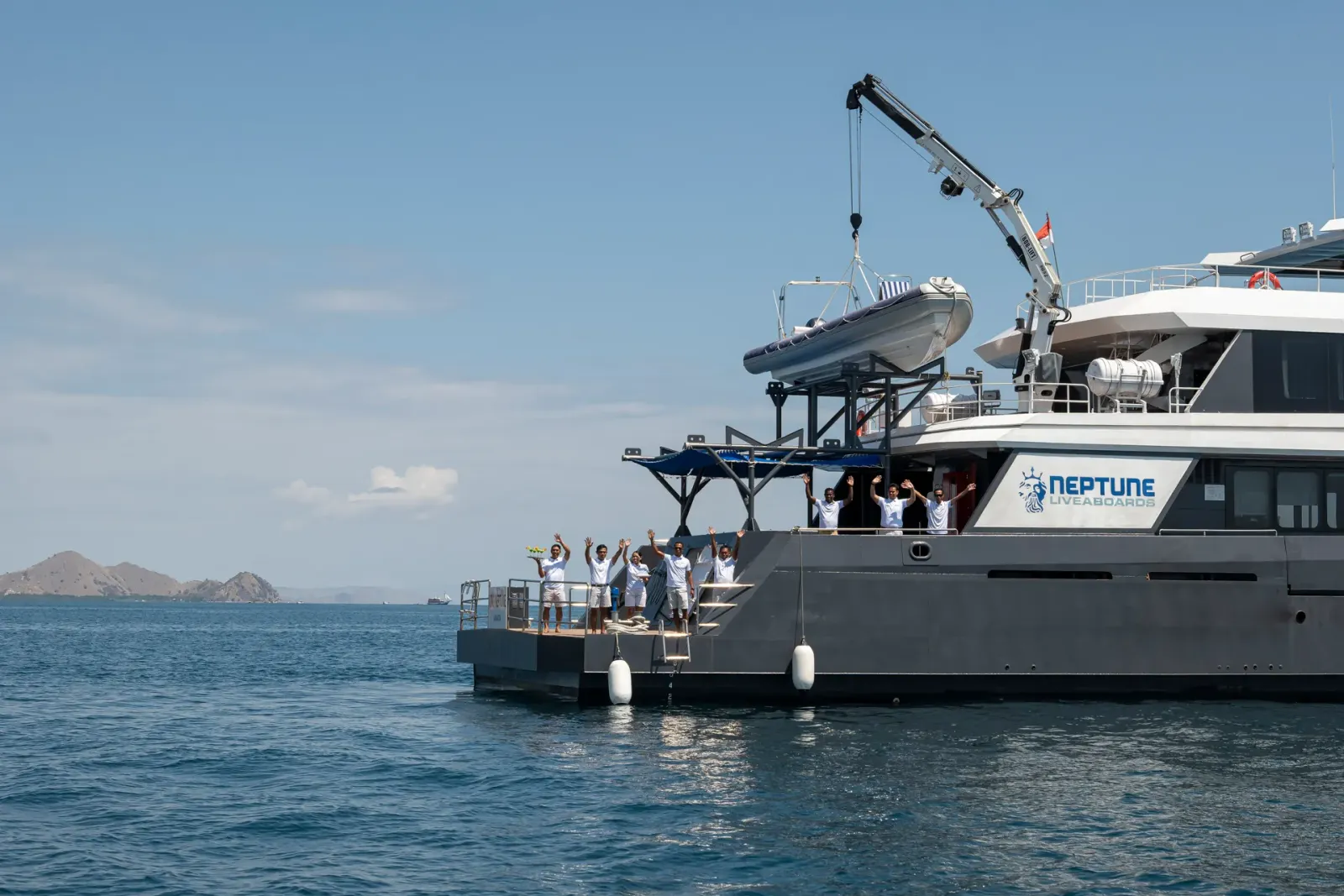
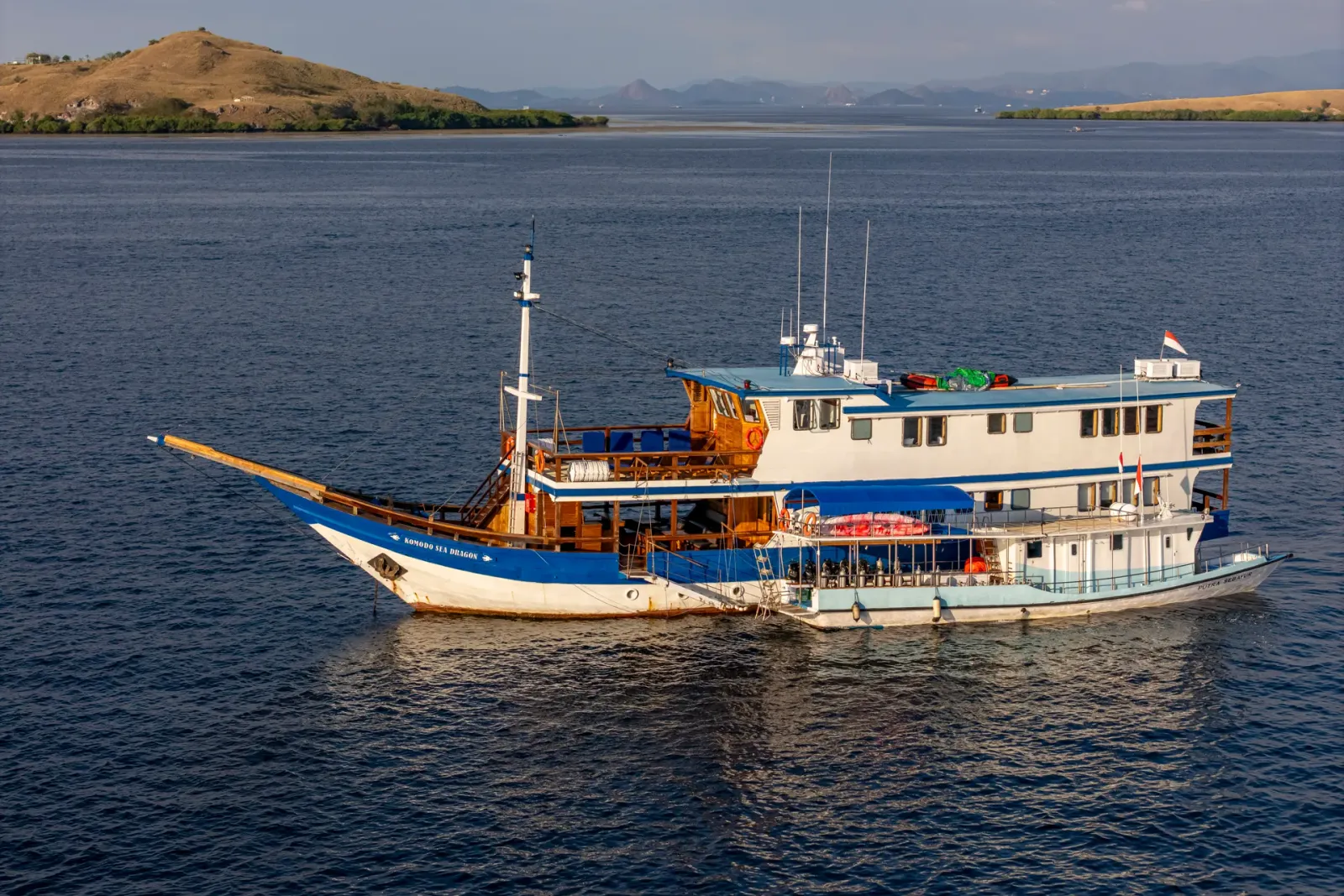
Our three boats are in the small-to-mid range. Komodo Sea Dragon takes up to fourteen guests on Komodo routes; Neptune One takes up to fourteen on Komodo and Raja Ampat itineraries; King Neptune carries up to sixteen on the longer expedition routes through Banda Sea, Forgotten Islands, and Triton Bay. All three are sized for the social dynamics we are describing.
Cabin layout and how it shapes solo experience
How the cabins are laid out matters more than people think. Some boats have all cabins on one deck, with shared social space stacked above. Others have cabins on two or three decks, with social space distributed throughout. The distributed-deck layout is friendlier to solo travel, because there are more places to wander between, more pockets of conversation, and more options for finding solitude when you want it. A single-deck cabin layout puts everyone in the same social space all the time, which is fine when the group is gelling and uncomfortable when it is not.
Itinerary length
Trips run from three nights (a Komodo short-hop) to fifteen-plus nights (Raja Ampat to Banda crossings). For solo travellers, the trade-off is real. Shorter trips are lower commitment but barely give the social structure time to form; you are starting to know everyone by the time the trip ends. Longer trips form deeper connections, but if the social fit is poor you are stuck. Our recommendation for first-time solo travellers is seven nights: long enough to bond, short enough to recover from if it does not click.
Boat character, photographer-heavy vs mixed
Photographer-heavy trips have a specific dynamic. Most divers on the trip are working photographers, the dive sites are chosen for photo subjects, the surface intervals run long because everyone is downloading and editing, and the dinner conversation is largely about photo equipment and technique. If you are a photographer, this is the best possible environment. If you are not, photographer-heavy trips can feel cliquey and technical and you may struggle to find conversation outside of camera talk.
Mixed-experience trips have couples on holiday, friend groups, solo travellers of varying skill levels, and a smaller photography contingent. The conversation at dinner is broader: travel, work, family, the day's sightings. If you are travelling solo and not heavily into photography, mixed-experience trips are the better fit. The way to figure out which a given trip will be is to ask the operator straightforwardly: is this trip running heavy on photographers, or is it a mixed-experience group?
Itinerary recommendations for solo travellers
Here is how we would steer different solo-traveller profiles. These are the trip types we run; the same logic applies if you are choosing among other operators.
First-time solo, the safe bet
Komodo, seven nights. Komodo is the easiest first liveaboard for a solo traveller. The diving is varied (mantas, sharks, macro, reef), the conditions are mostly approachable, the route is well-trodden, and the timing of the trip (Saturday-to-Saturday is most common) allows easy flight planning. Group sizes are usually mixed-experience. The pre-trip night in Labuan Bajo is comfortable, the dive variety is high enough that there is something for everyone in the social group, and the seven-night length gives the group time to bond. The best Komodo dive sites and the standard itinerary options cover what to expect on the route. We run Komodo trips on Komodo Sea Dragon and Neptune One; either is a good starting point.
Confident solo, the rich option
Raja Ampat, ten to twelve nights. If you have done one or two liveaboards already, or if you are an experienced diver coming to Indonesia for the first time, Raja Ampat is the next step. The trip is longer, the diving is more varied, the destinations are more remote, and the group bonds more deeply because of the length. The diving in Raja Ampat is the densest you will encounter anywhere in the world; the country's coral and fish biodiversity peak there. The dive sites and the liveaboard route cover the practicalities. Raja Ampat trips are best on Neptune One on a Sorong-Sorong loop. The longer length filters for serious divers, so the social dynamic is intentionally diver-focused; this is rarely a problem for solo travellers, who have time to form real connections over twelve nights.
Specialist solo, the adventure option
Banda Sea, Forgotten Islands, or Triton Bay on a longer expedition. These are the routes for solo travellers who have done two or three liveaboards already and are looking for something less crowded and more remote. The trips are longer (twelve to fifteen nights typical), the diving leans toward sharks, mantas, and pelagic action, and the routes spend long days at sea between dive sites. The social group on these trips skews older, more experienced, and more independent; people are there for the diving, not the social scene. Solo travellers fit naturally into this format because the format is itself solo-leaning, even for couples. The Banda Sea, the Forgotten Islands, and Cenderawasih Bay guides cover what to expect. We run these expedition routes on King Neptune.
The route NOT to book as a solo traveller
Honesty: a honeymoon-themed itinerary is the wrong booking for a solo traveller. Some operators run dedicated honeymoon trips, with the cabin configuration, dining setup, and excursion plan all geared toward couples. The boat character is romantic-quiet rather than social-warm, and a solo traveller in that environment feels conspicuously single. Our honeymoon-liveaboard guide describes the format; it is great for the audience it serves and not great for solo travellers. Stick to general-itinerary trips.
The format that actually does work as a "solo retreat"
If your reason for travelling solo is decompression rather than adventure, the longer Raja Ampat or Forgotten Islands itineraries work surprisingly well as solo retreats. Twelve to fifteen days at sea, no internet for most of it, no contact with anyone you know, three diving sessions a day, and the same fourteen people at dinner. Solo travellers come off these trips clearer-headed than they arrive. We have had divers tell us afterward that the trip did the work of a much longer holiday, because the structure was such that they could not check email, could not respond to messages, could not be anywhere except where they were. The format is a forced retreat; for some solo travellers, that is the whole point.
Practical logistics for solo divers
The logistics that look simple on a couple's trip are sometimes worth thinking through twice as a solo traveller. None of this is hard; it is mostly things that a partner would otherwise be quietly handling that you handle for yourself.
Flights and meeting points
Plan to arrive at the embarkation port at least one full day before the trip starts. This is not optional. Indonesia's domestic flight reliability is improving but still imperfect, and a missed connection on the day of embarkation means missing the boat. Arrive a day early, check into the pre-trip hotel, sleep, and meet the operator's transfer team in the morning. Our Labuan Bajo arrival guide covers Komodo embarkation; the broader cruise guide covers Sorong and Manado embarkation if you are heading to Raja Ampat or Lembeh.
Pre-trip and post-trip hotel nights
Solo travellers sometimes try to compress the trip by booking same-day arrival and same-day departure. This is a false economy. The pre-trip night gives you a chance to recover from the international flight, swap your duffel for what you actually need on the boat, and meet the operator's airport transfer at a reasonable hour. The post-trip night gives you a buffer in case the boat returns to port late (winds and tides do not always cooperate) and an evening to decompress on land before the long flights home. Pay for both nights; they are inexpensive relative to the trip cost and they prevent the kind of compressed-itinerary stress that solo travellers feel more acutely than couples.
Dive insurance, do not skip this
The honest framing of dive insurance for solo travellers: a dive emergency in remote Indonesia handled without insurance is a financially catastrophic experience, and a dive emergency in remote Indonesia handled with insurance is an inconvenience. The economics are clear. The two main providers for international divers are DAN (Divers Alert Network, US, Europe, and Asia-Pacific affiliate organisations) and World Nomads (general travel insurance with dive coverage as an add-on). Either is fine for most cases.
The annual DAN membership-plus-coverage package is roughly seventy to one hundred and fifty US dollars depending on the tier, and it covers the chamber, the evacuation, and the medical care after. World Nomads' diver-add-on is similar in price and broader in scope (it covers non-dive travel disruptions too). For a solo traveller, the case is even stronger than for a couple, because you do not have a partner on land to coordinate from your bedside if something goes wrong; the insurance company's case-management line is your proxy. Buy it before you fly. Carry the policy number on a card in your wallet and on a note in your phone, and tell the boat's dive guide on day one.
Travel insurance separately
Travel insurance and dive insurance are different products. Dive insurance covers diving-related medical events. Travel insurance covers cancelled flights, lost luggage, illness unrelated to diving, and trip cancellation. Solo travellers are slightly more exposed to flight-disruption costs (no second person to share a recovery hotel room with) and slightly more exposed to luggage delays (no spare gear in a partner's bag). The annual policy is inexpensive; buy it before each trip.
Visa, vaccinations, prescriptions
Most international visitors to Indonesia get a thirty-day visa on arrival or e-visa, which is fine for a typical seven-to-fourteen-night liveaboard trip. Long-trip travellers (above thirty days, including pre-trip and post-trip days) need a sixty-day extension, which is easy in Bali and somewhat slower elsewhere. Confirm the current rules with the Indonesian embassy or consulate in your country; they change occasionally.
Vaccinations: standard travel vaccinations (hepatitis A, hepatitis B, typhoid for some itineraries, tetanus current). Yellow fever is required only if you are arriving from a yellow-fever country. Malaria is present in remote eastern Indonesia (Raja Ampat, Triton Bay, parts of West Papua); ask your travel doctor about prophylaxis if you are heading to those regions. Most divers on Komodo and Bali skip prophylaxis; most divers on the eastern routes take it.
Prescriptions: bring more than you need. The pharmacy network in Bali is good; in Sorong and Labuan Bajo it is patchy. If you take a daily medication, bring a week of buffer beyond your trip length and keep it in your carry-on, not your checked bag. Solo travellers without a partner to handle a pharmacy run on their behalf should not be relying on getting a refill on a remote island.
Telling the crew about medical conditions
This is the small thing solo travellers most often skip and the operator most wishes they would not. If you have a medical condition (diabetes, heart issue, asthma, recent surgery, anything), tell the dive guide on day one. Not because we want to know your medical history; because if something goes wrong on a dive, the response speed is meaningfully different if we know the context. We have a confidential medical declaration form on every trip; fill it in honestly. The information stays with the dive team and goes nowhere else, and it is the best small investment you can make in your own safety.
What it is actually like, the social rhythm
Some context that the booking page does not tell you. The actual social arc of a typical solo traveller's week.
Day one, the welcome dinner
You arrive at the boat in the afternoon, sometimes with the rest of the group, sometimes on your own depending on flight timing. The crew show you to your cabin. You meet your roommate if you are sharing. You sit on the upper deck for an hour while the boat finishes loading. The welcome dinner is at sunset on the first evening, and it is the moment of social arrival. The captain welcomes the group, the dive guide goes through the safety brief, the crew is introduced. Solo travellers, in our observation, often sit quietly during this dinner, scanning the group, deciding who they will gravitate toward. That is normal. Nobody expects you to be the life of the party on day one.
Days two and three, the friendships form
Days two and three are when the social structure crystallises. You discover who you click with, who you do not, and where you are going to spend your meals. By dinner on day three, you have made one or two friends. The introvert solo travellers gravitate to specific people (the photographer they share a viewing angle with, the early-morning coffee group on the upper deck). The extrovert solo travellers know everyone's name. Both work; the boat is small enough that you do not have to choose.
Days four to six, the rhythm
The middle of the trip is where the format works hardest for solo travellers. You have your morning routine. You have your dive group. You have your dinner conversation. You have the after-dinner small talk on the deck. The trip ceases to feel like an event and starts to feel like a temporary life. Solo travellers, more than couples, report that this is the part of the trip they remember most fondly afterward; the absence of a relationship to manage means the friendships with the crew and the other guests feel more textured.
The last night, the exchange of details
The last dinner is a particular thing on liveaboards. The group has been together long enough that goodbyes are real; phone numbers and Instagram handles are exchanged; people promise to dive together again. Many do. We have had solo travellers meet on a Komodo trip in 2024 and book a Raja Ampat trip together as friends in 2026. The format produces this result remarkably reliably.
Returning home alone
The reverse-culture-shock moment hits the day after you fly home. You go from a week of structured social rhythm with seventeen other people to your kitchen at three in the morning with jet lag, and the contrast is sharp. Solo travellers feel this more acutely than couples. The mitigation is a quiet day-after, not booking work meetings the morning after you fly home, and giving yourself permission to feel the come-down for a day or two. Many solo travellers we know book their next trip in the come-down week, while the experience is fresh; that is a fine impulse and we do not discourage it.
Common solo-traveller mistakes
The pattern of errors we see in solo bookings, in rough order of frequency.
Booking the wrong group size for your personality. Introvert solo travellers sometimes book large boats and find the social dynamic exhausting. Extrovert solo travellers sometimes book very small boats and feel cooped up. Match the boat size to your social tolerance. If unsure, twelve to sixteen is the safe middle.
Skipping the single supplement when you should pay it. The single supplement is a real cost, but for some solo travellers (light sleepers, those with strong morning routines, those decompressing from a tough year) it is worth every dollar. Do not chase the savings if the savings will cost you sleep for seven nights.
Compressing the itinerary. Same-day arrival, same-day departure, no buffer. This is the mistake we see most often, and it is the one that hurts most when something goes wrong with a flight. Add the night before and the night after. Our packing list includes the soft-bag-and-day-bag setup that works well for the buffer-night setup.
Underestimating sea sickness alone. Solo travellers are more affected by mild sea sickness than couples, because there is no partner to fetch water, ginger tablets, or a pillow. Bring sea-sickness medication (cinnarizine or scopolamine patches, prescription dependent on country), take it before you board, and tell the crew if you start feeling unwell. They have the kit to help; they cannot help you if they do not know.
Missing the social ramp-up by arriving late. Some solo travellers arrive on the boat after the welcome dinner has already started, because they connected through Bali on a tight schedule. The welcome dinner is when the group forms, and arriving late means you walk into a group that has already started bonding. Arrive in time for the welcome dinner; if you cannot, plan to spend day two doing the social work you missed on day one.
Bringing too much gear without a buddy to share carrying it. The packing inflation that solo travellers do not anticipate: nobody else's bag to put your spare regulator in, nobody else's shoulders to share the dive bag. Pack lighter than you would for a couple's trip. The boat has rental gear if you forget something; you can buy spares in Bali en route.
Not telling crew about medical conditions. Covered above. Worth repeating.
Booking back-to-back trips without recovery. Solo travellers sometimes try to extract maximum value by booking two trips in a row, no rest day between. The first trip is great; the second trip is exhausting. The body and the social bandwidth need at least a recovery day between trips. The dive-safari guide covers the structure of multi-region Indonesian dive trips with sensible buffers built in.
Wrap-up
The solo-traveller liveaboard is one of the more underrated forms of travel. It is structurally social without being forced, structurally safe without being institutional, structurally interesting without requiring much planning. The format does the heavy lifting; you bring the willingness to dive and to share dinner with strangers, and the rest works.
If you are reading this trying to decide whether to book one, the honest answer from us as an operator is: solo travellers have some of the best trips on our boats. They make the deepest friendships, they often dive the hardest, and they leave with the strongest sense of having actually been somewhere rather than having watched their holiday from the sidelines. The format is built for it, intentionally or not, and the Indonesian dive community has had decades to refine the operator side of how solo travel works.
If you would like help structuring a solo trip (which boat, which itinerary, which week of the year, single supplement vs cabin sharing, the works), contact us and we will work it through with you. The right trip for a solo traveller is a different question from the right trip for a couple, and we have run enough of both to know the difference.