Walk down the tank rack of almost any dive boat in Indonesia and you will see them: green and yellow bands, contents stickers scrawled with percentages, divers hunched over an analyser before breakfast. Nitrox has gone from a niche technical gas to something like half of all cylinders filled on an Indonesia liveaboard, and yet most divers who ask us about it at booking are working from at least one wrong assumption. Some think it lets them dive deeper. It does the opposite. Some think it makes their air last longer. It does not, not by a single bar.
What nitrox actually does is quieter, less glamorous, and, on a boat running three to four dives a day, genuinely valuable. It changes your nitrogen arithmetic. That single change ripples through an entire week of repetitive scuba diving in Indonesia in ways that matter far more on a liveaboard than they ever will on a two-tank day boat. This guide explains what enriched air is, what it does and does not do, what the certification involves, what it costs, and, honestly, who should not bother. We fill thousands of nitrox cylinders a season across our fleet, so the numbers below come from our own compressor room rather than a textbook.
What nitrox actually is
Nitrox, or enriched air nitrox (EAN), is simply breathing gas with more oxygen and less nitrogen than normal air. Air is roughly 21 percent oxygen and 79 percent nitrogen. The two blends you will meet on almost every recreational boat are EAN32 (32 percent oxygen) and EAN36 (36 percent oxygen). That is the whole trick. Nothing exotic is added. Helium is not involved. The gas in a nitrox cylinder would keep you alive on the surface just as well as air would, only slightly more flammable to handle at the filling stage, which is why blending is done carefully and why the cylinders carry those loud green and yellow markings.
The reason less nitrogen matters comes down to what nitrogen does to a diver. Under pressure, the nitrogen you breathe dissolves into your blood and tissues. The deeper you go and the longer you stay, the more accumulates. Ascend with too much of it on board and it comes out of solution as bubbles, which is decompression sickness. Every no-decompression limit on your dive computer is an estimate of how long you can stay at a given depth before that risk crosses a line. Breathe a gas with less nitrogen in it, and the same dive loads less nitrogen into you. Your limits stretch. That is the entire physiological story, give or take some second-order detail.
The numbers: what EAN32 actually buys you
Abstract percentages convince nobody, so here are the tables most agencies teach, rounded a little. At 18 metres, air gives you roughly 56 minutes of no-decompression time on a first dive; EAN32 gives you around 95. At 21 metres, air allows about 45 minutes and EAN32 roughly 70. At 24 metres the gap is about 35 minutes on air against 55 on EAN32. At 30 metres, where a lot of Indonesian reef diving actually happens, air offers around 20 minutes and EAN32 closer to 30.
Two things stand out. First, the benefit is largest in exactly the 16 to 28 metre band where the best light, the healthiest coral and most of the fish action live. Second, on a single dive the extra time often exceeds what your tank will let you use anyway. A diver with ordinary consumption will run low on gas at 24 metres before hitting either limit. This is why nitrox is famously wasted on people who do one shallow dive a day, and why the picture changes completely when you dive repetitively. If your gas consumption rather than your no-deco limit is what ends your dives, that is a separate problem with separate fixes, and we wrote about them in our guide to using less air while diving.
Where nitrox earns its keep: the repetitive dive week
A liveaboard is a nitrogen accumulation machine. Three dives a day, sometimes four, for five to ten days straight. On a two-tank holiday your body gets eighteen hours of surface interval to off-gas. On a boat you get ninety minutes and a plate of fried bananas, then you are kitting up again. By dive three of the day, your starting nitrogen load is what determines your bottom time, not the depth of the dive in front of you. Why that accumulation behaves the way it does across a week, and what the newest data says about managing it, is set out in our guide to decompression sickness on a liveaboard.
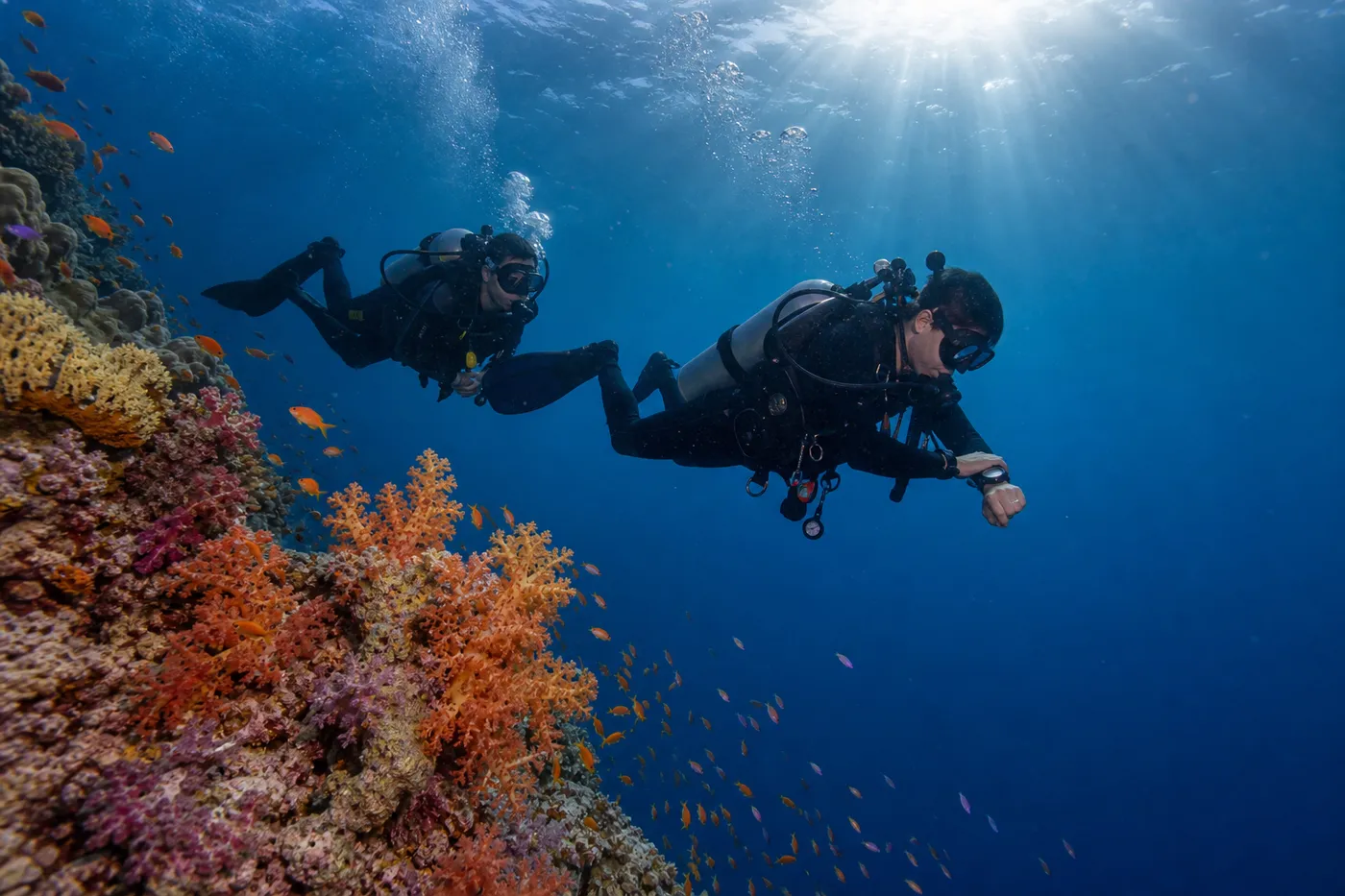
This is where the arithmetic compounds. On air, a typical third dive of the day to 20 metres might give you 30 to 35 minutes before your computer starts nagging. On EAN32, the same dive commonly gives 50 or more. Multiply that difference across a ten-day Raja Ampat liveaboard itinerary with 30-plus dives, and nitrox is buying you literal hours of extra bottom time, precisely on the afternoon and dusk dives when air divers are watching their no-deco clock instead of the reef. We see it on our own boats every trip: by day four, the air divers are surfacing first on nearly every dive, and it is rarely because of gas.
There is a second benefit that shows up in how people feel. Many divers swear they are less tired at the end of a nitrox day. The formal evidence for this is thin, and at least one blinded study found no difference, so we present it honestly: it may be real, it may be placebo. What is not placebo is the extra conservatism. Dive nitrox while your computer is set to air, a practice some cautious divers deliberately adopt, and every dive carries a wider safety margin against decompression sickness. On remote itineraries in the Banda Sea or the Forgotten Islands, where the nearest recompression chamber can be a day away, that margin is not academic.
The two things nitrox does not do
First: it does not make your gas last longer. You breathe a nitrox cylinder down at exactly the rate your lungs demand, the same litres per minute as air. If you surface with 60 bar on air, you will surface with 60 bar on EAN32. The number of divers who arrive on board believing otherwise is, honestly, remarkable, and dive shops rarely rush to correct the misunderstanding when it is selling fills.
Second: it does not let you dive deeper. It does the opposite, and this is the part of the course that actually matters. Oxygen becomes toxic to the central nervous system when its partial pressure climbs too high, and the accepted recreational ceiling is a partial pressure of 1.4 bar. On air, you would need to descend past 55 metres to reach that. On EAN32, you reach it at 33.7 metres. On EAN36, at roughly 28.9 metres. Cross the line far enough and the risk is an underwater convulsion, which through drowning rather than the seizure itself is frequently fatal. This is not a theoretical hazard for deep technical divers only; 34 metres is a depth a distracted photographer can wander past on a wall dive. It is why every nitrox diver analyses their own cylinder, writes the percentage and the maximum operating depth on a sticker, and sets both into their computer before every single dive. Done properly it takes ninety seconds. Nobody skips it twice after watching a boat crew handle a mislabelled cylinder.
The certification: what the course actually involves
The enriched air specialty is, by some distance, the easiest card in recreational diving. There are no required open-water dives, though some shops bundle a couple in. The course is theory: how oxygen and nitrogen behave under pressure, how to calculate a maximum operating depth, how to plan repetitive dives on enriched air, and, practically, how to use an oxygen analyser and log a fill. Most agencies now deliver the academic part as e-learning you can finish on the flight over, in roughly four to eight hours, followed by a practical session with an instructor, analysing cylinders and setting a computer.
Cost runs from about US$150 to US$250 depending on where you take it, sometimes less as e-learning only. You can complete it at home before you travel, and we would gently recommend that over doing it on board: not because on-board courses are bad, but because your evenings on the boat are better spent watching the sunset than a tablet. Prerequisites are minimal: an Open Water certification and, with most agencies, a minimum age of 12 to 15. If you are weighing which courses are worth taking before a trip, we ranked nitrox first among them in our guide to dive certifications worth taking before an Indonesia liveaboard, ahead of even the deep specialty, and nothing about that ranking has changed.
What it costs on a boat, and how the economics shake out
Pricing varies across the industry. Some operators charge per fill, typically US$5 to US$12 a cylinder. Others sell an unlimited nitrox package for the week, usually US$100 to US$180 on a ten-day itinerary. A growing number of boats, particularly at the premium end, include nitrox free for certified divers, ours among them on most departures. Ask when you book rather than assuming; it is one of those line items that quietly moves the total price of a trip.
Is it worth paying for? Run the arithmetic on a typical trip. A 27-dive itinerary with a US$150 nitrox package works out at about US$5.50 per dive for, conservatively, ten to twenty extra minutes of bottom time on the dives where nitrogen is the limit. Divers happily pay far more per minute for the flight that got them there. Against that, if you are a diver whose gas runs out well before your no-deco time on every dive, the honest answer is that you are paying for headroom you cannot yet use, and the money is better spent later in your diving life. There is no commission in saying that, but it is true.
A day of nitrox on board, in practice
Here is what the routine actually looks like, because the course makes it sound more ceremonial than it is. Before the morning briefing, the cylinders are filled and settled. You carry the analyser to your station, calibrate it against air, hold it to a slow flow from your valve, and watch the number stabilise: 31.9, say. You write 31.9 and your maximum operating depth on the contents tag, sign the fill log, and punch 32 into your computer. Ninety seconds, coffee in the other hand. The computer then does everything else silently: tracking your oxygen exposure, recalculating your no-deco time, warning you if you drift toward your depth limit.
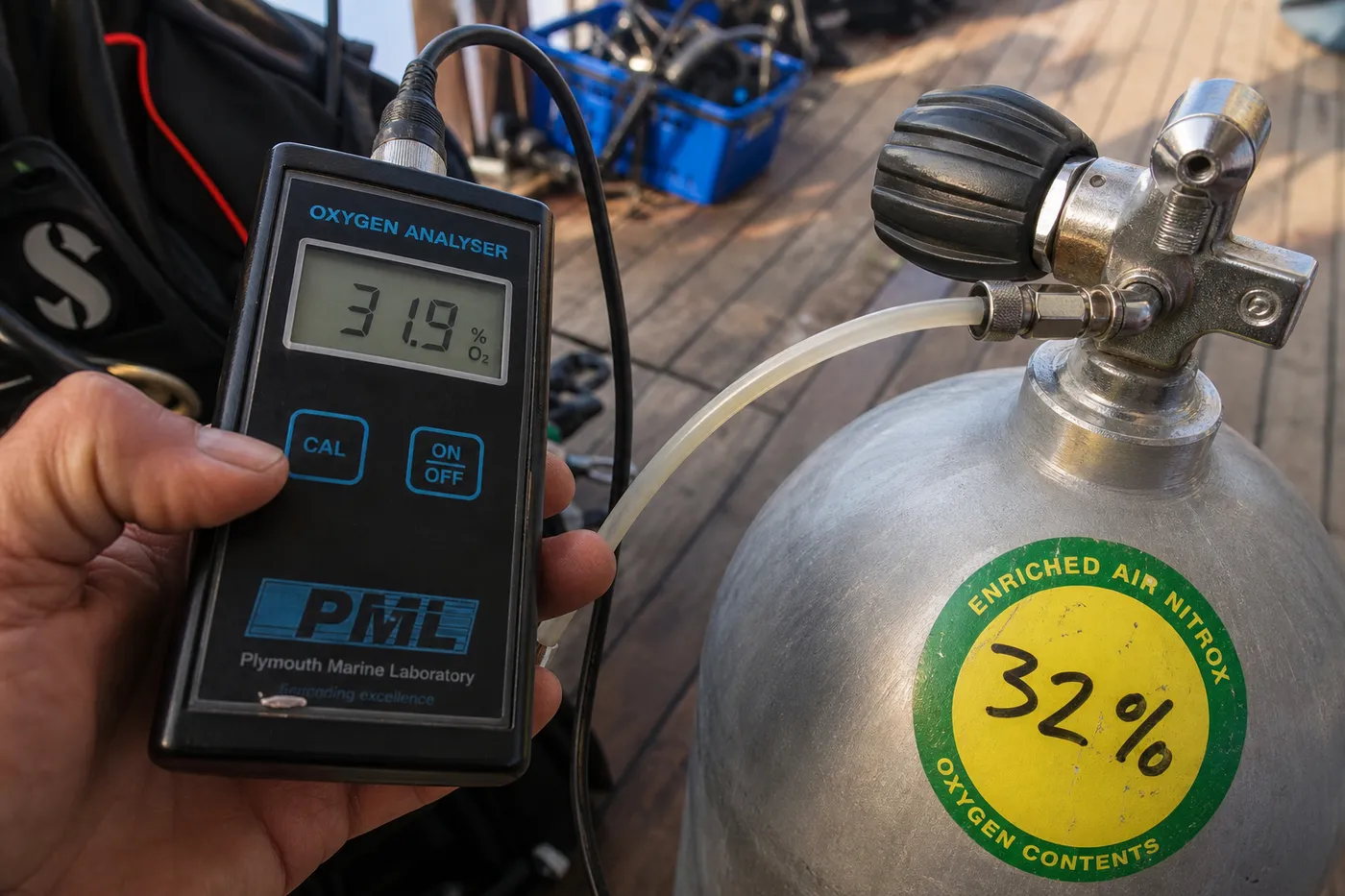
This is the best argument for the analyser ritual we know. Cylinder banks get blended to different mixes on the same boat: one guest’s shallow afternoon profile might call for EAN36 while everyone else is on EAN32, and the tanks look identical on the rack. An experienced diver, chatting through a surface interval, picks up what he assumes is his usual 32 and does not check. On a thirty-metre dive at a site like Manta Alley, an unnoticed 36 percent mix puts his oxygen partial pressure right at the ragged edge of the limit. Analysing takes forty seconds and catches it. That is the entire system, and it works only because nobody treats it as a formality, including the divers who have done a thousand nitrox dives without ever finding a discrepancy.
Air vs EAN32 across a real liveaboard day
Numbers land better in context, so here is a composite of a genuinely typical day from one of our Komodo trip logs, comparing what the computer allows a diver on air against the same profile on EAN32. These are first-approximation no-deco figures for a diver following the standard three-dive rhythm with ninety-minute surface intervals; your computer will produce slightly different numbers depending on its algorithm and your exact profile, usually within a few minutes either way.
| Dive | Site profile | Air NDL | EAN32 NDL | What actually limits the dive |
|---|---|---|---|---|
| 1 (08:00) | Castle Rock, 28 m pinnacle | ~22 min at depth | ~34 min at depth | Air diver: nitrogen. Nitrox diver: gas supply |
| 2 (11:30) | Batu Bolong wall, 22 m | ~28 min | ~48 min | Air diver: nitrogen, and noticeably so |
| 3 (15:00) | Manta point drift, 16 m | ~55 min | ~90+ min | Both divers: gas or the guide's schedule |
Read the middle row twice, because that is the whole argument in one line. On the second dive of the day, the air diver has surrendered twenty minutes of a world-class wall. By the third day of a trip the gap widens further, since residual nitrogen carries forward dive after dive. The afternoon manta dive is the consolation: shallow enough that the gas hardly matters, which is exactly why experienced guests save their air fills, when paying per fill, for the deep morning sites.
Setting up your computer, and the CNS clock nobody worries about enough
Every dive computer sold in the last two decades handles nitrox. The setup is two numbers: the oxygen fraction from your analyser, and the partial pressure limit, which should stay at 1.4 bar for the working part of the dive. Set those and the computer silently recalculates your no-deco times, displays your maximum operating depth, and starts tracking a second, less famous quantity: your CNS oxygen toxicity loading, usually shown as a percentage.
On a single recreational dive the CNS clock barely moves; you might surface at 8 or 12 percent. Across a four-dive liveaboard day spent near the depth limit it climbs faster than people expect, and we have watched guests hit 60 percent by the dusk dive without ever having looked at the field. The limit is 100 percent, the tracking resets on a half-life of about 90 minutes at the surface, and in practice a recreational profile on EAN32 will not breach it unless you are doing something else wrong. But "will not usually breach it" is doing some work in that sentence, which is why the habit worth building is a two-second glance at the CNS field during your safety stop, the same way you glance at your pressure gauge. One more line in the mental checklist, and the only cost is attention.
Two settings mistakes come up repeatedly on our boats, so consider this a pre-emptive briefing. The first: entering 32 into the computer while actually breathing air, usually after switching cylinders for a shallow dive. The computer then under-counts nitrogen and every subsequent limit it gives you is optimistic, the dangerous direction. The second: leaving yesterday's gas in a rented computer. Rental units come back with all sorts of history in them. Check the gas screen before every dive, on every computer, including the one you own.
Who should dive nitrox in Indonesia, and who can skip it
Take the certification, and use the gas, if any of these describe you: you are booked on a liveaboard of five days or longer; you love the 18 to 30 metre band where the hammerheads, mantas and reef walls live; you are the sort of diver who does every optional dive including the dusk one; you are older, or carry a bit more body fat, or simply want more conservatism against decompression sickness on remote routes; or your air consumption is good enough that your computer, not your pressure gauge, is what ends your dives.
You can reasonably skip it, at least for now, if your diving is mostly shallower than 15 metres, where air already gives you more no-deco time than any tank can deliver; if you are a brand-new diver still working on buoyancy and consumption, in which case the money is better spent on a peak performance buoyancy course; or if you snorkel more than you dive. Muck diving days in Lembeh at 8 metres gain almost nothing from enriched air. A Raja Ampat week of sloping reefs and 25-metre pinnacles gains enormously.
One genuine restriction deserves a mention: freediving after scuba is already a bad idea, and nitrox does not change that, but divers managing certain medical conditions, epilepsy in particular, or taking medications that lower the seizure threshold should talk to a dive physician before using enriched air, since oxygen toxicity risk is the one hazard nitrox raises rather than lowers.
Nitrox questions we hear on deck, answered plainly
Can I mix air and nitrox dives in the same day? Yes, freely. Your computer tracks the actual gas you tell it for each dive and does the nitrogen bookkeeping across the sequence. Plenty of guests dive nitrox in the morning at depth and switch to air for a shallow mandarin fish dusk dive where it buys nothing.
Does nitrox change my flying-after-diving wait? No. The guidance is the same 18 to 24 hours after repetitive diving regardless of the gas you breathed, because it is your accumulated nitrogen that matters and nitrox reduces but does not eliminate it. The full breakdown is in our guide to flying after diving.
Is EAN36 better than EAN32? Deeper no-deco benefit, shallower depth ceiling. EAN36 shines on repetitive 16 to 24 metre days but its 28.9-metre operating limit is genuinely constraining in places like Komodo where a manta cleaning station sits at 30. Most Indonesian boats standardise on 32 for exactly this reason, occasionally blending richer on request for specific profiles.
What about "best mix" calculations? The course teaches you to compute the ideal blend for a target depth. In practice, on a recreational boat, you dive what the compressor bank holds, which is almost always 32. Learn the calculation, pass the exam, and then enjoy never doing it again outside technical diving.
The bottom line from our compressor room
Nitrox is the rare piece of diving kit-adjacent spending with an unambiguous answer for one specific customer: the repetitive multi-day diver in the 16 to 30 metre band. That customer is, almost by definition, a liveaboard guest. For a week in Komodo or Raja Ampat it converts directly into longer dives, later surfacing, and a wider safety margin in places where the nearest chamber is far away. For the once-a-year resort diver doing two shallow dives, it converts into a nice sticker on the tank and not much else.
Roughly six in ten of our guests now dive enriched air, and the share climbs every season. The ones who get the most from it did the course at home, arrived with the card, and spent their first morning analysing a cylinder instead of sitting a class. If your next trip is five days or more, we would put the nitrox certification near the top of your pre-trip list, somewhere between booking the flight and breaking in the new wetsuit. Your third dive of the day will thank you.