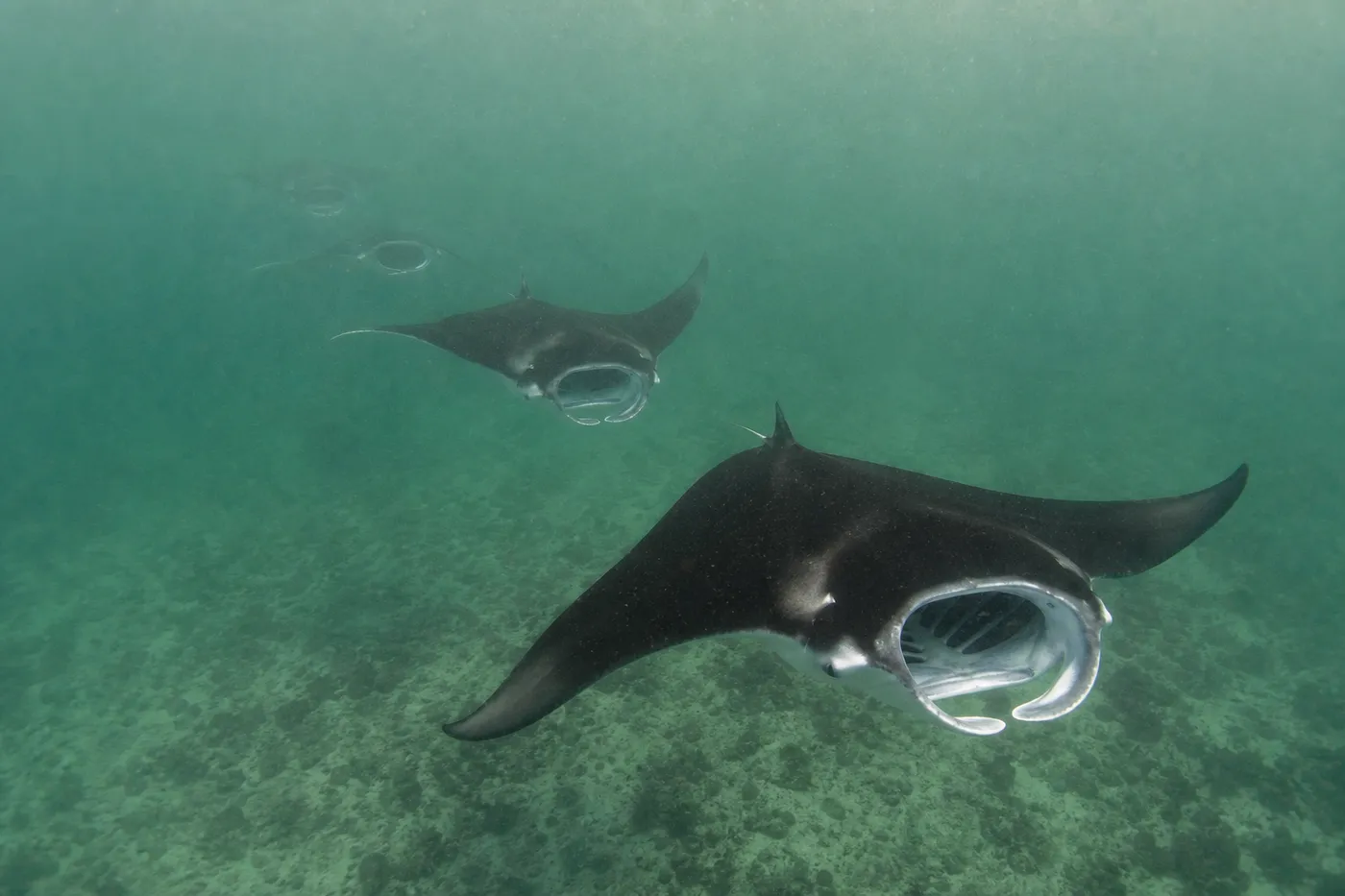
Ask a hundred divers why they booked Komodo and a good share will say one word: mantas. The park has dragons, it has the pink beach, it has some of the most aggressively alive reef diving in Indonesia, but the animal that sells the trip is a reef manta with a four-metre wingspan hanging in mid-water while a cloud of little cleaner wrasse works over its gills. The place that delivers that, more often than anywhere else in central Komodo, is a long grey plateau of coral rubble called Karang Makassar. Almost nobody uses that name out loud. Everybody calls it Manta Point.
It is the most requested single dive site in the park, and it is also the one guests arrive with the most muddled information about. Some have read that it is a beginner site. Some have read it is a ripping drift. Some have been told mantas are guaranteed, which is not a thing anyone can promise about a wild animal. And a surprising number have booked a Komodo liveaboard believing Manta Point and Manta Alley are the same place, which they are not, and then wondered why the itinerary only visits one of them. This guide is our attempt to put all of it straight: what the site actually is, when the mantas are genuinely at their thickest, what level you need, how to behave so the animals stay, and how to avoid the mid-morning crowd that turns a brilliant dive into a queue.
What and where is Manta Point (Karang Makassar)?
Manta Point, properly Karang Makassar and sometimes written Makassar Reef, is a shallow reef flat of sand and coral rubble on the eastern side of Komodo island, in the central zone of Komodo National Park. It runs for roughly three kilometres, sits mostly between five and fifteen metres deep, and is dived as a drift: you enter up-current, the flow carries you along the plateau, and you watch the cleaning stations go past. Reef mantas are resident here all year, and the site works for divers and snorkellers alike, which is unusual and is most of the reason it has become the park's signature stop.
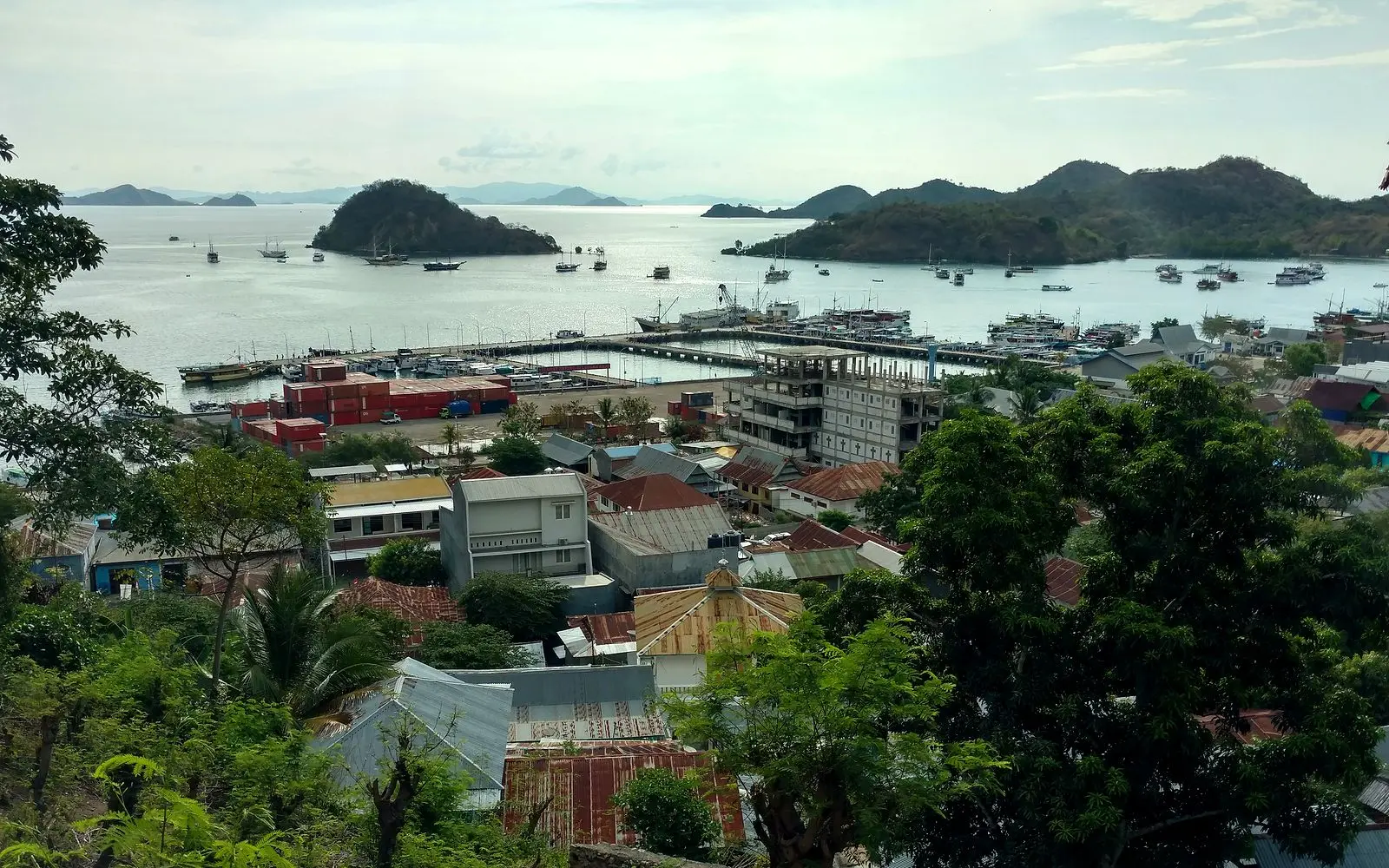
The geography is worth getting right, because published descriptions contradict each other and at least one of ours used to. The plateau lies in the channel between Komodo island and the smaller islands to its east, Tatawa Besar and Tatawa Kecil, in the water that separates the northern and central parts of the park. It is not in the Padar strait, and it is not in the far south. From the harbour at Labuan Bajo it is a run of roughly ninety minutes to two hours on a fast day boat, which is why it is on virtually every day-trip itinerary sold on the waterfront, and a shorter hop still for a liveaboard already anchored in the park.
| Site | Karang Makassar, marketed as Manta Point |
|---|---|
| Zone | Central Komodo, channel east of Komodo island near Tatawa |
| Depth | 5 to 15 metres, occasionally to 18 |
| Dive type | Drift over a rubble and sand plateau, multiple cleaning stations |
| Current | Mild to moderate on most tides, occasionally strong |
| Water temperature | 26 to 29 degrees Celsius |
| Visibility | 10 to 20 metres, lower when the plankton is thick |
| Level | Open Water and up, with drift discipline |
| Snorkelling | Yes, genuinely, on the right tide |
| Main draw | Reef mantas (Mobula alfredi), cleaning and feeding |
The name confusion: Karang Makassar, Taka Makassar, Manta Point, Manta Alley
Four names float around and they are not interchangeable. Karang means reef, so Karang Makassar is the rubble plateau you dive. Taka Makassar is different: it is the little crescent of pale sand a short distance away that appears in every Komodo photo album, a sandbar you walk on rather than a dive site, and day trips routinely pair the two so that guests snorkel the reef and then stand on the sandbar for photographs. Manta Point is the marketing name for the reef, and it is what your guide will say on the boat.
Manta Alley is a genuinely different site, and this is the confusion that costs people money. It sits in the far south of the park, in a narrow rocky channel off the southern coast of Komodo island, in colder water fed by Indian Ocean upwelling. It holds bigger aggregations, it is greener and rougher, and no day boat gets there usefully, so it needs a six-night or longer southern itinerary. If mantas are the whole point of your trip, read our Manta Alley guide alongside this one and then decide which experience you are actually buying, because plenty of guests want both and the itinerary has to be chosen accordingly.
What the site actually looks like underwater
Be prepared for the reef itself to underwhelm you. This is worth saying plainly, because guests who arrive expecting the coral gardens of Batu Bolong are briefly deflated when they descend onto what is, in visual terms, a grey gravel car park. The plateau is broken coral rubble and sand, scattered with isolated bommies. Sections of it were damaged years ago and the recovery is slow in water that moves this hard. The environment is the means, not the end.
What the rubble does is host the cleaning stations. Those isolated coral heads are staffed by cleaner wrasse and butterflyfish, and mantas come in to hover above them, sometimes for twenty minutes at a stretch, holding almost stationary while the cleaners work the gill slits and the trailing edges of the wings. On other tides the same site works as a feeding ground instead, with the current pushing plankton along the plateau and mantas cruising open-mouthed through it, occasionally falling into the loose single-file procession that guides call a feeding train. Both behaviours happen here. Sources that insist it is only a cleaning station, or only a feeding site, are describing one tide and generalising.
Between the mantas there is more life than the rubble suggests. Green and hawksbill turtles are common, eagle rays cross the sand, bamboo sharks and blue-spotted stingrays tuck under the ledges, and cuttlefish hang about the bommies. None of it is why you came. All of it fills the gaps in a dive where you may spend a long stretch simply waiting and watching an empty patch of water, which is the honest rhythm of manta diving anywhere in the world.
When to go, and why the season advice you have read disagrees
Search this question and you will get four different answers with equal confidence. One dive centre will tell you July to October. Another says November to April. A third says year-round and leaves it there. They are not all wrong, and the reason is that they are answering slightly different questions: how many mantas, how clear the water, and how comfortable the boat ride.
Here is our position, and it is the one used consistently across the rest of our Komodo writing. Reef mantas are resident at Karang Makassar in every month of the year, so there is no closed season and no month when the site is pointless. The largest gatherings come in the wet season, roughly December through February, when the plankton is thickest and the mantas concentrate to feed. The dry months from June to September still produce mantas most days, in smaller numbers, in noticeably clearer water. The shoulders on either side, April to May and October to November, are the best all-round compromise and are what we recommend to anyone who wants a good chance of numbers without committing to wet-season weather.
| Window | Manta numbers | Water and conditions | Who it suits |
|---|---|---|---|
| December to February | Highest of the year, feeding aggregations | Warm at 28 to 29 degrees, visibility often down to 10 metres, windier topside | Manta-focused divers who accept variable weather |
| March | Still good, tapering | Transitional and unpredictable | Flexible travellers, quieter park |
| April to May | Reliable, moderate numbers | Seas calming, visibility improving | Best balance, fewer boats |
| June to September | Regular but smaller groups | Clearest water of the year, cooler, best topside weather | First-timers, photographers, families |
| October to November | Building again, often excellent | Calm, warm, good visibility | Our own favourite window |
The trap in all this is treating the calendar as a guarantee. Mantas at a cleaning station are responding to tide, plankton and something we do not fully understand, and a brilliant January week can contain one dive where nothing shows up at all. We say this to guests before the dive rather than after it. The right way to protect yourself is not to chase the perfect month but to book a trip that dives the site more than once. Two or three passes across different tides in the same week will beat one pass in a statistically better month nearly every time, which is the single most useful piece of planning advice in this article. Our Komodo season guide works through how the rest of the park's diving shifts month by month, because the manta calendar and the whole-park calendar are not identical.
What the seasons do to the water, not just the animals
The two things that move in opposite directions are numbers and visibility, and understanding that resolves most of the contradictory advice online. Plankton is manta food. Thick plankton means more mantas and greener, murkier water. Thin plankton means fewer mantas and twenty-metre visibility. You cannot have both at their best in the same week, and any source promising you can is selling something.
Underwater photographers usually pick the compromise months for exactly this reason. A wide-angle shot of a manta at three metres' range in December water can come out flat and full of backscatter, while the same animal in September sits in clean blue that flatters the camera. Divers whose priority is simply seeing lots of mantas should ignore the visibility question and go in the wet season, accepting that some dives will feel like watching shapes emerge from soup, which is its own kind of atmospheric.
A note on the word migration
You will see it written that Komodo's mantas migrate, and that the season tracks their arrival. That is not really what happens. The reef mantas here are a resident population, studied and individually catalogued by their belly spot patterns, and they move around inside the park rather than travelling to it from somewhere else. In the dry months they disperse more widely and spend less time stacked at the central cleaning stations. In the wet months they concentrate where the food is. So the site does not empty out and refill on a schedule; the same animals redistribute. It matters because it changes how you plan: if the mantas have simply spread out rather than left, a boat that can move between several cleaning stations in a day is worth more than perfect timing.
How the dive actually works
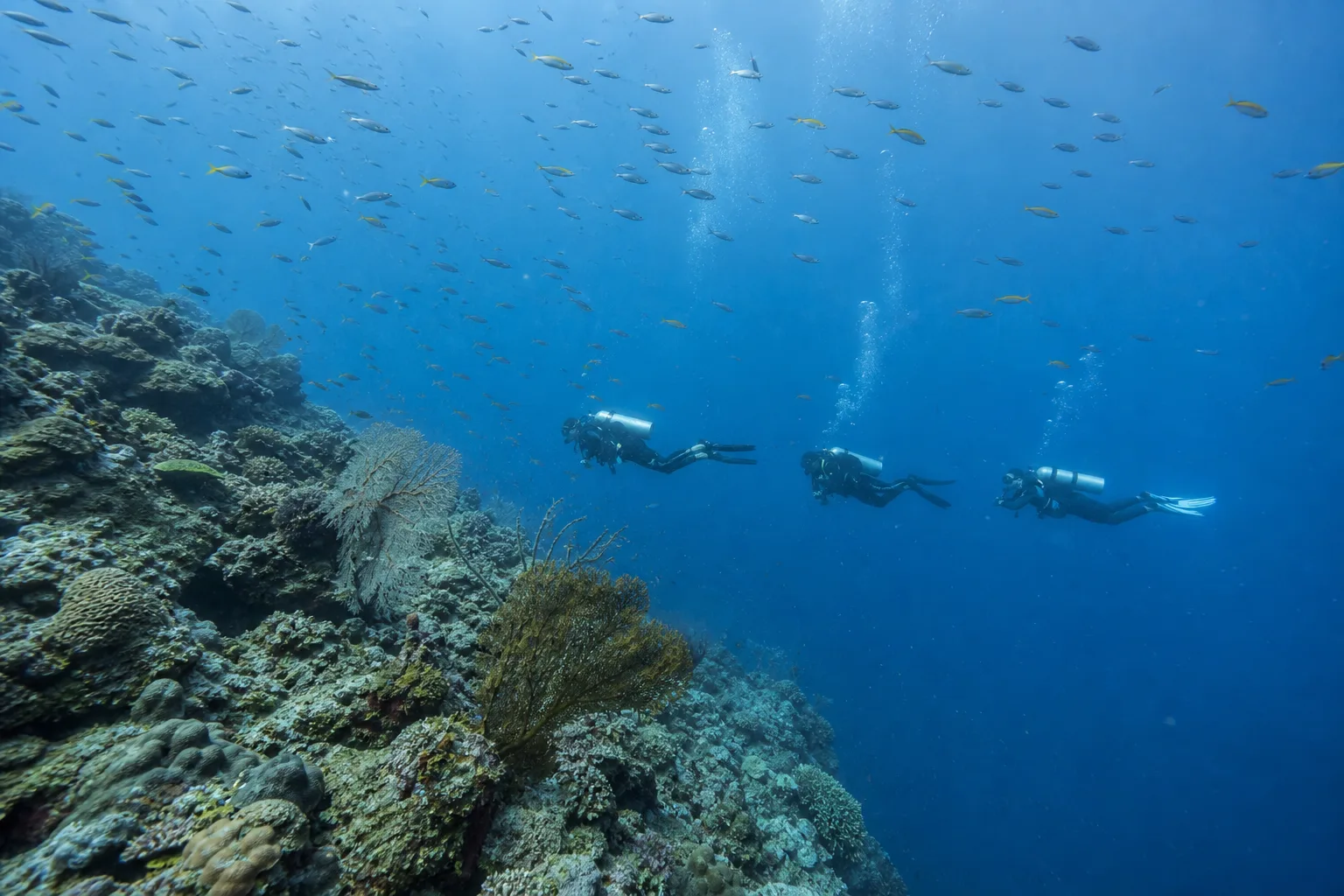
The briefing is short because the plan is simple. The tender drops you up-current of the productive stretch, you descend fast to the plateau, and you let the flow carry you along at whatever pace it is running. Your guide will be watching for the bommies that are active that day, and when one is holding mantas the group settles on the sand a respectful distance downstream and waits. When the animals move on, or the current pushes you past, you carry on down the plateau to the next station. Total time in the water is usually forty-five minutes to an hour, and because you are rarely below fifteen metres, air and no-decompression time are almost never the limiting factor. Cold is a bigger factor than depth, since an hour spent nearly motionless at twenty-six degrees takes more out of you than an active dive at the same temperature.
Reef hooks come up a lot in Komodo conversation and this is not really the site for them. Hooks are for holding station on hard structure in serious current, the way you might at Castle Rock or Crystal Rock. At Karang Makassar the bottom is loose rubble, the current is usually moderate, and the technique that matters is staying low, staying still and keeping your fins off the substrate. Some guides carry a hook for unusual tides. Most of the time it stays clipped off.
Can beginners dive Manta Point?
Yes, with a real caveat. In terms of the raw numbers this is one of the friendliest big-name sites in Indonesia: shallow, no wall, no overhead, no decompression pressure, and a bottom you can sit on. Open Water certification is enough, and dive centres in Labuan Bajo run newly qualified divers here routinely, often as one of the first dives after a course.
The caveat is drift discipline, which is a different skill from depth tolerance. On a moving tide you cannot stop, you cannot easily swim back to something you have passed, and the group has to stay together or the tender has a scattered pickup to manage across a three-kilometre plateau. Divers who have only ever dived from a beach in still water sometimes find that genuinely unsettling the first time. If you have fewer than about fifteen dives, say so honestly at booking, and ask to be put in a group with a guide who is running the site slowly. Buoyancy matters more here than certification level does, because the whole encounter depends on your ability to hold a position a metre off the sand without sculling. Our guide to buoyancy control covers the drills that fix this faster than most divers expect.
Snorkelling Manta Point
This is one of a small number of world-class manta sites where snorkellers get a genuinely good experience rather than a consolation one, and it is why the site is such a gift for mixed groups. The mantas feed and cruise in five to ten metres of water and regularly rise much closer to the surface than that, so a snorkeller floating quietly at the top can end up looking straight down at an animal a couple of metres below. For families and for couples where only one person dives, this changes what a Komodo trip can be, a point we develop in our guide for non-divers and snorkellers.
Two practical warnings. First, the current that makes the site work does not care that you have no tank: snorkellers drift too, and the boat needs to be following the group rather than anchored somewhere hopeful. Use a guide who gets in the water with you. Second, the temptation to duck-dive down towards a manta is enormous and it is the single fastest way to end the encounter for everyone, divers included. Stay at the surface, stay horizontal, and let the animal decide the distance.
Currents, and what actually goes wrong
Most days the flow here is mild to moderate and the dive feels relaxed. On a big spring tide it can pick up to the point where the plateau goes past faster than you can look at it, and on those tides the sensible guides will move to a more sheltered site rather than turn a manta dive into a sleigh ride. The other variable is down-current at the edges of the plateau, less dramatic than on Komodo's pinnacles but worth knowing about: if you feel yourself being pushed down, swim out and away from the structure rather than fighting upward.
The failure we see most often has nothing to do with current. It is divers arriving with too much lead, dropping onto the rubble in a cloud of silt and then spending the dive slightly upside down and finning to stay level, which broadcasts exactly the signal that stops mantas approaching. Sort the weighting on the first day of the trip, not on the manta dive.
Manta etiquette, and why it decides what you see
Every rule below exists because somebody broke it and the dive ended. Mantas are not skittish in the way a reef shark is, but they are making a choice to be there, and a cleaning station is abandoned in seconds when the animals decide the site is uncomfortable. The group that follows the etiquette sees mantas for forty minutes. The group that does not sees them for four. It is that direct, and it is why guides brief this harder than they brief the dive plan.
- Stay low and stay downstream. Settle on the sand or hover just above it, off to the side of and below the cleaning station. Mantas approach a bommie along a line they have chosen. Sitting in that line, or directly above the station, closes it.
- Never swim towards a manta, ever. This is the one that matters most. Let the animal come to you, and it very often will, closer than you would dare approach. Finning after one that is moving away simply escorts it out of the area.
- Do not swim over the top of them. A silhouette passing overhead reads as a predator. Keep below the animal's depth wherever you can.
- Keep your bubbles out of their path. A wall of exhaust rising into a manta's flight line will turn it. If one is coming straight at you, hold your breathing rhythm steady rather than gasping, and stay put.
- Three metres is the working minimum distance and more is better. Nobody touches a manta, at any time, for any photograph. Contact strips the mucus layer that protects them from infection.
- No flash into the eyes and no drones over the surface where snorkellers are in the water with animals. Rules in the park have tightened over the years, so check with your cruise director rather than assuming.
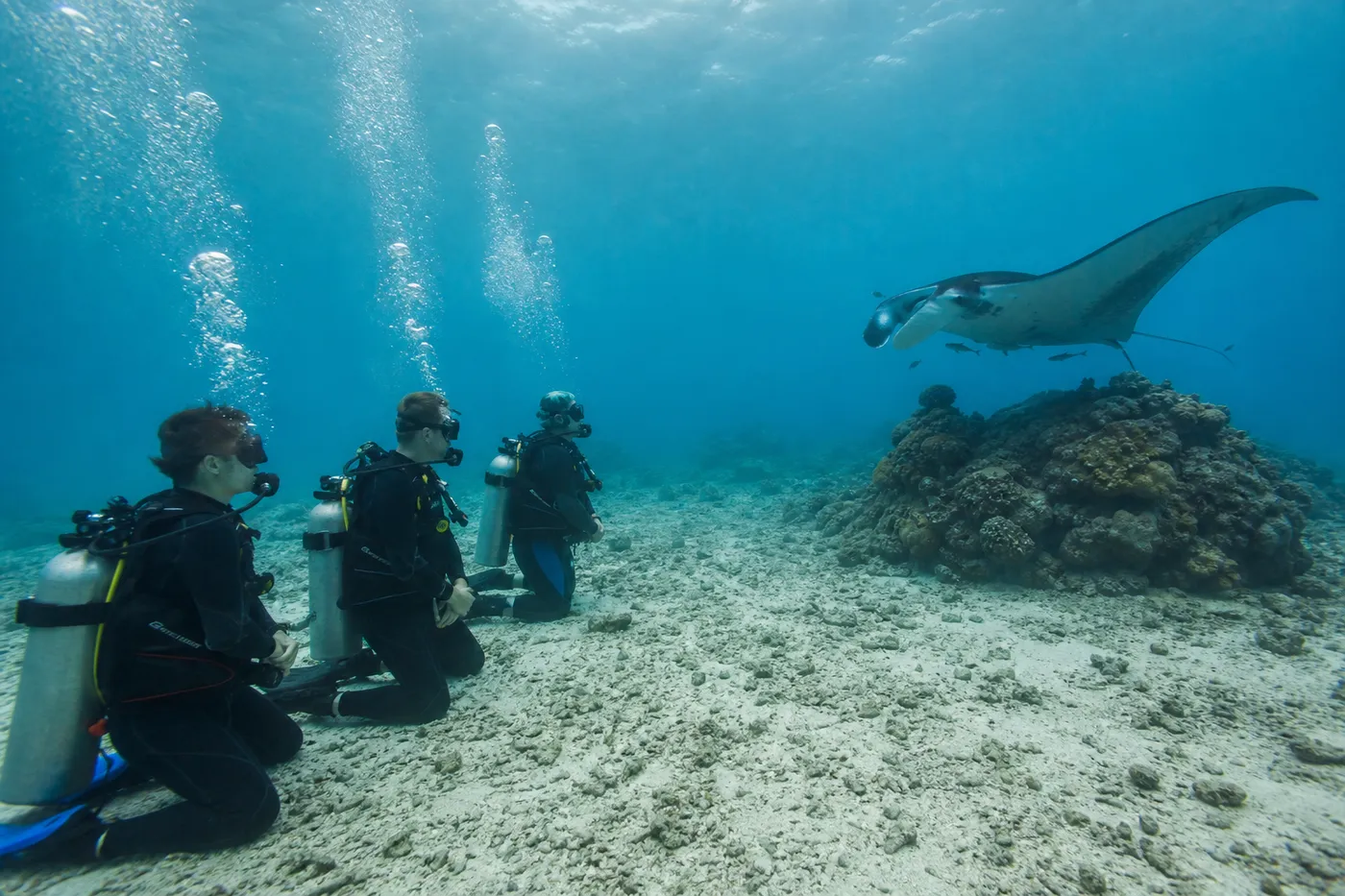
The point we make in briefings is that this is one shared encounter rather than a dozen private ones. Any single diver can end it for the whole group inside a minute, and the divers who come up having seen the most are reliably the ones who moved the least. It is a strange discipline to explain to people who have travelled a long way and paid a lot of money, since every instinct says to swim closer to the thing you came for. Sitting still is the technique.
Photographing mantas here
Wide angle, and get under them. The classic Karang Makassar frame is shot from low on the sand looking up, with the manta between you and the surface, because that is the angle that gives you the wingspan and some light. Long lenses are pointless. Strobes need to be pulled well back and angled outward or the plankton that brought the mantas will light up as a snowstorm across the frame, which is the single most common disappointment when people review wet-season shots. Shoot in bursts as the animal passes rather than chasing focus, and accept that the best pass of the dive will usually be the one where you had already given up and put the camera down. Our underwater photography guide goes further into settings and strobe positioning for this kind of water.
Planning the dive: crowds, fees and what to pair it with
The site's popularity is its main problem. Karang Makassar is on essentially every day-boat itinerary sold in Labuan Bajo, and in high season the surface above the plateau can hold a genuine fleet by the middle of the morning, along with snorkellers who have had no briefing at all. More boats does not just mean more people in your photographs, it means more disturbance, and on a busy Sunday the mantas do sometimes simply leave. This is the strongest practical argument for seeing the site from a liveaboard rather than a day trip.
The timing that works is early. Boats already anchored in the park can be in the water not long after first light, well before the fast boats have finished the run out from Labuan Bajo, and the difference between a 6.30 am dive and a 10.00 am dive here is the difference between a handful of divers and forty. Late afternoon works on the same principle once the day fleet has turned for home. Any operator running Komodo seriously knows this; if a boat's schedule puts Manta Point at mid-morning in August, ask why.
Fees and what it costs
Entry to Komodo National Park is charged separately from your diving nearly everywhere, and the structure has changed more than once in recent years, so treat any figure you read online, including ours, as needing confirmation at the time you book. As a rough guide, a full-day dive trip from Labuan Bajo including park fees has commonly sat around the IDR 3,000,000 to 3,500,000 mark per person, with the fees themselves a substantial slice of that and higher at weekends. On a liveaboard the fees are usually collected as a separate line item at the start or end of the cruise, in cash, so read your booking confirmation and bring rupiah. Nobody enjoys discovering a seven-figure rupiah cash requirement on the last evening.
What to dive it with
Karang Makassar is a half-day proposition rather than a destination in itself, and it pairs naturally with the sites in the same stretch of water. Tatawa Besar's soft-coral drift sits directly across the channel. Batu Bolong, arguably the finest reef in the park, is a short run away and is usually dived at slack. Siaba Besar gives you a gentle turtle dive that suits the same mixed-ability group. If your itinerary reaches south, Manta Alley is the other half of the manta story and is a genuinely different experience rather than a repeat. Our rundown of the best dive sites in Komodo puts the whole park in order, and the itinerary guide shows which trip lengths reach which zones.
Is it worth it?
Manta Point is not the best dive in Komodo. Batu Bolong is a richer reef, Castle Rock is a better piece of theatre, and Manta Alley is the bigger manta experience by some distance. What Karang Makassar has is accessibility: it is the one site in the park where a nervous new diver, a snorkelling partner and a photographer with a thousand dives can all get into the same water and all come out having had the encounter they wanted. That combination is rare enough to forgive the grey rubble. Get on it early, sit still when you are down there, and give it more than one attempt across the week.