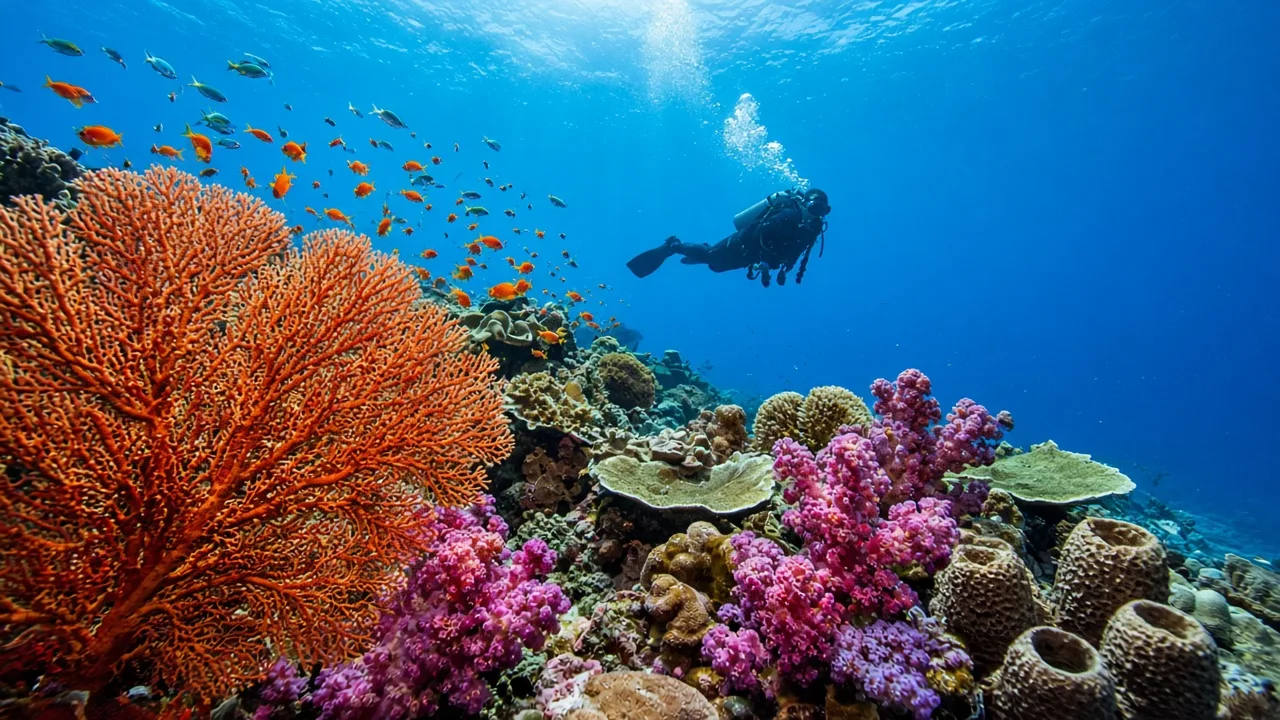
Komodo National Park holds two different dive destinations inside one boundary line. The north is warm, blue and fast, a run of current-swept pinnacles where grey reef sharks hang in the flow and the visibility on a good day reaches 30 metres. The south is cold, green and slow, a coast of plankton-thick bays where the water can sit at 22 degrees in August and reef mantas feed in numbers few places in the world can match. Both belong to Komodo, and both are a few hours' sailing from each other. They feel like separate countries.
Which half you dive depends on the month you travel, how many nights you book and how comfortable you are in current and cold water. A short Komodo liveaboard usually covers the north and the centre. Reaching the south takes a longer trip, because the crossing to the exposed southern coast adds roughly half a day each way. That one fact shapes more Komodo itineraries than anything else, and it is the question guests ask us most often at the enquiry stage.
Most divers only ever see one of them. The dragons, Padar and the famous photographs all sit in the north and centre, so that is where the short trips and the day boats go, and the south stays the quieter, colder secret of the park. The temperatures and seasons below are the ones we log on our own Komodo departures, and they match the month-by-month pattern in our guide to the best time to visit Komodo.
What is the difference between North and South Komodo diving?
North and South Komodo are the two halves of Komodo National Park's diving: a warm, clear, current-swept north and a cold, green, plankton-rich south.
- Water: 26 to 29 °C north, 22 to 26 °C south
- Visibility: 20 to 30 m north, 10 to 15 m south
- North: pinnacles, sharks, schooling fish
- South: mantas, macro, soft coral walls
Central Komodo sits between them and works almost all year, so every itinerary passes through it.
You reach the two halves on:
- Four and five-night Komodo liveaboard trips for the north and centre
- Six and seven-night departures that add the south
- Private yacht charters in Komodo planned around one half
In short: the north is for current and clarity, the south is for mantas and macro, and trip length decides whether you get both.
North Komodo vs South Komodo: what really separates them?
North Komodo
North Komodo is the cluster of islands and submerged rocks around Gili Lawa Darat and Gili Lawa Laut, at the northern entrance to the park, where warm water from the Flores Sea pours through narrow channels on every tide. It is pinnacle country: Castle Rock, Crystal Rock and the Cauldron, dived on reef hooks and fast drifts, with the best visibility in the park.
South Komodo
South Komodo is the exposed coast facing the Indian Ocean, from the southern tip of Rinca around to the south side of Komodo island, where cold, nutrient-loaded water rises from depth and turns the sea green with plankton. It is manta and macro country: Manta Alley, Cannibal Rock in Horseshoe Bay and the swim-throughs of Pillarsteen.
Key distinction:
- The north is defined by current and clarity; the south by cold water and food.
- Day boats from Labuan Bajo reach the north and centre; only liveaboards reach the south.
Why one national park has two seas
The reason is geography, and it is simple once you see the map. Komodo sits in the gap between Flores and Sumbawa, which makes it a doorway between two oceans. To the north lies the Flores Sea, warm and relatively calm, part of the vast body of water that flows south through the Indonesian archipelago from the Pacific. To the south lies the Indian Ocean, colder, deeper and far more energetic. The Sape Strait on the western side of the park and the Linta Strait on the eastern side are the channels where those two bodies of water meet and push against each other.
The tides do the rest. Twice a day the level difference between the two seas drives enormous volumes of water through the park's narrow passages, which is why Komodo's currents are famous and why they change direction by the clock rather than by the weather. In the north that flow is warm surface water, so the pinnacles get current, clarity and the pelagic fish that hunt in it. In the south the flow is coming up from the Indian Ocean, and in the dry season the southeast trade winds push the surface water offshore along that coast. Cold water rises to replace it. That upwelling is the engine of the whole southern ecosystem.
Cold water carries nutrients, nutrients feed plankton, and plankton feeds everything else. It is why the southern walls are so thickly covered in soft coral, crinoids and sea apples that the rock underneath is often invisible, and why the mantas gather there to feed. It is also why the south looks the way it does. Visibility that runs 25 or 30 metres at Castle Rock can drop to 10 metres at Manta Alley on the same week, and the water takes on a green tint that surprises divers who have only seen Komodo in photographs of the north.
The counterintuitive part is the timing. Most travellers assume the warmest, calmest water arrives in the dry season, and in the north it largely does. In the south the opposite happens: the driest months, roughly June to September, are when the upwelling is strongest and the water is coldest, sometimes around 22 degrees in August. In the wet season the trade winds drop, the upwelling fades and the south warms to 27 to 29 degrees, close to the north. It is the single most common surprise among guests who planned their trip from generic Indonesia weather pages rather than from diving-specific ones.
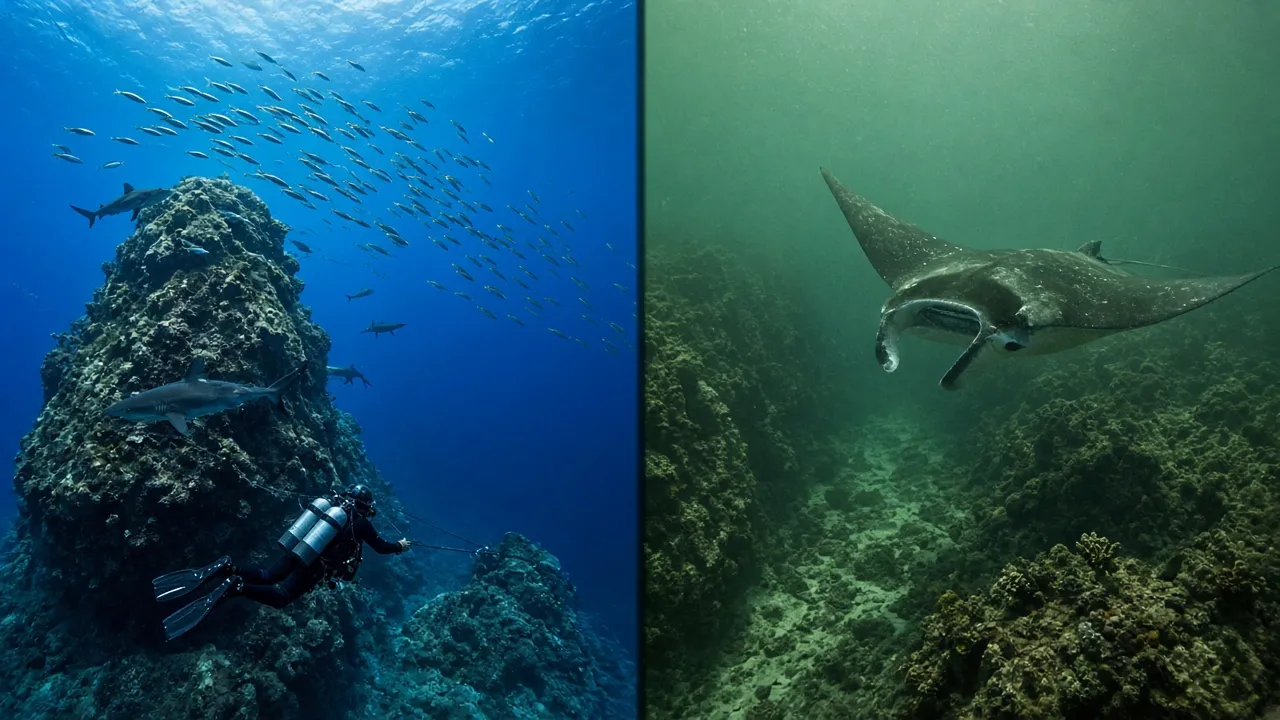
North and South Komodo side by side
The table is a summary of the typical pattern, not a guarantee. Seasons drift by a few weeks from year to year, and on any given morning the captain's read of the tide and the swell matters more than a monthly average.
| North Komodo | South Komodo | |
|---|---|---|
| Water temperature | 26 to 29 °C, warmest in the wet season | 22 to 26 °C in the dry season, 27 to 29 °C in the wet |
| Visibility | Often 20 to 30 m in the dry season | Commonly 10 to 15 m when plankton is thick |
| Current | Strong on the pinnacles, reef hooks standard | Moderate in the bays, surge on exposed points |
| Signature life | Grey reef sharks, trevally, barracuda, fusiliers | Reef mantas, frogfish, nudibranchs, pygmy seahorses |
| Best months | April to November | June to September for the upwelling |
| Suits | Advanced divers comfortable in current | Divers happy in cold, green water |
Read the two columns as two different trips rather than a better and a worse one. A diver who has done the north twice and wants something new is usually the one who falls hardest for the south.
Diving North Komodo: pinnacles, sharks and fast water
The north is the Komodo of the dive magazines. Its sites are clustered tightly around the Gili Lawa islands, which means a boat anchored in the lee of Gili Lawa Darat can reach three or four world-class dives without a long transit, and the whole day revolves around the tide table.
Castle Rock and Crystal Rock are the reason most northern itineraries exist. Castle Rock is a submerged pinnacle whose top sits at about 6 metres, with the seabed falling away past 40 metres on every side, and when the current runs the water column above it fills with fusiliers, trevally, snapper and barracuda, with grey reef sharks working the edges. The dive plan is always the same: a negative entry, a fast descent to the upcurrent corner, a reef hook and then patience. Crystal Rock, less than 200 metres away, is the gentler twin, with cleaner light and a slightly more forgiving shape, and we often run it first as a warm-up for guests who are nervous about the reputation of its neighbour.
Then there is the Cauldron, also called Shotgun, the channel between Gili Lawa Laut and Gili Lawa Darat. It is less about fish counts and more about the ride: a sandy bowl that feeds into a narrow passage where the current accelerates and carries you out over the reef on the far side. Most guests rate it their favourite dive of the northern leg even when the mantas do not show up.
All of this has a price, and the price is current. On a big tide the northern pinnacles are not beginner territory. Our standard is Advanced Open Water with recent drift-diving experience and the confidence to use a reef hook and deploy a surface marker buoy, and on the strongest days the dive guides will change the plan rather than push it. If you have not dived in serious current before, our article on diving in currents in Indonesia covers the technique, and it is worth reading before you arrive rather than on the boat.
The reward is clarity. In the dry season the northern visibility often runs 20 to 30 metres, the water stays between 26 and 29 degrees, and a 3 mm full suit is usually enough. It is the most comfortable big-animal diving in the park, as long as you are comfortable in moving water.
The weak point of the north is the wet season. From roughly December to March the wind swings to the northwest and the swell rolls straight into the northern entrance. Castle Rock and the Cauldron become unreliable, and boats that are still running in those months often skip them entirely and work the centre and south instead.
Diving South Komodo: cold water, mantas and macro
The south is a different kind of trip, and it asks more of you in a different way. The current is usually gentler than in the north. The cold is not. On a normal dry-season dive the water sits somewhere between 22 and 26 degrees, around 22 in August when the upwelling peaks, and on a liveaboard running four dives a day that chill accumulates. By the third dive an under-insulated diver is finished, no matter how tough they felt on the first.
What you get in exchange is food, and everything that comes to eat it. Manta Alley, a channel between rocky islets on the southern coast of Komodo island, is the headline. Reef mantas gather there to feed and be cleaned, and on the right tide fifteen to twenty-five animals on a single dive is not unusual. The site runs from 5 to 25 metres, the channel shape concentrates both current and plankton, and the encounters depend heavily on arriving when the water is moving the right way. Manta Alley also has resident black morphs, solid black above and below, which most divers have never seen.
Cannibal Rock, a pinnacle in Horseshoe Bay on the southern coast of Rinca, is the other half of the southern case. The bay is sheltered from the open ocean and the cold water pools inside it, sometimes below 22 degrees in August, and the result is soft coral and crinoid cover so dense that the rock disappears beneath it. Frogfish, ghost pipefish, pygmy seahorses and a ridiculous range of nudibranchs live there, and the right way to dive it is slowly, a sixty-minute dive spent on a few square metres rather than a lap of the pinnacle. Its character is closer to the cold-water macro of Lembeh than to the warm reefs of northern Komodo.
Pillarsteen, a limestone cliff on the southwestern coast of Komodo island, completes the set with swim-throughs, caverns and overhangs full of glassfish and resting whitetip reef sharks. It needs good buoyancy and comfort in overhead sections rather than current skills.
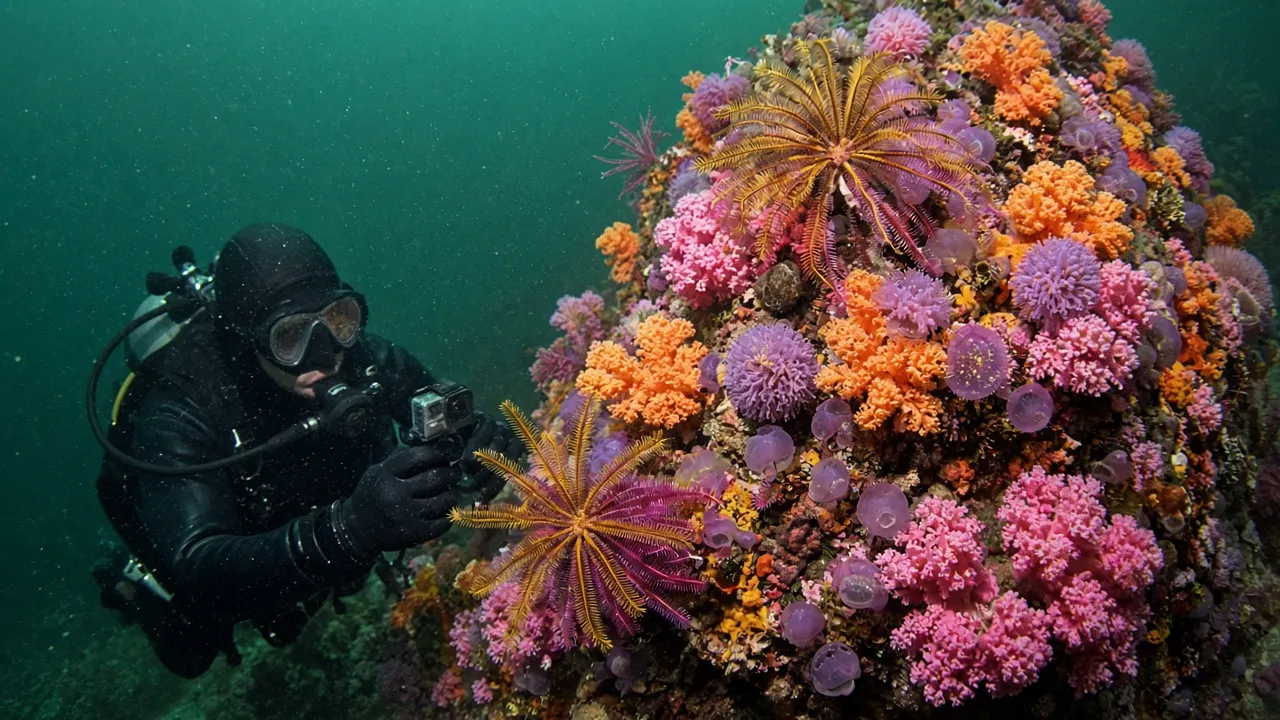
The honest drawbacks are visibility and exposure. When the plankton is thick, 10 to 15 metres is a normal day, and the water has a green cast that photographers either love or curse. The southern coast also faces the Indian Ocean, so the decision to run south is made on the day by the captain reading the swell. Some crossings are cancelled. That is the correct call on an exposed coast a long way from help, and an operator who never turns back from a southern crossing is one to think carefully about.
Above all, the south is liveaboard country. Manta Alley is roughly 38 kilometres from Labuan Bajo in a straight line and a great deal further in practical terms, no day boat can reach it with useful bottom time, and a four-night itinerary built around the north cannot realistically include it either.
Central Komodo: the part every trip shares
Between the two extremes lies the stretch of water every itinerary uses, the channels and islands between Komodo and Padar and along the Komodo coast. It is the most-dived part of the park for good reasons: the transits are short, the difficulty ranges from easy to demanding within a few kilometres, and the area works in almost every month.
Batu Bolong is the star, a pinnacle barely the size of a tennis court where the upcurrent face is a vertical wall of soft coral and feather stars, fronted by pyramid butterflyfish and fusiliers. The current is always present, so the plan is to drop on the sheltered side and work around the rock. Tatawa Besar, a long sloping reef nearby, is the dive we most often schedule after a hard pinnacle morning, because Open Water divers with good buoyancy can enjoy it without being stretched.
Then there is Manta Point, the reef the charts call Karang Makassar, a long shallow rubble drift where reef mantas are cleaned and feed. It runs on the opposite calendar to Manta Alley. Its biggest aggregations come in the wet season, roughly December to February, when plankton-rich water moves through the centre of the park, which is why a wet-season trip can still be a superb manta trip even with the north closed. Central Komodo also holds the land excursions, the dragon walks on Komodo and Rinca and the sunrise climb on Padar, so whichever half your trip favours, the middle comes with it.
How a north and south Komodo week actually runs
A trip that covers both halves is not a fixed route. It is a loop out of Labuan Bajo with a rough shape, and the captain and cruise director fit the dives into that shape day by day around the tides, the swell and where the other boats are. This is how it usually works on our six and seven-night departures.
1. Check dive and the centre
The first afternoon is almost always an easy check dive close to Labuan Bajo or in the centre of the park, so the guides can see everyone's buoyancy and weighting before the harder sites. The first full day stays central, with sites such as Tatawa and Siaba and often a first look at Batu Bolong or Manta Point.
2. The northern leg
In the dry season the boat then moves north to the Gili Lawa islands for a day or two of pinnacle diving, timed to catch Castle Rock, Crystal Rock and the Cauldron on workable tides. This is where the reef hooks come out. Northern days usually start early, because the best tide window for the pinnacles often falls soon after sunrise.
3. The crossing
Moving from the north or the centre down to the southern coast is the expensive part of the trip in time. Counting the run down the coast and the positioning around Rinca or southern Komodo, it costs roughly half a day each way. The captain makes the call the evening before, looking at the swell forecast for the Indian Ocean side, and if the south is not workable the trip stays central and north. Guests who understand this in advance take a cancelled crossing in their stride; guests who were told the south was guaranteed do not.
4. The southern leg
Once in the south, the boat usually anchors in a sheltered bay such as Horseshoe Bay and spends one or two days on Cannibal Rock, Manta Alley, Pillarsteen and the walls around them. The suits get thicker, the dives get longer and slower, and the photographers start counting nudibranchs.
5. Back through the centre
The final day is spent working back north through the centre, often with a dragon walk and the Padar viewpoint, a last dive or two and a dive-free interval before the flight home. Nobody should fly within 24 hours of their final dive, and the last-day schedule is built to respect that.
Worked example: six nights in June
Take the Komodo Sea Dragon departure from 15 to 21 June 2027, six nights out of Labuan Bajo. That is enough time for the full loop above in a normal June, with the northern pinnacles in good dry-season shape and the southern water cooling as the upwelling builds. A Main Twin cabin on a six-night 2027 Sea Dragon trip lists at USD 3,010 per person, with the Second Twin at USD 2,779 and the Double at USD 3,381.
On top of the fare, plan for national park, environment and port fees of roughly USD 180 to 250 per guest (paid in rupiah, Rp 3,258,000 to 4,525,000 depending on trip length and nationality), and a fuel surcharge in the region of USD 150 to 200. With up to four guided dives a day, minus the arrival afternoon and the no-fly final day, a six-night trip usually lands somewhere around 18 to 21 dives. Nitrox is an extra on the Sea Dragon, so budget for it if you use it. The full breakdown of what is and is not included sits in our Komodo liveaboard cost guide.
A four-night trip on the same boat drops the southern leg and gives you the centre and the north in more depth. That is not a lesser trip. It is a different one, and for a first visit in July it is often the better fit.
North and South Komodo by season
Komodo is a year-round destination, but the two halves peak at different times, and the best month for you depends on which one matters more.
| Months | North | South | What it means |
|---|---|---|---|
| April | Opening up, clearing visibility | Warm, upwelling not yet strong | Shoulder month, quieter sites |
| May to July | Excellent, 26 to 28 °C | Cooling, mantas building | The sweet spot for doing both |
| July to August | Good but windy and busy | Coldest, around 22 °C, biggest manta feeding | Peak crowds, peak southern mantas |
| September to October | Very good, winds easing | Still cool, still productive | Strong all-round months |
| November | Good, warming | Warming, clearing | Transition, mixed weather |
| December to March | Northwest swell, often unreliable | Warm and calm, 27 to 29 °C | Centre and south pattern, Manta Point at its best |
If both halves are the goal, May, June and early July are the months we recommend most often. The north is in good condition, the south has cooled enough to bring the food without yet being at its coldest, and the July and August crowds have not fully arrived. Late September and October are close behind.
July and August are the strongest case for the south specifically. The upwelling is at its peak, and so are the manta feeding aggregations at Manta Alley, but this is also the windiest and busiest stretch of the year, with the most boats in the park and the coldest water you will dive in Komodo. Go then for the mantas, and pack for it.
The wet season reverses the logic. From December to March the north is often closed by swell, while the centre and south turn warm and calm, and Manta Point in the centre has its biggest manta counts. It is a perfectly good time to dive Komodo, just not the time to go looking for Castle Rock.
Wetsuits and packing for both halves of Komodo
Exposure protection is where north-and-south trips go wrong most often, because the suit that is perfect at Castle Rock is miserable at Cannibal Rock two days later. Pack for the coldest water on the itinerary, not the average.
- A 5 mm full suit as the minimum for any dry-season trip that includes the south. Many regulars bring a 7 mm or add a hooded vest.
- A hood or hooded vest, which weighs almost nothing and makes a bigger difference on the fourth dive of the day than another millimetre of neoprene.
- A reef hook and a surface marker buoy of your own for the northern pinnacles. Our guides carry spares, but a hook you have practised with is better.
- A warm layer for the deck. Wind across a wet suit between dives in July chills people faster than the water does.
- Reef-safe sunscreen and a long-sleeved rash top for the surface intervals and the land excursions on Komodo and Padar.
For a north-and-centre trip only, a 3 mm full suit is usually enough, and a 5 mm is a comfortable choice for anyone who feels the cold. In the wet season, when the south warms to 27 to 29 degrees, a 3 mm works across the whole park. Rental suits are available on our boats, but sizes run out on full departures, so ask before you travel if you plan to rent.
How to choose between North and South Komodo
Most guests do not really have to choose, because the decision makes itself once three things are pinned down: when you can travel, how many nights you can take, and how much current and cold you are happy with.
By month of travel
Travelling between May and October, you can have both halves on a long enough trip. December to March points you at the centre and south, with the north often off the table. April and November are transition months, good for the north and centre, less predictable in the south.
By trip length
This is the real filter. Three and four nights cover the centre and the north well and leave no realistic time for the southern crossing. Five nights is the borderline, sometimes enough for a brief southern visit if the weather cooperates, often not. Six and seven nights are where a proper north-and-south loop fits, with a day or more in each half. If the south is the thing you came for, book six nights or more and say so when you enquire.
By experience and comfort
Divers with fewer than 30 or so logged dives, or no drift experience, usually enjoy the centre and the easier northern sites more than the full pinnacle programme, and the guides will choose the dives accordingly. Strong current is the northern test. Cold, green water is the southern one, and plenty of experienced warm-water divers find the south harder than they expected, simply because they have never dived at 22 degrees with 10 metres of visibility. Neither half is suitable for divers who are not yet comfortable controlling their buoyancy without a guide holding on. Our guide to the best dive sites in Komodo goes through each site in more detail, including the ones that suit newer divers.
By what you want to see
Sharks, schooling fish, big blue water and the adrenaline of a hook dive point north. Mantas in numbers, soft coral colour and macro point south, with the caveat that Manta Point in the centre also delivers mantas, especially in the wet season. Underwater photographers split down the middle: wide-angle shooters tend to prefer the north for its light and clarity, macro shooters the south.
When the answer is still unclear, the six-night loop in June is the safest default. It gives you a fair look at both halves, and on the day you can always lean towards whichever one the conditions favour.
Who a north and south Komodo trip is for, and who it is not for
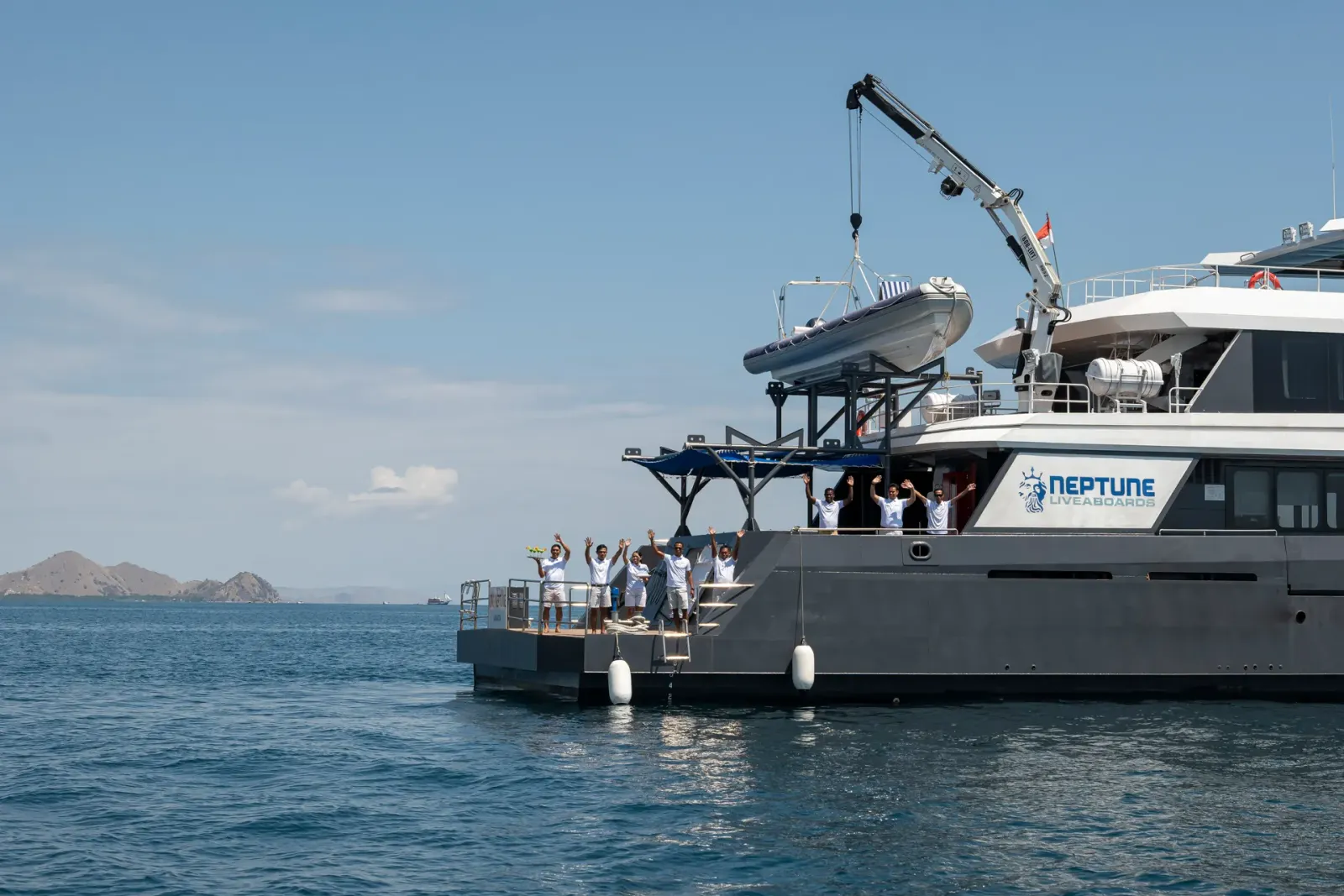
Our three boats all run Komodo, and they reach the two halves in different ways.
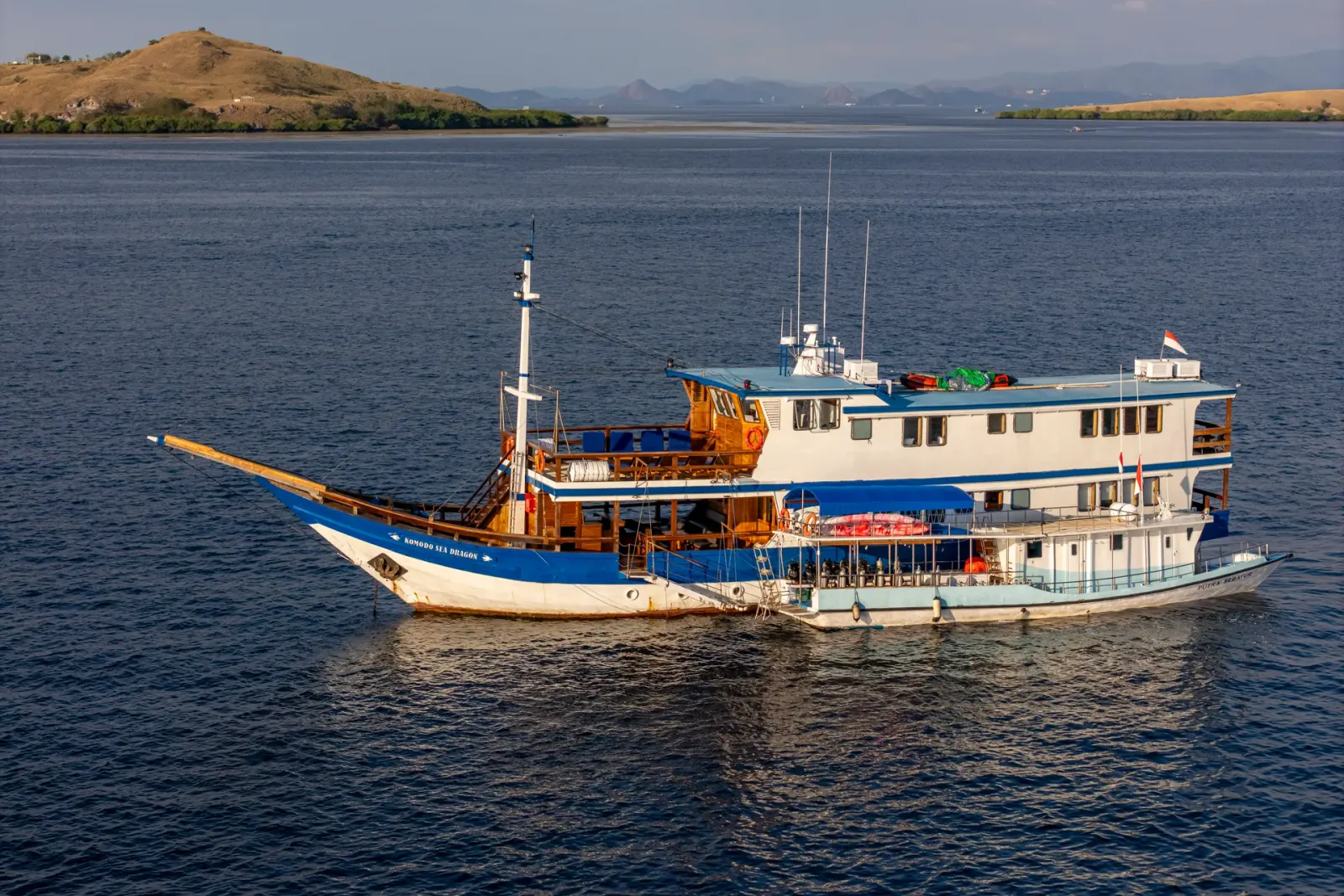
- Komodo Sea Dragon is a 35-metre wooden phinisi with 6 cabins and 12 guests, running round trips from Labuan Bajo through the whole year on three to seven-night itineraries. The six and seven-night departures are the ones that reach the south.
- King Neptune, 46 metres and 20 guests, runs a dedicated "Komodo North & South" itinerary from late May through August 2027, with nitrox included, as well as longer Komodo to Alor crossings.
- Neptune One, 39 metres and 16 guests, runs a "Best of Komodo" itinerary in July and August 2027, and a Bali to Komodo route in June 2027 that arrives in the park from the west.
The north-and-south trip is for certified divers with Advanced Open Water or equivalent experience, recent drift dives and the patience to let the captain choose the day's sites, who want the full range of the park rather than its highlights. It suits photographers who want both wide-angle and macro on one trip, and repeat Komodo visitors who have done the north and want the half of the park most people miss.
It is not for divers below Advanced level who want the northern pinnacles at full strength, for anyone who hates cold water and does not want to pack a 5 mm suit, or for travellers who need a guaranteed itinerary, because no honest operator can promise the southern crossing in advance. A non-diving partner is also better served by a shorter north-and-centre trip with more land time, Padar and the dragon walks, than by a week built around cold southern dives. For a private group that wants to set the route itself, a charter is usually the better structure than a scheduled cabin trip.
Key takeaways
- Komodo's north is warm, clear and current-driven; its south is cold, green and plankton-rich, fed by Indian Ocean upwelling.
- Northern pinnacles such as Castle Rock need Advanced-level current skills; southern sites such as Cannibal Rock need a 5 mm suit or thicker.
- The south is coldest and best for feeding mantas from June to September, around 22 °C in August.
- The northwest swell from December to March often closes the north, while the centre and south stay warm and calm.
- Reaching the south adds roughly half a day each way, so plan six or seven nights to dive both halves.
- May to early July is the most reliable window for a single trip covering north and south.