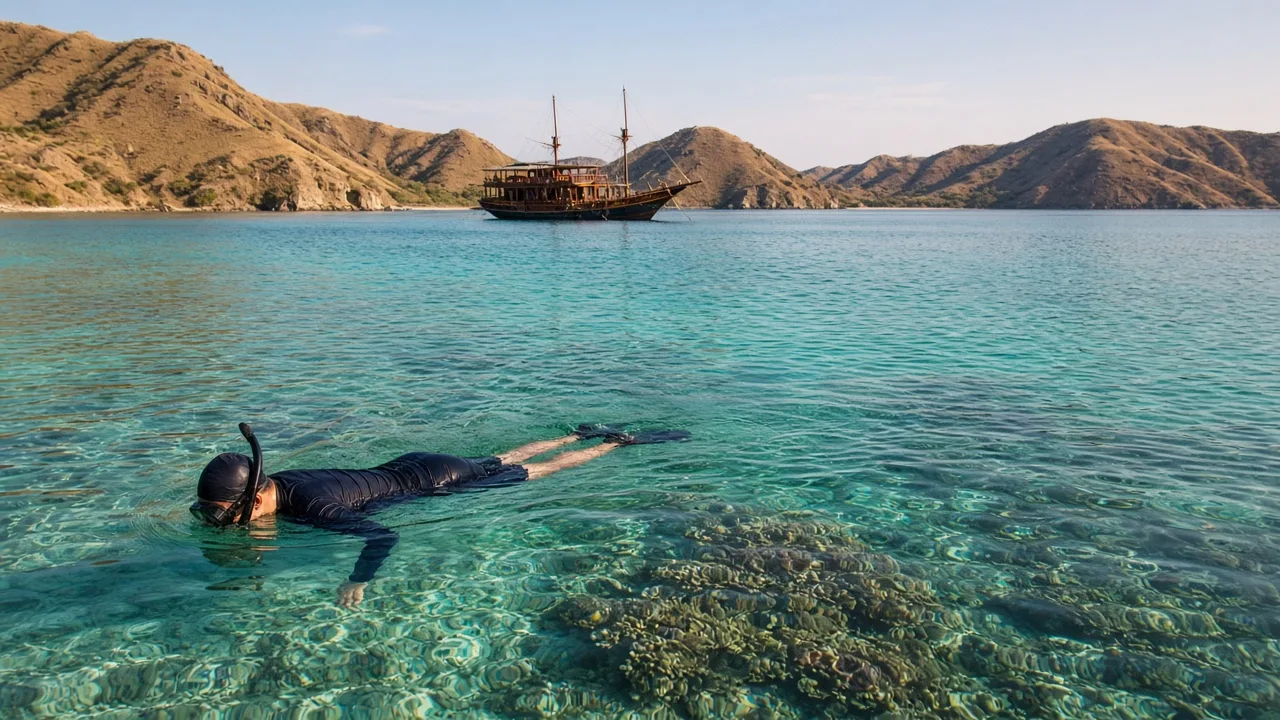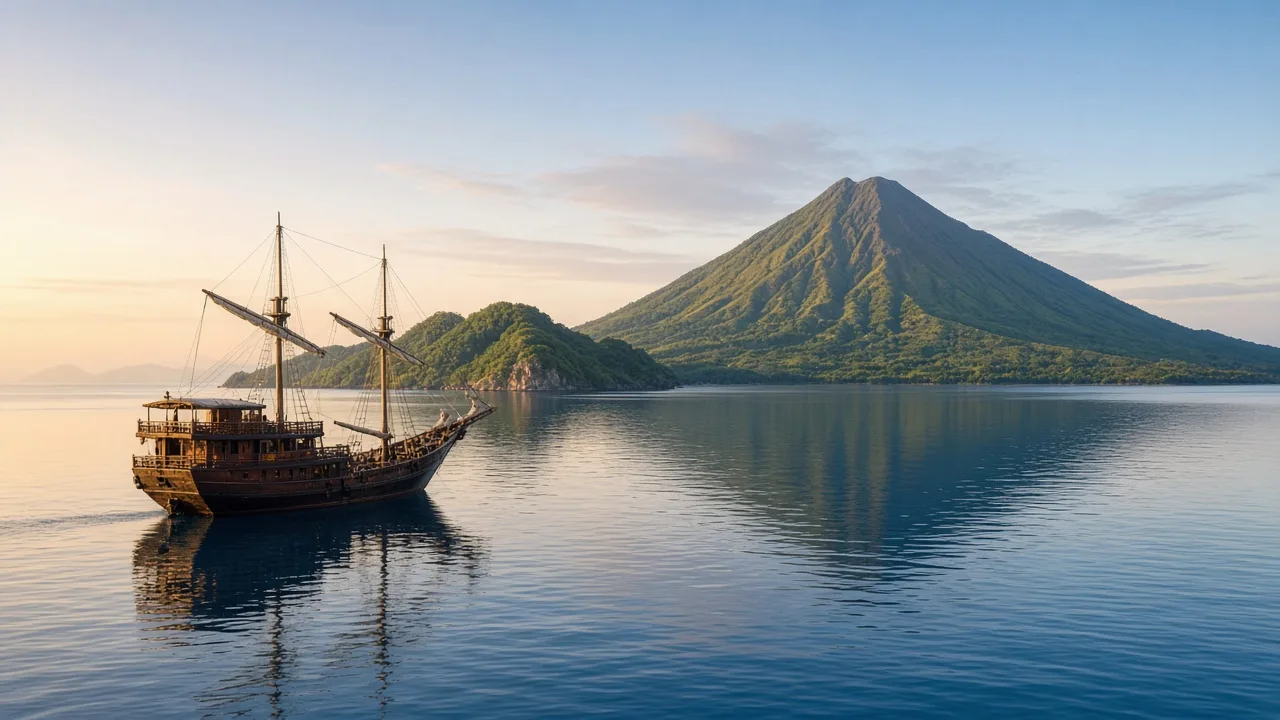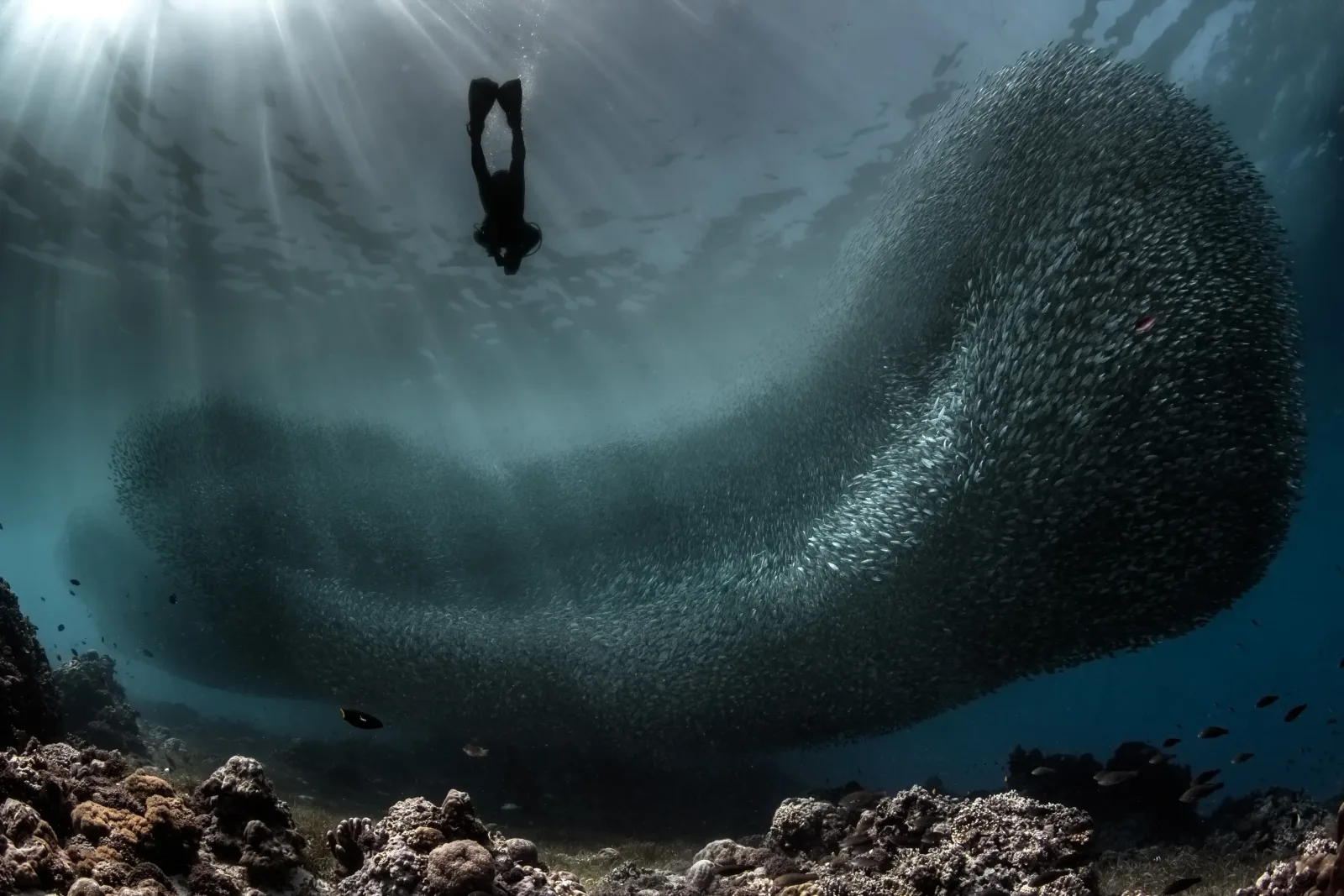
Komodo National Park is a 1,800-square-kilometre marine and terrestrial reserve in the centre of Indonesia, sitting between Sumbawa to the west and Flores to the east. It is best known topside for the Komodo dragons that share its name, but underwater it is a different kind of remarkable. The park sits at the boundary where warm Pacific water flowing south meets cold Indian Ocean water rising from the Sape and Lintah Straits, and the temperature contrast drives a current system that delivers two of the most opposite diving experiences in Indonesia within a few hours of each other.
In the north, you get warm, current-fed pinnacles with schooling pelagics, sharks, and adrenaline-grade drifts. In the south, the same currents bring up cold water (sometimes 22 degrees Celsius in August), and the cold-water diving produces extraordinary macro density, soft coral walls, and the biggest manta aggregation in Komodo. Few dive areas anywhere on earth offer this kind of variety in a single park.
This guide covers eleven sites we genuinely consider the best Komodo has to offer, organised by region. It is written from operator perspective, drawing on the trips our three liveaboards run through Komodo each season. The aim is to be specific and honest. We tell you what each site delivers when conditions cooperate, what happens when they do not, and the difficulty level you actually need to be ready for. We also note which sites are realistic on which itinerary lengths, because Komodo's three regions cannot all be dived on a five-day trip. If you are still deciding between Komodo and Raja Ampat, our Raja Ampat vs Komodo comparison covers that question. For broader logistics, see our Komodo liveaboard itineraries guide.
How Komodo National Park Is Laid Out
For diving purposes Komodo divides into three practical regions, and understanding the geography determines which sites are reachable from where:
- North Komodo (Gili Lawa group): the islands of Gili Lawa Darat and Gili Lawa Laut and the surrounding water at the northern entrance to the park. Pinnacle sites with strong currents, schooling pelagics, and the highest concentration of sharks. Reachable from Labuan Bajo (Flores) in three to four hours by liveaboard. The base region for short itineraries (3 to 4 nights).
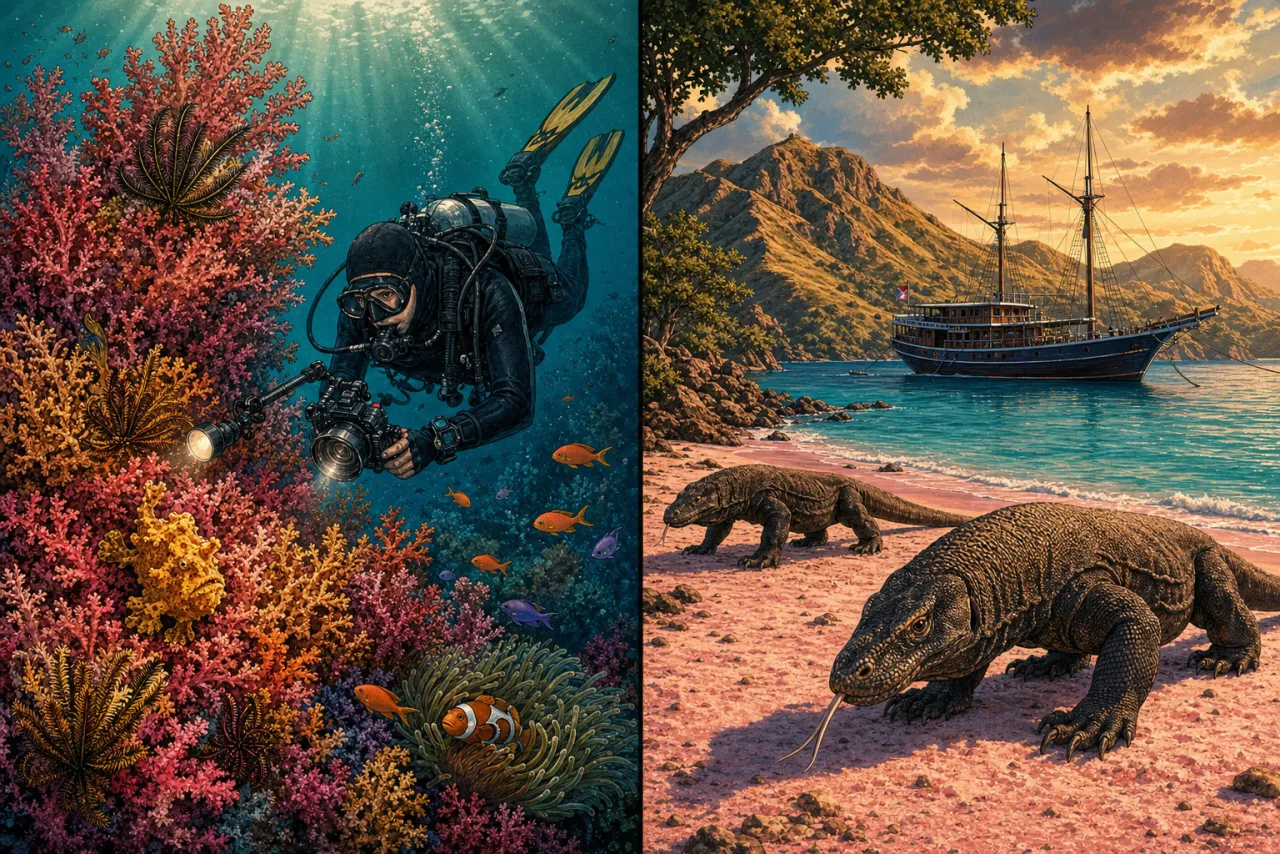
- Central Komodo (Komodo and Padar): the channel between Komodo and Padar islands, plus the western and southern coasts of Komodo island. Mixed depth profile with both dramatic pinnacles and easier reefs. Includes the photogenic dragons-on-pink-beach topside stops. Most week-long trips operate primarily here.
- South Komodo (Horseshoe Bay region): the cold-water bay at the southern tip of Rinca and the open water south of Komodo island. Cooler temperatures (22 to 26 degrees), exceptional macro, and the biggest manta aggregation in the park at Manta Alley. A separate world from the rest of Komodo, requiring at least a 6-night itinerary to include reliably.
A standard 4-day Komodo itinerary covers North and a slice of Central. A 6-7 day itinerary can include all three regions if the weather cooperates. South Komodo is the region most likely to be skipped on shorter trips because reaching it adds half a day of crossing each way.
North Komodo: Adrenaline Diving on the Pinnacles
The northern entrance to Komodo National Park is dominated by a series of submerged pinnacles between Gili Lawa Darat, Gili Lawa Laut, and the smaller islets in the channel. The combination of strong tidal flow and high-relief topography creates the conditions that make this the most reliable pelagic diving in the park. Five sites stand out.
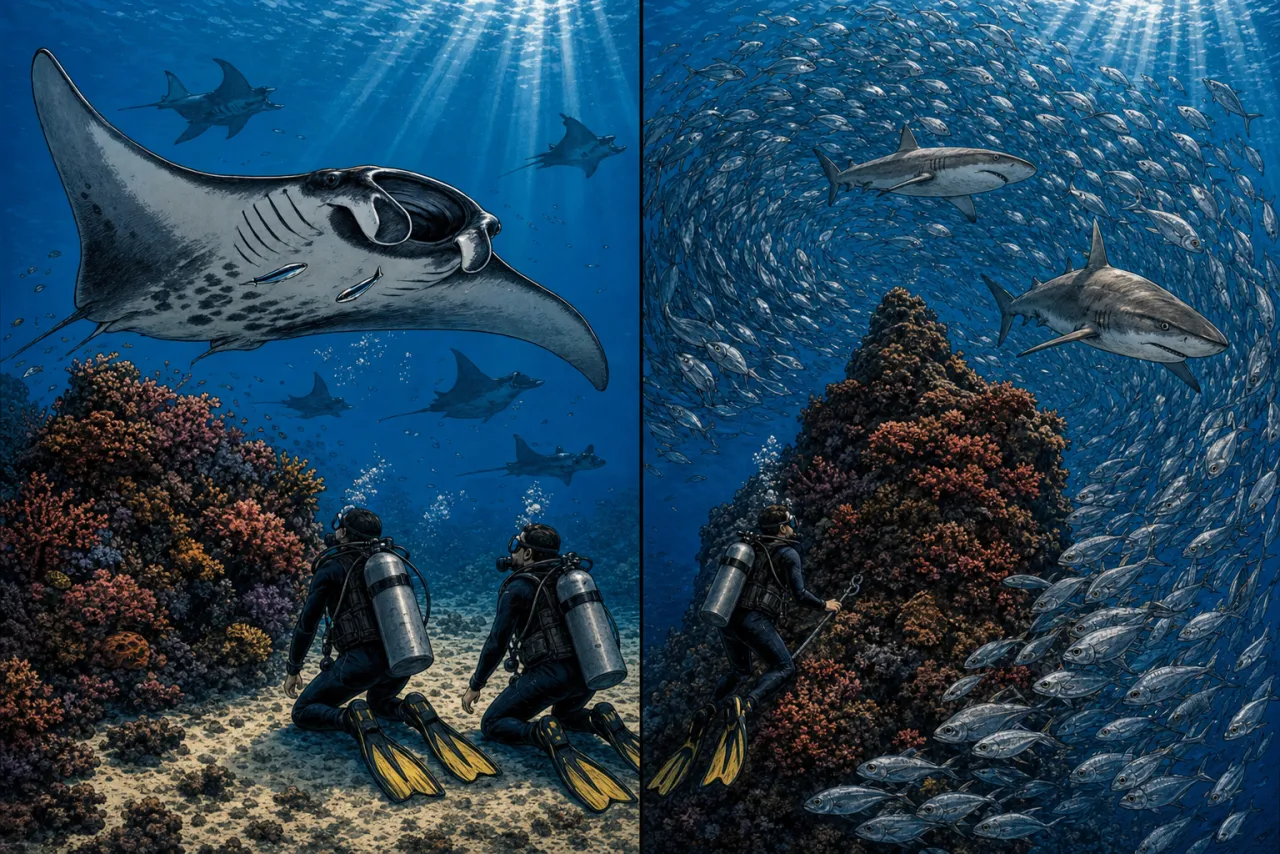 Castle Rock with two grey reef sharks bursting through the school and a single diver hooked-in by a reef hook" loading="lazy">
1. Castle Rock
A submerged pinnacle in the channel north of Gili Lawa Laut, with its top at about 6 metres and the surrounding water dropping away to 40-plus metres on all sides. Castle Rock sits directly in the path of the tidal current that flushes through the northern channel, and on a running tide, the entire water column above the pinnacle fills with fish hunting in the current.
What you see: dense schools of trevally, fusiliers, snapper, and barracuda. Whitetip and grey reef sharks are routine, often a dozen or more circling the pinnacle on a strong incoming current. Dogtooth tuna, giant trevally, and Spanish mackerel work the edges. Eagle rays and the occasional manta passing through. The reef itself is heavily encrusted with soft coral and gorgonian fans on its leeward side.
Difficulty and conditions: advanced. Currents at Castle Rock range from manageable to fully ripping, and the dive plan is always a negative entry, fast descent to the pinnacle, and reef-hook the upcurrent corner. Depth typically 18 to 30 metres. Open Water divers cannot dive Castle Rock; the operator standard is Advanced certification with recent reef-hook experience.
Operator note: Castle Rock is the dive most North Komodo trips are organised around. We time it to the slack-to-incoming tidal phase whenever possible, because that combination produces the strongest fish action without making the dive technically dangerous. On the wrong tide, currents can turn so strong that the dive becomes a struggle just to stay in place, and we move guests to a backup site rather than force a poor experience.
2. Crystal Rock
A neighbouring pinnacle to Castle Rock, less than 200 metres away in the same channel. The geometry is similar (a submerged pinnacle in current) but the visibility tends to be cleaner here, which gives the site its name, and the topography is slightly more forgiving. Crystal Rock is often dived as the second dive of a Castle Rock morning, since the same boat anchorage serves both.
What you see: the same cast as Castle Rock: schooling fusiliers, trevally, snapper, and barracuda, sharks circling at depth, pelagic predators on the edges. Crystal Rock has a cleaner descent profile and slightly better light penetration, which makes it the photographer's favourite of the two pinnacles. Soft corals and sea fans cover the slopes.
Difficulty and conditions: advanced. Same current pattern as Castle Rock, with similar reef-hook requirement on running tides. Depth 5 to 30-plus metres.
Operator note: for guests intimidated by Castle Rock's reputation, we sometimes run Crystal Rock first as a current-management warmup. It is the same kind of dive, just slightly more forgiving in current strength. By the time the guest does Castle Rock the next day, the technique is second nature.
3. The Cauldron (Shotgun)
A unique dive site shaped by the geography of the channel between Gili Lawa Laut and Gili Lawa Darat, in the north of the park. The current accelerates through a narrowing passage, then ejects divers over a shallow coral garden on the far side, creating a "shotgun" effect that has given the site its English name. The Indonesian name, Lautan Tertawa or "Laughing Sea," refers to the foam patterns the surface produces during the strongest tidal phase.
What you see: the dive begins with a manta cleaning station on a sandy plateau before the channel narrows. Reef mantas (Mobula alfredi) are present here in season, often circulating above the cleaning fish. The next phase is the channel itself: a current-fed drift that propels divers through a narrow gap before opening into the amphitheatre, where the released current attracts schools of fusiliers and predator fish. Sharks (whitetips, grey reefs) patrol the deeper edges of the amphitheatre.
Difficulty and conditions: advanced. The approach and the bowl are usually calm, but the gap itself can run at around five knots, and at peak spring tides the channel develops up-currents, down-currents and turbulence where opposing flows meet. The exit from the bowl in particular has a reputation for pulling divers deeper than they planned. This is an Advanced Open Water site requiring roughly 30 to 50 logged dives and genuine drift experience, and it is dived only within a specific tidal window. Our full guide to the Cauldron and Shotgun covers the tides, the four zones and the skills it asks for.
Best time: mantas are present at the cleaning station almost year-round but most reliably between December and February. The strongest current effect is two to three hours either side of full and new moon spring tides.
Operator note: the Cauldron is the most visually distinctive dive in North Komodo. Where Castle Rock is about pelagic density, the Cauldron is about the experience of riding a controlled current through a defined geographic feature. Most guests rate it as their favourite dive of the northern leg even when the manta count is modest.
4. Tatawa Besar
A long, sloping reef wall off the eastern side of Tatawa Besar island, between Komodo and Padar. The site is a classic drift dive: a single direction, a long stretch of healthy reef, and a current that does most of the work. Tatawa Besar is one of the most reliable dives in central Komodo for divers who want the visual scale of a long dive without the technical demand of the northern pinnacles.
What you see: a continuous slope of soft coral, gorgonian fans, and barrel sponges in 5 to 25 metres of water, dotted with schools of fusiliers, snapper, and surgeonfish. Whitetip and blacktip sharks rest on sandy patches. Turtles cruising through, sometimes several on a single dive. Octopus and reef cuttlefish in the coral. The colour density of the soft corals is what most divers remember.
Difficulty and conditions: intermediate. The current is reliably present but rarely strong enough to require a reef hook, and the slope topography makes it easy to manage depth. Typical depth 10 to 25 metres. Open Water divers in good buoyancy can dive Tatawa Besar without issue.
Operator note: Tatawa Besar is the site we most often run as a recovery dive after a pinnacle morning. The drift is relaxing, the visual variety is high, and the dive ends naturally at a sandy bottom that is easy to surface from. Photographers who want soft coral work without the chaos of Castle Rock often rate Tatawa Besar higher than its reputation.
5. Tatawa Kecil
The smaller sister island of Tatawa Besar, with a single bommie-style dive site on its leeward side. Tatawa Kecil is the bommie that the dive name refers to: an isolated coral pinnacle rising from a sandy bottom, encrusted with hard and soft corals and surrounded by reef fish in concentrations the small footprint should not be able to support.
What you see: dense schools of yellowtail fusiliers, glassfish, sweetlips, and snapper hovering off the bommie. Whitetip reef sharks resting under coral plates. The occasional grey reef shark passing in deeper water. A high concentration of cleaner shrimps and small reef fish makes the site rewarding for macro photographers as well.
Difficulty and conditions: easy to intermediate. The current is sometimes present but the bommie geometry creates calm pockets on the leeward side where divers can shelter and observe. Depth 5 to 25 metres. Open Water divers welcome.
Operator note: Tatawa Kecil is the site we recommend for divers who feel intimidated by the northern pinnacles but want a similar "lots of fish, healthy coral" experience. It produces the same visual sensation in a much more forgiving package.
Central Komodo: Variety on a Single Channel
The water between Komodo and Padar islands is the most-dived stretch in the park because it combines short transits between sites, mixed difficulty levels, and the ability to alternate dramatic pinnacle dives with calmer reef dives within a single morning. Three sites stand out.
6. Batu Bolong
A pinnacle barely the size of a tennis court, in the middle of the channel between Komodo and Padar. From the surface Batu Bolong looks unremarkable: a small rocky outcrop with a tunnel through it (its name means "rock with a hole"). Underwater it is one of the most concentrated dive sites in Indonesia. The pinnacle drops vertically on all sides, with current splitting around it and creating both a fish-magnet on the upcurrent face and shelter on the downcurrent face. Within that small footprint is some of the densest hard coral, soft coral, fish, and macro life in the park.
What you see: the upcurrent face of Batu Bolong delivers a vertical wall of soft coral and feather stars, fronted by schools of pyramid butterflyfish, fusiliers, and unicornfish. Sharks (whitetips, grey reefs) patrol the shoulders. Eagle rays and trevally pass on the open-water side. Macro divers find pygmy seahorses on gorgonian fans, frogfish in the coral encrustations, and flamboyant cuttlefish in the rubble at the base. The volume of life on a 30-metre pinnacle is the kind of thing that has to be seen to be believed.
Difficulty and conditions: intermediate to advanced. Current at Batu Bolong is always present and can be strong; the dive plan is to drop on the leeward side and work around the pinnacle, ascending into the current shadow as the dive progresses. Depth typically capped at 20 to 25 metres on the upcurrent face, deeper if you choose to explore the southern face. Reef hooks are not standard equipment for this site; the technique is to use the topography itself for shelter.
Operator note: Batu Bolong is the dive that most often produces the sentence "I have never seen anything like that." For experienced divers it is also the most photogenic single site in Komodo: the combination of vertical wall, soft coral, and reef-fish density compresses everything Komodo offers into a single 60-minute dive. We schedule it for the middle of the trip when guests have enough buoyancy practice to manage the current without panicking.
7. Siaba Besar
A long, shallow reef on the western side of Siaba Besar island, in the central channel. Where Batu Bolong is dramatic, Siaba Besar is gentle. It is a shallow turtle and sea cucumber haven with a sandy slope that gradually deepens, and the dive flows along the reef edge with no particular current management required.
What you see: sea turtles in genuinely large numbers, five to fifteen on a typical dive, including both green and hawksbill species. The reef supports schools of damselfish, butterflyfish, and parrotfish, and the sandy bottom hosts garden eels and the occasional reef ray. The site is also a known sleeping spot for whitetip reef sharks during the day.
Difficulty and conditions: easy. Calm water, gentle slope, depth easily managed in the 5 to 15 metre range for most of the dive. One of the most beginner-friendly sites in Komodo. Open Water divers welcome.
Operator note: Siaba Besar is the site we recommend for guests' first dive in Komodo, particularly after a long travel day. The turtle density is high enough to feel rewarding without requiring any current technique, and the calm water gives newer divers space to settle their buoyancy before tackling the pinnacles.
8. Makassar Reef (Manta Point)
A long, sandy plateau in the northwestern part of central Komodo, between Komodo island and Tatawa, often referred to as "Manta Point" by liveaboard operators. The plateau acts as a manta highway: reef mantas use it as a feeding lane on incoming tides, sometimes in pairs or trains, and divers position themselves along the sandy bottom to watch them pass overhead.
What you see: reef mantas (Mobula alfredi) almost exclusively, with occasional eagle rays and reef sharks moving through. The site is a feeding ground rather than a cleaning station, so the experience is dynamic (mantas pass through rather than circulate) but encounter rates are high in season.
Difficulty and conditions: easy to intermediate. The plateau is shallow (5 to 15 metres) and the dive is conducted as a drift along the sand. Currents are typically light to moderate. Open Water divers welcome.
Best time: December to February is the peak feeding season at Makassar Reef. Outside this window, manta encounters drop sharply. Year-round, it remains a pleasant easy dive but the pelagic action belongs to the wet season.
Operator note: Makassar Reef is one of the few Komodo dives where guest expectations need calibrating before the dive. We tell guests up front that "Manta Point" is not a guarantee. Some dives produce zero mantas, particularly outside peak season. When the mantas are running, however, it is the kind of dive that justifies a return trip in itself.
South Komodo: Cold Water, Macro, and the Manta Aggregation
The southern part of Komodo National Park is a different world. The cold upwelling from the Indian Ocean drops the water temperature to 22 to 26 degrees in places, and the cold water carries nutrients that feed an exceptional macro and soft coral ecosystem. This is also where the park's most spectacular manta aggregation occurs. South Komodo is liveaboard country: it is too far from Labuan Bajo for day boats, and reaching it from a 4-night northern itinerary is not realistic. The three sites that follow define why a longer Komodo trip is worth the extra days.
9. Manta Alley
A narrow channel on the southern coast of Komodo island, where reef mantas aggregate in numbers that are genuinely difficult to overstate. On the right tide, twenty or more mantas circulating a single cleaning station is normal. The channel itself is shaped to funnel both current and plankton, and the mantas exploit this to feed and clean at the same locations day after day.
What you see: reef mantas (Mobula alfredi), in numbers. Encounters of fifteen to twenty-five mantas in a single dive are not unusual during peak season. The channel walls are themselves heavily encrusted with soft coral and host schools of reef fish, but the mantas are the entire reason to dive here. Eagle rays and reef sharks are frequent supporting cast.
Difficulty and conditions: intermediate. The current in Manta Alley can be strong and the channel topography requires careful positioning to avoid disturbing the mantas. Water temperature drops to 22 degrees in August, so a 5mm wetsuit is the minimum recommended kit, and many divers use 7mm or hooded vests for comfort. Depth 5 to 25 metres.
Best time: April to June and September to November are the most reliable manta windows. December to February also produces good encounters but conditions are less consistent. The cold August upwelling is the most dramatic feeding event of the year: water temperatures drop, plankton density spikes, and the mantas appear in their largest aggregations.
Operator note: Manta Alley is the single dive that justifies a 6-night Komodo itinerary on its own. Guests routinely describe it as the most extraordinary dive of their lives, and we have repeat visitors who book southern Komodo specifically for this site. Compared to Makassar Reef in central Komodo, Manta Alley delivers higher numbers and more dramatic feeding behaviour, in cooler water that requires more thermal preparation.
10. Cannibal Rock
A submerged pinnacle in Horseshoe Bay, on the southern coast of Rinca island. The bay is sheltered from the open ocean and the cold upwelling pools here, producing water temperatures that can drop below 22 degrees in August. The result is a macro and soft coral ecosystem unlike anywhere else in Komodo, closer in character to the cold-water diving of Lembeh than to the warm-water reefs of the north.
What you see: the soft coral and crinoid coverage at Cannibal Rock is among the densest in Indonesia. Macro highlights include frogfish, ghost pipefish, nudibranchs in extraordinary diversity, pygmy seahorses, and the resident schools of striped catfish. Reef fish include schools of fusiliers and snapper, and reef sharks are frequent. The pinnacle itself supports such heavy soft coral growth that the rock is often invisible beneath it.
Difficulty and conditions: intermediate. Currents at Cannibal Rock are typically moderate. Water temperature is the main complication: a 5mm minimum, longer surface intervals to warm up, and shorter dives for less thermally-tolerant divers. Depth 5 to 30 metres.
Operator note: Cannibal Rock is the site that most rewards a slow approach. The soft coral and macro density rewards 60-minute dives focused on small areas rather than long perimeter drifts. We schedule it for both a morning and a dusk dive when possible because the colour of the soft coral changes dramatically with the angle of the light. For divers who enjoy this kind of cold-water macro work, our Lembeh Strait diving guide covers the most famous muck destination in Indonesia.
11. Pillarsteen
A vertical limestone cliff on the southwestern coast of Komodo island, with a series of swim-throughs, caverns, and overhangs that have given the site its English name. Pillarsteen ("pillar stone") is the most architecturally distinctive dive site in Komodo and offers a contrast to the open pinnacle and reef diving elsewhere in the park.
What you see: the topography is the draw. Swim-throughs and caverns at varying depths host glassfish, lobsters, and resting whitetip reef sharks. Soft corals and sea fans cling to the vertical wall faces. The deeper sections (25 to 30 metres) feature occasional grey reef shark sightings. Macro photographers find pygmy seahorses on the gorgonian fans and a high diversity of nudibranchs in the swim-through walls.
Difficulty and conditions: intermediate. Currents are typically light, but the swim-through navigation requires good buoyancy and comfort with overhead environments. Water temperature 22 to 26 degrees depending on season. Depth 5 to 30-plus metres.
Operator note: Pillarsteen is the architectural highlight of southern Komodo and complements Cannibal Rock's macro focus and Manta Alley's pelagic focus. A 6-night southern itinerary that includes all three sites covers the full character of the cold-water region.
Practical: Itinerary Length, Season, and Certification
Itinerary length and what you can reach:
- 3 to 4 nights: North Komodo only. Castle Rock, Crystal Rock, the Cauldron, and a slice of central. Good for a short add-on to a Bali trip but misses Manta Alley and the southern macro entirely.
- 6 to 7 nights: the standard Komodo itinerary. Covers all three regions with at least one full day in the south. The realistic minimum to reach Manta Alley.
- 8 to 10 nights: more dive time per region, the Banda Sea passage as an option, and the ability to repeat the best northern pinnacles on the right tides.
Best time to dive Komodo:
- April to June: dry season starting, reliable conditions across all three regions, manta activity ramping up in the south.
- July to August: strongest cold upwelling in the south, peak macro and manta aggregation at Manta Alley. Slightly cooler water in the north and more wind topside.
- September to November: the operator's favourite season. Good conditions everywhere, manta activity continuing, fewer crowds at the major sites.
- December to February: wet season. Manta activity peaks at the central sites, Makassar Reef above all, but wind and swell make the exposed northern channel sites unreliable and boats often favour the centre and south.
- March: transitional, weather variable. Many liveaboards reposition for the new dry season.
Certification:
Komodo rewards advanced certification more than most Indonesian destinations because so many of the headline sites are current-managed. Open Water divers can absolutely have an excellent trip: Siaba Besar, Tatawa Besar, Tatawa Kecil and Karang Makassar are all accessible and produce memorable dives. But Castle Rock, Crystal Rock, the Cauldron and the strongest Batu Bolong dives are advanced-only. Reef-hook training is genuinely useful before a Komodo trip; we run a reef-hook briefing on every itinerary but the technique is easier to learn outside of Castle Rock's current.
Equipment:
The temperature range across Komodo is wider than most Indonesian destinations. North Komodo runs at 27 to 29 degrees and a 3mm wetsuit is comfortable. South Komodo can drop to 22 degrees in August and a 5mm minimum is recommended; many guests carry a 5mm with hooded vest for the southern leg specifically. A reef hook is essential equipment, and we provide them on all itineraries. SMB (surface marker buoy) deployment skill is required for the northern drift dives.
The Verdict: Choosing Your Komodo Dives
If you want pelagic adrenaline, the northern pinnacles (Castle Rock, Crystal Rock) deliver the most dramatic version of that experience anywhere in Indonesia. If you want manta encounters, Manta Alley is the strongest single-site manta dive in the country. If you want soft coral and macro, the cold water of Cannibal Rock and Pillarsteen produces some of the best in the region. If you want the iconic Komodo experience in its broadest form (pinnacles, mantas, swim-throughs, dragons on the topside) give yourself six to seven nights and visit all three regions.
For divers weighing Komodo against Raja Ampat as a single-trip choice, our Raja Ampat vs Komodo article covers that decision in depth. For trip planning specifics, our Komodo liveaboard itineraries guide breaks down route options. And for divers visiting Indonesia for the first time, our best diving in Indonesia overview puts Komodo in the wider context of what the country offers.