Last updated: May 2026.
Indonesia is the most photographed country underwater that nobody quite calls a photography destination. The Bahamas have Tiger Beach. The Galápagos have Darwin's Arch. French Polynesia has Fakarava. Indonesia has, somehow, all of it: the densest soft-coral walls on the planet at Misool, the manta cleaning stations of Manta Alley, the muck-diving capital of the world at Lembeh, the wobbegongs and walking sharks of Raja Ampat, the schooling hammerheads of the Banda Sea, and the volcanic mola pinnacles of Bali. And yet ask a photographer where they're going next year and you'll hear Sipadan, Anilao, or the Maldives more often than you'll hear "Raja Ampat."
That's a marketing problem more than a real one. In terms of what you actually photograph, Indonesia is genuinely without equal. It has the broadest subject range of any single dive country on earth, the widest seasonal calendar (some part of the country is in peak photography conditions essentially year-round), and the kind of biodiversity that lets a serious photographer come back five times in five years and still be shooting new species. Our shooters who've been doing this for fifteen years routinely tell us the same thing: Indonesia is the country that keeps surprising them.
This guide is for divers who shoot. We're going to walk through the country region by region, separated cleanly into wide-angle territory (where reef walls, big animals, and seascapes are the headline) and macro territory (where critter hunts and tiny subjects are the work), with seasonality, gear, conditions, and the practical realities of shooting from a liveaboard. We'll be honest about what works and what doesn't, what's hyped and what's quietly excellent, and what the boats need to have for a photographer to actually get the most out of a trip. By the end you should know exactly which region fits your camera setup and your travel calendar.
The Big Picture: Wide-Angle vs Macro, Region by Region
Indonesia divides cleanly into two photographic realms, and you don't really pick a trip without first picking which side you're shooting.
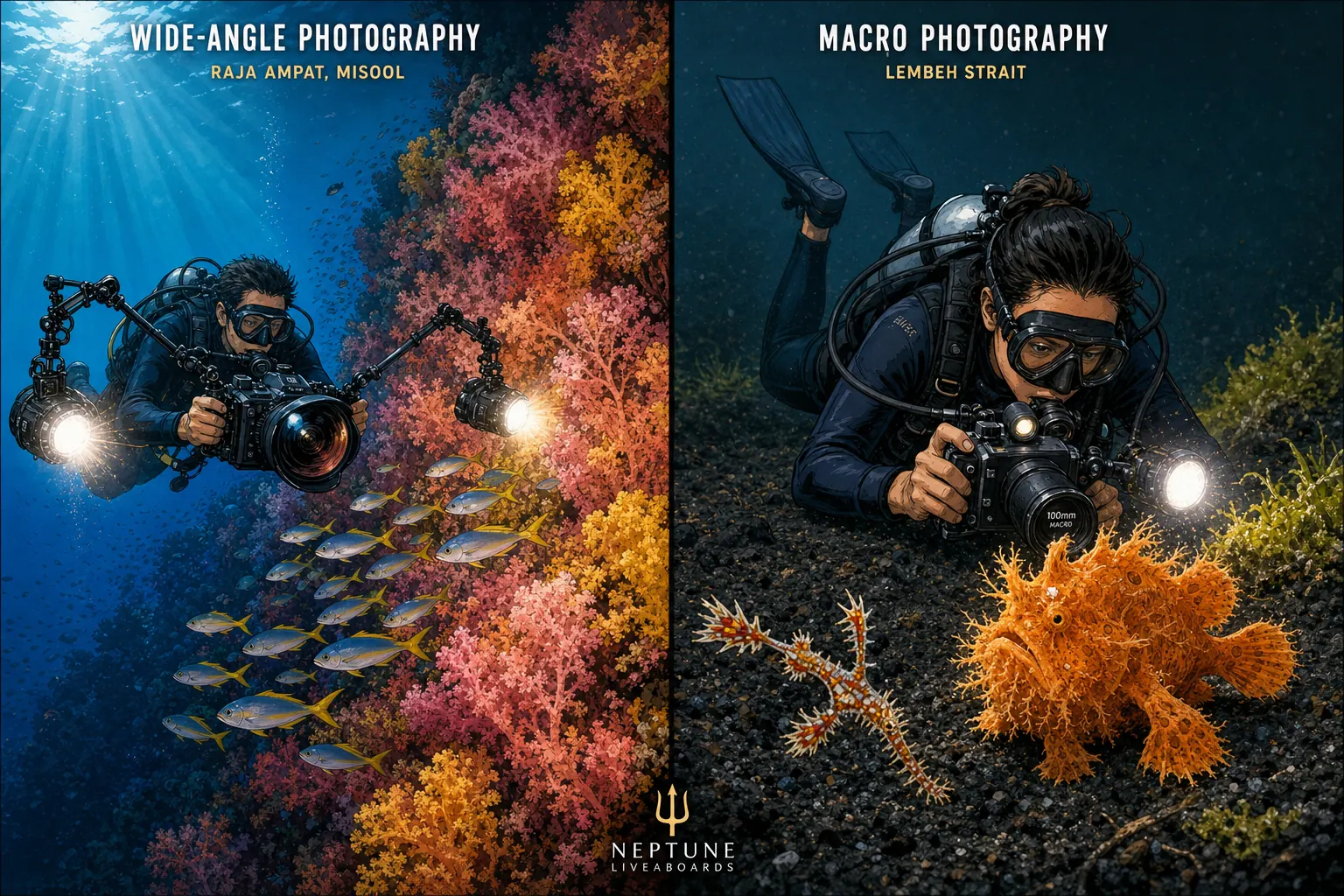
The wide-angle regions are Raja Ampat (Misool, Dampier, Aljui, Wayag), Komodo (Manta Alley, Castle Rock, Crystal Rock), Cenderawasih Bay (whale sharks at the bagans), the Banda Sea (volcanic seamounts, hammerhead schools, giant sea fans), and Wakatobi (wall diving). These are the regions where a 14mm fisheye or rectilinear wide is on the camera most of the dive, where dome ports and dual strobes are the kit, and where the subjects are big and the compositions are about light, depth, and seascape rather than detail.
The macro regions are Lembeh Strait (the global capital of muck), Ambon Bay, parts of Bali (Tulamben muck, Padang Bai macro), and parts of the Forgotten Islands. These are the regions where a 60mm or 100mm macro lens is glued to the body, flat ports replace dome ports, single or focusing-light setups become more common, and the dive is a slow, patient hunt for nudibranchs, frogfish, mimic octopuses, hairy frogfish, harlequin shrimp, pygmy seahorses, and the dozens of other macro headliners that make Indonesia macro photographers come back annually.
A handful of regions blur the line. Raja Ampat does have macro at Mansuar's reef-flats and inside Aljui Bay (the Yenbuba pygmy seahorse scene is world-class). Komodo has surprising macro in Cannibal Rock and Yellow Wall. But by and large, you choose your trip by the type of photography you came to do, and you don't really try to do both well in a single cruise. The mistake we see most often on first-time photo bookings is the diver who shows up with a macro-only setup to a Raja Ampat wide-angle cruise, or the wide-angle shooter who goes to Lembeh and spends a week wishing they'd brought the 100mm.
Wide-Angle Indonesia: Reef Walls, Big Animals, and Seascapes
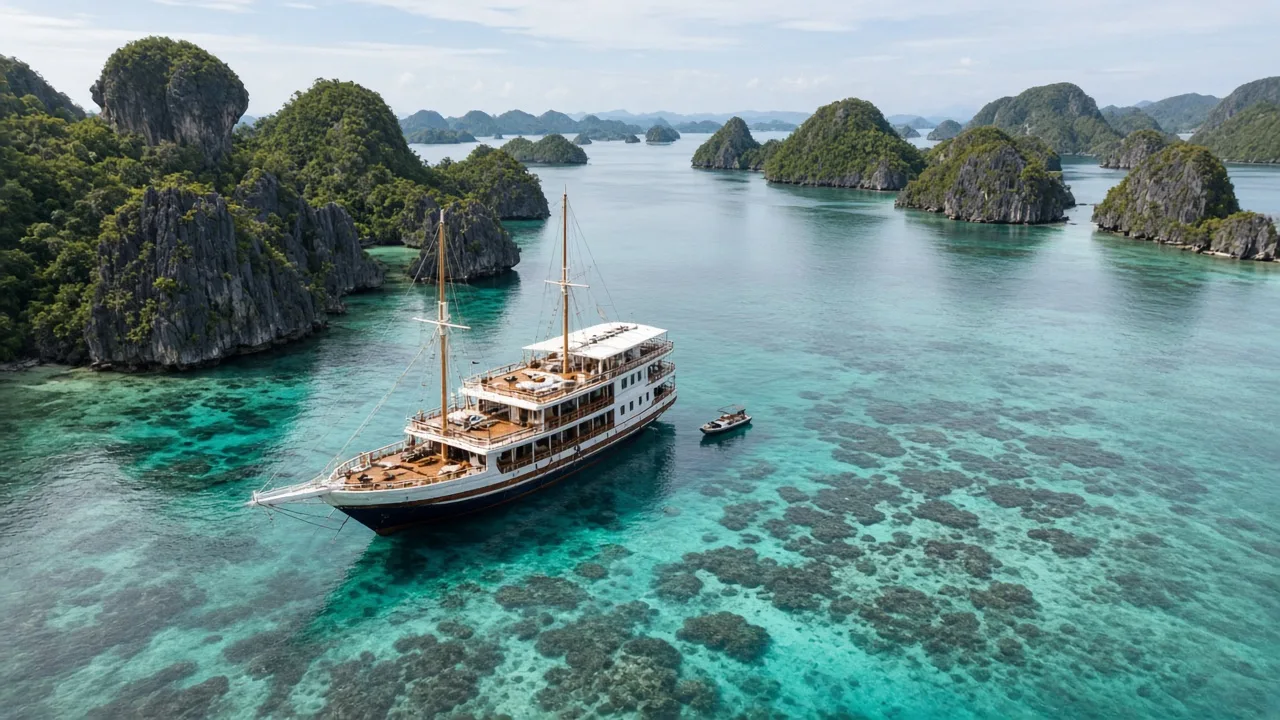
Raja Ampat: The Country's Wide-Angle Capital
If we had to pick a single Indonesian region for a photographer who shoots wide-angle and only wide-angle, the answer is Raja Ampat. The combination of soft-coral density, water clarity, fish biomass, and seascape variety is unmatched anywhere we've worked. A typical Raja Ampat dive at Magic Mountain in the southern Misool group will give you twenty minutes of soft-coral wall (every shade of fuchsia, orange, and soft yellow), passing manta rays at the cleaning station mid-dive, schools of fusiliers and trevally for foreground action, and a shallow safety stop over a coral garden in five metres of clear water that's its own small composition opportunity.
The Misool sites we'd point a wide-angle photographer at first: Magic Mountain for manta cleaning stations and soft-coral walls, Boo Window for the swim-through with the natural light beam, Whale Rock for blue-water composition with reef silhouettes, and Four Kings for the deeper soft-coral ridges. The Dampier Strait's headline is Cape Kri, where the schooling fusiliers and reef-shark fly-bys are the daily fare, and Sardine Reef for the namesake bait-ball density. North in the Wayag area, the topside karst-island viewpoint is the postcard shot you've seen a hundred times, and the underwater is shallower and calmer than the southern routes, good for novice wide-angle shooters working on technique.
Conditions: visibility at twenty to thirty metres on most days, water at twenty-eight to twenty-nine degrees year-round, current management with reef hooks at the more exposed sites. The peak photography season is October through April, with December and January as the most consistent months. We cover the sites in detail in the Raja Ampat dive sites guide; for cruise itineraries see the Raja Ampat liveaboard guide.
Komodo: Big-Animal Wide-Angle in Strong Currents
Komodo's wide-angle photography is high-tempo. The current-fed pinnacles (Castle Rock, Crystal Rock) deliver the densest schools of grey reef sharks, whitetips, jacks, and trevally you'll see anywhere in the country, but they require a different shooting discipline than Raja Ampat's softer drifts. You're often hooked in to a rock with one hand, trying to keep the camera level, with current fast enough that the strobes flag in the flow. Composition is about reading the school's movement and pre-firing the shutter at the right moment. The Cauldron, or Shotgun asks for the opposite approach again, since you cannot hook in through the channel at all: set a wide lens, leave it on video, and let the current do the panning.
The two Komodo sites that produce the most published wide-angle frames are Manta Alley in the southern park (a shallow, current-managed cleaning station where reef mantas come in low and slow, ideal for the over-under mantis-with-coral foreground composition) and Castle Rock in the central park (vertical seamount, schooling sharks, deep-blue background, dramatic). Cannibal Rock is the dark horse, a small pinnacle in the southern Komodo group with both wide-angle (small schools, soft corals) and macro (frogfish, octopus) on the same dive. We cover the broader site list in the Komodo dive sites guide; cruise structures are in the Komodo itineraries piece.
Komodo conditions: visibility fifteen to twenty-five metres, water cooler than Raja Ampat (twenty-five to twenty-eight degrees in peak months), current from gentle to ripping. Peak wide-angle photography is July through September, with late August often the single best window for fish biomass.
The Banda Sea: Volcanic Seamounts and the Pelagic Wide-Angle Window
The Banda Sea is the eastern, harder-to-reach region that the country's most-experienced wide-angle photographers tend to favour for the variety of pelagic and seascape opportunities a single cruise can deliver. The volcanic pinnacles at Suanggi and Manuk hold deep-water schooling hammerheads from late September into early November (one of the few sites in the country where you can get a hammerhead-school wide-angle frame in clear water), the historic islands of Banda Neira and Run offer rare topside-meets-underwater composition possibilities (the Dutch fort-on-island silhouettes plus reef work), and the giant sea fans on the southern walls are some of the largest in the Indo-Pacific.
This is not a starter wide-angle trip. The hammerhead pinnacles are deep (thirty to forty metres) with tight no-deco margins, the cruises run eleven to fourteen nights ex-Ambon, and you need to be comfortable shooting at depth with thermocline-cooled water. The reward, for photographers who manage the conditions, is a portfolio that no other Indonesian region can produce. Banda Sea region guide here; our shark guide covers the hammerhead sites in detail.
Cenderawasih Bay: Whale Sharks at the Fishing Platforms
Cenderawasih is the country's whale-shark photography destination. The bay's fishing platforms (locally called bagans) attract whale sharks year-round, with peak interactions from May through September. The shooting setup is unique: shallow water (often three to seven metres), one or sometimes two large adult animals at a time, fishermen feeding small bait-fish from the platform, and the photographer hovering at the surface with a fisheye on a dome port for the classic over-under-with-bagans composition.
Cenderawasih conditions favour shooters with light setups and good free-diving fundamentals; many of the best frames are made breath-hold rather than on scuba. The trip is logistically demanding (three flights from most international gateways) but the imagery is unique to the region. Cenderawasih guide here; whale-shark-specific guide here.
Wakatobi: Quieter Wall Diving for the Slow Wide-Angle Photographer
Wakatobi is the wide-angle pick for photographers who want technical excellence on coral wall composition without the current dynamics of Komodo or the long flights to Raja Ampat. The walls are dense, healthy, and dive-able year-round, the conditions are gentle, and the visibility is excellent. The trade-off is fewer big animals and less of the dramatic seascape variety. We'd recommend Wakatobi for photographers who want to work slow, on technique and lighting, and for shooters refining a portfolio rather than chasing trophy frames. Wakatobi guide here.
Macro Indonesia: Lembeh, Ambon, and the Critter Hunters' Country
Lembeh Strait: The Global Capital of Muck
Lembeh is the world's most photographed muck-diving destination, and there's no real competition for the title. The strait runs between Sulawesi and Lembeh Island in north Sulawesi, the substrate is volcanic black sand, the water is fertile and slightly turbid, and the species list reads like a wishlist for any macro photographer: hairy frogfish, painted frogfish, mimic octopus, wonderpus, blue-ringed octopus, mototi octopus, harlequin shrimp, ornate ghost pipefish, robust ghost pipefish, halimeda ghost pipefish, flamboyant cuttlefish, dragon shrimp, and a roster of two hundred-plus nudibranch species that turns over season by season.
The dive style is patient, slow, and guide-led. Lembeh dive guides are some of the most accomplished critter spotters on earth (most have ten-plus years on the same sites and know individual frogfish by personality), and a typical Lembeh dive is the guide spotting four or five subjects, the photographer spending five to twenty minutes on each, and a ninety-minute dive total. The kit is single-strobe or twin-strobe macro, focus light, snoot for the harder shots, and 60mm or 100mm macro lens. Wide-angle photographers usually have a frustrating week in Lembeh; this is genuinely a macro-only region.
The headline sites we'd point a macro photographer at: Hairball for the namesake hairy frogfish, TK 1 and TK 2 for octopus and ghost pipefish, Aer Bajo for the rhinopias scene, and Nudi Falls for the nudibranch density. Conditions: visibility variable (often eight to fifteen metres), water at twenty-six to twenty-eight degrees, current low to none. Peak macro photography is essentially year-round, with the Lembeh dry season (June through October) slightly more productive but the wet-season months still excellent. Lembeh Strait guide here.
Ambon Bay: The Underrated Second-Best Macro Country
Ambon is the rest of the macro-diving country that nobody talks about, and that's largely because the photographers who know it would prefer it stayed quiet. The bay sits on the south coast of Ambon Island in Maluku, the species roster overlaps significantly with Lembeh but with a quieter, less-shot variety, and the boat traffic is a fraction of what you'd see in the Lembeh strait. The Ambon scallops are part of the macro vernacular here (a species described from the bay), and the psychedelic frogfish (Histiophryne psychedelica) was first described from Ambon's reef-flats in 2009.
Most photographers find Ambon as a tail-end stop on a Banda Sea liveaboard or as a dedicated four-to-five-day land-based macro trip from a small Ambon resort. We route Ambon Bay into the longer Banda Sea cruises when calendar and conditions allow. The macro density is excellent, the guides are good (less polished than Lembeh's, but more time per critter), and the trip cost is lower than a Lembeh-only week. Ambon region guide here.
Tulamben (Bali): USS Liberty, Coral Garden, and the Macro at Seraya
Tulamben is the macro alternative for photographers who're combining a Bali trip with their liveaboard. The volcanic-sand bay holds the famous USS Liberty wreck (a mid-water wide-angle subject that's one of the most photographed wrecks anywhere), but more importantly for this guide, Tulamben's adjacent Seraya Beach is muck of similar quality to Ambon, the Coral Garden is a critter-rich shallow with juvenile reef fish, and the Liberty wreck itself produces both wide-angle and macro work depending on the conditions.
Tulamben is one of the few Indonesian sites where you can shoot a wreck at sunrise (60 metres of corroded steel covered in coral and crocodile-fish), then walk back to a black-sand muck dive twenty metres up the beach, all from the same kit room. We don't run liveaboards in Bali (it's a land-based diving region) but we do book Bali pre/post-trip stays for photo guests on Komodo and Raja Ampat cruises. The best macro at Seraya is October through April. Bali sites guide here.
The Photographer's Seasonal Calendar for Indonesia
Indonesia's photographic calendar runs on regional seasons that don't quite line up with the country's general dive calendar. Here's the photographer-specific version, by month, of what's at peak.
January: Raja Ampat at peak (wide-angle), Lembeh productive (macro, wet season), Bali Tulamben dive-able. The country's strongest single month for combined wide-angle and macro options if you split a trip.
February: Raja Ampat strong (wide-angle), Lembeh productive (macro), some monsoon variability in Bali.
March: Raja Ampat tail-end of peak (wide-angle), Lembeh transitions toward dry (macro), Ambon excellent (macro).
April: Komodo cruise season opens (wide-angle), Raja Ampat winds down, Lembeh strong, Bali productive.
May: Komodo building (wide-angle), Cenderawasih whale-shark season starts (wide-angle), Lembeh peak begins (macro).
June: Komodo strong (wide-angle), Bali mola season begins (wide-angle), Lembeh peak (macro), Ambon peak (macro).
July: Komodo at peak (wide-angle, fish biomass at maximum), Bali mola peak (wide-angle), Lembeh peak (macro).
August: Komodo peak (wide-angle), Bali mola peak (wide-angle), Lembeh peak (macro), Ambon excellent (macro). Generally the strongest single month for serious shooters who want big-animal wide-angle.
September: Komodo tail-end, Banda Sea season opens (wide-angle, hammerheads), Bali mola tail, Lembeh strong.
October: Banda Sea peak (wide-angle, hammerheads, sea fans), Komodo last cruises, Raja Ampat opens (wide-angle), Lembeh strong (macro).
November: Banda Sea season ends early in the month, Raja Ampat building (wide-angle), Komodo closed, Lembeh strong (macro).
December: Raja Ampat at peak (wide-angle), Lembeh strong (macro), Bali variable (monsoon edge).
If you're trying to compress two regional photography trips into one calendar year, the combinations that work best are: Raja Ampat in January or February + Komodo in August (both peaks of wide-angle, six months apart), or Lembeh in June + Raja Ampat in November (macro then wide-angle). For seasonality-by-region beyond photography, see the Indonesia liveaboard seasons guide.
Gear: What to Bring for Wide-Angle and Macro
The gear conversation for underwater photography in Indonesia comes down to the same trade-offs as anywhere, but the regional answers are different enough to be worth being specific about.
Wide-Angle Setup (Raja Ampat, Komodo, Banda, Cenderawasih, Wakatobi)
Camera body in a housing of your preferred brand (Nauticam, Aquatica, Ikelite, Sea & Sea, Isotta), large dome port (8-inch glass is the standard, 6-inch is the lighter pack-friendly option), 14mm fisheye lens (Tokina 10-17mm fisheye is the traditional crop-sensor pick; full-frame shooters typically use a 15mm or 8-15mm fisheye), or a rectilinear wide-angle 16-35mm for the cleaner edges. Dual strobes are standard (Inon Z-330, Sea & Sea YS-D3, Retra Pro Max are the popular picks at the moment), focus light for low-light composition, dual fibre-optic or sync-cord triggers, and the float arms long enough to position lights wide. Pack a backup port o-ring kit and at least three spare battery sets per shooting day.
For Raja Ampat soft-coral walls, a fisheye is on the camera ninety percent of the dive. For Komodo's faster-current sites, the rectilinear wide-angle is often a better choice (less distortion at close-range fish-school work). For Banda Sea hammerhead dives at thirty metres, a faster lens (f/2.8 zoom) and ISO discipline are essential because the ambient light at depth is meaningful.
Macro Setup (Lembeh, Ambon, Tulamben/Seraya)
Camera body in housing, flat port (replaces the dome), 60mm or 100mm/105mm macro lens (Nikon and Sony 105mm, Canon 100mm L are the workhorses; Olympus shooters use the 60mm), single or dual strobes positioned tight to the lens for traditional macro work, snoot for the precision lighting (Retra LSD, Backscatter Mini Flash, Inon Snoot), strong focus light for the autofocus-stealing low-light Lembeh work. Pack a wet diopter (Nauticam SMC, Saga +10) for super-macro on tiny subjects like shrimps and small juveniles.
For Lembeh and Ambon, the 100mm focal length is the better pick for working distance (you can light a frogfish without inhaling its head into your dome), and the snoot is genuinely transformative on the right subjects (mantis shrimp, juvenile filefish, harlequin shrimp). For Tulamben combined wide-angle and macro days, you'll need to commit to one configuration per dive and switch between dives; the salt rinse and re-port routine is part of the rhythm of the day.
The Practical Pack List
Beyond the camera, the pack list that separates a successful Indonesia photo trip from a frustrating one: at least four spare camera batteries (six is better for an eleven-night cruise), a dual-rate USB-C and mains charger that handles 100-240V, a hard case for housing transport (Pelican 1535 fits most full-frame setups in carry-on), ten spare port o-rings of each size you use, two backup memory cards minimum, a soft camera rinse-tank cover (the boat's tank will be shared), a microfibre lens-cloth set, and a small waterproof storage bag for shore-side transport between cabin and dive deck.
Lithium-ion battery rules on flights matter: hand-carry only, individual battery terminals taped or in original packaging, total watt-hour limits per battery (most camera batteries are well within the 100Wh limit, but very large external strobe packs can approach the limit). We'll send a baggage briefing to every photo guest pre-trip.
What to Look For in a Photo-Friendly Liveaboard
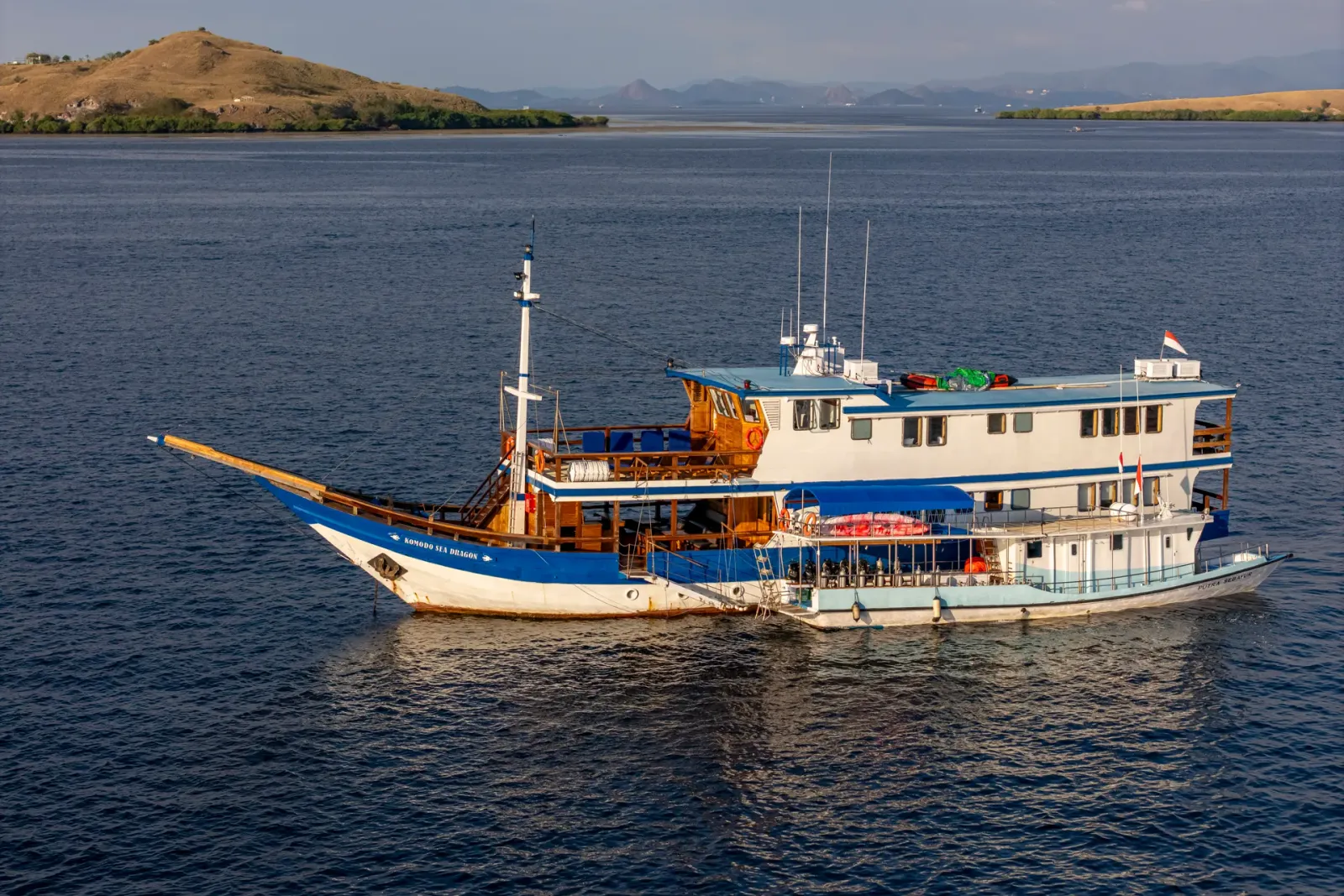
This is the section the photo gear forums get wrong most often. Choosing a liveaboard for photography is not about which boat has the best dive sites (most Indonesian liveaboards visit a similar core of sites); it's about which boat is set up for the workflow.
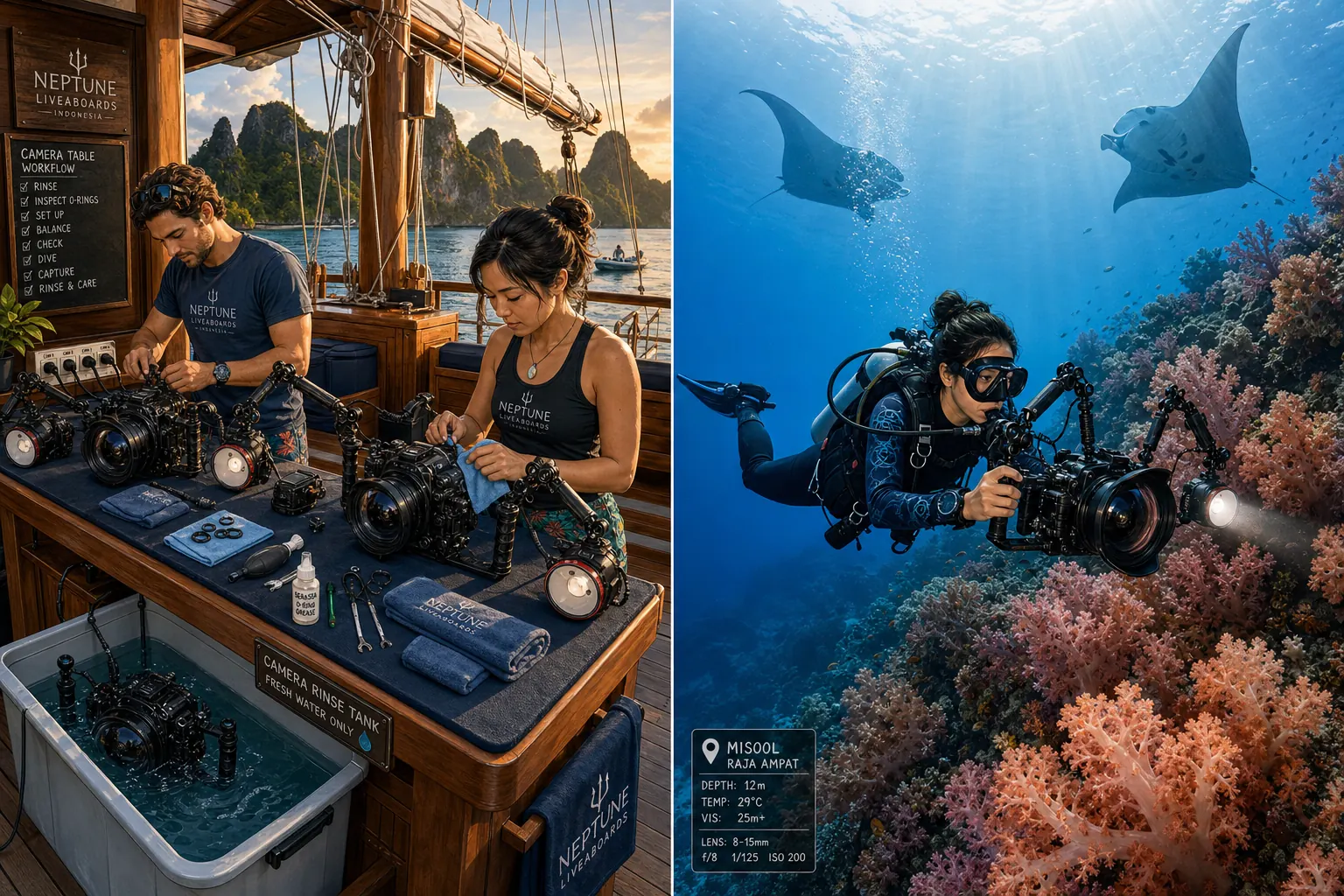
Camera tables. The single biggest tell of a photo-serious boat. Look for a dedicated, padded, raised camera table on the dive deck with at least one square metre per shooter, ideally individual workstations with personal storage. We've operated photo trips on boats with shared communal tables and on boats with individual stations; the latter cuts setup-and-breakdown time by half and dramatically reduces the chance of someone else's strobe getting elbowed into your dome.
Charging stations. Multi-outlet charging banks at the camera table, not in the cabins. The charging logistics for ten photographers each running three batteries on rotation requires a well-thought-out wiring layout. The boats that get this right have dedicated 110V and 220V outlet groups, USB-C banks, and surge-protected power. Boats that don't will have cabin trip-strips and cable spaghetti by day three.
Dedicated camera rinse tank. Separate from the regular salt rinse, ideally with fresh water rotated daily. We rinse every camera between dives in the dedicated tank; in a shared salt tank you'll get sand and silt working into o-ring grooves over the course of a week.
Group sizes and dive guide ratios. For serious photo trips, look for four-to-six photographers per dive guide maximum. Photographers shoot slow; a group of eight photographers and one guide produces frustrated photographers and a frustrated guide. Most of our photo-leader cruises run at four-photographers-per-guide, and dedicated photo-leader trips at three-per-guide.
Crew patience and photo-awareness. The single hardest thing to assess pre-trip but the single most important thing on the water. A dive guide who understands frame composition and will hold the group at a frogfish while a photographer dials in a snooted shot for ten minutes is worth their weight in dive insurance. Most of our crew have been with the boats for five-plus years; ask the operator what their crew tenure is when you book.
Air consumption and dive length. Photo dives run long. We default to seventy-five-minute dives for the photo groups against the standard sixty for non-photo groups. Boats that don't flex on dive length (because the schedule is too tight, or the next dive site requires a long surface transit) are not photo boats.
Surface intervals long enough for image review. Photographers want at least an hour and forty-five minutes between dives, ideally two hours. A boat running a tight schedule with seventy-five-minute surface intervals produces shooting fatigue by day four. Long surface intervals plus shaded outdoor seating with charging stations is the work environment that good photo trips need.
The Five Mistakes Photographers Make on Indonesia Trips
We see them often enough that they're worth being explicit about.
1. Wrong genre, wrong region. Bringing the macro setup to Raja Ampat or the wide-angle setup to Lembeh. The single most common booking-call regret. Pick the region first, configure the camera second.
2. Buoyancy and trim. A photographer who can't hold horizontal trim with the camera held forward at half a metre off the substrate will miss every nudibranch in Lembeh and bump every coral bommie in Raja Ampat. Trim is the foundational photographic skill underwater, more important than any composition theory or any piece of gear. Spend a week on a buoyancy-and-trim refresher before a serious photo trip if you've been off-water for a year or more.
3. Chasing subjects. The fastest way to ruin a frame and the fastest way to alienate the dive guide and the rest of the group. Indonesian dive guides will hold a manta or a pygmy seahorse for the whole group's photo time if the photographers are patient and respectful. They'll also pull the group off the site instantly if a photographer chases or harasses an animal. We brief every photo guest on this before the first dive.
4. Strobe placement. Macro shooters putting strobes too close to the lens (hot-spot reflections off pale sand) or wide-angle shooters keeping strobes too tight to the housing (backscatter from the particulate-rich tropical water). Indonesian water has a fair particulate load in most regions; strobes need to be wide and forward. The general rule we use for wide-angle is strobes outside the dome's edge by at least the dome's diameter, angled inward by ten to fifteen degrees. For macro, the strobes ride low and tight to the lens for direct lighting on the subject.
5. Battery and charging logistics. Photographers who arrive with two batteries for an eleven-night cruise and assume they can charge between dives. Plan three-batteries-per-day minimum, with overnight recharge cycles, and bring backup batteries that can survive a wet flight day. We've had cruises where a photographer had to borrow batteries for the last four dives because they hadn't planned the rotation properly.
Photo Etiquette and Conservation
Indonesian dive operators have, over the past decade, gotten increasingly strict about photo etiquette and animal handling, and rightly so. The country is the global epicentre of marine biodiversity; the same density of subjects that makes it a photographer's destination also means many of those subjects are under pressure from pure dive-tourism volume. The rules we brief every photo guest on:
Don't move subjects. A frogfish on a yellow sponge in a position that doesn't quite work for your composition is still a frogfish on a yellow sponge. Moving it to a "better" position, or asking the guide to, is not done. The good Lembeh and Ambon guides will refuse if asked, and they'll mark you as a guest who doesn't understand the standard.
Don't crowd cleaning stations. Manta cleaning stations work because the mantas trust the divers to stay back. Crowding the station, or worse, swimming into the cleaning area, sends the mantas off, often for the rest of the day, often costing the rest of the dive group their cleaning-station encounters too. Stay back, low, breathe slow, let the animals come to you.
Mind your fins on the bottom. The biggest contributor to coral damage on a photographic dive isn't the strobe arms, it's the fin-tip dragging across a soft coral while the photographer composes. Macro shooters in particular need to be aware of where their fins are; you cannot see the back of your body when your face is in a viewfinder.
Reef-safe sunscreen and no DEET on the boat. Most Indonesian liveaboards now require reef-safe sunscreen as a matter of policy, and most require no aerosol bug-spray with DEET on the dive deck. The chemicals get into the rinse tanks and onto camera gear and into the water column. We supply reef-safe sunscreen on board if guests don't bring their own.
Photo Workshops and Photo-Leader Trips
The photo-leader cruise model is increasingly common in Indonesia and worth understanding. The format: a known underwater photographer (workshop leader) charters or co-charters a boat for a defined cruise window, brings a small group of paying photo-trip guests (usually six to twelve), and runs daily image-review sessions, in-water shooting tips, gear briefings, and post-processing workshops over the course of the trip. Most of the leaders are professional photographers with established workshops that run annually; a few are emerging shooters running their first or second trip.
Whether to book a photo-leader trip vs a regular cruise depends on what you want from the experience. A photo-leader trip costs more (typically twenty to thirty percent above the equivalent regular booking) but delivers structured learning, dedicated shoot time, and the trip leader's site selection (which is usually photographer-optimised). A regular cruise gives you the same dive sites at the regular price, with the boat's standard programme, and you make your own photographic decisions.
The signal we give first-time photo guests: book a regular cruise to learn the country, then pick a photo-leader trip for your second visit when you know which region you want to develop a portfolio in. The exception is photographers who want to make rapid progress or who're working toward a specific portfolio goal; for that, a workshop with a leader who's done the country fifty times is genuinely worth the upcharge.
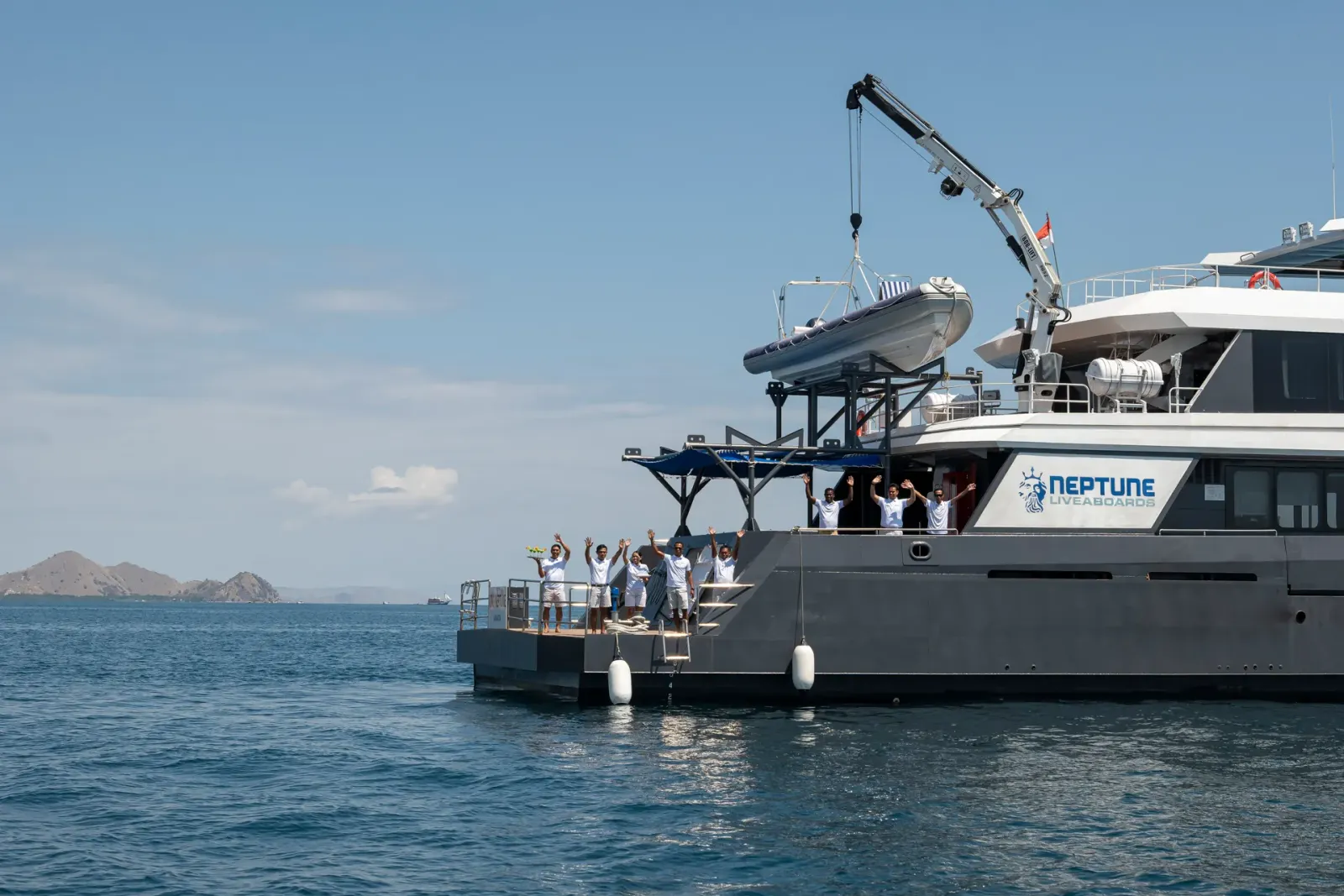
We host photo-leader trips on Neptune One and King Neptune most years; the schedule for the upcoming season is on each vessel page, and our regular cruises also accommodate self-organised photo groups (we've had six-photographer self-organised groups book the entire boat, which is essentially a private photo charter at the regular cruise price).
Practical Planning
Certification and Experience
Advanced Open Water minimum for any of the wide-angle regions. Fifty logged dives recommended for Komodo's current sites and the Banda Sea hammerhead pinnacles. Lembeh and Ambon's shallow muck sites are Open Water-friendly in principle, but the slow, focused, buoyancy-discipline-required style of shooting means we'd really recommend at least thirty logged dives before a serious macro week. The most common photo-trip weakness we see is divers with the camera skill but not the in-water skill; the camera amplifies any buoyancy or trim weakness.
Booking Lead Time
Six to twelve months ahead for the peak photography windows (December-February in Raja Ampat, July-September in Komodo, late September to early November in the Banda Sea). Photo-leader trips often book out twelve to eighteen months ahead because the leader brings a regular waiting list. For self-organised photo groups wanting a private charter, we'd recommend nine to fifteen months of lead time depending on the region.
Travel Insurance for Camera Gear
Standard travel insurance covers very little camera gear. For a full housing-strobes-camera setup running into five figures, we recommend dedicated camera insurance (DEPP, Aon Affinity, or a specialist underwater-camera policy) plus dive-specific travel insurance (DAN World, World Nomads dive endorsement, or Diveassure) for the dive coverage. Confirm both before the cruise.
Baggage on Indonesian Domestic Flights
The pinch point for photo trips is Indonesian domestic flights, particularly Sorong (for Raja Ampat) and Ambon (for Banda Sea). The domestic carriers (Garuda, Lion, Wings, Batik) typically allow twenty kilograms checked plus seven hand-carry, with strict enforcement on the regional routes. A serious photo kit alone runs fifteen to twenty kilograms. We pre-book excess baggage allowances for photo guests as part of the cruise booking, which gets you to thirty or forty kilograms checked at a flat fee per route.
Bringing It Together
If you take one thing from this guide, take this: Indonesia is the country where serious underwater photographers can build the broadest portfolio of any single dive nation on earth, but the trip planning is more region-specific than any other country in the field. You don't go to Indonesia for "diving" the way you go to the Bahamas for sharks or the Galápagos for big animals. You go for one specific genre at a time, in one specific region at a time, in the right specific month, with the gear configuration that fits the genre.
The shape we'd actually book for a serious wide-angle photographer with eleven nights of holiday: Raja Ampat in late January or early February, Misool-and-Dampier rotation, Neptune One or a similar small-group boat, with a private dive guide and a self-organised group of four to six photographers booking the cabins. The frames you'll come home with from that trip beat any other single-region wide-angle cruise we know of.
For a macro photographer with seven nights, the answer is Lembeh in June or July, land-based at one of the macro-specialist resorts on the strait, with a Bali pre-trip for a few days at Tulamben to round out the imagery. We'll book the Bali side and route guests to a Lembeh operator we trust; we don't run a Lembeh boat directly because the strait is a land-based diving destination by geography.
For a photographer who wants both genres in a single longer trip, the combination is a Komodo eight-night cruise in August (wide-angle, mantas, sharks, schooling fish) plus a Lembeh four-night land-based extension afterward (macro, the year's full critter list). About sixteen days of total travel, two airports, two photographic genres at peak season, and a portfolio that no other Asian country can match in a single trip.
If you want help putting that itinerary together, the right cruise window, the right cabin, the right gear briefing, the right pre/post Bali days, we book the trip. Contact us with your travel window, your camera setup, and what you're trying to shoot, and we'll put a real plan together. Indonesia rewards photographers who plan around it. The serious shooters we know come back year after year because the country, frankly, is the best one for the work.