Ask ten dive professionals who work in Komodo to name the best single dive site in the national park and, in most years, you will get one answer eight or nine times: Batu Bolong. From the surface it is almost comically unimpressive, a car-sized hump of rock in the middle of the Lintah Strait with a hole worn through it (batu bolong means hollow rock in Indonesian) and seabirds standing on top. Underneath, that little rock is the visible tip of a coral-covered tower that falls away more than 70 metres into the strait, and it carries more fish per square metre than almost anywhere else in Indonesia.
It is also a dive site with rules. Batu Bolong sits in one of the fiercest tidal highways in the country, the currents that wrap around it have their own nicknames, and the difference between the best dive of your trip and a genuinely dangerous one comes down to timing and discipline. This guide covers all of it: what the site is and why the fish density beggars belief, how the dive actually runs (lee sides, slack windows, and why you never cross the rock), what you will see from three metres down to thirty, when to go, and how diving in Komodo aboard a liveaboard changes your odds of catching the pinnacle at its brief, glassy best.
What Batu Bolong Actually Is
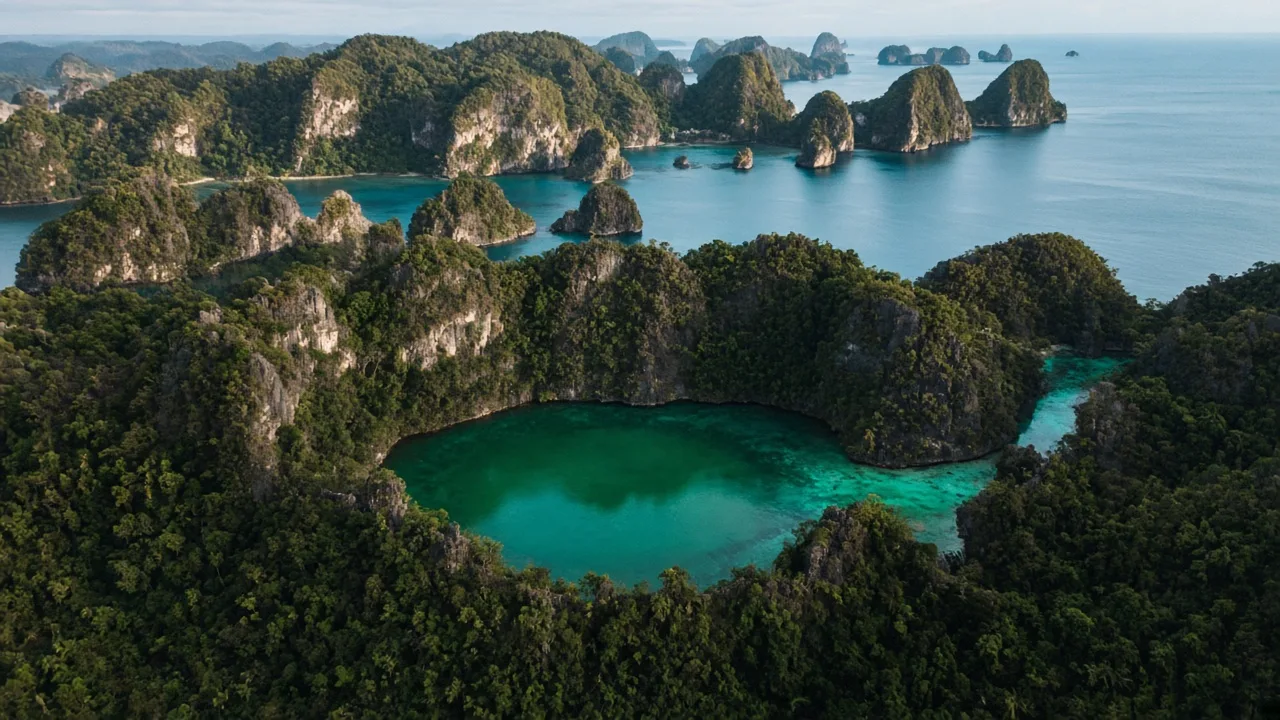
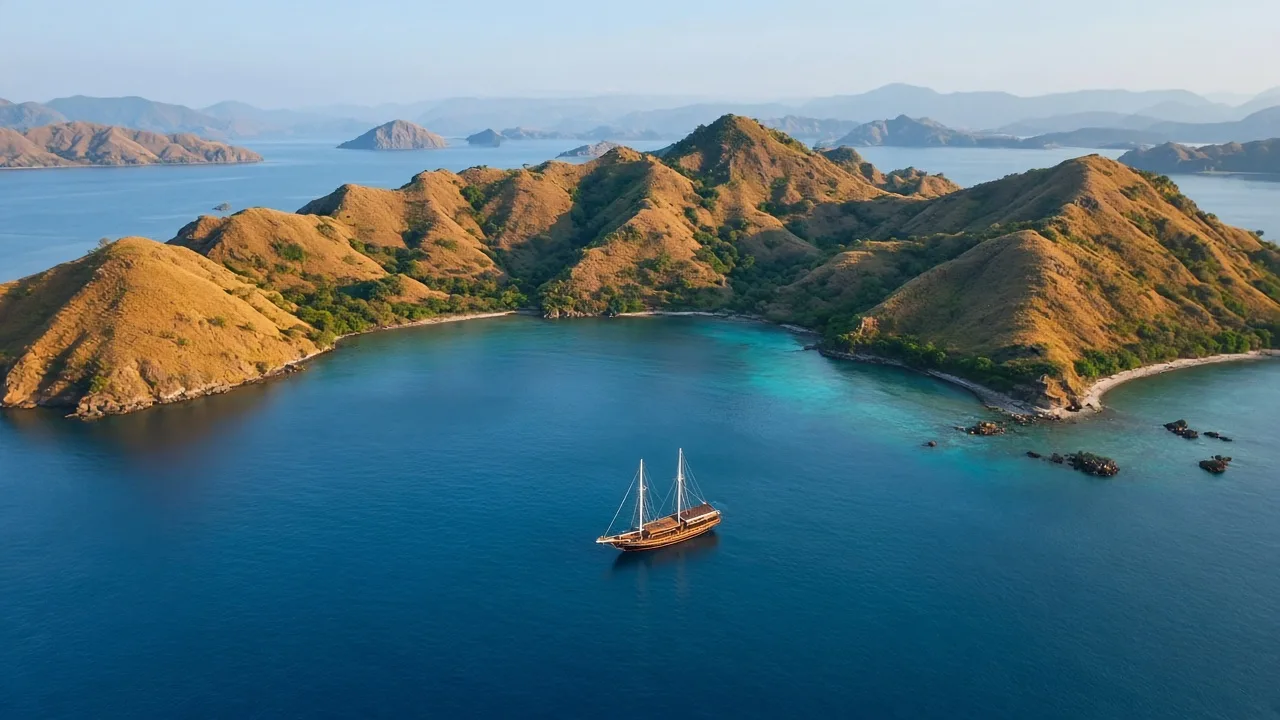
Geography first. The Lintah Strait runs between Komodo island to the west and the small islands of Tatawa to the east, right through the centre of the national park. Lintah means leech, a name the old boat captains gave the channel because it seemed to suck the power out of their engines; twice a day, enormous volumes of water move between the Flores Sea and the Indian Ocean through this gap, and everything in the strait feels it. Batu Bolong stands in the middle of the flow like a bridge pillar in a flooded river. The rock above the surface is trivial. Below, it is a steep-sided pinnacle, roughly conical, plunging past 70 metres, every face of it plastered in hard and soft coral so dense that the underlying rock is essentially invisible.
Arriving by boat sets the scene better than any briefing. From a few hundred metres out, the rock looks like an afterthought, but the water around it does not: on a running tide, the current lines stretch across the strait like seams in fabric, the downstream side boils with eddies, and standing waves can kick up where the flow meets the wind. Frigatebirds and terns work the surface, because the same upwellings that feed the reef push baitfish into reach. Then the tide slackens, the seams dissolve, the strait goes oily-smooth, and for a little while the most ferocious patch of water in central Komodo becomes a pond with a rock in it. That is the window. Watching it open from the dive deck, coffee in hand, is one of the small rituals of a Komodo liveaboard morning.
The current is the whole story of the place, in two opposite ways. On the one hand, it feeds the site: the tide delivers a conveyor belt of plankton and nutrients past the pinnacle, which supports the corals, which support the clouds of small reef fish, which support the predators, in densities local guides describe, accurately, as fish soup. On the other hand, the current has protected it. In decades past, when destructive fishing damaged reefs elsewhere in the region, the waters around Batu Bolong were simply too violent to work safely, and the pinnacle escaped largely untouched. What you see today is the result: a reef that has never been meaningfully damaged, sitting in a national park no-take zone, fertilised by one of the strongest tidal flows in Indonesia. There are precious few places left on earth with that combination.
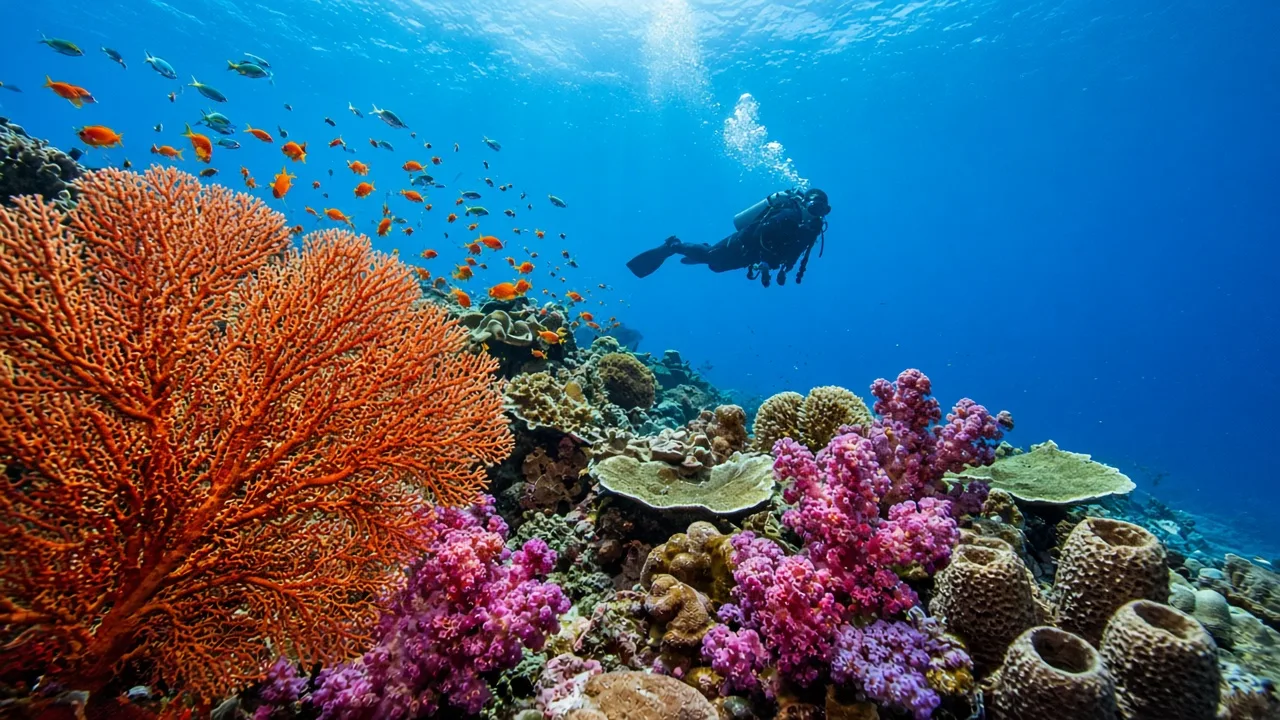
The result reads like exaggeration until you have hung on the lee side and watched it. Anthias and chromis rise off the coral in orange and silver clouds so thick they blur the reef behind them. Whitetip reef sharks patrol the deeper ledges. Napoleon wrasse the size of coffee tables drift past divers with total indifference. Hawksbill and green turtles wedge themselves into the coral to feed. Giant trevally and dogtooth tuna hunt the edges where the protected water meets the moving blue, and schools of fusiliers pour over the shoulders of the rock like weather. Our guides have a private benchmark for guests who ask what they will see: if you can find a patch of blue water with nothing in it, dinner is on us. In several seasons of making that offer, nobody has collected.
How the Dive Actually Works
Batu Bolong is not a swim-around-the-rock dive, and understanding why is the difference between loving this site and having a very bad morning. When the tide runs, the current strikes one side of the pinnacle, splits, and accelerates around both flanks, meeting again downstream in a mess of eddies and whirlpools you can see boiling on the surface from the boat. The upstream and downstream faces are out of bounds in any meaningful flow: the downstream side in particular can produce down-currents that pull water, bubbles and anything else over the edge and toward the deep. Every operator worth their licence dives one face only, the lee, the sheltered wedge of calm water on the protected side of the rock, and stays inside it.
The classic profile is a zigzag. You drop quickly onto the sheltered face, settle around 20 to 25 metres in what guides call the safe zone, and then work your way back and forth across the lee wall, climbing a few metres with each pass, finishing the dive in the coral garden near the surface where the top of the pinnacle flattens out. It is an ascending traverse rather than a tour, and it means the dive gets brighter, warmer and busier as it goes, which is the correct order for a dive to run. The width of your playground depends entirely on the tide: at true slack you may have most of the circumference to explore; on a gentle exchange, a wedge of perhaps 60 degrees. The guide reads the current lines from the boat before anyone kits up, and the brief is not a formality. Listen to it.
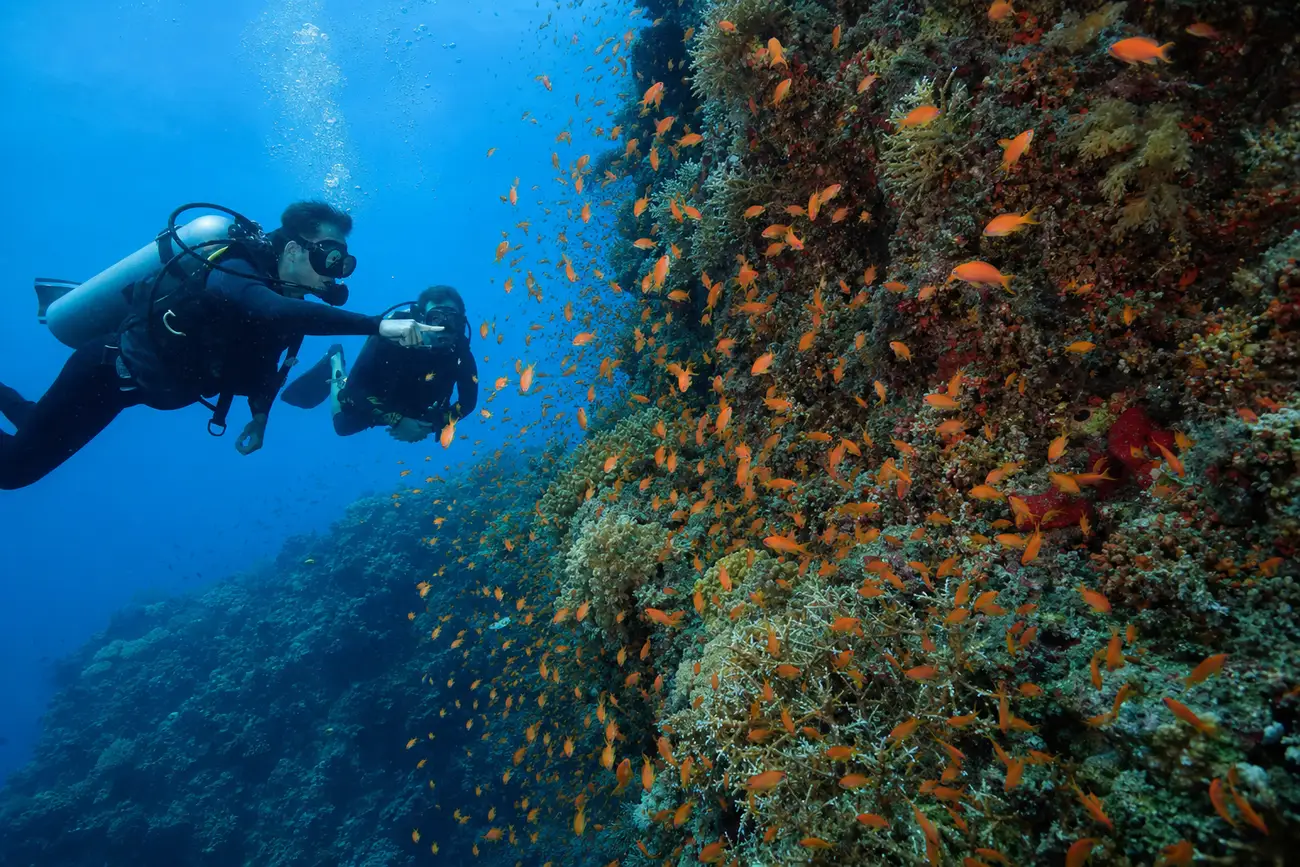
A few rules follow from the physics, and they are non-negotiable. Stay close to the reef and below the guide's line; blue-water excursions are how divers meet the current. Do not chase the trevally around the corner, no matter how good the photograph looks; the corner is where the flow starts. Carry a surface marker buoy and know how to deploy it, because if you do get swept off, the strait is wide, busy with boats, and not a place to be invisible. Mind your depth: the wall is featureless enough in places that dropping from 20 to 30 metres happens without noticing. And keep your buoyancy tight, since the site punishes flappers, both in air consumption and in coral contact; if your control needs a tune-up, our guide to buoyancy control is worth reading before the trip, not after.
Windows also close, and a good crew plans for that too. Slack at Batu Bolong can run 40 comfortable minutes or barely 15, depending on the moon, and the change announces itself underwater before the surface shows it: the anthias flatten against the coral, the fusilier streams bend, and the guide's rattle goes twice. When that happens, the dive finishes on the crown rather than pushing another circuit, and nobody argues. In practice this is why experienced operators run the site at first light or late in the day, when they can sit on the anchorage and take the window the strait actually gives, rather than the window a schedule printed in Labuan Bajo hoped for. We have aborted exactly two Batu Bolong dives in recent memory, both before anyone entered the water, both because the lines never opened; the strait does not negotiate, and the crews who last here never ask it to.
How hard is it really? Honest answer: at the wrong tide, unmanageable for anyone, which is why nobody dives it at the wrong tide. At a well-chosen window, it is a controlled, sheltered dive that confident open water divers handle routinely, and we have taken guests with 30 logged dives through it without drama. The site's fearsome reputation mostly describes the days and profiles that good operators simply avoid. What it does demand, at any tide, is obedience to the brief and decent basic skills. Komodo rewards divers who arrive with a little current experience, but Batu Bolong at slack is not the monster of the forums; it is the reason half of those forum posters keep coming back.
One more thing the forums rarely mention: at proper slack tide, Batu Bolong is a spectacular snorkel. The coral garden on the pinnacle's crown sits within a few metres of the surface, the anthias clouds reach nearly to the top, and turtles graze in snorkelling depth. On a calm morning we will often have snorkellers over the crown while the divers work the wall below, everyone watching the same fish soup from different floors, which makes it one of the rare marquee sites that a mixed group of divers and non-divers can genuinely share.
What You Will See, Floor by Floor
The pinnacle organises itself by depth, and it pays to know what lives where before you drop in.
The top five metres are the coral garden, and if the word garden suggests something tame, the reality does not. The crown of the rock carries table acropora, cabbage corals and fire coral in unbroken cover, swarmed by anthias, damselfish and sergeant majors in densities that make video look sped up. This is where the safety stop happens, and it is the only site we know where guests complain that the safety stop is too short. Hawksbill turtles feed here almost every dive, close enough to fill a frame, and moray eels stack themselves into the crevices, sometimes two and three to a hole.
From five to twenty metres, the walls and slopes are predator country. Whitetip reef sharks rest on the sand patches and cruise the ledges; Napoleon wrasse, usually a pair, sometimes a small squadron, make slow rounds of the lee; giant sweetlips and coral groupers hold station under the overhangs. Schools of fusiliers and surgeonfish stream continuously across the face, and when they flinch in unison it usually means a trevally has made a pass. Photographers with wide-angle lenses do their best work in this band, where the coral, the clouds and the big fish stack in the same frame.
Below twenty metres, the light cools, and the dive changes character. Grey reef sharks appear off the wall, dogtooth tuna and Spanish mackerel patrol the thermoclines, and great barracuda hang in the flow like parked cars. On the right tide, schooling barracuda form loose towers off the deep shoulder. The wall itself keeps going past 70 metres, but there is no need to follow it; almost everything worth seeing happens above 30, and the deeper water mostly costs bottom time that is better spent in the soup.
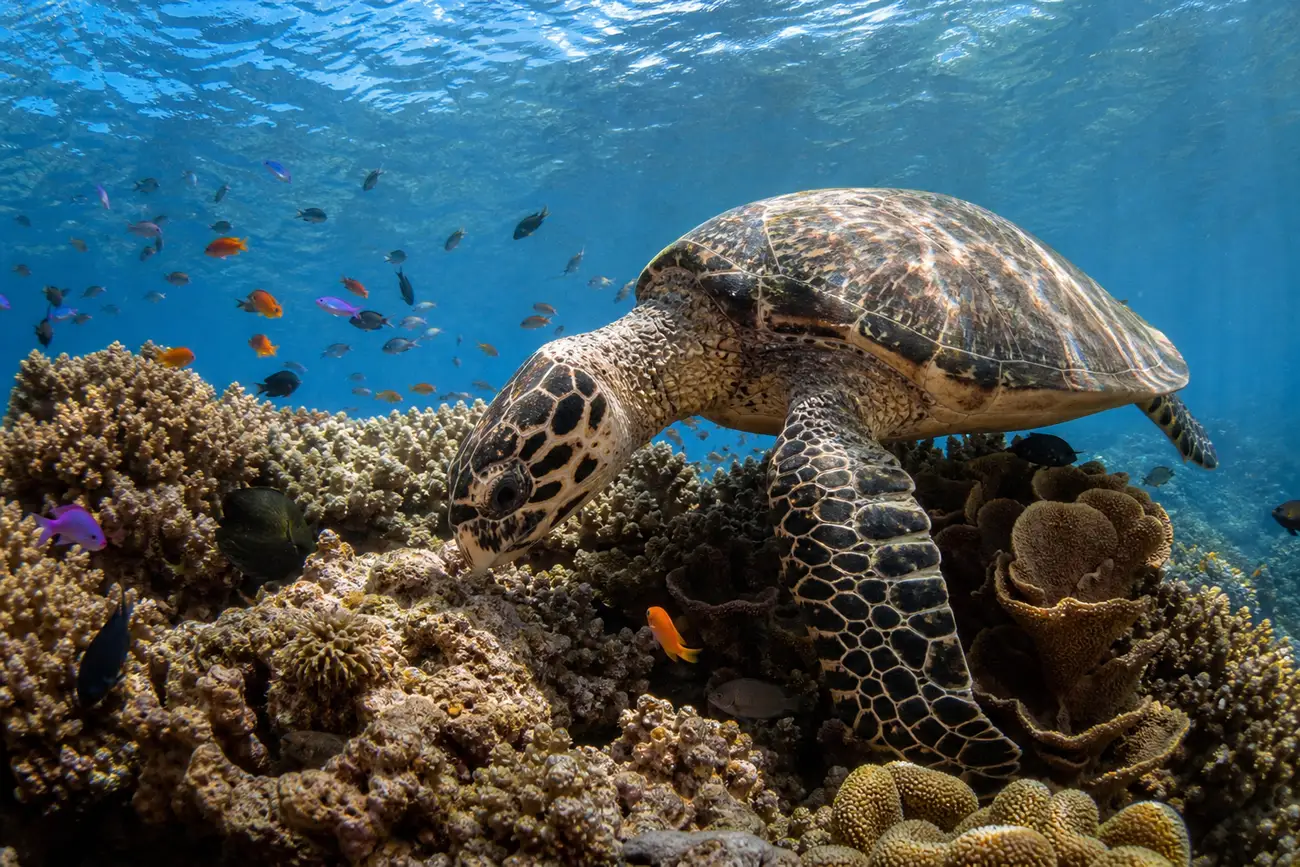
Visibility usually runs 15 to 30 metres, best in the dry season, and the site photographs differently through the day: morning slack gives the cleanest water and the calmest fish, while an afternoon window backlights the anthias clouds against the sun for the dramatic shots. If the plankton rolls in and the water greens up, do not sulk; that is the food arriving, and the fish behave accordingly.
And the macro life deserves a mention, because everyone forgets it amid the spectacle. The coral heads hide nudibranchs, orangutan crabs, banded coral shrimp and the occasional frogfish, and because most eyes are on the fish clouds, the macro subjects here are barely photographed. On a second or third visit, telling your guide you want to dive Batu Bolong slowly, with a macro lens, produces one of the most contrarian and rewarding dives in the park. Guests who do this tend to surface with a species list rather than a card full of schooling fish, and a slow lap of the lee wall has a habit of becoming the dive people talk about at dinner while the fish soup goes unmentioned.
For how Batu Bolong stacks up against the park's other headline sites, Castle Rock, Crystal Rock, Manta Point and the rest, our guide to the best dive sites in Komodo ranks the field; the short version is that the north's twin rocks give you more shark action and Manta Point gives you the manta rays, but for sheer density of life per minute of dive time, nothing in the park touches Batu Bolong, and precious little in Indonesia does.
Timing, Seasons and Getting There
Everything at Batu Bolong is downstream of the tide table. The site is dived at slack water or on a gentle exchange, the brief windows when the strait pauses between tidal pushes, and those windows move with the moon: generous around neap tides, tight and punchy around full and new moon springs. This is where how you visit matters more than when. Day boats out of Labuan Bajo reach the site in roughly two hours and have to take whatever window falls in the middle of their day, sharing it with every other day boat working the same table. A liveaboard sleeps in the anchorages nearby and positions for the window itself, which regularly means having the pinnacle to yourselves at first light on a glass-flat slack while the day fleet is still loading in the harbour. We plan our central park days around exactly this, and it is the single biggest upgrade a liveaboard gives you at this site; our Komodo itineraries guide shows how the pieces fit together.
Seasonally, the central and northern park dives best from April to November, the dry season, with June through August the peak for visibility and settled seas; water runs 24 to 29 degrees, coolest when the south-flowing upwellings reach the strait mid-year, and a 3mm suit serves most people fine. The wet season months still produce excellent dives here, with warmer water and fewer boats, at the price of less predictable weather; the full trade-offs are in our guide to the best time to visit Komodo. Batu Bolong is dived year round, which few Komodo sites can claim, because there is always a lee somewhere on the rock.
Logistics are simple by Indonesian standards: fly or sail to Labuan Bajo, the gateway town on Flores (covered step by step in our guide on getting to Labuan Bajo), and the site sits about 25 kilometres west, in the heart of the park, usually paired on the same day with Tatawa Besar's drift, Siaba Besar's turtles or a Manta Point run. National park fees apply as elsewhere in Komodo and are typically folded into your trip price; confirm with your operator rather than budgeting from an old blog post, since the fee structure has been a moving target in recent years.
A word on care, because the site's condition is not an accident and keeping it this way is not automatic. Batu Bolong sits in a no-take zone patrolled by national park rangers, boats hold position or use designated moorings rather than anchoring on the reef, and the informal code among crews is strict: no gloves, no touching, no chasing, fins well clear of the crown when snorkellers and divers share the slack. The pinnacle receives heavy traffic in high season, sometimes a dozen boats cycling through a single generous window, and the fact that the coral cover still looks untouched is the direct result of that discipline holding, year after year. Choose an operator who treats the rules as rules. The rock has survived the leech strait, the fishing decades and the tourism boom; it should not lose to a careless fin kick.
Is Batu Bolong Worth the Hype?
Yes, without our usual hedging. Plenty of famous dive sites are famous because they photograph well or because a travel writer got lucky once. Batu Bolong is famous because a specific set of physical accidents, a pinnacle in a nutrient highway, currents that kept the fishing boats away, and a national park drawn around the result, produced a reef that works like the ocean did a century ago. The fish density is not a good day; it is the baseline. We have guests who have dived it thirty times and still ask for it first.
A few final pointers, earned across many hundreds of dives on the rock:
- Take the brief seriously and stay on the lee. The site is safe precisely because everyone follows the same rules.
- Ask your operator how they choose the tidal window. A confident, specific answer is the mark of a crew that knows the strait.
- Bring a wide-angle setup for the first dive and consider macro for a repeat; the rock rewards both.
- Non-divers travelling with you are not excluded: at slack, the crown is one of the best snorkels in the park.
- If you are choosing between one dive here or two elsewhere, take the one dive here.
Batu Bolong is the strongest single argument for putting Komodo on a diving itinerary, and the strongest argument for doing Komodo by liveaboard rather than by day boat: the site gives its best fifteen minutes to whoever is floating over it when the strait goes quiet, and the boats that sleep beside it are the boats that collect. Time it right, drop onto the lee, keep your nose to the coral, and you will surface understanding why a rock the size of a car has a reputation the size of the park.