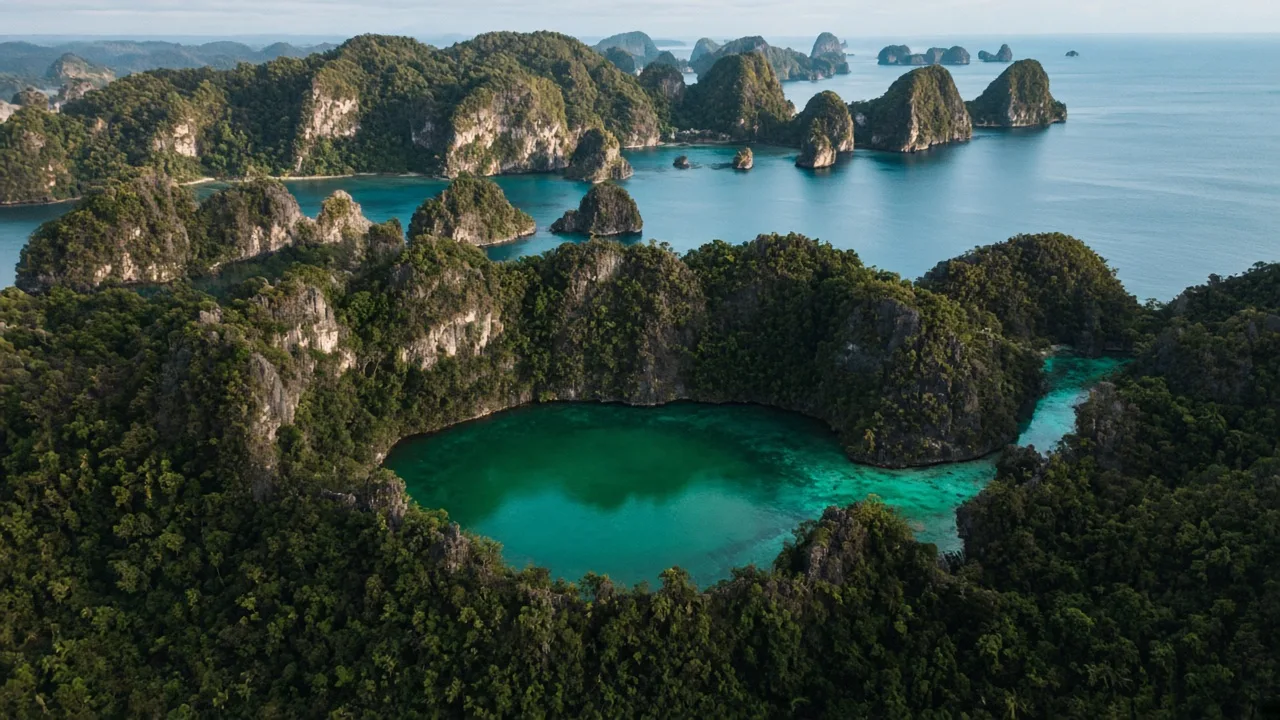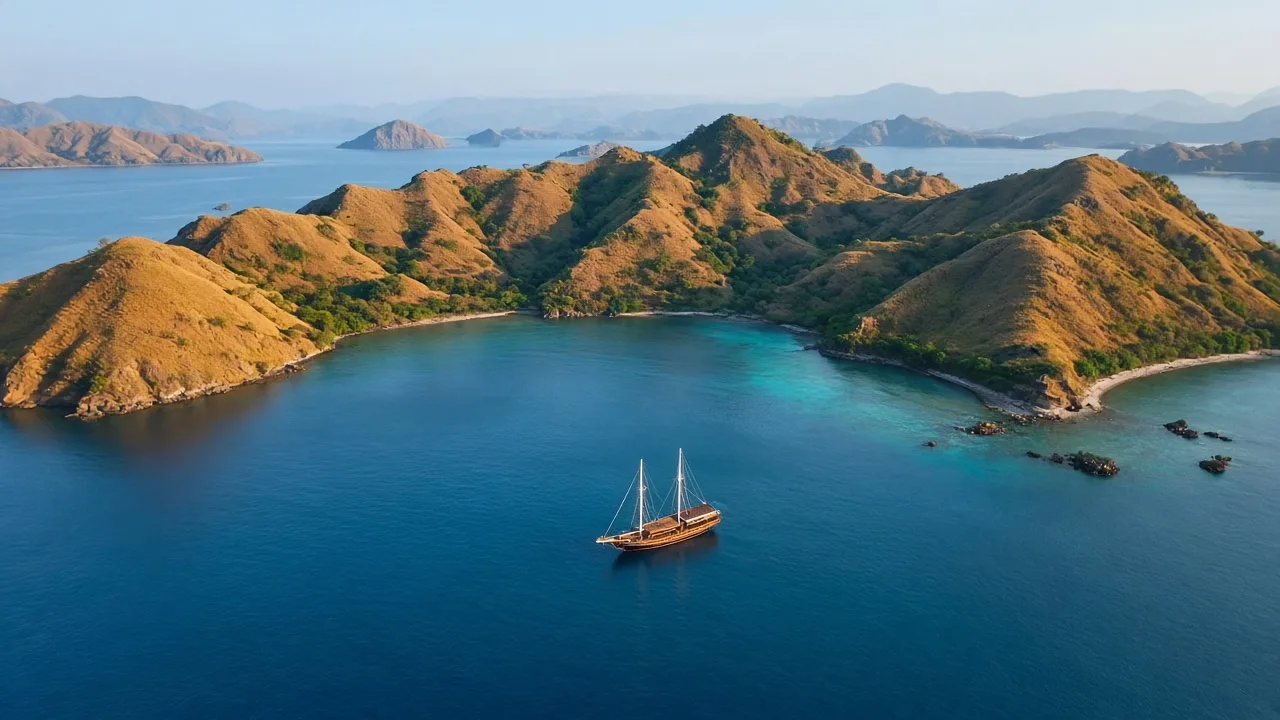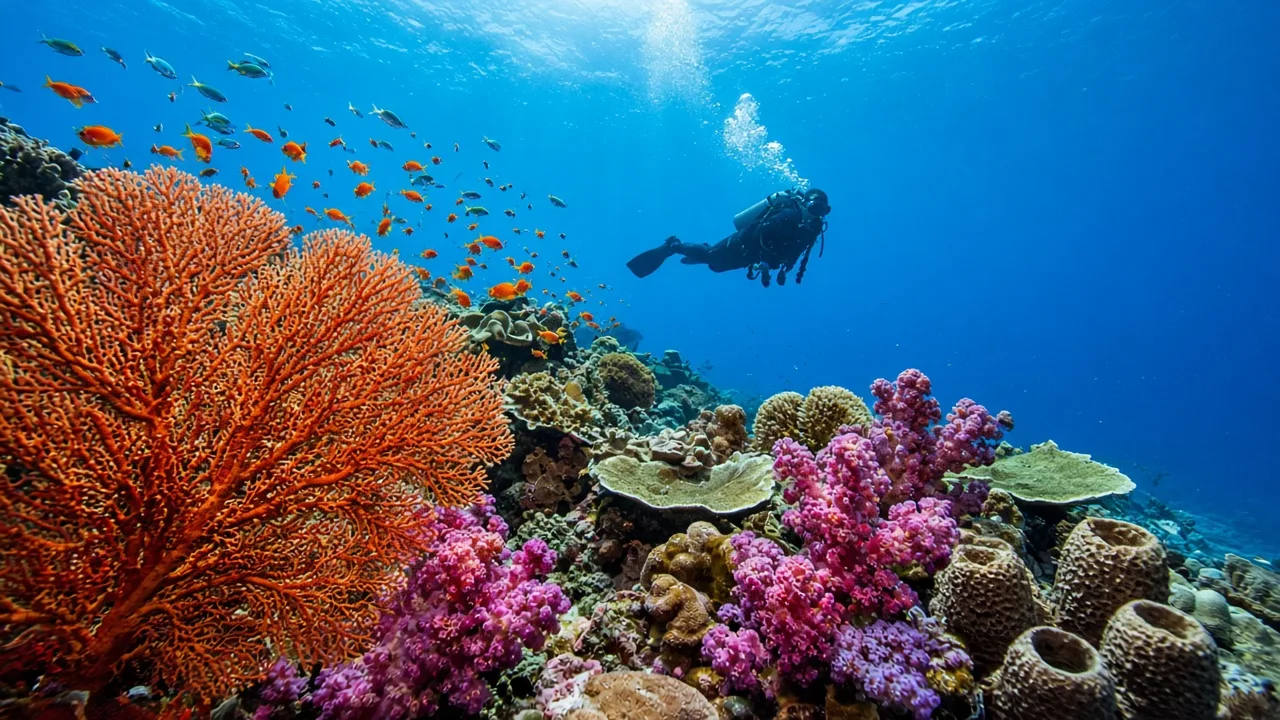
Most divers who want both Bali and Komodo fly between them. The flight from Denpasar to Labuan Bajo takes a little over an hour, and it skips something like 500 kilometres of sea that very few visitors ever dive: the Lombok Strait, the Gili Islands, the north coast of Sumbawa and the current-swept channel at Gili Banta. A one-way liveaboard sails that gap instead of flying over it. We run one such crossing on Neptune One in June 2027, and this piece explains how the route works, what it costs and who should book it.
The crossing is not a replacement for a standard Komodo liveaboard out of Labuan Bajo. Think of it as a different kind of trip. It spends roughly half its time in waters that most dive itineraries in Indonesia never touch, and the other half on the famous park sites at the end. If you have already done Komodo once, it is usually the more interesting way back. If it is your first time in eastern Indonesia, it gives you context that a week inside the park cannot: you watch the landscape dry out, the volcanoes get taller and the water change colour as you move east across the Lesser Sunda Islands.
The rest of this guide sticks to what we can stand behind. The route below is the one planned for our June 2027 departure, the prices are the published fares on our schedule, and where conditions vary from year to year we say so.
What is a Bali to Komodo liveaboard?
A Bali to Komodo liveaboard is a one-way dive cruise that boards in Bali and sails east past Lombok and Sumbawa, ending in Labuan Bajo after diving Komodo National Park.
- Nine nights or more on board
- Lombok, Sumbawa and Komodo dives
- Whale shark waters at Saleh Bay
- One flight home, not two
It sits between a Komodo round trip and an expedition crossing: longer and more varied than the first, calmer and closer to home than the second.
You will find it as:
- The Neptune One crossing of June 2027
- Sumbawa stops on the way to Komodo National Park
- A few other boats' schedules, usually once a year
In short: it is the long way to Komodo, and the dives along the way are the point.
Bali to Komodo liveaboard vs flying to Labuan Bajo: what is the difference?
Both get you from Bali to the Komodo dragons. They are built for different travellers, and the difference shows up in the dive log more than in the price.
The one-way crossing
You board in Bali and do not touch an airport again until Labuan Bajo, nine nights later. Around half the dives happen outside Komodo, on reefs off Lombok and Sumbawa that see far fewer boats than the park, and the last few days cover the park itself.
Flying in for a Komodo round trip
You fly Denpasar to Labuan Bajo, board the same afternoon or the next morning, and spend every day of a five to seven night trip inside the park. You see more of Komodo's headline sites, and fewer of everything else.
Key distinction:
- The crossing trades some Komodo dives for Lombok, Moyo, Satonda, Saleh Bay, Sangeang and Banta.
- The round trip trades that variety for more time on Komodo's best-known currents and manta sites.
There is a quieter practical difference too. A round trip means two internal flights if you are coming from and going back to Bali. The crossing needs one, because you sail the outbound leg. On a two-week holiday that can be the difference between a rushed final day and a relaxed one.
The route, region by region
The order of stops on a crossing is fixed by geography. The exact sites are not. Our captain and cruise director choose them day by day from the tides, the wind and what the guides heard from other boats, so read what follows as the plan for the June 2027 departure rather than a timetable.
Serangan and the Lombok Strait
Neptune One boards at Serangan, the small harbour on the island of the same name in south Bali, a short drive from the airport and from Sanur. The first night's sail crosses the Lombok Strait. It is short on a map. It is also one of the main channels through which Pacific water drains into the Indian Ocean, and it marks the Wallace Line, the boundary the naturalist Alfred Russel Wallace drew in the 1850s between Asian and Australasian wildlife. The crossing can be lumpy for a few hours. On most departures it happens while you sleep.
Lombok and the Gili Islands
The first full dive day is usually spent off northwest Lombok, around Gili Trawangan, Gili Meno and Gili Air. These are gentle, sloping reefs with plenty of green and hawksbill turtles, and they make a good place for the guides to see how everyone handles weighting and buoyancy before the currents start. Nobody books this trip for the Gilis. Most people are glad of them anyway, because a relaxed first day sets up the rest of the week.
Moyo and Satonda
After another night under way the boat reaches the north coast of Sumbawa. Moyo is a protected island with hard coral walls and a jungle interior, and when time allows the crew take guests ashore to the Mata Jitu waterfall. Satonda, a little further east, is a small extinct volcano whose crater holds a saltwater lake. The walk up to the rim usually takes under half an hour, and at dusk the island's fruit bats leave in a long stream across the water. Underwater, Satonda has a reputation for night dives, with the reef full of crustaceans and cephalopods after dark.
Saleh Bay
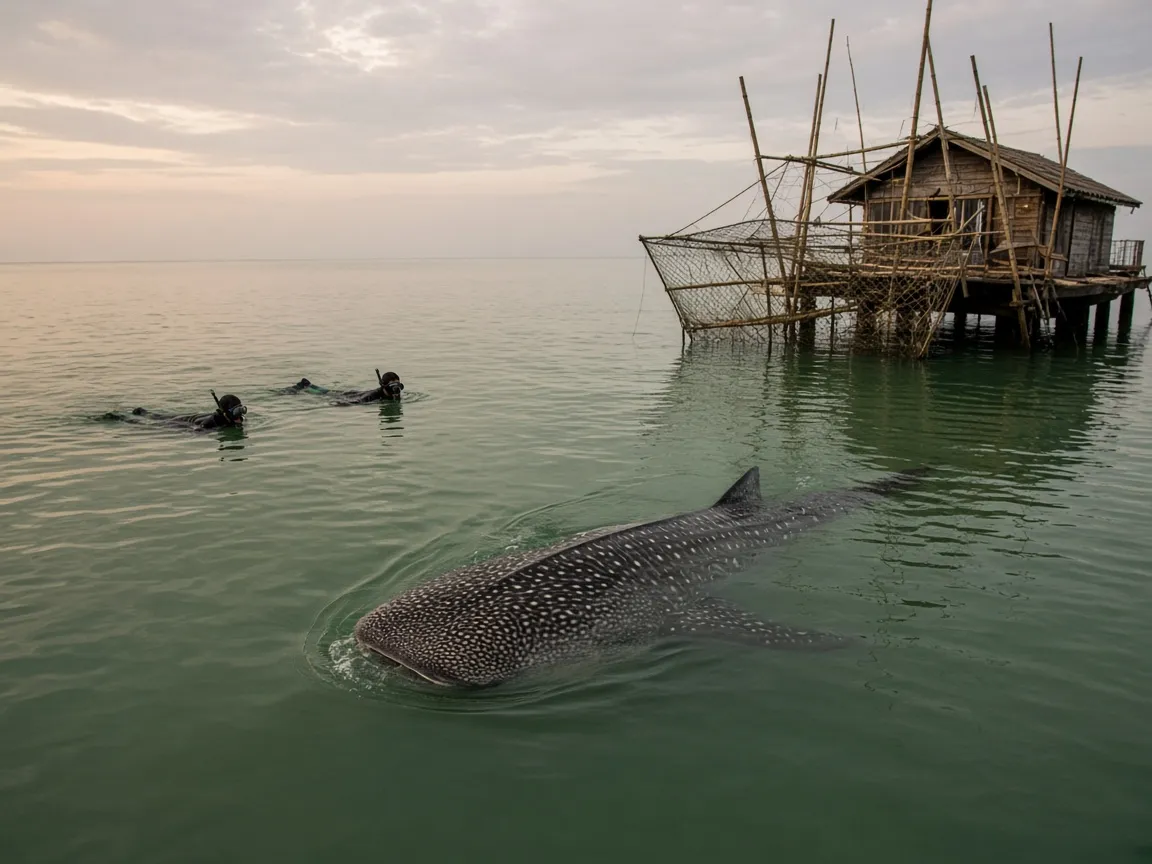
Saleh Bay is a deep, sheltered bay cutting into the north coast of Sumbawa, and its whale sharks are the reason a lot of people choose this route. They gather around bagans, the wooden fishing platforms whose night lights draw in small baitfish, and the encounters happen early in the morning, usually on snorkel. June falls inside the season that operators in the bay describe as the most reliable, roughly May to October. That makes sightings likely, not certain, and we would never promise one. Indonesia has protected whale sharks by law since 2013, and the local fishermen who run the platforms set firm rules about distance and touching.
Sangeang
Sangeang is an island made of a single active volcano, a little under 2,000 metres high, off the northeast tip of Sumbawa. It erupted in 2014 and grounded flights across the region for a couple of days. The diving is black sand and volcanic rubble, warm patches where gas seeps from the seabed at some sites, and a lot of macro life: frogfish, nudibranchs and octopus on most dives. Photographers tend to rank it as the high point of the Sumbawa leg. Divers who prefer big animals usually rank it lower, and both are right.
Gili Banta
Banta sits in the channel between Sumbawa and Komodo, right on the edge of the park. It is the first place on the route where the currents feel like Komodo's: GPS Point and the walls around it bring grey reef sharks, big schools of fish and, on a good tide, mantas. It is also where the guides start to be stricter about dive briefings, negative entries and reef hooks.
Into Komodo National Park
From Banta the boat crosses into the park and spends its final dive days there before tying up in Labuan Bajo. Which sites you get depends on tides and on where other boats are, but the June route normally reaches the northern and central sites (Gili Lawa, Castle Rock, Crystal Rock, Batu Bolong and the manta cleaning stations of the centre) that we cover in our guide to north and south Komodo diving. There is usually a morning for the Komodo dragons too, on Rinca or Komodo island, with a ranger.
How a Bali to Komodo crossing works
A crossing runs on the same daily rhythm as any other liveaboard: wake, dive, eat, dive, eat, dive. The difference is the overnight sailing, which is longer and more frequent than on a trip that stays inside one park.
1. Boarding in Bali
You are collected from the airport or your hotel as part of the group transfer included in the fare and taken to Serangan. Expect a safety briefing, cabin allocation and kit set-up on the first afternoon. The boat leaves in the evening.
2. The first check dive
The first dive of the trip is a check dive, kept shallow and easy so the guides can watch weighting and trim. On this route it normally happens on the Lombok or Gili reefs, which suit it well.
3. Long sails at night
Most of the distance is covered after dinner. On two or three nights the engine runs for many hours, and on those nights it helps to know that lower-deck cabins move less in a swell, while the upper-deck cabins have the windows. If you are prone to seasickness, our guide to preventing seasickness on a liveaboard is worth reading before you pack.
4. Up to four dives a day
The fare includes up to four guided dives a day, with tanks, weights and a guide. On crossing days that number drops, because the boat needs daylight hours to move. Nobody should count on a straight four times nine. A realistic total for a nine-night crossing sits well below the figure that multiplication suggests, and we would rather tell you that now than on day six.
5. Arriving in Labuan Bajo
The last dive is usually on the penultimate day, which leaves the 18 to 24 hours before flying that dive medicine guidance recommends after several days of repeat diving. You disembark in Labuan Bajo on the final morning and are transferred to the airport or your hotel.
A worked example: Neptune One, 20 to 29 June 2027
Here is the real departure. Neptune One boards at Serangan on 20 June 2027 and arrives in Labuan Bajo on 29 June: ten days and nine nights. The plan runs west to east through the Gili Islands off Lombok, Moyo and Satonda, Saleh Bay for the whale sharks, Sangeang, Gili Banta and finally Komodo National Park. The fare is USD 3,750 per person in a Deluxe Suite, USD 4,050 in a Deluxe Sea View cabin and USD 4,350 in a Deluxe Sea View cabin with a private balcony, with most cabins still open in October 2026. On top of the fare sit park, port and environment fees, a fuel surcharge where it applies, nitrox if you use it, and crew tips; we confirm the exact fees for this route when you book. The boat carries 16 guests at most, and the next Neptune One departure out of Labuan Bajo is a six-night Best of Komodo trip on 1 July, which you could add, space permitting, if you want a full week inside the park as well.
Why June suits the crossing
June is early dry season across the Lesser Sundas. The southeast trade winds have settled in, rain is rare, and the northern coasts of Lombok, Sumbawa and Flores sit in the lee of the islands, which is exactly the side a crossing follows. That shelter is the reason the route works at all. Try the same sail in January, when the northwest monsoon pushes swell straight onto those coasts, and much of it becomes uncomfortable or impossible.
The water is warm along most of the route, roughly 26 to 28 degrees in a normal June, with cooler pockets where currents pull up deep water, around Banta and in parts of Komodo. A 3 mm full suit is fine for most people on the Gili and Sumbawa dives. We would pack a 5 mm, or a hood and vest to layer, for the final days, because a cool thermocline on a long Komodo drift is noticeable even when the surface feels like bath water. June also comes before the busiest weeks of July and August in Komodo, so the park sites at the end of the trip are usually a little less crowded than they will be a month later.
One honest caveat. Seasons in Indonesia shift a little from year to year, and a week of unusual wind can rearrange the plan. Each region along the route behaves differently in that weather:
| Region | Character | Current | Main draw in June |
|---|---|---|---|
| Gili Islands, Lombok | Sloping reefs, sand and coral | Mostly mild | Turtles, an easy start |
| Moyo and Satonda | Walls, crater lake island | Mild to moderate | Hard coral, night dives |
| Saleh Bay | Sheltered, plankton-rich bay | Little | Whale sharks at the bagans |
| Sangeang | Black sand, volcanic rubble | Mild, variable | Macro life, frogfish, octopus |
| Gili Banta | Channel walls and points | Strong at times | Sharks, schools, mantas |
| Komodo, north and centre | Pinnacles, drifts, cleaning stations | Strong, tide-driven | Mantas, sharks, reef fish |
For the month-by-month picture inside the park itself, our guide to the best time to visit Komodo goes deeper into wind, swell and water temperature.
What a Bali to Komodo liveaboard costs
The headline is simple. On Neptune One, the June 2027 crossing costs USD 3,750 to 4,350 per person for nine nights, depending on the cabin. What surprises most people is the rate per night, because a crossing is not the expensive option it looks like at first glance.
The table compares the entry-cabin fare (the Deluxe Suite) across Neptune One's 2027 trips in and around Komodo, plus Raja Ampat for reference. These are the published fares on our schedule in October 2026.
| Neptune One trip, 2027 | Nights | Fare from | Per night |
|---|---|---|---|
| Bali to Komodo, 20 June | 9 | USD 3,750 | About USD 417 |
| Komodo to Alor, 17 August | 9 | USD 3,750 | About USD 417 |
| Best of Komodo, 17 July | 7 | USD 3,250 | About USD 464 |
| Best of Komodo, 1 July | 6 | USD 2,800 | About USD 467 |
| Best of Komodo, 26 July | 5 | USD 2,450 | About USD 490 |
| Raja Ampat, March and April | 7 | USD 3,650 | About USD 521 |
Per night, the crossing is the cheapest Neptune One trip of the 2027 Komodo season, roughly 10 per cent below a seven-night Best of Komodo. The main reason is the dive count: some days go to sailing rather than diving. That is a fair trade for most people, as long as they know they are making it.
The upgrade steps are USD 300 each. The Deluxe Sea View cabin, on the upper deck with large windows, costs USD 4,050; the Deluxe Sea View with a private balcony, the largest cabin on board at around 30 square metres, costs USD 4,350. Over nine nights that is about USD 33 a night for each step, which is a smaller premium than on most of our shorter trips.
Then the extras. Park, port and environment fees are charged at cost and are not in the fare; on this route they cover Komodo National Park and may include local charges on the Sumbawa leg, and we confirm the total for your departure when you book. A fuel surcharge applies on some departures. Nitrox (EANx 32) is extra on Neptune One, as are rental gear, alcohol, a private guide and crew tips. Our Komodo liveaboard cost guide walks through each of these lines with the numbers for a standard park trip, and most of it carries over to the crossing.
What the fare does include matters as much: your cabin with its own bathroom, every meal and snack, unlimited tea, coffee, soft drinks and water, up to four guided dives a day with tanks and weights, snorkelling gear, towels, VAT, and the group transfer at each end.
What to check before you book a Bali to Komodo liveaboard
These are the questions we would ask any operator about a crossing, ourselves included. Several only matter on a one-way route, which is why a standard Komodo checklist misses them.
1. Which way the boat sails
West to east, Bali to Labuan Bajo, puts the Komodo days at the end, when you are dive-fit and comfortable in current. East to west reverses that, and ends in Bali with easier connections home. Ours runs west to east in June. Ask which direction a departure runs and plan your flights around it.
2. The planned stops, in writing
A crossing that skips Saleh Bay or Sangeang is a different trip. Ask for the planned regions, and ask what the fallback is when the weather closes one. A good answer names a substitute; a vague answer usually means the plan is vague too.
3. How many diving days, not just nights
Nine nights does not mean nine days of four dives. Ask how many days are expected to be full dive days, and where the long sails fall. The answer tells you more about value than the fare does.
4. Whale shark policy at Saleh Bay
Ask how many mornings are planned at the bagans and whether the encounter is snorkel only. Ask too what the crew does if the sharks do not show on the first morning. Reputable operators will not promise a sighting, and neither will we.
5. Current experience for Banta and Komodo
The last third of the trip is drift diving in real current. Neptune One recommends Advanced Open Water or equivalent, and the guides will judge everyone on the early dives. If you have not dived in current recently, say so before you book. It changes how the guides plan your first Banta dive.
6. What the fees cover on a cross-region route
Komodo's park fees are well known. Charges on the Lombok and Sumbawa leg are less so, and they vary. Ask whether the quoted fees cover the whole route or only the park, and get the figure per person.
7. The flight home from Labuan Bajo
Arrival is in the morning, but give yourself slack. Flights out of Labuan Bajo are mostly to Denpasar and Jakarta, schedules change, and a same-day long-haul connection is a gamble we would not take. One night in Bali on the way home is the usual answer.
8. Cabin position for a long sail
On a park trip the cabin hardly matters, because the boat barely moves at night. On a crossing it does. Ask which cabins sit low and amidships if you are sensitive to motion, and which have windows if you want to watch the islands go by.
How to choose between the crossing and a Komodo round trip
Start with your logbook. The crossing eases you in on the Gili reefs and Sumbawa's sheltered sites, so a diver with Advanced Open Water and a few dozen dives arrives at Banta and Komodo better prepared than one who flies into Labuan Bajo and drops straight onto a northern pinnacle. Very new divers are a different case. Komodo's currents are the same on day eight as on day one, and if drift diving worries you, the park days will still be the hardest part of the trip.
Then look at your dates. The crossing is one departure, 20 to 29 June 2027. If June does not work, a Best of Komodo trip on Neptune One (July and August) or a North and South round trip on King Neptune (late May to the end of August) is the answer. If June does work, ask yourself how much of Komodo you need. The crossing gives you the park's northern and central highlights in its final days but not the cold southern sites; for those, a six or seven-night round trip is still the way.
Your interests decide the rest. Photographers who love macro tend to come back raving about Sangeang. People who came for the whale sharks or the dragons get both on one trip. And anyone curious about the islands themselves, about Sumbawa in particular, sees a part of Indonesia that most visitors only ever see from a plane window. Our longer guide to Sumbawa diving and liveaboards covers the island and its dive regions in more depth.
Budget, last, is less of a split than it looks. The crossing costs more in total than a six-night park trip but less per night, and it saves one internal flight. If you would otherwise fly Bali to Labuan Bajo and back and spend a night in Labuan Bajo each way, the gap in total trip cost narrows further.
Who this trip is for, and who it is not for
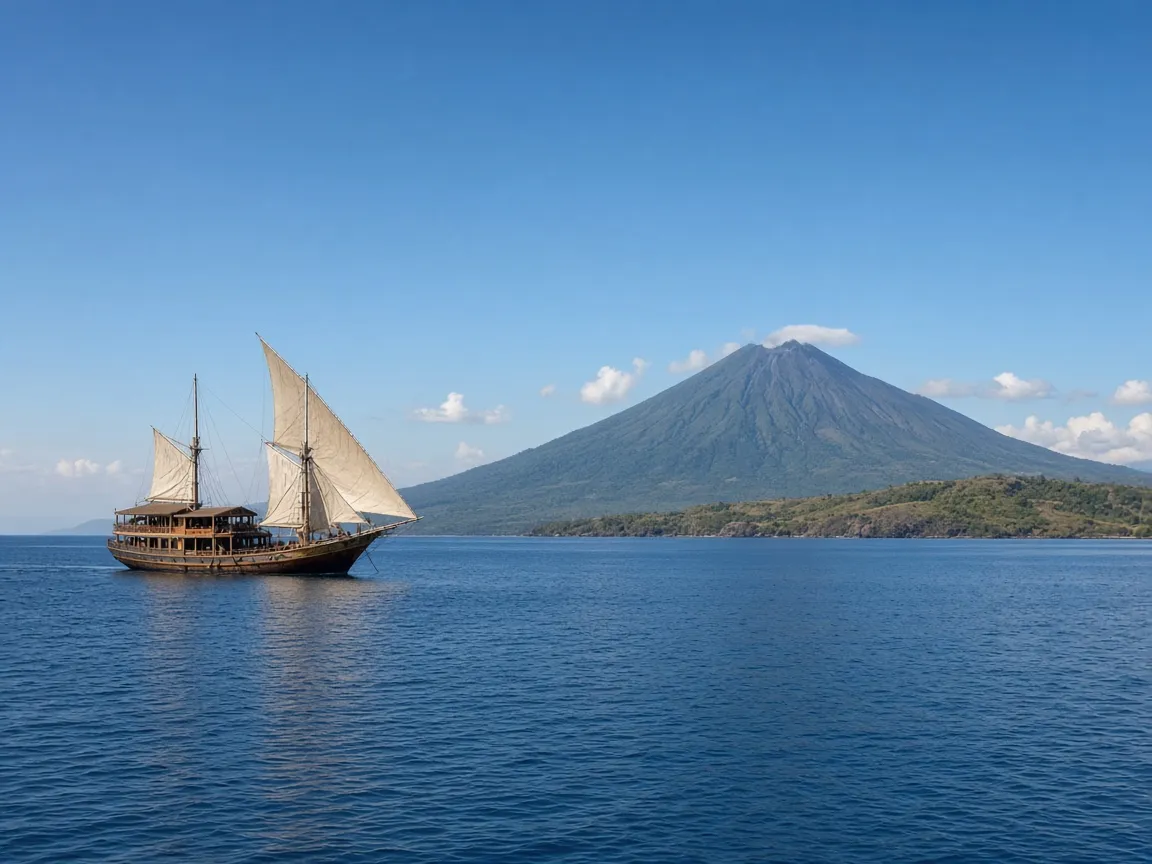
The Neptune One liveaboard is a 39-metre phinisi with eight cabins and room for 16 guests, which is the right size for a route like this: big enough to be steady on the open sections, small enough that a single dive group never feels crowded. It is the only one of our three boats on a Bali to Komodo route in the current schedule.
It suits:
- Divers who have done Komodo once and want to see what lies west of it.
- Couples or friends combining a Bali holiday with Komodo, who would rather sail than fly the outbound leg.
- Macro photographers who want Sangeang and Satonda's night dives on the same trip as Komodo's mantas.
- Anyone with whale sharks on a wish list who also wants serious diving the rest of the week.
It does not suit everyone, and we would rather say so. If you want every possible day on Komodo's best-known sites, a round trip from Labuan Bajo gives you more of them; Komodo Sea Dragon runs the park all year, and King Neptune runs Komodo trips in season with nitrox included. If you are a brand-new diver who has never met current, the final third of the crossing may be more than you want. And if you cannot sleep on a moving boat, two or three long night sails will test you in a way that a park trip never does. Non-diving partners are welcome on board, but the days are built around dives, and a non-diver who wants shore time would probably enjoy a few nights in Labuan Bajo more.
For divers who already know they love long routes, the Komodo to Alor and Alor to Wakatobi crossings later in the 2027 season are the next step up, with more sailing and fewer other boats.
Getting to Serangan and home from Labuan Bajo
Fly into Bali's Ngurah Rai airport at least a day early. That is our advice for every departure, and on this one it matters doubly, because a missed boarding on a one-way trip cannot be fixed by catching up the next morning. The boat is gone. Serangan is a short drive from the airport, usually under 40 minutes outside rush hour, and the group transfer collects you from the airport or your hotel. Sanur and the Jimbaran and Nusa Dua areas are the most practical places to stay the night before.
At the other end, Labuan Bajo's Komodo airport is a few minutes from the harbour. Direct flights run to Denpasar, taking a little over an hour, and to Jakarta; long-haul travellers usually connect through one of the two. Ferries and buses exist too, via Lombok and Sumbawa, but they take two days or more, which is a fair measure of how much ground the boat has covered. If you want a night or two in town before flying, our guide to things to do in Labuan Bajo covers where to stay, the sunset spots and the day trips that do not involve a dive.
Insurance is the last item. Make sure your policy covers diving to the depths you plan and medical evacuation from a remote area, since parts of this route are a long way from a hospital and further still from a recompression chamber. Your dive certification card, logbook and insurance details should all go in your hand luggage.
Key takeaways
- A one-way dive cruise from Bali to Labuan Bajo dives Lombok, Sumbawa and Banta before finishing in Komodo National Park.
- Neptune One sails it from Serangan on 20 June 2027: nine nights, USD 3,750 to 4,350 per person by cabin.
- Per night it is the cheapest Neptune One trip of the 2027 Komodo season, because some days go to sailing.
- June's dry-season trade winds keep the northern coasts sheltered; Saleh Bay whale sharks are likely, never guaranteed.
- Bring Advanced certification and recent current experience for Banta and Komodo, and a 5 mm suit for the final days.
- Fees for the whole route, nitrox and tips sit outside the fare; we confirm route fees when you book.