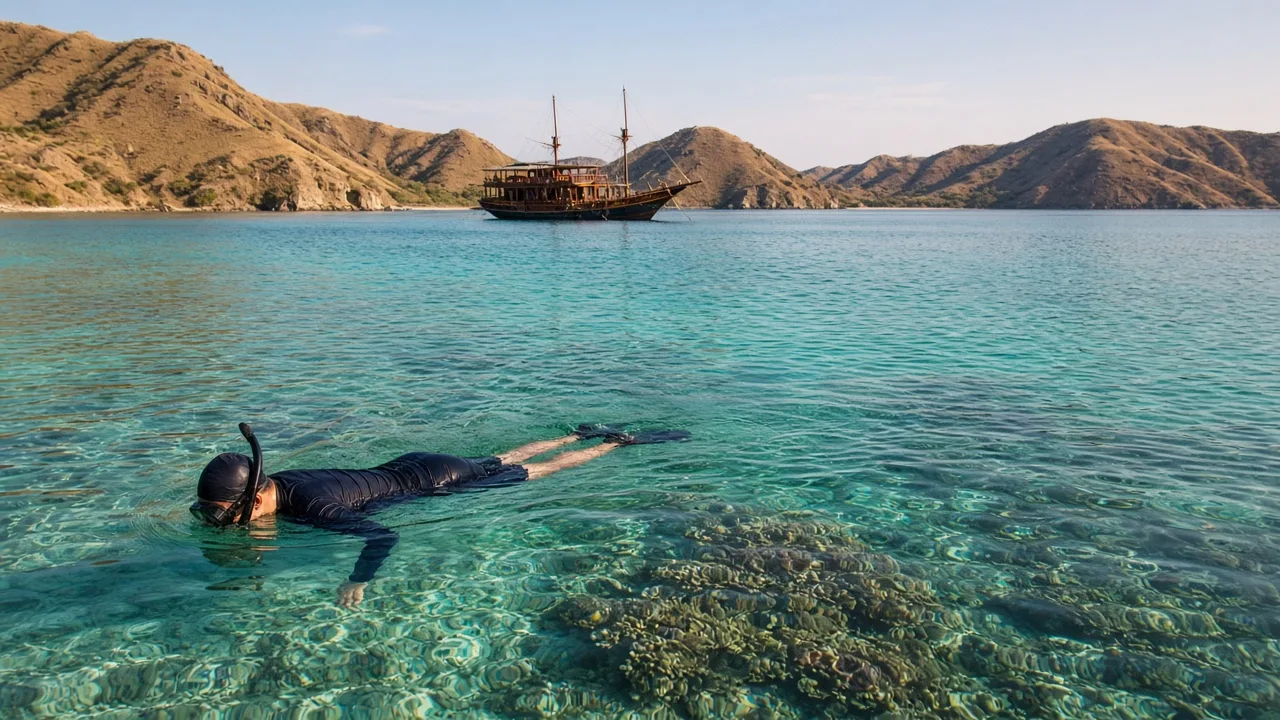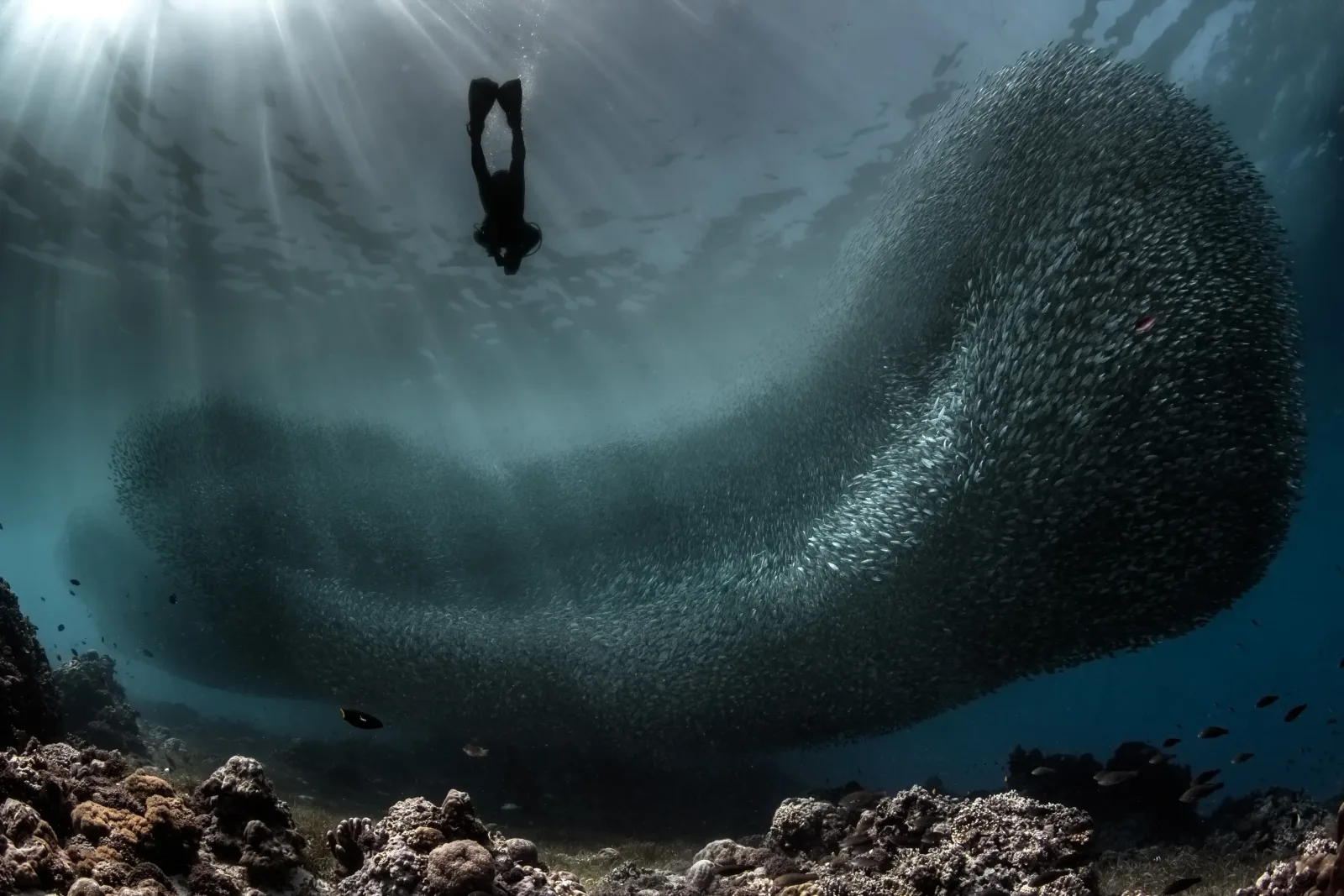
The question we are asked more than any other, usually by email, usually a few weeks before someone commits, is some version of this: how bad are the currents, really, and am I going to cope? It is the single biggest thing standing between people and an Indonesia liveaboard, and most of the answers online are either reassuring to the point of dishonesty or written to make the writer sound brave.
So here is the useful version. Current is not an obstacle to diving in Indonesia, it is the reason the diving is good. The same moving water that makes you work is what feeds the reef, stacks up the fish and brings the sharks and mantas in to feed. Learning to work with it is a small set of skills, most of which are unglamorous, and almost none of which are about being strong. What follows is what those skills are, how the water differs between the regions we run, what actually goes wrong, and how to judge honestly whether you are ready to book.
The current is different in each region, and that matters when you book
Most guides treat Indonesian current as one thing. It is not, and the differences are large enough to change which itinerary you should be on.
Komodo
The hardest water we dive, and the reason Komodo has the reputation it does. The park sits in the gap between the Pacific and Indian Oceans, and twice a day an enormous volume of water squeezes between the islands to equalise the difference. That produces genuinely fast lateral flow, but the real character of Komodo is vertical: upwellings that lift you, and down-currents that pull you down the outside of a pinnacle. These are the ones that catch people out, because they arrive without a surface signal and they cannot be out-swum.
Spring tides around the full and new moon amplify all of it. The north of the park (Castle Rock, Crystal Rock, Batu Bolong) is where the demanding diving is, and the south is generally calmer but colder.
Raja Ampat
Usually gentler than Komodo, and more predictable, but it has a serious end that people underestimate because the region is marketed as the easy one. The driver here is the Indonesian Throughflow, a more or less permanent movement of water from the Pacific towards the Indian Ocean, which accelerates as it squeezes through the Dampier Strait. Flow is largely horizontal and readable, and there is a lot of genuinely relaxed diving, jetties and shallow reefs where current is a non-issue.
But the headline sites are not soft. Cape Kri, Blue Magic, Sardine Reef and Chicken Reef on a running tide need the same skills Komodo asks for. The difference is that in Raja Ampat you can nearly always dive something else instead, which is not always true in the north of Komodo.
The Banda Sea and the remote east
A different animal again. These are oceanic seamounts and exposed volcanic islands rather than tidal channels, so the flow is less governed by the moon and more by open-ocean movement and wind. It can be dead calm or it can be pumping, and the shape of the site means there is often nowhere to hide. Surface conditions matter more, because you are frequently getting picked up in open water with nothing around.
The consequence is not that the current is worse. It is that everything else is thinner: fewer boats, no alternative site around the corner, and a hyperbaric chamber that may be more than a day away. The same mistake costs more.
Region by region, roughly
| Region | Character | Main hazard | Realistic minimum |
|---|---|---|---|
| Komodo, north | Fast tidal flow, strong vertical movement | Down-currents at pinnacles | Advanced, around 30 dives, current experience |
| Komodo, south | Milder, colder, more surge | Cold and reduced visibility | Open Water with good buoyancy |
| Raja Ampat, Dampier Strait | Horizontal, tide driven, readable | Being swept off the site on entry | Advanced for the headline sites, anyone for the rest |
| Misool and the south | Generally softer, superb soft coral | Little, in practice | Open Water |
| Banda Sea and Forgotten Islands | Oceanic, unpredictable, exposed | Open-water pickups, remoteness | 50 dives and genuine self-sufficiency |
The practical upshot: if current worries you, that does not mean Indonesia is closed to you. It means you should be on a Raja Ampat or south Komodo itinerary rather than a Banda Sea crossing, and you should say so when you book rather than discovering it on day two.
Are you ready? An honest self-assessment
Certification levels are a poor proxy for this and everybody in the industry knows it. A card tells you what course somebody sat, not whether they can hold a stop in moving water. We have taken divers with 30 logged dives through north Komodo without drama, and we have watched people with several hundred dives struggle, because their dives were all in quarries and calm bays.
So rather than a number, here is what a guide is actually assessing on your first dive of the week.
The four things that matter
- Buoyancy without thinking about it. This is the whole game. If holding a depth takes conscious effort in calm water, it becomes impossible in moving water. Our buoyancy guide goes into how to fix it, but the short test is whether you can stop, hover and stay put without sculling.
- Trim. Being horizontal is not aesthetic, it is drag reduction. A diver angled at forty five degrees presents several times the surface area to the flow and works several times as hard for the same result.
- Breathing that does not spiral. Current punishes panic quickly, because heavy breathing costs gas and gas is your dive. If your response to being pushed is to kick harder and breathe faster, you will be first up.
- Doing what the guide says, immediately. Current diving is the one situation where a delayed reaction genuinely matters. When the guide signals to drop and go, the group that goes together stays together.
Notice that none of those is fitness, and none of them is bravery. Strong swimmers frequently do worse than calm ones, because their instinct is to fight the water.
What certification and dive count actually buy you
As a rough guide, and this matches what most reputable operators here ask for: Advanced Open Water plus somewhere around 30 logged dives opens up the standard Komodo and Raja Ampat weeks, including most of the headline sites on a sensible tide. Around 50 dives with recent experience in moving water is where the Banda Sea, the Forgotten Islands and the more committed pinnacle diving become reasonable. Our piece on certification for Indonesian liveaboards breaks this down itinerary by itinerary.
If you are below that, you are not excluded, you are just on a different boat or a different week. Plenty of Indonesian liveaboard diving is genuinely gentle, and there is an itinerary shape that suits newer divers.
How to arrive better than you left
If your trip is a few months out and you know current is your weak point, the most valuable preparation is not a course, it is dives. Specifically:
- Get properly weighted. Most people are carrying two to four kilos more than they need, which wrecks trim and makes everything harder.
- Do some dives somewhere with mild current and pay attention to how the water changes near structure.
- Practise a negative entry with your local club or shop so the first one you do is not off a moving boat above a pinnacle.
- Deploy an SMB from depth until it is boring. This is the single most common gap we see in otherwise competent divers.
Four or five focused dives will do more than any certification card. Turn up able to hold a stop and shoot a bag, and you will have a very good week.
The techniques that actually matter
There are four, and none of them takes long to learn. What takes time is doing them without having to think.
The negative entry
At an exposed pinnacle the surface is the worst place on the site, because that is where the flow is fastest. Spend ninety seconds there faffing with your mask and the group is a hundred metres downstream of the reef before anyone has started descending.
So you go in with an empty BCD and descend immediately. Everything is sorted before you enter: air on, computer on, mask on your face, camera clipped off, weight correct. The guide gives the signal, the group rolls together, and everybody drops as one to the reef. It sounds intimidating and it is genuinely one of the easier skills, but it must be practised somewhere gentle first, because the first time is not the moment to discover you are two kilos overweighted. Dropping fast is also the main mechanical cause of ear injury, so equalise from the surface and keep going, for the reasons our guide to barotrauma in scuba diving sets out.
Staying low, and using the reef
Current is never uniform. It is fastest in open water and slowest in the lee of structure, and the difference over a metre or two of height can be dramatic. The whole craft of drift diving is finding the slow water and staying in it.
In practice this means hugging the contour, dropping into the scoured hollows behind boulders, and crossing exposed ground low and fast rather than high and slow. Divers who swim up and out into the blue to get a better view of the schooling fish immediately discover how strong the flow is out there, and spend the rest of the dive paying for it. The fish, incidentally, are doing exactly the same thing you should be doing, which is why they are stacked along the reef edge rather than out in the middle.
Reef hooks, used properly
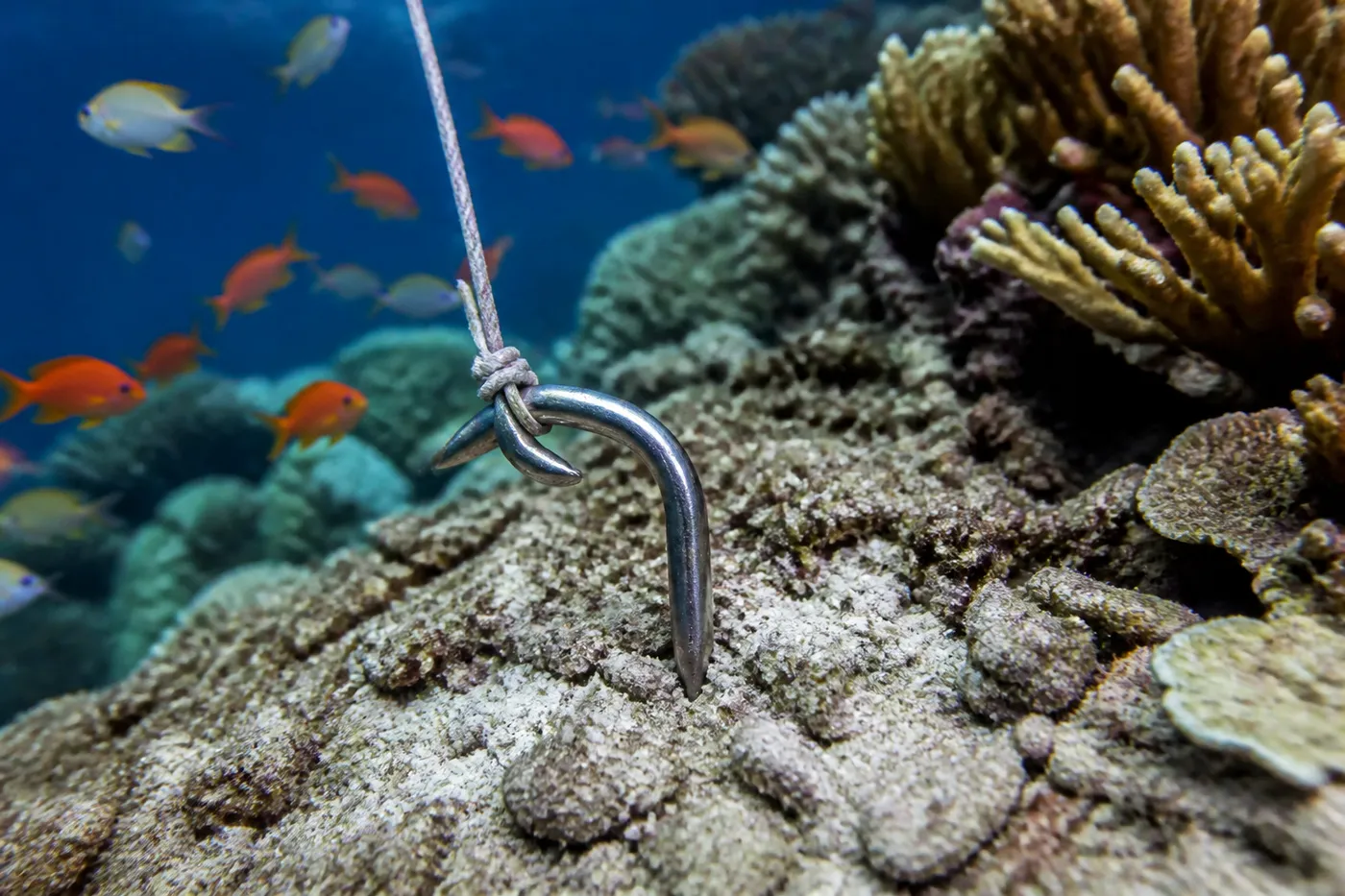
A reef hook is a stainless hook on a short line with a clip on the end. You set it into dead substrate, clip the line to your harness, and hang like a flag in the flow with your hands free. At a site where sharks and trevally hold station in the current, it turns a thirty second flyby into a ten minute encounter, and it drops your breathing rate enormously.
We carry them on board and provide them to every guest on the itineraries where they are useful, so you do not need to buy one, though you are welcome to bring your own if you have a hook you like. What matters is using it without wrecking the reef.
- Approach from shelter. Get into the lee of the reef edge first, where you can work without fighting.
- Choose the anchor point. Bare rock, dead substrate or stable rubble only. At established sites the scoured bare ledges are obvious, and your guide will point them out.
- Set it gently and test it. Place the hook, load it slowly, do not ram it in or scrape it along.
- Add a little air. A small amount, so you rise clear of the reef and hover horizontal with your fins up and off the coral. You want to be flying, not lying on it.
- Keep the line short. Many hooks ship with two metres of line, which is more than you want. Excess slack lifts you too high and sweeps across the reef.
- Dump your air before you unhook. This is the step people forget. Unhooking while positively buoyant fires you upward, which is an ascent you did not plan. Vent first, lift the hook off, stow it, then go.
Two things worth saying plainly. A hook is not a substitute for buoyancy control, and if you cannot hover without one you are not ready for the sites that need one. And it is not the answer everywhere: at several sites we dive, including some of the manta cleaning stations, hooking in is the wrong tool and the technique is to settle on rubble or simply use the topography. Ask in the briefing.
Down-currents, which are the actual hazard
Everything above is comfort and efficiency. This one is safety.
A down-current happens where flow hits a pinnacle or wall and is deflected downwards, and it can take a diver deeper faster than they can fin. The instinctive response, swimming up against it, is the wrong one: you are competing against a column of moving water that will out-work you while your gas consumption goes through the roof and your depth keeps increasing.
The correct response is to get out of it sideways. Down-currents are usually narrow, so swimming horizontally along the reef, or ducking in tight against the structure where the flow separates, gets you out of the column far faster than fighting vertically. Add air if you need to, but be ready to dump it the instant you clear the down-flow, because otherwise the same buoyancy that saved you carries you straight to the surface. Sites like Castle Rock and Crystal Rock are exactly where this comes up, which is why they are briefed carefully and dived on chosen tides.
The prevention is better than the cure and it is simply this: stay close to the reef, and stay close to your guide. Divers who get into trouble in vertical water are almost always the ones who had drifted out into open blue.
What a liveaboard changes
Most current-diving advice is written for day trips out of a shore base. A liveaboard week is a genuinely different proposition, in ways that cut both directions.
You dive the same site on different water, and that is the real teacher
From a boat that is already moored on the site, the guide picks the hour rather than the other way round. Over a week you will dive the same corner on a slack afternoon, on a building flood and at dawn on a rising tide, and those are three different dives.
That repetition is worth more than any course. By the third or fourth time you stop being a passenger and start reading it: you notice which way the soft corals are leaning before you descend, which side of the pinnacle is sheltered, where the fish are stacking. Divers who arrive nervous about current usually stop mentioning it somewhere around day three, and that is not bravado wearing off, it is genuine skill arriving.
Open-water pickups, and the bag that makes them work
Drift diving from a boat means you rarely surface where you started. You come up somewhere downstream, often out of sight of the mothership, and a tender comes to find you. In decent surface conditions that is routine. In a chop, a diver's head is invisible from fifty metres away.
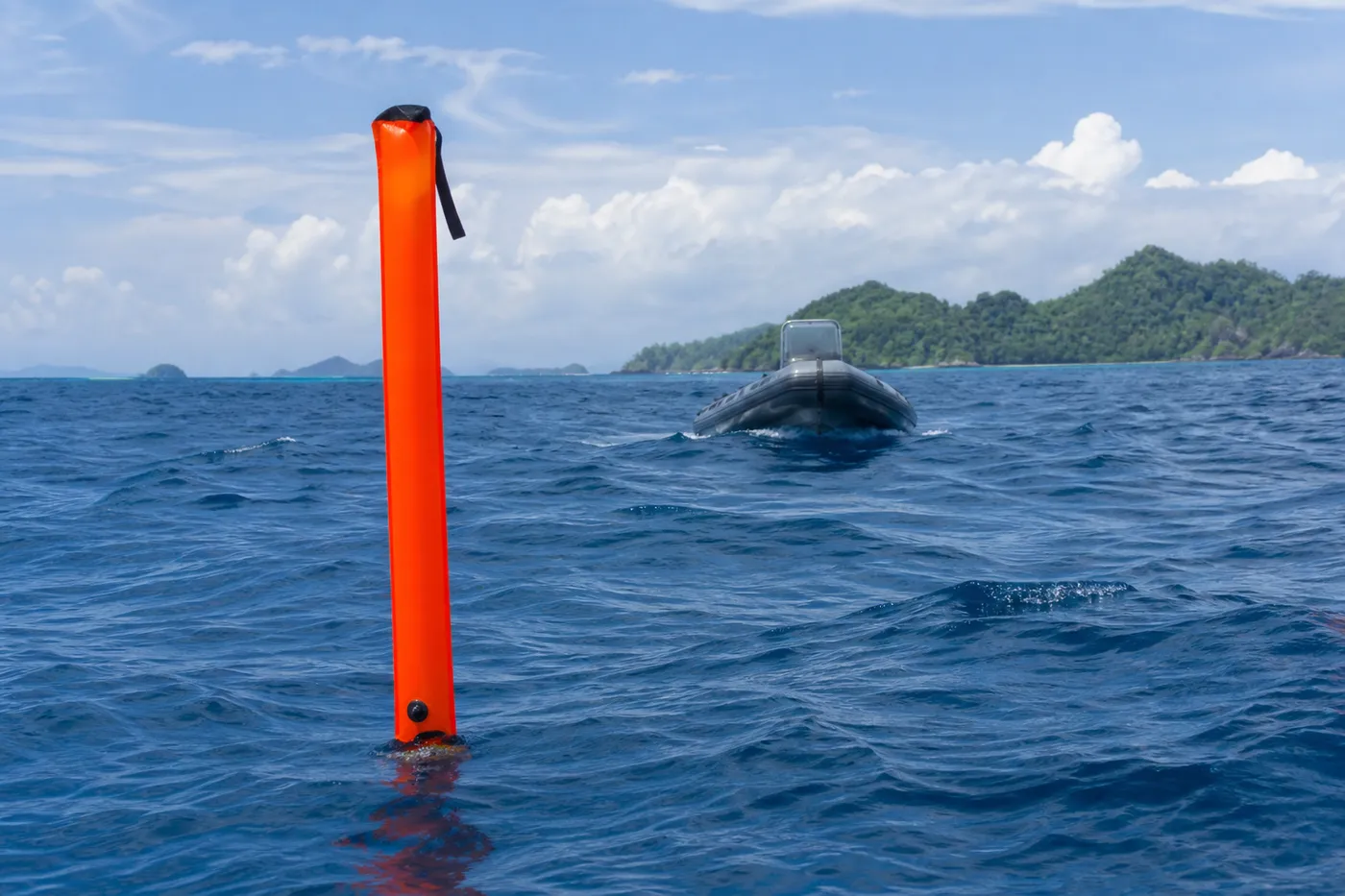
Which is why a surface marker buoy is not optional kit here, and why operators in Komodo treat deploying one before you surface as standard practice on drift dives rather than a nice extra. A tall orange bag, launched from your safety stop, is the difference between being collected in three minutes and being searched for. Carry it on every dive, know how to fire it without tangling yourself, and if your group splits, the rule is the usual one: look for a minute, then surface with the bag up.
Agree the separation plan before you get wet
Groups do get split in fast water, and it is not a disaster if everyone knows the plan in advance. Ours is briefed every time and it is worth asking yours for the same: how long do you look, what do you do if you cannot find the group, does the boat expect you to surface or to continue the drift, and what is the signal for a tender pickup. Sorting that out on the deck takes two minutes. Sorting it out underwater is not possible.
Remoteness changes the maths
The further east you go, the further you are from help. On the Banda Sea and Forgotten Islands routes the nearest recompression chamber can be a very long way off, sometimes more than a day of boat and aircraft away, and there is no realistic scenario in which that gets faster.
None of that should frighten anyone off, but it does argue for conservative diving in a way that a shore-based week in a busy destination does not: stay well inside your no-decompression limits, use nitrox if it is offered, add a bit to your safety stop, and do not let a great dive turn into a deep one because the sharks were slightly deeper than planned. It is also fair to ask any operator you are considering where the nearest chamber is on their route and how an evacuation would actually be coordinated. The quality of the answer tells you a lot. High-workload dives raise decompression risk measurably, which our guide to decompression sickness on a liveaboard quantifies.
Fatigue, over twenty-odd dives
Three or four dives a day for a week adds up, and tired divers make the small errors that current punishes. If you are cold, or your gas consumption has crept up, or you simply cannot be bothered, sitting out a dive is a completely reasonable decision and every good crew will tell you so. There will be another one in four hours.
The kit that earns its place
Current diving does not need much, and most of what it needs is about reducing drag and being findable.
| Item | Why |
|---|---|
| Surface marker buoy and spool | The single most important piece of safety kit on a drift itinerary. Tall, orange, and practised. |
| Reef hook | Provided on board. Short line, clipped to a hip or chest D-ring. |
| Audible signal | A whistle at minimum, a compressed-air horn is better in wind. |
| A streamlined rig | Nothing dangling. Loose hoses and octopus rigs snag reef and add drag. |
| Correct weighting | Being overweighted destroys trim, which is the root of most current problems. |
| Nitrox, where offered | More margin on repeated dives in the 15 to 30 metre band. |
Some divers also carry a small satellite messenger or a locator beacon on the remote routes. It is not standard and it is not necessary on a well-run boat, but if you have one, nobody sensible will object to it.
The short version
Get your weighting and trim right, breathe slowly, stay low and close to the reef, follow the guide's timing rather than your own, carry a bag and know how to shoot it, hook into dead rock only, and if you are pulled down, swim sideways instead of up. That is most of it. The rest arrives on its own, somewhere around the third day, when you realise you have stopped noticing the current and started watching the sharks.