
Watch any group of divers on a reef and you can sort them in about thirty seconds. There are the ones fighting the water: fins churning, arms sculling, BCD hissing every minute or two, a little cloud of sand rising wherever they pause. And there are the ones who simply hang there, exhale, drift a metre down to look under a ledge, and rise gently away again without touching anything. The difference between the two groups is not experience, exactly, and it is certainly not equipment. It is buoyancy control, the one skill that quietly decides how much air you use, what marine life you see, whether the reef survives your visit, and how much you enjoy the whole week of an Indonesia liveaboard. The good news: it is learnable, and faster than most divers think.
This guide collects the twelve techniques we teach and re-teach on our boats, from proper weighting through breath control to the hover drills that turn theory into muscle memory. None of it is exotic. Most of it was in your Open Water course, buried in a weekend of information overload and promptly forgotten. What we have added is the practical layer: what actually goes wrong, in which order to fix things, and the specific adjustments that matter when you are diving in Indonesia, where thick wetsuits are rare, aluminium tanks are the standard, and the currents reward divers who can hold position without thinking about it.
Why buoyancy is the skill that changes everything
It is worth spelling out what good buoyancy actually buys you, because "control" sounds abstract until you connect it to the things divers say they want. Lower air consumption is the big one. A diver constantly finning to stay off the bottom, or dumping and refilling the BCD all dive, is doing physical work, and work costs gas; we routinely see guests cut their consumption by a quarter or more over a single week simply by fixing their weighting and slowing their breathing. Longer dives follow directly. So does better photography, since a stable platform matters more than an expensive camera, a point we laboured in our underwater photography guide. Marine life behaves differently around calm divers too: hover quietly at a cleaning station and the mantas keep circling; chase them with churning fins and they leave.
And then there is the reef itself. Nearly all coral damage from divers comes down to buoyancy failures: a knee dropped on a plate coral during a photo, a fin swept through a sea fan mid-turn, a crash landing on the bottom because the diver descended faster than they could arrest. Guides notice. Marine parks notice. Your buddy, breathing your churned-up sand for the whole dive, definitely notices.
The physics you need, in one paragraph
Everything in this article rests on three facts. First, your BCD is a coarse instrument: it is for compensating big changes, mainly the compression of whatever you are wearing as you descend and the two-plus kilograms your tank lightens as you breathe it down. Second, your lungs are the fine instrument: a full breath in adds several kilograms of lift, a full exhale removes it, and this control is instant, free and precise. Third, everything changes with depth: air spaces shrink as you descend and expand as you rise, which means buoyancy is never "set and forget"; it is a small, continuous conversation. Divers who fight the water are usually using the coarse instrument for fine work. Reverse that and half the battle is over.
Start with weighting, because nothing else works until this does
Technique 1: do a real weight check. At the surface with a normal breath held and an empty BCD, you should float at eye level, and sink slowly when you exhale. That is the whole test. Most divers have never done it with their actual holiday kit and are carrying two to four kilograms too much, usually because a rental shop added "a bit extra to be safe" a decade ago and the number stuck. Overweighting is the root cause of most buoyancy misery: it forces air into the BCD to compensate, and that air expands and contracts with every metre of depth change, turning you into a yo-yo.
Technique 2: re-check with a nearly empty tank. The proper standard is to be able to hold a five-metre safety stop with 50 bar remaining and no air in the BCD. An aluminium 80, the standard tank on nearly every Indonesian boat including ours, swings from roughly two kilograms negative when full to around one kilogram positive when nearly empty. If you weighted yourself with a full tank and no margin, you will be fighting to stay down at the end of every dive. Add just enough lead to cover the swing and no more.
Technique 3: log what you learn. Weight requirements change with every wetsuit, tank type and water salinity, and memory is unreliable across a year between trips. Write the configuration in your logbook: suit, tank, lead, and whether the safety stop felt easy. On our boats the crew asks about your last logged setup on day one precisely because it saves the first two dives of trial and error. In a 3mm suit in warm salt water, most divers land somewhere between two and six kilograms; if you are carrying ten, something is wrong.
Breathe like a diver, not a swimmer
Technique 4: use your lungs for all small corrections. Want to rise half a metre over a coral head? Breathe in a little deeper and wait a beat. Want to drop to look under a ledge? Exhale slowly and let yourself sink. The lag is the part nobody teaches properly: the effect arrives a second or two after the breath, so beginners breathe in, feel nothing, breathe in more, and then balloon upward. Make the change, count two seconds, and trust it. After a few dives this becomes as unconscious as balancing on a bicycle.
Technique 5: slow everything down. A long, slow exhale is the most underrated tool in diving. It calms your heart rate, drops your air consumption, and gives you a continuous fine control of depth that no BCD can match. The rhythm we suggest: inhale over about four seconds, exhale over six or more, never holding, never forcing. If your bubbles come out in a steady quiet stream rather than a burst, you are doing it right. This alone, with no other change, has fixed more "I use too much air" complaints on our trips than any equipment tweak, and it pairs with the equalisation rhythm we covered in the ear equalisation guide.
Make peace with your BCD
Technique 6: small bursts, then wait. The BCD inflator is not a light switch; it is a tap filling a bucket that responds slowly. One short press, a two-second pause, assess, repeat if needed. The classic beginner loop goes: press and hold, start rising, panic, dump everything, start sinking, press and hold again. Each cycle wastes air and confidence. If you find yourself inflating and deflating more than a handful of times on a flat section of reef, go back to technique 1, because you are almost certainly overweighted.
Technique 7: vent before you rise, not after. Air in your BCD expands as you ascend, which means an ascent accelerates itself if you let it. The habit to build: the moment you begin moving up intentionally (end of dive, up the reef slope, over an obstacle), let a little air out first, before the expansion arrives. Learn where all your dump valves are and use the one highest in the water; raising the inflator hose while horizontal does very little. On sloping sites, which describes half of Indonesia, this one habit separates relaxed profiles from sawtooth ones.
Trim: the horizontal difference
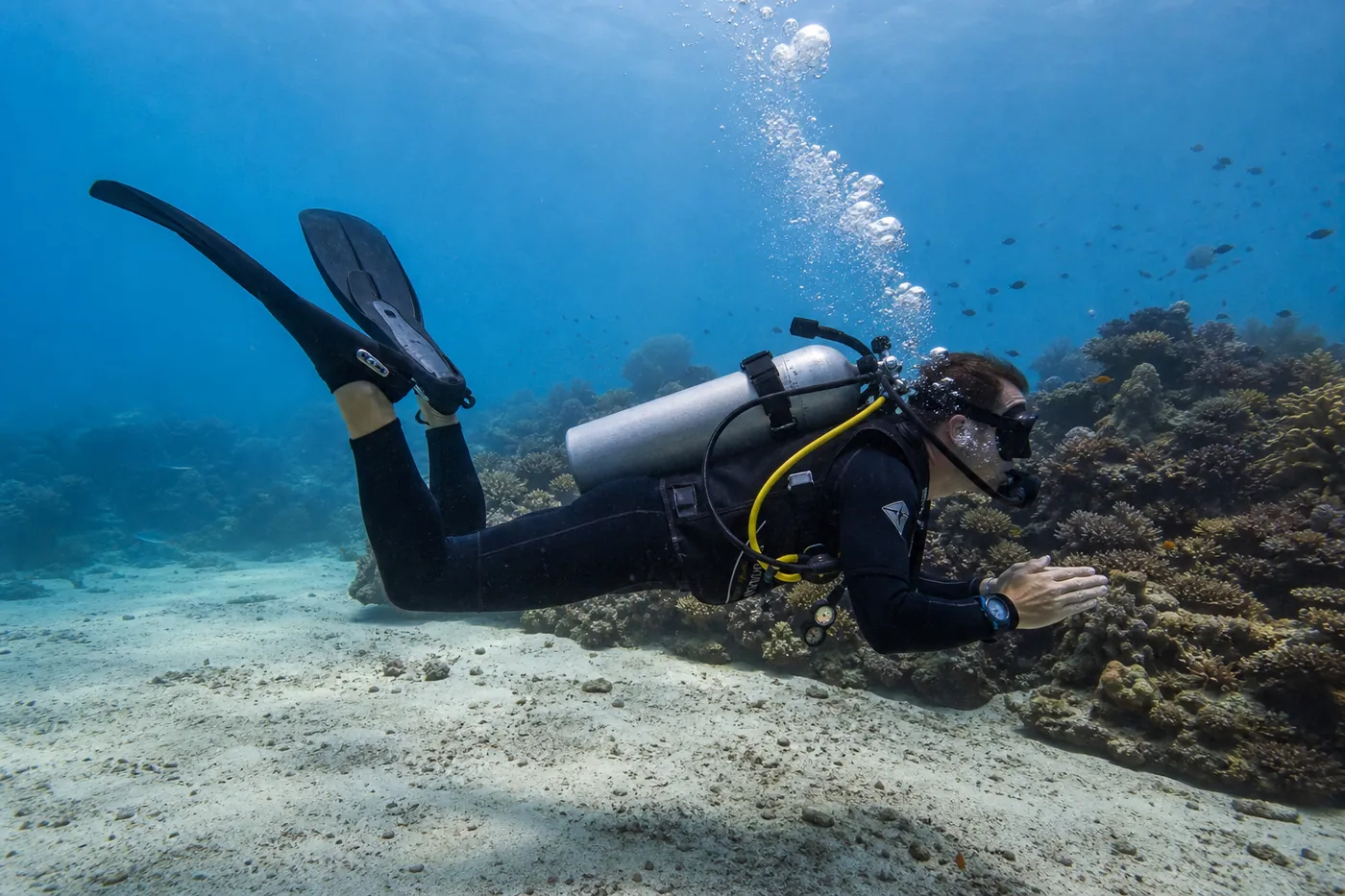
Technique 8: get flat. Trim is your body's attitude in the water, and the target is horizontal, like a skydiver. A feet-down diver's every fin kick drives them upward, which they then compensate for by dumping air, then sinking, then kicking, in an exhausting loop they usually blame on "bad buoyancy". Often the buoyancy is fine and the trim is the whole problem. Fixes are mostly weight placement: move lead from the hips toward the ribs with trim pockets, or shift the tank band a few centimetres. Ask your guide to film you for ten seconds; divers are reliably astonished by the difference between how they feel (flat) and how they look (forty-five degrees, feet down, silt rising).
Technique 9: still your hands, slow your fins. Sculling hands are a buoyancy tell: they mean you are using constant work to hold a position that your weighting and lungs should hold for free. Clasp them loosely in front of you and let the water show you what your buoyancy is actually doing; fix that, and the hands stay quiet on their own. The same logic applies to fins. A slow frog kick with a glide phase gives you time to feel depth changes and correct them with breath, where a fast flutter hides every signal under constant motion. Fewer, better kicks.
Drills that build the skill
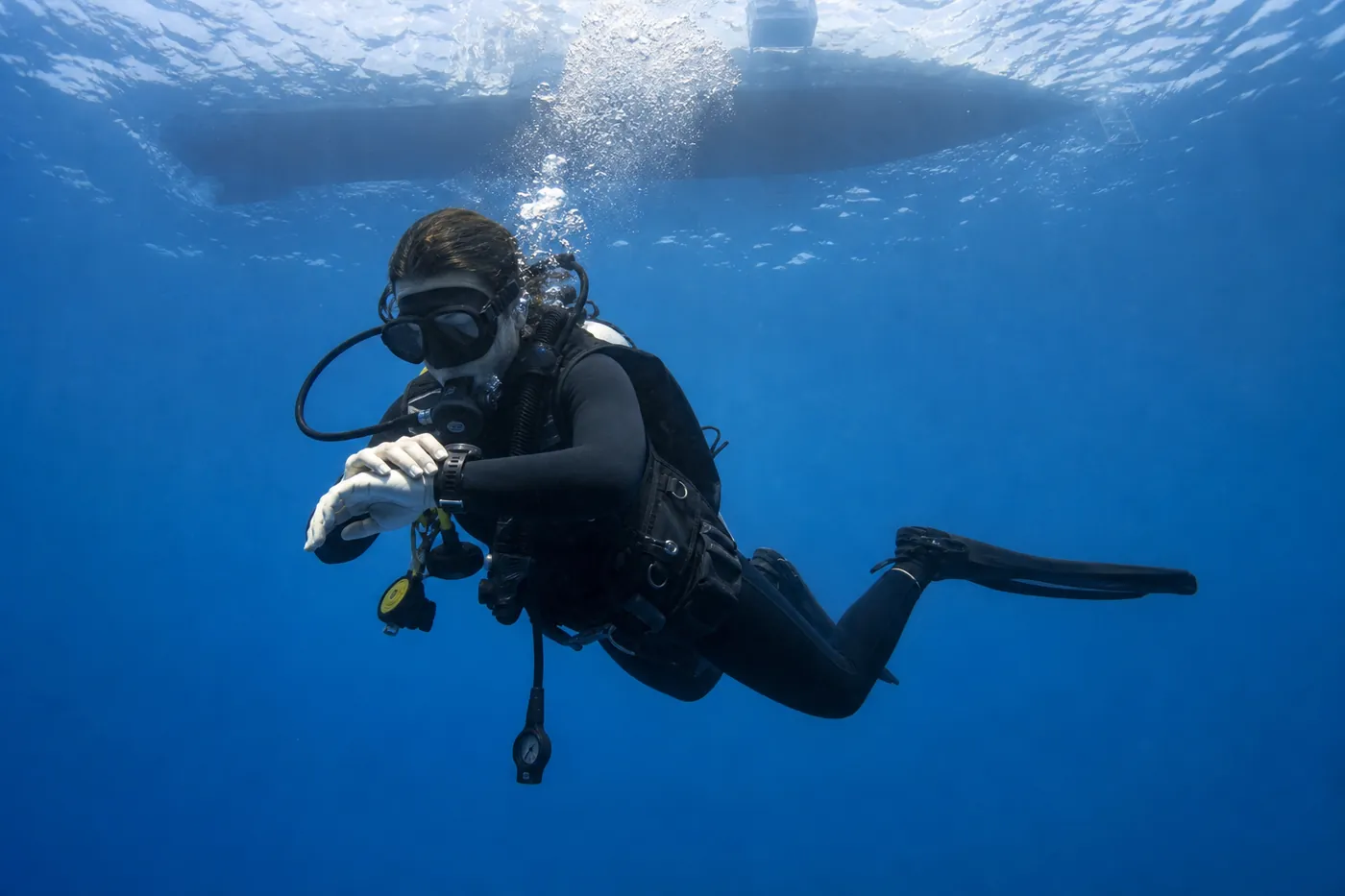
Technique 10: hover practice on every safety stop. You already have three minutes of enforced stillness at five metres on every dive; use them. Cross your ankles, fold your hands, and try to hold your depth with breath alone, watching your computer. Five metres is deliberately the hardest place to do this (pressure changes fastest near the surface), which makes it the best free classroom in diving. When you can hold plus or minus half a metre for a full stop without touching the inflator, your buoyancy has arrived. Extending that stop past three minutes is among the cheapest conservatism available on a repetitive week, as our guide to decompression sickness on a liveaboard explains.
Technique 11: play games with a purpose. On easy sites, give yourself small tasks: descend to a sandy patch and stop your descent with breath alone one metre before the bottom; swim a slow circle around a coral head at constant depth; rise over it by inhaling and settle behind it by exhaling. Ten minutes of deliberate practice like this on the first day of a trip is worth more than fifty dives of unexamined habit, and a sandy bottom at ten metres forgives every mistake while you learn.
Technique 12: take the feedback, or take the course. A Peak Performance Buoyancy course is a worthwhile shortcut if you like structure: an instructor watches you, adjusts your weights and trim on the spot, and runs the drills above with corrections in real time. We covered it alongside nitrox and other worthwhile add-ons in our guide to certifications worth taking before a liveaboard. But the honest version is that any good guide can do most of this for free if you ask. Tell the crew on day one that you want to work on buoyancy, and you will get weight checks, trim photos and quiet pointers all week. Guests who ask are the ones who improve.
Buoyancy in Indonesia: what changes in warm water
Most buoyancy advice online is written for cold-water training environments: thick neoprene, steel tanks, drysuits. Indonesia flips several of those assumptions, and divers arriving from temperate certification courses are often carrying habits, and lead, that no longer apply.
The wetsuit factor shrinks dramatically. A 3mm tropical suit, or a shorty, has far less inherent buoyancy than the 7mm you may have trained in, and it compresses less with depth, so the "big BCD adjustment on descent" you were taught to expect mostly is not there. Divers who reflexively add air at fifteen metres because that is what cold water taught them end up positive without understanding why. Start lighter and adjust less. The aluminium tank factor works in the opposite direction: unlike the steel tanks common in Europe, the aluminium 80s on Indonesian boats go noticeably positive as they empty, so the end of the dive, not the beginning, is where your weighting gets tested. And the salinity factor is real but small: tropical Pacific salt water is slightly more buoyant than what most people trained in, usually worth about a kilogram. Controlling the descent is also what keeps your ears out of trouble, as our guide to barotrauma in scuba diving explains.
Then there is current. At sites like those in Komodo, good buoyancy stops being a comfort skill and becomes an operational one: holding position at a reef hook point, staying flat and low through a channel, rising out of the current's shadow without ballooning. The sites themselves are covered in our Komodo dive sites guide and the seasonal picture in the Komodo best-time guide; the skill that makes them comfortable is the one this article teaches. It is no coincidence that guides in Komodo can spot a diver's buoyancy level from the dinghy, before anyone gets wet, just by watching how they descend.
One habit transfers everywhere, though: buoyancy discipline near the bottom. Indonesia's best small life (the pygmy seahorses, the rhinopias, the blue-ringed octopus of the macro sites) lives on or near silty and fragile substrate. The photographers who get the shot are the ones who can hover ten centimetres above the sand without a fin tip touching. That is technique 10 and 11 territory, practised until boring.
The mistakes we see every single week
A short and affectionate list, compiled from years of watching hundreds of divers a season. Overweighting is first, second and third: it is the default state of travelling divers and the upstream cause of nearly everything else on this list. Then comes inflator dependence, using the BCD for corrections the lungs should make. Then vertical trim, the feet-down posture that turns every kick into an elevator button. Then breath-holding at moments of concentration, usually with a camera, which sends the diver drifting slowly upward mid-shot, baffled. And finally the rushed descent: dumping all air, sinking fast, and arriving at the reef in a cloud of sand two metres deeper than intended. Every one of these is fixed by the techniques above, in roughly the order we presented them.
What the fix looks like in practice is less dramatic than most divers expect. The common pattern is someone arriving three or four kilograms overweighted, ending dives fifteen or twenty minutes before everyone else, and assuming that is simply their metabolism. A proper weight check on the second day usually takes several kilograms off. Moving some of the remaining lead into trim pockets by the ribs flattens the posture. One deliberately dull dive over sand, spent doing nothing but breath-controlled hovering, does more than a week of incidental practice. By the end of a week it is entirely normal to see the same diver surfacing with 70 bar instead of 30 and matching the group for dive time. Nothing about their fitness or their lungs changed. Only the weighting, the trim and the breathing did.
Does gear make a difference? Some, and less than you hope
Divers love to solve skill problems with shopping, so let us be honest about what equipment can and cannot do here. A well-fitted BCD helps, mainly because a loose one shifts as you move and drags your trim around with it; whether it is a jacket or a back-inflate wing matters far less than the fit, though wings do encourage a flatter position. Trim pockets, the small weight pouches that mount on the tank band, are the cheapest meaningful upgrade in diving, usually under thirty dollars' worth of nylon, and they solve the feet-down problem that no amount of technique fully fixes when all your lead sits on your hips. A dive computer with a clear depth display gives your practice a scoreboard. Lighter fins change less than the fin technique you use them with.
What gear cannot do is substitute for the weight check, the breathing or the practice. We have watched guests arrive with two thousand dollars of new equipment and sawtooth profiles, and we have watched instructors borrow the oldest rental kit on the boat and hang motionless in mid-water with it. The order of operations is skills first, then the modest gear tweaks that support them. If your budget allows exactly one purchase before an Indonesia trip, make it trim pockets, and spend the rest of the money on more dives.
How long does this actually take?
Faster than you fear, slower than a single tip. The weight check takes ten minutes and pays off immediately. Breath control starts working the first dive you consciously practise it and feels natural within five to ten dives. Trim adjustments are usually one conversation and one repositioned kilogram. The full package, hovering motionless without thinking about any of it, tends to click somewhere between twenty and fifty dives for divers who practise deliberately, and never quite arrives for divers who do not. A liveaboard compresses the timeline wonderfully: three or four dives a day, the same kit every dive, the same crew watching and correcting, warm calm water to practise in. It is, in most years, the single fastest environment we know for turning a nervous flapper into a quiet hoverer, which is one more argument in the case we made in our beginner's liveaboard guide.
Putting it together
If you take three things from this article, take these. Get weighted properly, with a real check at the surface and a nearly empty tank, because nothing else works while you are dragging spare lead. Make your lungs the fine control and your BCD the coarse one, in small bursts with patience between them. And get flat, with still hands and slow fins, so the water stops fighting you back. Everything else (the drills, the course, the guide's feedback) is just structured repetition of those three until they are automatic.
Then come and practise where practising is a pleasure. Our first-time liveaboard guide covers what a week on board looks like, the packing list covers what to bring (trim pockets included), and if you want a crew that will happily spend a week polishing your hover between manta dives, get in touch and we will point you at the right boat and season for it.