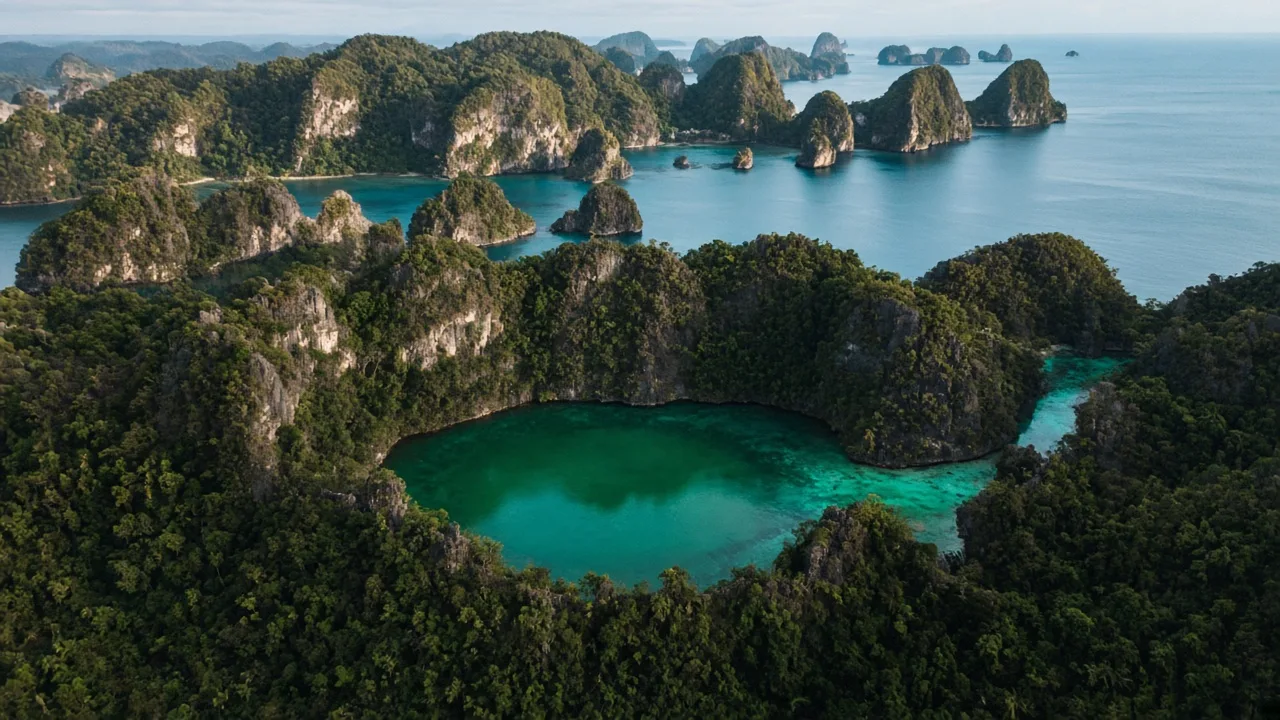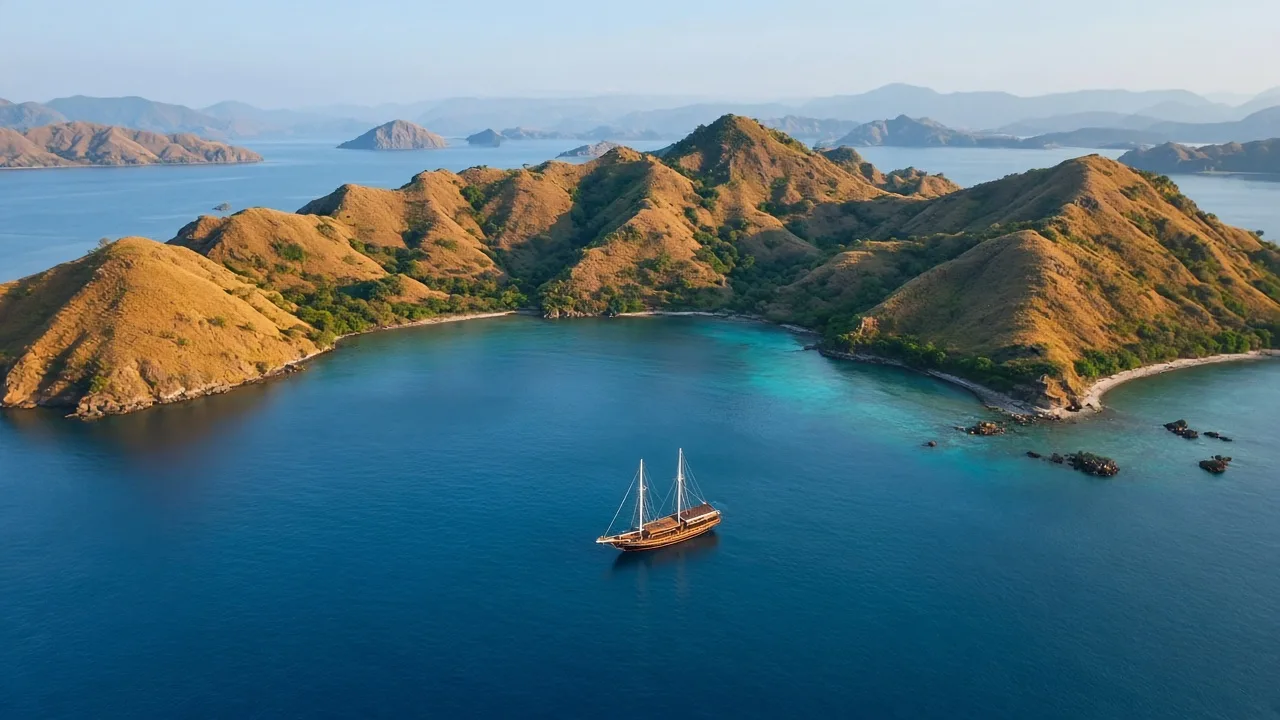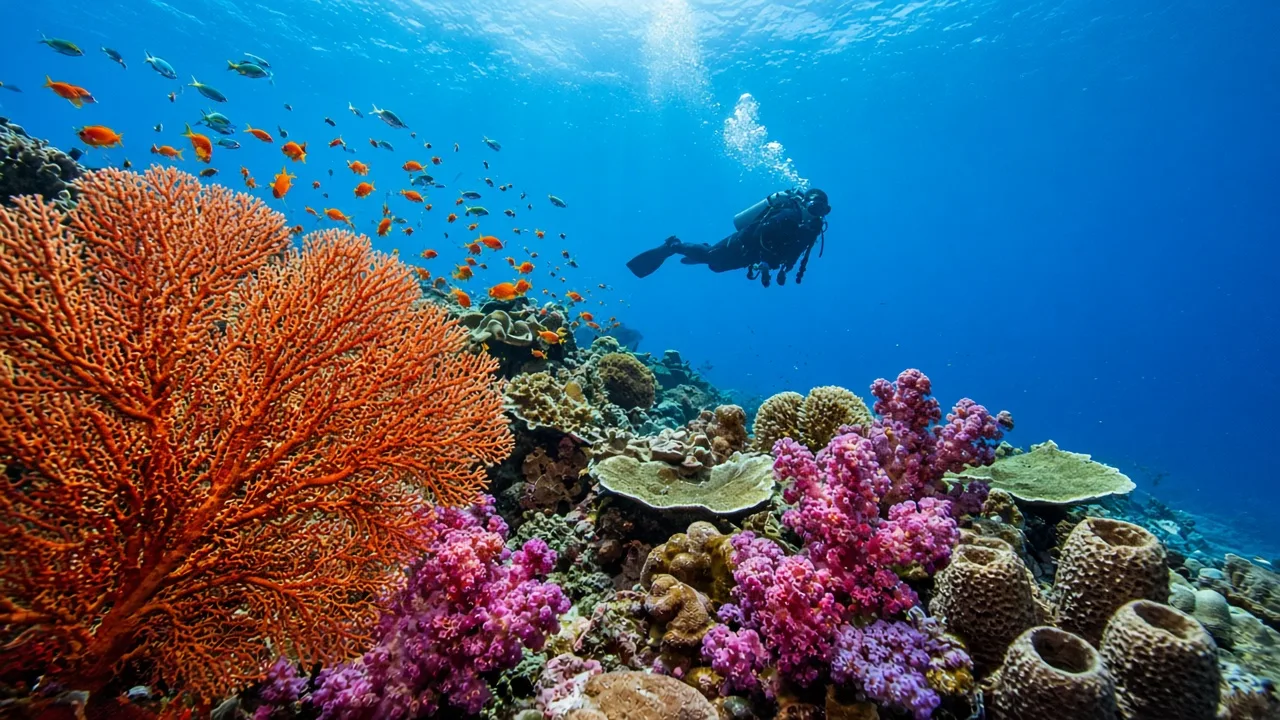
North Komodo keeps its two best dives within sight of each other. In the channel off Gili Lawa Laut, at the top of the national park where the Flores Sea pours through on every tide, two submerged pinnacles rise from deep water a few minutes' boat ride apart: Castle Rock and Crystal Rock. Neither offers a beach, a viewpoint or anything for the topside photographer. What they offer is the densest predator action in the park, sharks on nearly every dive, giant trevally hunting through walls of fusiliers, and mornings that experienced divers rank among the best of their lives.
They are also, without apology, advanced dives. This is negative-entry, reef-hook, listen-to-the-brief territory, and the same currents that stack the water column with fish will happily relocate an inattentive diver half a kilometre down-channel. This guide covers both rocks properly: what each one is and how the dives run, the differences that decide which you will love more, the skills and certification you genuinely need, the seasons and tide logic, and why a Komodo liveaboard parked overnight at Gili Lawa Laut owns the golden hour when these sites are at their wildest.
Two Rocks, One Channel
The geography explains everything. The northern edge of Komodo National Park faces the open Flores Sea, and the passage between the islands of Gili Lawa Laut and Gili Lawa Darat works as a funnel: every rising and falling tide drives nutrient-rich oceanic water through the channel and over anything standing in the way. Castle Rock and Crystal Rock are the things standing in the way, two seamounts anchored in the flow like fists raised out of a river. The current hits them, splits, and delivers a continuous broadcast of plankton and baitfish, and the entire food chain assembles in response, from clouds of anthias to the grey reef sharks that give north Komodo its reputation.
The two rocks divide the spectacle between them. Castle Rock sits fully submerged, its crown around four to six metres below the surface, with the seabed falling away past 40 metres on every side; there is no land reference at all, just a mountain top in open blue water. It is the fishier and by most accounts the wilder of the pair, the site where the trevally hunts reach their most violent and the shark count climbs past a dozen on a running tide. Crystal Rock, a short ride southwest, just breaks the surface at low tide, a knuckle of dark rock that gives the boat crew something to aim for. Below, a saddle connects its two peaks, the slopes carry some of the healthiest soft coral in the park, and the water lives up to the name: visibility here regularly exceeds 30 metres, the best in Komodo, which is why photographers usually crown Crystal their favourite while the adrenaline crowd votes Castle.
They come with supporting acts, which matters for planning. The same channel holds the Cauldron, also sold as Shotgun, a swim through a bowl between the Gili Lawa islands that ends with the current firing divers through a narrowing gap over a shallow coral garden, and Golden Passage, a classic drift along the channel between Gili Lawa Darat and Komodo island proper. A single northern day can run all four, sequenced around the tide table, which is why the north anchorage is where most liveaboard itineraries spend at least one full day and often two.
A note on names, since boat briefings juggle several. Castle Rock appears on Indonesian charts as Batu Toko Toko, and older guides still call it that. Crystal Rock earned its English name honestly, from the water clarity, and nobody seems to remember an older one. Both were essentially unknown outside local fishing lore until liveaboards began working the north in the 1990s, which by Komodo standards makes them recent celebrities; the park's protection arrived in time to meet them nearly untouched, and the no-take enforcement since has kept the predator populations at densities most of the Coral Triangle lost decades ago.
Both belong to the same tidal machine, and both appear in our ranked rundown of the best dive sites in Komodo alongside their central-park sibling Batu Bolong. The comparison with Batu Bolong is worth a sentence, because guests ask constantly: Batu Bolong is a sheltered-side dive where you hide from the current and watch the soup; the northern rocks are exposed dives where you go out into the moving water, hook in, and let the current bring the show to you. Same engine, opposite seats. Most week-long itineraries deliver both, and the contrast is half the education.
Castle Rock: The Dive
Castle Rock dives are choreographed, and the choreography starts on the dive deck. Because the pinnacle offers no surface reference and the current is usually running, the standard plan is a negative entry: BCD empty, camera clipped, roll in and descend immediately, no surface pause, dropping fast onto the crown before the flow can carry you off it. The boat positions up-current so the descent itself drifts you onto the rock. Done right, the whole group lands on the pinnacle inside a minute, regroups in its lee, and works up-current along the flank to the corner where the current splits, the front row seat.
That corner is the point of the site. On a running tide, you hook into bare rock at 18 to 25 metres, add a little air to lift off the reef, and hang in the flow like a flag while the ocean conducts its business an arm's length away. Fusiliers stream past in rivers. Grey reef sharks stack up ahead of the split, holding effortlessly in water that would strip your mask off if you turned your head wrong, with whitetips patrolling below and the occasional blacktip on the shoulder. Then the giant trevally arrive, and the rivers of fusiliers detonate. A GT hunt at Castle Rock is not a subtle spectacle; it is percussion you feel in your chest, silver walls collapsing and reforming, predators cutting through at speeds that seem to break the water's rules. Dogtooth tuna and Spanish mackerel work the edges, eagle rays pass in the blue, and every few seasons somebody's logbook gains a passing manta or a doubtful-sounding hammerhead entry that we have learned not to argue with.
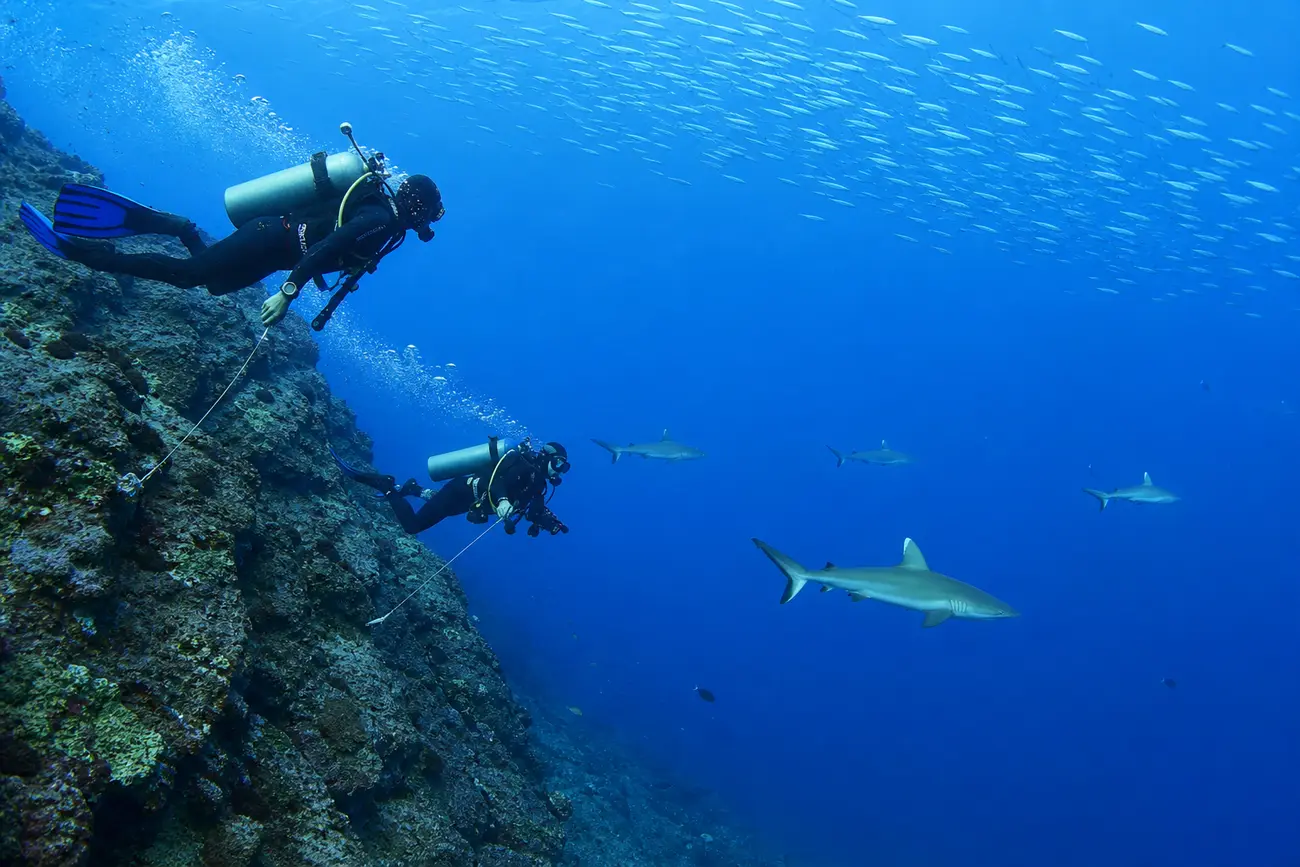
What does 45 minutes at Castle Rock actually contain? A representative log, from a running-tide morning this past June: minute one, negative entry, crown at six metres, regroup. Minutes two to eight, working up the flank in the lee, whitetips on the sand channels, a loose squadron of batfish holding station. Minutes nine to thirty, hooked at the corner: eleven grey reef sharks counted holding in the flow at peak, three separate GT strikes through the fusiliers, a dogtooth tuna of genuinely unreasonable size making two passes, one eagle ray below the group. Minutes thirty-one to forty, unhook and fall back across the crown, glassfish and anthias thick over the coral heads, a hawksbill wedged in against the rock ignoring everybody. Minutes forty-one onward, drift off the down-current end, DSMB up, blue-water stop, tender waiting. No single element is guaranteed on any given dive, mantas replace tuna some weeks and the shark count wanders between six and twenty, but that log is not a highlight reel; it is roughly the median.
The dive ends the way it began, by plan rather than improvisation. Unhook on the guide's signal, fall back along the flank, and let the current carry the group off the down-current end of the pinnacle for a drifting blue-water ascent, safety stop conducted mid-channel under a deployed surface marker with the boat following the buoy. First-timers find the blue-water stop the strangest part, three minutes of hanging in featureless moving water, but it is routine here, and it beats fighting back across the flow for the privilege of ascending where you started.
Slack tide softens all of this considerably, and guides use the gentler windows for divers newer to current work: same pinnacle, same sharks in residence, a fraction of the drama and effort. But the site's full character only switches on when the water moves. Our crews have a saying that translates roughly as no current, no dinner, and while the kitchen has never actually enforced it, the principle stands. You want Castle Rock with the tide running. That is the dive people cross oceans to repeat.
Crystal Rock: The Dive
Crystal Rock runs on the same physics with a different personality. The tip showing above the water gives the entry more reference than Castle's open blue, and the topography below is more varied: two peaks joined by a saddle at around 12 to 18 metres, slopes falling past 30 metres, and coverage that shifts the site's centre of gravity from pure fish action toward scenery. The soft coral growth on the current-facing slopes is among the finest in the national park, oranges, purples and whites at full extension when the water moves, layered with gorgonian fans and carpets of glassfish around the heads.
The marine life reads like Castle's cast list with the volume turned from eleven to eight: grey reef sharks and whitetips on the current line, trevally and barracuda over the peaks, dogtooth tuna on the deep edges, eagle rays gliding through with some regularity. Turtles are more common here than at Castle, and the shallows hold enough macro, nudibranchs, pygmy seahorses on the fans if your guide has the eyes for the safety stop to double as a second dive. What changes everything is the light. On a dry-season morning the visibility stretches past 30 metres, the whole seamount stands visible at once like a model on a table, and wide-angle photographers get the shot this site is famous for: soft coral foreground, shark mid-ground, sunball background, all in one frame. If Castle Rock is the action film, Crystal Rock is the same story shot by a cinematographer.
The dive plan mirrors Castle's, negative entry on a running tide, work the lee and the split, drift off for a blue-water stop, with one welcome difference: the saddle between the peaks offers shelter at deco-friendly depths, so the back half of the dive can go slow and shallow among the coral while the current hums overhead. On gentle tides Crystal is the more forgiving of the two rocks, and it is usually the one guides choose first when introducing capable divers to northern current work. We watched that theory play out last October with a father and daughter aboard, both freshly advanced-certified and nervous about the north after reading too many forums. Crystal at morning slack went so well that they demanded Castle on the running tide that same afternoon, hooked in at the corner like veterans, and spent dinner talking over each other about the trevally hunt. The daughter's logbook entry for the day, which she showed the whole salon, read in full: everything, everywhere, at once.
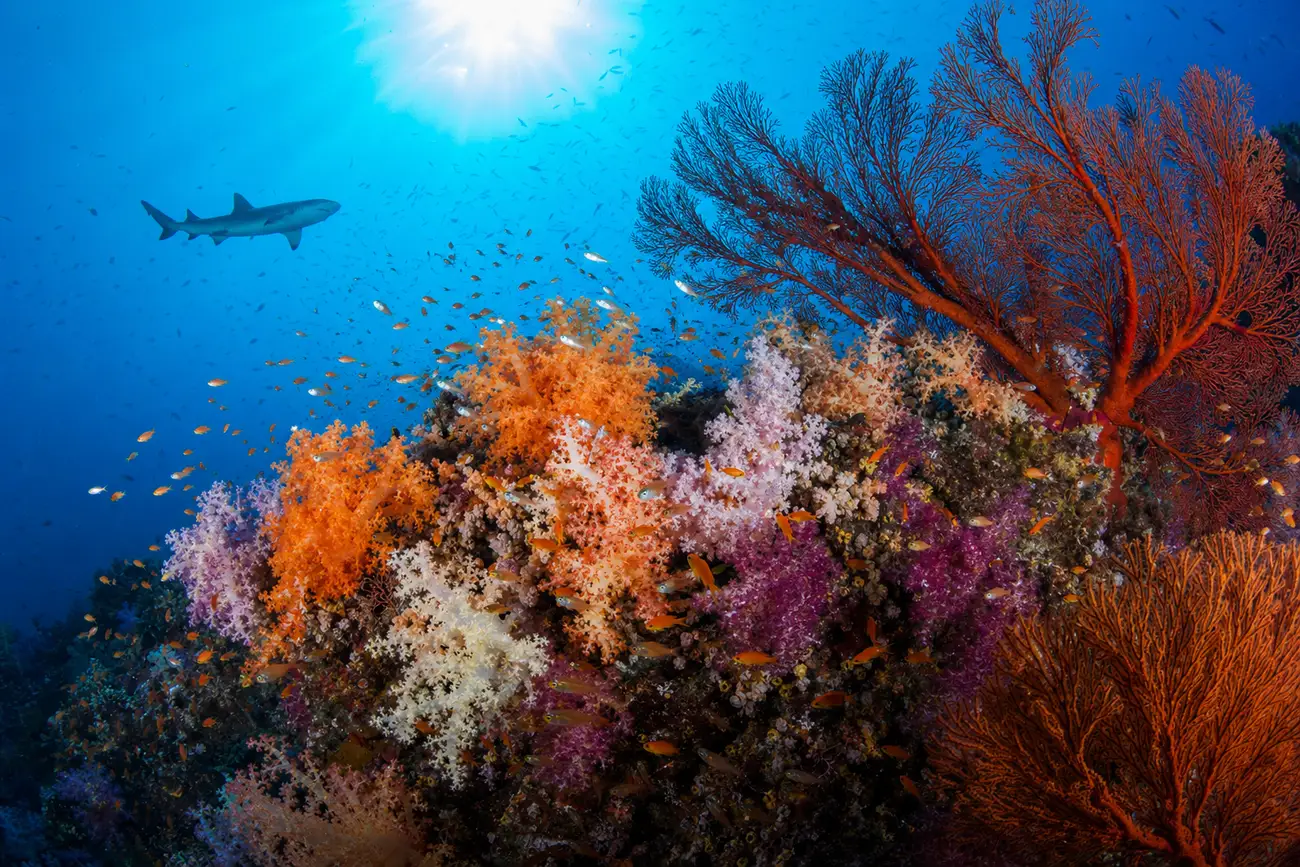
For photographers, a few specifics earn their keep. Wide angle is the only sensible first choice on both rocks, and at Crystal the working recipe is close-focus wide angle on the soft coral with the reef sharks layered behind; the corals only extend fully when the current runs, so the best coral shots and the hardest shooting conditions arrive together, and a reef hook plus two hands on the camera is a skill worth practising somewhere gentler first. Strobes matter less than usual in the famous visibility, and some of the best Crystal images we have seen from guests were shot ambient with a red filter above 15 metres. At Castle, give up on the reef and shoot the action: fast shutter, ISO up, aim where the fusiliers are nervous, because that is where the trevally are about to be. And on both rocks, the frame everyone wants, predator, prey and pinnacle in one composition, is a patience shot; pick a hookpoint with the sun behind you and let the cycle of hunts come to the lens rather than chasing it.
Which rock is better is a dinner-table argument we referee weekly, and the honest answer is that they are two halves of one experience. Castle gives you the ocean at maximum intensity; Crystal gives you the same ocean composed, lit and framed. Divers who visit the north and dive only one of the pair have seen a coin and called it the currency. Do both, ideally in the same day, and let the argument continue at your own table.
Skills, Safety and Who Can Dive the Northern Rocks
Here we owe you directness, because these two sites are where Komodo's reputation for current stops being a marketing flourish and becomes a set of entry requirements. The operator standard across the park is Advanced Open Water certification for both rocks, and unlike some minimums, this one is enforced rather than winked at; if your certification history needs untangling before a trip, our guide to dive certifications for Indonesian liveaboards covers what the northern sites expect. Open Water divers are not taken here on running tides, full stop, and a good operator will route them to Crystal at slack or to the gentler central sites instead while the advanced group does the corner at Castle.
The specific skills that matter, in rough order of consequence: a clean negative entry, because the descent is the most current-sensitive minute of the dive; fast equalisation, for the same reason; genuinely neutral buoyancy in moving water, since the difference between hovering beside the reef and being pinballed across it is mostly ballast discipline; reef-hook technique, hooking bare rock rather than coral, tension kept on the line, unhooking without leaving the hook behind; and DSMB deployment from mid-water, which is not optional equipment theatre but the thing that lets the boat find you after a blue-water stop in a channel. None of this is exotic. All of it should exist in your hands, not just your logbook, before the boat leaves Labuan Bajo. If big animals in current are the draw, our broader guide to shark diving in Indonesia sets these two rocks in national context; the short version is that nothing else in the country delivers sharks this reliably, this close to a marina. A week of negative entries asks a lot of your ears, and our guide to barotrauma in scuba diving is worth reading before you dive these two.
Two safety notes earn their own paragraph. Down-currents occur on the down-tide faces of both pinnacles, the same water that climbed the front must descend the back, and the response is drilled in every briefing: fin horizontally away from the rock, out of the descending column, rather than fighting vertically against it. And separation in the blue is managed, not feared: every diver carries a DSMB, every group ascends under one, and the tender tracks the buoys. The northern rocks have run thousands of dives a season for decades on this system. The sites are demanding; they are not reckless, and the difference is the discipline.
Seasons, Tides and Making It a Day
The north dives best in the dry season, April through November, when the Flores Sea lies down, visibility peaks and the anchorage at Gili Lawa Laut turns glassy; the wet months move the fleet toward the park's southern sites and their own trade-offs, a rhythm we cover in the guide to the best time to visit Komodo. Water runs 25 to 28 degrees, warmer than the upwelled south, and a 3mm suit is standard. Within any day, the rocks are dived on the tide windows, and the tide decides the running order: typically one rock on the morning exchange, The Cauldron or Golden Passage on the mid-day slack, the other rock in the afternoon, an itinerary logic laid out in our Komodo itineraries guide.
Two smaller planning notes. First, nitrox earns its cost in the north more than almost anywhere else in Indonesia: the interesting depth band at both rocks sits between 18 and 28 metres, exactly where enriched air buys the most bottom time, and a two-rock, four-dive northern day on air leaves people watching their computers when they should be watching the corner; the full arithmetic is in our piece on whether nitrox is worth it on a liveaboard. Second, currents here scale with the moon: the days around new and full moon bring spring tides and the wildest water, neaps bring the manageable middle, and a good cruise director builds the week's northern day around that lunar arithmetic rather than around the calendar. If your dates are flexible and Castle Rock is the trip's centrepiece, aim for the building tide a few days ahead of the full moon, strong enough for the full spectacle, short of the washing-machine extremes.
And the timing advantage belongs, once again, to the boats that sleep there. Day boats from Labuan Bajo spend upwards of two hours reaching the north and take the tide they are dealt. A liveaboard anchored off Gili Lawa Laut takes the dawn exchange, the hour when the night's hunters are still working and the day boats are still queuing for fuel, and it is not close: ask any northern guide for their favourite dive of the season and the answer is Castle Rock at first light, tide running, nobody else on the rock. Add the sunrise from Gili Lawa Laut's hill, one of the park's great topside views, and the northern day argues for itself. The rocks were always going to be on your itinerary; the reason to plan the trip around them is the hour of the morning you meet them.
One last piece of honest expectation-setting. The northern rocks are consistent by wild-ocean standards, not by aquarium standards: a slack-tide dive on a neap week will show you a handsome seamount with modest traffic, and first-time visitors who catch only that window sometimes wonder what the fuss was about. The fuss is real; it is simply tied to moving water. Trust the crew when they shuffle the schedule to chase a tide, take the dawn call even when the bed argues otherwise, and give the north two days rather than one if the itinerary allows. Divers who do almost invariably list Castle and Crystal among the best dives of their lives, and a fair number reorganise their next trip, and the one after that, around getting back to that corner when the water starts to run.