Decompression is the part of diving that most certified divers understand least well, which is odd, because it is the reason almost every rule you were taught exists. Ask a room of guests on an Indonesia liveaboard what a no-decompression limit is and you will get a confident answer from about a third of them, a rough answer from another third, and a slightly embarrassed silence from the rest. That is not a criticism. It is a gap in how the sport teaches itself.
It matters more here than in most places. A week of diving in Indonesia on a liveaboard is close to the most nitrogen-loaded thing a recreational diver ever does: three or four dives a day, five or six days running, often in current, sometimes cold, always a long way from a recompression chamber. This guide covers what decompression actually is, what a liveaboard week does to you that a weekend of shore diving does not, what the largest recent dataset says about who actually gets hurt, and how to stay well inside the margins without losing half your trip to caution. We are a dive operator and not a medical authority, so where this touches medicine it points you at the people who are.
What decompression actually is
Strip away the jargon and there is one physical process underneath all of it.
Going down: on-gassing
The air you breathe is roughly 78 per cent nitrogen, and your body does nothing with nitrogen. It is inert. At the surface your tissues hold a certain amount of it dissolved in solution, in equilibrium with the air around you, and that is where it stays.
Underwater, pressure rises fast. At 10 metres you are at twice the pressure of the surface, at 20 metres three times, at 30 metres four. Your regulator delivers air at ambient pressure, so every breath at 30 metres contains four times as many nitrogen molecules as a breath at the surface. That extra nitrogen dissolves into your blood and then into your tissues, and it keeps dissolving for as long as you stay down. Deeper and longer both mean more.
Coming up: off-gassing, and why the speed matters
On the way up the pressure drops and the process reverses. Your tissues now hold more nitrogen than the surrounding pressure can keep in solution, and the excess has to come out. Done slowly, it travels back through the bloodstream to the lungs and you breathe it out over the following hours, entirely uneventfully.
Done too quickly, it comes out of solution where it is, as bubbles in tissue and blood. That is decompression sickness. The usual analogy is a bottle of fizzy water, and it is a good one as far as it goes: open it gently and nothing happens, crack it fast and it foams. The analogy undersells one thing, though, which is that the damage is not the bubble itself so much as where it lodges and what it blocks.
The no-decompression limit
A no-decompression limit, or NDL, is the longest you can stay at a given depth and still ascend directly to the surface at a normal rate without needing to stop. It is not a safety margin with a cliff at the end. It is the point at which a decompression model says your ascent stops being optional.
Rough figures on air, and they vary between algorithms, so treat them as the shape rather than the numbers: somewhere around 55 to 60 minutes at 18 metres, about 20 minutes at 30 metres, and under 10 at 40. The steepness of that curve is the single most useful thing to carry in your head. Depth costs you bottom time far faster than most divers expect, and the difference between a 24 metre dive and a 30 metre dive is much larger than the six metres suggests.
Deco stop versus safety stop, which are not the same thing
This is the confusion we hear most often on the dive deck, and the two get used interchangeably by people who should know better.
| Safety stop | Decompression stop | |
|---|---|---|
| Is it optional? | Strongly recommended, not required | Mandatory. Your ascent is no longer direct |
| Typical form | 3 minutes at 5 metres | Varies: minutes to tens of minutes, often staged |
| What happens if you skip it | Slightly raised risk, no immediate obligation | You have surfaced with a decompression obligation unmet, which is a real incident |
| Where it sits | Inside the no-decompression limit | Beyond the no-decompression limit |
| On our boats | Every dive, every time | Not part of recreational itineraries |
Recreational diving is built around never incurring the second one. If your computer shows a decompression obligation on a normal liveaboard dive, something has gone wrong with the plan rather than something interesting having happened.
What your computer is actually doing
Worth saying plainly, because it changes how you should read the device: your dive computer is not measuring nitrogen in your body. It cannot. It is running a mathematical model, feeding your depth and time into a set of theoretical tissue compartments that off-gas at different assumed rates, and telling you what that model predicts.
The models are good. They are also generalisations built from population data, and you are one person with your own circulation, hydration, body composition and possibly a patent foramen ovale you do not know about. Two divers on the identical profile surface with genuinely different amounts of dissolved gas and genuinely different risk. This is why the sensible response to a computer that says you are fine is to treat that as the outer boundary of acceptable rather than as a target to swim towards.
Why a liveaboard week loads you more than any other diving
Most decompression theory a recreational diver meets is framed around one or two dives in a day. A liveaboard is a different exposure, and it is worth understanding why rather than just being told to be careful.
The arithmetic of a normal week
A typical Komodo or Raja Ampat itinerary runs three dives a day plus a night dive on some days, for five or six consecutive days. Call it eighteen to twenty-four dives in under a week. On land almost nobody does this. A keen diver at home might manage four dives across a weekend and then not dive again for a month.
The consequence is that your nitrogen loading never fully resets. The slower tissue compartments, the ones with half-times measured in hours, do not come back to baseline overnight when you start diving again at seven the next morning. They carry a residue forwards, and the residue accumulates across the week. By day four you are diving on a body that has not been at true equilibrium since day one.
The surface interval is the thing the schedule quietly steals
Here is the part worth paying attention to. On a packed schedule the pressure is always on the interval between dives, because that is the flexible bit. Breakfast runs late, the crossing to the next site takes longer than planned, someone wants an extra dive squeezed in before sunset, and the gap between dive two and dive three shrinks from two hours to seventy minutes without anyone deciding it should.
That gap is not dead time. It is when the off-gassing you started on your ascent actually happens. Shortening it is the most common way a well-run week becomes a marginal one, and it happens by drift rather than by decision, which is exactly why it needs someone watching it.
Current, cold and workload
Indonesian diving adds three things that a calm quarry does not. Current is the obvious one: a dive at Castle Rock or in the Dampier Strait can involve real physical work, and working hard underwater raises your circulation and changes how gas moves. Our guide to diving in current covers the technique side, and reef hooks matter here for a reason beyond comfort, because hooking in and hanging still is metabolically a completely different dive from finning against a two knot flow for forty minutes.
Cold is less obvious in water that is 28 degrees for most of the year, but the south of Komodo in the August season can drop towards 22 degrees, and by the fourth dive of the fourth day in a thin wetsuit, plenty of people are genuinely cold without quite admitting it. Being cold during the ascent and the stop, which is precisely when you most need good peripheral circulation, is not a trivial detail.
What a well-run boat does about it
Some of this is the operator's job rather than yours. On our boats the schedule is built with the intervals protected rather than treated as slack, the last day is lighter by design, the final dive is scheduled against the flight home rather than against the guests' enthusiasm, and the guides call depth and time on briefings instead of leaving it to individual interpretation. Nitrox is available and, as our guide to whether nitrox is worth it on a liveaboard sets out, its real value on a repetitive week is not longer dives but a smaller nitrogen debt carried into the next one.
The part that stays yours is honesty about how you feel on day four, and a willingness to sit one out. Which almost nobody does, for reasons that have nothing to do with physiology.
What the largest recent dataset says about who gets bent
In early 2026 a DAN Europe team published an analysis in International Maritime Health covering 127,957 recreational dives from 5,907 divers, drawn from the DAN Diving Safety Laboratory database. It is the biggest look at real-world recreational decompression risk we have, and several of its findings bear directly on how a liveaboard week should be run. It also needs reading carefully, because a couple of the results are easy to misuse.
First, the number that needs context
The study reported decompression sickness in 628 of those dives, an incidence of 0.49 per cent. Taken at face value that sounds alarming, roughly one dive in two hundred, and it is much higher than the figures usually quoted for recreational diving, which sit closer to one or a few cases per ten thousand dives.
The difference is the dataset rather than the danger. The Diving Safety Laboratory is a research cohort of volunteers who record their profiles and are actively prompted to report symptoms, including mild ones that would go unmentioned and undiagnosed in ordinary diving. That makes it excellent for comparing risk factors against each other, which is what the study set out to do, and a poor basis for estimating your personal odds. Read the findings below as relative rather than absolute.
How you surface matters more than how deep you went
The strongest single predictor in the model was not maximum depth. It was a measure of how supersaturated the diver's tissues were at the moment of surfacing, which the researchers call the DAN Surface Supersaturation Gradient. Dives that ended in decompression sickness had a median value of 0.866 against 0.743 for those that did not.
In plain terms: how close you were to the ceiling when you got to the top predicted trouble better than how deep you had been. That is a genuinely useful reframing, because depth is the thing divers fixate on and ascent discipline is the thing they hurry. The variables you control there are ascent rate, stop discipline and how conservative your computer is set, all of which come up in the next section.
Surface interval, quantified
Each additional hour of surface interval was associated with about a four per cent reduction in the odds of decompression sickness. That is a modest effect per hour and a substantial one across a week, and it is the finding that maps most directly onto liveaboard scheduling. Protecting the gap between dives is not fussiness. It is the single most controllable thing on the list.
Cold, workload and the pre-dive hike
Three behavioural factors came out clearly, and all three are things that happen on our itineraries constantly:
- Thermal discomfort carried an odds ratio of 2.83, an effect the authors note is comparable to the strongest gas-related factor in the model. Being cold is not just unpleasant.
- Exercise before diving came in at 2.06. The Padar sunrise hike before the morning dive is the version of this we see most.
- Workload during the dive came in at 1.61, which is the current-swept sites in one number.
The authors are careful to flag that thermal comfort and workload were self-reported and not quantified, which is a real limitation. But the direction agrees with older laboratory work, and none of the three is hard to act on.
Two findings that get misreported
Both of these have been repeated online in a form that would make you dive less safely, so they are worth spelling out.
The first is that each repetitive dive in a series appeared to reduce the odds of decompression sickness by around six per cent, which has been written up in places as evidence of acclimatisation across a diving week. The study's own authors offer a much more deflating explanation: their definition counted any dive within 48 hours as repetitive, so a longer series mechanically includes longer gaps between dives. The apparent protection is very likely the surface interval effect wearing a different hat. Do not read it as permission to stack more dives into a day.
The second is that divers who reported feeling tired before a dive had markedly lower odds, an odds ratio of 0.30. This is almost certainly behaviour rather than physiology. The authors suggest that a diver who feels tired dives more conservatively, and they note a strong negative correlation between pre-dive exercise and pre-dive tiredness in the data. Feeling rough and diving anyway is not protective. Feeling rough and adjusting your dive is.
The individual factors
Two results in the model concern who you are rather than what you do. Dives by female divers carried a substantially raised odds ratio of 4.63, and lower BMI classification was mildly protective at 0.85. The gender finding is striking and it is not new to this dataset, though the mechanisms remain debated and the underlying cohort is heavily male, which is worth holding in mind. It is a reason for anyone to dive conservatively rather than a reason for anyone not to dive. We have since put that number beside the wider literature in our guide to diving on your period and women’s health at sea: the Plymouth researchers and a NASA review both conclude that women are not at greater risk than men on the same profiles, and under an identical decompression dose women produced fewer venous gas emboli, not more. Sex on its own is not a useful predictor.
The study is also open about what it could not see. It had no data on patent foramen ovale, individual bubble-forming tendency, hydration or diet, all of which are known to move decompression risk. Any model built without them is incomplete by construction. Several of those personal factors are exactly what the pre-trip screening is meant to surface, and our guide to fitness to dive and the medical questionnaire covers which conditions a physician weighs and which rule diving out altogether.
| Factor | Direction | What it means on a boat |
|---|---|---|
| Supersaturation at surfacing | Strongest predictor | Ascend slowly, extend the stop |
| Shorter surface interval | Raises risk | Protect the gap between dives |
| Thermal discomfort | Raises risk (2.83) | Thicker suit, hood, dry between dives |
| Exercise before diving | Raises risk (2.06) | Do the volcano hike on a non-dive morning |
| Workload during dive | Raises risk (1.61) | Hook in, stop finning, use the current |
| Multiple gas mixtures | Raises risk (2.87) | Largely a technical diving signal |
Diving conservatively without losing the trip
None of the above is an argument for diving less. It is an argument for diving the same number of dives slightly differently, and most of the adjustments cost you nothing you would have wanted anyway.
Ascent rate, which is the cheapest safety you will ever buy
Training agencies set a maximum of 18 metres per minute, and that number is a legacy of older tables rather than current best practice. Most modern computers alarm somewhere around 9 to 10 metres per minute, and slower again through the final ten metres is better still, because that is where the pressure gradient changes fastest in proportional terms.
A useful mental model: from 30 metres, a controlled ascent to your safety stop should take around three minutes, not one. If you are arriving at 5 metres out of breath and having to dump air from your wing, you went up too fast, whatever the computer said afterwards.
Extend the stop
Three minutes at 5 metres is a minimum, not a ritual. Five minutes costs you nothing on a liveaboard, where you are not fighting a boat schedule at a shore site, and on the deeper or more worked dives it is the easiest conservatism available. If you have gas and no reason to surface, stay. Holding position properly while you do it is a skill worth having, and our guide to buoyancy control covers the hovering that makes a long stop restful rather than a wrestling match.
Set your computer honestly
Nearly every computer has a conservatism setting, and nearly every diver leaves it where it came out of the box without ever looking. On a repetitive week, and particularly if you are over forty, carrying an injury, tired, or diving harder than usual, dialling it up one level is a sensible default. You will lose a few minutes of bottom time on the deeper dives and nothing at all on most of them.
The other honest setting is nitrox. Diving EAN32 while your computer is set to air is the old trick for buying margin, and it works, but only if you actually set the computer to air deliberately and know why. Setting it wrong by accident in the other direction, air in the tank and nitrox in the computer, is genuinely dangerous.
The things that are not about the dive at all
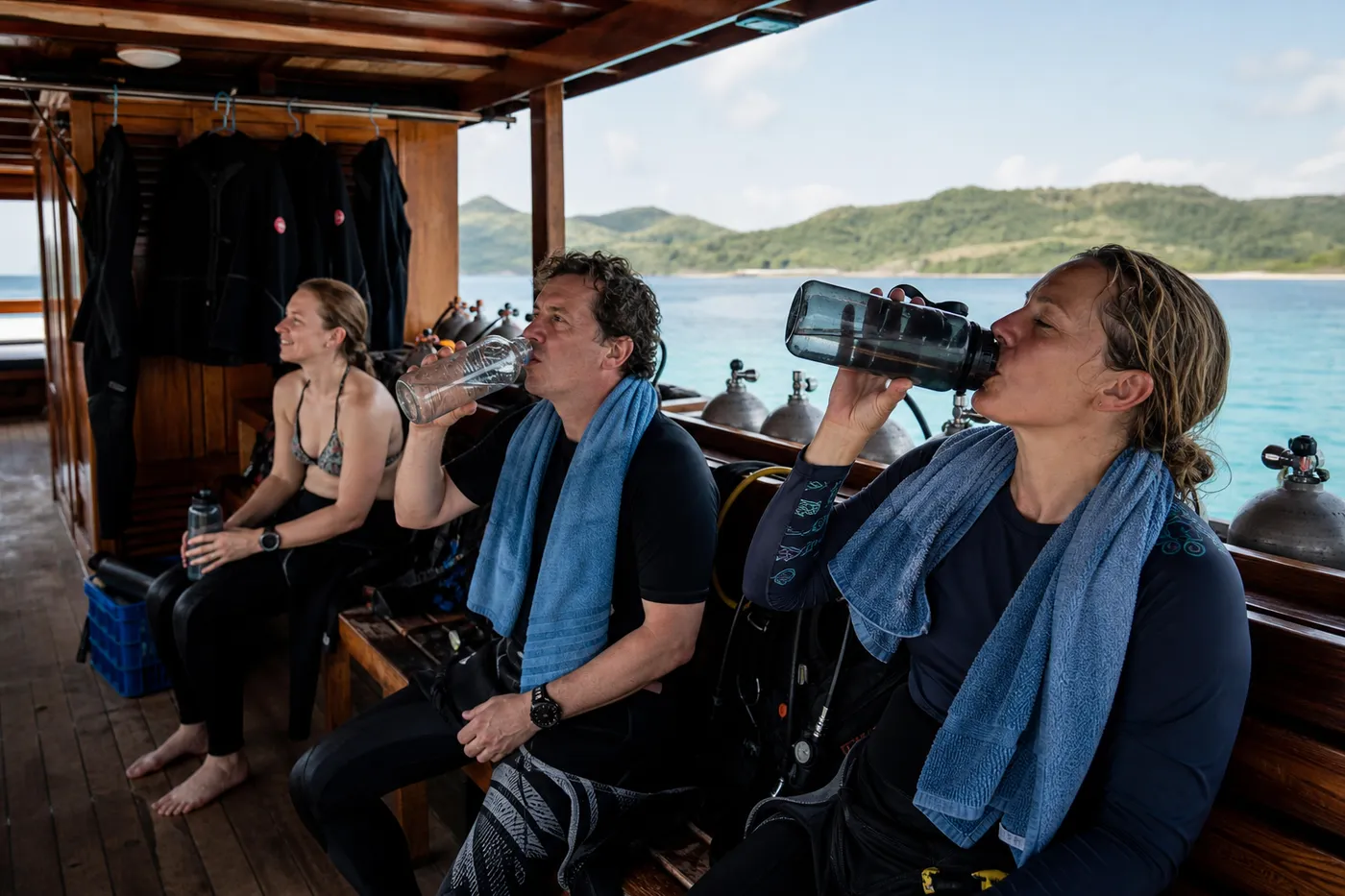
Hydration matters and is easy on a boat where cold water is always available and easy to forget in equatorial heat. Alcohol matters for the same reason and several others, which our guide to drinking and diving goes through properly. Sleep matters. So does the thing nobody wants to hear: the last dive of a week is the one most worth skipping, and the pressure to do it is entirely social.
Flying home
The whole week's loading comes due at the airport. The consensus guidance is at least 12 hours after a single dive, at least 18 after multiple days of diving, and 24 or more after any dive that required decompression stops. A liveaboard guest is always in the second category at minimum. We treat 18 hours as a floor and build the schedule so most guests get somewhere between 20 and 26. Our guide to how long to wait before flying after diving covers where those numbers come from and why your computer's own no-fly timer is not the same thing.
If something goes wrong out here
Worth reading before you need it, because the geography changes the calculus considerably.
Symptoms, and the ones people explain away
The dramatic presentations are not the problem, because nobody ignores sudden paralysis. The problem is the mild end, which is where most real cases start and where divers are remarkably good at finding alternative explanations.
- Unusual fatigue after a dive, beyond the ordinary pleasant tiredness
- Joint pain, most often shoulder or elbow, which people attribute to lifting tanks
- Skin itching or a blotchy marbled rash, usually on the torso
- Tingling, numbness or odd patches of altered sensation
- Dizziness, nausea or unusual clumsiness
- Weakness, difficulty with balance, or trouble passing urine, all of which are serious
Onset is usually within an hour and the large majority appear within 24 hours. The rule that matters is that if you are wondering whether it might be decompression sickness, that is itself the reason to say something. Telling a guide you feel a bit off costs you nothing. Not telling them costs you the early hours, which are the ones that matter for outcomes. Symptoms that begin during the descent instead, or that sit in one ear on its own, more often point at barotrauma, which is a separate injury with a different and sometimes opposite treatment.
What actually happens on board
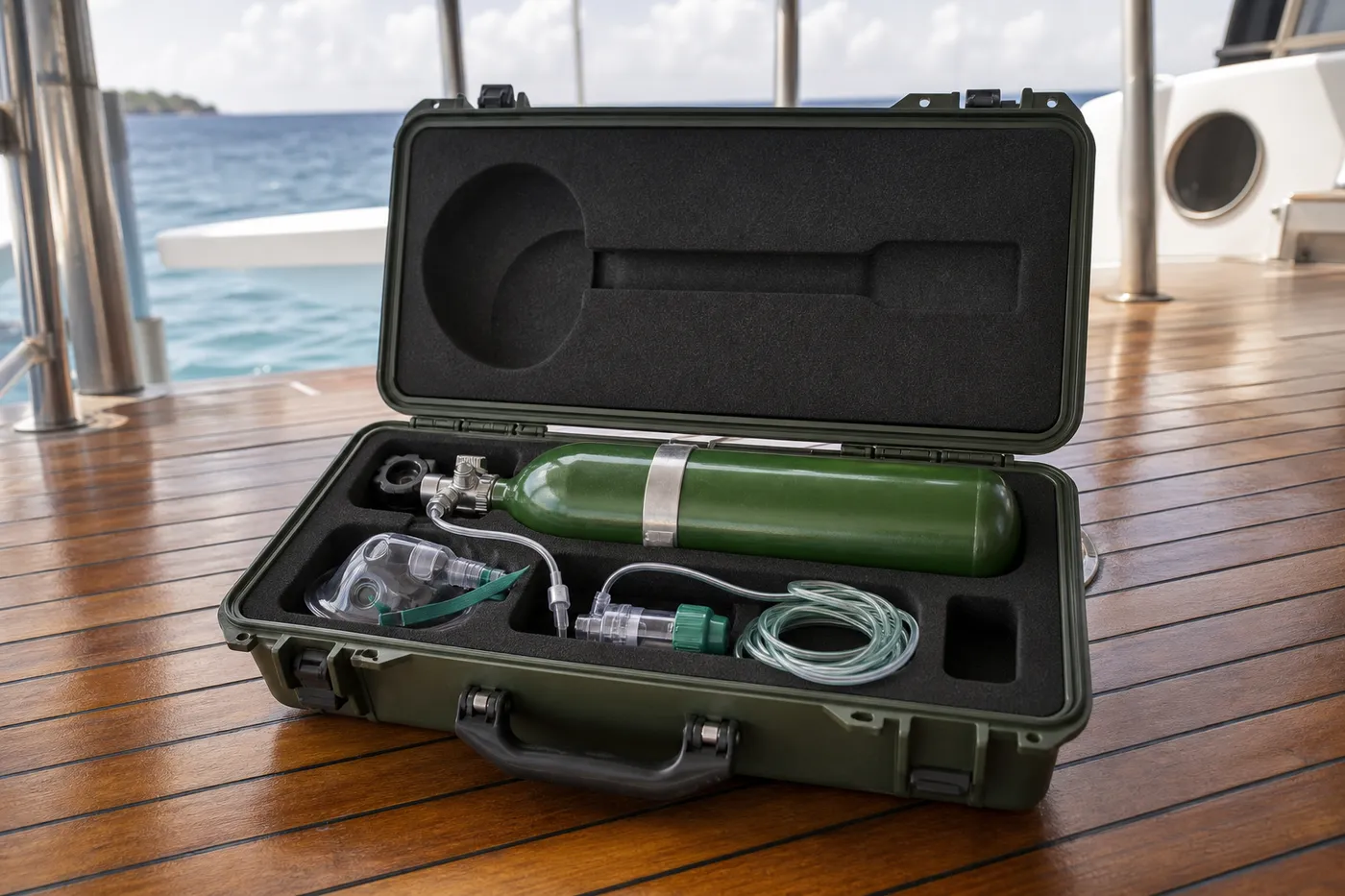
The first response anywhere is high-concentration oxygen, laid flat, and fluids if the diver can take them. Oxygen is not a cure and it does not remove the need for a chamber, but it accelerates off-gassing and it buys time, which in this part of the world is the commodity in shortest supply. Any boat that is serious carries a proper kit with enough oxygen to run for hours rather than minutes, and crew trained to use it. That is a fair thing to ask about before you book, and the answer tells you a lot.
Alongside that, the crew will be on the satellite link to the shore office and to DAN's emergency line, which exists precisely for this and is staffed by people who do dive medicine for a living. The decision about where a diver goes is a medical one, and it is made by them rather than by the boat.
The distances are the point
The chamber closest to our Komodo itineraries is at Siloam Hospitals in Labuan Bajo, which opened in 2018 and was the first in East Nusa Tenggara. There is a further hyperbaric unit at the regional public hospital in Maumere, and serious cases are routed to the larger facilities in Bali or Makassar. Our Maumere guide goes into what that regional provision does and does not mean in practice, because a hyperbaric unit at a district hospital is not the same thing as a dive medicine service on call at two in the morning.
Further east the numbers get uncomfortable. From the middle of a Banda Sea or Forgotten Islands crossing you may be more than a day of boat and aircraft away from definitive treatment, and no amount of planning shortens that. This is the real reason to dive those itineraries with more margin than you think you need, rather than any difference in the diving itself.
Insurance
Ordinary travel insurance usually excludes diving injuries, chamber treatment and medical evacuation, and finding that out afterwards is a category of bad day worth avoiding. Dedicated dive cover from DAN or an equivalent costs less than a single day of most itineraries. Check that it names hyperbaric treatment and evacuation explicitly, and check the depth limit matches the diving you are actually going to do.
The short version
Ascend slowly and stop for longer than you have to. Guard the surface interval, because it is the one variable the schedule will eat if nobody protects it. Stay warm, stay hydrated, skip the hike on a dive morning, and use the current instead of fighting it. Turn the conservatism up on a repetitive week and turn your ego down on day four. Say something the moment you feel off. Carry insurance that names the chamber. Then go and dive, because done properly this is a very safe activity, and the divers who get hurt are almost never the ones who were thinking about it.