Most people booking their first liveaboard ask the same thing, just phrased six different ways: am I qualified enough? It is a fair worry. A week on an Indonesia liveaboard packs in more diving than many divers do in a whole year at home, and the brochure shots of someone hanging weightless beside a manta, or pinned to a reef in ripping current, do not exactly settle the nerves. The good news is that the entry bar is lower than it looks. The better news is that a couple of well-chosen courses, taken in the right order, will change your trip more than any new fin or torch you could buy.
The card in your wallet matters far less than what sits behind it. We have spent years watching divers of every level explore Indonesia from our boats, and the people who come home grinning are rarely the ones with the most ratings. They are the ones who match their training to the diving they actually want to do. This guide is the long version of the conversation we have with guests at the dive desk: what you genuinely need to board, which certifications change the diving, and the small number of specialties that earn their place before you fly. We will be honest about the ones that do not.
The one card you actually need to get on the boat
Start with the floor. For most Indonesian liveaboard itineraries the minimum is an entry-level open-water certification (PADI Open Water Diver, SSI Open Water Diver, or any equivalent from a recognised agency) plus a modest number of logged dives. Different boats and different routes set that bar at different heights, and the number on the booking page is not arbitrary. It is a rough proxy for whether you will be comfortable, and safe, on the sites that itinerary visits.
As a guideline, the gentler Komodo and Raja Ampat weeks usually want Open Water plus around 20 to 30 logged dives. The more exposed routes, the Banda Sea crossings, the strong-current channels, the sites where the plan is a fast negative-entry descent into blue water, tend to ask for Advanced certification and 50 or more dives. Those numbers move around a little between operators, so always read the specific trip page rather than assuming. If you are close but not quite there, talk to the reservations team before you rule yourself out. We can often suggest an itinerary that suits your logbook, or a way to bank a few more dives before departure.
One thing worth saying plainly: the logged-dive count is not box-ticking. A reef where the current can switch from nothing to two knots in the time it takes to check your gauge is not the place to discover that you have only ever dived a calm quarry. The certification proves you learned the skills once. The dive count is what tells the cruise director you have actually used them.
Why Advanced Open Water quietly decides which boat you can book
If you only add one rating before an Indonesia trip, make it Advanced Open Water (or the SSI Advanced Adventurer equivalent). It is not because the course turns you into an expert. It does not. The value is more practical than that, and it works on two levels at once.
First, depth. An entry-level certification limits you to roughly 18 metres. A good number of Indonesia's signature moments sit just past that line. The manta cleaning stations at Komodo's Karang Makassar, the sloping coral fields off Raja Ampat, the deeper sections of a wall in the Banda Sea where the big schooling fish hold, all of it opens up once you are certified to around 30 metres. Stay shallow and you will still have a wonderful week. You will simply be looking at some of it from above while the rest of the group drops a little deeper.
Second, and less obvious, the Advanced course bundles in a clutch of adventure dives that map almost perfectly onto liveaboard diving: a deep dive, an underwater navigation dive, and usually a drift, a night, or a buoyancy dive among the options. None of these makes you an authority. What they do is give you a supervised first go at the exact situations you will meet in Indonesia, before you meet them for real at six in the morning on a site you have never seen. That first taste, done with an instructor watching, is worth a great deal. We have watched plenty of newly Advanced divers who were visibly steadier on day one than equally experienced friends who had skipped it.
If you are weighing up where to dive once you are qualified, our destination notes on Komodo and Raja Ampat spell out which sites sit deep and which stay within easy reach of an Open Water limit.
Enriched Air Nitrox: the best-value upgrade for liveaboard diving
Here is the course nobody gets excited about and almost everybody should take. Enriched Air Nitrox, the specialty that certifies you to breathe a higher-oxygen, lower-nitrogen blend, is the single most useful thing you can add to your training for a liveaboard specifically. Not because it lets you go deeper. It does not. Its whole point is what happens when you are doing a lot of diving in not very much time, which is exactly what a liveaboard is.
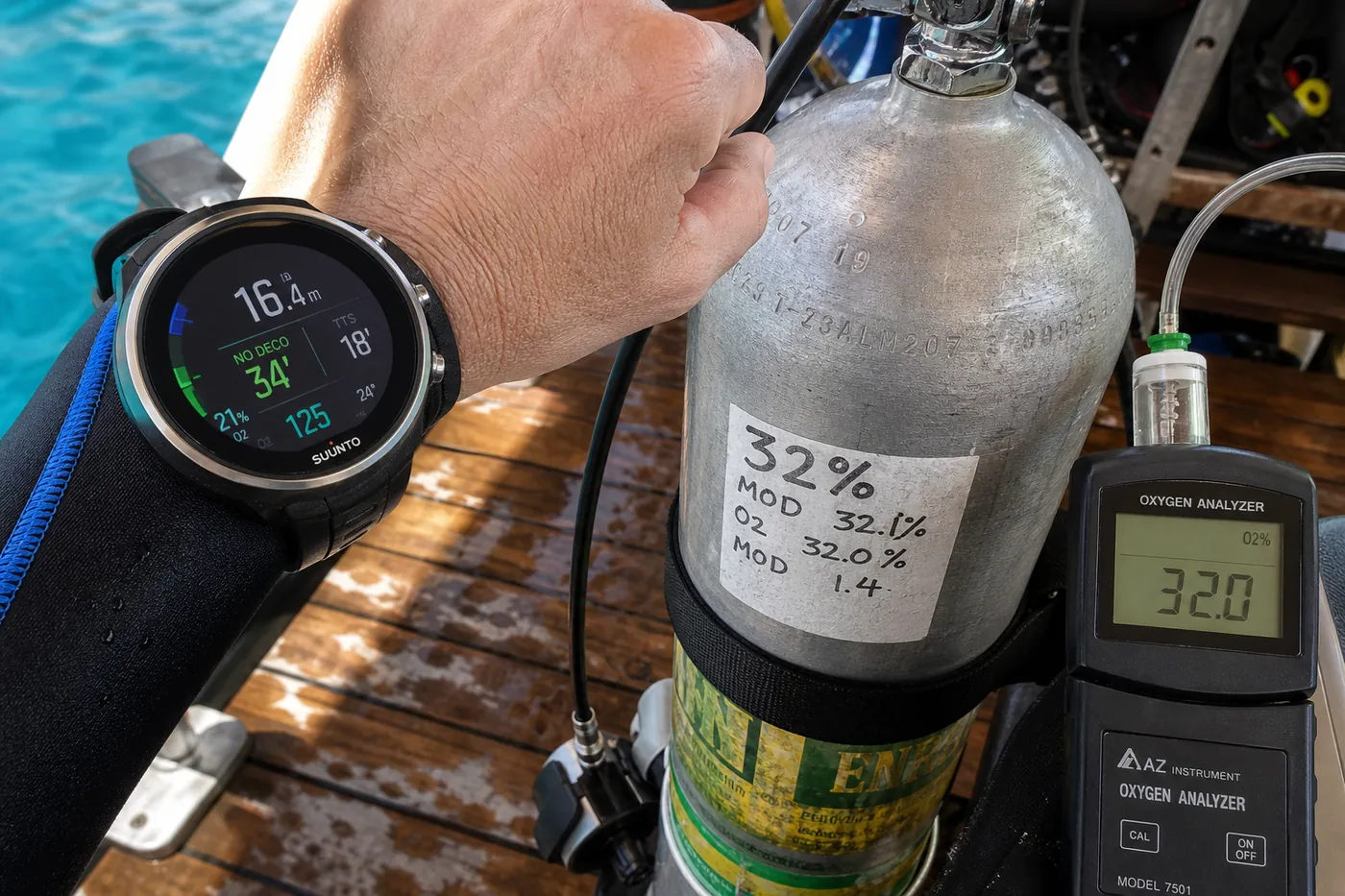
A typical day on one of our boats runs to three or four dives, repeated for six or seven days straight. On ordinary air, that schedule loads your body with nitrogen, your no-decompression limits shrink dive by dive, and your last dive of the day is often the shortest because your computer is being conservative. Switch to a 32 percent blend and the maths shifts in your favour. You get longer no-stop times at the depths most reef dives actually sit, your surface intervals do more work, and a lot of divers report feeling less wrung-out by the end of the week, though the science on that last point is softer than the marketing suggests, so treat it as a maybe rather than a promise. What that repetitive loading actually does to you, and how to dive inside it comfortably, is covered in our guide to decompression sickness on a liveaboard.
The practical payoff is time underwater. Over a seven-day trip, the extra bottom time nitrox buys you can add up to the equivalent of an extra dive or two, spread across the week. When you have flown halfway around the world to be there, that is not nothing. Most Indonesian liveaboards, ours included, offer nitrox fills (often for a modest supplement), so arriving already certified means you can use it from the first morning rather than watching tank-mates extend their dives while you surface early. The course itself is short, a half-day of theory and a couple of dives at home, and it stays with you for life.
Drift and current skills: the specialty Indonesia really puts to the test
Indonesia is current country. The same tides that sweep nutrients through these channels, and that feed the manta rays and the schooling fish and the sheer density of life people come here for, also mean you will dive moving water. Not on every site, and rarely the washing-machine conditions of dive legend, but often enough that being comfortable in current is the difference between a brilliant week and a tense one.
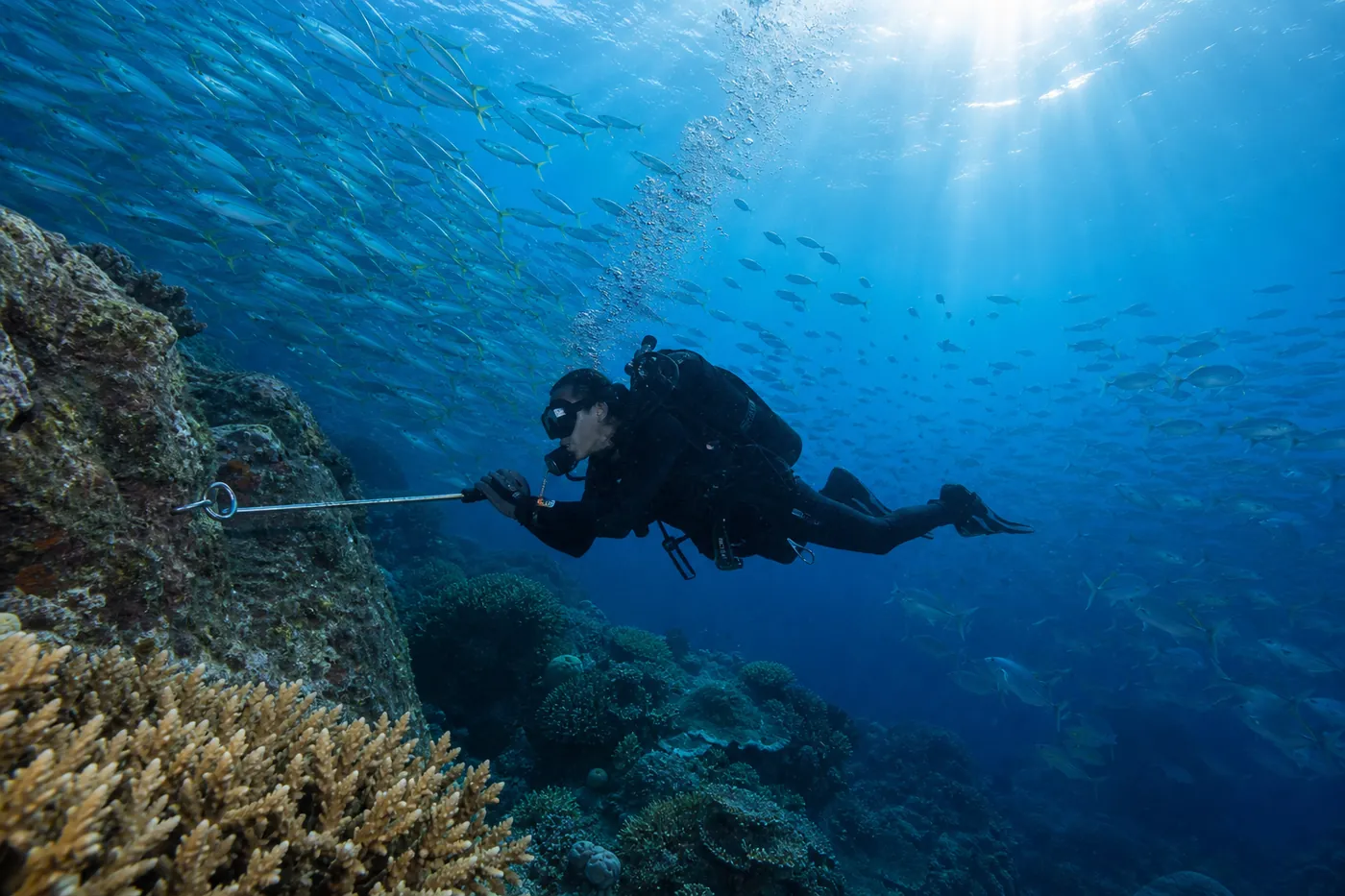
You do not strictly need a Drift Diver specialty card to join a liveaboard. But the skill set it teaches is genuinely useful here, and if your home diving has all been in still water, a course is the painless way to learn it. The techniques are specific: the fast negative-entry descent, where the whole group drops together the moment they hit the water so nobody gets blown off the site; reading the reef to find the calm pocket behind a bommie; using a reef hook to anchor yourself to bare rock so you can hang and watch the show without finning yourself exhausted; and the simple discipline of staying with your buddy and your guide when the water is moving. None of it is hard. All of it is much easier learned in advance than improvised at Komodo's Batu Bolong with the tide running.
If a full specialty feels like overkill, even a few drift dives logged at home, or as part of your Advanced course, will pay off. You do not need to buy or rent a reef hook, because we provide them on board. Many guides in Komodo and the Dampier Strait will brief you on using one, and the diving on the high-current days is far more relaxed when you can clip in and let the parade come to you. Our notes on diving Komodo go into which sites tend to run fast and when. For the rest of the kit, and what is worth owning rather than renting, see our guide to what scuba gear to buy first.
Peak Performance Buoyancy: the unglamorous course that fixes almost everything
If nitrox is the best-value specialty and drift the most relevant, buoyancy is the one that quietly makes you a better diver in every situation. It rarely makes anyone's wish list. It should. Poor buoyancy is behind most of the problems we see on the reef: divers who burn through a tank in 35 minutes because they are fighting the water, who kick up silt and wreck the visibility for everyone behind them, who clip a fragile sea fan they never meant to touch, who cannot hold a safety stop in a light surge.
A Peak Performance Buoyancy course, or its equivalent, tackles all of that. You learn proper weighting (most people are carrying too much lead), trim so you lie flat in the water rather than pedalling upright, breathing control for fine adjustments, and the kind of hovering that lets you hang motionless a metre off a coral head to watch a pygmy seahorse without disturbing it. On a liveaboard the benefits compound. Better buoyancy means lower air consumption, which means longer dives, which means more of what you came for. It means you protect the reef instead of bumping it. And in current, good trim and weighting are what let you hold position and stay calm. We would happily send a guest to do a buoyancy workshop over almost any other add-on, and the underwater photographers among our guests will tell you it is the foundation everything else is built on.
Deep Diver: how much depth does Indonesia actually demand?
There is a tendency to assume that exotic diving means deep diving. For Indonesia, that is mostly wrong, and it is worth saying so before you spend money chasing depth ratings you will not use. The overwhelming majority of the best diving here happens in the top 30 metres, and a fair slice of the very best, the manta cleaning stations, the soft-coral gardens of Raja Ampat, the reef-top chaos of a Dampier Strait site at slack tide, sits shallower than 18. Light, colour and life all thin out as you go down. The reef wants you up where the sun is.
So do you need the Deep Diver specialty, which extends your limit to 40 metres? For most guests, no. The Advanced course already certifies you to around 30, and that covers nearly everything a typical itinerary throws at you. Where the deep ticket starts to matter is on specific, niche sites: a handful of Banda Sea pinnacles where the hammerheads patrol below 30, certain wall dives where something interesting holds deep, or the kind of dedicated wreck or technical objective most reef trips never include. If your dream itinerary is built around those, the rating is worth having. If it is built around manta rays and coral, your money is better spent on nitrox and buoyancy. Our overview of the Banda Sea is honest about which of its signatures actually require depth.
The specialties that earn their place, and a couple that do not
Beyond the core three (nitrox, drift, buoyancy), a long menu of specialties exists, and dive shops are understandably keen to sell them. Some are genuinely worth it for an Indonesia liveaboard. Others are a poor fit for the diving here. A rough guide, based on what our guests actually get value from:
| Specialty | Worth it for an Indonesia liveaboard? |
|---|---|
| Enriched Air Nitrox | Yes. The highest-value upgrade for multi-dive days. Take it first. |
| Peak Performance Buoyancy | Yes. Improves air, safety, reef protection and photos all at once. |
| Drift Diver | Often yes, especially if your diving so far has been in still water. |
| Night Diver | Worth it if you love macro. Night and dusk dives unlock different animals. |
| Underwater Naturalist / Fish ID | Nice to have. Deepens what you understand of the Coral Triangle. |
| Deep Diver | Only for specific deep-site itineraries. Most trips do not need it. |
| Wreck Diver | Limited use. Indonesia's classic liveaboard routes are reef, not wreck. |
| Self-Reliant / Sidemount | Niche. Useful for very experienced divers; unnecessary for most. |
The Night Diver specialty deserves a special mention because the after-dark diving in Indonesia is so good. Walking sharks (epaulettes) hunt across the sand, Spanish dancers unfurl in the open water, and the macro life that hides by day comes out to feed. If you are the sort of diver who would rather spend twenty minutes on a single nudibranch than chase big animals, a night rating and a decent torch will be among the best investments you make. For the truly obsessed, it is also the gateway to black water diving, a strange and addictive branch of night diving over deep open ocean that a few of our trips can arrange.
The Fish ID or Underwater Naturalist courses will not change your safety or comfort one bit, but they change how much you see. Indonesia sits in the heart of the Coral Triangle, the most biodiverse stretch of ocean on the planet, and a little knowledge transforms a wall of generic fish into a readable, named community. Plenty of guests tell us this is what tipped a good week into an unforgettable one.
Logged dives versus the card: what cruise directors actually look at
New divers fixate on the certification level. Experienced ones know the logbook tells the truer story. When our cruise directors plan who dives where, and which guide takes which group, the card is only the start. They look at how many dives you have done, how recently, and in what conditions. Someone with 200 dives, all in warm clear water with no current, is in some respects less prepared for a fast Komodo channel than someone with 60 dives who has cut their teeth in cold, low-visibility, tidal water at home. Honesty here serves you. Inflating your logbook to get on a more demanding trip helps nobody, least of all you when the briefing assumes a competence you do not have. The same argument applies to the medical form you sign alongside it, and our guide to fitness to dive and the diver medical questionnaire explains what each question is actually screening for.
Currency matters as much as the total. If your last dive was three years ago, you are rusty whatever your card says, and the kind thing to do is admit it. A refresher (a Scuba Review or ReActivate session at home, or a check dive on the first day) shakes the cobwebs off your skills, your weighting and your gas planning before they matter. We build a gentle check dive into the start of most itineraries for exactly this reason, and there is no shame in using it. The divers who relax into the week fastest are almost always the ones who were straight with us about where they were starting from.
How to sequence your training before the trip
Order matters, because time and money are finite and some courses do far more for a liveaboard than others. If you are starting more or less from scratch and have a trip on the horizon, this is roughly the sequence we would suggest, give or take your own goals.
- Get certified, then dive. Earn your Open Water rating at home, then log as many real dives as you can before you fly. Twenty unhurried dives in varied conditions are worth more than any single advanced card.
- Add Advanced Open Water. It opens the deeper sites and gives you supervised first attempts at deep, navigation and drift diving.
- Take Enriched Air Nitrox. Cheap, quick, and it pays you back in bottom time every single day of the trip.
- Do a buoyancy workshop. The least glamorous and arguably the highest-impact thing on this list.
- Consider drift and night ratings if your itinerary or your interests point that way.
Where you train is a real choice too. Doing it all at home means you arrive ready to dive from the first morning, which we think is the better plan for a once-a-year trip. The alternative is to certify or upgrade in Indonesia itself, and Bali is the obvious base for this: it has a deep bench of good schools, calm training bays, and easy onward connections to the liveaboard ports at Labuan Bajo and Sorong. Some divers build a few days in Bali into the front of their trip and knock out a specialty there. It works, but it eats into holiday time, so weigh it against simply arriving prepared. A handful of operators, ourselves included on certain departures, can arrange a specialty or two onboard, though sea time for coursework is limited and we would not rely on it for anything you truly need.
On cost, treat these as rough 2026 figures that vary widely by country and school: an Open Water course usually lands somewhere in the region of a few hundred US dollars, Advanced a little less, and a single specialty like nitrox or buoyancy is typically modest on top. None of it is trivial money, but set against the cost of the liveaboard and the flights, the right courses are some of the best value in the whole budget.
What the right preparation actually buys you
The divers who get the most out of a first Indonesia liveaboard are rarely the most experienced people on board. They are the ones who prepared honestly. A diver with forty logged dives in gentle water at home, who arrives having done a nitrox course and half a day of buoyancy work, is in a better position than someone with twice the logbook and no recent time in the water. The nitrox buys no-decompression time across repetitive days, so the computer stops being the thing that ends the dive. The buoyancy work is what turns a drift site in the Dampier Strait from something you brace against into something you hang in, hooked into the reef, breathing slowly, watching a wall of barracuda turn in the blue. Neither is talent and neither is expensive. Being straight with us about your dive count and how recent those dives are does the rest, because that is what lets us put you on the right sites with the right guide.
Planning your certification path for an Indonesia liveaboard
Pulling it together: the floor for most trips is Open Water plus a sensible number of recent, varied dives, and the more exposed routes want Advanced and a fuller logbook. The upgrades that change the diving are nitrox first, then buoyancy, then drift, with night and Fish ID as rewarding extras for the curious. Deep, wreck and the more technical tickets matter only for specific itineraries, so do not let anyone upsell you into them by default. And whatever your card says, be honest about your dive count and your currency, because that honesty is what lets us put you on the right sites with the right guide.
If you are still unsure where you sit, the simplest move is to tell us your certification, your dive count and what you most want to see, and let us match you to a route. Our guide for first-timers and newer divers is a good companion to this article, and the destination pages for Raja Ampat diving lay out exactly what each region asks of you. Get the training right, in the right order, and Indonesia stops being intimidating and becomes what it should be: the best week of diving you have ever had. When you are ready, the reservations team can help you pick the itinerary that fits your logbook today, not the one you wish you had.