Barotrauma is the most common injury in diving, and most divers could not define it. Ask on the dive deck and you will get "something to do with your ears", which is right about eighty per cent of the time and misses the part that occasionally kills people. It is worth ten minutes of your attention before a week on an Indonesia liveaboard, because unlike most dive theory this one comes with a decision attached, and the decision usually has to be made by you, on a boat, while everyone else is getting kitted up.
The short version is that barotrauma is physical damage caused by pressure squeezing or expanding the air spaces inside your body. It is not the bends. The two get muddled constantly, they have different causes and different symptoms, and in one important case they have opposite treatments. A week of diving in Indonesia gives you twenty or more descents, which is twenty or more chances to get this wrong, and the sites that make the region worth the airfare are often the ones that ask you to go down fast. What follows is what is actually happening, which body parts are at risk and in what order, why a liveaboard schedule shifts the odds, and what to do when it goes wrong a long way from an ear specialist. We are a dive operator rather than a medical authority, so where this touches medicine it points you at the people who are.
What barotrauma actually is, and why it is not the bends
Your body is mostly water, and water does not compress in any way that matters. Squeeze it and it shrugs. This is why pressure does almost nothing to the bulk of you, and why a diver at forty metres is not crushed despite carrying five atmospheres on their shoulders.
Gas is the exception. Gas compresses, and it does so predictably: halve the volume and you double the pressure, which is Boyle's law and the only physics in this article. Every air space in your body therefore has to keep up with the water around it, either by letting gas in on the way down or letting it out on the way up. When a space cannot keep up, the pressure difference has to go somewhere, and it goes into the tissue lining the space. That is barotrauma.
The spaces at risk
There are fewer than most people think, and they are worth knowing by name because the symptoms follow the anatomy:
- The middle ear, vented by the Eustachian tube, which is the narrowest and fussiest passage of the lot
- The sinuses, vented through small openings that block easily when the lining swells
- The lungs, vented by your airway, and the only space here that can kill you quickly
- The gut, which handles gas the way you would expect and rarely causes more than discomfort
- Cavities in teeth, usually under old dental work, which is a real and genuinely surprising phenomenon
- Anything you strap on, meaning the space inside a mask or a drysuit, which are technically external but behave the same way
Descent squeeze, ascent block, and why the second one is worse
Going down, the water pressure rises and the gas in these spaces shrinks. If fresh gas cannot get in to replace the lost volume, the space develops a relative vacuum and the surrounding tissue is pulled into it. Blood vessels stretch, the lining swells, and eventually something tears. Divers call this a squeeze, and it is the version almost everyone has met in a mild form.
Coming up, everything runs backwards. The gas in those spaces expands, and if it cannot vent, it pushes outwards instead. This is a reverse block, and there is an asymmetry here that we do not think is emphasised nearly enough in training.
On the way down, a squeeze has an obvious escape route. It hurts, you stop, you go up a metre or two, the pressure comes off and you sort it out or you call the dive. The option is always there. On the way up, it is not. You cannot stay down and wait for the problem to resolve, because the air in your cylinder is finite and eventually you are surfacing whether the block has cleared or not. That single difference is why "diving with a slightly blocked ear because it cleared alright on the way down" is a worse bet than it feels like at the time.
Barotrauma against decompression sickness
These are separate injuries with separate mechanisms, and the confusion between them causes real problems when someone is trying to describe symptoms over a satellite phone.
| Barotrauma | Decompression sickness | |
|---|---|---|
| What causes it | Pressure squeezing or expanding a gas space | Dissolved nitrogen coming out of solution as bubbles |
| The physics | Boyle's law, mechanical | Henry's law, gas solubility |
| When it happens | Usually during descent, sometimes ascent | After surfacing, occasionally during ascent |
| Depends on dive time? | No. A three metre pool dive can do it | Yes. Depth and duration are everything |
| Typical symptoms | Ear or facial pain, blocked hearing, nosebleed | Joint pain, fatigue, rash, neurological signs |
| Chamber? | No, and for inner ear injury it can make things worse | Yes, urgently |
Two footnotes, because the terminology is genuinely messy. The first is that one specific kind of lung barotrauma, arterial gas embolism, does need a chamber, and it gets grouped with decompression sickness under the heading of decompression illness for exactly that reason. The second is that the umbrella term covering the whole lot is dysbarism, which you will meet in medical writing and almost nowhere else. Our companion guide to decompression sickness on a liveaboard covers the dissolved-gas side properly, and the two conditions are worth understanding as a pair rather than one at a time.
The air spaces, in the order they cause trouble
Not all of these are equally likely, and the ranking is stable across every dataset we have seen. Divers Alert Network's injury reporting breaks down roughly as follows, and the shape of it is more useful than the exact figures.
| Site | Share of reported barotrauma | How serious, honestly |
|---|---|---|
| Ears and sinuses | About 80 per cent | Usually mild, occasionally trip-ending, rarely permanent |
| Lungs, including gas embolism | About 15 per cent | Rare and genuinely dangerous |
| Gut, teeth, mask, suit | About 5 per cent | Mostly nuisance, occasionally memorable |
Ears, which is where four out of five cases live
Middle ear barotrauma is the single most common diving injury there is. Depending on which survey you read, somewhere between ten and thirty per cent of divers have had it, and in one large survey of recreational divers around half reported ear pain on more than one occasion. It is close to a rite of passage, which is part of the problem, because a thing everybody has had is a thing nobody takes seriously.
The mechanism is simple. The middle ear is a sealed pocket behind the eardrum, and its only vent is the Eustachian tube running down to the back of your throat. Equalising is you opening that tube deliberately. If it does not open, the eardrum gets pushed inwards, the lining behind it swells and fills with fluid and blood, and in the worst case the drum perforates. Mild versions give you a few days of muffled hearing and a feeling of fullness. Serious versions end the trip.
We are not going to re-teach technique here, because we have a separate guide to how to dive deep without your ears hurting that goes through Valsalva, Frenzel, Toynbee and the rest properly, and technique is genuinely the whole ballgame for prevention. What matters for this article is the injury rather than the manoeuvre, and one specific warning about how divers hurt themselves trying.
That warning is about force. When the pressure difference across a blocked Eustachian tube gets past roughly 90 mmHg, the tube stops being openable at all: it locks shut, and no amount of blowing will shift it. What a diver usually does at that point is blow harder. A forceful Valsalva raises the pressure inside your skull, that pressure is transmitted through to the inner ear, and it can rupture the round window from the inside. So the harder you try to fix a stuck ear, the more likely you are to convert an irritating middle ear problem into an inner ear injury, which is the one with lasting consequences. If it will not clear gently, it will not clear.

Sinuses, and the nosebleed that alarms everyone
Sinuses vent through openings narrow enough that ordinary congestion closes them, and unlike your ears you cannot consciously do anything to help. They either equalise passively or they do not.
The usual presentation is pain across the forehead or in the cheekbones during descent. The other classic is blood in the mask, which is dramatic and almost always benign: the sinus lining bleeds under the pressure difference, and it clears up on its own. What surprises people is that sinus trouble often shows up on ascent rather than descent, as a sharp stab in the face followed by a nosebleed or a taste of blood at the back of the throat. That is a reverse block, and it usually means a sinus that filled with fluid on the way down and could not vent on the way up.
Lungs, which is the one that matters
Pulmonary barotrauma is uncommon. It is also the second leading cause of death in recreational diving, behind drowning, and those two facts belong in the same sentence.
Here is the part that gets undersold in open water courses. The rule you were taught, never hold your breath, is not a guideline about good habits. Your lungs sit at the point of the pressure curve where volume changes fastest, and the greatest proportional change of the whole dive is in the last few metres before the surface. A diver who panics at five metres, clamps their airway shut and kicks for daylight can over-expand their lungs from that depth alone. It does not need forty metres and it does not need a long dive.
When alveoli tear, the escaping gas goes to one of three places. It can leak into the space around the lung and collapse it, which is a pneumothorax. It can track up through the middle of the chest into the neck, which produces a puffy throat and a strange, higher voice, and is called mediastinal emphysema. Or it can get into the pulmonary veins, travel to the left side of the heart and be pumped straight into the arteries, which is arterial gas embolism. That last one behaves like a stroke, comes on within minutes of surfacing, and is a chamber emergency.
The practical prevention is unglamorous: breathe continuously, ascend slowly, and never dive on a chest infection. Asthma is worth a real conversation with a dive physician rather than a shrug, since trapped gas behind a narrowed airway is the exact mechanism at issue. If you want to know what that physician will actually be assessing, the published criteria are specific, and our guide to fitness to dive and medical conditions sets them out. Good ascent discipline is the same skill that keeps you out of decompression trouble, and our guide to buoyancy control covers the hovering that makes a slow, controlled last ten metres feel effortless rather than like a fight with your wing.
The odds and ends
Mask squeeze is the one guests are most startled by, because it is visible. If you never exhale through your nose on descent, the air in the mask shrinks and the mask becomes a suction cup on your face. The result is bloodshot eyes and bruised eyelids, occasionally spectacular enough that people photograph it, and it is harmless but takes a fortnight to fade. It shows up most often in divers who have just started freediving between scuba dives, where nobody thinks to mention it.
Tooth squeeze, properly barodontalgia, happens when a pocket of air is trapped under a filling or a crown. In diving it usually bites on descent. It is uncommon, it is severe enough to end a dive, and there is nothing to be done about it underwater. Gut barotrauma is expanding gas on ascent, and it is exactly as undignified and as harmless as it sounds. Fizzy drinks and beans at breakfast before an early dive are a choice.
Why a liveaboard week is where this actually bites
Most of what is written about ear barotrauma is written for someone doing two dives on a Saturday. A liveaboard is a different exposure, and the difference is not just that you dive more.
Twenty-something descents, and the way small injuries compound
A typical Komodo or Raja Ampat itinerary runs three dives a day plus a night dive on some days, across five or six consecutive days. That is somewhere north of twenty descents in under a week. At home, a keen diver might manage four in a month.
Barotrauma does not care how long you spend at depth, only how many times you cross the pressure gradient, so a liveaboard multiplies your exposure to this particular injury far more sharply than it multiplies your nitrogen loading. And ear injuries stack in a way that most divers do not expect. A mild squeeze on dive two leaves the lining of the middle ear inflamed and slightly swollen. Swollen tissue equalises worse than healthy tissue. So dive three is harder than dive two, dive four is harder again, and by the second morning you are working noticeably to clear an ear that gave you no trouble at all on arrival.
The pattern we see most often is not a dramatic injury on day one. It is a diver who felt a twinge early, dived through it because it seemed minor, and lost the back half of the week to an ear that will not clear at all. The trip-ending version is almost always built out of a series of small, ignored versions.
The day four decongestant trap
This one deserves its own heading, because it catches experienced divers and the timing is cruelly specific.
Someone arrives with mild congestion, or picks something up on the flights, and reaches for a nasal spray. Oxymetazoline, sold as Afrin or Iliadin depending on where you bought it, works within minutes and lasts around twelve hours. On day one it is genuinely excellent. Day two, fine. Then somewhere around the third or fourth consecutive day of use, rebound congestion sets in, and the swelling that follows can be worse than the original problem it was treating.
This lands, reliably, in the middle of the itinerary. Which is when the boat has moved somewhere good and nobody wants to sit out. Worse, rebound swelling primes you for a reverse block rather than a simple squeeze, and we have already covered why that is the wrong end of the problem to be at.
DAN's guidance is worth following properly rather than approximately. Short-acting sprays go in around thirty minutes before descent and last through a full day of diving, so a second dose before the afternoon dive achieves nothing except bringing the rebound forward. Keep them to two consecutive days at the outside. Steroid nasal sprays do not rebound, which makes them the better option for anyone who knows they have troublesome sinuses, but they are slow and need starting roughly a week before the trip, so that is a decision you make at home rather than on the boat.
The blunter point underneath all this: a drug that opens your Eustachian tube for the descent has no obligation to still be working during the ascent. The honest pre-dive question is not whether a pill can get you down. It is whether you can get back up without it wearing off on you.
The sites want you down quickly, and your ears do not
Here is the genuine conflict, and pretending it does not exist helps nobody.
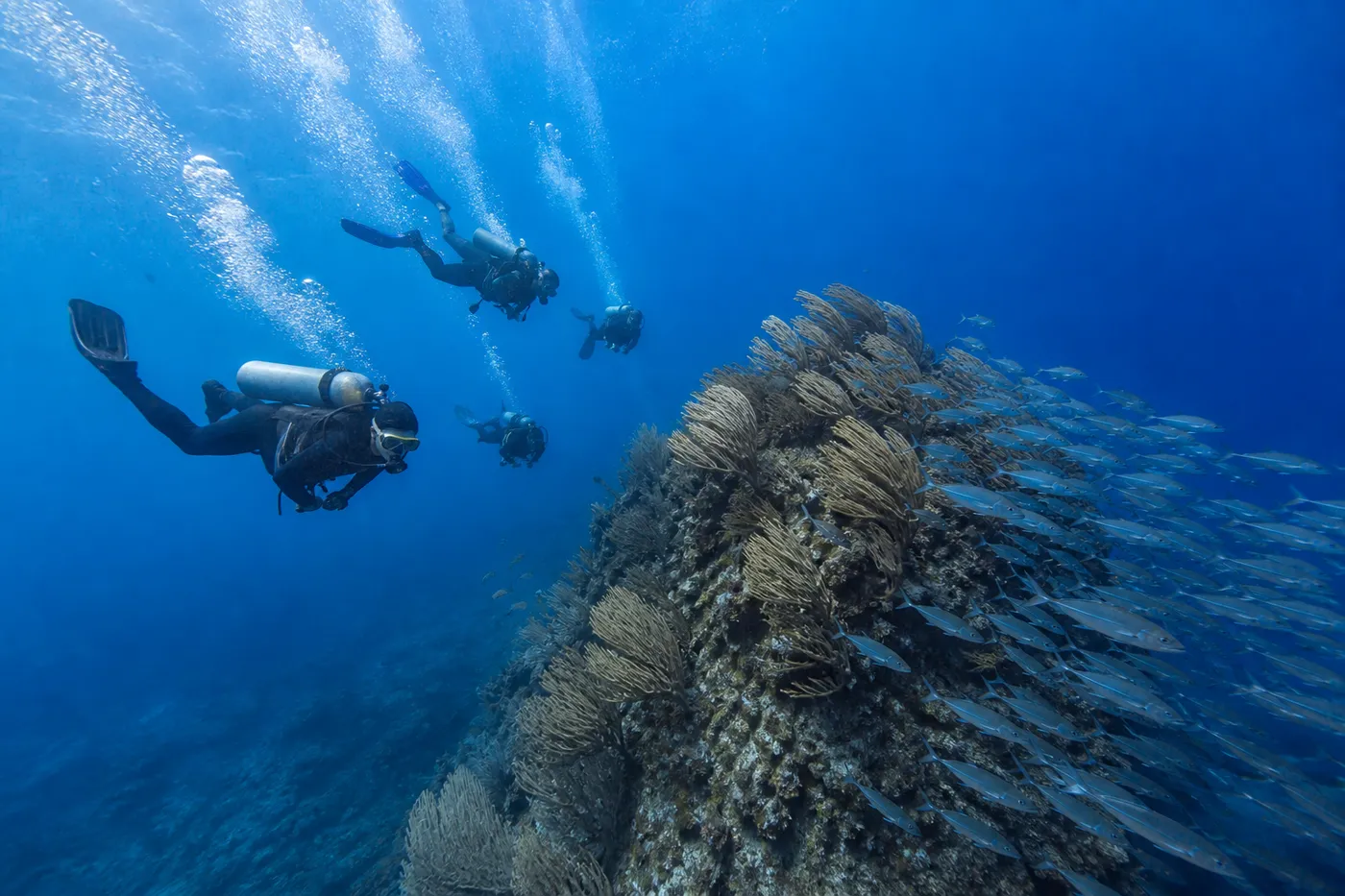
The best diving in eastern Indonesia happens in moving water. At sites like Castle Rock, Crystal Rock or the corner at Cape Kri, the group often goes in on a negative entry, meaning you deflate completely and drop fast so the current does not take the group off the site before anyone reaches the reef. Our guide to diving in current explains why that technique exists and why it is the right call for the dive.
It is also, in ear terms, the single most demanding thing you will be asked to do all week. Fast descent is the primary mechanical cause of middle ear barotrauma, and here it is built into the dive plan.
The reconciliation is not to refuse negative entries. It is to equalise early and continuously from the surface, before you feel anything, so that you are never playing catch-up. Divers who get hurt on these entries are almost always the ones who started equalising once they noticed pressure. Start on the boat, clear again as your head goes under, and keep clearing every metre for the first ten. If an ear will not come along, signal the guide, and be aware that on a drifting negative entry your realistic options narrow quickly, which is a reason to sort out marginal ears before the week rather than during it.
The pressure to keep diving is mostly social
Nobody flies to Sorong or Labuan Bajo to sit on the sundeck. Guests have often spent a considerable sum, taken limited leave and waited a year, and the boat is going to the good site tomorrow regardless of anyone's sinuses. There is no equivalent of "I will skip this one and come back next weekend", because there is no next weekend.
That pressure is real and we would rather name it than pretend divers are perfectly rational about it. But the arithmetic runs the other way. Sitting out one dive with a marginal ear costs you one dive. Diving on it and perforating an eardrum costs you the rest of the week, the flight home is miserable, and you are looking at weeks out of the water afterwards. On a six day trip, the diver who skips the afternoon dive on day two very often gets more dives in total than the one who did not.
What the boat can and cannot do
Some of this is our job. Briefings should say what the descent will be like and whether it is a negative entry, so nobody is surprised into a fast drop. Guides should be told about a dodgy ear before the dive rather than after, and should be willing to take one diver down slowly on a line while the rest go ahead. Schedules can be nudged, and a guest who needs a slow descent can usually be given one if anyone knows in advance.
What we cannot do is feel your ears for you. That part stays yours, and it is a judgement call made in about four seconds at ten metres, usually against your own strong preference to continue.
Prevention, and the decision to call a dive
Almost all of this injury is preventable, and the prevention is behavioural rather than technical. None of it requires equipment you do not already own.
The habits that do the work
- Start equalising before you are underwater and clear every metre or so through the first ten. Waiting until you feel pressure means you are already behind, and the tube gets harder to open the further behind you get.
- Go down feet first where the dive allows it. Head-down descents make the Eustachian tube work against gravity and against the fluid shift, and they are noticeably harder for most people.
- Use the line. A mooring or shot line lets you control descent rate precisely and stop dead when you need to, which a mid-water descent does not.
- Treat pain as a signal you already missed one. Discomfort is the warning. Pain means tissue is being stretched, and pushing past it is how mild becomes serious.
- Stop, ascend a metre or two, then try again. Going up slightly is free, it is available at any point in the descent, and it works.
- Never dive congested, which is the single highest-value rule on this list. Somewhere between thirty and fifty per cent of dive barotrauma is linked to an upper respiratory problem the diver knew about beforehand.
Two things worth mentioning because guests ask about both. Standard earplugs have no place in scuba diving: they create an additional sealed air space in the ear canal and cause exactly the injury you were trying to avoid. Vented plugs designed for diving exist, they slow water entry rather than solving equalisation, and they remain a niche solution rather than a fix. Second, a tight wetsuit hood can seal against the ear canal and trap air in front of the drum, which produces an external ear squeeze. Breaking the seal with a finger for a moment as you descend deals with it.
Calling it, and what "recovered" actually means
The decision to abort is easy to describe and hard to make. If an ear will not clear after a few gentle attempts, the dive is over. Not postponed until you have tried harder, which as we covered is how inner ear injuries happen. Signal the guide, go up, and accept that the cost is one dive.
Coming back after a squeeze is where people get impatient, and the useful framing is that the test is functional rather than chronological. There is no fixed number of days. You are ready to dive again when you can equalise gently, on both sides, without medication propping the tube open. If a decongestant is still doing the work, the congestion has not resolved, it has been masked, and depth will pull the mask off. Mild cases often settle in a couple of days. A perforation is done for the trip and needs a doctor.
If it happens out here
Worth reading before you need it, because the geography changes what the sensible response is.
The symptoms that mean tell someone now
Muffled hearing, a feeling of fullness, mild ear ache and a bit of blood in the mask are all common, all usually minor, and all reasons to stop diving until they settle rather than reasons to panic.
The list that needs raising immediately is shorter and quite different:
- Severe vertigo, the room-spinning kind, with or without vomiting
- Sudden hearing loss or loud ringing in one ear
- Any breathing difficulty, chest pain, or coughing blood after a dive
- A change in your voice, or a puffy, crackling feeling in the neck
- Confusion, weakness, disturbed vision or any stroke-like sign within minutes of surfacing
The last three are lung barotrauma until proven otherwise, and arterial gas embolism typically announces itself within minutes of reaching the surface. That is a get-on-the-radio-now situation, oxygen and flat and an evacuation conversation, handled exactly as our decompression sickness guide describes, because the treatment pathway is the same.
The distinction that changes the treatment
This is the part most divers have never heard, and it is the reason this article exists in the form it does.
Vertigo and hearing loss after a dive can come from two completely different injuries. One is inner ear barotrauma, where the round window between middle and inner ear has torn, usually from a forceful Valsalva against a locked tube. The other is inner ear decompression sickness, where bubbles have formed in the inner ear. They present almost identically. The treatments are opposites: inner ear decompression sickness needs recompression urgently, ideally within six hours, while recompression is contraindicated for inner ear barotrauma and can worsen the injury.
Nobody expects you to diagnose this, and you should not try. What you can do is give the doctor on the other end of the phone the handful of details that let them tell the difference, because they will ask and divers routinely cannot answer:
| What they will ask | Points to barotrauma | Points to decompression sickness |
|---|---|---|
| Did you struggle to clear? | Yes, and you forced it | No trouble equalising |
| When did symptoms start? | During the descent, or immediately | Well after surfacing, often 45 minutes or more |
| The dive profile | Ordinary, no decompression concern | Deep, long, repetitive, or a fast ascent |
| Other symptoms? | Just the ear | Rash, joint pain, fatigue, neurological signs |
| Hearing | Hearing loss common | Spinning and balance more common |
So the practical instruction is to note the time symptoms began relative to surfacing, remember whether you had trouble equalising on that specific dive, and say both out loud to whoever is coordinating. Those two facts do most of the diagnostic work.
Distance, and what the boat carries
The nearest recompression chamber to our Komodo itineraries is at Siloam Hospitals in Labuan Bajo, with a further hyperbaric unit at the regional hospital in Maumere and serious cases routed on to Bali or Makassar. That matters for a lung injury. It does very little for a ruptured eardrum, and an ENT specialist is a much longer journey than a chamber is.
Further east the numbers get uncomfortable. In the middle of a Banda Sea or Forgotten Islands crossing you can be more than a day from definitive care, and no amount of planning shortens it. That is not an argument against those itineraries, which are some of the best diving in the world. It is an argument for arriving with clear sinuses and for calling a dive early when you are out there, because the threshold for "I will push on and sort it out later" should move with the distance to help.
Flying home on a blocked ear
The trip is not over at the dock. A cabin pressurised to the equivalent of two thousand metres puts the same demand on your ears as a dive does, in the opposite direction, and a middle ear that is inflamed and full of fluid handles it badly. This is a common way for a mild squeeze to turn into a genuinely awful eight hours and occasionally into a perforation.
If you finish the week with a blocked ear, say so before you fly, use a decongestant spray in good time before descent into the destination rather than after the pain starts, and swallow and yawn continuously as the aircraft comes down. If an ear is badly affected, being seen before boarding is worth the inconvenience. This sits alongside the separate nitrogen question covered in our guide to how long to wait before flying after diving, and they are two different problems that happen to arrive at the same airport.
Insurance, and the short version
Ordinary travel policies commonly exclude diving injuries. Dedicated cover from DAN or an equivalent costs less than a single day of most itineraries, and it is worth checking that it names ear and sinus treatment rather than only chamber rides, since barotrauma is far and away the likelier claim.
The short version of all of it: equalise before you need to and keep doing it, go down feet first and slowly enough that you are never catching up, never force an ear that has locked, treat congestion as a reason not to dive rather than a problem to medicate around, and remember that the way up is the half you cannot abort. Skipping one dive is cheap. Almost everything else on this list is not.