Halmahera is the largest island in Maluku and one of the least-dived corners of the Coral Triangle. It sits on the equator between North Sulawesi and the Raja Ampat islands, a sprawling, four-armed island ringed by volcanic satellites, sheltered bays and current-swept straits. Most divers have never heard of it. The few who go tend to come back talking about two things: the empty reefs, and how strange it felt to see no other dive boat for a week.
That emptiness is partly a scheduling problem. Very few boats on the Indonesia liveaboard circuit run Halmahera every year, because it sits between the seasons that matter commercially, Banda in the autumn and Raja Ampat from late October. Operators who go there usually do it on the way from one to the other, in a short window of a few weeks. Ours is no different, and we would rather say so plainly than dress it up.
Our 46-metre King Neptune runs three Halmahera trips back to back in late 2027: a crossing from Ambon to Ternate, an eight-night round trip from Ternate, and a crossing on to Raja Ampat. This article explains what a Halmahera liveaboard actually is, where the boats dive, when the window falls, how you get to Ternate, what it costs in real numbers and who should, and should not, book one.
What is a Halmahera liveaboard?
A Halmahera liveaboard is a multi-night dive cruise around the islands of North Maluku, in eastern Indonesia, that usually starts and ends in the port of Ternate.
- Eight to eleven nights on board
- Three or four dives a day
- Strait drifts and macro bays
- Night dives for walking sharks
It sits between a Raja Ampat trip and an exploratory expedition: the reefs are as rich, the dive sites far less charted.
You will find Halmahera trips running:
- On our King Neptune in October and November 2027
- As crossings to a Raja Ampat liveaboard season
- As crossings from a Banda Sea liveaboard season
In short: it is a Ternate-based dive cruise to reefs that very few boats visit.
Halmahera liveaboard vs Raja Ampat liveaboard: what is the difference?
People compare the two because the map makes them look like neighbours, and they are, in a way. The same Indo-Pacific water feeds both, and Halmahera's eastern coast faces the Raja Ampat islands across a stretch of open sea. But the trips feel very different once you are on board.
Halmahera liveaboard
A Halmahera trip starts in Ternate, a busy provincial city on a volcano, and spends its days among small islands south and west of the mainland, most of them unknown outside the region. You rarely share a site, the briefings lean more on the guide's own knowledge than on published maps, and the season on the boats that run it is short.
Raja Ampat liveaboard
A Raja Ampat trip starts in Sorong and moves between some of the best-documented reefs in the world, from the Dampier Strait to Misool, inside a marine park with its own entry permit. Boat traffic is real in peak months, and the season runs for most of the year on many boats, ours included.
Key distinction:
- Raja Ampat is the famous, well-mapped reef system with a long season and more company.
- Halmahera is the quieter frontier next door, with a few weeks a year on the schedule and almost nobody else around.
Where Halmahera liveaboards dive
Halmahera is shaped a little like the letter K, with four long peninsulas wrapped around three deep bays. Most of the liveaboard diving happens off the west coast, in the arc of islands that runs south from Ternate towards Bacan. The crossings in this area are short, usually a few hours between dives or overnight, which is one reason the trips work well on an eight-night schedule.
Ternate and Tidore
Ternate is a single volcanic cone, Gamalama, rising to roughly 1,715 metres straight out of the sea, with its twin Tidore a few kilometres to the south. Both were the seats of rival spice sultanates and the reason the Portuguese, Spanish and Dutch fought over this corner of the world for cloves. Underwater, the black sand and lava slopes near Ternate give good macro diving, and the reefs around Ternate are where the Halmahera walking shark was first collected for science. Most trips use these waters for a check dive on the first day and a final dive before returning to port.
The Goraici islands
A day's sail south, the Goraici group is a scatter of low islands and rocks, including Siko, Gafi, Laigoma, Lilai, Tolimago and Taneti, set on a shallow platform. This is where most itineraries spend two days. Expect pinnacles and seamounts covered in hard coral, sandy slopes with critters, and reefs thick with fusiliers and snappers. Some operators report mantas visiting cleaning stations here, though nobody should book a Halmahera trip on the promise of a manta.
The Patinti Strait
Between the south of the Halmahera mainland and Bacan, a cluster of small islands, among them Saleh and Kusu, partly blocks the Patinti Strait and squeezes the tide through narrow gaps. This is the adrenaline end of a Halmahera trip. On the right tide the drifts are fast and full of jacks, barracuda and reef sharks; on the wrong one, nobody gets in. We plan these dives around the tide tables and the guide's judgement on the day, and we always keep a sheltered alternative within reach.
Bacan
Bacan is the largest island south of the strait, with a small airport at Labuha and a Dutch-era fort above the town. Its outer walls carry big sponges and sea fans, and its bays have the kind of muck and night diving that makes macro photographers happy. On longer trips the boat turns around somewhere south of Bacan and works its way back north to Ternate.
What a Ternate round trip does not reach
Halmahera is huge, and an eight-night loop from Ternate cannot cover all of it. The Second World War wrecks off Morotai sit far to the north. The Widi islands, a remote atoll system, lie off the southern tip of the mainland. Weda Bay, on the east coast, has its own walking shark population but is a long way round by sea. These areas turn up on specialist expeditions, and our guide to the best dive sites in Halmahera covers them in detail, but you should not expect them on a standard round trip.
King Neptune's Halmahera routes in 2027
Our Halmahera season is a single block of three trips. King Neptune finishes the Banda Sea season in October, sails north to Ternate with guests on board, runs one round trip from Ternate and then carries on east to Raja Ampat for the start of the season there. You can join any one of the three, or string two together if you have the time.
| Route | Dates | Nights | Starts and ends | Fare from |
|---|---|---|---|---|
| Banda Sea to Halmahera | 25 Oct to 5 Nov 2027 | 11 | Ambon to Ternate | USD 5,390 |
| Halmahera round trip | 7 to 15 Nov 2027 | 8 | Ternate to Ternate | USD 4,100 |
| Halmahera to Raja Ampat | 17 to 28 Nov 2027 | 11 | Ternate to Raja Ampat | On request |
The fares in the table are the lowest on each trip, which on King Neptune means one of the two upper-deck bunk-bed cabins. The sea-view cabins with a double or twin bed cost more, and we break the numbers down further on in the cost section. Prices are per person in US dollars, as published on our trip search page in October 2026, and they can change before you book.
Two things in that table are worth reading twice. First, the eight-night round trip is the only one of the three that begins and ends in the same place, so it is the simplest to fly into and out of. Second, the crossings are long for a reason: the Ambon to Ternate leg crosses a long stretch of open sea, and some of that is overnight steaming rather than diving. A crossing gives you the transition between two regions, with dives along the way, rather than eleven nights parked on Halmahera's reefs.
If your dates do not fit 2027, be realistic about the alternatives. Halmahera is not on our schedule in 2028 at the time of writing. For a similar quiet, current-driven trip in another year, a Banda Sea route in September or October is the closest match on our boats.
How a Halmahera liveaboard week runs
Every liveaboard has its routine. On a Halmahera trip the routine is the same as on our other routes, with two differences: more of the day is shaped by the tide, and the guides have fewer published references to work from, so they lean on their own scouting.
1. Boarding in Ternate
Guests fly into Sultan Babullah airport on the embarkation day, and the group airport transfer included in the fare brings you to the boat. The afternoon is for cabin allocation, the safety briefing, kit set-up and, if everyone has arrived in time, a check dive close to Ternate. The boat leaves for the south in the evening.
2. The daily rhythm
A normal diving day on King Neptune has up to four guided dives: an early dive before breakfast, a late-morning dive, an afternoon dive and a night or dusk dive. Between dives the boat moves, usually for an hour or two, sometimes longer at night. Nitrox refills are included on King Neptune, which matters on a trip with three or four dives a day and plenty of time in the 15 to 25 metre range.
3. Tide-driven diving in the strait
In the Patinti Strait the schedule bends around the tide. Dive times can shift by an hour or more from one day to the next, and the guides will sometimes cancel a planned site after looking at the water. Groups go in from the tenders, with a guide and a surface marker buoy, and the tender follows the bubbles. If drift diving is new to you, read our guide to diving in currents in Indonesia before the trip.
4. Night dives for the walking shark
The Halmahera walking shark is a night animal. It shelters under coral heads by day and comes out after dark to hunt on the shallow reef. Expect at least a couple of night dives over the week planned with the shark in mind, at depths of five to ten metres, with slow, careful torch work.
5. Land and village visits
The islands south of Ternate have a long and complicated history, from the clove sultanates to Dutch forts, and a short shore visit is often possible on the way back north. Whether it happens depends on the weather, the tide and the group's appetite for a fourth dive.
6. The last day
The final morning usually has one or two dives near Ternate, then a long surface interval while kit is rinsed and dried. Guests normally disembark the next morning. Plan your flight home for at least 18 to 24 hours after your last dive, as covered in our guide to flying after diving.
A worked example: the 7 November 2027 round trip
Take the eight-night trip from Ternate on 7 November 2027. You fly in that day, board in the afternoon and dive close to Ternate if the timing allows. The middle six days are full diving days with up to four dives each, usually split between the Goraici islands, the Patinti Strait and Bacan, with the exact order and number of days set by the cruise director around the weather and the tides. On a trip of this length, guests who dive every dive usually log somewhere in the mid-twenties, give or take the weather and the tide. Depths run from five metres on the walking shark night dives to 25 or 30 metres on the walls. The water should be around 28 to 29 degrees, so a 3 millimetre suit is plenty for most people. The boat is back in Ternate on 15 November, and on top of the fare you pay a fuel surcharge of roughly USD 150 to 200 and environment and port fees of roughly USD 180 to 400.
The best time for a Halmahera liveaboard
Ask five operators about the Halmahera season and you will get at least three answers, and none of them is entirely wrong. The island sits almost exactly on the equator, so the monsoons that shape diving further south, in Komodo or the Banda Sea, arrive here weaker and more muddled. Diving is possible in most months. What changes is the sea state on the crossings, the rain on shore and how clear the water is.
The broad pattern runs like this. From roughly December to February the northwest monsoon brings more rain and swell, especially to exposed northern coasts, and January is usually the most unsettled month. From about June to September the southeast winds can make the open crossings in the south choppier, though many operators still favour these months for visibility. The transitional months either side, around March to May and October to November, tend to bring the calmest seas. Water stays warm all year, roughly 27 to 30 degrees, with cooler pockets in the strait where deep water comes up with the tide.
Our own window is late October and November. That is partly logistics, since King Neptune moves from the Banda Sea to Raja Ampat at that time, and partly because it is a good time to be there: the southeast winds have usually eased, the northwest monsoon has not yet set in, and the crossings between the islands are generally calm. Visibility in November is more often in the 15 to 25 metre range than the 30 metres of a perfect day, and the odd afternoon squall is normal. We would rather tell you that now than have you expect glassy seas every day.
For comparison, the Raja Ampat season that King Neptune sails into at the end of November runs well into the following spring; our month-by-month guide to the best time to visit Raja Ampat covers it in detail. The Banda Sea window it leaves behind is much shorter, roughly September to early November.
The Halmahera walking shark and the rest of the marine life
The animal that puts Halmahera on a diver's list is a small, spotted bamboo shark that rarely swims at all. The Halmahera walking shark, Hemiscyllium halmahera, was described by Gerald Allen, Mark Erdmann and Christine Dudgeon in 2013 from two specimens collected at Ternate. It grows to about 68 centimetres, has a brown body covered in clusters of dark spots, and moves across the reef at night by pushing itself along on its paired fins, which look and work more like legs than fins.
Walking sharks cannot cross deep water. Each species is confined to its own shelf of shallow reef and the islands connected to it, which is why the Raja Ampat islands have their own species and Halmahera has another. On Halmahera the species is known from the satellite islands off the west coast and from Weda Bay in the south. That makes the shallow reefs around Ternate and its neighbours the natural place to look for one, usually at five to ten metres, on a slow night dive with a good torch.
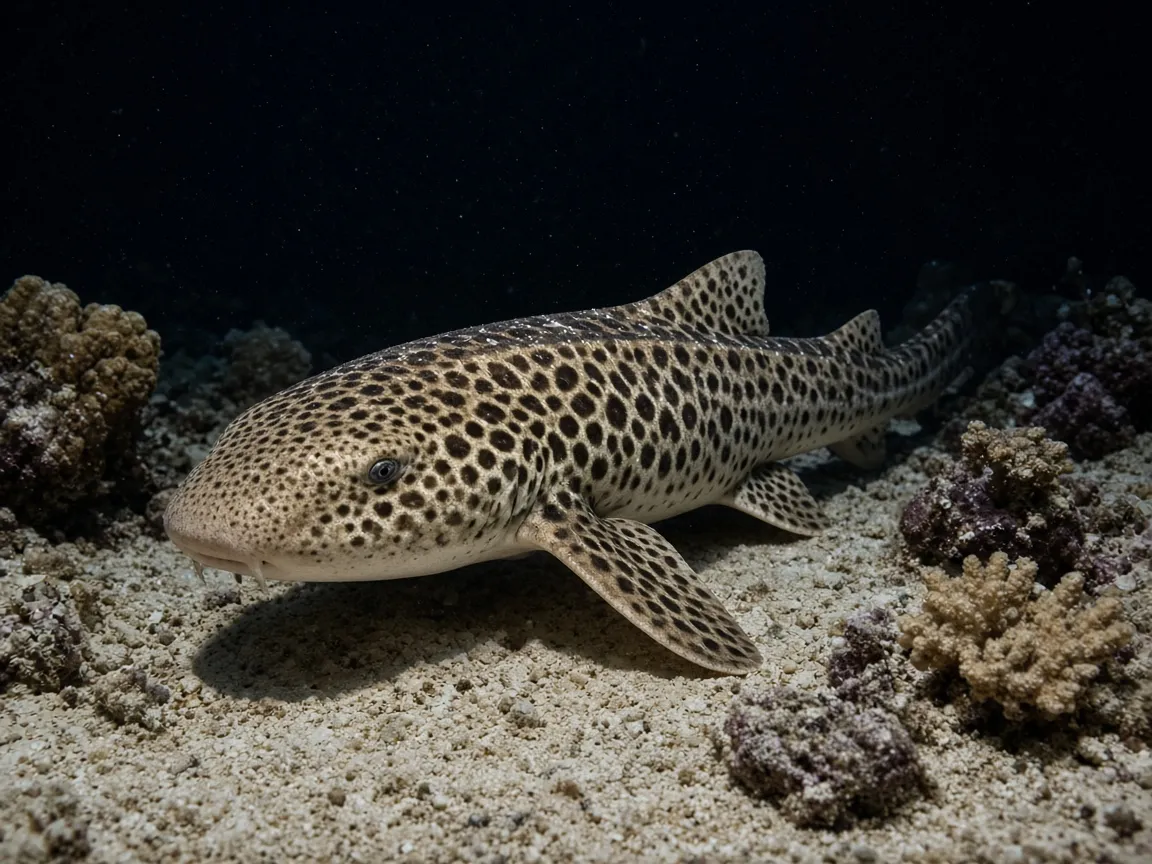
There is no guarantee of a sighting, and anyone who promises one is guessing. A walking shark hides deep in the reef by day and can be very hard to spot even at night. Groups who put in the time on several dedicated night dives give themselves a fair chance, but a bad night is still a bad night. Be patient, keep your torch low, and resist the urge to chase.
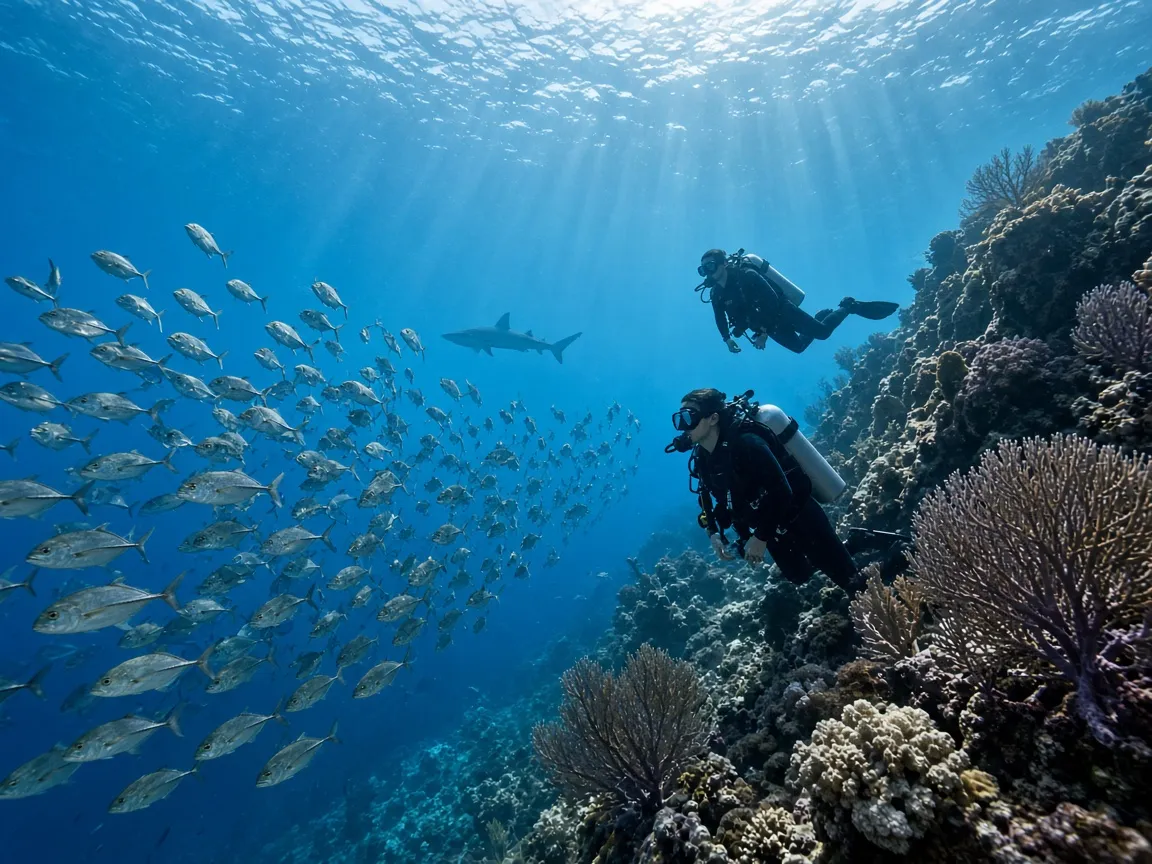
The rest of the marine life is classic Coral Triangle, with fewer divers looking at it. The Halmahera ecoregion is one of the richest in the Indo-Pacific for reef-building corals, with surveys recording more than 500 species. In the strait you get the big schools: jacks, barracuda, fusiliers and the occasional grey or whitetip reef shark patrolling the edge of the current. On the calmer slopes and in the bays, the macro list is long, from pygmy seahorses on sea fans to frogfish, ghost pipefish and a wide range of nudibranchs. Turtles are common. Dugongs live along some Halmahera coasts, but they are shy and rarely seen from a dive boat. Our wider guide to shark diving in Indonesia puts the walking shark alongside its relatives in Raja Ampat and Cenderawasih Bay.
How to get to Ternate for a Halmahera liveaboard
Ternate is better connected than most divers expect. Sultan Babullah airport (TTE) has direct flights to Jakarta, Manado and Makassar, and the city is a regional hub for North Maluku, so you do not need a chain of small connecting flights to reach it.
From Jakarta, Garuda Indonesia, Batik Air, Lion Air and Sriwijaya Air fly direct, with most flights leaving Jakarta overnight or in the small hours and landing in Ternate in the morning. The flight takes around three and a half hours. Economy fares in late 2026 were in the region of IDR 3.2 million to 4 million one way on Garuda, so budget roughly USD 300 to 500 for a return in economy, depending on the airline and how far ahead you book. From Manado, the shortest hop, Wings Air, TransNusa and Sriwijaya run several flights a day. From Makassar, Lion Air and Sriwijaya fly direct.
Ternate runs on eastern Indonesia time (WIT, UTC+9), two hours ahead of Jakarta. It catches people out every season, mostly on the way home, when a 08:00 departure from Ternate lands in Jakarta at 09:35 local time and looks shorter on the ticket than it is. Our guide to Indonesia's time zones explains the three zones.
For a trip that boards on the afternoon of 7 November, the safest plan is to arrive in Ternate the day before. Domestic flights in Indonesia are generally reliable, but delays and schedule changes do happen, and the boat cannot wait for a missed connection in Jakarta. Ternate has a range of hotels for that extra night. If you are coming on the crossing from Ambon, the same logic applies at the other end: Ambon has its own direct flights to Jakarta and Makassar.
Two practical points. Visa on arrival is available for most nationalities at major Indonesian entry airports, but Ternate is a domestic airport, so you will clear immigration in Jakarta, Bali or another international gateway first; our guide to park fees, permits and visas covers the current rules. And North Maluku is a malaria area, so talk to a travel clinic about prophylaxis well before you fly.
What a Halmahera liveaboard costs
The fare is the biggest number, but it is not the only one, and Halmahera adds a domestic flight to Ternate that a Komodo trip from Bali does not. These are King Neptune's published fares for the two priced Halmahera trips, per person, in US dollars, with the rupiah equivalent at roughly Rp 18,100 to the dollar.
| Cabin | Round trip, 8 nights | Ambon to Ternate, 11 nights |
|---|---|---|
| Upper-deck bunk-bed cabin | USD 4,100 (Rp 74,210,000) | USD 5,390 (Rp 97,559,000) |
| Main-deck sea-view cabin | USD 6,200 (Rp 112,220,000) | USD 7,700 (Rp 139,370,000) |
| Upper-deck sea-view cabin | USD 6,400 (Rp 115,840,000) | USD 7,920 (Rp 143,352,000) |
The fare includes all meals, tea, coffee, soft drinks and water, up to four guided dives a day with tanks and weights, nitrox refills, snorkelling gear, daily towels and linen, group airport transfers and VAT. It does not include flights, alcohol, rental equipment, insurance, crew tips, the fuel surcharge or the environment, park and port fees. Halmahera's local charges are modest next to Raja Ampat's marine park permit, but they still exist, and the fee line covers them along with harbour costs.
Here is a realistic budget for one person on the eight-night round trip in a main-deck sea-view cabin, flying from Jakarta. The fare is USD 6,200. Add USD 150 to 200 for the fuel surcharge and USD 180 to 400 for environment and port fees. Crew tips, at the commonly suggested Rp 271,500 to 362,000 per guest per day, come to roughly USD 135 to 180 over nine days; our guide to liveaboard tipping in Indonesia explains how the pool works. A return flight from Jakarta to Ternate runs to roughly USD 300 to 500, and a hotel night in Ternate before boarding USD 30 to 80. That puts the total at about USD 6,995 to 7,560, or roughly Rp 127 million to Rp 137 million, before international flights and insurance.
The same sums in a bunk-bed cabin start from the USD 4,100 fare and come to about USD 4,895 to 5,460, or roughly Rp 89 million to Rp 99 million. That is the cheapest way onto a Halmahera trip, and it suits solo travellers and friends happy to share. If you plan to join two trips back to back, note that the schedule leaves a day in port in Ternate between them, and ask us how that night is handled before you book.
Finally, budget for insurance. North Maluku is remote, medical facilities on the outer islands are basic, and an evacuation from a Halmahera route is not cheap. Our guide to dive insurance for an Indonesia liveaboard sets out what a policy needs to cover.
What to check before you book a Halmahera liveaboard
Halmahera is remote enough that the details matter more than usual. These are the questions we would ask any operator, including ourselves.
1. Whether the dates are real
Some boats list Halmahera as a possibility rather than a scheduled trip. Ask whether the departure is confirmed or only planned, how many guests it needs to run and what happens to your booking if it does not fill. Ours are published with live availability on the trip search page.
2. The route, honestly described
Ask which areas the trip covers and which it does not. An eight-night loop from Ternate does not reach Morotai or Widi, and any operator who says it does is either running a very different route or being optimistic.
3. Experience requirements
The strait drifts are not beginner dives. Ask what certification and how many logged dives the operator expects, and how they handle mixed groups. On King Neptune we recommend Advanced Open Water for this kind of route and group divers by experience.
4. Tenders and current procedures
Drift diving needs a tender for each group and guides who know the tide. Ask how many tenders the boat carries, whether every diver carries a surface marker buoy and how a group is recovered if it surfaces away from the planned spot. King Neptune carries two tenders.
5. Emergency planning
Ask where the nearest operating chamber is, how the boat would reach it and what oxygen and communications are on board. A good answer is specific; a vague one is a warning.
6. What the fare includes
Nitrox, fuel surcharges, park and port fees and airport transfers vary from boat to boat and can add several hundred dollars. Get the inclusions in writing before you pay a deposit.
7. Cabin layout
On a trip with long crossings, cabin position matters. Lower and midship cabins move less in a swell. On King Neptune the main-deck cabins sit lower in the hull than the upper-deck ones, and the bunk-bed cabins suit sharing friends better than couples.
Who a Halmahera liveaboard is for, and who it is not for
A Halmahera trip suits divers who have already done the famous names and want something quieter. If you have dived Komodo and Raja Ampat and found yourself counting the other boats, this is the trip for you. It suits macro photographers who like a challenge, divers comfortable in current who want a few fast drifts mixed in with easier reef dives, and anyone who would cross Indonesia for a single shark species found nowhere else. Our Halmahera destination guide has the season calendar and the practical details in one place.
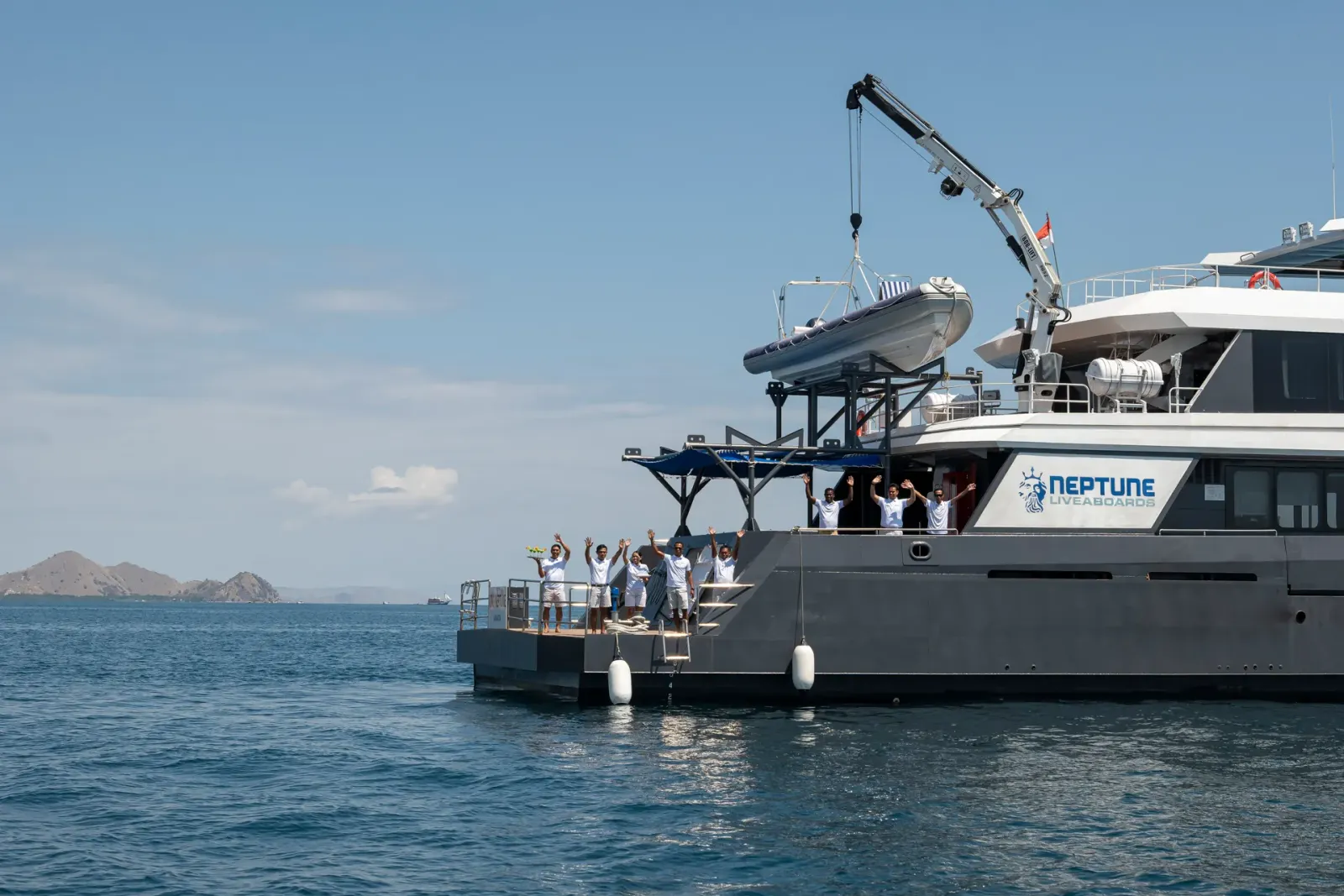
On our boats, all three Halmahera trips run on King Neptune, a 46-metre yacht with ten en-suite cabins for twenty guests, a crew of twenty and two tenders. The full specifications, cabin layouts and safety equipment are on the King Neptune liveaboard page.
It is not the right trip for everyone, and we would rather lose a booking than have someone on board who is not enjoying it. Newly certified divers with few logged dives will find the strait sites too demanding, and should start on a calmer route. Divers who want guaranteed big animals, such as mantas on every dive or whale sharks, should look elsewhere, because Halmahera is a place of discoveries rather than certainties. A non-diving partner may find eight nights long, with few land excursions. And if your travel dates are in 2026 or the first half of 2027, Halmahera is simply not on our schedule; a Raja Ampat or Banda Sea trip will serve you far better.
If you are unsure which camp you fall into, tell us how many dives you have and where, and we will give you a straight answer before you book.
Key takeaways
- A Halmahera liveaboard is a dive cruise of eight to eleven nights in North Maluku, usually from Ternate, to reefs few boats visit.
- King Neptune runs three Halmahera trips between 25 October and 28 November 2027, from USD 4,100 per person.
- Round trips focus on the Goraici islands, the Patinti Strait and Bacan; Morotai and Widi need specialist expeditions.
- The endemic Halmahera walking shark is found on shallow reefs at night, with a fair chance but no guarantee.
- Ternate has direct flights from Jakarta, Manado and Makassar; arrive the day before boarding.
- Strong strait currents make Advanced Open Water and some drift experience the sensible minimum.