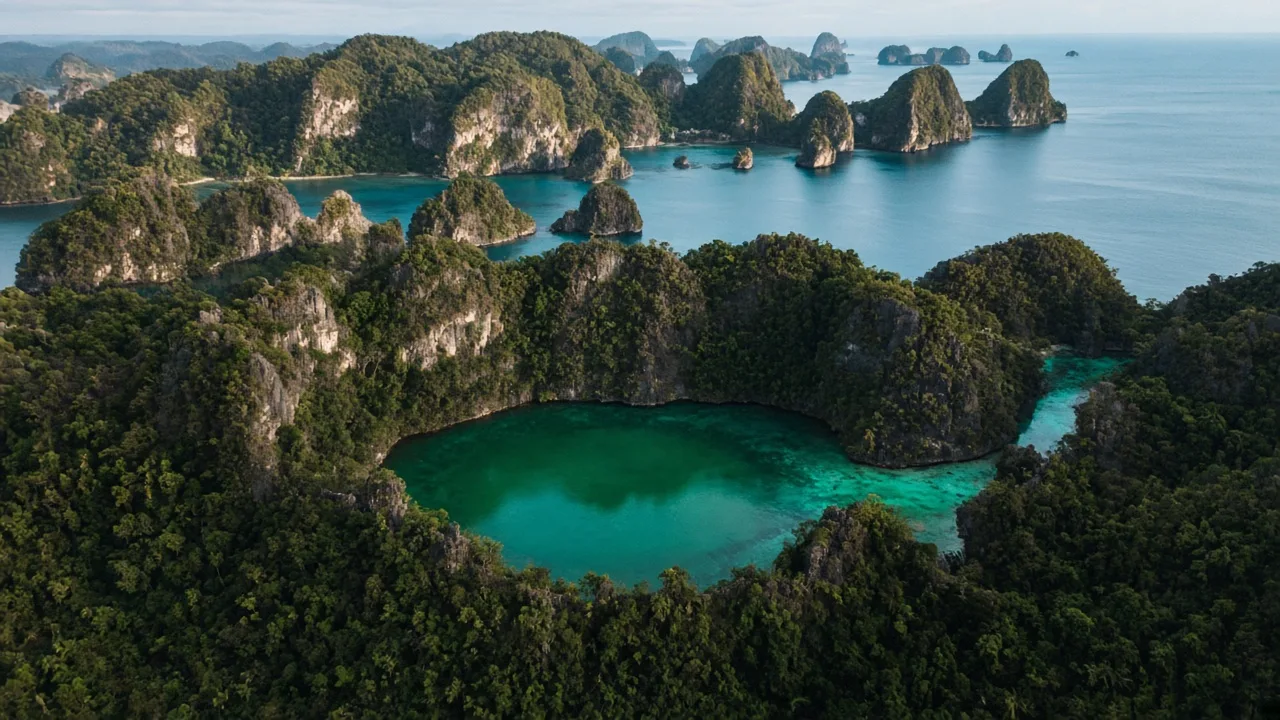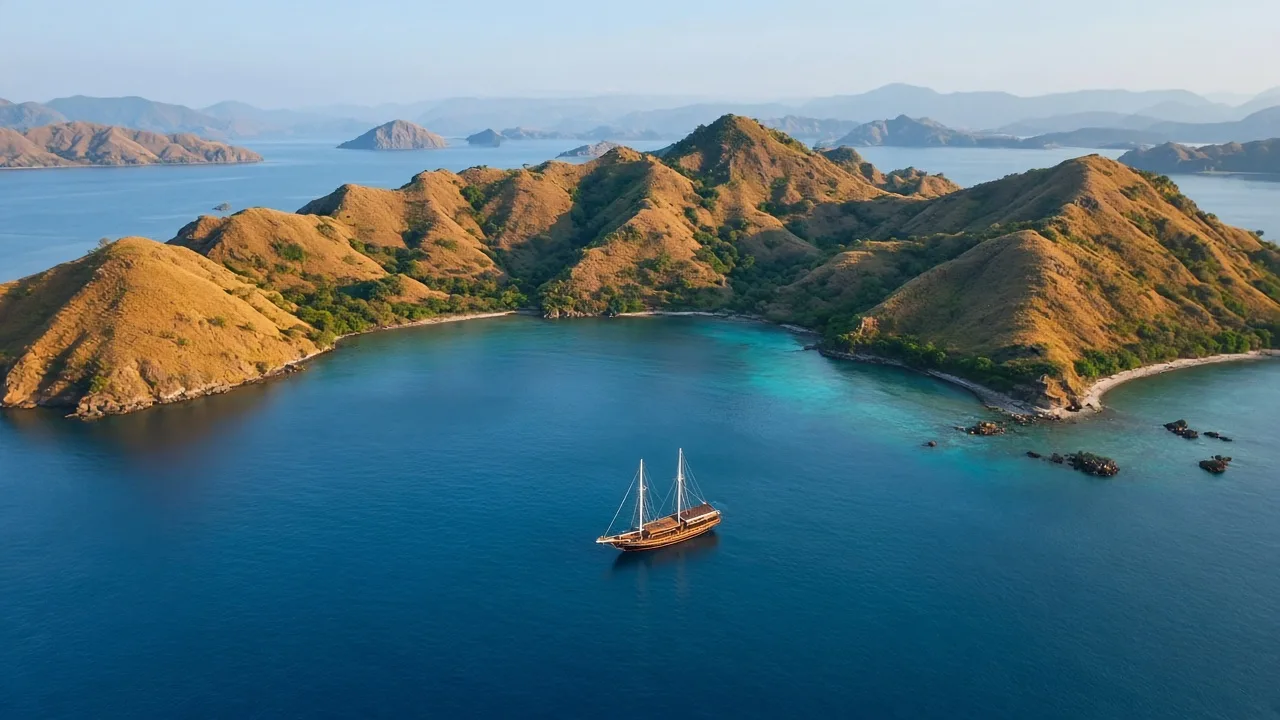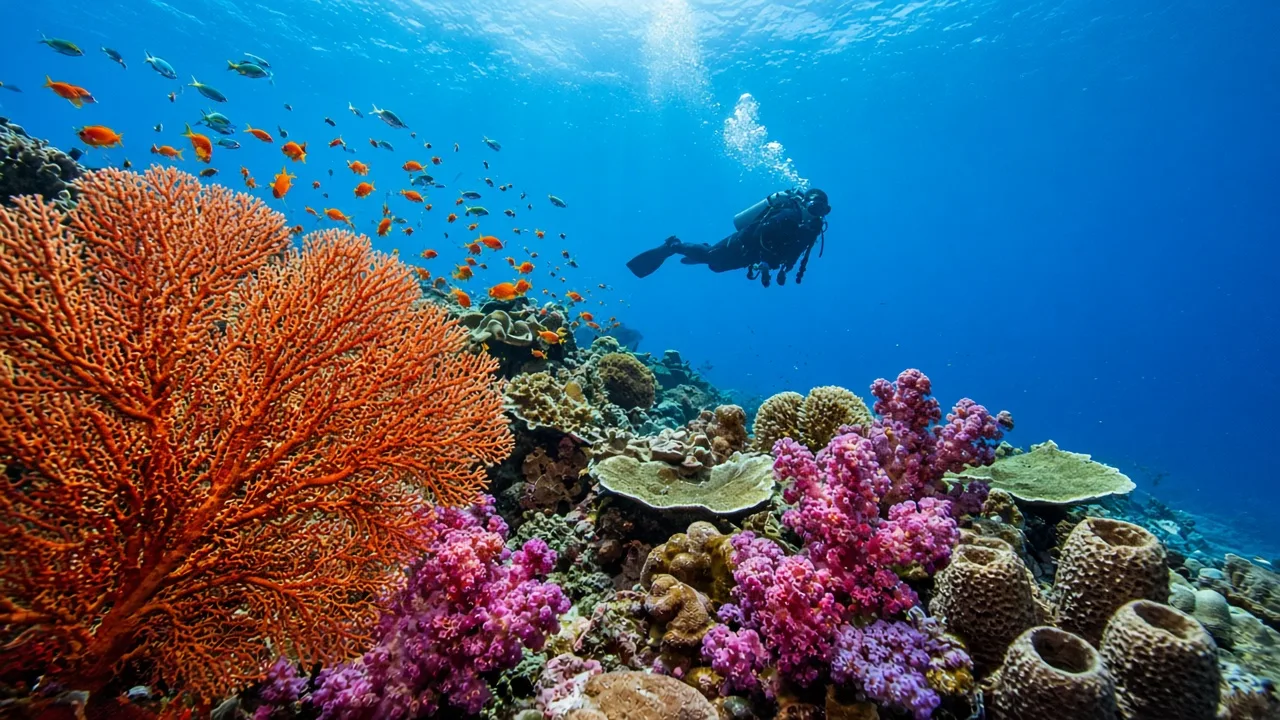
The Cauldron, sold on almost every dive deck as the Shotgun, is a tidal channel dive in the north of Komodo National Park. It runs between two islands, Gili Lawa Laut and Gili Lawa Darat, and it is the one dive in the park where the water does the swimming for you. The tide compresses a large volume of water into a narrow gap, the gap accelerates it, and for roughly thirty seconds you fly.
It is also the most misdescribed site in Komodo. Half the write-ups online call it a gentle drift suitable for anyone with good buoyancy, which is wrong and occasionally dangerous, and the other half describe it as a five-knot rollercoaster with no mention that the ride is a small part of a dive that is mostly slow and quiet. This guide is the version we would give a guest on the sundeck the night before, written properly. If you are still choosing a trip, our Komodo liveaboard pages cover which itineraries reach the northern channel at all.
One framing note before the detail. The Cauldron is not really a dive site in the way Batu Bolong is a dive site. It is a sequence of four distinct features that you pass through in a fixed order, each with its own depth, its own current behaviour and its own marine life. Understanding that sequence is most of what separates divers who enjoy it from divers who spend the whole dive slightly behind the plan.
What the Cauldron actually is
The Cauldron is a channel dive between Gili Lawa Laut and Gili Lawa Darat, two small islands off the northern tip of Komodo Island, inside Komodo National Park. The dive begins on a sloping reef, crosses a sandy plain, descends into a bowl-shaped depression on the seabed, then exits through a narrow rocky gap where the current accelerates sharply before releasing you over a shallow coral garden.
Depths run from about 5 metres in the shallows to roughly 25 to 30 metres at the deepest point of the bowl. Visibility is typically 20 to 30 metres. Water temperature in the north sits around 26 to 28 degrees, warmer than the upwelled southern sites, and a 3mm suit is standard. The site lies roughly 45 kilometres from Labuan Bajo harbour, which is why it belongs to liveaboards and long-range speedboats rather than to ordinary day trips.
| Detail | The Cauldron (Shotgun) |
|---|---|
| Location | Channel between Gili Lawa Laut and Gili Lawa Darat, north Komodo National Park |
| Dive type | Tide-timed channel drift, with a slow first half |
| Depth range | 5 to 30 m; bowl floor around 24 to 30 m; the Shotgun gap around 8 to 12 m |
| Current | Mild to moderate on the approach, up to about 5 knots through the gap |
| Visibility | 20 to 30 m |
| Water temperature | 26 to 28 C |
| Level | Advanced Open Water plus roughly 30 to 50 logged dives and real drift experience |
| Entry | Negative entry from a tender, on a guide-selected tidal window |
| Signature sightings | Reef manta rays, whitetip and grey reef sharks, giant trevally, sweetlips |
| Distance from Labuan Bajo | Around 45 km, liveaboard territory |
Why it has two names
The two names describe two different features, and people use them interchangeably only because both sit on the same dive.
The Cauldron is the bowl. It is a crater-shaped depression in the seabed, something like 40 metres across, with walls of gorgonian fans and soft coral and a floor of sand and rubble. Inside it the current largely falls away, which is what makes it possible to hang there and watch sharks holding station in the eddy.
The Shotgun is the exit. At the eastern edge of the bowl the seabed rises and pinches into a narrow rocky gap, and the entire volume of water crossing the channel has to squeeze through it. Squeezing water through a smaller opening speeds it up, which is the whole mechanism, and the result fires divers through the gap and out over the reef beyond. The name is descriptive rather than marketing.
You will also hear the shallow reef at the far end called the China Shop, and a crack at the northern rim of the bowl called the Fish Bowl. Those four names, the Cauldron, the Fish Bowl, the Shotgun and the China Shop, are the whole dive in order.
Where the current comes from
The current at the Cauldron is tidal, and it is a local expression of something much larger. Komodo National Park sits in the path of the Indonesian Throughflow, the movement of Pacific water southwards towards the Indian Ocean, which is funnelled through the straits of the Lesser Sunda Islands. Twice a day the tide pushes that water back and forth across the park, and every time the flow meets a constriction it accelerates.
The Gili Lawa channel is one of those constrictions, and the gap at the Shotgun is a constriction inside the constriction. That is why the same body of water can be moving lazily over the sand at the start of the dive and at several knots ninety metres later. Nothing about the current is random; it is geometry plus the moon, and it is completely predictable a week in advance, which is the reason the site can be dived safely at all.
It is also the reason the site is worth diving. The same flow that makes the gap fast carries plankton, and plankton is what brings mantas in to feed and what keeps the cleaning stations busy. The thrill and the wildlife have the same cause.
The dive, zone by zone
The Cauldron is dived in one direction, west to east, because that is the direction the current has to be running for the site to work at all. What follows is the sequence in the order you meet it. Times are approximate and vary with the strength of the tide.
1. The entry and the sloping reef
You enter from a tender on the western side, close to the Gili Lawa Laut reef, and you enter negative. A negative entry means going in with no air in your buoyancy jacket so that you descend immediately rather than floating on the surface while the group assembles. At a site where the water is already moving, the surface is the one place you do not want to spend time, because thirty seconds of drifting on the top can put you well past the point where you meant to go down.
If you have never done a negative entry, say so in the briefing. It is a simple skill, guides teach it in two minutes, and flagging it beforehand is infinitely better than discovering the problem at the entry point. Our guide to diving in currents in Indonesia covers the technique properly, along with reef hooks and drift positioning, so this article does not re-teach it.
Once you are down, the first few minutes are calm. You are on a healthy sloping reef with hard coral and good light, and the current is usually mild. This part of the dive surprises people who arrived expecting to be fired out of a cannon from the moment they hit the water.
2. The sandy plain
The slope levels out into a sandy bottom somewhere around 20 to 23 metres, and you move east across it. This is the slow, quiet section, and the section most guests forget to mention afterwards because the ending overwrites it.
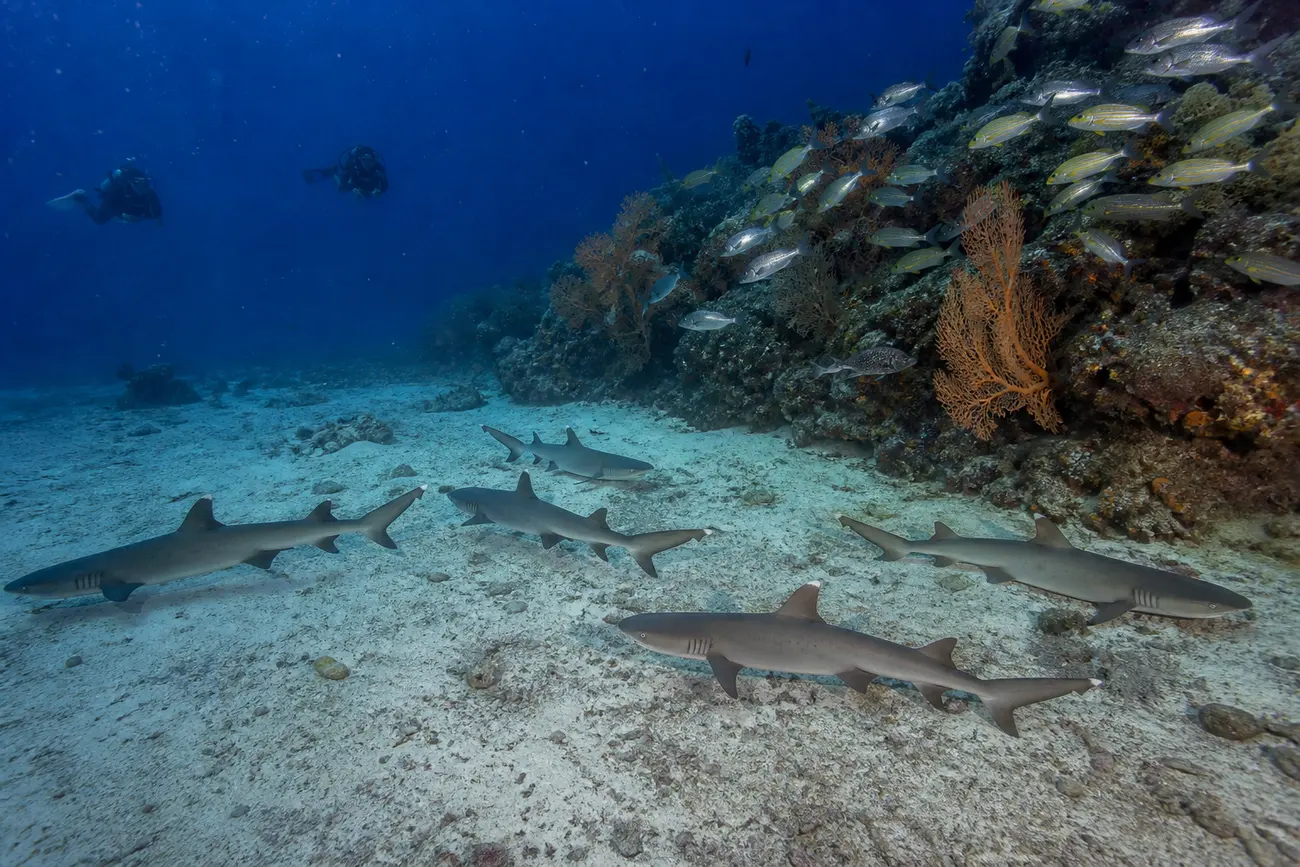
It is worth paying attention here. Whitetip reef sharks rest on the sand, blue-spotted and larger stingrays sit half buried, garden eels stand in colonies and retract as you pass, and there are gorgonians and sea fans scattered along the way. Because the current is still gentle, this is the part of the dive where a camera is actually usable.
3. The Cauldron itself
The seabed rises to roughly 15 metres and then you arrive at the western lip of the bowl, which is a genuinely striking piece of underwater landscape. It is a crater, something in the order of 40 metres across, dropping to a floor at around 24 to 30 metres depending on where you cross it.
You drop into it. Inside, the current largely disappears, and the effect is like stepping out of a river into an eddy behind a rock. That is precisely what it is. The stillness is why the bowl holds animals: grey reef and whitetip sharks hold station in the slack water, large groupers sit motionless, midnight snapper and sweetlips stack up along the walls, and giant trevally patrol through. Manta rays are seen inside the bowl fairly regularly, though not reliably enough that anyone should promise them.
This is also the deepest part of the dive, and it is where your gas planning gets decided. Divers who have spent the crossing at 23 metres and then drop into the bowl arrive at the fast section with less air than they expected, and the fast section is the part you do not want to rush. Nitrox helps here more than at most Komodo sites.
4. The Fish Bowl
At the northern rim of the Cauldron there is a crack in the rock that guides call the Fish Bowl. It is a small feature and easy to miss if nobody points it out, and it is often the densest concentration of fish on the dive: packed schools of trevally, sweetlips and snapper holding in the shelter of the rock.
Whether you get to it depends on the day. On a strong tide the group may cross the bowl too quickly to detour, and a good guide will make that call rather than dragging eight divers sideways across a running channel to see one crack. If conditions allow it, it is worth the two minutes.
5. The Shotgun
This is the part everyone comes for, and it lasts about thirty seconds.
At the eastern edge of the bowl the terrain rises sharply and narrows into a rocky gap, roughly 8 to 12 metres deep. Your guide will signal, usually with a reminder to dump any remaining air from your jacket, and you rise into the gap. The current takes you immediately.
The technique is the opposite of what instinct suggests. You do not swim. You get streamlined, arms tucked in, and you stay low over the rock, because the flow is fastest in the middle of the water column and slightly more manageable near the bottom. Finning achieves nothing except making you harder for your guide to keep track of. The single most common mistake is trying to steer.
Reef hooks stay clipped to your harness through this section. This is not a hooking dive, the rock is not a suitable anchor at speed, and a hook deployed in a running channel is a hazard to you and to the reef. That advice is specific to the Shotgun and does not contradict the general Komodo picture, where hooks earn their place on the pinnacles at Castle Rock and Crystal Rock. We supply hooks free of charge on every trip; this is simply the dive where you keep yours stowed.
6. The China Shop
The gap releases you over a shallow coral garden at around 5 metres, and the current dissipates almost as suddenly as it arrived. The name is a joke about being a bull in one, since divers arrive at speed over a fragile hard and soft coral reef.
Buoyancy control matters here more than anywhere else on the dive, because you go from moving fast to hovering over living coral in a few seconds while your ears and your adrenaline are still catching up. The China Shop is also where the dive becomes gentle again: it is sunlit, shallow, full of reef fish and macro life, and reef mantas, including juveniles, are seen cruising over it. Most groups spend the remainder of the dive here before deploying a marker buoy and ascending.
The order of events is worth restating because it is the opposite of the reputation. The Cauldron is a slow dive with a fast punctuation mark near the end, not a thirty-minute washing machine.
Tides, and why the moon writes the schedule
The Cauldron is the clearest example in Komodo of a site that is dived when the ocean allows rather than when the itinerary would prefer. On a liveaboard this is visible to guests: the dive order changes, the briefing time moves, and occasionally the site is dropped altogether.
Which tide the site needs
The operative requirement is direction. The current has to be running west to east through the channel, because that is the direction that carries you from the entry reef across the sand, into the bowl and out through the gap. Run it the other way and the geography stops working: you would be trying to swim into the fast section from the wrong end, which is neither possible nor sensible.
Worth being straight about one thing, because it appears differently on different operators' websites. Some describe the Cauldron as a falling-tide dive and others as a rising or building-tide dive. Both descriptions are in circulation and they cannot both be universally true. What is consistent is the direction of flow through the channel, which your guide works out from the tide tables for that specific day. Treat the direction as the rule and the tidal label as local shorthand, and if you are the sort of diver who likes to understand the plan, ask at the briefing which way the water is going and why. Guides in Komodo are generally delighted to be asked.
What happens on the wrong phase
Two different failure modes, and they are not the same.
On too little current, the dive is simply flat. The Shotgun does not fire, the bowl does not hold fish in the same way, and you have done a pleasant sandy reef dive with a rocky gap in it. Nobody is in danger and nobody is thrilled.
On too much, it stops being a recreational dive. At peak spring flow the channel develops the things that make Komodo genuinely serious: horizontal jets, up-currents, down-currents and washing-machine turbulence where opposing flows meet. The bowl exit in particular has a reputation for pulling divers deeper than they planned. This is why a competent operator will decline the site rather than run it on the wrong phase, and why a guide who says "we are diving Golden Passage instead today" is doing their job rather than short-changing you.
Spring tides, neap tides and your week
Tidal range is not constant. Around the full and new moon you get spring tides, where the difference between high and low water is largest and the currents are strongest. Around the first and last quarter you get neap tides, with a smaller range and gentler flow.
For the Cauldron, the practical consequences are these. Spring tides give the biggest ride and the narrowest safe window, sometimes only an hour or so, and are the phase most likely to be cancelled outright. Neaps give a milder, more forgiving version of the dive and a wider window. Neither is wrong. A first-time visitor to the site is usually better served by a neap-tide run, and the divers who chase the site specifically for the speed are the ones watching the lunar calendar when they book.
Because a Komodo week covers roughly a quarter of a lunar cycle, most itineraries encounter a mixture. The northern channel sites, the Cauldron included, tend to be scheduled around the tide windows first, with the rest of the day built around them, an approach we describe in our Komodo liveaboard itineraries guide.
When the site gets skipped
It happens, and it is worth setting expectations before you book rather than being disappointed on the boat. The northern channel is exposed, and in the wet season, roughly December to February, wind and swell can make the northern sites unreliable for days at a time. Boats then favour the central and southern park. Our guide to the best time to visit Komodo sets out the seasonal pattern in full.
No operator can guarantee you the Cauldron on a given week, and any who does is telling you something about themselves rather than about the site.
What you will see
The Cauldron is unusual in Komodo because it produces both a genuine wide-angle spectacle and a decent macro dive, in different sections, on the same tank.
Manta rays
Reef manta rays are the headline, and they are seen at the Cauldron regularly rather than reliably. There are cleaning stations in and around the channel, and the shallow reef at the exit is a known spot for mantas, including juveniles, cruising through.
Mantas are present in Komodo National Park all year. Sightings concentrate when plankton is thickest, which broadly runs from December through February, with a wider window either side. But if your priority is a guaranteed manta dive rather than a channel ride, the honest answer is to book the sites that exist for that purpose: our guides to Manta Point at Karang Makassar and Manta Alley in south Komodo both cover far more dependable encounters. The Cauldron is a terrain dive that sometimes has mantas on it.
Sharks, trevally and the schooling fish
The bowl is the reliable part. Whitetip reef sharks are close to a certainty, resting on the sand on the approach and holding in the slack water inside the crater. Grey reef sharks work the edges. Giant trevally hunt through clouds of fusiliers, and the Fish Bowl crack at the northern rim packs in trevally, sweetlips and snapper when the group has time to reach it.
Eagle rays and devil rays turn up in the channel. Large stingrays sit on the sand. Napoleon wrasse and big camouflage groupers are regulars in the bowl. This is not the pelagic density of Castle Rock and Crystal Rock, which remain the park's best sites for sheer numbers of sharks and schooling jacks, but the animals here are close, calm and sitting in still water, which often makes for better watching than a hooked-in dive in a ripping current.
The macro nobody expects
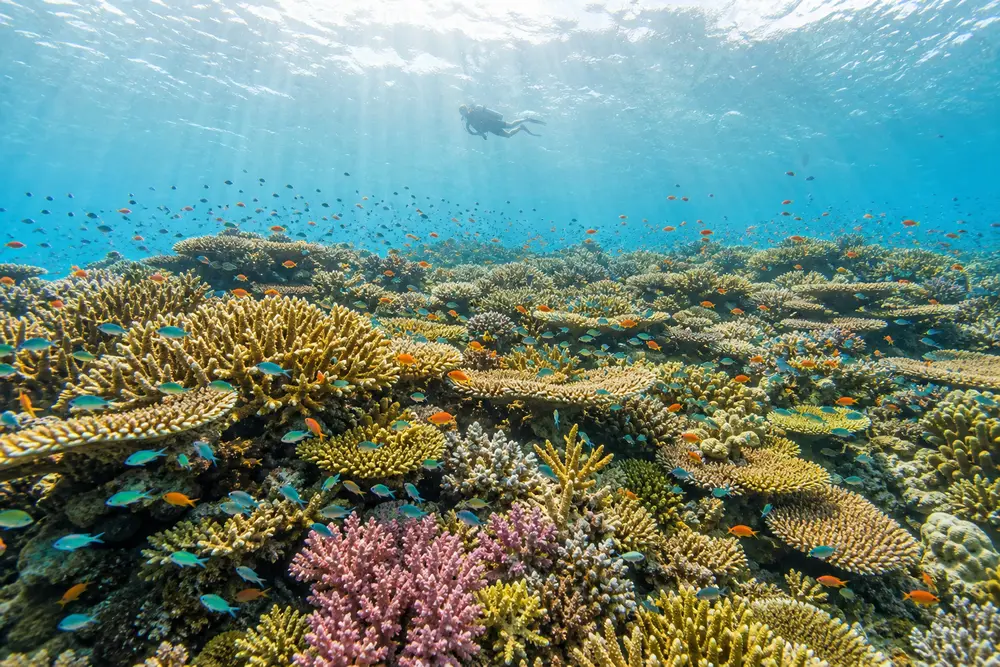
Because half the dive is slow, the Cauldron rewards divers who look small. Garden eel colonies stand on the sandy plain. Nudibranchs, glassfish and frogfish are found along the reef sections, and pygmy seahorses are reported on the gorgonians on the bowl walls, though finding one while managing a channel dive asks a lot of a guide.
Realistically, treat the macro as a bonus on the approach and in the China Shop rather than as the reason to be there. A dedicated macro dive elsewhere in the park will be a better use of a tank.
Best time of year
| Period | Conditions in the northern channel | What it means for this dive |
|---|---|---|
| April to June | Dry season building, good visibility, settled seas | Reliable access, excellent all-round conditions |
| July to August | Peak dry season, strongest tidal flow on springs | The biggest rides, and the most cancellations on spring tides |
| September to November | Settled, good visibility, fewer boats | Often the best balance of access and conditions |
| December to February | Wet season, wind and swell in the north | Plankton and manta activity peak, but northern access is unreliable |
| March | Transitional, variable weather | Many boats reposition; access varies week to week |
The compressed version: if you want to dive the Cauldron specifically, the dry season from April to November is the sensible target, with September to November arguably the sweet spot.
Can you dive it? Requirements and honest limits
This is the section that matters most, because the Cauldron is the site where the gap between what a diver can technically do and what a diver should comfortably do is widest.
Certification and experience
The Cauldron requires an Advanced Open Water certification or equivalent, and in practice around 30 to 50 logged dives with genuine experience of moving water. Neptune applies the Advanced requirement to the northern channel sites as policy, which also covers Castle Rock and Crystal Rock, and an equivalent deep or drift specialty is accepted in its place.
That figure of 30 to 50 dives is not a formality invented to sell courses. It is the number at which most divers have stopped spending attention on the basics. If you are still thinking about your buoyancy, your trim and where your buddy is, you have nothing left over for a channel that is deciding your direction for you. The stronger the forecast current, the closer we hold to the upper end of that range.
We should be plain that a claim appears in some places, including in an older article of our own, that Open Water divers can dive the Cauldron on lighter tides. We no longer stand behind that. It underestimates how quickly the channel changes with the tide, and the site's own reputation for down-currents at the bowl exit means the margin for error is smaller than a light-tide reading suggests. If you hold an Open Water certification, Komodo has a great deal for you, and we would rather point you at it than sell you a dive you have to survive.
The skills that actually matter
- Negative entry. Not difficult, but it must be automatic, and the middle of a moving channel is not the place to learn it.
- Buoyancy without thinking. Particularly at the China Shop, where you arrive fast over living coral in five metres of water.
- Streamlining. Gauges clipped, octopus stowed, nothing dangling. A free-swinging console at five knots finds coral.
- Deploying a marker buoy from depth. The dive can end in open water, and a diver on the surface without a buoy is close to invisible in a channel with boat traffic.
- Staying with the guide. Obvious, and the single thing that goes wrong most often, because the fast section separates groups by design.
Down-currents and the bowl exit
The Cauldron has a documented reputation for vertical water movement, particularly around the exit from the bowl, and it should be treated as a real feature of the site rather than a rumour.
A down-current is water moving downwards rather than sideways, and it will take you deeper than you planned without any obvious warning. The response is counterintuitive and worth knowing before you need it. Do not inflate and swim up: adding gas is the highest-risk option available, because the moment you leave the descending column that gas becomes an uncontrolled ascent, which is a considerably worse emergency than the one you started with. Down-currents behave like rip currents, powerful but usually narrow, so the correct first move is to swim horizontally out of the column, perpendicular to the flow, with little or no air added. If the flow is stronger than that, get negative, get a hand on the rock and move along it, which keeps your depth stable.
This is general Komodo technique rather than anything peculiar to this site, and we treat it in full in our currents guide. Read it before the trip, not on the tender.
Is the Cauldron dangerous?
The Cauldron carries real and manageable risk, and the risk comes almost entirely from water movement rather than from anything alive. The specific hazards are being pulled deeper than planned at the bowl exit, separation from the group in the fast section, and surfacing away from the boat in a channel that carries traffic.
Against that, the site is dived hundreds of times a season without incident, because the controls are straightforward and well established: dive it only on the correct tidal window, brief the entry and the exit properly, keep groups small, carry a marker buoy, and cancel when the phase is wrong. Serious incidents in Komodo are rare relative to the number of dives conducted, and the ones that do occur usually involve separation and surface drift rather than the reef itself.
One correction while we are here, because it circulates widely. An often-cited incident in which seven Japanese divers were swept away and rescued by coastguard occurred off Nusa Lembongan near Bali, not in Komodo National Park. The two are roughly 800 kilometres apart, and the story is regularly misattributed to Komodo in travel write-ups.
If you are not ready yet
There is no shame in this and it is a normal conversation on a Komodo boat. If you are newly certified, or if it has been a few years, the northern channel is not where you want your first current dive.
The sensible progression is to spend the early part of the week on the gentler central sites, then step up. Siaba Besar, Mawan and Wainilu are calm. Karang Makassar gives you mantas in moderate current and shallow water. Batu Bolong is the natural intermediate step, and Crystal Rock is usually the more forgiving of the two northern pinnacles. Divers who follow that order frequently dive the Cauldron later in the same week having enjoyed it, rather than having endured it, and our beginners' guide to Indonesian liveaboards sets out what a realistic first week looks like.
Tell your guide your dive count honestly at the start of the trip. Nobody is grading you, the number changes which sites you are offered, and a guide who knows what they have in the water makes better decisions for everybody. If you want us to look at your certification and logbook against a specific departure before you commit, contact us and we will give you a straight answer about which northern sites are open to you.
The short version
The Cauldron is a tide-timed channel dive between Gili Lawa Laut and Gili Lawa Darat that runs from a sloping reef, across a sandy plain, down into a still bowl at around 25 metres, then out through a narrow gap that accelerates you to something near five knots before releasing you over a shallow coral garden. It needs Advanced certification, roughly 30 to 50 dives and a west-to-east flow. It gives you sharks in slack water, a fair chance of mantas and about thirty seconds of the closest thing to flying that recreational diving offers.
Most guests rate it as the most memorable dive of the northern leg. Not the best dive, which is usually Castle Rock, and not the prettiest, which is usually Crystal Rock. The most memorable, which is a different thing and is the point of it.