Last updated: May 2026.
Indonesia is a shark country. That sentence sounds obvious until you start counting. Schooling scalloped hammerheads on the volcanic pinnacles of the Banda Sea. Carpet-textured wobbegongs sleeping under coral overhangs in Raja Ampat. The strange, beautiful epaulette walking sharks that crawl across reef flats on their fins after dark, not actually swimming so much as ambling. Grey reefs lined up against the current at Komodo's Castle Rock. Whitetips in every channel; blacktips on every reef edge; and a quiet, less-talked-about variety of bamboo sharks, cat sharks, and a handful of pelagic threshers and silvertips that pass through if you happen to be looking up at the right moment.
And yet "Indonesia" is rarely the first answer when divers ask where to go for sharks. The Bahamas, Fiji, the Galapagos, Cocos Island, those names dominate the conversation. We think that's a mistake. The truth is, Indonesia has the broadest shark diversity of any single dive country in Asia, and probably anywhere outside the eastern Pacific seamounts. What it doesn't have is a single hero site like Tiger Beach or Darwin's Arch. The country's shark diving is spread out, across the Banda Sea, Raja Ampat, Komodo, Halmahera, the Forgotten Islands, and a few quieter pockets, and that distribution is both its strength and the reason it gets undersold.
This guide pulls all of it together. We're going to walk through the species you can realistically expect to see, the sites where each one is most reliable, the seasons that work for each region, what cert level and conditions you need, and how to plan a trip that actually maximizes your shark count rather than chasing one species at the expense of the others. We'll be straight about what's reliable, what's lucky, and what's frankly hype. The country deserves a serious shark-focused write-up, and most of what's out there isn't one.
How to Read This Guide
Indonesia's shark diving is regional. There is no one site that gives you everything, the way a single Galapagos liveaboard or a single Tiger Beach trip can. So this guide is structured by species and region, not by site, because the right trip for you depends on which sharks you actually care about.
If you want hammerheads, you fly to Ambon and board a Banda Sea liveaboard between September and early November. If you want walking sharks, you go to Raja Ampat, base in Sorong or on Misool, and dive at night. If you want grey reefs and whitetips lined up in current, that's Komodo from July to October. If you want all of the above plus a whole lot of reef-shark filler, you do two trips in one calendar year, Banda in autumn and Komodo in summer, or Banda in autumn and Raja Ampat in winter, depending on what fits the rest of your travel.
The honest sequence we tell first-time guests: pick the region by season and primary species. Build the rest of the trip around that. Don't try to chase three species in three regions in two weeks; you'll spend half the trip on planes and miss the windows where each region actually peaks. We've watched dozens of guests make exactly that mistake. The people who plan one region at a time, and come back the following year for the next one, see more sharks per dive than the people who try to do it all at once.
Hammerheads of the Banda Sea, Suanggi, Manuk, and the Volcanic Pinnacle Belt
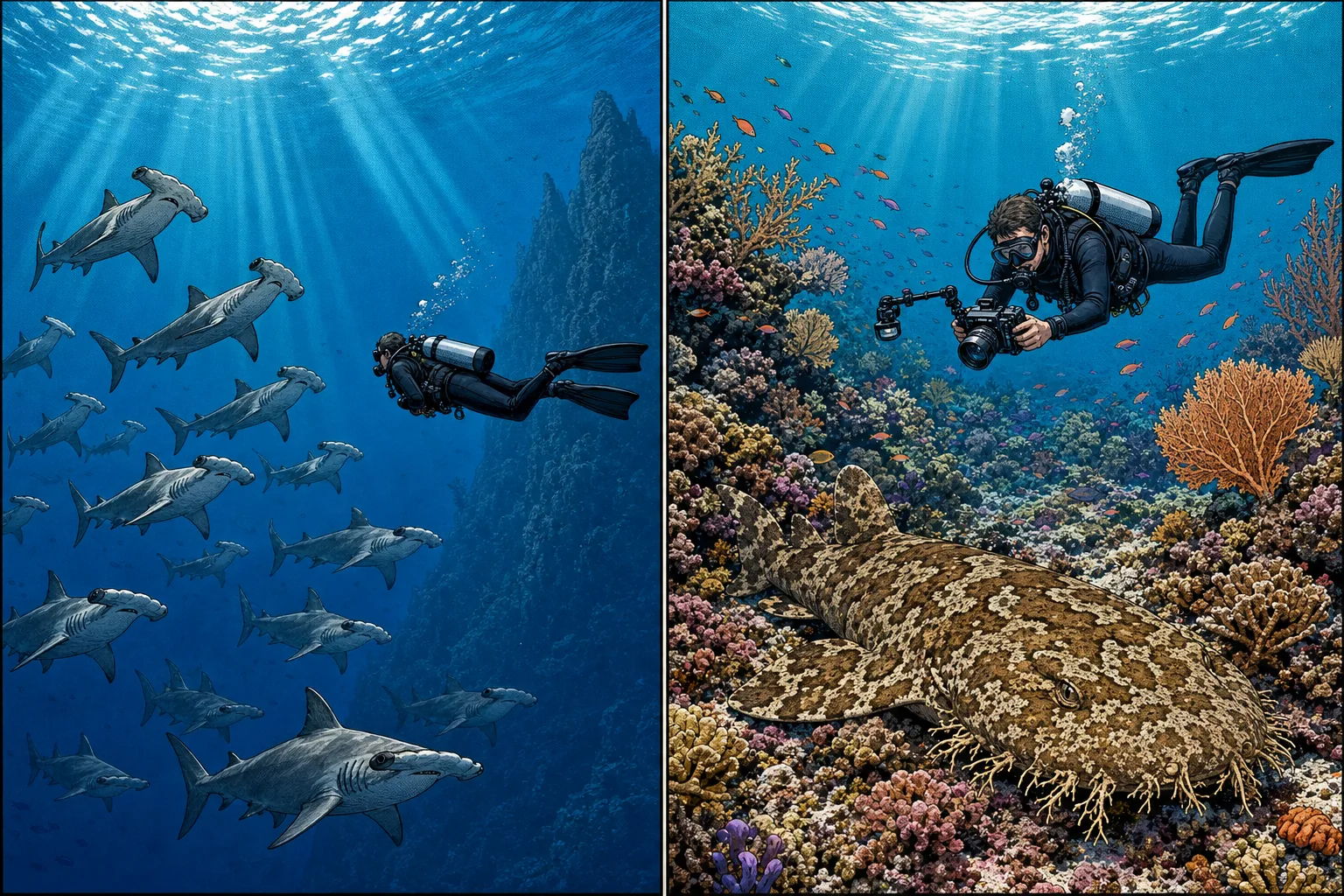
Scalloped hammerheads (Sphyrna lewini) are the species most divers come to Indonesia for, and the Banda Sea is where you actually see them in numbers. The species schools at deep volcanic pinnacles in cool water, typically twenty-eight to forty metres deep, where the upwelling brings cooler water up against vertical rock walls and the sharks stack along the thermocline in groups of fifteen to a hundred. The sight is one of the genuinely great big-animal experiences in diving.
Three sites do most of the work. Suanggi, an isolated pinnacle a half-day's sail east of Banda Neira, is the most consistent for hammerhead aggregations from late September through early November. Manuk, the snake island farther north, runs hammerhead schools on similar timing but with less reliability, some seasons the schools come; some seasons they don't. Hatta in the eastern Banda group catches passing schools and the occasional solo bull-shark or silvertip alongside the hammerheads.
What does an actual encounter look like? Picture a pinnacle wall dropping into deep blue. You hold a negative-entry descent to thirty metres, turn, look out into the channel rather than at the wall, and wait. After two to four minutes the schools appear. They cruise in a loose horizontal formation, maybe forty animals strong on a strong day, the lead sharks at slightly shallower depth than the rear, the whole formation drifting past you at a horizontal distance of fifteen to twenty metres before melting back into the blue. You'll get one to four passes per dive depending on the day. The dive is short, twenty-five minutes at thirty metres on regular air leaves very little no-deco margin, and the safety stop is where you reflect on what you just saw, because nothing about a hammerhead school feels real until you're back at five metres watching it replay in your head.
Conditions are not beginner. The Banda Sea hammerhead dives are run as Advanced-only with thirty to fifty logged dives. Currents can rip from any direction; the cold thermocline at thirty metres often sits at twenty-three to twenty-four degrees Celsius (warm by California standards, cold by Indonesian standards); and the depth itself takes a chunk of your bottom time. Most boats will run them on EAN32 nitrox to extend the no-deco window, which we recommend. Bring your nitrox cert.
The Banda Sea liveaboard season runs from mid-September to early November. Outside that window, the hammerhead schools disperse, the upwelling shifts, and the cruise itineraries don't run. We cover the broader region in the Banda Sea diving guide and the cruise calendar in the Indonesia liveaboard seasons guide. If hammerheads are your priority, those two articles plus this one are the planning trio.
Wobbegongs of Raja Ampat, The Carpet Sharks Hiding in Plain Sight
If hammerheads are the dramatic cousins, the Indonesian wobbegong (Eucrossorhinus dasypogon) is the introvert at the family reunion. They're flat. They're patterned like a Persian rug. They lie under coral overhangs all day, and most divers swim straight past them without noticing because the camouflage is genuinely that good. Once you've spotted one, you start seeing them everywhere, and Raja Ampat has more wobbegongs per kilometre of reef than anywhere on earth.
The species is endemic to a narrow band of northern Australian and Indonesian waters; in Indonesia, Raja Ampat (especially the Misool, Aljui Bay, and southern Dampier areas) is the global stronghold. Adults reach up to 1.8 metres, with a wide flat head fringed by branching skin tassels that break up their outline against the coral substrate. They're ambush predators, hunting at night, and during the day they sleep in the same handful of preferred rest spots over and over. Good Raja Ampat dive guides know which coral bommies tend to host wobbegongs and will route the dive past them. A typical Raja Ampat dive in southern Misool will turn up two to five wobbegongs without trying hard.
Photographically, they're a gift. They don't move. They don't spook. You can set up a careful 14mm wide-angle composition over twenty seconds, dialing in lighting and composition, while the animal stares at you with its small forward eyes and does absolutely nothing. The classic shot is a low-angle wide-angle frame with the wobbegong in the foreground and a clear water column behind, and the trick is positioning yourself flat on the sand or shelf so the animal becomes the dominant graphic element. Strobes at quarter to half power with the angle pulled wide to avoid hot-spotting on the pale belly markings.
The catch is that you have to be close to the substrate to find them, which means buoyancy and trim matter. A diver who hovers two metres above the reef will miss every wobbegong on the dive. The encounter is for divers who are comfortable working at half a metre off the bottom in trim, and who can hold position in current without finning. The Raja Ampat dive sites guide covers which sites tend to be wobbegong-rich; we won't repeat it here.
Walking Sharks of Raja Ampat, The Strangest Shark You'll Ever Meet
Here's the one most divers don't know about. The Raja Ampat epaulette shark, also called the walking shark (Hemiscyllium freycineti and the closely-related H. galei in northern Cenderawasih), is a small bottom-dwelling cat shark that doesn't really swim. It walks. On its fins. Across the reef.
This is not a marketing trick. The species evolved on isolated reef-flat habitat where adjacent tidal pools sometimes get cut off from the open sea, and natural selection produced a shark that can drag itself overland, on its pectoral and pelvic fins, between pools at low tide. It can also survive low oxygen better than almost any vertebrate on earth, they shut down non-essential brain function and can sit motionless in a tidal pool for over an hour without normal respiration. The biology is genuinely extraordinary, and Raja Ampat is essentially the only place on the planet where divers can see them reliably.
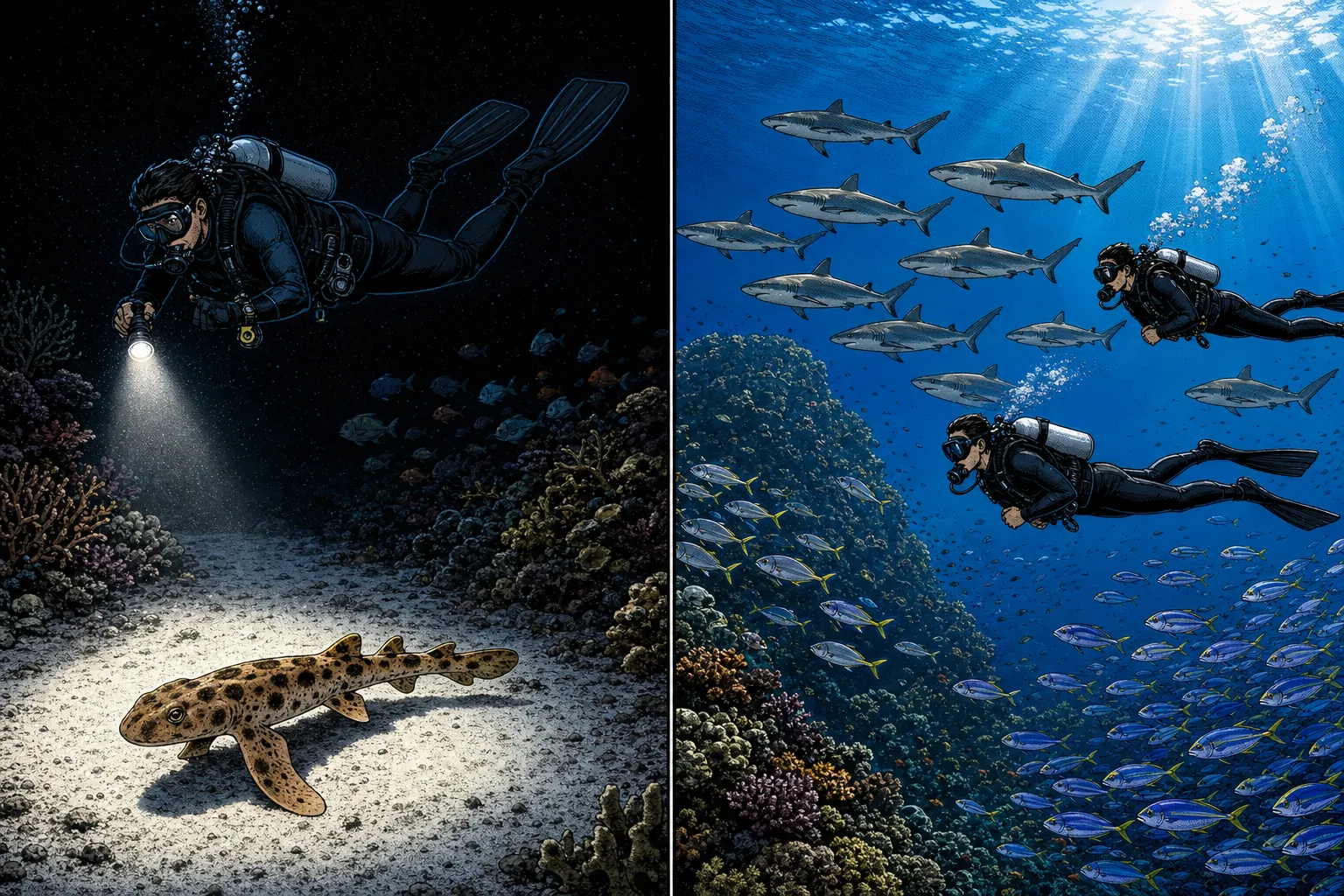
The encounter is almost always at night. They're nocturnal, hunting small reef invertebrates after dark, and the daytime is spent tucked into reef crevices where you'd never find them. The standard play is a Raja Ampat night dive on a sandy flat or shallow coral garden, five to twelve metres deep, with a guide who knows the species, and you cruise slowly, torch beam low, looking for a small slim animal slowly working its way over the substrate. They're maybe sixty to ninety centimetres long, brown with darker brown spots, and the way they "walk" looks more like a salamander than a shark.
The right dive operators in Raja Ampat (Misool, Mansuar, Kri, the Yenbuba channel) build their night-dive schedules around walking-shark sightings. Two or three night dives in the right area will almost always turn up at least one. We've seen four animals on a single night dive on the right reef. The encounter is often combined with bobtail squid, hunting octopus, and the rest of the Raja Ampat night scene, it's not a shark-only dive but a critter-heavy night dive on which sharks happen to be the headline species.
Of all the shark dives in Indonesia, this is the one we'd argue is most under-marketed and most worth doing. Most diving photographers haven't seen a walking shark. Most divers haven't either. It's the kind of encounter you tell other divers about and they don't quite believe it until they see your photographs.
Grey Reefs and Whitetips at Komodo's Castle Rock
Komodo's shark diving is current-driven and dramatic. Different vibe entirely from the Banda Sea hammerhead expedition or the slow-cooked Raja Ampat night dive. This is fast water, big animals, and a dive that ends with you holding a reef hook and counting predators stacking up against the flow.
Castle Rock, in Komodo's central park, is the headline. The site is a submerged seamount in a major channel, with the top at about ten metres and the wall plunging to forty-plus. When the tide runs hard, which is essentially always, grey reef sharks (Carcharhinus amblyrhynchos) line up on the up-current side, holding station against the flow, while the dive group hooks in just below them and watches. On a strong day you'll count fifteen to thirty-five greys plus a dozen whitetips (Triaenodon obesus) and the occasional silvertip cruising through. Schools of jacks, fusiliers, and giant trevally run alongside. Eagle rays drift past at the deeper end. It is, frankly, one of the great drift-dive shark sites in the western Pacific.
Crystal Rock, the sister seamount to Castle Rock, runs on the same principle but with shallower current dynamics and slightly fewer sharks. Batu Bolong, the chimney rock between Komodo and Tatawa Besar, hosts whitetips and the occasional grey but is more about reef fish than shark counts. Shotgun, in the northern channel between Gili Lawa Laut and Gili Lawa Darat, pulls strong drift through a narrow gap where reef sharks and trevally pile up at the choke point, and we cover it in full in our guide to the Cauldron and Shotgun dive site. None of these sites have hammerheads, Komodo is shark country but it's a reef-shark country, not a pelagic-shark country.
The Komodo shark season is essentially the dry-season liveaboard window: April to early November, with peak activity July to September when the south-east monsoon drives the strongest currents. Cooler water in those peak months (twenty-four to twenty-six Celsius at depth, which feels chilly in a 3mm) brings fish density up and the shark counts with it. Outside that window the cruise calendar quiets down, the currents are softer, and the shark numbers drop. The Komodo dive sites guide covers all the sites and the seasonality in more detail. For broader trip planning, see the Komodo liveaboard itineraries guide.
Cert and conditions: Advanced Open Water minimum, fifty logged dives recommended, comfort with reef hooks essential. Castle Rock is not a gentle introduction to current diving. We give the same brief to every guest: drop fast, find the rock, hook in low, do not let go to chase a photograph. The most common Komodo current accident is a diver who unhooks at the wrong moment, gets swept off the seamount, and ends up doing a long blue-water drift while the rest of the group watches the sharks they came to see.
Reef Sharks Across the Country, Whitetips, Blacktips, and the Everyday Encounters
Below the headline species, Indonesia is dense with reef sharks. Whitetip reef sharks are everywhere from Komodo to Lembeh to the Banda Islands. Blacktip reef sharks (Carcharhinus melanopterus) cruise the shallows of every island chain in the country, often the first shark a snorkeler sees in waist-deep water. Grey reefs show up not just at Komodo but on the deeper Raja Ampat seamounts (Cape Kri, Sardine Reef, Manta Sandy at depth), the outer pinnacles in the Banda Sea, and most of the offshore Halmahera sites.
For the diver who wants "lots of reef sharks" without the specialist conditions of Komodo's Castle Rock, the easiest answer is southern Raja Ampat, Misool's outer reefs, especially Boo Window and Magic Mountain, where blacktips and whitetips are essentially constant background fauna. A Raja Ampat liveaboard in the December-to-March peak season will deliver fifty or more shark sightings across a seven-night cruise without anyone trying. Komodo gives you fewer sightings but more dramatic ones; Raja Ampat gives you more sightings of less dramatic encounters. Both are valid. Which one fits depends on whether you want the photograph or the count.
Bamboo Sharks and the Macro Shark Hunt
Most divers stop their shark list at the species above. They shouldn't. Indonesia has a quiet undercurrent of small bottom-dwelling shark species that show up on muck dives and macro-focused trips, and for divers who care about shark biodiversity rather than shark spectacle, these are the encounters that keep adding to the species list.
Brown-banded bamboo sharks (Chiloscyllium punctatum), small slim cat-shark-like sharks, maybe a metre long, are common around Lembeh Strait, Ambon, and the muck-diving sites of the northern Sulawesi coast. They tuck into rubble and reef rubble during the day and emerge to hunt invertebrates at night. On any reasonable Lembeh week you'll see two or three on night dives, often missed by guests who're focused on the small critter content. Tasselled wobbegongs and ornate wobbegongs occasionally turn up on Halmahera and Ternate dives. Whitespotted bamboo sharks show up in the same range. Coral cat sharks (Atelomycterus marmoratus) are common in macro-rich areas, the Lembeh group is the obvious place, but you have to look for them, and you have to know what you're looking at, because the camouflage is excellent.
If you're working through a serious life list, an Indonesia trip can plausibly add four to six small shark species that simply don't exist in the popular shark-dive destinations. The Lembeh Strait diving guide covers the muck-diving region in detail; the night dives there are where the macro shark hunt actually happens.
Pelagic Rarities, Threshers, Silvertips, and the Banda Sea Wild Cards
The Banda Sea throws up rarities that Indonesia is usually given no credit for. Silvertip sharks (Carcharhinus albimarginatus) cruise the deep walls at Manuk and Suanggi alongside the hammerhead schools, often picked up at the deepest part of the dive at thirty-five to forty metres. Pelagic thresher sharks (Alopias pelagicus), the same species that's the headline of Malapascua in the Philippines, show up on the Banda Sea pinnacles often enough that we've had multiple guest sightings over the past three seasons, although they remain unreliable. Tiger sharks have been recorded on Manuk in remote-camera surveys but have never been confirmed in the recreational dive record.
The honest version of the rarities pitch is this: you don't pick a Banda Sea cruise for the threshers or the silvertips. You pick it for the hammerheads, and you accept that the rare encounters happen on perhaps one in three trips. Going out specifically for threshers, in Indonesia, is not the right plan; for that, fly to Cebu and dive Malapascua. But if you're going for hammerheads anyway, the rest of the Banda Sea pelagic catalogue is a real chance, and it's part of why the cruise is worth the long sail to Ambon.
Outside the Banda Sea, the rarities thin. Bull sharks have been confirmed on a handful of Halmahera and Forgotten Islands dives but never reliably enough to plan around. The Forgotten Islands guide covers the south-east frontier where most of these unicorn sightings happen.
Conservation, Where Indonesia Is, and Where It Isn't
The conservation picture in Indonesia is mixed and worth understanding before you go.
The good news first. Raja Ampat declared a regency-wide shark and ray sanctuary in 2013, the first in Asia, and one of the first anywhere, making it illegal to catch, kill, or trade any species of shark or ray within the regency's waters. The sanctuary is enforced by local marine police and by a strong community-led monitoring programme that has produced measurable population recoveries across the past decade. Manta numbers are up. Wobbegong sightings per dive are up. Walking shark recordings have increased. The model has been imitated elsewhere in the country, with similar sanctuary declarations in Misool (which lies inside the Raja Ampat regency anyway), parts of West Papua, and a slowly expanding patchwork of marine protected areas across the rest of the archipelago.
The country also banned manta-ray fishing nationwide in 2014, becoming the world's largest manta sanctuary. The bigger umbrella isn't quite there yet for sharks, there's no national shark sanctuary, and shark fishing remains legal in most Indonesian waters except for those covered by specific MPAs.
The bad news is that the country is a major historical exporter of shark fin, and the artisanal fishing fleet still takes large numbers of pelagic sharks across the wider Indian Ocean and the Banda Sea. Bycatch on tuna long-lines is a separate, substantial pressure. Estimates of total Indonesian shark mortality are difficult to pin down, but the country is consistently in the top three globally for total shark landings, alongside India and Spain. The official policy position has tilted toward conservation over the past ten years, but enforcement at sea remains thin outside the Raja Ampat regency and the headline MPAs.
For divers, the practical takeaway is straightforward. The MPA-rich destinations, Raja Ampat, Komodo, Wakatobi, Bunaken, parts of Banda, are where shark populations are stable or recovering. The further you go into unmanaged waters, the thinner the populations get. Operator selection matters: small operators that pay MPA entry fees, employ local crew, and brief divers on shark-friendly behaviour are directly funding the system that's working. Operators that cut corners on MPA compliance are not.
Diver behaviour matters too, but in a smaller way than most articles will tell you. Touching is bad, chasing is bad, and crowding cleaning stations is bad, all of which apply to mantas more than to sharks, but the principles transfer. We brief every guest on the simple rules: stay back, don't chase, don't touch, control your bubbles around skittish species (hammerheads in particular). The animals are not the threat. Bad operator practice is the threat.
How to Plan a Shark-Focused Indonesia Trip
Now the practical bit. Here's the trip-planning logic we walk every guest through, in the order it actually matters.
Step One: Pick the Calendar
Mola you can plan around. Manta you can plan around. Sharks in Indonesia, you plan around the calendar first and the species second. The seasons are inverse, Banda Sea peaks September to early November, Komodo July to October, Raja Ampat December to March, and you cannot do all three in a single fortnight. So start with your travel window.
Travel window in September, October, or early November: go to the Banda Sea for hammerheads. Combine with a short Bali pre- or post-trip if you want.
Travel window in July, August, or September: go to Komodo for grey reefs and whitetips at Castle Rock. Combine with Bali (mola peak overlaps).
Travel window in December, January, February, or March: go to Raja Ampat for wobbegongs, walking sharks, and dense reef-shark counts. Combine with Misool or Cenderawasih if you have the time.
Travel window in April, May, or June: this is the off-season for most of Indonesia's shark hotspots. Bali is dive-able. Lembeh is dive-able. The macro shark hunt at Lembeh works year-round. But the headline shark dives (hammerheads, walking sharks, Castle Rock greys) are all out of season. We'd suggest waiting for the right window rather than forcing a sub-optimal trip.
Step Two: Pick the Region by Primary Species
Once the calendar is set, the species follows. There's no point flying to Raja Ampat in December for hammerheads (they're not there) or to the Banda Sea in February for walking sharks (the cruise calendar isn't running). The previous section gives the species/region pairing; respect it.
Step Three: Pick the Operator
Shark-focused diving rewards experienced operators. Castle Rock is not a site you want a trainee divemaster on. The Banda Sea hammerhead dives demand crew who've run them for multiple seasons and know the depth, current, and timing rhythms. Walking-shark night dives need guides who know the species' habitat preferences and aren't winging it. Look for operators with multi-season tenure on the species you care about, with crew turnover low, and with explicit shark-conservation policies in their guest briefings.
Step Four: Pick the Cert and Gear
Advanced Open Water minimum for any of the headline shark sites in this guide. Fifty logged dives is the practical threshold for Castle Rock and the Banda hammerhead pinnacles. Nitrox cert is strongly recommended for the deeper Banda Sea dives, the no-deco extension at thirty metres is meaningful. Reef-hook training (or at least familiarity) is essential for Komodo. A good torch with a backup is essential for Raja Ampat night dives. The first-time liveaboard guide covers the broader gear logic that applies across all our trips.
Step Five: Plan the Multi-Region Combo
For most guests, one region per trip is the right answer. But if you have the holiday and want to maximize species diversity, the two combinations that actually work are:
Banda + Komodo (September to early October): Komodo cruise first, then fly to Ambon for the Banda cruise. You'll be travelling against the calendar slightly, Komodo peak is starting to soften and Banda peak hasn't fully arrived, but both are still in season, and the species mix is hammerheads plus Castle Rock greys plus all the reef-shark filler. About sixteen to nineteen days total including transfers.
Bali (mola) + Raja Ampat (sharks) split (October-November or February): ride the seasonal seam where Bali's mola is winding down and Raja Ampat is winding up. You sacrifice a little of each peak but the combination of sunfish plus walking sharks plus wobbegongs is hard to beat.
Beyond those, the combinations get geometric and the marginal benefit drops. The single-region trip is almost always the better answer.
Bringing It Together
If you take one thing from this guide, take this: Indonesia's shark diving is regional and seasonal, and the country is genuinely better than its reputation. Most divers we meet have already been to the Bahamas or Fiji or Cocos and assume Indonesia is the manta-and-mola country. It isn't. It's all of those things plus a serious, broad shark inventory that's quietly one of the best on earth, once you know where to point the trip.
The hammerhead schools at Suanggi and Manuk are the headline. The wobbegongs and walking sharks of Raja Ampat are the hidden gems. The grey-reef walls of Komodo's Castle Rock are the dramatic high-current showpiece. The macro shark roster of the Lembeh Strait closes the species list with the small, weird, often-overlooked bottom-dwellers that nobody's chasing on a typical trip. Across all four regions you can plausibly tick a dozen species in a year, more than most divers see in a decade in any other country.
What we'd actually book for a guest who told us "I want to see sharks in Indonesia and I have one fortnight": Banda Sea cruise in late September, eleven nights ex-Ambon, with Bali for two days either side as decompression. That's the trip. Hammerheads, plus reef-shark filler, plus the chance at silvertips and threshers, plus the quality of a remote eastern-Indonesia cruise. For the second-best two-week trip, it's a Komodo nine-night liveaboard in August with the Castle Rock and Crystal Rock current dives plus mola at Crystal Bay on the Bali transfer. For the third-best, it's a Raja Ampat eleven-night cruise in January with the Misool and Dampier rotation, all the reef-shark counts you can absorb, plus the walking-shark night dives that nobody's done.
If you want help putting that itinerary together, the right calendar window, the right boat, the right cert briefings, we book the trip. Contact us with your travel window and what you want to see, and we'll put a real plan together. Indonesia is genuinely one of the great shark-diving countries on earth. It just takes one slightly-too-long article to explain why.