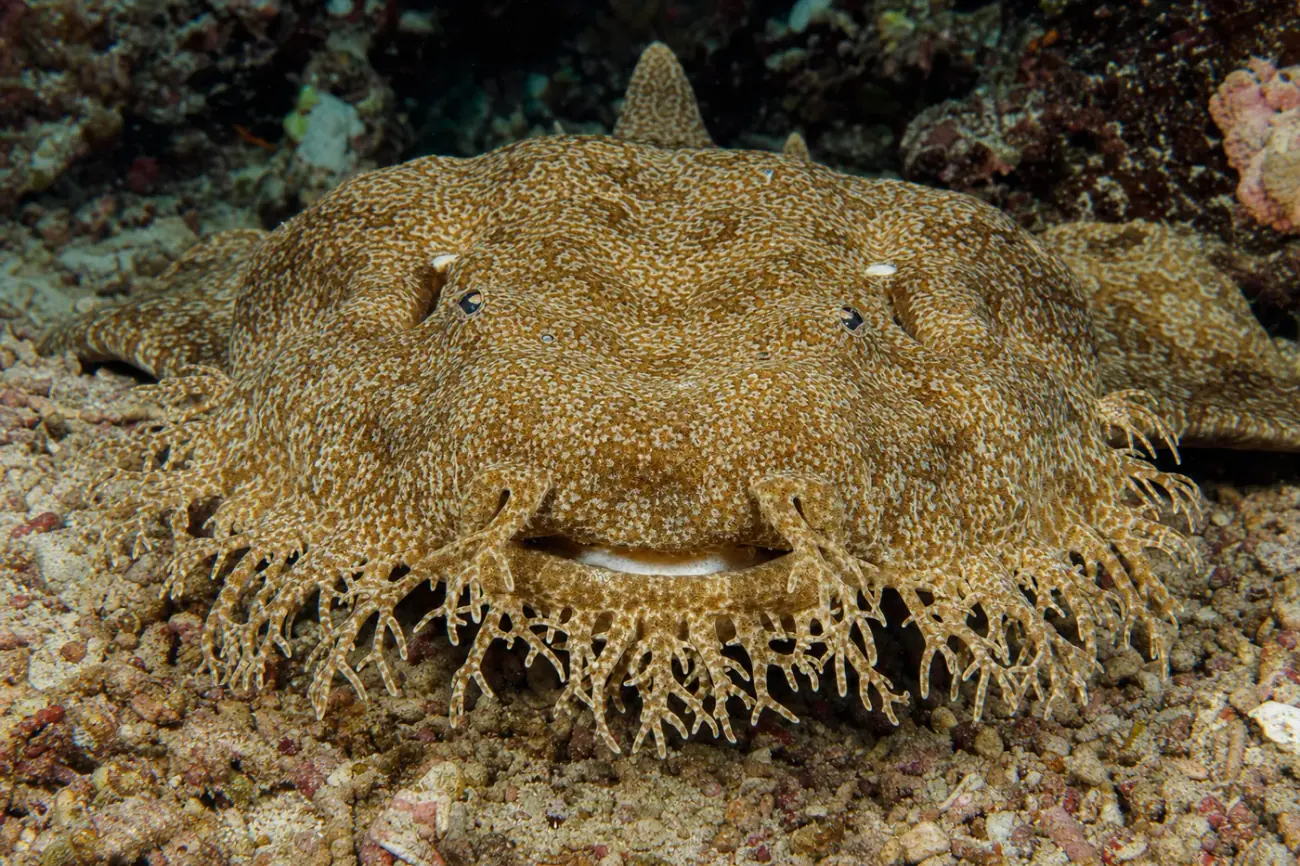
The first time you see a wobbegong, you usually do not. That is rather the point. You hang above a coral ledge while your guide taps their tank and points at what looks like a flat patch of algae-covered rubble, and it takes a long, slightly embarrassing moment before the patch resolves into a shark: a fringed, mottled, impossibly still carpet of a creature with a fringe of skin tassels around its jaw and two small dark eyes watching you back. Indonesia, and Raja Ampat in particular, is one of the very best places on earth to have that moment. The reefs here hold more wobbegongs, in better condition, than almost anywhere, and once you learn to read the reef for them they turn up on dive after dive.
This guide is the long version of everything we get asked about these sharks: what they actually are, why their camouflage works so well, the genuinely strange business of their fish-hook teeth and suction-feeding jaws, whether they are dangerous, and, above all, where in Indonesia you can reliably find them. We run Raja Ampat liveaboard trips through the exact reefs where wobbegongs are most common, so most of what follows is drawn from years of watching divers meet them, rather than from a textbook. We will name the sites, the depths, the months and the technique. We will also be honest about the one species in Indonesian waters that is quietly in trouble.
The short version, for anyone in a hurry: there are two wobbegong species you might meet in Indonesia, the famous tasselled wobbegong of Raja Ampat and the lesser-seen Indonesian wobbegong of cooler, deeper water further west. Both are bottom-dwelling ambush predators that lie motionless for hours and strike in a fraction of a second. They are not aggressive, but they will bite if you crowd or grab them. And Raja Ampat, for reasons we will come to, is the place to build a trip around if seeing one is high on your list.
What exactly is a wobbegong?
Wobbegongs are carpet sharks, members of the family Orectolobidae, and there are twelve recognised species in the group. The name is the giveaway to the personality. "Wobbegong" is generally thought to come from an Australian Aboriginal language and to mean something close to "shaggy beard", which is exactly what the fringe of branched skin flaps around the mouth looks like. They are not the sleek, torpedo-shaped sharks of the documentaries. They are flat, broad, patterned and slow, built not for chasing but for waiting.
Most wobbegong species top out around 1.25 metres, though a couple of the Australian ones, the spotted and banded wobbegongs, reach close to three metres. They spend the vast majority of their lives resting on the seabed, tucked under ledges, inside small caves, or simply draped across a coral head in plain sight, trusting their camouflage. They are largely nocturnal, becoming more active after dark when they hunt, which is why a night dive sometimes shows you a wobbegong on the move, a genuinely odd sight after a week of seeing them lie like doormats.
What makes them such a draw for divers is the combination of the camouflage, the prehistoric look, and the fact that, unlike most sharks, they let you approach. A reef shark gives you a wide berth. A wobbegong does the opposite: it relies on stillness, so a calm, respectful diver can get close enough to study the intricate skin pattern and the strange fringed face in detail. For an underwater photographer, that patience is a gift.
The two wobbegongs you can meet in Indonesia
People talk about "the wobbegong" as if there is one, but in Indonesian water there are really two species worth knowing, and they could hardly live more differently.
The tasselled wobbegong (Eucrossorhinus dasypogon) is the star, and the one nearly every diver means when they say they want to see a wobbegong in Raja Ampat. It was first described by the Dutch ichthyologist Pieter Bleeker in 1867, and its scientific name is a small poem in Greek: roughly "well-fringed nose with shaggy beard", from words for tassel, nose, hairy and beard. It is the most ornately fringed of all the wobbegongs, with a continuous mass of branched dermal lobes running right around the front of its head and chin, and it is more or less restricted to the reefs of eastern Indonesia, Papua New Guinea and the far north of Australia. It is a shallow-reef animal, which is the whole reason it is so divable: you find it from around 5 to 25 metres, exactly where recreational divers spend their time. On the international conservation scale it is currently listed as Least Concern with a stable population, which, given what is happening to sharks globally, is a genuine relief.
The Indonesian wobbegong (Orectolobus leptolineatus) is the one most divers never knowingly see, and its story is more sobering. It grows to a little over a metre, lives across a wider stretch of Indonesia and the western Pacific, and prefers deeper, cooler water on the continental shelf, often well below recreational depths. The handful of shallow sightings come from places with cold-water upwelling, most famously the east coast of Bali, with scattered records around Komodo and the muck-diving reefs of the Lembeh Strait in North Sulawesi. Unlike its tasselled cousin it is listed as Near Threatened with a decreasing population, largely because it turns up as bycatch on the longlines and trawls working the deeper shelf, and because shark meat and fins still find a market. It is harmless to people. The threat runs entirely the other way.
For the rest of this guide, when we talk about spotting wobbegongs on a dive, we mostly mean the tasselled wobbegong, simply because it is the one that lives where you can see it. But the Indonesian wobbegong is worth carrying in your head, because it is a reminder that "common" and "safe" are not the same thing, and that the reefs we dive sit inside a much bigger fishery.
The three-layer camouflage that makes them vanish
A wobbegong's invisibility is not one trick but three, stacked on top of each other, and understanding them is half of learning to spot one. The first layer is the skin pattern itself: a variegated mottle of browns, greys and creams in blotches and reticulated lines that mimics the dappled light and broken texture of a coral reef. It breaks up the body into meaningless fragments, so your eye never assembles a "shark" shape. The second layer is the body plan. A wobbegong is flattened almost like a ray, with broad rounded pectoral fins spread against the substrate, so there is no fin standing proud, no silhouette, nothing that reads as a fish hanging in the water. From above, which is how a diver usually approaches, it is just texture.
The third layer is the famous one: the beard. That fringe of branched dermal lobes around the head does not just decorate the shark, it dissolves the hard line of the jaw, the one edge that might otherwise give the game away, and makes it look like a clump of seaweed or soft coral growing off the rock. Put the three together and you get an animal that experienced divers routinely look straight at without seeing. We have watched guides hover a hand's width from a tasselled wobbegong, pointing, while the guest stares blankly at what they are convinced is empty reef.
There is a fourth trick, and it is the one biologists find most charming. The tasselled wobbegong has been observed using its tail as a lure. It curls the tail up near its own head and gives it small rhythmic twitches, and the tail tip, patterned to resemble a small fish, draws curious little reef fish toward, of all places, the shark's mouth. It is the same caudal-luring behaviour you see in anglerfish, and it is rare among sharks. The wobbegong does not even need to move. It makes the reef come to it.
Wobbegong teeth: the fish-hook jaws up close
If the camouflage is what gets a wobbegong noticed by divers, the teeth are what get it respected. This is the part people search for and the part that genuinely surprises them, because wobbegong teeth look nothing like the triangular serrated blades of a white shark. They are long, slender and needle-like, smooth-edged rather than serrated, and they curve backward into the mouth. There are no lateral cusplets to speak of on the tasselled wobbegong, just a single strong central spike per tooth, arranged in a few rows: depending on the source, roughly two to three rows at the front of each jaw, with a total tooth-row count in the region of 23 to 26 in the upper jaw and around 19 in the lower.
The shape is the whole story. Those recurved, backward-pointing fangs work exactly like the barb on a fish hook. When prey is seized, every struggle to escape simply drives the teeth deeper and locks the animal in place. A fish that swims into a wobbegong's mouth is not bitten so much as hooked, and the harder it fights the more thoroughly it is held. This is also why a wobbegong bite on a human, while rare, is such a nuisance: the shark tends not to let go, and pulling away tears the wound. The teeth are built to retain, not to slice.
The jaws that carry them are just as specialised. A wobbegong's mouth is highly protrusible, meaning the whole jaw apparatus can shoot forward and open to a startlingly wide gape in a tiny fraction of a second. Estimates put the strike somewhere around 50 to 100 milliseconds, faster than you can register it as a diver. And the strike is not really a bite at all in the way we picture one. It is a suction event. The wobbegong drops its lower jaw and expands its mouth cavity so violently that it creates a sudden pressure drop, and the prey is sucked in along with a slug of water before it has any idea what is happening. The teeth then do their hook-and-hold job, and the shark spends the next several minutes slowly "jaw-walking" the prey backward down its throat. The whole sequence, from invisible to swallowing, can be over before the rest of the reef notices anything moved.
What wobbegongs eat, including the shark that swallowed a shark
Given all that hardware, the diet is predictable in its broad strokes and astonishing in its extremes. Day to day, a wobbegong eats whatever bottom-living animal drifts within range: reef fish like gobies, wrasse and surgeonfish, the nocturnal squirrelfish, soldierfish and sweepers that share its caves, plus octopus, squid, crabs, lobsters and other crustaceans. It is an opportunist that lets the reef deliver dinner rather than going to find it.
The extreme is where it gets memorable. Because the jaw can gape so wide and the teeth hold so well, a wobbegong can take prey as large as, or larger than, its own head. The case that gets cited again and again was documented in the journal Coral Reefs in 2010: a roughly 1.3-metre tasselled wobbegong was recorded swallowing a one-metre brown-banded bamboo shark whole, working it down over the course of an evening. Wobbegongs have also been recorded eating smaller wobbegongs from rival patches of reef, one of the few documented cases of a shark preying on its own family. None of this should alarm a diver, who is far too large to register as food, but it tells you exactly what those backward fangs are for.
One practical consequence of all this is worth holding onto for the next section. A wobbegong is an ambush predator that mistakes things that move suddenly near its mouth for prey. It is not interested in you. But a hand placed on the reef without looking, a fin kicked into a ledge, or a grab at the tail can all be misread by a creature whose entire hunting strategy is "strike first at anything that enters the kill zone". Respect the kill zone and you will never have a problem.
Where to see wobbegong sharks in Indonesia
Here is the section most people came for. The honest headline is that if seeing a wobbegong is a priority, you go to Raja Ampat, and you go on a liveaboard so you can dive the spread of sites where they are common. Everywhere else in Indonesia is a bonus or a long shot. Let us take it region by region.
Raja Ampat: the world capital of wobbegongs
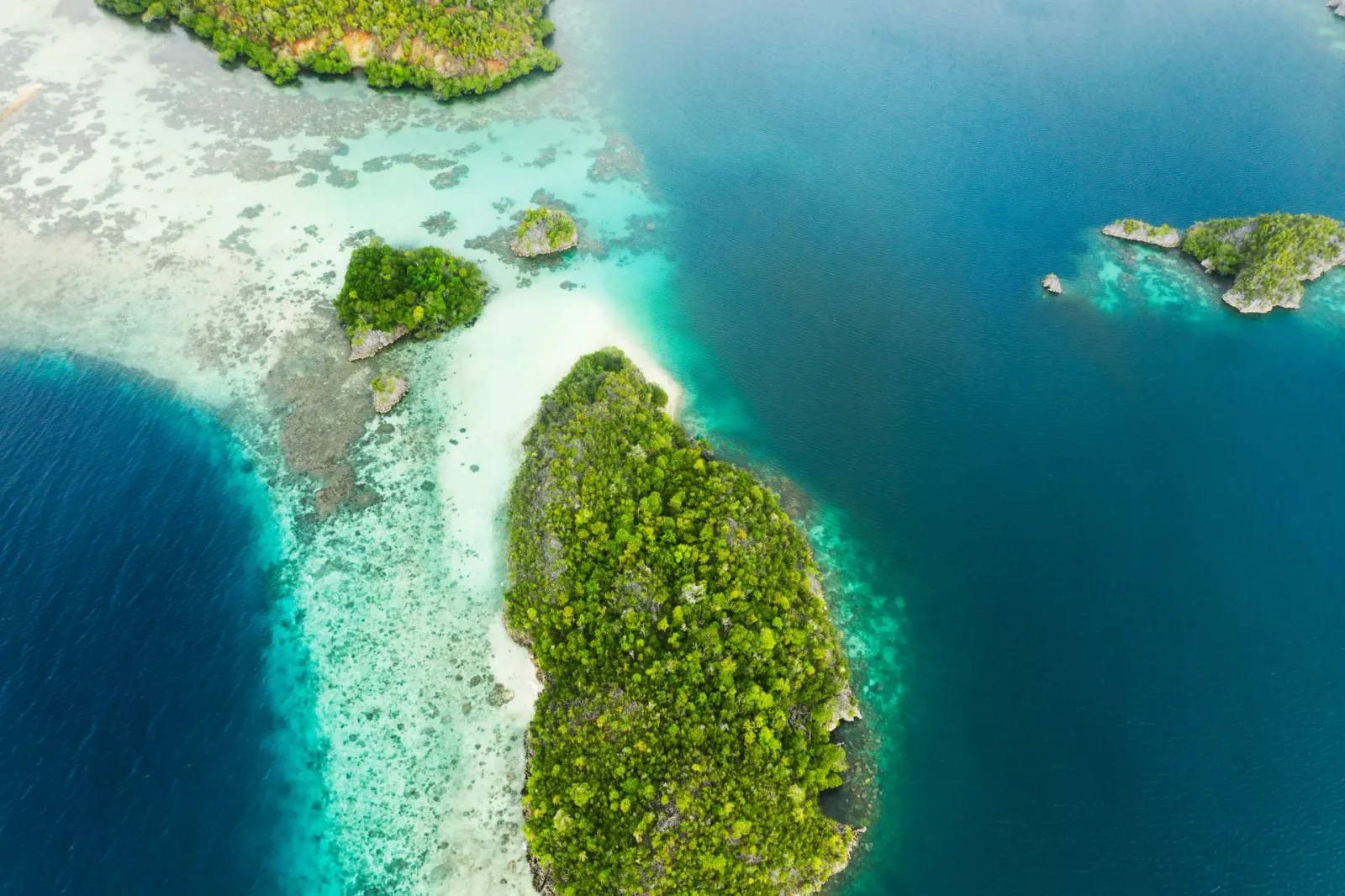
Nowhere does tasselled wobbegongs like Raja Ampat. The archipelago sits at the bullseye of the Coral Triangle, with the highest reef-fish and coral diversity measured anywhere on the planet, and that abundance feeds an unusually dense population of the sharks. On a week's liveaboard working the central reefs, regular sightings are the rule rather than the exception, and on a good trip you can lose count. Our Raja Ampat scuba diving overview lays out the wider picture, but for wobbegongs specifically, the heart of it is the Dampier Strait.
The Dampier Strait, the channel between Waigeo and Batanta, is where the nutrient-rich currents and tangled reef structure come together, and it holds the classic wobbegong sites. Mioskon (sometimes written Mios Kon) is perhaps the single most reliable, a reef where the sharks shelter under coral ledges at 5 to 25 metres and where guides know individual animals by their patch. Cape Kri, which still holds the world record for fish species counted on a single dive, regularly turns one or two up among the schooling chaos. Sardine Reef, Blue Magic, Mike's Point and the friendly shallows under Arborek Jetty all produce them, and the pier pilings at Arborek in particular are a good place for a relaxed search once the wide-angle action calms down. Our rundown of the best dive sites in Raja Ampat goes deeper on each of these.
Misool
The southern reefs around Misool are, if anything, even more pristine than the Dampier Strait, with cathedral-like soft-coral walls and a maze of limestone islets. The complex structure gives wobbegongs endless ledges and overhangs to tuck into, and while the schooling-fish drama tends to steal the show here, a careful diver scanning the reef floor and the undercuts will find them. Misool is also the part of Raja Ampat that feels most remote and least dived, which is part of its appeal. Our Misool diving guide covers the region in full.
Waigeo, Batanta and the night-dive juveniles
The reefs fringing the larger islands of Waigeo and Batanta hold wobbegongs throughout, and they are also where you have the best chance of the real prize: a tiny juvenile. Newly born wobbegongs are barely the length of a hand, and they turn up on night dives tucked into the rubble, looking like miniature versions of the adults. We have had divemasters lay a dive computer beside one just to prove to the guests at dinner how small it was. Night dives in this area also give you the chance to see an adult actually moving, hunting across the reef rather than lying still, which reframes the whole animal.
Beyond Raja Ampat: Komodo, Bali and Lembeh
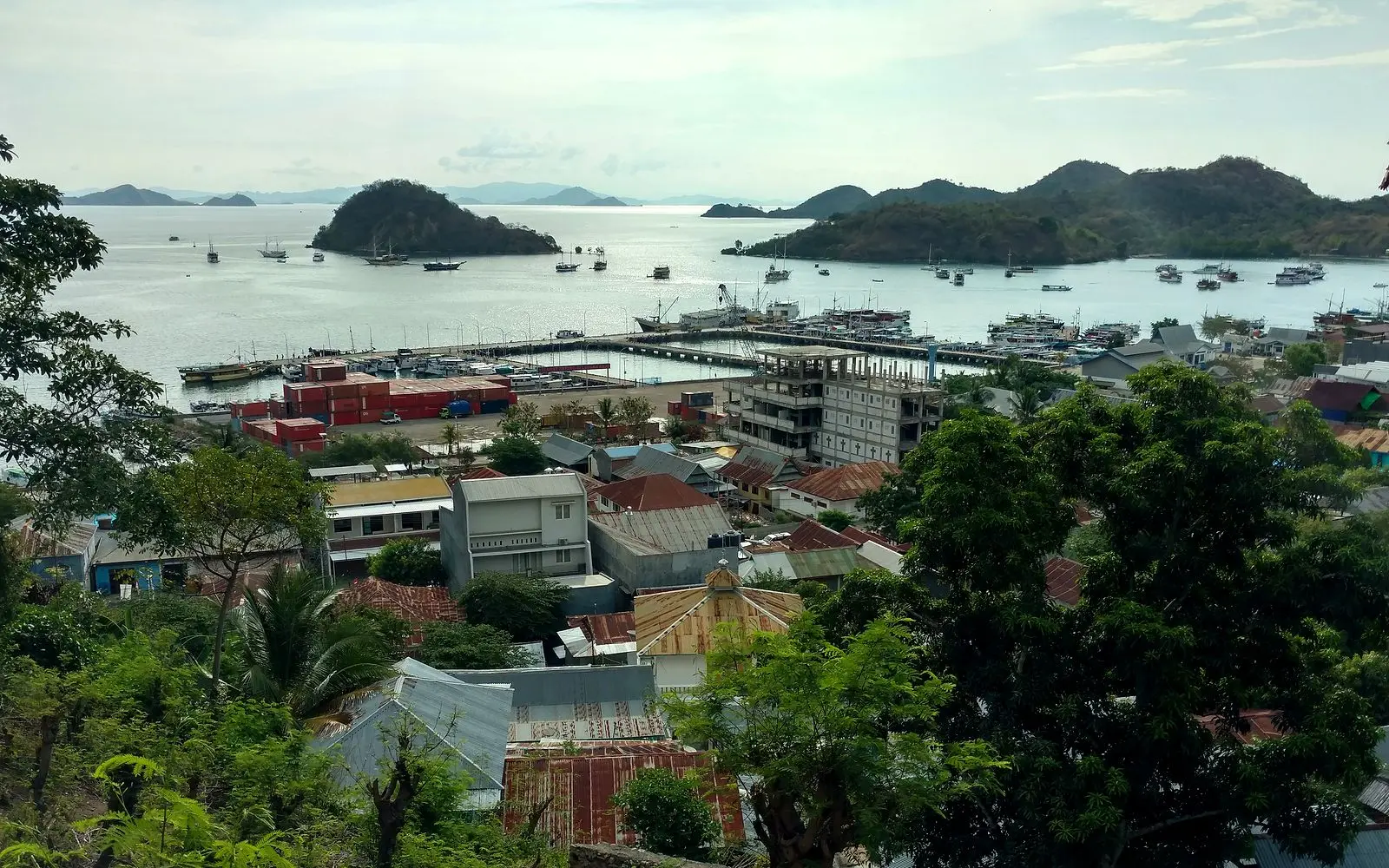
Outside Raja Ampat, wobbegongs become a much rarer encounter, and usually it is the deeper-living Indonesian wobbegong rather than the tasselled. There are scattered records from Komodo, where the cooler upwelling-fed water on some southern sites suits the species, though sightings are sporadic and never something to plan a trip around. The east coast of Bali, with its strong cold-water upwelling, has produced some of the few shallow Indonesian wobbegong observations on record. And the muck-diving slopes of the Lembeh Strait in North Sulawesi occasionally surprise critter hunters with one. If you specifically want a wobbegong, treat all of these as happy accidents and book Raja Ampat for the near-certainty.
When to go, and the conditions to expect
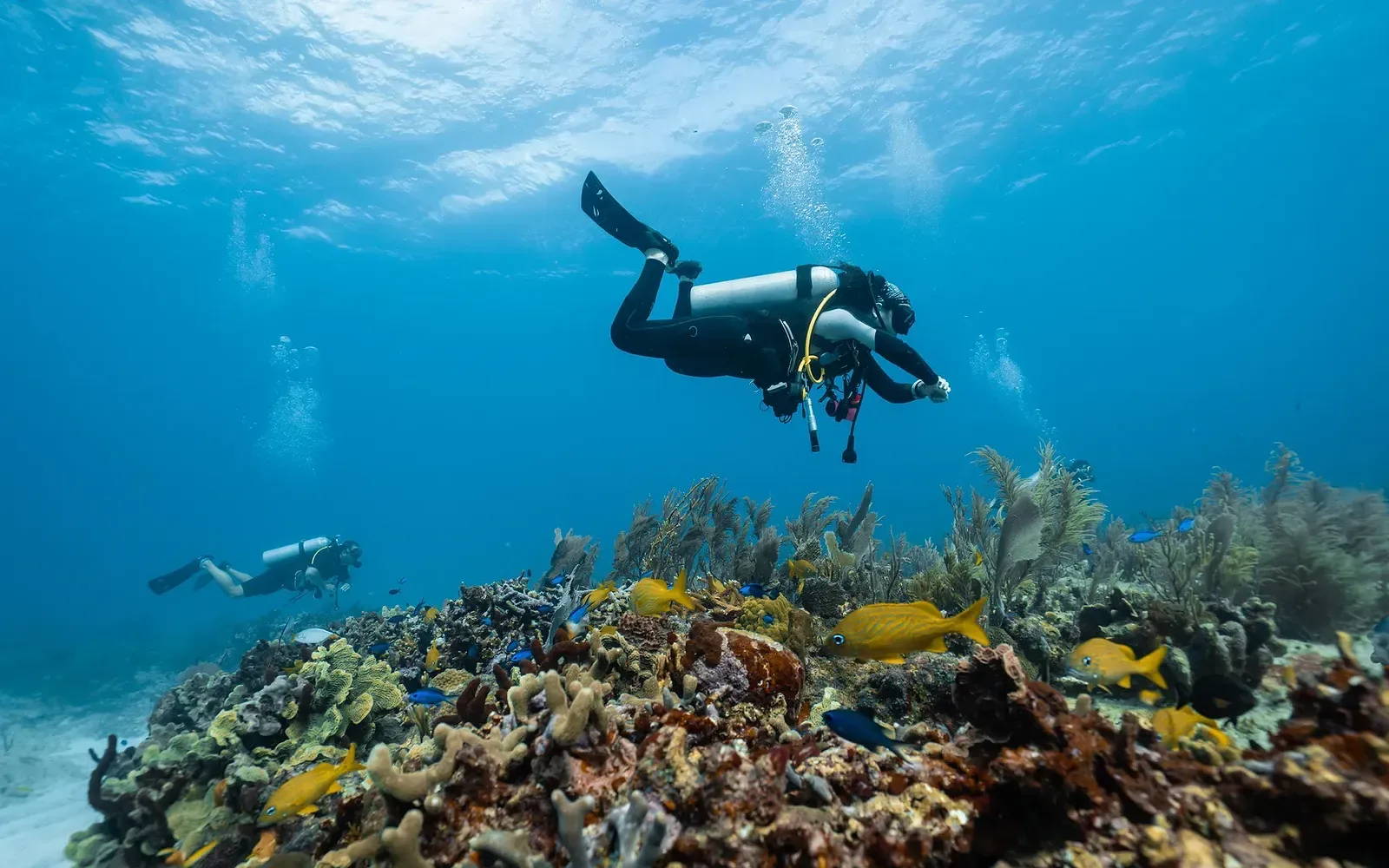
Wobbegongs are resident year-round, so the timing question is really about when Raja Ampat dives best. The main season runs from roughly October to April, when the seas are calmest and the liveaboard fleet is operating; the wettest, windiest months in the middle of the year see most boats stand down. Within the season the sharks do not migrate or disappear, so any operating week gives you a strong chance. Water temperature sits around 27 to 30 degrees, visibility is typically good outside the plankton blooms (and the blooms, ironically, are what feed the manta aggregations), and the wobbegong sites themselves are mostly gentle, shallow and accessible to any certified diver. Our guide to the best time to visit Raja Ampat breaks the calendar down month by month. Bring a torch regardless of the time of day, because the single most useful tool for finding a wobbegong is a beam of light raked slowly under the ledges.
How to actually spot one
Finding a wobbegong is a learnable skill, and once it clicks you cannot unsee them. The trick is to stop looking for a shark and start looking for the things the camouflage cannot hide. Slow right down; nobody ever found a wobbegong in a hurry. Then work the edges of the reef, the undercuts, ledges, the mouths of small caves and the bases of big coral heads, because that is where they rest out of the current. Rake a torch beam across those shadows even in bright daylight, since the light catches the skin pattern and, more reliably, the eyes.
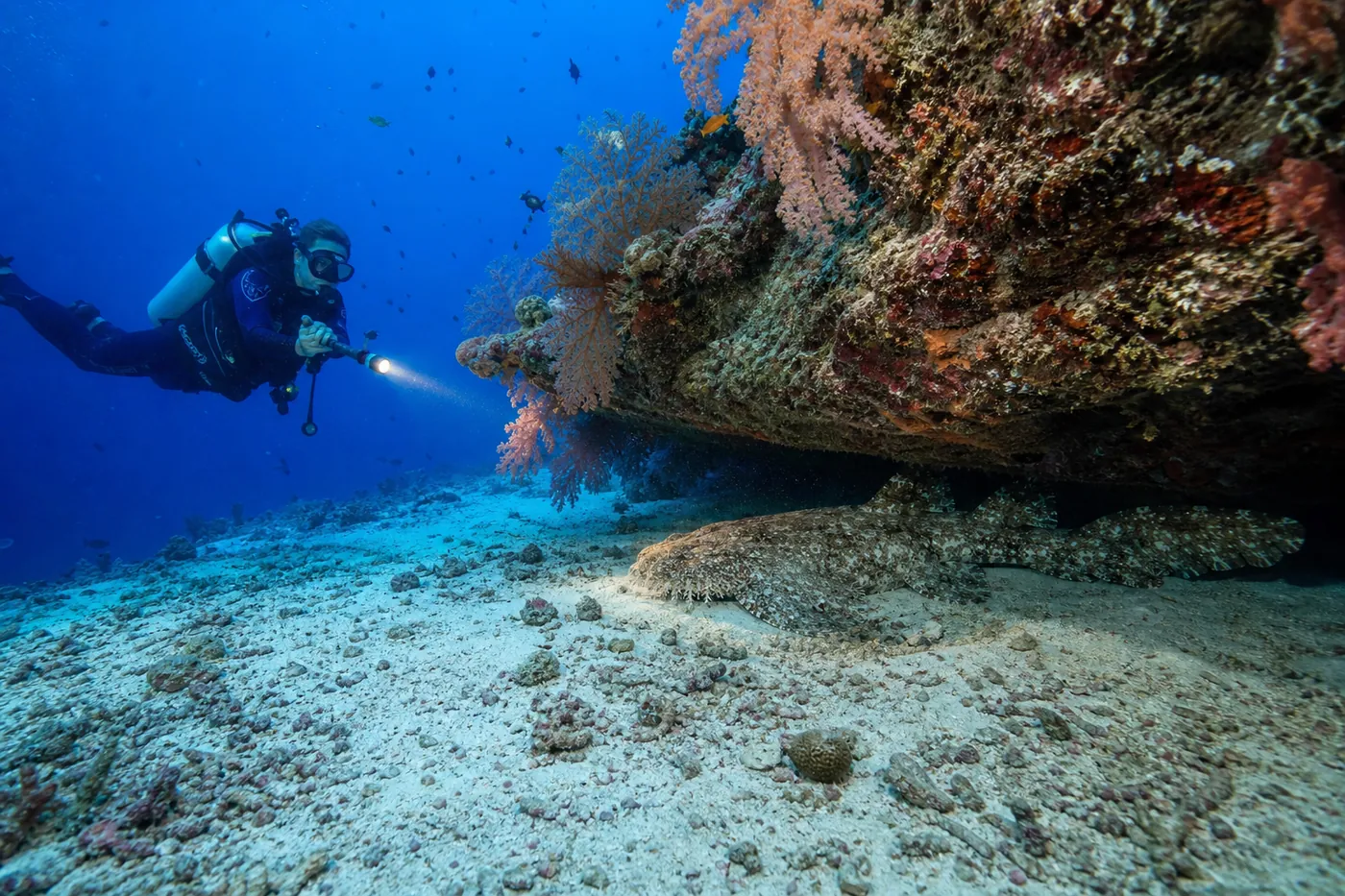
What gives them away, in order of usefulness: the eyes, two small dark beads that do not match the reef texture around them; the fringe, that unmistakable row of branched tassels along the front of the head once you know its shape; and the outline of the broad pectoral fins where they meet the substrate, a soft curved edge that is just slightly too regular to be coral. A guide who knows a site will often take you straight to a resident animal, but the real pleasure is training your own eye over a week until you are the one tapping your tank.
Are wobbegong sharks dangerous?
This deserves a clear answer because it is the question non-divers always ask. Wobbegongs are not aggressive toward people and they are not interested in divers as food. There has never been a fatal wobbegong attack on record. But, and it is a real but, they will bite if they are provoked, and provocation can be as innocent as not paying attention. The bite records that exist, mostly involving the larger Australian species rather than the tasselled wobbegong, almost all trace back to someone standing on a hidden shark, cornering one, or grabbing its tail. Because of those fish-hook teeth, a wobbegong that does bite tends to hold on, and the wound is more a tearing laceration than a clean nip, even through a wetsuit.
So the etiquette writes itself, and it is the same etiquette that makes you a good diver anyway. Keep a respectful distance, the length of your body or more. Never touch, never block its exit from a ledge, and never, ever reach for the tail for a photo. Mind where you put your hands and fins around overhangs, because that is where a wobbegong is most likely to be resting unseen. Maintain good buoyancy so you are not forced to grab the reef. Do all of that, which you should be doing regardless, and a wobbegong is one of the safest large animals you will ever share water with. Our wider guide to shark diving in Indonesia covers the etiquette for the other species you will meet on the same trips.
Photographing a wobbegong
For underwater photographers, wobbegongs are a dream subject and a deceptively tricky one. The dream part is the stillness: unlike almost every other shark, a wobbegong will sit and let you compose, refocus and try again. The tricky part is that the very camouflage that makes them special also makes them melt into a busy background in a photograph, so a shot that looked dramatic through the mask comes out as a confusing tangle. The fixes are to get low and shoot along the reef rather than down onto it, to use a wide-angle lens up close so the fringed face fills the frame, and to use your strobes or a focus light to lift the skin pattern off the substrate. The eyes and the tassels are your subject; build the composition around them. And keep your fins still and off the reef while you work, both for the shark's sake and the coral's. Our Indonesia underwater photography guide goes into the gear and settings in detail.
Conservation: why Raja Ampat matters
It is easy to assume that because tasselled wobbegongs are common in Raja Ampat they are fine everywhere, but that comfort is partly a product of where Raja Ampat sits in the world. The regency declared its waters a shark and manta sanctuary over a decade ago, banning shark fishing and finning across a vast area, and the wobbegongs you enjoy on these reefs are protected in a way they are not across much of their range. That protection, plus the sheer richness of the Coral Triangle reefs that feed them, is a large part of why the tasselled wobbegong's population is judged stable while so many sharks are crashing.
The Indonesian wobbegong is the cautionary half of the story. Living deeper and further west, outside the famous sanctuaries, it is caught as bycatch on the shelf longlines and trawls and is listed as Near Threatened with a falling population. The two species, side by side in the same country, are a neat illustration of what protection does and does not reach. Diving responsibly, choosing operators who respect the reefs and support local marine protection, and simply valuing these animals alive are all small parts of keeping the picture from tipping the wrong way.
Retraining your eye
The most common complaint we hear about wobbegongs is that somebody has dived for several days elsewhere without seeing one and has half convinced themselves the animal is a marketing myth. It almost never is. The problem is the search image. A guide will point one out under a ledge at twelve metres, move a torch across it twice, and the guest still will not see it, because the brain is hunting for a shark-shaped object while the animal is a flat, fringed piece of reef floor filling half the field of view. The moment it clicks, often when a guide gives up and writes on a slate with an arrow pointing at the eye, it stops being difficult forever. Divers who could not find one on Monday are finding their own by Friday, including hand-sized juveniles on night dives off Batanta. The wobbegong was never hard to find. The eye simply had to be retrained, and a week of Raja Ampat reefs is the ideal place to do it.
How to plan a wobbegong trip
If a wobbegong encounter is high on your list, the plan is straightforward: a Raja Ampat liveaboard in the October-to-April season, working the Dampier Strait and ideally reaching Misool, with at least a couple of night dives built in for the chance of a hunting adult or a juvenile. Beyond the usual questions about cabins and food, it is worth asking an operator how many dives the itinerary spends in the central Dampier sites, whether the guides actively look for and know the resident wobbegongs, and whether night dives are included. A good operator will know exactly which ledges hold animals.
To start that conversation you can get in touch with our reservations team, and the King Neptune, Neptune One and Komodo Sea Dragon pages cover the boats that run these routes. If you are still weighing regions and timing, our Indonesia liveaboard overview is the place to compare options. The wobbegongs will be exactly where they always are, draped invisibly across the reef, waiting for you to learn how to see them.