Food matters more on a liveaboard than it does on almost any other kind of holiday, for one blunt reason: you cannot leave. On a land-based trip a disappointing dinner is an inconvenience you solve by walking to a different restaurant. Aboard a dive boat, whether that is an Indonesia liveaboard or a Red Sea vessel out of Hurghada, you are eating from one galley, cooked by one small team, for seven to twelve days, often several hundred kilometres from the nearest shop. If the food is good, it becomes one of the things guests talk about for years. If your dietary needs get mishandled, there is no fallback, and that is a genuinely serious problem rather than a mild one.
This guide is deliberately global. The mechanics described here hold whether you are diving the Red Sea out of Hurghada, the Maldives atolls, the Galapagos, Palau, the Bahamas or Indonesia. Cuisine changes by region; the physical constraints of feeding twelve to twenty-six people from a boat galley do not. We run boats in eastern Indonesia and have hosted guests with just about every dietary requirement there is, and the pattern we keep seeing is that outcomes depend far less on how expensive the boat is than on how early and how precisely the guest communicated. Though it is fair to say that a luxury liveaboard has more capacity to absorb a complicated request, for reasons that come down to crew numbers rather than marketing.
What dining on a liveaboard actually looks like
Set aside the brochure photography. The realistic picture is this: three main meals plus two or three snack services, served at fixed times dictated by the dive schedule rather than by convention, in a single indoor or shaded outdoor saloon, at shared tables.
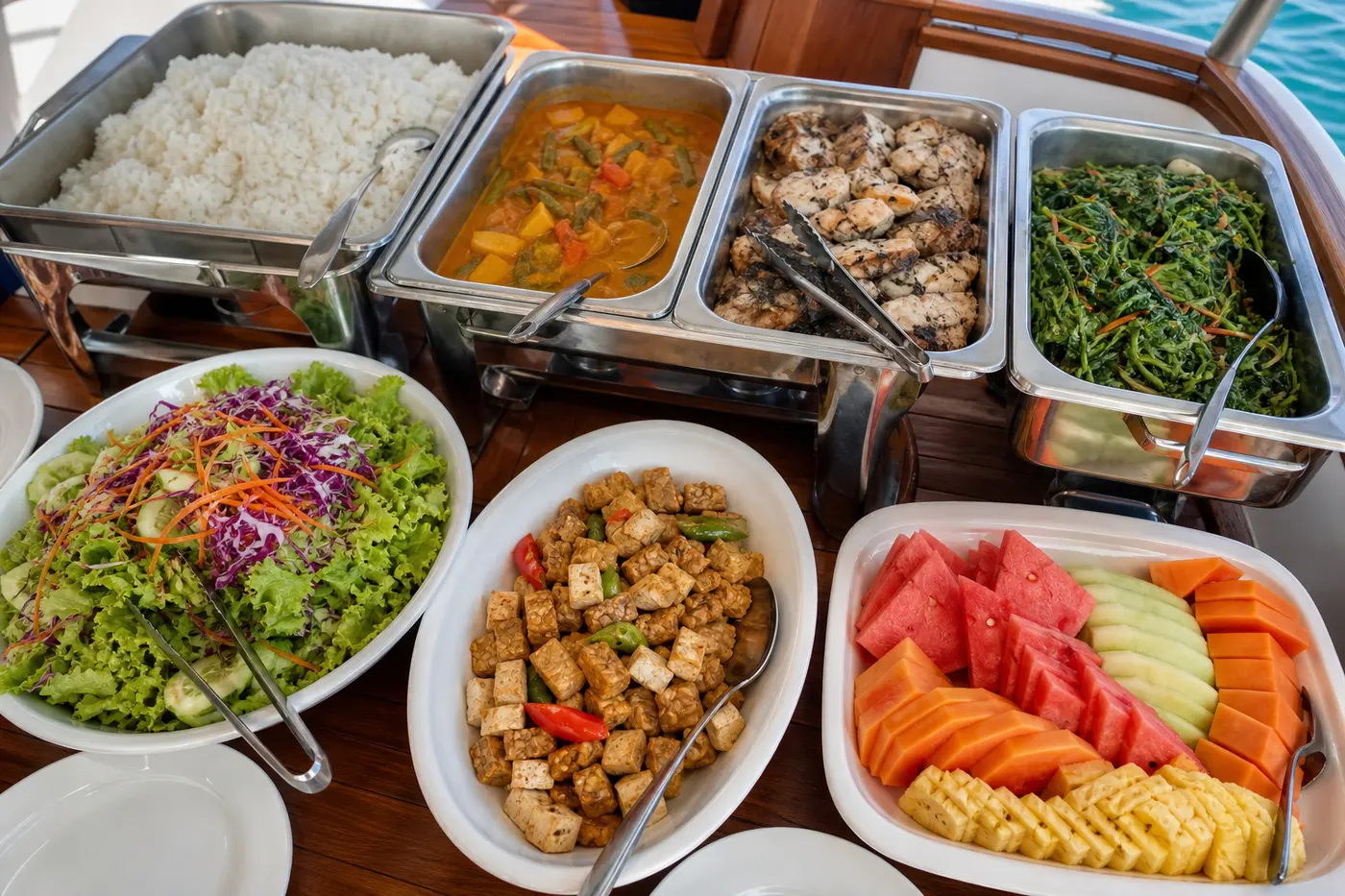
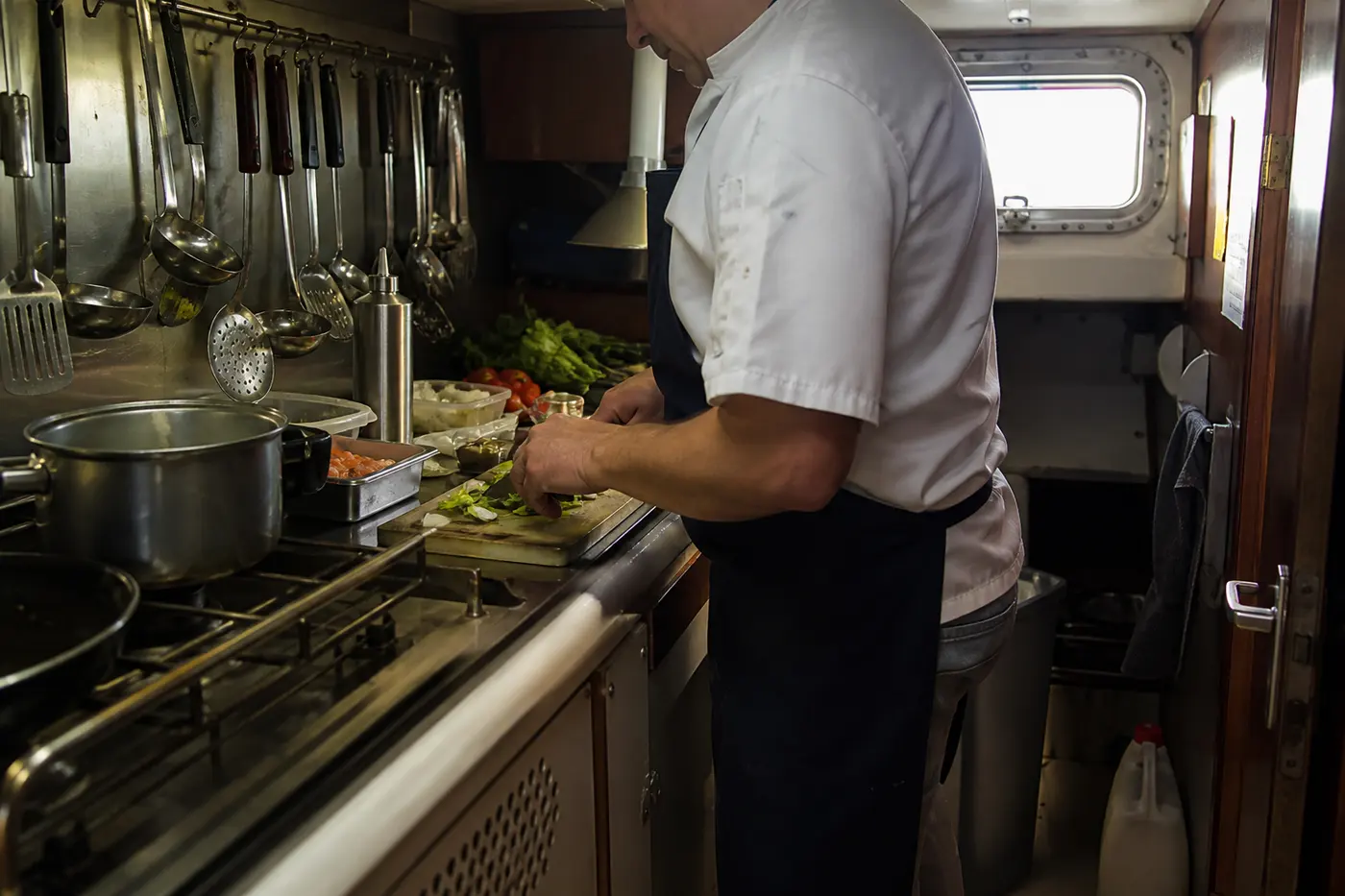
Almost all of it is buffet. That is not a cost-cutting decision, it is a physics decision. A boat galley is typically the size of a domestic kitchen, sometimes smaller, with limited refrigeration, limited fresh water, a gas hob, one or two ovens and a floor that moves. Feeding twenty hungry divers who all surfaced within ten minutes of each other means everything has to be ready simultaneously and hold its temperature for half an hour. Buffet does that. Individually plated courses, fired to order across a two-hour window, do not, at least not with two people in the galley.
The food itself is usually a hybrid: a rotation of local dishes plus recognisable Western options, with a carbohydrate, two or three protein dishes, cooked vegetables, a salad, and fruit. Breakfast tends to be the most Western meal of the day because that is what most guests want at six in the morning. Dinner is where a good chef shows off.
Quality across the industry is, honestly, higher than most first-timers expect. It is one of the most consistently praised parts of the experience in guest feedback, ours included, and we have covered the wider onboard picture in our first time on a liveaboard guide. What varies is not really the cooking. It is the boat's ability to handle exceptions.
Buffet or a la carte: what actually determines it
This is the question we get asked most, usually phrased as whether the boat has "proper" dining. The answer has almost nothing to do with the price of the cabin and almost everything to do with two numbers: how many guests are aboard, and how many crew are in the galley.
A la carte becomes genuinely possible in two situations. The first is a boat with a small guest count, say eight to twelve, where one chef and an assistant can realistically cook to order because there are only a handful of plates. The second is a larger vessel that carries a bigger galley brigade, where a chef plus two or three cooks can run a plated service for twenty-plus guests because the labour exists to do it. What does not work is the middle: a boat carrying twenty guests with a two-person galley. That configuration produces buffet, and any operator promising otherwise is either redefining the term or setting you up for a slow, cooling dinner.
| Guests aboard | Typical galley team | Realistic service style |
|---|---|---|
| 6 to 12 | 1 chef, 1 assistant | A la carte or plated is genuinely feasible |
| 12 to 20 | 1 chef, 1 to 2 assistants | Buffet, often with plated dinners a few nights |
| 20 to 26 | 1 chef, 2 to 3 cooks | Buffet, or plated if the brigade is genuinely staffed |
| 20 to 26 | 1 chef, 1 assistant | Buffet only, and expect queues |
So when you are comparing boats, the useful question is not "is it buffet or a la carte". It is "how many crew work in the galley, and how many guests are you carrying at full capacity". A boat with a 1:1 crew-to-guest ratio can do things a boat at 1:3 cannot, and that ratio is the single most reliable predictor of how well an unusual request will be handled. We made the same argument about service generally in our piece on what actually defines a luxury liveaboard, and dining is where the ratio shows up most visibly.
One caveat worth stating, because it cuts against our own commercial interest: buffet is not the inferior option for most divers. After four dives you want volume, choice and speed, not a tasting menu. The guests who most appreciate plated service tend to be on honeymoon or celebrating something, which is a different trip with different priorities.
How meals are timed around the diving
Meal times on a liveaboard are not a lifestyle choice. They are built backwards from the dive schedule, and the schedule is built around light, tides and current windows. A typical four-dive day looks roughly like this.
Something light before the first dive, usually around 06:00: fruit, toast, porridge, coffee, sometimes eggs to order. Nobody sensible eats a full breakfast before a dive at depth. Then the real breakfast lands after dive one, around 08:30, and it is substantial. Lunch follows the second dive around midday. Cake, fruit or savoury snacks appear after the third dive in the mid-afternoon, which is the meal guests underestimate and end up relying on. Dinner comes after the last dive, somewhere between 19:00 and 20:30, often later if there was a dusk or night dive.
Two practical consequences. First, you will eat more than you expect, because repetitive diving in water that is cooler than your body burns a genuinely surprising number of calories, and most guests are hungry in a way they find slightly embarrassing by day three. Second, if you have a medical condition requiring food at fixed intervals, diabetes being the obvious one, you need to map it against this schedule before you book rather than negotiate it at sea. Tell the operator, and ask specifically whether snacks can be made available outside service times. On most boats the answer is yes, but it needs arranging.
If you are prone to motion sickness, the timing matters even more, because an empty stomach and a rough crossing are a bad combination. Our guide on preventing seasickness on a liveaboard covers what to eat and when, and the short version is that dry carbohydrates early and often beat both fasting and a heavy meal.
Provisioning: why the food changes across a trip
Here is something operators rarely explain and guests frequently notice. The menu on day one is not the menu on day nine, and there is a structural reason.
Everything comes aboard before departure. Fresh leafy greens, soft fruit, dairy, delicate fish and fresh herbs have a working life of a few days in a boat fridge in the tropics, often less if the refrigeration is fighting a 32 degree ambient. So a well-run galley front-loads perishables and shifts progressively toward root vegetables, cabbage, longer-life fruit, frozen protein and store-cupboard cooking as the trip goes on. A salad on day two is likely to contain lettuce. On day ten it may be cabbage, carrot and tomato. That is competent provisioning rather than a decline in standards.
On genuinely remote itineraries, and eastern Indonesia has plenty of them, there is no resupply at all. Nothing comes aboard for eleven days. Some boats do a mid-trip top-up of fruit, fish or vegetables from a village or a passing fishing boat, which is the single best thing that can happen to a long itinerary's menu. Ask whether your route includes one.
Why this matters for dietary requirements: substitutes are finite. If you are the only guest who cannot eat wheat and the boat loaded four days of gluten-free bread for a ten-day trip, you will be eating rice from day five. Not because anybody was careless, but because nobody can buy more in the middle of the Banda Sea. This is the single most under-appreciated fact in this whole subject, and it is the reason a specialised diet needs declaring at booking, not at boarding.
Food allergies: the honest risk assessment
We are going to be direct here, because gentle vagueness on this subject gets people hurt.
A liveaboard galley is not an allergen-controlled environment. It is a small, hot, busy kitchen where a two or three person team produces six services a day on a moving platform. There is usually one set of chopping boards, one wok, one fryer, limited counter space, and no formal allergen labelling regime of the kind a European restaurant is legally bound by. Crew are often working in their second or third language. The realistic risk of trace cross-contamination is meaningfully higher than in a professional shore kitchen, and any operator who tells you they can guarantee a nut-free or gluten-free environment is overpromising.
Then layer on the second factor, which is the one that actually determines severity: you are far from medical care. A significant allergic reaction on a reef in a remote archipelago is not the same event as one in a city. Evacuation may be measured in many hours. There is no pharmacy. This is why the calculus for a severe, anaphylactic allergy is different from the calculus for an intolerance that makes you uncomfortable.
So, an honest framing by severity.
- Intolerances and preferences, meaning lactose, mild gluten sensitivity, dislikes: almost always handled well. Tell the boat and get on with your holiday.
- Moderate allergies where accidental exposure means discomfort rather than danger: manageable on most boats with clear advance notice and a direct conversation with the chef on day one.
- Severe or anaphylactic allergies, particularly nuts, shellfish and fish: possible, and we do carry such guests, but it requires a specific set of conditions. You must declare it at enquiry rather than booking, you must carry at least two adrenaline auto-injectors and ideally more, your dive buddy and the crew must know where they are and how to use them, and you must accept that shellfish in particular is close to unavoidable as an ingredient in a tropical galley. If an operator does not want to have that detailed conversation with you, that is useful information about the operator.
A shellfish allergy deserves its own note, because it is the hardest one on a dive boat. Fish and seafood are the cheapest, freshest, most local protein available in most liveaboard regions, and shrimp paste, fish sauce and dried shrimp are foundational seasonings across Southeast Asia in particular. Removing them is not a matter of skipping a dish; it means cooking your food on a separate track. Boats can do it. They need to know weeks ahead.
How to communicate a dietary requirement so it actually lands
Most dietary failures we have seen were communication failures, not cooking failures. The information existed somewhere and did not reach the person holding the knife. Five things fix that.
Declare it at enquiry, not at booking, and never at boarding. The moment to raise a serious requirement is before money changes hands, because it is also the moment an honest operator will tell you if they cannot manage it. Provisioning for a ten-day remote itinerary is typically finalised days in advance and shopped in a mainland town. A request that arrives the night before departure cannot be provisioned, only improvised.
Be specific rather than categorical. "I'm vegan" is a label, and labels travel badly across languages and cultures. What the galley needs is the operational version: no meat, no fish, no fish sauce, no shrimp paste, no eggs, no dairy, no honey. Fish sauce is the classic failure point, because in much of Southeast Asia it is treated as salt rather than as an animal product, and a vegetable stir fry seasoned with it is offered in complete good faith. Similarly "I can't eat gluten" is better expressed as no wheat flour, no soy sauce unless it is tamari, no breadcrumbs, no beer batter.
State the severity explicitly. Crew triage by consequence. There is a world of difference between "dairy gives me a stomach ache" and "traces of peanut will put me in anaphylaxis", and if you describe both as an allergy you have flattened the information the chef most needs. Say the word anaphylaxis if it applies. It changes behaviour.
Get it in writing and confirm it twice. Once on the booking form, once again by email about a fortnight before departure when provisioning is being planned. Then have a two-minute conversation with the chef or cruise director on day one, in person, before the first meal. Any decent boat will initiate this themselves. If yours does not, initiate it yourself and do not feel awkward about it.
Write it down for the galley in simple terms. A short list on a card, in plain words, is worth more than a paragraph of explanation delivered verbally to someone working in their third language. If you are travelling somewhere with a language barrier, a translated version is a genuinely good idea, and free translation apps do this well enough.
The operator side of this matters too, and it is worth knowing what good looks like. When a guest declares a requirement to us, it goes onto the trip manifest, the chef sees it before shopping, and the cruise director raises it at the day-one briefing. If the boat you are talking to cannot describe a process like that, treat it as a warning sign.
Vegan and vegetarian diets: usually the easy case
Good news first. Vegetarian and vegan diets are among the simplest requirements to accommodate on a liveaboard almost anywhere in the world, and in Asia they are easier than at home. The cuisines that dominate liveaboard menus lean heavily on rice, noodles, tofu, tempeh, legumes, coconut, peanut and an enormous range of vegetables. Tempeh in particular is an Indonesian staple that happens to be an excellent vegan protein, and most galleys cook it well without being asked.
Three things to watch, though.
Hidden animal products in seasoning. Covered above and worth repeating because it is the number one issue: fish sauce, shrimp paste, dried anchovy, chicken stock and, less obviously, prawn crackers served as a side. None of these register as "meat" to a cook who has not been told they count.
Protein adequacy over a diving week. You are doing three or four dives a day for ten days. A vegan buffet assembled thoughtlessly can end up being rice, vegetables and fruit, which is pleasant and nutritionally thin for that workload. Ask specifically for tofu, tempeh, beans, lentils, nuts and seeds to be included as protein at each main meal. Most chefs are glad to be told, because the alternative is guessing.
Regional variation. Southeast Asia, India and the Red Sea are comfortable territory. Boats operating in regions where the default diet is heavily meat and fish based, parts of Central America and some remote Pacific itineraries for instance, may have less practised. Ask what they actually served the last vegan guest, which is a much better question than whether they can cater for vegans.
Dairy-free and egg-free follow the same logic and are similarly straightforward, with the caveat that Western-style breakfasts and desserts lean on both, so expect fruit rather than cake at the end of dinner.
Gluten-free, and everything else
Gluten-free is the requirement most likely to be genuinely constrained by provisioning rather than skill. Rice is the default carbohydrate across most liveaboard regions, which helps enormously, and a naturally rice-based cuisine is far easier to make gluten-free than a bread-based one. The constraints are soy sauce, which contains wheat unless it is tamari, wheat flour thickeners, breadcrumbs and the finite supply of specialist bread. If you need coeliac-grade avoidance rather than reduction, say so explicitly and expect to bring your own bread and snacks.
For the rest:
- Halal is standard in Indonesia, Malaysia, the Maldives and Egypt, where most crew and galleys are Muslim, and pork is often absent by default. Elsewhere it needs asking.
- Kosher at any strict level is not realistically achievable on a liveaboard galley. Guests who need it generally bring sealed prepared meals, and boats can usually store and heat them if asked in advance.
- Keto and low-carb are easy to accommodate by subtraction, since protein and vegetables are abundant, though be aware that cutting carbohydrate hard while doing four dives a day is a decision to discuss with your doctor rather than your chef.
- Low FODMAP, low-histamine and similar clinical diets are difficult, because they eliminate onion, garlic and fermented seasonings that underpin almost all local cooking. Possible on a small boat with a dedicated chef. Ambitious on a full one.
- Children and fussy eaters are usually fine. Plain rice, plain noodles, eggs, fruit and bread exist on every boat, and a good chef will quietly make something simple for a child who is not eating.
Subtraction or substitution: the tell that separates boats
If you take one diagnostic away from this article, make it this one. There are two ways a galley can handle a dietary requirement, and the difference tells you almost everything about the boat's real service level.
Subtraction is when the kitchen removes the offending item and serves you the remainder. The vegan guest gets the buffet minus the chicken and minus the fish, which on a bad day means rice and cooked vegetables while everyone else eats four dishes. Nothing was done wrong, exactly. You simply got less.
Substitution is when the kitchen replaces what it removed. The vegan guest gets a tempeh curry cooked alongside the chicken curry, and eats the same number of dishes as everyone else. The gluten-free guest gets a separate portion thickened with cornflour rather than a sauce scraped off.
Substitution requires two things that subtraction does not: an extra pair of hands in the galley, and advance knowledge so the ingredients were purchased. Which brings the whole article back to the same two variables, crew ratio and lead time. It is also why we keep saying that declaring a requirement early is not administrative box-ticking. It is the mechanism by which you get substitution instead of subtraction.
A short story that made this concrete for us. A few seasons ago we had a guest with coeliac disease and a separate guest with a severe shellfish allergy on the same eleven-night trip, which is about as awkward a combination as a galley can face given that shellfish and soy sauce are everywhere. Both had told us at enquiry. The chef shopped for both, ran a separate board and pan for the shellfish-free cooking, and plated those two guests' dinners individually every night while everyone else served themselves from the buffet. It worked, and neither guest had a bad day. What made it work was six weeks of notice, not the size of the boat. Had either of them mentioned it at boarding, the honest outcome would have been eleven days of careful subtraction and a much duller trip.
What to bring yourself
Even on a boat that handles your requirement well, a small personal supply removes all the residual anxiety. It weighs very little and it is the difference between managing your diet and worrying about it.
- Your specific staple, whatever the boat cannot reliably resupply: gluten-free bread or crackers, a favourite protein bar, dairy-free milk powder, a jar of a spread you rely on.
- Medication in duplicate. Two or more adrenaline auto-injectors if you carry them, antihistamines, enzyme supplements, and whatever you take for reflux, because eating large meals late after diving provokes it in people who never get it at home.
- Electrolyte sachets. Not a dietary item exactly, but the single most useful thing in your bag. Dehydration is the common thread linking fatigue, headaches and decompression risk on a diving week.
- A translated allergy card if there is a language barrier.
- Snacks you actually like for the mid-afternoon gap and for long crossings.
Our full liveaboard packing list covers the rest of the bag. Do check whether your boat has a policy on bringing food aboard, since a few restrict it for pest and quarantine reasons, and be sensible about anything that will not survive a week without refrigeration.
Alcohol, water and the rest of the drinks question
Drinks vary more between operators than food does. Water, tea, coffee and usually soft drinks are included essentially everywhere, and refillable bottles are the norm rather than single-use plastic on any boat that takes its environmental position seriously. Beer, wine and spirits are more often charged, either per drink or as a bar tab settled at the end alongside gratuities, and a minority of premium boats include them.
Two points worth flagging. Drinking and repetitive diving interact badly, mostly through dehydration, and the sensible convention on almost every boat is no alcohol until the day's diving is finished, which includes any night dive. We went through the physiology in our article on drinking and diving. Separately, if you do not drink, check whether the trip price assumes you do, because on boats where alcohol is included you may be subsidising other people's wine.
Questions to ask before you book
If you have any dietary requirement at all, these six questions will tell you more than any amount of brochure reading. The answers matter less than whether they come readily.
- How many crew work in the galley, and how many guests do you carry at full capacity?
- Is service buffet or plated, and does that change on longer itineraries?
- How far in advance do you finalise provisioning, and is there any mid-trip resupply on my route?
- How do you handle a severe allergy specifically, and has this chef done it before?
- Will my requirement be met by substitution or by removing items?
- What did you actually serve the last guest with my requirement?
That last question is the good one. It cannot be answered with reassurance, only with detail, and the quality of the detail tells you everything.
The bottom line
Liveaboard food is usually one of the pleasant surprises of the experience, and dietary requirements are accommodated successfully far more often than not. Buffet service is the industry default for sound practical reasons, and a la carte is realistically a function of small guest numbers or a properly staffed galley rather than of price. The variables that determine whether your own requirement is handled well are how early you declared it, how specifically you described it, and how many people are working in that kitchen.
Declare it at enquiry. Describe it operationally rather than by label. State the severity honestly. Bring a small personal supply and your own medication in duplicate. Then relax, because the chances are you will eat better than you expected and spend the week slightly astonished at how hungry diving makes you. If you are still assembling the rest of the picture, our guides to what to expect on a first liveaboard and to whether beginners can do a liveaboard cover the parts of the trip that happen outside the saloon.