On a strip of black volcanic sand between mainland North Sulawesi and Lembeh Island, divers spend hours kneeling in the silt looking for animals the size of a fingernail. There are no swim-throughs, no cathedral-like reefs, no big pelagic encounters. What there is, is a concentration of bizarre, rare, and beautifully strange marine life that has no equal anywhere on the planet. Lembeh Strait is to muck diving what Yosemite is to climbing or Bordeaux is to wine: the original benchmark, the place every other destination is measured against.
This guide walks through what Lembeh actually is, why it produces such extraordinary critter encounters, where to dive, when to go, and how to plan a trip. It also looks at how Lembeh fits into the wider Indonesian diving landscape, and at the alternatives if you want a similar critter experience from a liveaboard rather than a land-based resort. Whether you're a photographer chasing the rarities, a long-time diver wanting to see species you'd never imagined existed, or a first-time muck diver curious about the experience, this is an honest, field-informed overview.
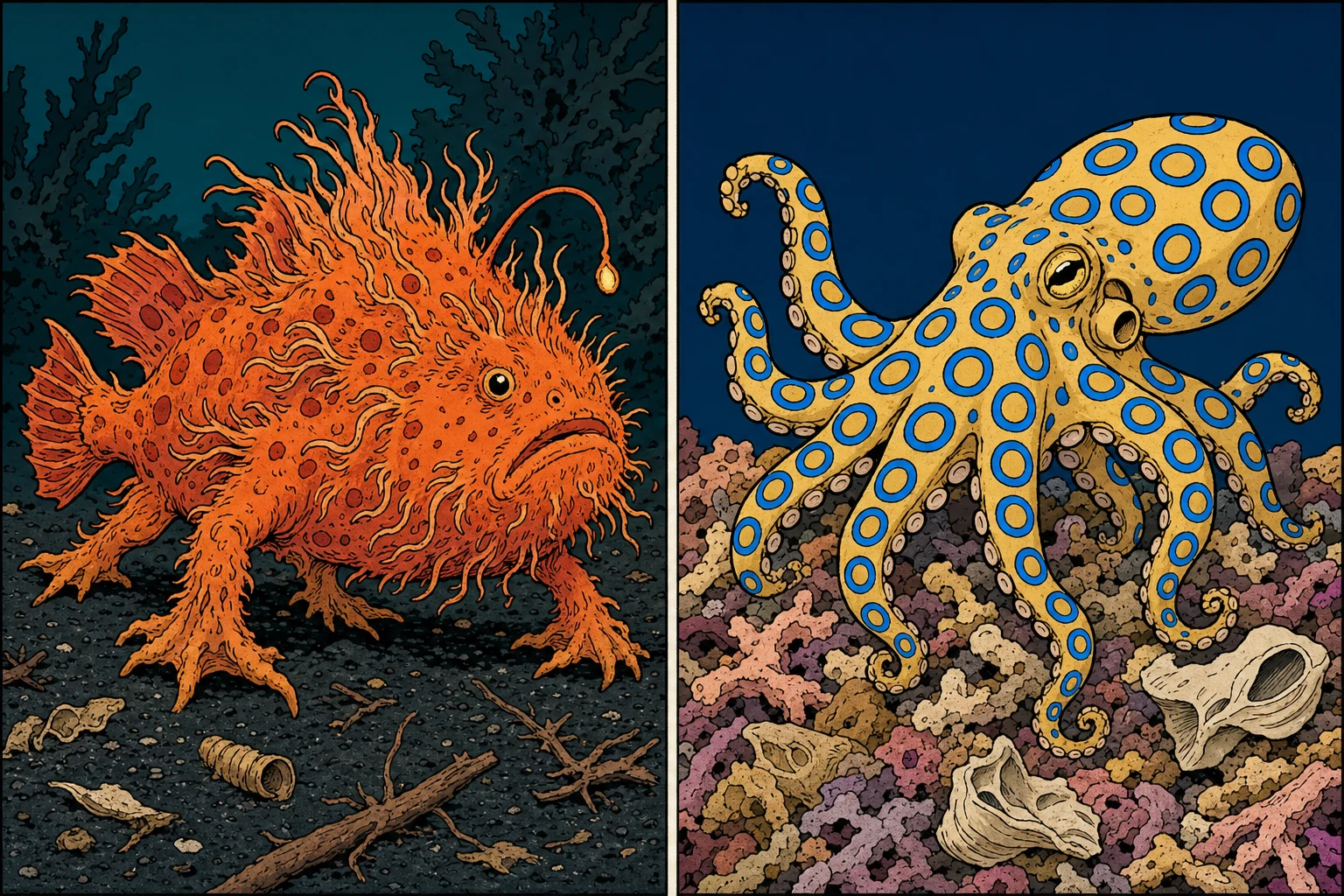
There is no "wow factor" reef in Lembeh. The wow factor here is biological. Hairy frogfish that walk across the sand, blue-ringed octopuses pulsing fluorescent warnings, hairy shrimp the size of a grain of rice, juvenile fish in psychedelic colour phases that vanish as adults. If your idea of great diving is hovering over a sea fan looking for something everyone else missed, Lembeh is genuinely unmatched.
Where Is Lembeh Strait?
Lembeh Strait is a narrow channel of seawater between the northeast tip of Sulawesi and the smaller island of Lembeh, in Indonesia's North Sulawesi province. The strait is roughly 16 kilometres long and 1 to 2 kilometres wide, with the city of Bitung sitting on the mainland side. It opens north into the Celebes Sea and south toward the Molucca Sea.
Geographically, the strait is a textbook muck-diving environment: protected from open-ocean swell, fed by mineral-rich water from the surrounding volcanic landscape, and lined with sloping black sand and rubble bottoms. Run-off from the surrounding islands, including organic detritus, leaves, and silt, settles in the strait and creates the unusual habitat that critters thrive in.
The closest international gateway is Manado (MDC), with daily flights from Jakarta, Bali, Singapore, and Kuala Lumpur. From Manado airport, the drive to Lembeh dive resorts takes about 90 minutes, including a short boat transfer across the strait to the resort jetty.
What Exactly Is Muck Diving?
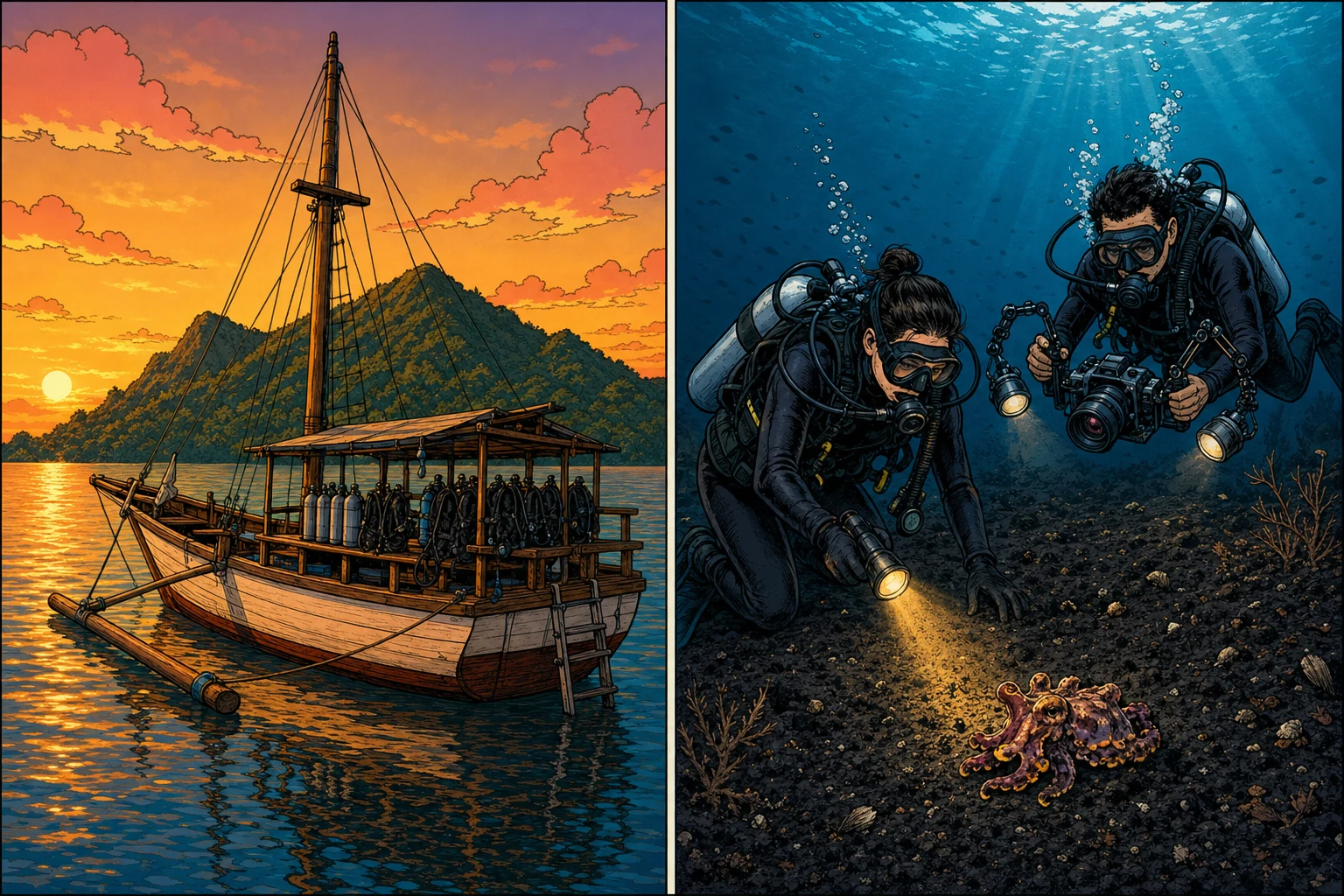
The name is unflattering on purpose. Muck diving describes the practice of finning slowly across silty, sandy, or rubble bottoms, usually in shallow water and rarely deeper than 25 metres, looking for small, often well-camouflaged or rare animals. The "muck" refers to the substrate: dark sand mixed with shells, branches, plastic, and decomposing organic material. To a diver scanning a coral wall for the first time, it looks like a wasteland. To an experienced muck diver, it is an open library.
The animals that inhabit this environment have evolved astonishing camouflage and weird behaviours. Many are juvenile-stage versions of fish that look unremarkable as adults. Others are species that genuinely cannot survive on a healthy reef because they need the substrate to bury into, ambush prey from, or mimic. Lembeh's protected, current-poor, organically rich habitat is basically a critter incubator.
Muck diving is slow. A typical Lembeh dive lasts 60 to 70 minutes, covers maybe 50 metres of bottom, and involves long pauses while a guide points out something the size of a peanut. It rewards patience, good buoyancy, and a willingness to stare at a single patch of sand for several minutes.
The Critters That Made Lembeh Famous
Lembeh's reputation rests on the sheer density of unusual species you can encounter on a single trip. Among the regulars:
- Hairy frogfish (Antennarius striatus): ambush predators that "walk" across the sand on modified pectoral fins. Lembeh has them in higher concentrations than anywhere else.
- Blue-ringed octopus: small, lethally venomous, and unmistakable when its iridescent rings light up. Lembeh sees both the greater and the southern blue-ringed.
- Mimic and wonderpus octopuses: long-armed species that imitate the patterns of other animals. Lembeh is one of the most reliable places on earth to find both.
- Mandarin fish: tiny, brilliantly coloured dragonet that emerges at dusk to spawn. Most Lembeh resorts run dedicated dusk dives for them.
- Rhinopias frondosa and weedy scorpionfish: highly prized rare scorpionfish with elaborate dermal flaps.
- Flamboyant cuttlefish: small, almost cartoonishly coloured cuttlefish that walks on modified arms.
- Hairy shrimp (Phycocaris simulator): 5-millimetre commensal shrimp that lives among algae and hydroids. Often considered a Lembeh signature.
- Pygmy seahorses: not the same fan-living species you find in Raja Ampat, but Lembeh has multiple pygmy and dwarf seahorse species in seagrass and rubble.
- Juvenile fish in extraordinary colour phases: rockmover wrasses, batfish juveniles, banded sole, and others that look completely different in their first weeks of life.
This list is not exhaustive. Lembeh resorts maintain rolling species logs and most experienced guides can show you 30 to 50 species across a typical week of diving. The critter density also reflects the wider richness of Indonesia's Coral Triangle, the most biodiverse marine region on the planet.
Top Dive Sites in Lembeh Strait
Lembeh has somewhere between 35 and 50 named dive sites depending on whose count you use. Most are in the 5 to 25 metre range and accessible from any resort by boat in 5 to 15 minutes. A handful of the most reliably productive:
- Hairball (and Hairball 2, 3): black sand slopes that consistently produce the namesake critters and dozens of others. Probably the single most-photographed muck site on earth.
- Nudi Falls: a small wall on the Lembeh Island side, named for the high concentrations of nudibranchs but home to far more than that.
- TK1, TK2, TK3 (Tanjung Kusu-Kusu): a series of black sand slopes opposite the resort strip. Reliable for blue-ringed octopus, frogfish species, and ribbon eels.
- Aer Bajo 1 and 2: shallow rubble flats that often produce mimic octopus and hairy frogfish.
- Critter Hunt: an open sand plain at moderate depth, popular for rare scorpionfish.
- Police Pier: a jetty dive that's especially good after dark, with mandarin fish, dragonets, and pipefish.
- Angel's Window: a rare break from pure muck. A small swim-through with soft corals, schools of glassfish, and the occasional pelagic visitor.
Most divers do three to four boat dives per day plus a dusk or night dive. A productive Lembeh week typically covers 15 to 20 dives across 8 to 12 different sites.
Diving Conditions and Difficulty
Lembeh is a friendly destination for divers across the certification spectrum, with two important caveats. The water is calm in most of the strait, with currents generally light to moderate and visibility in the 8 to 18 metre range. Average depths sit between 5 and 25 metres, well within recreational limits. There are no demanding drift dives, no required reef hooks, no challenging entries.
The first caveat is buoyancy. Muck diving is unforgiving of bad buoyancy because the silty bottom kicks up the moment a fin touches it, and clouds of suspended sediment can ruin a dive for everyone behind you. Lembeh is genuinely better for divers who are confident in horizontal trim, controlled descent, and small-fin propulsion. Open-water-certified divers with 30 to 50 logged dives generally do well; less-experienced divers should expect their first day or two to be a buoyancy adjustment.
The second caveat is patience. New muck divers often find the slow pace and small-target search a bit disorienting after coming from reef diving. Three days in, almost everyone is converted. The first day or two can be quiet. Trust the guide and the process.
Water temperature ranges from 26 to 30°C year-round. A 3 mm wetsuit suffices for most divers, with a 5 mm shorty or hooded vest preferable for those who feel cold during long shallow dives.
When to Dive Lembeh
Lembeh is a year-round destination, which is unusual in Indonesian diving. The strait sits north of the equator, sheltered between two landmasses, and is largely insulated from the seasonal monsoons that close other Indonesian dive areas. For a wider view of how Indonesian dive seasons work, see our Indonesia liveaboard seasons guide.
That said, there are subtle seasonal windows:
- March to May and September to November: typically the calmest months and what most resorts consider peak conditions. Slightly better visibility on average.
- December to February: occasional rain and slightly cooler water, but no formal closure. Some resorts report the highest critter counts during these months because cooler water draws certain species into shallower depths.
- June to August: dry season for North Sulawesi. Conditions are reliable but this is also peak resort-booking season; expect higher prices and busier dive sites.
Practically speaking, you can have an excellent Lembeh trip in any month. The resort's house reef and the most productive muck sites operate every day of the year barring extreme weather, which is rare.
How to Dive Lembeh: Resorts, Day Boats, and Liveaboards
Lembeh is well served by both dedicated dive resorts and a handful of liveaboard itineraries. The strait is tightly contained and dive sites are close together, which makes either model viable depending on what you want from the trip.
A handful of well-known dedicated dive resorts operate on the Lembeh side and the mainland side, ranging from boutique 12-room dive lodges to larger 40-room properties. All include daily diving, full board, and airport transfers in their package rates. Most have on-site camera rooms with rinse tanks and charging stations, multiple spotters per dive guide, and three to four boat dives a day from a jetty just minutes from the best sites.
Liveaboards do visit Lembeh, typically as part of wider Sulawesi or Maluku itineraries that combine one to two days of muck diving in the strait with reef diving elsewhere in the region. This is a great option for divers who want exposure to Lembeh's critter scene alongside more varied diving in a single trip. For divers whose main goal is the muck diving itself, a Lembeh-focused resort week tends to be the better pick: more dive time per critter site, a dedicated photo workflow, and the ability to repeat productive sites across the week.
Day-boat diving from Manado is technically possible but rarely worth the travel time. The transfer eats into bottom time, and the on-site camera and gear setup at dedicated dive resorts pays off across multiple days. Most divers fly into Manado, transfer directly to the resort, and stay put for the full trip.
If you want a multi-region trip that includes Lembeh, the most common pattern is to spend 5 to 7 days at a Lembeh resort, then transfer to a different region for a liveaboard week. Manado is a useful pivot point: from there, divers commonly continue to Bunaken for reef diving, or fly south to Bali, or east to Sorong for a Raja Ampat liveaboard.
Cost and Value
Lembeh sits in the mid-range to upper-mid-range of Indonesian dive pricing. A typical 7-night package at a well-regarded dive resort, including all meals, three boat dives per day, and airport transfers, lands in the USD 1,800 to 3,500 per diver range depending on the resort tier and room category. Premium properties with private villas and unlimited boat dives can climb above USD 4,000 per week.
Add to that:
- International flights to Manado: USD 800 to 1,400 from Europe, USD 200 to 600 from Asian gateways.
- Marine park / strait fees: typically USD 30 to 50 per trip, included or charged separately by the resort.
- Equipment rental: USD 25 to 35 per day if needed; many resorts include rental at no extra cost in higher-tier packages.
- Camera setup considerations: Lembeh is heavily a photography destination, and most resorts have dedicated camera rooms with rinse tanks, charging stations, and gear shelves. Underwater photo and video equipment shipping or insurance is a real cost line for serious shooters.
Value-wise, Lembeh is fair-priced for what it delivers. Critter density per dive is among the highest in the world, guide skill levels are exceptional (most have spotted these species thousands of times), and the resort experience is comfortable without being extravagant. It is not a budget destination. There is no real backpacker option. But it is far cheaper than the equivalent Maldives or Galapagos experience.
Tips for First-Time Muck Divers
A handful of small adjustments will dramatically improve a first Lembeh trip:
- Bring a torch, even on day dives. Lembeh's dark sand and shaded slopes mean colour disappears quickly, and many critters live tucked under coral fragments or in burrows.
- Practice neutral buoyancy before you arrive. Even one or two pool sessions improving horizontal trim and small-fin kicks pay off enormously.
- Slow down. Most new muck divers cover too much ground. Stay close to the guide, hover, and look at the same patch for longer than feels necessary.
- Bring or rent a magnifying lens if you plan to take photos. Many of Lembeh's headline critters are smaller than a one-cent coin.
- Trust the guides. Lembeh's spotters are world-class. They will see things you walk straight past for ten minutes.
- Plan a rest day. Three or four critter-heavy dives a day is mentally fatiguing, even if physically light. Most resorts encourage at least one rest day during a longer week.
Lembeh vs Indonesia's Other Muck Diving Regions
Lembeh is the most famous, but it is not the only muck destination in Indonesia. A short comparison helps situate it:
- Ambon: Maluku's main muck-diving destination, often called Lembeh's quieter cousin. Similar habitat, fewer resorts, often included as a stop on Banda Sea liveaboards.
- Triton Bay: a remote Papuan bay reachable mostly by liveaboard. Mixes muck-style critters with whale shark encounters and untouched reefs. A genuine adventure-traveller destination.
- Halmahera: another remote North Maluku region with strong critter potential, again more of a liveaboard destination than a resort one.
- Bali (Tulamben, Seraya, Padang Bai): not pure muck, but Bali's volcanic-shore sites have meaningful critter density alongside reef and wreck diving. See our best diving in Indonesia overview for more.
If you want density of rarities and the best guides on the planet, Lembeh wins. If you want the same kind of small-life thrill but reached by liveaboard rather than resort, Ambon, Triton Bay, and Halmahera are the natural alternatives. Several Indonesian liveaboard itineraries combine wider routes with critter-heavy Maluku stops, which is the closest thing you'll get to "Lembeh from a boat" without compromising the quality of the muck diving.