Raja Ampat sits at the geographic centre of the Coral Triangle, the global hotspot of marine biodiversity, and the waters around its 1,500-plus islands hold more documented fish, coral, and invertebrate species per square kilometre than anywhere else on earth. The challenge in Raja Ampat is not finding good diving. The challenge is choosing among hundreds of named dive sites, each with its own character, current pattern, and ideal season. A trip here lives or dies by site selection.
This guide covers eleven sites that we genuinely consider the best Raja Ampat has to offer, organised by region. It is written from operator perspective, drawing on the trips our three liveaboards run through Raja Ampat each season. The aim is to be specific and honest. We tell you what each site delivers when conditions cooperate, what happens when they do not, and the difficulty level you actually need to be ready for. We also note which sites are realistic on different itinerary lengths, because you cannot reach Misool from Sorong on a five-day trip and any operator that says you can is selling something else.
If you are still deciding between Raja Ampat and Komodo, our Raja Ampat vs Komodo comparison covers that question. For the broader logistics of getting to Raja Ampat and choosing a liveaboard, see our Raja Ampat liveaboard guide. This article is for the diver who has chosen Raja Ampat and now wants to know which water to dive in.
How Raja Ampat Is Laid Out
"Raja Ampat" means "Four Kings", a reference to the four largest islands of the archipelago: Waigeo, Salawati, Batanta, and Misool. For diving purposes the region divides into three practical zones, and understanding the geography is the first step to understanding which sites are reachable from where.
- Dampier Strait (central Raja Ampat): the narrow channel between Waigeo and Batanta. Home to the most-dived sites in the region, including Cape Kri, Manta Sandy, and Blue Magic. Most liveaboards operate here for the bulk of any itinerary. Reachable from Sorong in four to six hours by boat.
- Misool (southern Raja Ampat): a separate island group roughly 200 kilometres south of Sorong. Soft coral walls, both manta species at Magic Mountain, and the best swim-throughs in Indonesia. Practically liveaboard-only, because the crossing from Sorong takes 12 to 18 hours.
- Wayag and Northern Raja Ampat: the karst islands and bays north of Waigeo. Less-dived than Dampier, but spectacular topside scenery and reliably good diving. The walking shark and pearl farm region.
A standard 7-day liveaboard itinerary covers two of these three zones. A 10-to-12-day trip can cover all three. The choice of base region shapes the entire trip, which is why itinerary length matters as much as boat quality. The full breakdown of what you can realistically reach in each trip length is at the end of this guide.
Dampier Strait: The Central Diving Hub
The Dampier Strait is the channel that separates Waigeo and Batanta. The combination of strong tidal currents, the depth profile of the channel, and a series of seamounts creates the conditions that make this the most reliably extraordinary diving in Raja Ampat. Six sites stand out, each with a distinctly different character.
1. Cape Kri
If Raja Ampat had to be summarised in a single dive site, Cape Kri would be it. The site is the eastern tip of Kri Island, in the Dampier Strait. Here, currents from two directions converge over an underwater ridge and concentrate enough nutrient flow to support a density of marine life that is hard to overstate. In 2012, a single dive at Cape Kri logged 374 fish species, a record that still stands. On a good day with running current, the volume of fish in the water column is so dense it begins to obscure the visibility itself.
What you see: dense schools of fusiliers, jacks, snapper, batfish, sweetlips, and barracuda. Frequent grey reef sharks and blacktips passing by. Wobbegong sharks resting under coral overhangs. Resident schools of giant trevally hunting on the corner. Bumphead parrotfish in the early morning. The corner itself acts as a magnet for big pelagics on incoming tides.
Difficulty and conditions: moderate to advanced. Currents range from gentle to strong depending on tidal phase. On a running current, this is a reef-hook dive: you hook in at the corner and watch the show. On a slack tide, you can drift the wall and explore the saddle. Depth typically 18 to 30 metres. Open Water divers in good buoyancy can dive Cape Kri on a slack tide; advanced certification and reef-hook experience are needed for the running-current version.
Operator note: a single Cape Kri dive depends entirely on tidal timing. Three dives across a week can produce three different experiences. We rotate our dive plan, north corner, south corner, or a drift across the saddle, based on the morning's tidal chart. New divers often find their first Cape Kri dive sensorily overwhelming because there is so much going on. Most ask to repeat it.
2. Manta Sandy
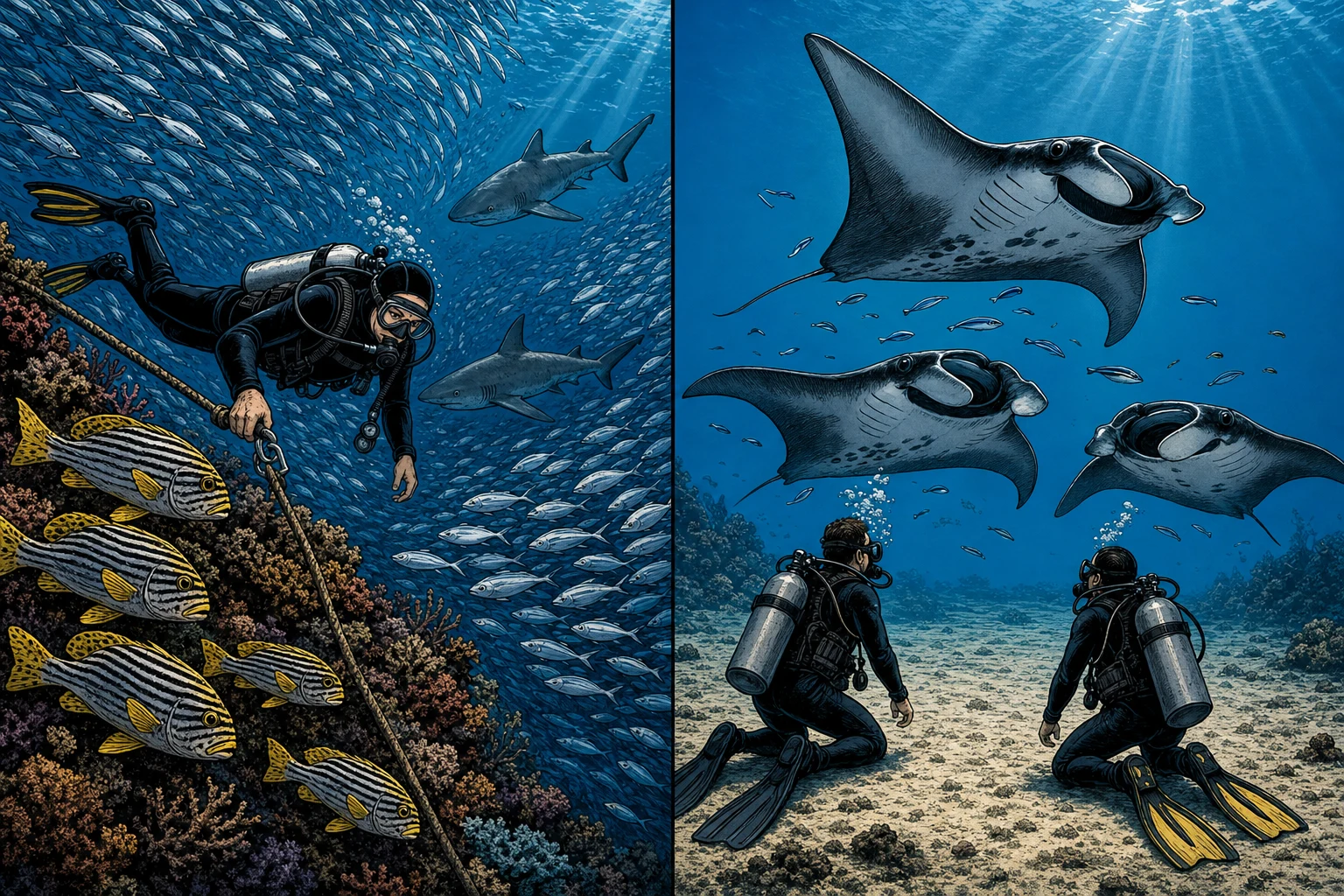
A reef manta cleaning station on a sandy bottom in the Dampier Strait, between the islands of Mansuar and Arborek. The site is named for what it is: a sandy plateau where reef mantas pause to be cleaned by wrasses and angelfish. There are designated viewing positions marked by buoys, and divers kneel along the line and wait. When mantas are present, you can have five or six in the water column above you, sometimes with one passing within metres of your mask.
What you see: reef mantas (Mobula alfredi), almost exclusively. The site is a cleaning station rather than a feeding ground, so the experience is contemplative rather than dramatic. You sit, breathe slowly, and watch them circulate. On a good visit you may also see bumphead parrotfish, schools of fusiliers, and the occasional shark moving through.
Difficulty and conditions: easy. Depth is shallow, 10 to 15 metres on the sand, with little to no current. The challenge is patience and behaviour: mantas avoid divers who chase, kick up sand, or position themselves directly above the cleaning station. The dive briefing covers etiquette in detail. Open Water divers are welcome.
Best time: dry season (October to April) tends to produce more reliable manta encounters at this site, though Manta Sandy is dived year-round. The peak window is December to March when mantas aggregate. There are no guarantees on any given dive, but most week-long Raja Ampat trips include three to four Manta Sandy attempts and most divers see mantas on at least two of them.
Operator note: Manta Sandy is one of those sites where guest expectations need calibrating before the dive. We tell guests up front that some dives produce zero mantas. The site has a strict no-chasing rule, and the experience is best described as patient watching rather than active encounter. Compared to Komodo's Manta Point, Manta Sandy is less dramatic but more reliable for sustained encounters with several individuals over a single dive.
3. Blue Magic
A submerged seamount between Mansuar and Cape Kri, rising from the deep to a top of about 8 metres. Blue Magic does what its name suggests: it acts as a magnet for everything passing through the Dampier Strait open water. It is one of the few sites in Raja Ampat where pelagic encounters are routine rather than lucky.
What you see: oceanic mantas pass through here regularly between November and April, sometimes in numbers. Schools of barracuda, rainbow runners, jacks, and tuna circle the seamount on incoming currents. Sharks (grey reef, blacktip, occasional silvertip) work the edges. The reef itself is heavily fish-stocked.
Difficulty and conditions: moderate to advanced. Currents at Blue Magic range from manageable drift to fully ripping, and the seamount sits in open water with no visual reference for descent. A negative-entry, fast descent to the top of the mount is standard. Reef hooks help on the strong-current days. Depth 8 to 30+ metres. Advanced certification recommended.
Best time: oceanic mantas are most common between late November and April. Outside this window, Blue Magic remains an excellent shark and pelagic site, just without the manta lottery.
Operator note: of all the Raja Ampat sites, Blue Magic is the most dependent on conditions. We brief our guides to read the current and visibility on every dive: the same site on different tides can be a serene drift or a reef-hook battle. When it works, it is the dive most guests rate as their favourite of the trip. When the current is wrong, we move to a backup site rather than force a poor experience.
4. Sardine Reef
An underwater ridge in the Dampier Strait, named for the dense bait balls of silver sardines that swirl along its length. The reef is fed by the same nutrient-rich currents that supply Cape Kri, but the topography is more accessible: a long oval ridge rather than a sharp corner, easier to dive at any current strength.
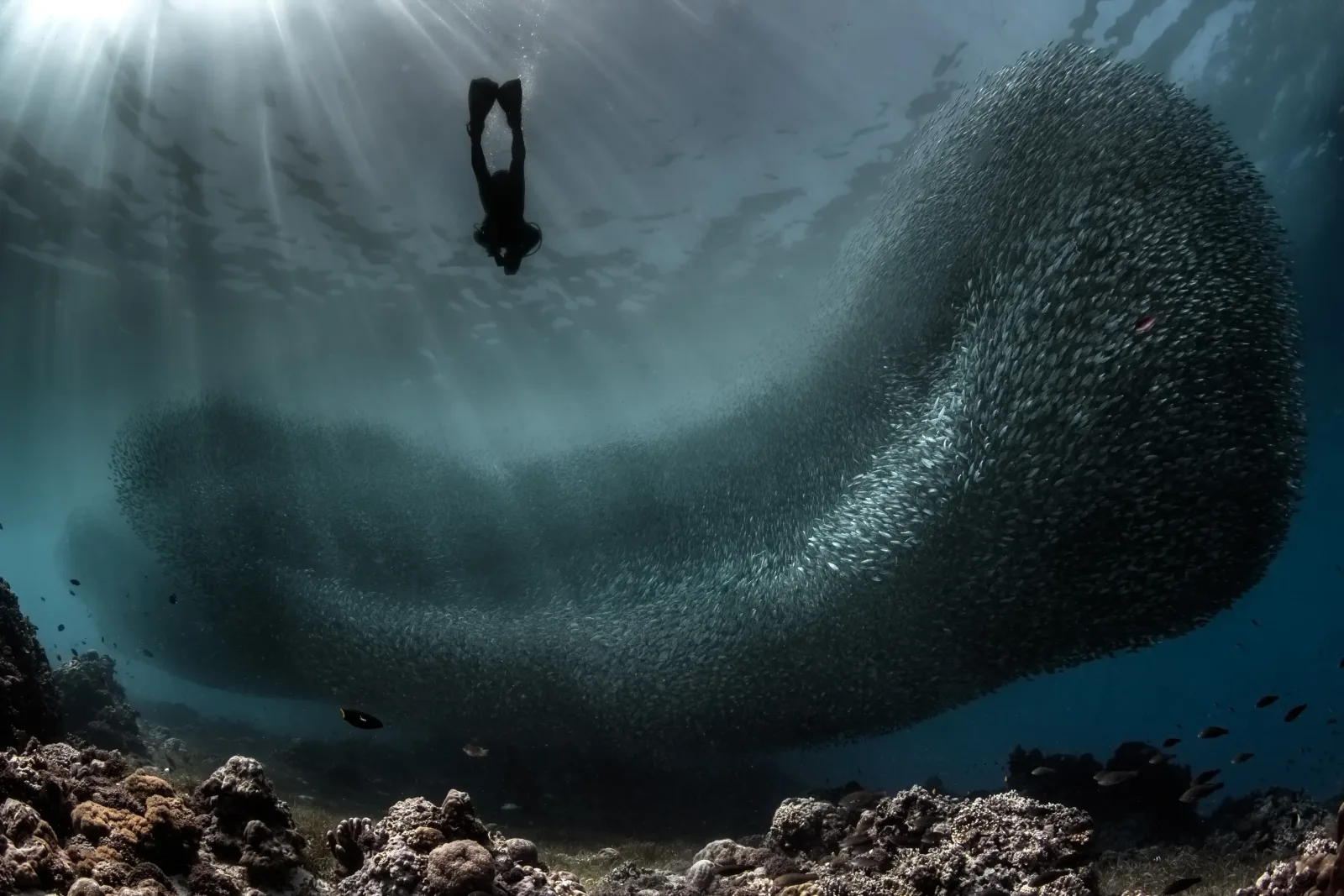
What you see: the namesake silver sardines, often in tornado formation when predators close in. Schools of jacks, fusiliers, and snapper. Grey reef sharks circling the deeper edge of the reef. Wobbegongs and walking sharks under coral plates on the shallower section. Frequent appearance of giant trevally, dogtooth tuna, and Spanish mackerel hunting the bait balls.
Difficulty and conditions: moderate. Current usually drift-friendly. Depth 5 to 30 metres. Open Water divers can dive Sardine Reef on lighter currents; on a strong day, advanced certification is preferable.
Operator note: Sardine Reef is one of our favourite sites for newer divers because it gives the full Raja Ampat sensory experience (massive schools, sharks, healthy reef) without the technical demand of Cape Kri or Blue Magic. It also produces some of the most rewarding underwater photos of any site in the region: the predator-prey tension when a school of jacks forms a tight ball is the kind of moment that stays with you.
5. Mike's Point
A small, low-lying island in the central Dampier Strait, named after a divemaster who first explored it. The site is a complete circumnavigation: a wall on one side, a sandy slope on another, swim-throughs on a third, and a current-fed shallow reef. Mike's Point packs four different dive types into a single site, which makes it ideal for either two consecutive dives or a single longer exploration.
What you see: the variety here is the draw. Wall side: soft coral and gorgonian fans with pygmy seahorses. Sandy slope: garden eels and shrimps with goby cohabitations. Swim-throughs: glassfish swarms and the occasional whitetip reef shark resting in the cave. Shallow reef: hard corals and reef fish density.
Difficulty and conditions: easy to moderate. Currents vary by section: stronger on the corners, calm in the swim-throughs. Depth 5 to 25 metres. Open Water divers can dive most of the site comfortably.
Operator note: Mike's Point is the most underrated site in the Dampier Strait. Most operators run it as a single dive and miss half the reef. We schedule it as a double-dive day when conditions allow, doing the wall and gorgonian side first and the swim-throughs and shallow reef second. It is a good spot for divers who want photographic variety in a single morning.
6. Arborek Jetty
A wooden jetty extending from the small village of Arborek into the Dampier Strait. The jetty sits over a sandy bottom in 8 to 12 metres of water, and the structure itself has become a dive site over the years through the combination of growing coral, accumulated fish life, and the calm shallow water beneath.
What you see: schooling juvenile batfish (often hundreds beneath the structure), wobbegong sharks resting on the sand at the jetty's base, walking sharks in the shallow rubble, and a high concentration of macro life on the pilings (nudibranchs, blennies, shrimps). The site is also a frequent stop for free-swimming epaulette sharks at dusk.
Difficulty and conditions: easy. Calm water, no current, shallow depth. One of the most beginner-friendly sites in Raja Ampat. Depth typically capped at 12 metres.
Operator note: Arborek Jetty is the site we recommend for guests' first dive of any Raja Ampat trip. The conditions are forgiving, the marine life is impressive without being overwhelming, and the shallow bottom gives photographers ideal natural light. The village is also worth a topside visit: many of our guests buy locally-woven palm-leaf souvenirs from the women's cooperative there. The dive plus village stop makes a good half-day in itself.
Misool: Soft Coral Wonderland
Misool sits 200 kilometres south of Sorong, far enough that reaching it requires either a long boat crossing or a dedicated liveaboard itinerary. The compensation is some of the most spectacular soft coral diving in the world, in a region that is fully protected as a marine sanctuary by the Misool Foundation and the Indonesian government. Visibility tends to be slightly better than the Dampier Strait, and the topside scenery (limestone karst islands rising from turquoise water) is extraordinary in its own right.
7. Magic Mountain (Shadow Reef)
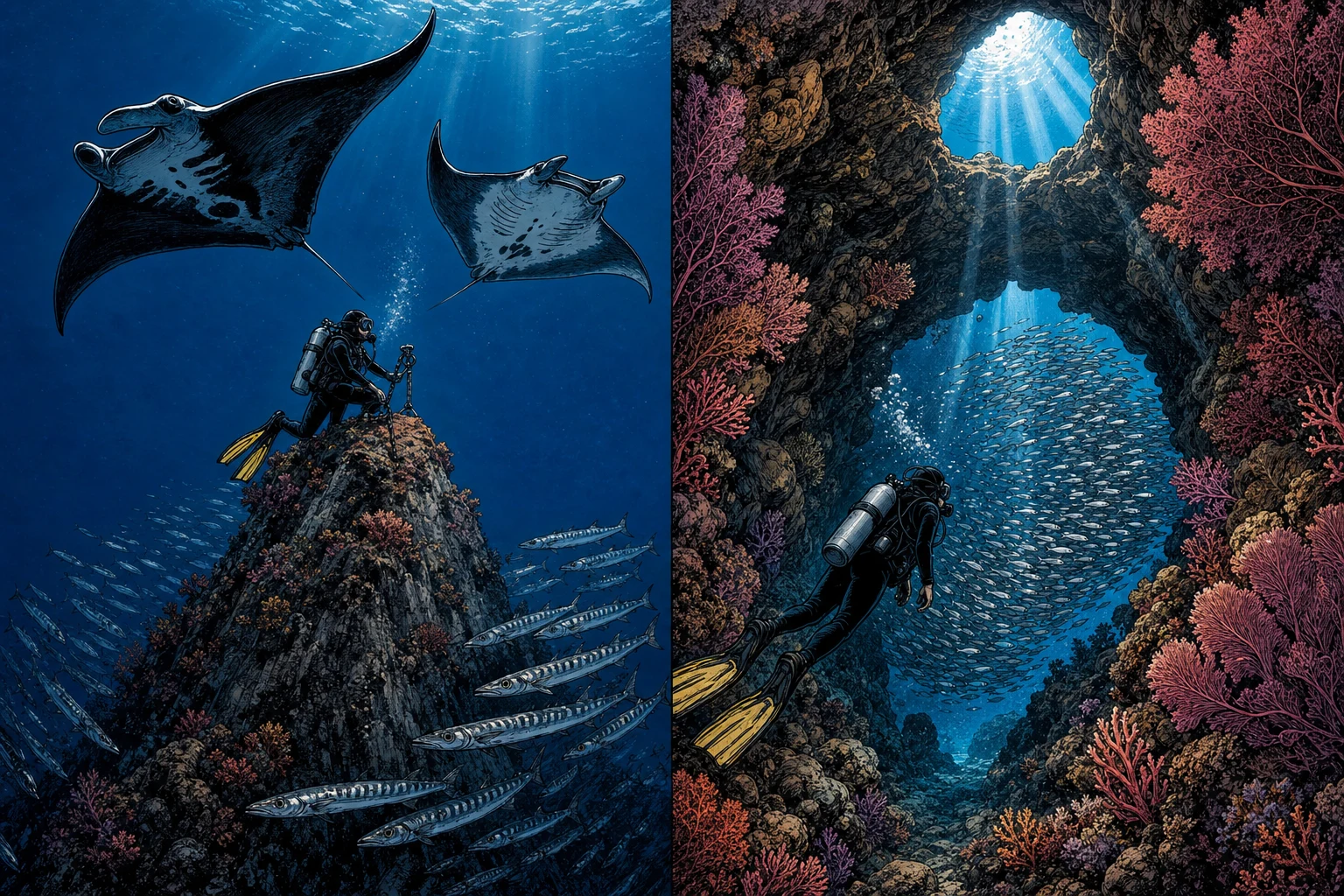
A submerged seamount in the southwestern part of Misool, often referred to as Shadow Reef in English or Karang Bayangan in Indonesian. The geological feature is a pinnacle that rises from deep water to about 8 metres below the surface, and the cleaning stations on its top draw both species of manta ray. This is one of the few places on earth where reef mantas (Mobula alfredi) and oceanic mantas (Mobula birostris) can be encountered on the same dive.
What you see: both manta species circulating the cleaning stations on the top of the pinnacle. Schools of barracuda, jacks, and rainbow runners on the slope. Whitetip and grey reef sharks patrolling the deeper edges. Soft coral and sea fan growth on the sides of the seamount. The Misool Manta Project has been documenting individuals here since 2012, and many of the same mantas return year after year.
Difficulty and conditions: advanced. Currents at Magic Mountain are strong on most tides, descent is into open blue water with the seamount as the only reference, and a reef-hook dive on the top is standard. Depth 8 to 30+ metres. The dive is not suitable for divers with fewer than 50 logged dives, or for those uncomfortable with negative-entry descents.
Best time: October to April produces the most reliable manta encounters. Oceanic mantas peak between December and March. The site dives year-round but the manta probability drops outside the peak window.
Operator note: Magic Mountain is the dive most guests cite as the highlight of any Misool itinerary. We typically schedule it on the first morning of our Misool block and try to dive it twice if conditions allow. The combination of two manta species, current-fed pelagic activity, and the geological drama of the pinnacle itself is something no other Raja Ampat site replicates.
8. Boo Windows
A pair of small limestone islets in southern Misool, with two natural arches eroded through the rock at depths of 6 and 18 metres. The "windows" are framed swim-throughs that pass directly through the islet, and each transit gives a different experience: the shallower window opens into a soft coral garden, the deeper window into a school of glassfish that can darken the entire passage.
What you see: the windows themselves are the centrepiece, but the surrounding reef is equally productive. Soft corals (red, pink, orange) cover the walls in densities that are hard to overstate. Schools of glassfish, fusiliers, and sweetlips swarm the swim-throughs. Lionfish, scorpionfish, and several species of pygmy seahorse on the sea fans. Reef sharks pass by occasionally on the outer edge.
Difficulty and conditions: moderate. Light current most days. The deeper window requires good buoyancy because divers transit a confined space; the shallow window is easier. Depth 6 to 18 metres. Open Water divers in good buoyancy can dive the shallow window; the deep window is more comfortable for advanced certification.
Operator note: Boo Windows is a photographer's site. Almost every diver wants to capture the moment of swimming through the arches with light streaming down from above. We position our boat to give two passes through each window during a typical 60-minute dive, and we dive it both early morning and late afternoon depending on light direction. The site is also one of the best examples of the conservation success Misool represents: 20 years ago this region was a shark-finning ground; today it is a biodiversity sanctuary.
9. Wayilbatan and the Kaleidoscope Wall
The Wayilbatan area sits at the southern tip of Misool, encompassing several closely-grouped sites that together form what locals call "Kaleidoscope" for the dense soft coral colour palette. The flagship dive is a long wall covered top-to-bottom in soft corals and gorgonians of every colour, with a current-driven sweep that lets you drift along the entire length.
What you see: the colour density is the headline. Red, pink, yellow, orange, and white soft corals carpet the wall. Resident schools of fusiliers and sweetlips. Hawksbill turtles browsing the wall. Pygmy seahorses (multiple species, including the elusive Pontohi) on the sea fans. The occasional manta cruising past on stronger currents.
Difficulty and conditions: moderate. Currents are typically gentle to moderate, drift-friendly. Depth 5 to 25 metres along the wall, with deeper sections reachable. Open Water divers comfortable in mild current can enjoy this dive.
Operator note: Wayilbatan is the site to put on the second dive of a Misool morning. After the adrenaline of Magic Mountain, the long drift along the Kaleidoscope wall is what most guests describe as the dive where they realised they were somewhere genuinely different. It is also the one Misool site we tell new divers they should not miss.
Wayag and Northern Raja Ampat: The Iconic North
The northern reaches of Raja Ampat, the area around Wayag and the bays of northwestern Waigeo, deliver a different experience from the Dampier Strait or Misool. The diving here is generally less intense, the currents more forgiving, and the marine life shifts toward macro and unusual species. The compensation, beyond the diving itself, is the topside scenery: the limestone karst islands of Wayag are widely considered the most photographed seascape in Indonesia.
10. Aljui Bay
A long, sheltered bay on the northwest coast of Waigeo, home to several pearl farms and a series of dive sites that blend muck-style critter diving with traditional reef habitat. The bay's calm water and varied bottom (sand, rubble, scattered coral, pearl-farm jetty pylons) creates the kind of environment where you can have a full critter dive on the sand and then ascend to a healthy reef in the same swim.
What you see: walking sharks (Hemiscyllium freycineti, a Raja Ampat endemic species) at most sites. Variety of pygmy seahorses, frogfish, and ghost pipefish in the rubble and on the gorgonians. Spanish dancers, octopuses, and cuttlefish on night dives. Pearl-farm pylons act as artificial reef and concentrate fish life.
Difficulty and conditions: easy. Calm bay, no significant current, varied depths from shallow rubble flats to wall sections. Open Water divers welcome.
Operator note: Aljui Bay is the easiest diving in Raja Ampat and one of our recommended stops for divers who want a slower-paced day after the intensity of Cape Kri or Blue Magic. The walking shark encounters are among the most reliable in the region. The pearl farms also offer an interesting topside visit and a chance to see how cultured South Sea pearls are grown.
11. Wayag
The Wayag islands sit at the far northern edge of Raja Ampat, a cluster of limestone karst formations that rise vertically from turquoise lagoons and reach 100 metres above sea level. The topside is so striking that many trip itineraries include a stop here primarily for the scenic value: a hike to the top of one of the smaller summits gives the iconic Raja Ampat aerial-view photograph. The diving, though less famous than Dampier or Misool, is still very good.
What you see: the underwater landscape mirrors the topside, with limestone walls, swim-throughs, and submerged passages between islands. Reef sharks (blacktip and whitetip) frequent the deeper walls. The shallow lagoons have resident populations of juvenile blacktip sharks (the famous "swim with baby sharks" experience). Macro life is rich on the walls: nudibranchs, ghost pipefish, and frogfish.
Difficulty and conditions: easy to moderate. Currents are mild to moderate around the karst islands. Depth varies by site, generally 8 to 25 metres. Open Water divers can dive most Wayag sites.
Operator note: a Wayag stop is more about the topside experience than the diving alone. We typically schedule a half-day with a morning shore dive, a hike to a karst summit for photos, and an afternoon snorkel in the lagoon with juvenile blacktips. Guests who come to Raja Ampat expecting only diving sometimes underestimate Wayag, then end up calling it the trip's highlight. The remoteness is part of the experience: there are no other dive groups, no resorts, and minimal phone signal.
Which Sites Match Which Itinerary Length
Geographic distance is the practical constraint that determines which Raja Ampat sites you can reach. Sorong is the airport hub, all liveaboards depart from there, and the time from Sorong to each region dictates what fits in a given trip length.
- 5-day trips: realistic for Dampier Strait only. You can dive 4 to 5 of the six Dampier Strait sites listed above. Misool and Wayag are not reachable.
- 7-day trips: Dampier Strait plus either Misool or Wayag. You can cover all six Dampier sites and roughly half of either the Misool or Wayag list. Most operators offer this as the standard itinerary.
- 10 to 12-day trips: all three regions. You can cover Dampier Strait fully, all three Misool sites in this guide, and one or both Northern RA sites. This is the only itinerary length that gets you to Magic Mountain, Boo Windows, and Wayag in the same trip.
- Land-based with day boats: Dampier Strait sites only. You can dive most of the Dampier list from a Mansuar or Waigeo dive resort, with longer day-boat runs to the southern Dampier sites.
Itinerary length is therefore the single most important booking decision after destination. If Magic Mountain or Wayag are on your bucket list, do not book a 7-day trip and assume you can squeeze them in. For more on choosing a trip and operator, see our Raja Ampat liveaboard guide.
Best Season for Raja Ampat Diving
Raja Ampat has two practical seasons. Most operators run trips between October and April (the dry season and prime conditions), and many close or relocate boats during the southwest monsoon between June and August. May and September are transitional months with variable conditions.
- October to April: dry season. Calm seas, best visibility (typically 20 to 30 metres), and peak manta probability at both Manta Sandy and Magic Mountain. December to March is the high season for both reef and oceanic mantas. This is also the busiest period and the most expensive to book.
- May and September: shoulder season. Conditions still good most days, lower prices, smaller crowds at the major sites. We have had some of our best Cape Kri and Blue Magic dives in May.
- June to August: southwest monsoon. Most operators relocate or close. The exception is sheltered northern routes around Wayag, which can still be diveable. We do not run our main Raja Ampat itineraries during these months.
For the broader picture of how Indonesian dive seasons work across regions, our Indonesia liveaboard seasons guide explains how Raja Ampat fits alongside Komodo and Banda Sea timing. The wider context of why these waters are so productive is covered in our Coral Triangle overview.
Choosing Your Raja Ampat Trip
The best Raja Ampat dive site is the one whose conditions match your skill level on the day you visit. There is no single "must dive" site that defines the trip. What defines the trip is the combination: the diversity of three or four exceptional sites across a week, the operator's flexibility to adjust plans based on tides and weather, and the time you spend in the water.
If you want pelagic adrenaline, target Cape Kri and Blue Magic on the strongest currents your certification allows. If you want manta rays, plan for both Manta Sandy and Magic Mountain. If you want soft coral photography, prioritise Misool. If you want the iconic Raja Ampat experience in its broadest form, including the famous topside scenery, give yourself ten days and visit all three regions. For divers weighing Raja Ampat against Komodo as a single-trip choice, our Raja Ampat vs Komodo article covers that decision in depth, and our overview of Raja Ampat's islands covers the wider geographic context.