Almost everyone who dives Komodo passes through Labuan Bajo twice, and almost everyone treats it as a corridor rather than a place. You land, you go to the boat. A week later you come off the boat and you go to the airport. The town gets looked at through a car window for eleven minutes in each direction, which is a shame, because the two gaps either side of a cruise are longer than people expect and one of them is not optional.
That second gap is the interesting one. After a week of repetitive diving you cannot fly for eighteen hours, so the day you step off a Komodo liveaboard is a land day whether you planned one or not. Most guests discover this at the point of booking their flight home and then spend the day drifting between a cafe and their hotel lobby with wet fins in a bag. It is a genuinely good day if you use it, and there are a couple of popular excursions that you specifically should not use it for. That is the part nobody at the tour desk will mention.
This guide is about the town and the land around it, not the park. Getting here is covered separately in our guide on how to get to Labuan Bajo, which handles flights, baggage limits and the harbour transfer. Padar, Pink Beach, Rinca and the dive sites are on your boat itinerary already. What follows is what to do with the hours that are yours.
The two windows you actually have
They are not the same length and they are not interchangeable, which is the first thing to get straight.
The night before you board
Most Komodo itineraries board in the late morning or early afternoon, so if you fly in the day before you have an afternoon, an evening and a slow morning. This is the generous window. You can do anything on this list, including the things involving altitude and cliffs, because you have not been diving yet and nothing is loaded.
We push guests hard to fly in a day early, and not for sightseeing reasons. The Bali to Labuan Bajo leg is cancelled or delayed often enough in the wet season that a same day connection to a departing boat is a real risk, and a missed boarding is not a problem anyone can fix for you. Arriving the day before turns a potential disaster into an afternoon with nothing to do. Then you may as well spend the afternoon well.
The day after you disembark
Boats usually come alongside between seven and nine in the morning. If your last dive was the previous afternoon, and you have been diving three or four times a day for a week, the standard guidance is eighteen hours on the surface before you fly. Our guide to flying after diving goes through the reasoning, but the practical shape of it is this: you disembark Saturday morning, and a Sunday morning flight is comfortable while a Saturday afternoon flight is not.
So you have roughly a day. A real one, eight or ten hours of it, with your luggage in a hotel or a left luggage room and nothing scheduled. The mistake is treating it as a bonus adventure day, because it is not quite that.
Why the day after has a filter on it
The eighteen hour number is about ambient pressure, not about aeroplanes. Any ascent counts, including one you make in a car. The Divers Alert Network guidance applies to altitude exposures between roughly 610 metres and 2,438 metres (2,000 to 8,000 feet), and treats anything below 610 metres as mild enough to need no special consideration. Above that line, a mountain road on Flores is doing the same thing to you as a pressurised cabin.
This matters here more than you would guess, because western Flores goes uphill fast. The Trans Flores road climbs out of town within twenty minutes. Several of the most heavily marketed day trips from Labuan Bajo sit at or above the line, and the tour desks selling them have no idea you have just finished a dive week.
Here is the filter, with the numbers, so you can decide for yourself rather than guessing.
| Where | Roughly how high | Safe on your no-fly day? |
|---|---|---|
| Puncak Waringin viewpoint | 45 to 55 m | Yes, no issue at all |
| Waterfront, Kampung Ujung, Pasar Tua | Sea level | Yes |
| Batu Cermin cave | Around 100 m | Yes |
| Rangko Cave | Sea level | Yes, it is a boat trip |
| Bukit Sylvia (Silvia Hill) | Low coastal hill | Yes |
| Cunca Wulang canyon | Low, but the drive climbs | Marginal, and the cliff jumps are the real problem |
| Melo Village | 600 to 625 m | Sits exactly on the line. We would not |
| Wae Rebo | 1,100 to 1,200 m | No. Do it before the boat |
Two entries there deserve a sentence more. Melo is the awkward one, because 624 metres is close enough to 610 that the honest answer is "it depends how conservative your week was", and we would rather guests simply moved it to the front of the trip than did that arithmetic on holiday. Wae Rebo is not marginal at all, it is well over the line, and it is a two day commitment regardless. Our Wae Rebo guide covers the trip properly and reaches the same conclusion: do it before you dive, not after.
Cunca Wulang is a different category of caution. The canyon itself is low, so nitrogen is not really the argument. The argument is that the site's appeal is jumping off rocks into pools, some of them from a fair height, on your first day out of the water after a week of repetitive diving. Blunt impact and a heavy nitrogen load are not a combination anyone sensible goes looking for. Go and swim, skip the jumps, and nobody will mind.
In town, on foot
Labuan Bajo has one quality that gets undersold: once you are in it, you do not need transport. The waterfront strip and the streets climbing behind it hold nearly everything worth eating at or looking at, and the whole of it is a fifteen minute walk end to end. After a week on a boat where your longest walk was the dive deck to the saloon, that turns out to be the appeal rather than the inconvenience.
Puncak Waringin at the end of the afternoon
The viewpoint on the hill above the main street is the single best hour in town and it costs almost nothing. Puncak Waringin sits about 45 to 55 metres up, which is to say a short walk or a two minute ojek ride from Jalan Soekarno Hatta, and it looks west over the harbour and the outer islands with the sun going down behind them. Foreign visitors pay around 50,000 rupiah. It opens from eight in the morning until six in the evening, which is worth noting, because in the dry season the sun goes down close to that and the gate is not sentimental about it.
Come an hour before sunset rather than ten minutes. The platform is small, the good spots fill, and the light on the phinisi hulls in the harbour is better before the sun actually touches the horizon than after. If you have just come off a boat you will probably recognise your own vessel down there, which is a strange and pleasant feeling.
The promenade, which is new enough to surprise returning guests
The waterfront has been rebuilt in stages over the past few years and the work is largely finished now. Wider walkways, proper lighting at night, and a much cleaner run between the harbour and the restaurants. Guests who last came in 2019 tend to be genuinely startled. It is not Singapore, and there is still a working fishing harbour smell in the middle of the day, but the evening walk along the water is now an actual pleasure rather than an obstacle course.
Kampung Ujung after dark
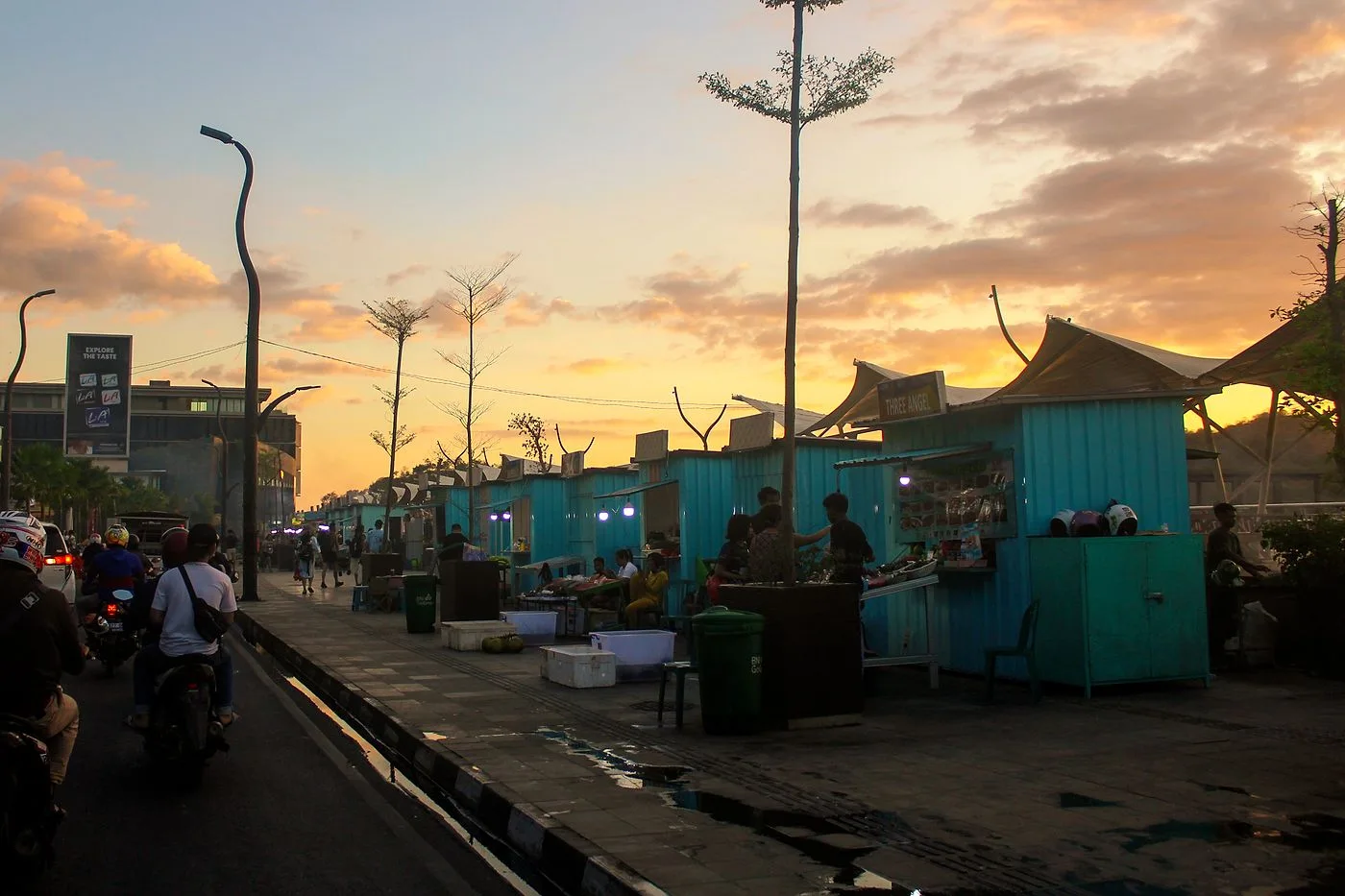
This is the one to plan around. Kampung Ujung is a strip of seafood stalls on the coastal road that switches on around six in the evening and runs until ten or so. You walk the line, you look at what is on ice, you point, you agree a price before anything gets cooked, and then it goes on the grill in front of you. Snapper, grouper, squid, prawns, lobster if you want to spend properly.
Agree the price first. Not because anyone is running a scam, but because lobster is sold by weight and the number can climb faster than you expect if you wave vaguely at the biggest one. For fish, most people eat very well for 60,000 to 150,000 rupiah a head. Arrive around half past five if you want the sunset from the same spot, or after seven if you would rather have the full night market noise and do not mind waiting for a table.
It is cash and QRIS territory. Very few of the stalls take cards.
Where the town actually eats
Behind the waterfront, around the old market area, there are warungs doing nasi campur, bakso and soto ayam for 15,000 to 40,000 rupiah. No English menus, no photographs on the wall, frequently no sign. These are best in the early morning, between about six and eight, and many of them shut by mid afternoon. If you are up early on your last morning with a flight to kill, this is a better breakfast than your hotel is serving.
At the other end, the waterfront restaurants run 100,000 to 250,000 a head with a view and a wine list. Both are reasonable. The mid range is thinner here than in Bali, which surprises people.
One practical note that matters after a dive week: kitchens close early. Most stop serving around ten. If your boat comes in late or your driver is slow off the mark, do not assume you will find dinner at eleven, because in most of the town you will not.
Coffee, and the Flores angle
Flores grows good arabica, mostly up around Bajawa and Manggarai, and the cafes in town have got noticeably better at making something of it in the last few years. If you want a souvenir that is not a carved dragon, a kilo of Flores beans from a roaster in town travels better and gets used. Ask for Manggarai or Bajawa specifically rather than accepting "Flores coffee" as a description, since the two taste quite different and the good places will happily tell you which is which.
Batu Cermin, the reef you can walk into
Four or five kilometres east of town there is a limestone cave called Batu Cermin, which translates as mirror stone. The name comes from what happens around the middle of the day, when sunlight comes through a gap in the roof, hits walls that are studded with salt crystal, and scatters. Most guides will tell you to come between nine and one for exactly this reason, and they are right, because outside those hours it is just a cave.
The reason to send divers there is not the light effect. It is the walls. Batu Cermin is uplifted seabed, and there are marine fossils in the rock, coral structures and shells sitting in limestone a hundred metres above the water. You spend a week looking at living reef in Komodo and then you can go and put your hand on a dead one that got pushed into the air by the same tectonics that make the diving here what it is. Nobody sells it that way. They should.
Practically: foreign entry runs around 50,000 rupiah, a guide is either included or costs another 20,000 to 50,000 depending on who is at the gate that day, and the whole visit takes about an hour. Open roughly eight or nine in the morning to five in the afternoon. It is cash only. There is a 300 metre walk in from the car park through bamboo, then some ducking and a couple of genuinely narrow squeezes inside, so wear shoes you can grip in and skip it if you are claustrophobic or your knees are unhappy. An ojek from town is 20,000 to 30,000 each way. It is around 100 metres above sea level, so it raises no altitude question at all.
The three half day trips, and which one to pick
These get sold as a bundle by every agency on the main street, usually as a single long day combining two or three of them with a driver. Taken individually they are more enjoyable and much less rushed.
Rangko Cave
An hour or so north of town, then fifteen or twenty minutes in a local wooden boat, and you arrive at a cave with a saltwater pool in the floor of it. When the sun is high the light comes through the opening and lights the water from above, and you swim in a pool inside a rock chamber. It is a genuinely lovely thing and it photographs absurdly well.
Timing is everything. Go around midday. Go at four in the afternoon and you get a dark hole with cold water in it, and people do this constantly and come back unimpressed. The pool is tidal and brackish to properly salty depending on the state of the tide, and it is at sea level, so this is the most no-fly-day-friendly excursion on the list. If you want one thing to do with a post cruise day and you would like it to still involve water, this is our pick.
Cunca Wulang
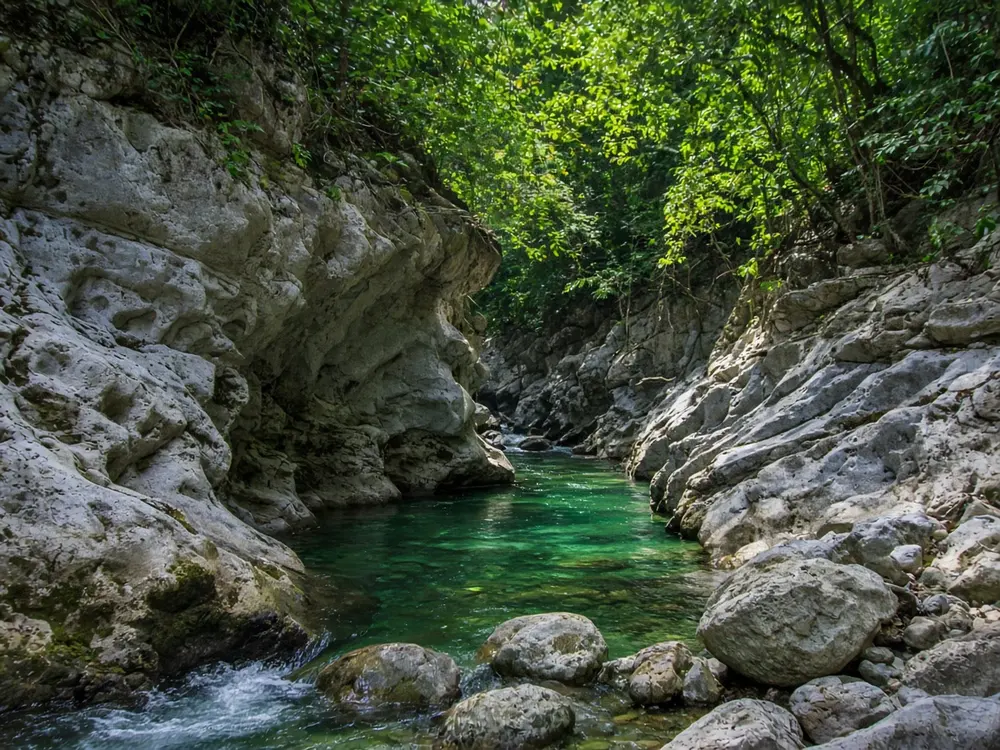
About 30 kilometres south, an hour by road, then a walk of roughly twenty minutes down into a limestone gorge with a river running through it. There are swimming holes, sections narrow enough that you swim between the walls, and rocks people jump off. Entry is only 20,000 to 25,000 rupiah with a local guide for another 50,000 to 100,000, which makes it the cheapest good day out around Labuan Bajo.
Season changes it a lot. In the dry months from about April to October the water is lower and the rock formations are more exposed, and conditions are predictable. In the wet season the flow is stronger and the swimming is better, but after heavy rain the entrance section is sometimes not passable at all, and the jumps need more care. As covered above, if you are on your no-fly day, swim and leave the jumping alone.
Melo Village
Melo sits in the hills at Liang Ndara, about 17 kilometres out and 30 to 45 minutes by road, at roughly 600 to 625 metres. It is a Manggarai village that has organised itself around cultural tourism through a local cooperative, and the draw is the Caci, a whip and shield dance between two men that is a real Manggarai tradition rather than something invented for visitors. There is also Rangkuk Alu, the bamboo pole jumping game, which guests always end up being pulled into.
Two things to know. The Caci is not performed daily and has to be arranged in advance through an agency or the village cooperative, so turning up unannounced gets you a view and a coffee and no dance. And the view is genuinely one of the best in West Manggarai, out over the hills to the islands of the park.
The elevation is the catch, and it is why we keep saying to do this one at the front of your trip. At 624 metres you are just over the line where diving guidance starts to care. Before the boat it is a non issue and it makes a lovely first afternoon in Flores.
The practical layer nobody briefs you on
Small things, but they are the ones that go wrong.
Cash, cards and the ATM arithmetic
Labuan Bajo has plenty of ATMs. They cluster along Jalan Soekarno Hatta near the harbour and there is a row of them at the airport, with BCA, Mandiri, BNI and BRI all represented and all reliably accepting foreign Visa and Mastercard. The catch is the withdrawal cap, which sits somewhere between 1,250,000 and 2,500,000 rupiah per transaction depending on whether the machine is stocked with 50,000 or 100,000 notes. Each withdrawal usually triggers its own fee, so pulling a large amount means several transactions and several charges.
Hotels, dive operators and the better restaurants take cards, often with a two to three percent surcharge. Everything else, warungs, ojeks, the night market, laundry, park entry gates, porters, runs on cash and QRIS. Draw what you need for the week before you board, because there are no ATMs anywhere in the park. If you are thinking about crew gratuities, our guide to tipping on an Indonesian liveaboard has the numbers, and that is cash you need to have withdrawn before you leave town, not after.
Laundry, which is more urgent than it sounds
A week of diving produces a bag of salt stiffened, faintly biological clothing, and laundry in town runs about 20,000 rupiah a kilo with same day or next day turnaround. Most places on the side streets will do it. If you are connecting onward to Bali or elsewhere in Indonesia rather than flying straight home, dropping a bag off the morning you disembark and collecting it that evening is the single highest value errand of your land day.
Wet dive gear is a different problem. Boats rinse and dry what they can, but a wetsuit that came off the line at six in the morning is not dry, and packing it wet for a long flight is how a bag arrives smelling like a swamp. Hotels with a roof terrace or a garden will usually let you hang things for the day if you ask. Ask.
The medical facts worth knowing before you need them
Siloam Hospitals Labuan Bajo, on Jalan Gabriel Gampur in Gorontalo a few minutes inland from the harbour, is the largest hospital in town and runs a 24 hour emergency department. It holds the only hyperbaric chamber in Labuan Bajo, installed in October 2018 and the first anywhere in East Nusa Tenggara. That single fact changes the risk picture of diving Komodo compared with more remote Indonesian itineraries, and it is worth knowing where the building is even though you will almost certainly never go near it.
Do not treat it as a walk in. Chamber availability changes, it can be under maintenance or already occupied, and the first call in any suspected incident should be to your operator or to the Divers Alert Network hotline rather than to a taxi. Our guide to decompression sickness on a liveaboard dive week covers what the symptoms actually look like, which is the part most divers are vague on.
For everything ordinary, there are pharmacies on the main street. Bring your own supply of anything you actually depend on, because brand availability is patchy.
Getting connected again
Coming off a boat, most people want a signal before they want anything else. Coverage in town is fine and an Indonesian eSIM activates in a couple of minutes if you did not sort one out on the way in. We go through the options and the coverage reality in the park in our guide to Indonesian SIM cards and eSIMs.
Two plans that work
Rather than a list of everything, here is how we would actually spend each window.
The afternoon and evening before you board
Land, drop bags, and go straight out to Melo while you still can, because this is the only window in which the altitude is irrelevant. Back by late afternoon. Puncak Waringin for the sunset, then walk down to Kampung Ujung and eat fish by the water. Draw your cash for the week on the way back to the hotel. Sleep early, because the first day on a boat starts sooner than you think.
If you land too late for Melo, Batu Cermin is only fifteen minutes out and works right up until five.
The no-fly day after you disembark
Off the boat by eight or nine. Hotel or left luggage, then laundry in. Batu Cermin mid morning while the light is doing its thing, or Rangko Cave if you would rather have a proper half day and do not mind the drive. Both are at sea level and neither raises a question. Long lunch. Afternoon doing nothing, which after seven days of four dives a day is not a waste. Sunset at Puncak Waringin, dinner at the night market, collect your laundry, fly out the following morning with eighteen hours behind you and a dry wetsuit.
What we would not do with that day: Wae Rebo, Melo, or a session throwing yourself off the rocks at Cunca Wulang. Not because any of them are dangerous in isolation, but because the timing is wrong and all three of them are better at the other end of the trip anyway.
If you are still working out when to come at all, our month by month guide to Komodo covers how the seasons change both the diving and the land weather. And if you want a hand fitting a land day around a specific departure, contact us and we will tell you honestly whether it fits.