Most people who come to Komodo never look inland. They fly into Labuan Bajo, step onto a boat, spend a week underwater, and fly out again without seeing more of Flores than the road between the airport and the harbour. That is a reasonable way to spend a holiday. But there is a village about five hours inland, sitting in a bowl of mountains at roughly 1,200 metres, where seven conical thatched houses stand in a circle around a stone altar, and getting there involves a walk of two to three hours that no vehicle can shorten.
Wae Rebo is the most photographed place in the Manggarai highlands and still one of the least understood. Guests booking a Komodo liveaboard ask us about it constantly, usually with the assumption that it is a half day trip from town. It is not. It is a two day commitment at minimum, the rules for visiting changed twice in 2026, and there is a decompression problem hidden in it that nobody selling the tour is going to mention. This guide covers where it is, how to get there, what it costs now, how to fit it either side of a cruise without hurting yourself, and what is expected of you once you arrive.
What Wae Rebo actually is
Wae Rebo is a living Manggarai village in West Satar Mese district, Manggarai Regency, on the southern side of western Flores. It sits at 8°46'S, 120°17'E in a natural amphitheatre ringed by seven peaks. Sources put the altitude anywhere between 1,088 and 1,250 metres depending on whether they measured the village floor, the ridge or the trail high point, and the honest answer is somewhere around 1,100 to 1,200 metres. Remember that number. It matters more than it looks, and we come back to it later.
The name is literal. In Manggarai, wae means water and rebo means fog or dew, which is a fair description of a place that spends much of the year wrapped in cloud. The village markets itself as the village above the clouds, and for once the marketing is accurate rather than aspirational. Cloud genuinely pours over the ridge in the late afternoon and sits in the bowl until the sun burns it off the following morning.
The seven houses
What you have seen in photographs are the mbaru niang, conical houses framed in timber and bound with rattan, thatched from the ground to the point with palm fibre so that the roof and the wall are the same object. There are seven of them, arranged in an open circle. The number is not arbitrary. Each corresponds to one of the seven peaks surrounding the village, which are treated as the guardians of the community's wellbeing.
Each house has five levels, and each level has a job. The ground floor is where families live and sleep. The floors above hold seed stock, food stores and, at the top, offerings for the ancestors. A single mbaru niang normally accommodates six families. The exception is the niang gendang, the main or drum house, which holds eight and functions as the ceremonial centre of the village. That works out at roughly 44 families, though in practice not everyone lives up there full time, and numbers move with the school year and the coffee harvest.
At the centre of the circle sits the compang, a round platform of rammed earth and stone. It is an altar, not a monument, and it is used. Ceremonies addressed to God and to the ancestors happen there. Do not climb on it, do not sit on it, and do not put a camera bag down on it while you change lenses.
The UNESCO thing, which is usually reported wrongly
You will read on a great many websites that Wae Rebo is a UNESCO World Heritage Site. It is not, and the distinction is worth getting right if you are going to talk to anyone in the village about it.
By the early 2000s the mbaru niang were in poor condition and the form had effectively vanished from the rest of the Manggarai highlands, replaced through the mid to late twentieth century by rectangular houses with tin roofs. The community, working with conservation architects, rebuilt them using traditional techniques and local materials. In August 2012 that work won the Award of Excellence, the top honour in the UNESCO Asia-Pacific Awards for Cultural Heritage Conservation, announced in Bangkok. It is an award for conservation practice rather than a World Heritage listing, and arguably it says more about the village than a listing would, because it recognises something the community did rather than something it inherited. Wae Rebo went on to take an Indonesia Sustainable Tourism Award in the culture category in 2018 and a national tourism village award in 2021.
The upshot for a visitor is simple. This is not a preserved site or an open air museum. It is a working village of coffee farmers who agreed to let people walk in, and the arabica grown on the slopes around it is a real part of the local economy rather than a souvenir. Buy some. It is good, and the money stays in the right place.
Getting there from Labuan Bajo
There are two stages, and neither can be skipped. First a long drive to the end of the road on the south coast, then a walk uphill through forest. No road reaches Wae Rebo, and there is no helicopter option, no matter what someone in a bar in Labuan Bajo tells you.
The drive covers roughly 110 to 130 kilometres and takes four to six hours, occasionally seven if it has been raining hard or you are in a slow vehicle. That average speed tells you everything about the road. The first stretch out of Labuan Bajo is sealed and genuinely improved compared with a few years ago. The last section is not. It narrows, the surface breaks up, and it climbs and drops through a series of tight switchbacks where meeting a truck means somebody reverses.
Two routes are in common use. The inland route runs through Ruteng, the Manggarai regional capital, then south through Todo to the coast, and takes about three and a half to four hours to Ruteng plus another one and a half to two hours down to the trailhead villages. The southern coastal route goes via Lembor and is more direct. Which one your driver picks depends on conditions, and it is worth letting them choose rather than insisting on the one you read about.
Denge, Dintor and where the walk starts
The road ends at a pair of villages, Denge and Dintor, which sit close together near the coast. Denge is the older and better known starting point. Dintor, sometimes given as Wae Lomba, has become the more common access in the last couple of years because the approach is shorter and the trek from it is more efficient. Both work. Your guide or homestay will tell you which one you are using, and it is not a decision you need to make in advance.
From the village there is one more short section of track up to the trailhead proper, usually called Pos 1. It is too narrow, steep and broken for a car. You go up on the back of an ojek, a motorbike taxi, for around IDR 50,000. It takes about fifteen minutes and most people find it the least comfortable part of the whole journey, which says something, because the drivers are extremely good at it.
The walk
| Distance | About 4.5 to 5 km each way, so 9 to 10 km round trip |
|---|---|
| Elevation gain | Roughly 600 to 750 metres from the trailhead |
| Time going up | 2 to 3 hours at a steady pace, longer in wet conditions |
| Time coming down | 1.5 to 2 hours |
| Difficulty | Easy to moderate, with sustained uphill and no technical sections |
| Surface | Forest trail, roots and stone, slippery clay after rain, several small river crossings |
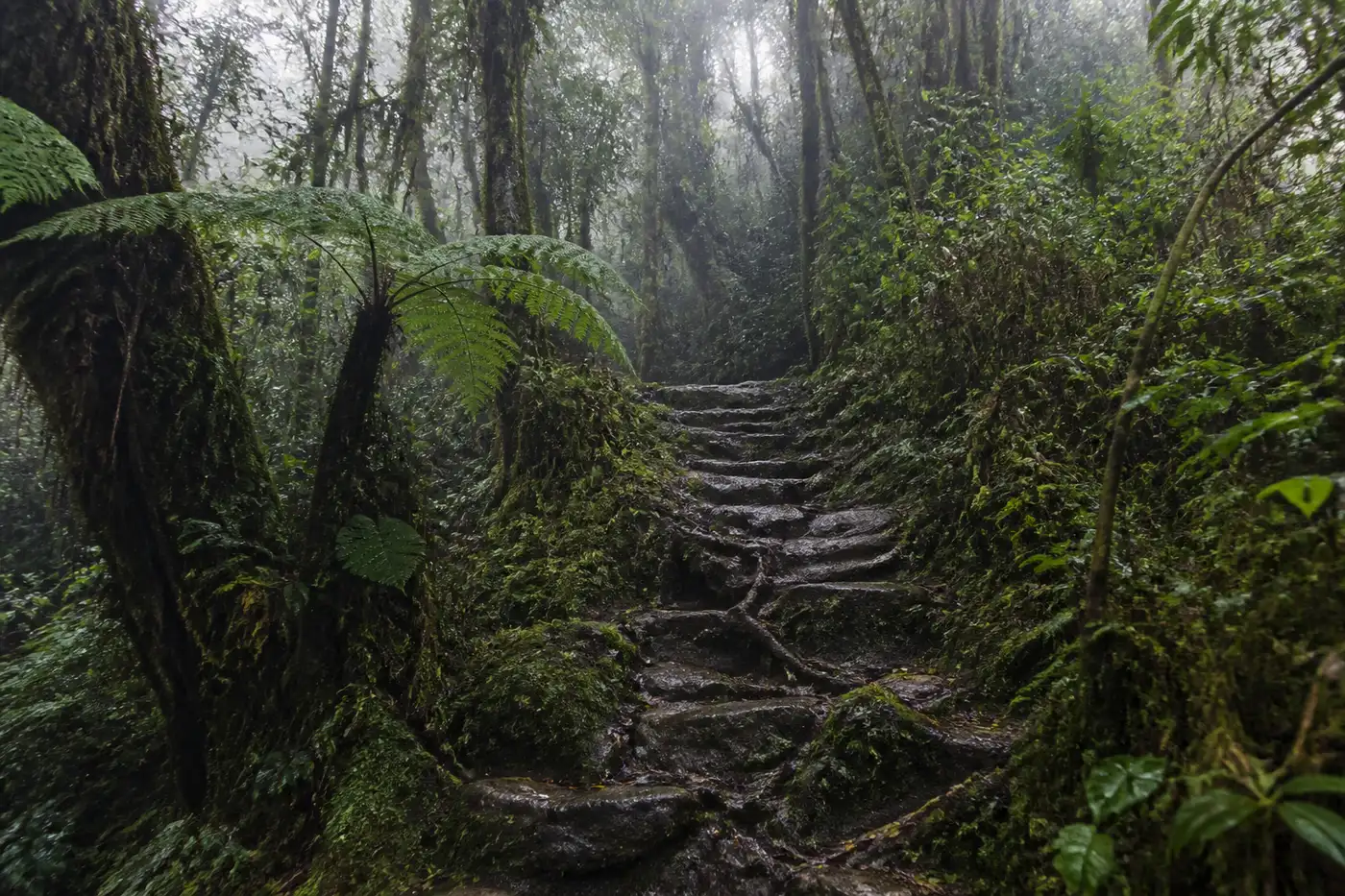
It is not a mountaineering exercise. It is a steady, unrelenting climb through cloud forest on a clear and well used path, and reasonably fit people in their sixties and seventies do it regularly. What catches people out is the humidity and the fact that the gradient rarely lets up long enough to get your breath back. Trainers with worn soles are the usual mistake. After rain the clay goes greasy and the stepping stones at the river crossings shift position between seasons, which is one of the reasons to take a local guide rather than navigate alone. Expect to pay somewhere around IDR 250,000 to 400,000 for a guide for the day, and IDR 150,000 to 250,000 for a porter if you would rather not carry your own bag. Both can be arranged through the homestays in Denge and Dintor or through whoever books your trip.
Roughly two thirds of the way up there is a wooden platform where guides stop and beat a length of hanging timber to announce the group. The sound carries down into the village so that the community knows visitors are coming. It is also the point where most people sit down and stop talking for a while.
The 2026 rule change nobody tells you about
This one has caught out a lot of independent travellers this year, so read it twice. Since 1 May 2026, every visitor must register and pay in full at the Wae Rebo Tourist Information Centre in Dusun Kombo, before starting the walk. Payment in the village itself is no longer accepted except in circumstances the managers decide on case by case. You get an official receipt at the TIC, and that receipt is what gets you into the village.
There are also cutoff times for starting the climb, set for safety rather than convenience, because the last thing anyone wants is visitors on a forest trail after dark. If you are staying the night, you must start before 16:00 local time. If you are visiting for the day only, you must start before 12:00. Miss the cutoff and you sleep in Denge, which is not a disaster but is not what you paid for.
Work backwards from those numbers and the trip plans itself. A 16:00 cutoff with a five to six hour drive in front of it means leaving Labuan Bajo by about 09:00 at the very latest, and that assumes nothing goes wrong. Most operators leave considerably earlier. This is also why a good many people break the journey with a night in Ruteng and drive the short final leg fresh the next morning, which we would generally recommend over arriving at the trailhead already tired.
What it costs in 2026
Prices moved this year alongside the change to the payment system, and the figures below are what the village management published for the 2026 season. Treat them as a floor rather than a fixed tariff, because packages vary with group size and with whoever is arranging your trip.
| Overnight package, per person per night | From IDR 325,000, commonly quoted at IDR 350,000 to 500,000 |
|---|---|
| Day visit, per person | From IDR 200,000, commonly quoted at IDR 200,000 to 250,000 |
| Wae Lu'u customary contribution | No fixed amount, given as you see fit |
| Ojek, village to trailhead | Around IDR 50,000 each way |
| Local guide | IDR 250,000 to 400,000 per day |
| Porter | IDR 150,000 to 250,000 per day |
| Car and driver from Labuan Bajo | Usually IDR 700,000 to 1,000,000 per day, more for a multi day charter |
The overnight rate covers a sleeping place inside a mbaru niang, dinner, breakfast, coffee or tea, and basic bedding, meaning a mattress on the floor and a blanket. The day rate normally includes lunch and a drink. The Wae Lu'u is separate from both and is not a tip. It is a customary contribution handed to the village elders during the welcome ritual, and there is deliberately no price on it.
Bring cash, all of it, in notes small enough to be useful. There is no ATM in Denge or Dintor, no card machine, and no QRIS payment up in the village. Your last reliable cash points are Labuan Bajo or Ruteng. Running short at the TIC in Kombo after a five hour drive is a genuinely miserable way to end a day, and it happens to somebody every week.
Fitting it around a Komodo liveaboard
Here is the part that matters if you are diving, and the part that no tour desk in Labuan Bajo is going to raise with you.
Wae Rebo sits at roughly 1,200 metres. Diving guidance treats any ascent above about 600 metres after diving as an altitude exposure, governed by the same physiology as getting on an aeroplane, because what harms you is the drop in ambient pressure rather than the aircraft. Our guide on how long to wait before flying after diving goes through the surface interval in detail, and the same intervals apply here. Finishing a dive on Saturday afternoon and standing on that ridge on Sunday morning is not a cultural excursion as far as your body is concerned. It is an ascent to altitude.
It gets slightly worse, because the drive itself is an altitude excursion. Ruteng, the town most inland routes pass through, sits at about 1,100 metres, and the Todo road crosses higher ground still. You do not have to reach the village to have gone up. You only have to take the road.
The simple version
Do Wae Rebo before the boat, not after. Guests who arrive in Labuan Bajo two or three days early, drive out, walk up, sleep in the village and come back down have a wonderful time and step onto the boat with nothing to think about. Guests who try to bolt it onto the end of a cruise are compressing an altitude exposure, a long drive and usually a flight home into about seventy hours, and the sequencing has to be right or it is not safe. If the days at the end are the only ones you have, spend them at sea level instead; there is a full list of things to do in Labuan Bajo that carry no altitude penalty at all.
If the end of the trip is the only slot you have, build in a full clear day between your last dive and the drive inland. That day is not wasted. It is the same buffer day you should be leaving before your flight anyway, so in practice you are moving the buffer rather than adding one, and you can spend it at sea level in Labuan Bajo.
Two days minimum, three is better
Ignore anyone offering Wae Rebo as a day trip from Labuan Bajo. On paper it is possible if you leave at three in the morning and everything runs perfectly. In practice you would spend ten to twelve hours in a vehicle, walk four to five hours, and get perhaps ninety minutes in the village, arriving in the heat of the middle of the day when the cloud has burned off and the light is flat. You would also be pushing the 12:00 cutoff for day visitors, which means one puncture ends the trip at the TIC.
The village at dawn is the entire point. Mist sitting in the bowl, smoke coming up through the thatch, the community starting its day around you, and almost nobody else there because the day visitors have not arrived yet. That is worth arranging your travel around.
It closes, and not always with warning
Wae Rebo is not a permanently open attraction. It shut to visitors on 21 July 2026 because of extreme weather, staying closed while the management assessed the trail and the village's readiness, and reopened on 1 August 2026. Closures also happen for customary ceremonies, which are not scheduled around tourism and are not negotiable.
So do not make Wae Rebo the immovable centrepiece of a trip that has a flight bolted to the end of it. Have a second plan, keep the arrangement flexible, and have whoever is organising it confirm the village is open within a few days of you travelling rather than relying on a booking made months earlier.
Staying the night, and how to behave when you get there
You do not simply walk into Wae Rebo. Before anything else happens, before you unpack, wander around or take a single photograph, your guide will bring you into the niang gendang, the main house, for the Wae Lu'u welcome ritual.
An elder addresses the ancestors in Manggarai, explains who you are and where you have come from, and asks that you be received and kept safe while you are there. It takes a few minutes. You sit, you stay quiet, you take your hat off, and you wait until you are told the village is open to you. Ask before photographing any part of it, and accept no as an answer. This is not a performance staged for arrivals. It is the mechanism by which strangers are made acceptable to the place, and skipping it or treating it as a photo opportunity is the fastest way to be remembered badly.
What the night is actually like
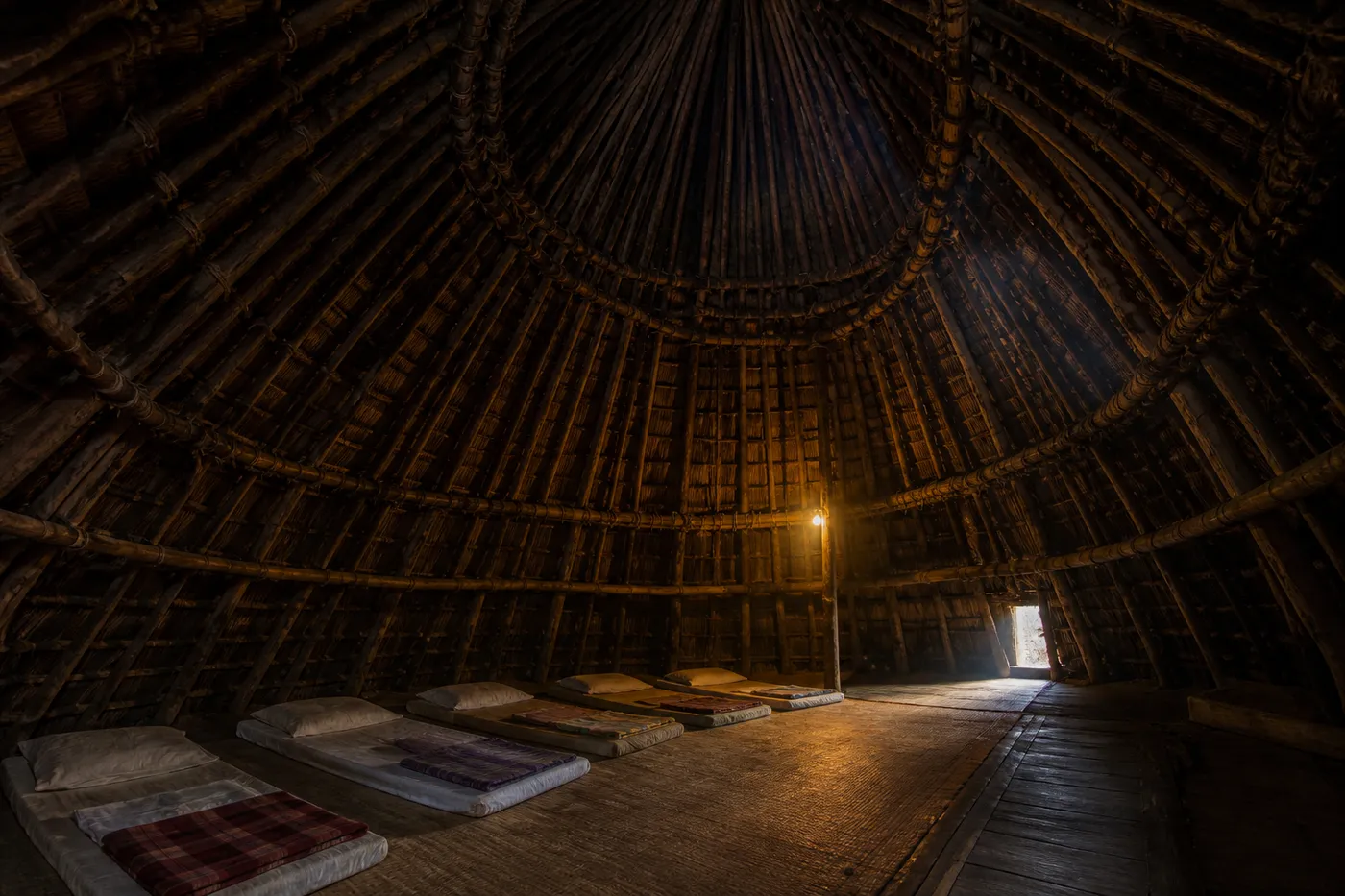
Accommodation means a mattress and a blanket on the floor of a communal house, alongside other visitors. There are no rooms and no doors. Facilities are basic and washing is cold. Electricity runs for limited hours from a generator, so charge everything before you leave the coast and bring a head torch, which you will use more than you expect. Mobile signal ranges from nothing to almost nothing, which most people find is the best feature of the place by the second hour.
Bring a warm layer. This surprises people every single time. They have spent a week diving in twenty eight degree water and packed accordingly, then discover that a mountain bowl at 1,200 metres in the small hours is cold enough to keep you awake. A fleece and long trousers are enough. Food is simple, local and generous, usually rice and vegetables with coffee grown a few hundred metres from where you are sitting.
The etiquette, briefly
- Dress modestly, covering shoulders and knees, and keep it that way inside the village rather than just for the ceremony.
- Ask before photographing people, particularly children and anyone taking part in a ritual.
- Stay off the compang, the stone altar at the centre of the circle.
- Do not enter a house you have not been invited into, and follow your guide's directions on where you may and may not walk.
- Carry your rubbish back down. Everything that goes up has to come down on somebody's back.
When to go, and what to put in the bag
The dry season, roughly May to October, gives you the best odds of a walkable trail and a clear view from the ridge. April and November are usually fine at the edges. From December to March the path turns to mud, the river crossings run higher and the cloud can sit in the bowl all day, so you make the walk and see very little. The village can be visited year round, but in the wet months you are trading comfort and visibility for a quieter village.
Footwear with actual grip matters more than anything else you carry. Trail shoes or light boots, not the trainers you wore on the plane. Beyond that: a rain layer that packs small, a warm layer for the night, a head torch, a two litre water supply, cash in small notes, and a daypack. Leave your main luggage at a homestay in Denge or Dintor, because nobody enjoys carrying a wheeled suitcase up 600 metres of forest, and it is a sight the porters have seen more often than you would think.
One small thing worth building in if your timing allows it. Dintor faces west across the Sawu Sea towards Mules Island, and the sunset from the shoreline there is one of the better ones in Flores. Most visitors arrive in the afternoon, go straight to their homestay and miss it entirely before the early start the next morning.
Is it worth it?
If your idea of a good holiday is efficient, no. The arithmetic is brutal: something like twelve hours of travel in each direction for one night in a village, and you will spend more time getting there and back than you spend in the place itself.
But almost nobody comes back describing it as a poor use of two days. What people tend to talk about afterwards is not the architecture, striking as it is, but the specific quiet of standing in that circle at six in the morning with cloud pouring over the ridge, and the sense that the village is carrying on exactly as it would if you were not there. That is unusual, and it is getting rarer.
Our practical advice is unchanged and simple. Build it into the front of your trip rather than the back, give it two nights and three days if you possibly can, book it through people who will tell you honestly when the village is closed, and treat the altitude as seriously as you would a flight. Then get on the boat and go diving in Komodo with the best land day in Flores already behind you rather than hanging over the end of your holiday.