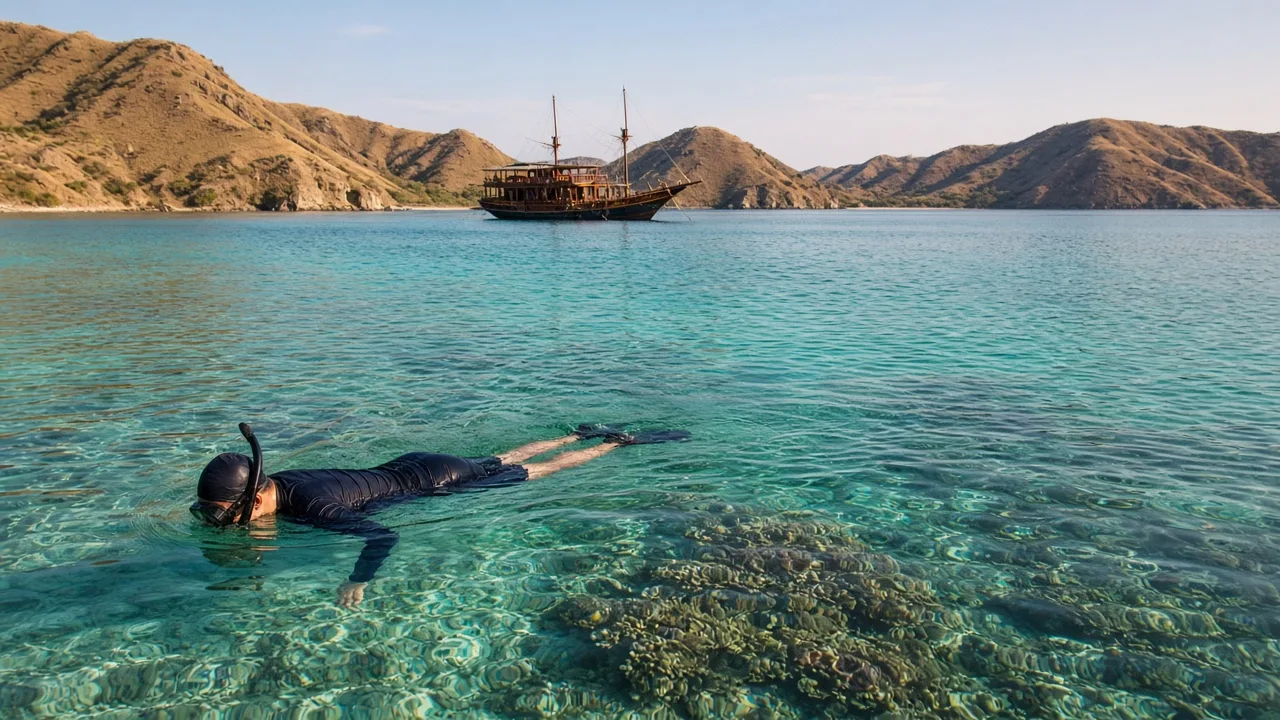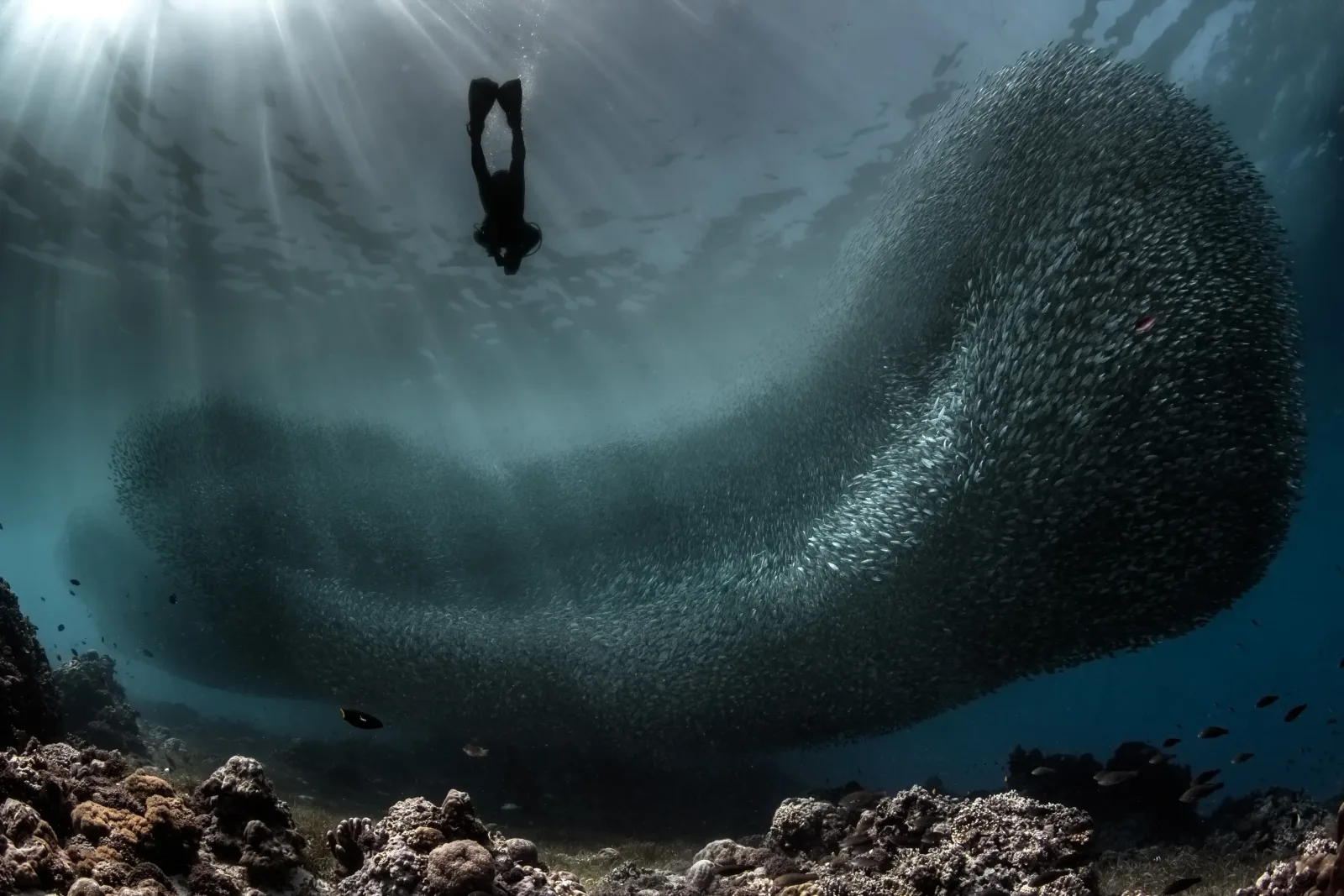
Every week someone on one of our boats asks the cruise director the same question, usually on day five, usually with a flight itinerary open on their phone: "My flight out of Labuan Bajo is at 11 AM. Can I do the morning dive the day before?" It is the right question to ask. Flying too soon after diving is one of the few genuinely dangerous mistakes a recreational diver can make, and it is also one of the easiest to avoid, because the guidelines are clear and the planning is simple once you know the numbers. On an Indonesia liveaboard, where nearly every guest arrives and leaves on a domestic flight, the question is not academic. It shapes the last day of every trip we run.
The short answer, straight from the Divers Alert Network guidelines: wait at least 12 hours after a single no-decompression dive, at least 18 hours after multiple dives per day or multiple days of diving, and 24 hours or more after any dive that required decompression stops. Liveaboard divers are almost always in the second or third category. This guide covers where those numbers come from, what is actually happening in your body during the wait, how your dive computer's no-fly timer fits in, and, because this is what we do all day, how to build an Indonesian dive trip around the rule without losing dives you paid for. If you are still comparing trips, our guide to scuba diving in Indonesia covers the regions themselves; this article covers getting home from them safely.
The short answer: 12, 18, and 24 hours
The waiting periods below are the consensus recommendations from the 2002 Flying After Recreational Diving Workshop, organised by the Divers Alert Network (DAN) and the Undersea and Hyperbaric Medical Society. They remain the standard reference in 2026, and they are what every reputable training agency teaches. They apply to divers with no symptoms of decompression sickness who will be flying at cabin altitudes between roughly 600 and 2,450 metres (2,000 to 8,000 feet), which covers essentially every commercial flight you will ever take.
| Your diving | Minimum preflight wait | Typical situation |
|---|---|---|
| Single no-decompression dive | 12+ hours | One morning dive on a day trip |
| Multiple dives per day, or multiple days of diving | 18+ hours | Any liveaboard trip, any dive holiday |
| Dives requiring mandatory decompression stops | 24+ hours, longer is prudent | Technical or accidental deco profiles |
Two things about that table matter more than the numbers themselves. First, these are minimums, not targets. DAN is explicit that longer surface intervals further reduce the risk of decompression sickness, and the workshop data showed cases occurring inside the minimums under some profiles. Second, if you are reading this because you are planning a liveaboard, you are in the 18-hour row. Nobody does a single dive on a liveaboard. A typical Komodo or Raja Ampat week runs three to four dives a day for five or six consecutive days, which is close to the most nitrogen-loaded profile a recreational diver ever carries. We treat 18 hours as the floor on our boats and we build the schedule so most guests get more, usually somewhere in the 20 to 26 hour range depending on the flight.
Where the numbers come from
The guidelines are not folklore; they came out of one of the larger experimental programmes in recreational dive medicine. Between 1992 and 1999, DAN and Duke University ran flying-after-diving trials in dry hyperbaric chambers, putting volunteers through dive profiles near recreational no-decompression limits and then exposing them to a simulated cabin altitude of 8,000 feet. Across 802 trials there were 40 incidents of decompression sickness during or after the simulated flight. The pattern in the data was reasonably clean: for single no-stop dives to 18 metres or deeper, no DCS occurred with surface intervals of 11 hours or longer. For repetitive no-stop dives, cases occurred with surface intervals shorter than 17 hours. The 2002 workshop rounded those observations into the 12 and 18 hour recommendations and acknowledged that decompression diving had too little data for a firm number, hence the cautious "substantially longer than 18 hours" wording that most agencies communicate as 24 hours or more.
It is worth knowing the limitations of that research, not to dismiss it but to respect its margins. The trials were run on people at rest, in dry chambers. Real divers swim, get cold, get sunburnt, carry gear up ladders, sleep badly, and drink a beer at sunset. Almost all of those variables push nitrogen physiology in the unhelpful direction. The researchers knew this, and it is one reason the published minimums should be read as a lower boundary rather than a precise safety line. In most years we see this play out on the boats: the guests who cut the interval closest are rarely the ones with problems, but the handful of DCS cases the Indonesian chambers treat each season from all operators combined are heavily weighted toward people who flew early, dived hard on the last day, or both.
What is actually happening in your body
The mechanism is simple enough to explain in a paragraph and worth understanding, because it makes the waiting periods feel like physics rather than bureaucracy. Every minute you spend breathing compressed air at depth, nitrogen dissolves into your blood and tissues at a higher concentration than it holds at the surface. When you ascend, that nitrogen comes back out of solution gradually, exhaled a little with every breath over the hours that follow. Slow tissues (joints, fat, spinal tissue) offload much more slowly than fast ones. After a week of repetitive diving, your slow tissues are still meaningfully loaded 12 hours after your last dive, even though you feel completely normal.
A commercial aircraft cabin is pressurised, but not to sea level. Cruise cabin altitude is typically the equivalent of 1,800 to 2,450 metres of elevation, which is a 20 to 25 per cent drop in ambient pressure compared with the beach you just left. Drop the pressure around a nitrogen-loaded body and the dissolved gas wants to come out of solution faster, and if it comes out fast enough it forms bubbles in tissue and blood. Bubbles in the wrong place are decompression sickness: joint pain, skin mottling and rashes at the mild end; numbness, vertigo, difficulty walking, and bladder or bowel dysfunction at the serious end. Getting bent at altitude is materially worse than getting bent at the surface, because the treatment (recompression in a hyperbaric chamber) is hours away in the best case, and the aircraft cannot descend below its route floor to help you. That same drop in pressure is why flying home with a blocked ear hurts so much, which our guide to barotrauma in scuba diving treats as a separate problem from the nitrogen one.
One detail that surprises many divers: the rule is about altitude, not about aircraft. Driving over a mountain pass on the way home from a dive trip counts. The DAN guidance applies to any ascent to 2,000 feet (roughly 600 metres) or higher, by any means, within the waiting period. This matters in Indonesia less than in, say, Bali's volcanic interior; the coastal roads between our ports and airports stay near sea level, but guests who add a Mount Batur sunrise trek or a Kelimutu crater visit immediately after a liveaboard are making an altitude excursion, and the same waiting periods apply.
Your dive computer's no-fly time is not the DAN guideline
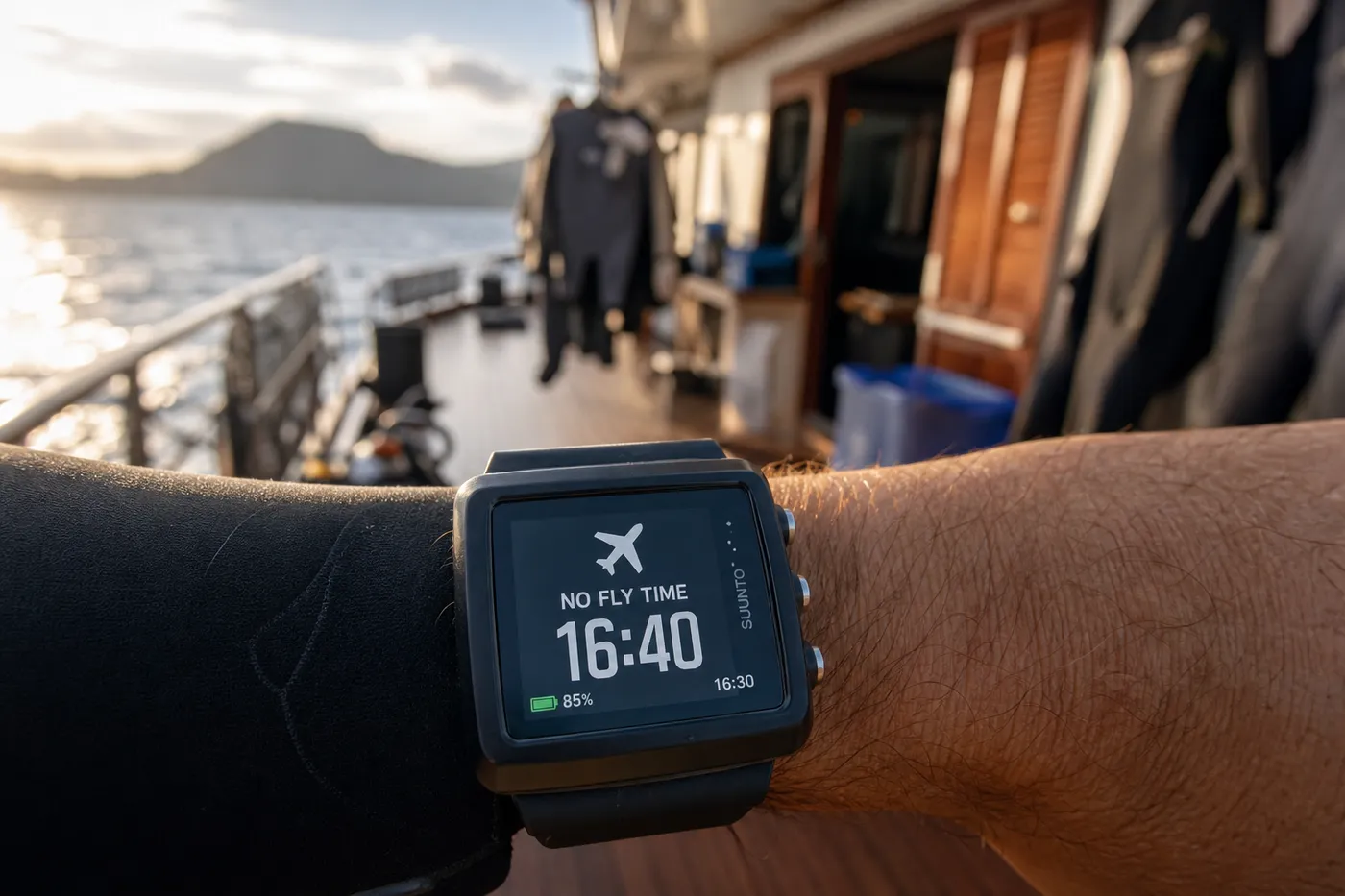
Every modern dive computer displays a no-fly countdown after diving, usually an aeroplane icon with a timer. Divers reasonably assume this is the authoritative number. It is not, or rather, it is one manufacturer's number, and the manufacturers do not agree with each other. Some computers run a fixed 24-hour countdown from the last dive regardless of profile. Others calculate a tissue-loading estimate and produce anything from 10 to 20 hours for a typical liveaboard week. A Suunto and a Shearwater sitting on the same wrist for the same week of diving will routinely show different no-fly times, sometimes hours apart.
The sensible way to use the two numbers together: obey whichever is longer. If your computer clears you at 14 hours but you did four days of repetitive diving, the DAN 18-hour minimum governs. If your computer is still counting at 19 hours after a deco-obligation dive, the computer governs. The computer knows your actual profiles; the DAN guideline knows the population statistics. Neither knows whether you slept, drank, or are dehydrated, so give yourself margin beyond both when the schedule allows. On our boats the cruise directors log every guest's last dive time and check it against the manifest of departure flights; give or take the odd charter guest with a private schedule, nobody boards a flight inside 18 hours.
Nitrox, dehydration, and the other variables that move your real risk
The published waiting periods assume air diving and an average body. Several factors shift the real risk in one direction or the other, and a diver planning a tight connection should know which side of the average they sit on.
Diving enriched air nitrox on an air computer setting, or on nitrox tables with conservative settings, reduces nitrogen loading dive by dive, and over a liveaboard week the cumulative difference is significant. This is one of several reasons we recommend nitrox certification before an Indonesian liveaboard; our guide to dive certifications worth taking before a liveaboard covers the course itself. Be careful with the logic, though: nitrox reduces loading, it does not shorten the official waiting period. DAN's numbers are the same whatever gas you breathed. Treat the nitrox benefit as extra margin inside the same 18-hour rule, not as a licence to fly at 14.
On the unhelpful side of the ledger: dehydration thickens blood plasma and slows gas elimination, and tropical liveaboard life is quietly dehydrating (sun, salt, air-conditioned cabins, the celebratory last-night beer). Age, body fat percentage, poor sleep, a patent foramen ovale, and strenuous exercise after diving all push the same direction. Exercise deserves its own sentence: hauling luggage, sprinting through Jakarta's Terminal 3 for a connection, or squeezing in a last-morning surf session all raise bubble formation risk in the hours after diving. The last day of a dive trip should be physically boring. We tell guests this plainly, and roughly half of them listen.
How liveaboard schedules are built around the rule
A well-run liveaboard never leaves the no-fly maths to the guest. The standard structure across the Indonesian fleet, ours included, is that the final full day of the trip ends with diving by early afternoon, the boat repositions to the departure port overnight, and disembarkation happens the following morning. Count the hours and you will see the logic: last dive at 2 PM, disembark at 8 AM the next day, and a guest on an 11 AM flight out of Labuan Bajo or Sorong is at 21 hours when the wheels leave the runway. Comfortably past 18, with margin for a delayed departure or an honest extra safety stop. Where guests do get caught is on the land side, booking a hill trip into that final morning without realising a mountain road counts as altitude; our guide to what to do in Labuan Bajo before and after a cruise sorts the local excursions by height for exactly this reason.
On our Komodo itineraries the last diving day usually finishes with a Batu Bolong or Siaba Besar dive before the boat turns for Labuan Bajo; on Raja Ampat trips the final afternoon is often a Dampier Strait site within a short steam of Sorong. The pattern is the same everywhere: the itinerary quietly sacrifices one afternoon dive slot at the end of the week to buy every guest their interval. When you compare liveaboard itineraries and one boat advertises "four dives daily including the final day," ask exactly what time the last dive ends and what time you disembark. The answer occasionally reveals a schedule that only works if your flight leaves after 4 PM.
When the airline moves your flight
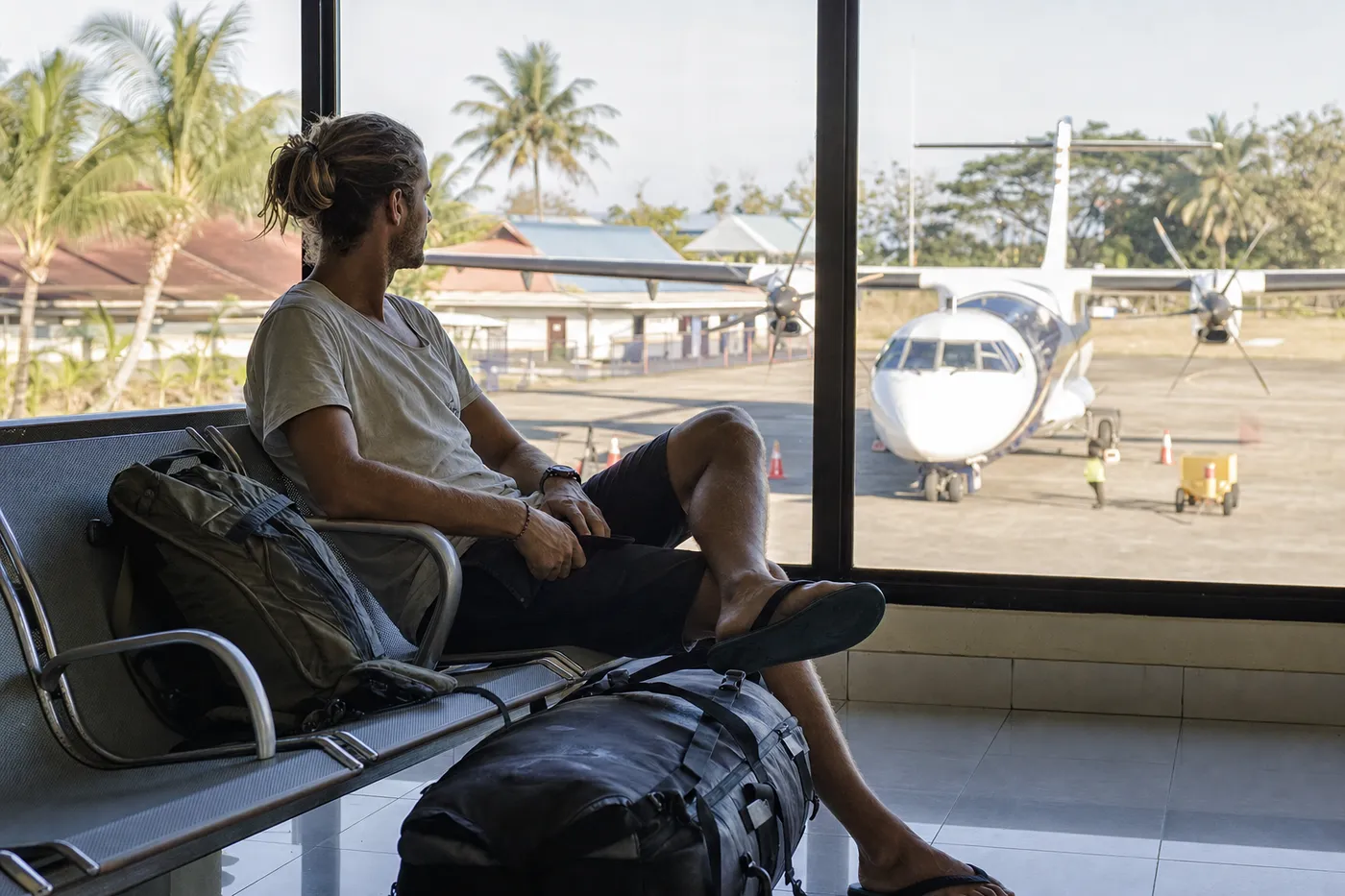
This is the version of the problem that actually bites, so it is worth walking through the arithmetic. Say your last dive is planned for the final afternoon at 2.30 pm and your flight out of Sorong leaves at 12.40 pm the next day. That is a comfortable interval of just over twenty-two hours. Then the airline moves the departure forward to 8.35 am, which happens often enough on Indonesian domestic connections that you should plan for it rather than be surprised by it. Your interval has quietly dropped to eighteen hours. The fix is usually cheap: sit out the final afternoon dive and make your last splash late morning instead, which puts you back over twenty-one hours. It costs one dive out of twenty. The general rule is that when the ticket changes the maths changes with it, so recheck the interval every time a schedule notification lands.
What to do with your extra day
The 18-to-24-hour window between last dive and flight is not dead time, and the ports are more interesting than people expect. In Labuan Bajo the standard moves are the Batu Cermin cave, a sunset at Paradise Bar, or simply a long lunch overlooking the harbour; guests with more energy day-trip to a waterfall at Cunca Wulang. In Sorong most guests sleep, eat, and organise photos, and honestly that is the right call after a Raja Ampat week. Our Labuan Bajo travel guide covers the town side in detail. What you should not do with the day: climb anything above 600 metres, freedive, do strenuous exercise, or drink heavily. Gentle topside tourism at sea level is exactly what the interval is for.
Planning your Indonesia trip around the no-fly window
Because nearly every liveaboard guest in Indonesia connects through Jakarta, Bali, or Makassar on domestic flights, the no-fly window belongs in your itinerary planning from the first booking, not the last day. The arithmetic that works, in our experience across a few thousand guests a year:
- Book your outbound international flight for the day after disembarkation, not the same day. Same-day connections from Labuan Bajo or Sorong to an evening international departure out of Jakarta or Bali can work on paper and then collapse when the domestic leg delays. A night in Bali or Jakarta on the way home removes both the DCS maths and the missed-connection risk in one move.
- Treat the domestic flight as the flight. The 18-hour rule applies to the 90-minute Labuan Bajo to Bali hop exactly as it applies to the long-haul home. Cabin altitude on an ATR turboprop or a 737 is in the same band.
- If you must fly the same day, tell the operator at booking. A good boat will adjust which dives you do on the final diving day, or tell you honestly that the itinerary cannot give you 18 hours. Either answer is useful before you have paid.
- Leave a buffer day before any altitude tourism. Bromo, Batur, Rinjani, Kelimutu, and Wae Rebo all sit well above the 600-metre line. Diving Saturday and standing on a 2,300-metre crater rim Sunday morning is the same physiology as flying.
- Check the interval again whenever a flight changes. Airlines in Indonesia reshuffle domestic schedules frequently, sometimes by hours. The plan you made at booking is only as good as the current ticket.
None of this is complicated, and it costs at most one dive and one hotel night. Against the alternative, a helicopter evacuation to the recompression chamber in Bali or Makassar and a holiday remembered for all the wrong reasons, it is the cheapest insurance in diving.
If symptoms appear anyway
The guidelines reduce risk; they do not abolish it. A small number of divers develop decompression sickness despite honest intervals, and a diver who knows the early signs is a diver who gets treated early, which is most of what determines the outcome. Mild (Type 1) symptoms are joint or musculoskeletal pain, skin rashes or mottling, swelling, and unusual fatigue. Serious (Type 2) symptoms are numbness or tingling, muscular weakness, loss of coordination, vertigo, confusion, chest pain or breathing difficulty, and bladder or bowel dysfunction. Anything on the serious list, or mild symptoms that persist or worsen, is a call to the DAN emergency hotline (+1 919 684 9111, 24 hours) and a conversation with a dive physician before you board any aircraft. The symptoms to watch for, and what happens on board if they appear, are covered in our guide to decompression sickness on a liveaboard.
Two practical points for Indonesia specifically. First, know where the chambers are relative to your route. Siloam Hospitals in Labuan Bajo has had one since October 2018, which is the relevant facility for Komodo; there is a hyperbaric unit at the regional hospital in Maumere for the eastern Flores itineraries; and the facilities operators route serious cases to are in Bali (Sanglah, Denpasar) and Makassar, with more in Jakarta and Manado. From Raja Ampat or the remoter eastern routes, reaching any of them involves a boat transfer and a low-altitude medevac flight, which is why every hour of honest surface interval is worth more out here than it would be in Florida. Second, carry dive insurance that explicitly covers hyperbaric treatment and evacuation. Chamber treatment runs to thousands of dollars per session and a serious case needs several sessions; evacuation multiplies that. We check certification cards at check-in, but the insurance question is on you, and the guests who wave it off are betting more than they think. Symptoms that appear in-flight do not improve at cruise altitude; tell the crew, breathe oxygen if offered, and get assessed on landing rather than "seeing how it feels" at the hotel.
Freediving, snorkeling, and the edge cases
A few situations the standard table does not obviously cover, answered the way we answer them on the boat. Snorkeling at the surface loads no meaningful nitrogen; a snorkeler can fly whenever they like, which is convenient for the non-diving partners we wrote about in our non-divers and snorkelers guide. Repeated breath-hold diving to depth is a different story: serious freediving sessions produce measurable nitrogen loading and documented DCS cases, and the working recommendation from DAN for a long session of deep freedives is to wait at least 12 hours, with some agencies suggesting more after repetitive deep sessions. A casual afternoon of duck-diving to five metres over a reef is not a serious freediving session, but a guest doing repeated 20-metre drops off the back of the boat on the last afternoon has quietly re-entered the waiting game.
Discover Scuba Diving participants and students mid-course follow the same rules as certified divers; one shallow DSD is a single no-deco dive (12 hours), a day with two training dives is repetitive diving (18 hours). Helicopter transfers deserve a mention because people assume they are exempt: they are not pressurised at all, and a transfer that crosses terrain above 600 metres counts as an altitude exposure. And for completeness, the rule that surprises the most people at the bar: a hot, long soak or massage immediately after the last dive is mildly discouraged by dive physicians too, since rapid peripheral warming can provoke bubble formation in loaded tissue. The last day, again, should be boring.
The bottom line
Wait 12 hours after a single dive, 18 after a dive holiday, 24 or more after decompression diving, and add margin whenever life allows. Read your computer's no-fly timer as a second opinion, obey the longer of the two numbers, and plan the last day of the trip as a surface day from the moment you book your flights. On a liveaboard, let the boat do most of this for you; it is our job, we do the arithmetic for every manifest, and the schedule already assumes it. The rule costs you one afternoon of diving per trip. What it buys is getting home with nothing to show for the week but a full logbook and several hundred photographs of mantas, which is the only acceptable outcome.
If you are at the planning stage, our Indonesia liveaboard seasons guide covers when to go, the packing list covers what to bring, and our first-time liveaboard guide covers everything else about the week itself. If you have a specific flight itinerary and want us to sanity-check the intervals against a trip you are considering, contact us with the flight times and we will do the maths with you before you book anything.