Every few weeks someone emails us a version of the same question, usually apologetically, usually with a line about not knowing who else to ask. She has booked an Indonesia liveaboard, the dates are fixed, the flights are paid for, and her period is going to land somewhere in the middle of it. Is that a problem? Is it dangerous? Should she have said something at the time of booking?
The short answer is no, no, and no. But the longer answer is worth writing down properly, because a week on a boat is a genuinely different proposition from a morning of scuba diving in Indonesia off a day boat, and almost everything published on this subject is written for the day boat. You can leave a day trip. You can walk to a pharmacy. You can go home and sleep in your own bathroom. On a liveaboard in the Banda Sea you can do none of those things, and the nearest shop may be two days of open water away.
So this guide covers the medical evidence, which is more reassuring than the internet suggests, and then it covers the part nobody writes about: supplies, waste, small bathrooms, seasickness, contraception that stops working when you are being sick, and what to do about a trip you booked eleven months ago that has landed on the wrong week. We have also put pregnancy and returning to diving after birth in here, because those questions arrive at our inbox just as often and they deserve straight answers rather than a shrug.
One thing before we start. Nothing here is a substitute for your own doctor, and we are a dive operator rather than a medical practice. Where the guidance below comes from published research or from diving medicine bodies we have said so, and where it comes from running boats in eastern Indonesia we have said that too.
The short answers first
If you only read one section, read this one.
- Can you dive on your period? Yes. There is no medical reason not to, no agency prohibits it, and you do not need to declare it to anyone.
- Does it raise your risk of decompression sickness? The honest answer is that the evidence is soft and mixed. Reported post-dive aches do vary across the cycle. Diagnosed decompression illness has not been shown to.
- Will sharks come for you? No. This one has been examined and there is nothing in it.
- Does the pill affect diving? No study has established that it does. It is specifically excluded from the medication question on the standard diver medical form.
- But can seasickness stop your pill working? Yes, and this is the one genuinely liveaboard-specific risk in this article. Details below.
- Can you dive while pregnant? No. This is the single place in this guide with no grey area, and the reason is specific rather than precautionary.
- How long after giving birth? Roughly four weeks after an uncomplicated vaginal birth, at least eight after a caesarean, twelve where there were complications, with clearance.
- Should you tell us anything? Only if you want to. It changes nothing operationally. Some guests mention it so the crew can be useful about timing, which is a reasonable thing to want.
Diving on your period, and what a week of it looks like at sea
Start with the evidence, because it is better than the folklore.
What the research actually shows
The largest dataset anyone has assembled on this comes from the Diving Diseases Research Centre in Plymouth, which tracked 34,625 dives across 21,165 dive days and 11,461 menstrual cycles. By the standards of diving research, where a study of forty people is respectable, that is an enormous sample.
What they measured matters more than the headline, so it is worth being precise. They recorded reported post-dive discomfort. Not confirmed decompression illness. Those are two different things and running them together is how this subject gets distorted every time it is discussed. Post-dive discomfort means the aches, the odd fatigue, the vague niggles that divers report after surfacing, the overwhelming majority of which are never diagnosed as anything at all.
The overall rate was 28.3 reports per 1,000 dives. Spread across the cycle it was uneven: 39.2 per 1,000 in the first week, dropping to 19.7 in the third week, then climbing again to 31.9 at the end of the fourth. The pattern was statistically significant and it was not a straight line. Smaller studies going back to the late 1980s, including work on altitude decompression, found something similar, which is why the finding is taken seriously despite the soft endpoint.
Read that carefully and you get a modest, practical conclusion rather than a warning. Some women report feeling rougher after dives in the first few days of their cycle. That is not the same as being injured, and it is roughly what most people would predict from how the first days of a period feel on land, before any nitrogen is involved.
The 38 per cent figure, and why it misleads
There is a second number that circulates constantly, usually without the context that makes it interpretable. A retrospective review of 956 women divers who had suffered decompression illness found that 38 per cent were menstruating at the time.
That sounds alarming until you do the arithmetic. Menstruation occupies roughly a fifth to a quarter of a cycle, so a figure of 38 per cent is higher than a flat expectation, but the study had no control group of uninjured divers to compare against, no record of how many dives were done on which cycle days, and no adjustment for anything else. It tells you the timing of injuries within one group. It does not tell you the risk of that group relative to anyone else. Those are different claims and only one of them is supported.
Are women at higher risk of decompression sickness?
This needs its own heading, because we have published a number on this ourselves and the number deserves company.
In our guide to decompression sickness on a liveaboard we reported a study in which dives by female divers carried an odds ratio of 4.63. That is a real published result and we are not withdrawing it. But it came from a model of real-world diving behaviour that was not adjusted for suit thickness, thermal exposure, body composition, workload against current, or dive buddy pairing, and the same model produced results that are plainly behavioural artefacts, including pre-dive tiredness appearing mildly protective.
Set against that, the wider literature points the other way. The Plymouth researchers concluded that women do not appear to be at greater risk than men on the same dive profiles. A NASA review of sex differences in decompression sickness reached the same conclusion for scuba, and then found something genuinely counterintuitive in the altitude chamber data: given an identical decompression dose, women produced fewer venous gas emboli than men, and fewer of the highest grade bubbles.
The honest synthesis is that sex on its own is not a useful predictor of decompression risk. The useful predictors are the same ones we would list for anybody: depth, bottom time, ascent rate, thermal stress, exertion against current, and how heavily you load the week. On a liveaboard running four dives a day for six days, that last one does far more work than anything on this page.
The shark question, briefly
We include this only because it still gets asked, and because being told a myth is a myth without any detail rarely settles anything.
Menstrual blood is a small volume of mostly non-blood material released slowly, and it is not the stimulus the myth requires. It has been looked at, including in controlled work, and no relationship has been demonstrated between menstruation and shark interest. The sharks you meet in Komodo and Raja Ampat are reef whitetips, blacktips, grey reefs and the occasional wobbegong, all of which are considerably more interested in leaving than in you. In roughly twenty years of running boats through both parks we have never had an incident of any kind that anyone attributed to this, and we would know, because the crew talk.
The practical side, which is where a boat differs from a day trip
Here is where the standard advice runs out. A liveaboard is a small, closed, water-rationed environment with a fixed inventory, no shops, and a sewage system that objects to almost everything. None of that is dangerous. All of it is worth thinking about a fortnight before you fly rather than on the second morning.
Bring the whole week, and then some
Pack for the full trip plus a few days of margin, and pack the specific things you use rather than assuming you will improvise. We already say in our Indonesia liveaboard packing list that the pharmacies in Labuan Bajo and Sorong stock the basics but not the specifics, and that anything you might want in Bima, Banda Neira or Misool is effectively unavailable. That applies here with particular force.
Two details catch people out. The first is that pads are sold almost everywhere in Indonesia while tampons are much less reliably stocked, especially once you are east of Bali and Java. You may well find them in a large supermarket in Denpasar. We would not plan a week around finding them in Sorong. The second is that trips get extended. Weather delays a crossing, a flight out of Ambon is cancelled, the group votes to add a dive day. Two or three days of buffer costs you nothing in luggage weight and removes an entire category of problem.
If you are flying domestically to Labuan Bajo or Sorong, note that the small aircraft on those legs are strict about weight, sometimes weighing passenger and bag together. Personal supplies are light, so this is not really a conflict, but it does mean the answer to "should I just buy it there" is no.
Why a cup earns its place on a boat
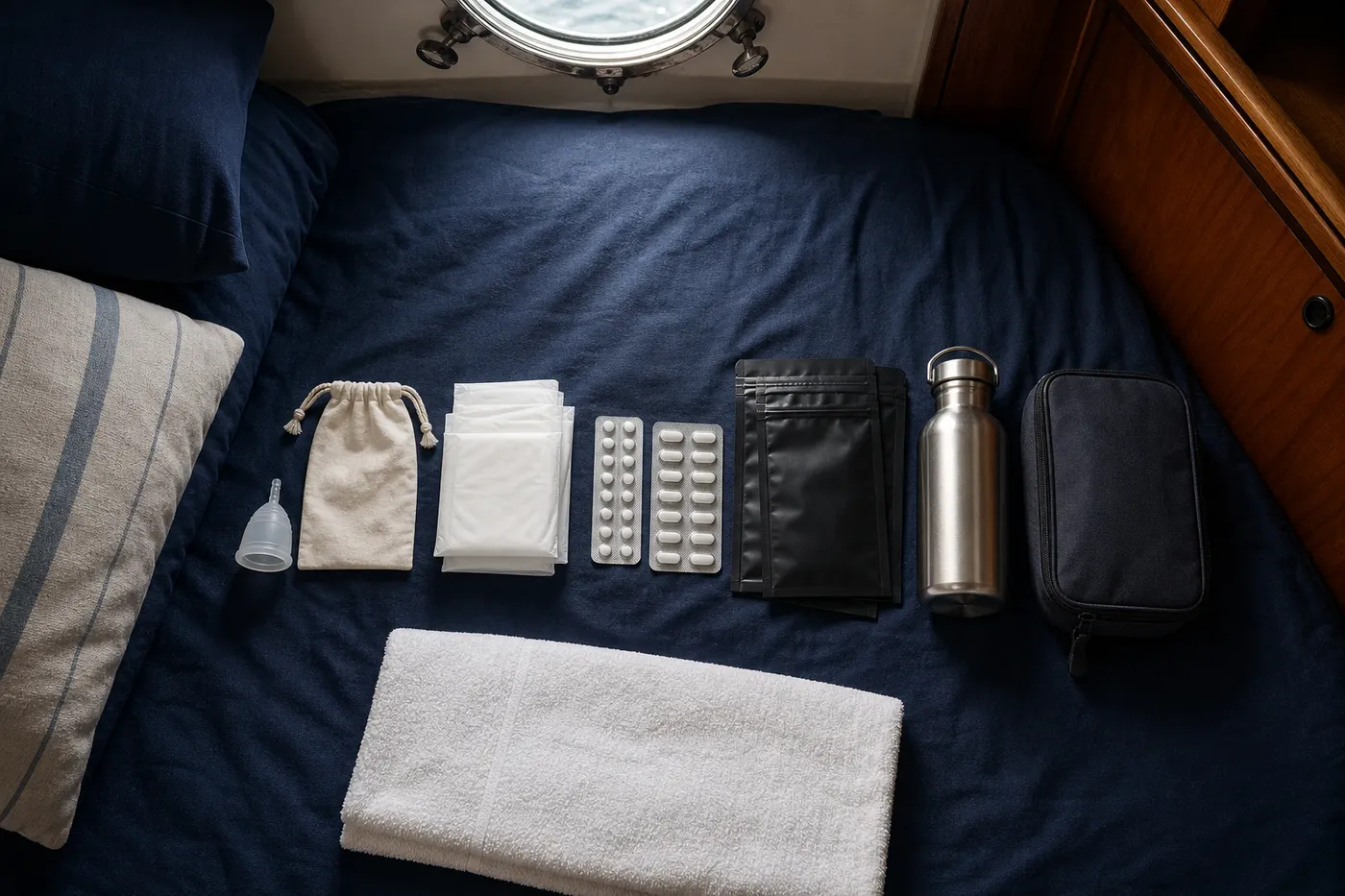
We are not in the business of telling anyone what to use, and if you have a system that works you should bring it. But a menstrual cup suits a liveaboard unusually well, and enough guests have arrived wishing they had tried one at home first that it is worth spelling out the reasoning.
It removes the resupply problem entirely, because there is nothing to run out of. It removes the waste problem, which on a boat is a real one and we will come to it. It holds more than a tampon, which matters when the schedule is a dive at 06:30, breakfast, a dive at 10:00, lunch, a dive at 14:00 and a night dive after dinner, with the gaps spent mostly wet. And it does not care about immersion.
The caveats are honest ones. Do not let a liveaboard be the first time you use one. The learning curve is a few cycles for most people and a boat with three shared heads is a poor classroom. You will need to think about rinsing, since fresh water on board is made by a watermaker and is not unlimited; carrying a small bottle of drinking water into the bathroom solves this neatly. And hands should be clean before and after, which on a boat means the soap dispenser rather than a rinse in the sea.
None of that is an argument against tampons or pads. It is an argument for deciding at home, with a backup, rather than at sea without one.
Nothing goes down a marine toilet
This is the single most useful sentence in this article and almost nobody is told it before they board.
Marine heads are not house toilets. They are small pumps with narrow bores and a macerator, and they block on things a domestic system swallows without complaint. On our boats, as on essentially every liveaboard in Indonesia, the rule is that nothing goes down the toilet except what your body produced and, where the crew allows it, a small amount of thin paper. Everything else goes in the lined bin beside it. That includes pads, tampons, applicators, wipes and packaging, without exception.
Guests are sometimes embarrassed by this. They should not be. The crew empty every cabin bin daily as a matter of routine, they have done it several thousand times, and a blocked head on day three of a Banda Sea crossing is a considerably more public event than a bin. Bring a few opaque zip bags if the shared bin bothers you. That is what most experienced guests do, and it also solves the problem of a cabin in thirty degree heat.
If you are in a twin share with someone you have never met, which is common on our boats and covered properly in our guide to solo liveaboard diving in Indonesia, the bags do the discreet work for you and the subject never needs to arise.
Small bathrooms, wetsuits, and four dives a day
The practical rhythm is worth picturing. Cabins on a phinisi are compact and the ensuite is compact with them. You will be changing in and out of a wetsuit four times a day in a shared, wet, sociable space, and privacy is available but it takes a small amount of planning rather than being the default.
A few things help. Change in your cabin rather than on the dive deck when you want to; nobody will think anything of it and the crew will not be waiting on you. Ask the guides for your surface interval timings at the morning briefing so you know exactly how long you have, which on most days is an hour or more and is plenty. If you want a slightly longer gap, say so; skipping the third dive of a day to lie on the sundeck with a book is such a routine choice on a liveaboard that the crew barely register it, and it is worth remembering that a week of four dives a day is a heavy load for anybody.
Wetsuits are the practical irritation rather than any kind of hazard. A 3mm suit is a struggle to get into when you are wet regardless of anything else. The usual advice applies: get in dry where possible, use the freshwater rinse, and do not fight it in a hot cabin when the shaded deck is cooler.
Cramps, painkillers and the dehydration problem
Bring whatever you normally take, and take it. Diving through significant pain is a bad idea for the ordinary reason that pain is distracting and distraction is what actually causes problems underwater, not because of anything exotic.
Two points specific to diving. Ibuprofen and similar anti-inflammatories are widely used by divers and are not contraindicated, but they are mild gastric irritants and a boat is already a slightly dehydrating environment, so take them with food and water rather than on an empty stomach before the first dive. Paracetamol is the gentler option if either is equally effective for you.
Dehydration is the one to watch, and it is not specific to your cycle so much as compounded by it. Four dives a day in the tropics, dry compressed air, heat, sun, a couple of beers at sunset and mild seasickness all pull the same direction, and dehydration is one of the few decompression risk factors genuinely within your control. Drink more than you think you need. The crew will keep filling the jugs; that is what they are there for.
Contraception, seasickness, and the interaction nobody mentions
Two separate questions get tangled here. Whether hormonal contraception affects your diving, and whether a week at sea affects your contraception. The first has been studied for decades and the answer is reassuring. The second is barely discussed anywhere, and it is the one that can actually go wrong on a liveaboard.
The pill and decompression risk
The theory was plausible. Hormonal contraception reduces venous tone and increases water retention, and both of those could in principle slow circulation and make nitrogen harder to offload. People have been testing that idea for more than thirty years.
DAN's summary of the research is that no study has found evidence to support it. The Plymouth group put it more cautiously, saying the jury is still out. The NASA review found no compelling evidence that hormonal contraception raises decompression risk in divers, while noting a slightly elevated signal in altitude decompression, which is a different exposure with different physiology and does not transfer neatly to diving.
There is one figure worth defusing because it travels without its context. In that same review of 956 injured divers, 85 per cent of those taking oral contraceptives were menstruating when they were hurt. Alone it reads as damning. But it describes the timing of injuries inside one group rather than that group's risk against any other, and a large share of people on the pill deliberately shift or skip their bleed, which makes cycle-day analysis unreliable in precisely this population.
The practical position: hormonal contraception is not a barrier to diving, it does not need a medical sign-off, and the standard diver medical questionnaire explicitly excludes the contraceptive pill from its question about medication. That last detail saves a surprising number of guests an unnecessary appointment before a trip.
If you are being sick, your pill may not be working
This is the part we would most like guests to read before they board, and it has nothing to do with diving.
Oral contraception has to be absorbed to work. Vomit soon enough after swallowing it and it may not have been. The NHS guidance is specific: if you are sick less than three hours after taking a combined pill, take another one straight away and then take the next at the usual time. If you are still being sick, use another method of contraception until you have managed seven days of pills without vomiting. Diarrhoea lasting more than 24 hours has a similar effect, and there the advice is to keep taking your pill and use a backup method until seven days after it settles.
The progestogen-only pill is tighter still. A traditional progestogen-only pill may not work if you vomit within two hours; the desogestrel and drospirenone versions extend that to roughly three or four. If you are not sure which you take, the pack tells you, and it is a great deal easier to check that at home than in a cabin at midnight.
Now put that beside a liveaboard itinerary. Day one of a Banda Sea trip is frequently an overnight crossing, and the Banda crossings are the ones that make people sick who are never sick. Even in Komodo, an afternoon repositioning past the southern capes can be lively. As our guide to preventing seasickness on a liveaboard puts it, once vomiting starts, tablets have a habit of not staying down long enough to help. That applies to your contraceptive pill exactly as it applies to the anti-emetic.
None of this is a reason to worry. It is a reason to do three small things. Read the leaflet for your specific pill before you travel so you know your window. Bring a spare pack, since a lost or vomited pill is trivial with one aboard and a genuine problem without. And bring backup contraception if that is relevant to your trip, because it is not available at sea and asking a dive guide is nobody's idea of a good evening.
Timing helps too. If you can take your pill with a meal in a calm anchorage rather than at the roughest hour of a crossing, do. On most of our itineraries the boat is at anchor and flat for the whole evening, which makes that easier than it sounds.
Skipping a period for the trip
Guests ask this often, usually about a trip they have waited years for, and it is a legitimate thing to want. It is also a decision to make with your own doctor or pharmacist, weeks before you fly, and not one to improvise on board.
Broadly there are two routes and both are ordinary. If you take a combined pill, running packs back to back to skip the withdrawal bleed is common practice and your prescriber can tell you whether your particular pill suits it. If you do not use hormonal contraception, a short course of a period-delaying tablet is something GPs and many pharmacists prescribe for exactly this situation, usually started a few days before the bleed is due.
Two caveats we would add from the operational side. Breakthrough bleeding is reasonably common when you first run packs together, so a trip is a poor time to try it for the first time; if you want to do this, do a trial run on a cycle at home first. And whichever route you take, still pack supplies. Plans have a way of not consulting you.
Coils, implants, injections and patches
Nothing here presents a diving problem. An intrauterine device, a hormonal implant, the injection and the patch are all unaffected by pressure and none of them require a medical sign-off to dive.
The relevant advantage on a liveaboard is simply that they are not swallowed, so seasickness cannot interfere with them, and there is nothing to remember at 06:00 before a dive. If your renewal or replacement falls anywhere near your travel dates, sort it before you fly rather than after you return. Contraceptive patches stay on in the water in normal use; if one lifts, follow the leaflet for your brand, which is another argument for having read it.
One small note on implants and diving that comes up in a different form. Breast implants are sometimes raised as a diving question, and the short answer is that saline and silicone implants are effectively incompressible, so a small volume change at recreational depths is not clinically meaningful. Where surgery is recent, the relevant limit is wound healing and the weight of a cylinder, not pressure, and that is a conversation with your surgeon.
Pregnancy, and coming back to diving after birth
These two arrive in our inbox constantly, often from someone who has already booked and is quietly hoping we will tell her it is fine. On the first we cannot, and the reason is worth understanding rather than accepting. On the second the guidance is unusually concrete, and there is a liveaboard-specific point that most sources miss.
The one clear no, and the reason behind it
Every training agency, DAN's guidance to physicians, and every diving medicine centre we are aware of say the same thing: do not dive while pregnant, at any stage, or while actively trying to conceive. We apply that without exception, and no, we will not make a case-by-case call on it.
The reason is specific. In an adult, almost all blood returning to the heart passes through the lungs, and the lungs work as a filter that catches the small bubbles that form after any dive. Nearly every diver produces some. That filter is the reason they almost never matter, and it is the same mechanism we describe in our guide to barotrauma in scuba diving when explaining why healthy lungs do so much quiet work.
A fetus does not have that filter. Fetal circulation deliberately bypasses the lungs through two shunts, the foramen ovale and the ductus arteriosus, because the lungs are not yet doing the work of breathing. A bubble forming in a fetus is therefore not intercepted on its way round. It can pass into the arterial circulation and travel anywhere it likes, which is the definition of an arterial gas embolism. The mother can be entirely free of symptoms while this happens, which is what makes the usual reassurance of "I felt fine" worthless here.
It is worth being straight that the human evidence base is thinner than the confidence of that recommendation suggests. Animal studies have been contradictory. Human data can only really come from retrospective questionnaires, which depend on recall. But this is a case where the mechanism is clear, the potential harm is severe and permanent, the person at risk cannot consent, and the cost of waiting is one dive trip. That is not a difficult trade.
Being pregnant on a boat is a separate question from diving
Here is the part specific to us, and it is one we would raise even with a guest who had no intention of getting in the water.
A liveaboard is remote in a way that a resort is not. On a Banda Sea itinerary you can be a full day and a half of open water from a hospital, and considerably further from an obstetrician. The complications of early pregnancy that matter most, an ectopic pregnancy or a miscarriage with heavy bleeding, are time-critical rather than manageable with a first aid kit and patience. Add motion, heat, dehydration, disturbed sleep, a galley menu you cannot easily vary, and evacuation options that depend on daylight and sea state.
So the honest advice is not simply "you can come and snorkel". It is that a remote liveaboard is a reasonable trip in the second trimester if your pregnancy is straightforward, your obstetrician agrees, and your insurance actually covers you, and it is a poor choice in the first trimester or where anything is complicated. Check the insurance wording specifically, since many travel policies restrict cover beyond a certain gestational week, and note that airlines typically want a fit-to-fly letter in the last weeks and decline travel near term. Talk to us as well; if you tell us at the contact stage we can be honest about how far a given itinerary sits from help, which varies a lot between Komodo and the Banda Sea.
If you dived before you knew you were pregnant
This happens, it is nobody's fault, and the first thing to do is stop diving and the second is to not panic.
Tell your obstetrician what you did, with the depths and the profiles if you have them logged, and let them advise. The published follow-up data, limited as it is, does not show the kind of clear harm signal that would justify assuming the worst, and most reported outcomes have been normal. Very early exposure, before the placental circulation is properly established, is generally regarded as lower risk again. What nobody can give you is a guarantee, in either direction. Get proper advice from someone with your notes in front of them rather than from a forum.
Snorkelling instead, and coming as a non-diving guest
Snorkelling is a different activity physiologically. There is no compressed gas, no meaningful pressure loading, and no decompression obligation, so the bubble mechanism above does not apply. It is generally regarded as acceptable in an uncomplicated pregnancy, with sensible limits: stay shallow and skip the breath-hold descents, watch overheating and dehydration, and be realistic about currents and about getting in and out of a tender in swell.
Plenty of guests do a trip this way. Our guide to Indonesia liveaboards for non-divers and snorkellers covers what a week looks like when you are not diving, and it already lists pregnancy among the ordinary reasons people join a boat without a cylinder. The reefs in Raja Ampat in particular do a great deal of their best work in three metres of water.

How long after giving birth
The guidance here is refreshingly concrete, and it is driven as much by wound healing and load bearing as by anything to do with nitrogen.
- Uncomplicated vaginal delivery: a minimum of 21 days, with four weeks as the working rule of thumb. The 21 days is about the cervix closing and therefore about infection risk from immersion rather than from exertion.
- Uncomplicated caesarean: at least eight weeks. Obstetricians often clear normal activity at four to six, but diving is not normal activity. Most post-caesarean advice includes lifting nothing heavier than your baby for six to eight weeks, and a cylinder in a BCD comfortably exceeds that.
- Complications, twins, pre-term labour or bed rest: twelve weeks, with medical clearance first. Extended bed rest costs real aerobic capacity and muscle mass, and that shows up on a dive.
- After a miscarriage: return once your physician has cleared you for unrestricted activity.
Whether a liveaboard is the right first trip back
Usually not, and this is the point most guidance skips because most guidance is written for a shore dive.
Clearance to dive is clearance for a dive. A liveaboard week is twenty or more dives in six days, some of them in current, all of them in a schedule you do not control, three or four hours from a decompression chamber. Those are different requests. DAN makes a related point we would echo: caring for a newborn is a sustained stretch of broken sleep and fatigue, and fatigue does more to how a first dive back feels than almost anything else on the list.
What works better is a couple of gentle local dives or a refresher session first, so that the skills, the weighting and the sheer novelty of breathing underwater again are behind you before you commit to a week at sea. Then book the boat. Our first liveaboard guide sets out what the daily load actually looks like, and it is worth reading with a realistic eye rather than an optimistic one.
Breastfeeding on board
Diving while breastfeeding is not contraindicated. Inert gas does not accumulate in milk in any amount that matters, and there is no reason to discard a feed because you dived.
The real issues are practical. Hydration matters more than usual, and a liveaboard is already a drying environment. Feeding or expressing on a schedule around four dives a day takes some planning, and cabins are small, so it is worth telling us in advance if you need a plug socket, fridge space for storage, or a quiet corner at predictable times. Every one of those is arrangeable and none of it is unusual; it just works far better when the crew know on day one rather than day three.
If anything in this article applies to a trip you have already booked, the useful move is to write to us and ask. We would much rather answer a direct question two months out, when itineraries, cabins and dates can still be moved, than have someone spend a week on a boat quietly making the best of something we could have solved in an email.