Seasickness is the single most common worry we hear at the booking stage, ahead of sharks, currents, and flight connections combined. It is also the most fixable. Roughly one in three guests on a typical Indonesia liveaboard tells us they are "prone to motion sickness" before boarding, and in most years fewer than one in twenty actually loses a meal over the rail. The gap between the fear and the outcome is not luck. It comes down to route planning, cabin choice, timing of medication, and a handful of habits in the first 24 hours that most first-timers have never been told about.
This guide gives you everything you need to board with confidence: why your body reacts the way it does, which crossings are the culprits (and which routes barely move), how to pick a boat and cabin that work with you, which medications actually work for divers, and the habits in the first 24 hours that decide your whole week. Most of it applies to any tropical liveaboard, but the specifics, the straits, the months, the sea states, are written for the routes across the Indonesian archipelago. If you are still comparing destinations, our guide to scuba diving in Indonesia covers where the diving itself is best; this one is about arriving at those sites feeling great and ready to dive.
Why you get seasick on a boat and not in a car
Motion sickness is a sensory disagreement. Your inner ear reports movement; your eyes, fixed on a cabin wall or a phone screen, report a stable room. The brain, faced with two conflicting reports, does what it evolved to do when the vestibular system and vision disagree: it assumes poisoning and prepares to empty the stomach. That is the whole mechanism, give or take some academic argument about the details. It is why reading below deck is the fastest route to nausea ever devised, and why standing on deck watching the horizon, where eyes and inner ear finally agree, is still the single most effective free remedy on any boat.
Two things follow from the mechanism. First, seasickness is not weakness, and it is not something you can will away once it has started. The reflex sits below conscious control. We have watched dive instructors with 4,000 logged dives feed the fish in the Sape Strait while a 68-year-old first-timer ate a second helping of nasi goreng beside them. Second, almost everyone adapts. The brain recalibrates within 24 to 48 hours of continuous motion, which is why the guests who are queasy on Saturday are usually the ones asking for seconds by Monday. Sailors call it getting your sea legs. Neurologists call it habituation. Either way, the first night is the price of admission, and everything in this guide is about making that price as small as possible.
The honest map: where Indonesian itineraries actually get rough
Brochures do not talk about sea state, so let us do it here. Indonesia is not the open Pacific. Most liveaboard diving happens in the lee of islands, inside national parks, and across short channels, and for most of the year most anchorages are calm enough that you will forget you are on a boat. But there are a handful of crossings where the sea earns respect, and an honest operator will tell you when your itinerary includes one.
| Crossing | Route | When it gets lively | Typical exposure |
|---|---|---|---|
| Sape Strait | Sumbawa to Komodo | July to August, southeast trades | 2 to 4 hours |
| Linta Strait | Central Komodo, around Manta Point | Afternoon chop, most of dry season | Under 1 hour |
| Banda Sea open legs | Ambon to Banda Islands and onward | Edges of the season, September and early November | 6 to 10 hours, usually overnight |
| Lombok Strait | Bali toward Sumbawa and beyond | Year-round current, worst with wind against tide | 2 to 3 hours |
| Dampier Strait approaches | Sorong to Raja Ampat | Rarely; short fetch keeps waves small | 2 to 4 hours, mostly sheltered |
The pattern worth noticing: Komodo itineraries that start in Labuan Bajo skip the Sape Strait entirely, and Raja Ampat is, in our experience, the calmest major liveaboard destination in the country because the islands break every fetch before a swell can build. The Banda Sea is the genuine open-water route, and we say so plainly to every guest who books it. Crossings there are scheduled overnight on purpose. A sleeping brain does not get seasick anywhere near as easily as a waking one, and most guests wake up at the anchorage having slept through the entire leg. If you know you are badly susceptible, book Raja Ampat or a Labuan Bajo round-trip in Komodo first, and save the Banda Sea crossing for your second or third trip, once you know how your body behaves on a hull.
Pick the boat before you pick the pills
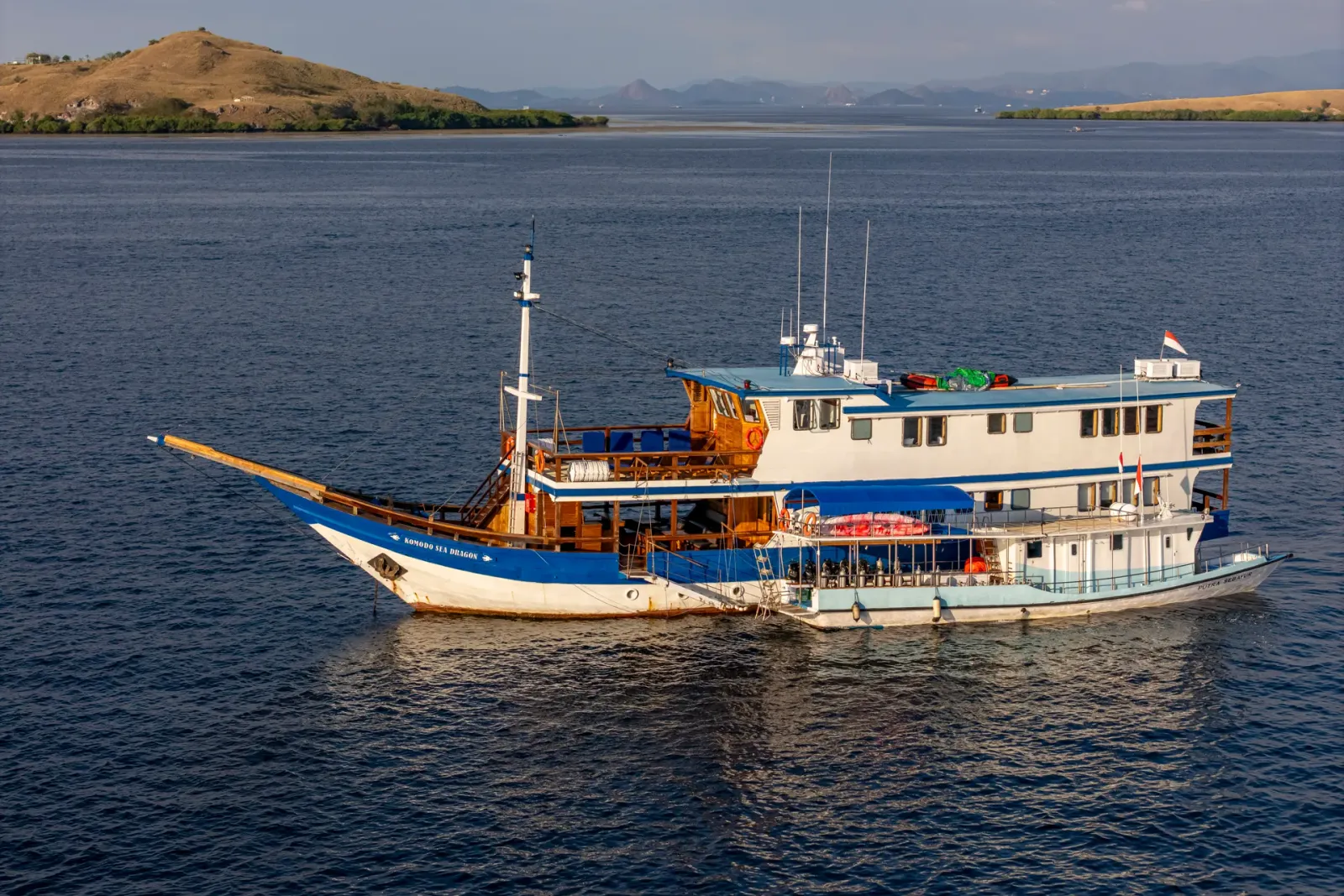
Hull design does more for your stomach than any pharmacy. A traditional Indonesian phinisi is a heavy, deep-keeled wooden sailing hull, and that mass matters: heavier boats have a slower, longer roll period that most inner ears tolerate far better than the quick snap-roll of a light fibreglass day boat. It is one reason guests who were miserable on a speedboat transfer from Bali are often surprised to feel fine on the liveaboard itself. Length helps too. A 40-metre boat bridges two wave crests where a 20-metre boat falls into the trough between them.
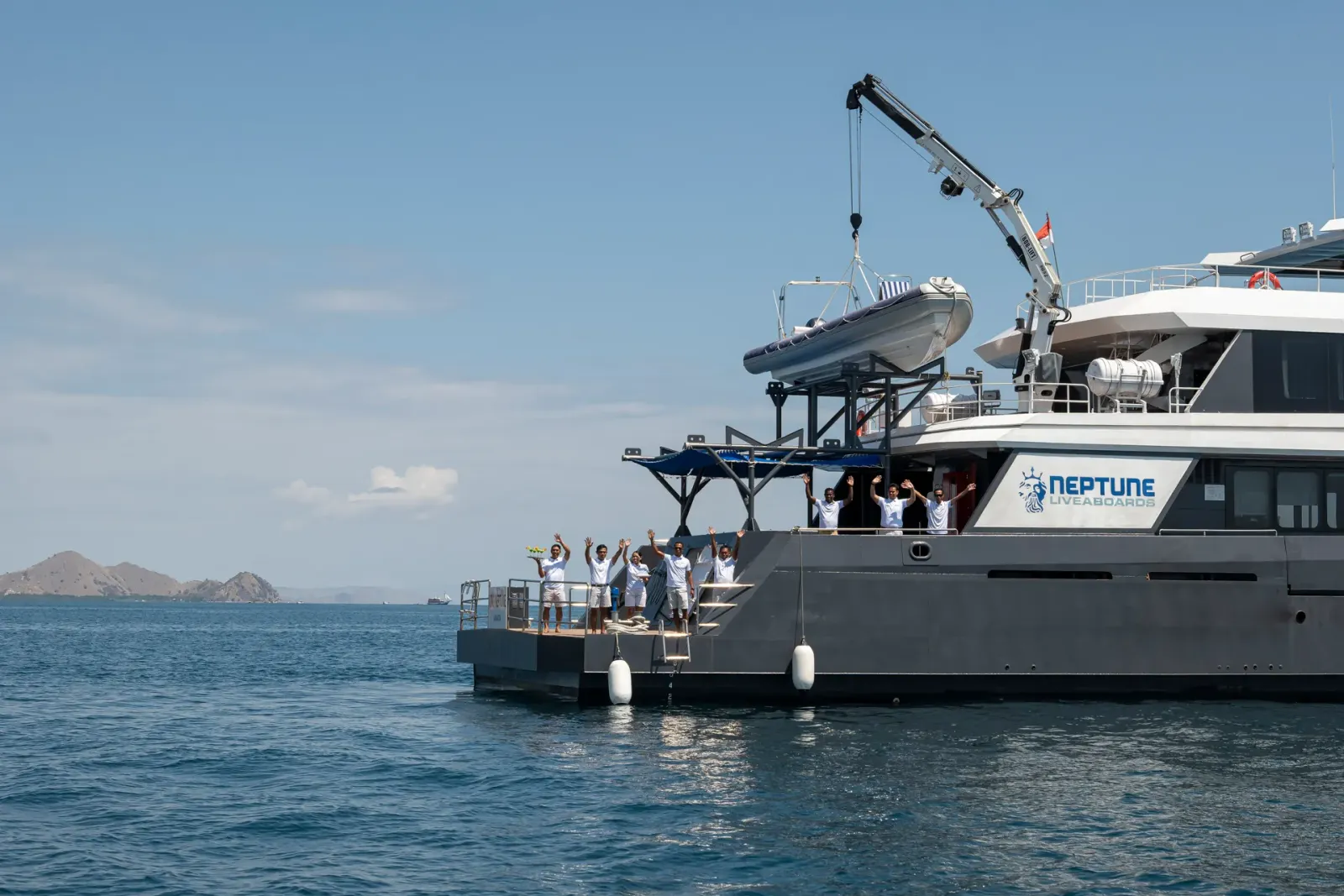
Stabilisation is the other question worth asking an operator. Some steel-hulled expedition boats carry active fin stabilisers; most phinisi rely on their sail rig, their keel, and sensible routing. Neither is automatically better, but you should know what you are booking. When guests who have suffered badly before ask us which of our departures to choose, we usually steer them toward the larger hulls on the calmer routes and we schedule the one exposed crossing of the itinerary for the small hours. That single scheduling decision, crossing while guests sleep, prevents more seasickness than every tablet on board combined.
Cabin choice: the cheapest upgrade you will ever make
Motion on a boat is not evenly distributed. The bow pitches most, the stern vibrates most, and the highest deck rolls through the longest arc. The gentlest place to sleep on any hull is low and central: a lower-deck midship cabin moves perhaps half as much as a bow cabin on the same boat in the same sea. Guests pay premiums for upper-deck cabins with picture windows, and for scenery they are worth it, but if seasickness is your main worry, the humble lower midship cabin is the best money you will not spend. Tell the operator why you are asking. We reshuffle cabin assignments for motion-sensitive guests on most departures, and we have seen this fail only when the request arrives after every cabin is sold.
While you are at it, think about where you will spend your waking hours too. A shaded bench midship on the main deck, close to the rail and the breeze, is worth claiming early on any crossing day. The worst seats in the house are the ones that feel most appealing: the enclosed air-conditioned salon (no horizon, cold air, usually a screen playing something) and the top sun deck (longest roll arc on the boat). Give or take the layout of the individual vessel, low, central, shaded and ventilated wins every time.
Medication: what works, what to skip, and when to take it
Every remedy in this section works better as prevention than cure. Once vomiting starts, tablets have a habit of not staying down long enough to help, which is why the golden rule is simple: take the first dose before the boat leaves the harbour, not when you start feeling odd. That absorption problem applies to everything else you swallow, which is why our guide to women’s health on a liveaboard explains what to do when a rough crossing costs you a contraceptive pill.
- Cinnarizine (Stugeron), 15 to 25 mg. The quiet favourite among dive crews in Asia and Europe. Taken two hours before departure, it is effective for most people with less drowsiness than the older antihistamines. Widely available in Indonesian pharmacies, not sold in the United States, which surprises American guests every season.
- Meclizine (Bonine), 25 mg. The gentler of the two common American options, once daily, modest sedation. A reasonable default if you are flying in from the US and want something tested before the trip.
- Dimenhydrinate (Dramamine), 50 mg. Works, but sedating enough that we see guests sleep through briefings on it. Fine for a crossing day, less fine for a diving day.
- Scopolamine patch, 1.5 mg behind the ear. The strongest prevention available, applied 6 to 8 hours before departure and lasting roughly three days. Side effects are real (dry mouth, blurred near vision in some people) and it needs a prescription in most countries. Never cut a patch in half; it destroys the dose control.
- Ginger, 1 to 2 grams. The evidence is mixed but genuinely positive in several trials, the side effects are none, and the galley has it anyway. Our crew brews ginger tea by the flask on crossing days.
- Acupressure wristbands. The trial data is weak. Some guests swear by them. They cost a few dollars, they cannot hurt, and we suspect most of the benefit is the placebo, which still counts as a benefit when the alternative is misery.
Two cautions from the dive deck. First, test any medication you plan to use on land, before the trip, on a day you are not driving. Individual reactions vary widely, and a drug that makes you foggy is a problem 25 metres down. Second, if you plan to dive on scopolamine, talk to a dive-medicine doctor rather than a general pharmacist; the combination is common and mostly considered acceptable, but the blurred-vision side effect and any hint of unusual drowsiness are disqualifying underwater. There is a longer conversation about drugs, alcohol and diving in our guide to drinking and diving, and the short version applies here too: whatever alters your head on the surface follows you down the line.
The first 24 hours: habits that decide your whole week
Adaptation is the goal. Everything below is about keeping symptoms low enough, for long enough, that your brain finishes recalibrating before misery sets in. None of it is complicated. Most of it is the opposite of what instinct tells you to do.
Eat, even though you do not want to
The classic first-timer mistake is boarding on an empty stomach, reasoning that less in means less out. An empty stomach is more nauseating, not less. Eat something bland and solid an hour or two before departure, rice, bread, bananas, and keep grazing lightly through the first day. Skip the two genuine accelerants: alcohol and heavy grease. The welcome beer can wait one sunset. We have watched that exact beer, drunk in the first hour out of Labuan Bajo in July, decide a guest's entire first night.
Stay on deck and give your eyes the horizon
For the first few hours underway, stay in fresh air with the horizon somewhere in your peripheral vision. Midship, facing forward, is the sweet spot. What you must not do is the thing everyone does: go below, lie down in a windowless cabin, and scroll a phone. Screens are the modern engine of seasickness; reading forces your eyes to report stillness precisely while your inner ear reports swell. If you need to rest, lie flat on your back with eyes closed, flat and closed is fine, it is the half-measures that hurt, propped up on one elbow with a paperback being the worst posture ever invented for a moving hull.
Watch the diesel, not just the waves
Exhaust fumes are an underrated trigger. The stern deck of any boat under engine collects a faint diesel haze, and an hour of it will turn a borderline stomach. If you smell fumes, move forward and upwind. Our crew already knows which corners of each boat to keep queasy guests away from; ask yours.
If it happens anyway
Go to the leeward rail, downwind, and let it happen. Do not lock yourself in a head (toilet) below deck; small windowless rooms are where nausea goes to get worse, and the crew cannot keep an eye on you there. Afterwards, rinse, sip water or ginger tea in small amounts, stay on deck, and remember the encouraging statistic: for most people a vomiting episode is followed by an hour or two of relative peace, and adaptation is still proceeding underneath it all. Most guests who are sick on night one are fine by lunch on day two and stay fine for the rest of the trip. Dehydration is the one real medical risk worth watching, especially in the tropics and especially for divers, because a dehydrated diver is a diver at elevated risk of decompression sickness. If someone cannot keep fluids down for more than 12 hours, that stops being seasickness management and becomes a medical conversation with the cruise director.

Seasickness and diving: the part most guides skip
A liveaboard is not a ferry crossing; you are here to dive, and the interaction between motion sickness and diving deserves its own section. The good news first: the ocean is calm underneath. Divers who feel rough on the surface almost always feel fine within minutes of descending, because the water column does not roll. More than once we have had a green-faced guest insist on making the dive, and surface 50 minutes later cured, hungry, and mildly smug.
The places seasickness actually intersects with diving are the boundaries. A rolling dive deck during kit-up is where queasy divers tip over the edge, so kit up early, sit near the stern gate, and get into the water without lingering. Long surface intervals on a moving boat are harder than the dives themselves; plan your medication so it covers the middle of the day, not just the morning. Safety stops in swell bother some people, holding 5 metres while the surge rocks you, and focusing on a fixed point on the reef or the line helps. And vomiting through a regulator, while perfectly survivable and something every instructor has a story about, is an experience worth one sentence of technique: keep the regulator in, purge, and breathe; do not spit it out at depth.
Fitness to dive is the other side. A diver who is actively vomiting, badly dehydrated, or foggy from a sedating antihistamine should not be getting in the water, and our dive guides make that call gently but firmly a few times each season. It is one of the topics we cover for newer divers in our first-time liveaboard guide, and the principle is the same for every skill level: the reef will still be there on the next dive.
Choosing your route and season if you know you are susceptible
You can stack the odds heavily in your favour before you ever pack a bag, because the difference between Indonesian regions and months is bigger than the difference between any two medications.
Raja Ampat between November and March is the gold standard for calm: short channels, thousands of islands breaking the fetch, and anchorages so still that guests forget to take their second tablet. Komodo from Labuan Bajo is nearly as good between April and June and again in September and October; July and August bring the southeast trade winds, which make the famous south-Komodo sites lively and put whitecaps in the straits by mid-afternoon, though mornings usually stay workable. The Banda Sea runs on its own calendar, with a single short season from September to early November, chosen precisely because the monsoons are changing over and the open water is at its most settled. Our full breakdown of Indonesia liveaboard seasons covers the diving side of the same calendar, and the two happily coincide: the calm months are usually the good diving months.
The most useful thing we can tell anxious first-timers is that the self-diagnosis is usually wrong. Guests who describe themselves as lifelong sufferers, sick on ferries, sick on lakes, arriving with two kinds of tablet, a patch, wristbands and a note from their doctor, very often finish the week having taken almost nothing. Part of that is the boats. A loaded phinisi of thirty-odd metres in the sheltered water of Raja Ampat or north Komodo moves far less than the small craft most people formed their opinion on. Part of it is that the long crossings happen overnight while you are lying down, which is the position the vestibular system copes with best. It is genuinely common for someone to ask at breakfast whether the boat moved at all, after sixty nautical miles. Take the medication anyway for the first couple of days, but do not let the fear of it decide whether you book.

What our crew actually does when a guest goes green
Guests are sometimes embarrassed to mention nausea, as if it were a personal failing rather than the most predictable event in small-boat hospitality. Please mention it. The response on a well-run boat is quiet and practised: ginger tea from the galley, a spot midship on the shaded deck, dinner plated early or held late, the night's route checked for an alternative anchorage with better shelter, and, if the guest agrees, a tablet from the first-aid stock with the timing planned so it covers the next leg rather than the last one. On crossing nights our captains will sometimes shift departure by an hour or two to take a strait at slack tide instead of against it. None of this is heroic. It is the accumulated habit of taking a few thousand guests across the same water, and it works often enough that the ship's log records more seasick crew than seasick guests in some months, usually the new deckhand, to everyone's delight.
A realistic pre-trip checklist
- Choose the route to match your susceptibility: Raja Ampat or Labuan Bajo round-trips first, Banda Sea later.
- Ask the operator which crossings your itinerary includes and when they are scheduled. A straight answer is a good sign about everything else on the boat.
- Request a lower-deck midship cabin, and say why.
- Test your chosen medication on land before flying.
- Take the first dose one to two hours before departure, or apply the patch 6 to 8 hours before.
- Board fed, hydrated, sober, and rested; jet lag amplifies everything.
- Spend the first hours on deck, horizon in view, phone in the cabin.
- Keep water and plain crackers by your bunk for the first night.
Seasickness has probably cancelled more diving dreams than any other single worry, and it deserves to cancel none of yours. Your body adapts, the medications work when taken early, the routes can be chosen kindly, and a good crew has seen it all before. Book the calm season, take the tablet before the harbour mouth, watch the horizon for an hour, and by the second morning you will be standing on the dive deck wondering what you were ever worried about.
And if you want to stack the odds in your favour from the very first click, start with the two gentlest itineraries in the country: a Komodo liveaboard departing round-trip from Labuan Bajo, or a calm-season Raja Ampat liveaboard between November and March. Mention that you are motion-sensitive when you get in touch and we will plan around it before you ever step aboard: a lower-deck midship cabin, crossings timed for the small hours, and ginger tea waiting on the first evening. The reef is not going anywhere, and neither is your dinner.