Most divers who end up in Maumere did not set out to go there. They booked Alor, or a Banda Sea crossing, saw that the boat leaves from a town on the north coast of Flores they had never heard of, and worked out the flights from there. It is one of the few places in Indonesia that a lot of experienced divers have technically visited without ever getting in the water, which is a waste, because the bay they are flying into was once catalogued as the most species-rich piece of water anyone had surveyed.
This guide is written to be used rather than skimmed. It covers what Maumere Bay is actually famous for, the named dive sites and what you can expect to see at each, how to get there and from where, how far it really is from Komodo, where to stay and dive, what it costs, and how to sequence the days either side of a Banda Sea liveaboard. Our sister resort in Komodo has published a guide to Maumere as a resort destination and how to pair it with the national park, so this one concentrates on the bay itself and on Maumere as the port you leave from.
What Maumere is famous for, and why divers end up there
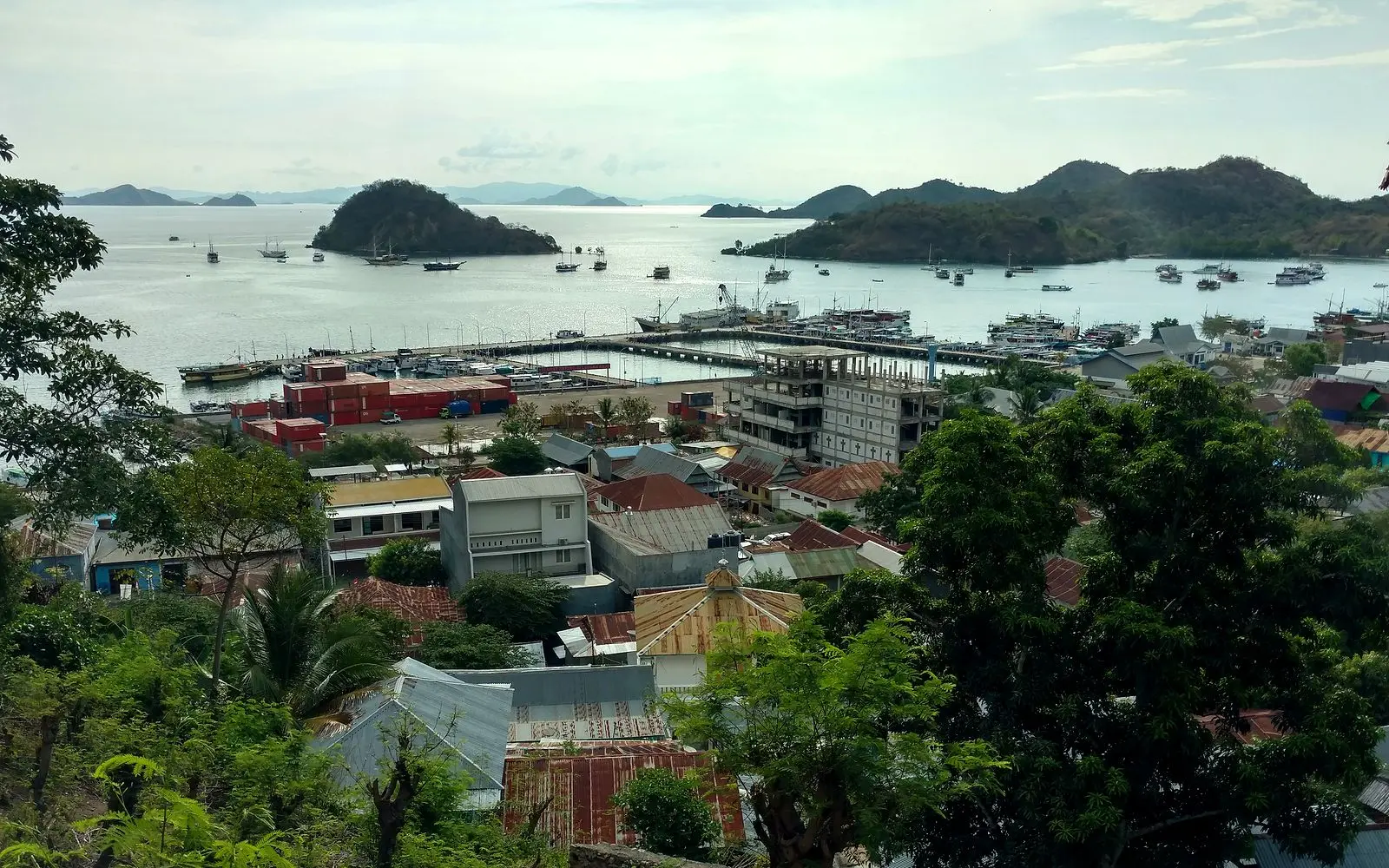
Maumere is the largest town on Flores, around 90,000 people, on the north coast towards the eastern end of the island in Sikka Regency. It is a working Indonesian port with a market, a cathedral and very little tourism infrastructure by the standards of Labuan Bajo. Nobody comes for the town.
The reputation, and what is left of it
Four things give Maumere Bay its name among divers who know it.
- Biodiversity. The underwater photographer Rudie Kuiter catalogued more than 1,200 fish species in this single bay, several new to science at the time. In the 1980s it held the reputation that Raja Ampat carries today, and the government gazetted the water as a marine nature tourism park on 21 April 1987 partly on the strength of it.
- Macro and muck. This is the main reason to dive here now. The volcanic sand slopes along the mainland shore are as good as anywhere in Indonesia outside Lembeh and Ambon, and considerably emptier than either.
- The recovery story. The 1992 earthquake and tsunami wrecked the shallow reefs, and the bay quietly rebuilt itself over the following three decades while the dive industry looked elsewhere. One site, The Crack, lets you look at the damage directly.
- Emptiness. On a normal day you will share a dive site with your own boat and nothing else. That is increasingly rare in Indonesia and it is worth something.
What Maumere is not famous for is big-animal diving on a schedule. Dolphins and pilot whales are seen through the year when the sea is flat, sperm whales turn up in the November and December rains, and whale sharks are reported most often in April and May, but none of that is reliable enough to plan around. Come for the small things and treat the rest as a bonus on the boat ride out.
Why the port exists on liveaboard schedules
Maumere sits where the Flores Sea narrows towards Alor, Pantar and the long chain running east towards Timor and the Banda arc, which makes it the natural western end of several itineraries that have no other sensible starting point. Our own Alor departures leave from here. The Forgotten Islands routes that run down to Saumlaki through Alor and the southern arc, typically over 10 to 14 nights, usually begin or end here. Boats crossing to Ambon for the Banda Sea use it the same way.
There is a quieter reason as well. Indonesian liveaboards reposition their fleets twice a year, roughly April to May and again from September to November, moving between the Komodo and Raja Ampat seasons, and Maumere sits on that road. Some of the most interesting one-way itineraries in the country exist because a boat had to get from one end of Indonesia to the other and decided to sell the journey.
| Where | North coast of Flores, Sikka Regency, East Nusa Tenggara |
|---|---|
| Airport | Frans Seda (MOF), still called Wai Oti by some |
| Direct flights | Denpasar, Kupang, Labuan Bajo, Makassar. Nothing else |
| The bay | Gugus Pulau Teluk Maumere marine park, gazetted 21 April 1987, just under 60,000 hectares, ten islands |
| Dive sites | Around 30 named sites, most within an hour of the coast road resorts |
| Water temperature | 26 to 29 degrees Celsius, stable, no cold upwellings |
| Visibility | Commonly 20 to 30 metres in the dry season |
| Currents | Negligible at most sites, strong at the channel and a few mainland points |
| Best months | April to October, with the dry season running to about December |
| Typical cost | Around 25 USD a shore dive, 75 USD for two boat dives |
| Level | Suits beginners and courses, with a handful of advanced sites |
How far is Maumere from Komodo?
Further than most people assume, because both are on Flores and the island is long. Maumere is at the eastern end, Labuan Bajo at the western, and Komodo National Park lies west of Labuan Bajo again, reached by boat.
| From Maumere to | Distance | How, and how long |
|---|---|---|
| Labuan Bajo | 257 km | 1 hour by air, Wings Air, three days a week. By road it is about 650 km of mountain switchbacks and twelve hours of driving |
| Komodo National Park | 257 km plus the boat | Fly to Labuan Bajo, then 1.5 to 4 hours by boat depending on the site |
| Denpasar, Bali | Around 700 km | About 1 hour 30 minutes by air |
| Kupang, West Timor | 230 km | Under an hour by air, roughly eleven services a week |
| Makassar, Sulawesi | Around 700 km | About 1 hour 35 minutes by air |
| Kelimutu crater lakes | Moni village, roughly 100 km | 3 to 4 hours by road |
The practical consequence is that Maumere and Komodo are a flight apart, not a taxi ride, and that flight runs on three days a week. Anyone planning to do both needs to build the itinerary around those departure days rather than assuming a daily shuttle.
The bay, and the day it stopped being famous
The bay is a broad, sheltered basin roughly thirty kilometres across, closed off to the north by a line of islands that behave like a barrier. Pulau Besar is the largest, with Dambilah and Pangabatang extending the chain to the east and Babi sitting out on its own. That barrier is why the water inside is usually flat, why visibility holds up, and why dolphins and pilot whales use the bay as easily as the fishing boats do. Everything that follows about the diving comes back to that geography.
Then, on 12 December 1992, a magnitude 7.8 earthquake struck at fifteen kilometres depth a few kilometres off Pulau Babi. The tsunami that followed killed roughly 1,690 people across Flores. Babi took the worst of it, with waves topping five and a half metres, two villages on its flat southern shore erased, and 263 of the island's 1,093 residents dead. Something close to 90 per cent of the buildings in Maumere town came down. Aftershocks ran for months.
Underwater, the shallow coral communities were destroyed, and the bay was then unlucky twice over, because a severe storm swept the same coastline within two months and scientists working there afterwards could not always separate which event had caused which damage. In some places the storm may have done more harm than the wave. Either way, the bay lost its name almost overnight, and unlike the town it never really got it back.
What actually came back
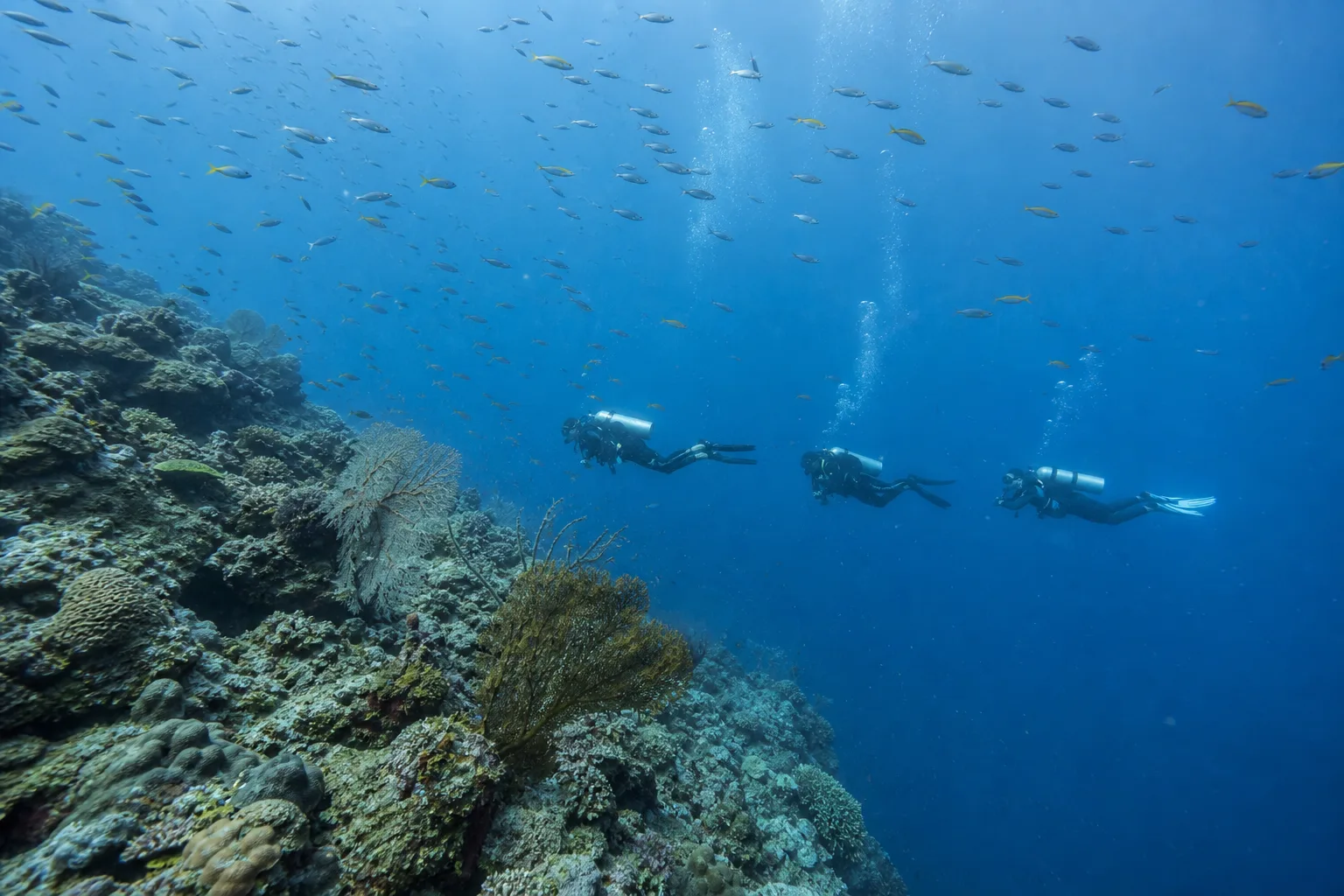
Thirty years on, the honest picture is a good deal better than the reputation. Indonesia's national reef monitoring programme assessed recovery in the bay at roughly 90 per cent across work carried out between 2006 and 2012, and divers going in today generally find dense hard coral, gorgonians the size of car doors on the outer island walls, and heavy fish life, with visible damage confined to patches of shallow water at a handful of sites.
Go in with that calibration rather than the brochure version. This is a recovered reef system and not a pristine one. If you swim over a rubble field in six metres of water somewhere off the mainland shore, you are looking at 1992 rather than at anything anyone did last year. Most divers find that more interesting than disappointing, and it is one of the few places where you can see what three decades of reef recovery actually looks like instead of reading about it.
The Crack
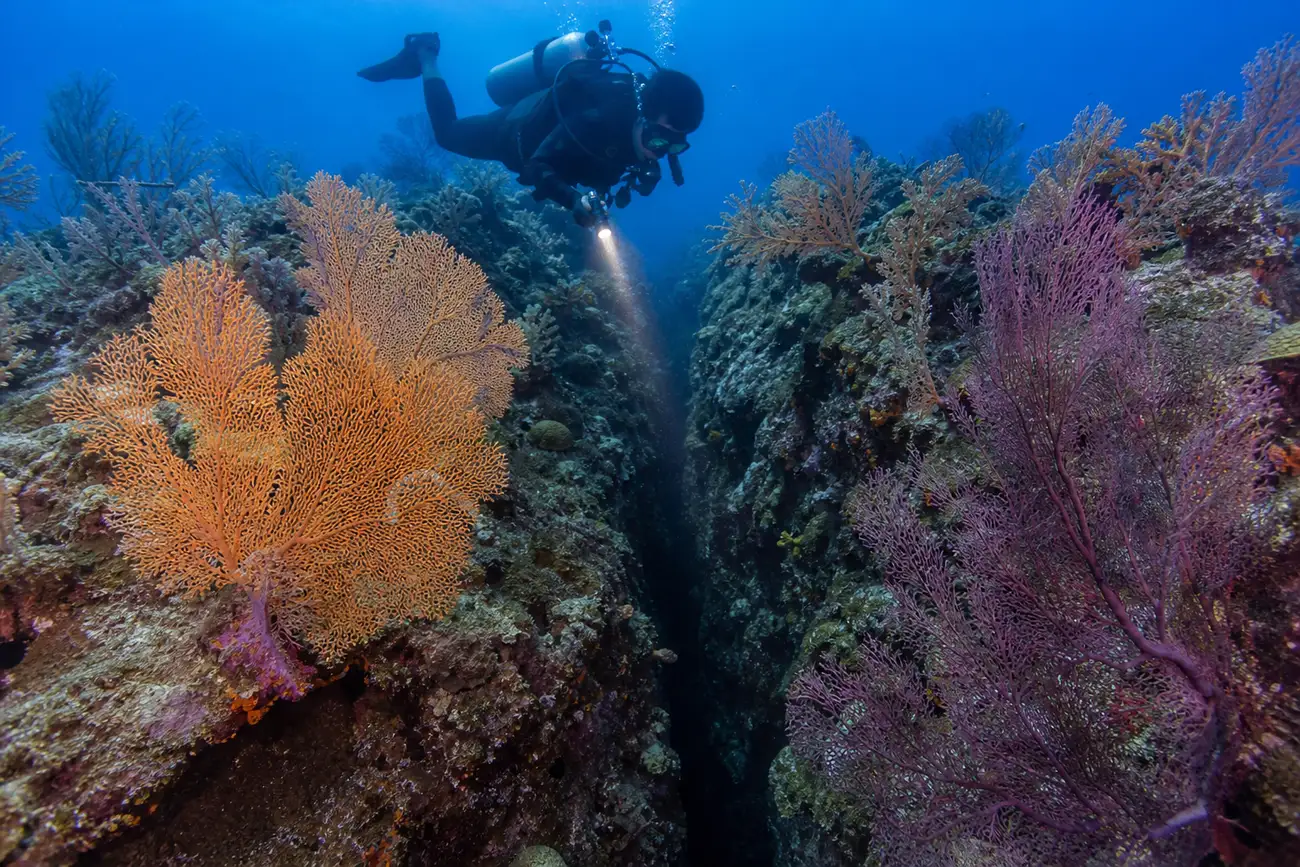
One site turns all of that history into something you can look at. The Crack, on Babi, is a fissure about 70 centimetres wide that the earthquake opened in the reef at around 18 to 20 metres, running perhaps thirty metres back into the coral. You do not go inside it. You hang above and look down into the internal structure of a reef, which is not a view available in many places, and the corals growing across the opening are gradually sealing it.
Babi itself is worth understanding before you dive it. Rebuilding on the island was never permitted after the tsunami, so what you see from the boat is a scattering of seasonal fishing huts on an island that had more than a thousand residents. The diving there is genuinely good, with soft corals, crevices full of frogfish and pygmy seahorses, and the occasional shark or eagle ray out in the blue. Guides will tell you about hammerhead sightings. Treat those the way you would treat hammerhead stories anywhere.
The dive sites, and what you will actually see
Operators in the bay work from a roster of roughly thirty named sites. Most sit within an hour of the coast road east of town, a handful need two hours or more, and several are shore dives you walk into. The list below covers the ones you are most likely to be offered, with the depths and levels operators generally quote.
| Site | Where | Depth | Level | What it is known for |
|---|---|---|---|---|
| The Crack | Pulau Babi | 5 to 30 m | Intermediate | The 1992 earthquake fissure, plus a wall of sea fans, sponges and sea squirts |
| Babi Wall | Pulau Babi | 10 to 40 m | Advanced | Steep wall, Napoleon wrasse, eagle rays, occasional grey and whitetip sharks |
| The Channel, also called Fish Soup | Between the mainland and Pangabatang | 10 to 30 m | Advanced | The bay's one serious current dive. Huge gorgonians, a drop where jacks, rays and sharks stack up |
| Pangabatang North | Pangabatang | 5 to 30 m | Intermediate | Slope to a sandy plateau at 30 m before it drops again. Usually some current |
| Maragajong | Pulau Besar | 10 to 35 m | Intermediate | Coral blocks used as cleaning stations by sweetlips and batfish, then a steep slope with barrel sponges and mackerel schools |
| Dambilah | Dambilah island | 5 to 30 m | Easy | Barrier reef coral gardens, the calmest of the island sites |
| Labuan Tur | West coast, Pulau Besar | 5 to 25 m | Easy | The closest island site to town, so the one you get on a half day |
| Bad Mood | Mainland coast | 15 to 30 m | Advanced | Drift along a sloping reef with whip corals and sea fans deep. The bay's most reliable shark dive |
| Shark Point | Mainland coast | 10 to 30 m | Advanced | Steep wall drift, sometimes strong |
| New Ankermi Slope | Wairterang, off the resort | 3 to 25 m | Easy | The signature muck dive. Fine volcanic sand and ash, frogfish, mimic octopus, ghost pipefish |
| Old Ankermi Muck | Ankermi Bay | 3 to 20 m | Easy | The original critter slope, still productive |
| Mandarine Patch | Mainland coast | 3 to 12 m | Easy | Resident mandarinfish that spawn over the rubble at dusk. A dedicated late afternoon dive |
| Wairterang Wreck | Off Wairterang beach | 12 to 33 m | Easy to intermediate | Second World War freighter, dived from the shore, critters in the sand alongside |
| Wailiti Reef | Just west of town | 5 to 25 m | Easy | The convenient dive when you have half a day and no boat |
| Pemana and Atoll Pasir Sari | Outside the bay | 10 to 40 m | Advanced | Over two hours by boat. Big drop-offs, big fish, mostly visited by liveaboards |
The black sand, which is the real answer
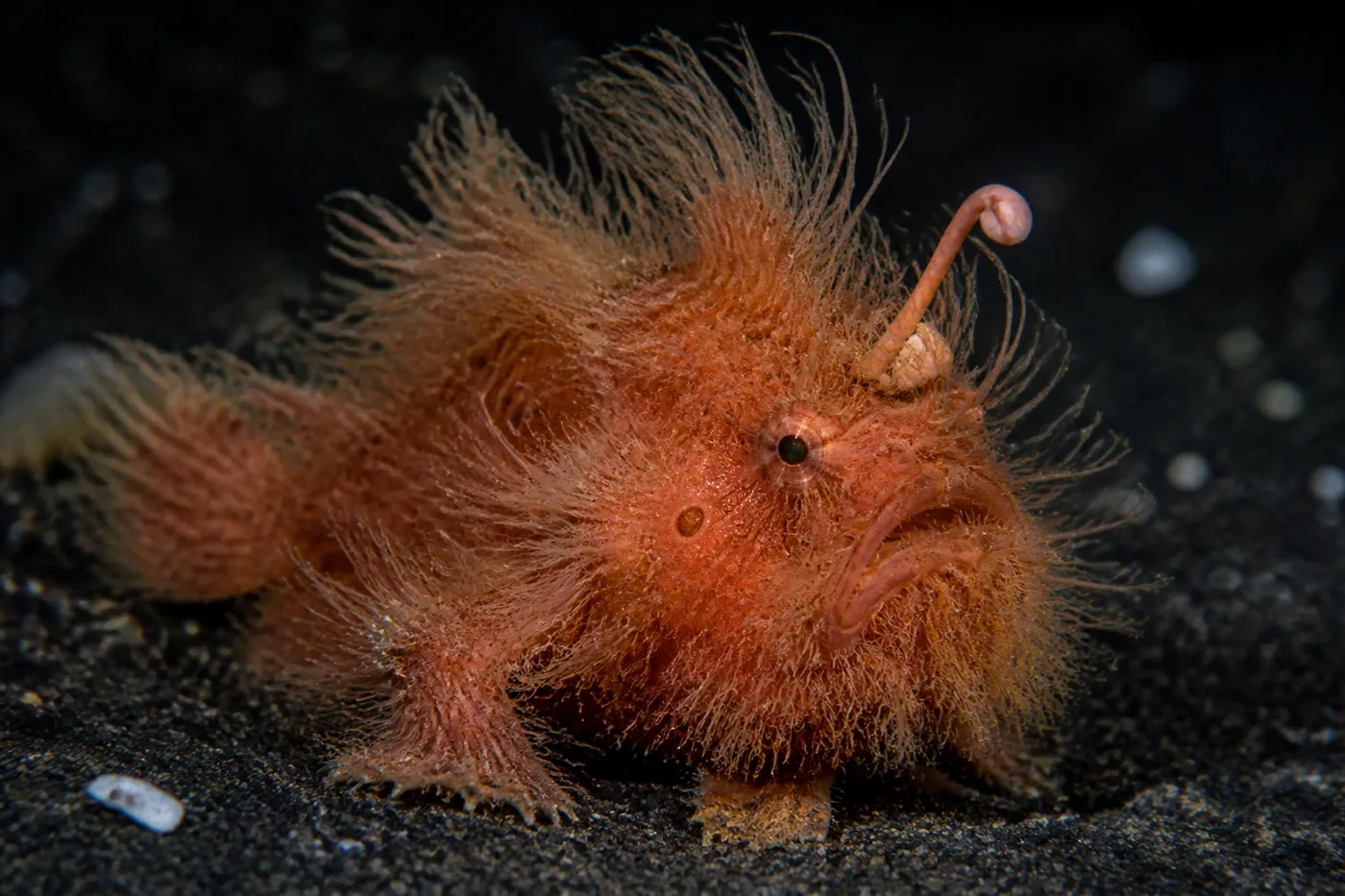
Maumere is a macro destination with good reefs attached, and if you spend all your dives on the outer island walls you will have missed the point. The volcanic sand slopes along the mainland shore are the heart of it. The sand at New Ankermi Slope is mixed with ash from Mount Egon, the volcano behind the coast, and it is fine enough that a careless fin kick will fog the site for everyone. Buoyancy matters more here than current does.
What lives on it: frogfish in several species including hairy and giant, mimic and blue-ringed octopus, ghost pipefish, whiskered pipefish, seahorses, orangutan crabs, bobbit worms, reef cuttlefish, and nudibranchs in the sort of numbers that fill a memory card before the tank runs down. Mandarinfish come out to spawn at dusk over particular rubble patches, which is worth planning an afternoon around.
Most of these sites are shallow, graded easy, and hold a photographer for a full hour without going past fifteen metres. Several are shore dives, which at around 25 USD including gear and a guide makes them some of the cheapest quality diving in Indonesia. If you shoot macro at all, this is where your days should go, and our guide to macro diving in Indonesia covers the technique side. Plan at least one night dive. The sand slopes change character completely after dark.
The outer islands, and the one site with current
Pangabatang and Pulau Besar offer the opposite kind of dive. Steep walls hung with enormous sea fans, plate coral terraces, clouds of anthias, and the clearest water the bay produces. Maragajong is the one to ask for if you only get a single island dive: it starts in a small valley of coral blocks that sweetlips and batfish use as cleaning stations, and with a little patience you can watch a sweetlips hold its mouth open while cleaner wrasse work inside it. Then the reef edge drops away into gorgonians and barrel sponges with mackerel and small tuna passing in the blue.
The Channel is the exception to everything else written here. It runs between the mainland and Pangabatang, about two kilometres wide, and the water forcing through it can be fierce. It behaves more like a Komodo site than a Flores one, with eagle rays, marbled rays and whitetips holding on the drop, and it earns its advanced rating rather than merely carrying it. If you have arrived early for an Alor trip and want to knock the rust off before a week of serious drift diving, ask for this one. If current makes you uneasy, skip it and nobody will think less of you, because the rest of the bay is flat.
The Wairterang wreck
About 29 kilometres east of town, off Wairterang beach, lies the bay's one wreck. It is a Second World War vessel, usually described as a Japanese freighter, that was anchored loading charcoal and timber when an Allied bomb sank it in 1943. Roughly 50 metres long, it sits between 12 and 33 metres on a sand bottom about 70 metres off the beach, close enough that most operators run it as a shore dive.
The hull lies flat and largely open, with the mid-section collapsed and the deeper end twisted onto its side. Portholes, a ladder, hatches and a set of rails running down the middle are all still legible. Its identity has never been settled. A German specialist who examined it thought the rails suggested a vessel used as a floating bridge for moving tanks between ships, which fits the structure better than the freighter story does. It is completely overgrown now, and that is the appeal rather than a complaint. Groupers and trevally patrol it, lionfish and scorpionfish sit on it, ghost pipefish and unusual shrimp live in the hydroids, and the sand and seagrass either side is prime critter ground. There is no penetration and nothing technical about it.
What you can realistically expect to see
Santai Divers puts the number of species recorded in the bay at around 1,200, which lines up with the original fish surveys. In practice the list divides into three tiers, and it helps to know which is which before you get on the boat.
- Near certain, most dives. Nudibranchs, frogfish, scorpionfish and lionfish, moray eels, sweetlips, batfish, anthias clouds, reef octopus, cuttlefish, pufferfish, damsel and butterflyfish, sea fans and barrel sponges on the walls.
- Likely if you dive the right site with a good guide. Mimic octopus, blue-ringed octopus, ghost pipefish, whiskered pipefish, pygmy seahorses, seahorses, bobbit worms, mandarinfish at dusk, turtles, Napoleon wrasse, whitetip reef sharks, eagle and marbled rays, giant trevally on the channel.
- Luck, and not something to plan a trip around. Dolphins and pilot whales, which are common through the year when the sea is flat and are usually seen from the boat rather than underwater. Sperm whales in the November and December rains. Whale sharks, reported most often in April and May. Hammerheads off Babi, which guides mention and which you should treat the way you treat hammerhead stories anywhere.
Conditions through the year
Water sits between 26 and 29 degrees Celsius and, unlike Komodo, it stays there. Maumere has none of the cold upwellings that can drop a dive into the low twenties without warning, so a 3mm suit is genuinely enough even across four dives a day. Visibility commonly runs 20 to 30 metres in the dry season and can be considerably better on the outer walls. April to October is the calmest and clearest window. The broader dry season runs to about December, and January to March brings rougher crossings and less predictable weather, though the sheltered inner bay still dives through it.
Getting there, where to stay, and what it costs
Frans Seda Airport (MOF), which older maps and a lot of locals still call Wai Oti, sits about three kilometres east of the town centre. It is small. One terminal, propeller aircraft and turboprops, and a schedule that rewards anyone who checks it before booking the rest of the trip.
Flights, and where they come from
There are no international flights and no connections from anywhere in Java except through a hub. Everyone arrives on one of four routes.
| From | Flight time | Notes |
|---|---|---|
| Denpasar, Bali (DPS) | About 1 h 30 m | The main route and the one most international divers use. Daily services, currently flown by Wings Air, IndiGo and Super Air Jet |
| Kupang, West Timor (KOE) | Under an hour | The busiest link by frequency, around eleven services a week. Useful if you are coming from Timor or the eastern islands |
| Labuan Bajo (LBJ) | About 1 hour | Three days a week on Wings Air. This is the Komodo connection and its limited frequency shapes a lot of itineraries |
| Makassar, Sulawesi (UPG) | About 1 h 35 m | The alternative hub if Bali routing is awkward, and the way in from northern Sulawesi |
Coming from Europe, North America or Australia, the realistic sequence is an international flight into Jakarta or Denpasar, a night in Bali, then the morning flight to Maumere. Trying to connect the same day from a long-haul arrival is possible on paper and a bad idea in practice, because a delay on the first leg leaves you with no second option until tomorrow.
One detail that catches people out: baggage allowances on these turboprop routes are tight, often 10 to 20 kilograms checked depending on the fare, and dive gear goes over that immediately. Buy the extra allowance online when you book rather than at the counter, where it costs more and where a full flight gives the agent very little room to help you.
Where to stay and dive
Almost nobody stays in Maumere town. The dive properties are strung along the coast road running east towards Larantuka, between roughly twenty and thirty kilometres out, which is where the black sand slopes and the house reefs are. Budget 40 minutes by car from the airport to most of them, and arrange the transfer in advance because taxis do not queue at arrivals the way they do in Bali.
- Happy Dive Retreat, formerly and still widely known as Ankermi Happy Dive, at Wairterang, 29 kilometres east of town. Run by Kermi and Claudia since 1998 and the most established operation in the bay. Beachfront bungalows, a pier for shore entries, and the Wairterang wreck and New Ankermi Slope both accessible from the beach. Long the default choice for macro photographers.
- Santai Divers, on Nangatobong Beach at Waigete, about 40 minutes from town. The first SSI centre in Maumere, small groups, a full course ladder from try-dive to divemaster, a house reef opposite the centre, and dive safaris that run overland between Maumere and Labuan Bajo. Notably they take solo divers on a per-day surcharge rather than turning them away, which is not universal out here.
- Sea World Club, on Waiara beach and the closest of the dive properties to town, so the easiest if you have an early flight. The older established resort in the bay, with beachfront rooms and its own dive operation.
- Coconut Garden Beach Resort and Budi Sun, further along the same stretch, both quieter and both able to arrange diving.
- Simple guesthouses in and around town, including Lena House, if you are just overnighting before a boat and do not intend to dive.
What none of these are is a resort in the Bali sense. Power can be intermittent, mobile signal is patchy east of town, several places are cash only, and the nearest ATM may be a half-hour drive. Draw cash in Maumere town or at the airport on arrival. Our Indonesia liveaboard packing list covers the gear side of the same problem. Which network actually reaches this stretch of coast, and where to buy it, is covered in our guide to Indonesian SIM cards and eSIMs.
What it costs
| Shore dive, gear and guide included | Around 25 USD |
| Two boat dives | Around 75 USD |
| Night dive | Around 30 to 35 USD |
| Open Water course | Roughly 400 to 500 USD |
| Beachfront bungalow, dive resort | Roughly 30 to 70 USD a night |
| Simple guesthouse in town | From about 10 USD |
| Airport transfer to the coast road resorts | Around 15 to 25 USD |
There is no marine park entry fee to speak of, which is a pleasant contrast with Raja Ampat and Komodo. Treat these figures as a planning range rather than a quote, and confirm with the property when you book.
Planning around the boat, and whether Maumere is worth diving
Maumere punishes tight scheduling at both ends, for different reasons. Getting in is about flights. Getting out is about physiology.
Before the boat
Arrive a day early. Not because Maumere is charming at night, but because a missed connection here is not recoverable inside twenty-four hours on most routes, and the boat will leave. If you are joining an Alor liveaboard or one of the long Forgotten Islands routes, that buffer day is the difference between a holiday and a very expensive lesson.
Two dives on the arrival day is a reasonable use of the buffer, provided you keep them shallow and unremarkable. It settles your gear, shakes out whatever the airline did to your regulator, and means the first dive of the actual trip is not also the first dive of your year. Ask for a black sand slope rather than The Channel. There is no sense arriving at a serious destination already tired.
After the boat, which is where people get it wrong
A liveaboard week is repetitive multi-day diving, often four dives a day, and the surface interval you owe before flying is correspondingly long. The standard guidance is at least 12 hours after a single dive and 18 to 24 hours after repetitive or multi-day diving, and our full explanation of how long to wait before flying after diving goes through where those numbers came from.
Because the Labuan Bajo service runs on only three days and the Denpasar flights are limited, people compress the last diving day to make the plane. This is the most common genuinely dangerous decision made in Maumere, and it is made by experienced divers who would never do the equivalent at home. Plan the last dive around the flight rather than the flight around the last dive. If the schedule is awkward, the answer is an extra night in Maumere, not a shorter surface interval.
The same rule catches people going inland. Maumere is the natural airport for Kelimutu, the volcano whose three crater lakes sit in different colours and periodically change them, and the classic plan is to drive to Moni in the afternoon, three to four hours away, and climb for sunrise. The summit area sits at about 1,639 metres. Ascending above roughly 600 metres after diving carries the same decompression risk as flying, which means the same 12 to 24 hour surface interval before you start driving up, not before you start walking. Sequenced properly it is a lovely way to end a trip. Sequenced badly it is a bend on a mountain road in central Flores.
Chambers, and what "nearest" really means out here
This deserves precision because the published information is contradictory. There is a hyperbaric unit at RSUD TC Hillers, the regional public hospital in Maumere, inaugurated in December 2018. There is also a chamber at Siloam Hospitals in Labuan Bajo, opened in October 2018 and the first in East Nusa Tenggara, at the opposite end of Flores. Beyond Flores, the facilities that liveaboard operators actually route serious cases to are in Bali and Makassar.
What that means in practice is less reassuring than a list of chambers suggests. A hyperbaric unit at a regional hospital is not the same thing as a dive medicine service on call at two in the morning, and you should not plan a trip on the assumption that treatment is an hour away. Dive conservatively, pad the safety stops, stay well inside no-decompression limits, and carry insurance that explicitly covers hyperbaric treatment and evacuation. If you are the sort of diver who asks operators where the nearest chamber is and how evacuation is coordinated, and you should be, a crisp answer tells you a lot about everything else on the boat.
How the bay compares with the trip you came for
Nearly everyone reading this is passing through on the way to Alor or the Banda Sea, so the useful comparison is not Maumere against Komodo. It is Maumere against the water you are about to spend a week in.
| Factor | Maumere Bay | Alor and the eastern crossings |
|---|---|---|
| Water temperature | 26 to 29 degrees, stable | 23 to 27 degrees, upwellings can drop it further |
| Currents | Negligible except at The Channel | Strong, the defining feature of the diving |
| Visibility | 20 to 30 metres in the dry season | 15 to 30 metres, often exceptional on the walls |
| What you are looking at | Small things on black sand | Vertical walls, pelagics, dramatic topography |
| Exposure protection | 3mm is plenty | 5mm, and a hood is not paranoid |
| Skill floor | Suits beginners and rusty divers | Comfort in current is not optional |
| Other divers | Usually none | Few, but you are on a boat with them |
| Cost per dive | Around 25 USD | Included in the trip, which is not cheap |
The point of laying it out this way is that the two barely overlap, and that is the argument for diving the bay rather than sitting in a hotel. You are not getting a preview of your liveaboard week. You are getting the opposite of it, warm and slow and shallow, which is exactly what a body wants before or after seven days of cold drift diving.
The verdict
If Maumere were the whole trip, we would struggle to recommend flying across the world for it. The bay is quiet, cheap, warm and unusually rich in small things, but it does not have the scale of Komodo or Raja Ampat and it is not trying to.
As a gateway, the calculation is completely different, and this is the case we would actually make. You are already here. The flights have already been paid for. The bay costs about 25 USD a dive against several times that almost anywhere else you might be going, the water is warm and flat, the macro life is genuinely world class rather than merely good, there is a wreck, and on a normal day you will share a site with your own boat and nothing else. Two days here on either side of an Alor or Banda crossing turns a travel day into part of the holiday, and it does so for the price of a night's accommodation and four dives.
There is a second argument that appeals to the sort of diver who ends up on our boats in the first place. Maumere is one of the very few places where you can dive a reef system that was catalogued at the top of the world, comprehensively destroyed inside a single afternoon in 1992, and then quietly rebuilt itself over thirty years while the dive industry looked somewhere else. Most reef recovery is something you read about in a paper. Here you can go and look at it, and then get on a boat heading east.