Last updated: June 2026.
Most divers come to Indonesia for what's on the reef. Black water diving asks a different question: what swims past the reef when nobody's watching, in open water, after dark, kilometres deep, on its way up to the surface for the night?
The answer turns out to be the largest animal migration on the planet. Every evening, across every ocean basin, billions of larval fish, juvenile cephalopods, gelatinous invertebrates, and the predators that eat them rise from the deep scattering layer between two hundred and a thousand metres up to the photic zone, feed for a few hours in the dark, and sink again before sunrise. Black water diving drops you into that vertical migration, hovering off a downline rigged with bright lights, drifting with the current over a seafloor too deep to see, while creatures that the average reef diver will never encounter swim up out of the dark and pose, briefly, in your beam.
It's the strangest, weirdest, most photogenic dive in any ocean, and Indonesia has quietly become one of the world's two best places to do it (Anilao in the Philippines is the other). The deep channel of Lembeh Strait in North Sulawesi is the established global capital of the genre, and the country's best underwater photography shooters have been quietly building careers around it for the past decade. This is an operator's guide to black water diving in Indonesia: what it actually is, what you'll see, where the genuine sites are, when to go, what gear and certification you need, how to combine it with a liveaboard cruise, and the mistakes we watch first-timers make.
What Is Black Water Diving, Exactly?
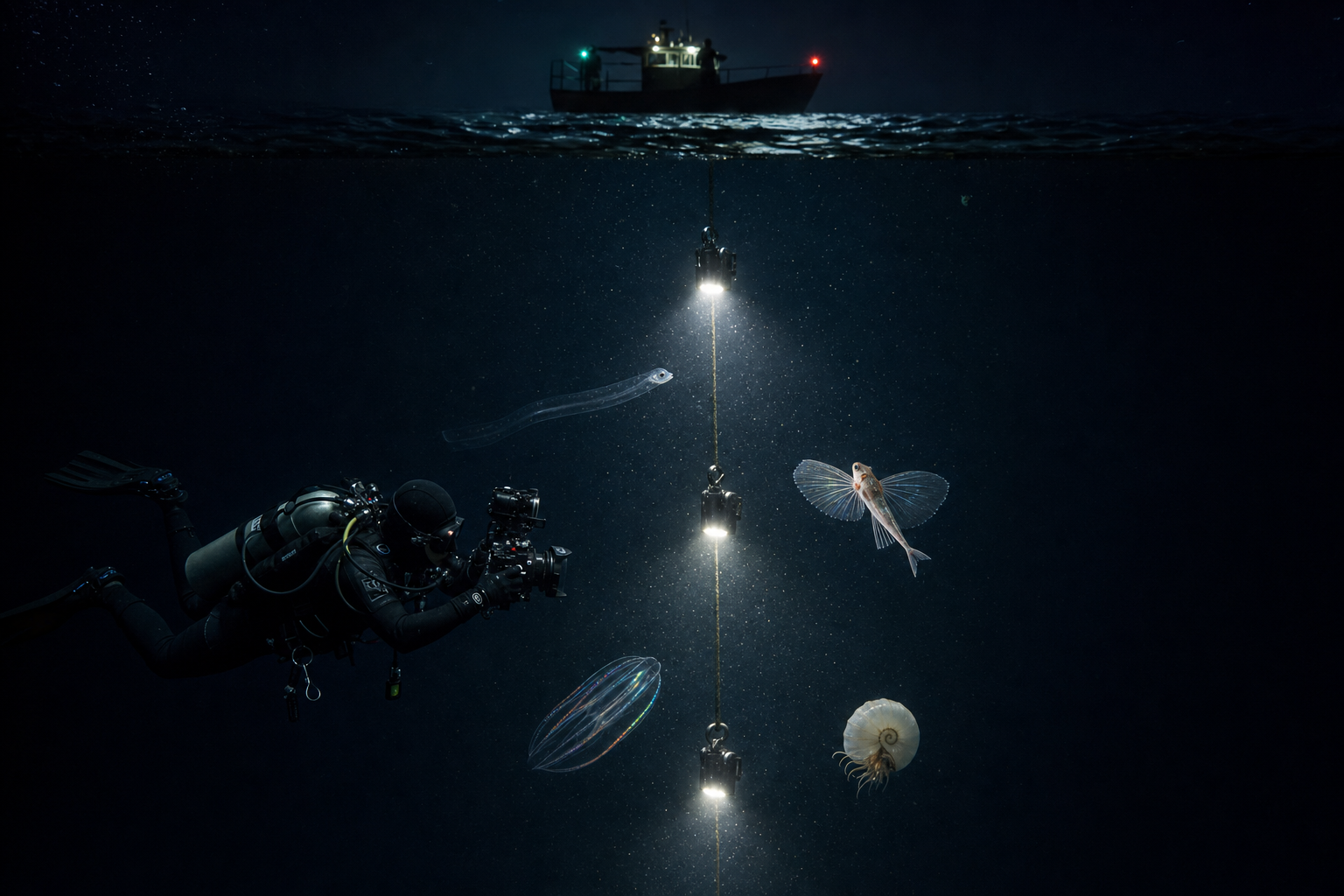
Black water diving is a night dive in open water, away from any reef, with the boat anchored or drifting over deep ocean (usually two hundred metres or more) and a lit downline as your only spatial reference. The dive depth is shallow, almost always between five and twenty-five metres, but the water beneath your fins is bottomless. The lights on the downline draw plankton, the plankton draws everything that eats plankton, and you spend sixty to ninety minutes hovering quietly while the deep ocean's larval and gelatinous fauna passes through.
It's not the same thing as a regular night dive on a reef. A reef night dive shows you the diurnal-to-nocturnal shift on a familiar substrate: hunting moray eels, sleeping parrotfish, decorator crabs out of their day-shelters, the occasional Spanish dancer. A black water dive shows you a completely different fauna: the open-ocean planktonic community on its nightly journey to the surface, almost none of which you can see during the day or on the reef at any time. Larval forms of fish you've seen as adults look unrecognisable. Animals that live their entire lives in the water column, salps, siphonophores, paper nautiluses, pelagic octopuses, are visible nowhere else.
Black Water vs. Bonfire Diving, the Distinction
The two terms get used interchangeably online and they shouldn't. Both are night dives over deep water with lights to attract subjects, but the geometry is different.
Bonfire diving happens close to shore, usually in five to fifteen metres of water, with the boat anchored and lights either on the boat itself or on a small array hung from the bottom of the hull. You drift slowly around the lit area, never far from the boat, and the subjects are mostly mid-water animals attracted in from the nearby reef edge. It's calmer, easier to navigate, more buoyancy-forgiving. Ambon Bay does bonfire diving well, as does Anilao in the Philippines.
Black water diving proper happens offshore, over genuinely deep water (a hundred metres minimum, ideally several hundred), with the boat drifting and a tethered downline rigged with multiple lights. You clip your safety reel to the line or stay within a defined radius of it, and the subjects are open-ocean migratory animals that have travelled hundreds of metres up from the deep scattering layer. It's harder to navigate, more disorienting, and produces the rarer subjects. The Lembeh Strait and the deep channels off Bali are where Indonesia does it properly.
Most operators advertise their offering as "black water" because the term is sexier and more searched, even when the reality is closer to bonfire. The genuine product, deep ocean below, drifting boat, tethered downline, is rarer than the advertising suggests, and Indonesia has more of it than most countries.
How a Black Water Dive Actually Works
The mechanics, in order. The dive boat motors out from the harbour or anchorage to a site over deep water, typically twenty to forty minutes after sunset. The captain drops the engines and the dive deck rigs the downline: a fifteen-to-twenty-metre weighted line with three to five high-intensity lights spaced along it (LED panels, flood torches, sometimes a single big strobe). The bottom of the line is weighted; the top is buoyed and tied off to the drifting boat. The line lights up the water column for several metres in every direction, creating a column of attractant in an otherwise pitch-black sea.
You enter the water at the line, descend along it to your working depth (usually fifteen to twenty metres), and clip your safety reel to the downline (or to a tether on your buddy if you're working a closer formation). The boat drifts with the current and the line drifts with the boat, so you're always within the lit zone. You hover, you watch, and you photograph what arrives. The dive is sixty to ninety minutes typically, ending with a slow ascent to a five-metre safety stop and back to the boat.
The crew runs a surface watch the entire time. A second crew member in a small skiff is usually on station nearby, monitoring divers and watching for any drift away from the line. Marine traffic in Indonesian waters is real, fishing boats run nightly with their own lights, so the surface watch is not optional. If you're booking a black water dive and the operator can't tell you who's running surface support and how, find a different operator.
Why Open Ocean and Why Night
The why is biological. The deep scattering layer (the DSL, on a vessel sonar it shows up as a thick reflective band at three hundred to seven hundred metres depth during the day) is where most of the open ocean's plankton-feeding fauna lives during daylight hours, hiding from visual predators. At dusk, the entire layer rises towards the surface to feed on the night-active planktonic community in the upper hundred metres. At dawn, it sinks again. The vertical migration is so universal that it happens in every ocean, every night, with biomass estimates running to ten billion tonnes of organisms moving up and down each twenty-four-hour cycle.
You can't observe this during the day (the animals are too deep) and you can't observe it on the reef (the migration happens kilometres offshore, over open water). You can only observe it at night, drifting offshore, with lights to draw a sample of the migration into your visual range. Black water diving is, structurally, a brief sampling of the largest animal movement on the planet, conducted from a swimmer's perspective with a torch and a camera.
What You Actually See, the Vertical Migration Spectacle
The fauna is the reason you book the dive, and it bears spelling out, because most divers' expectations are calibrated to reef diving and the black water roster is unfamiliar.
Larval Cephalopods
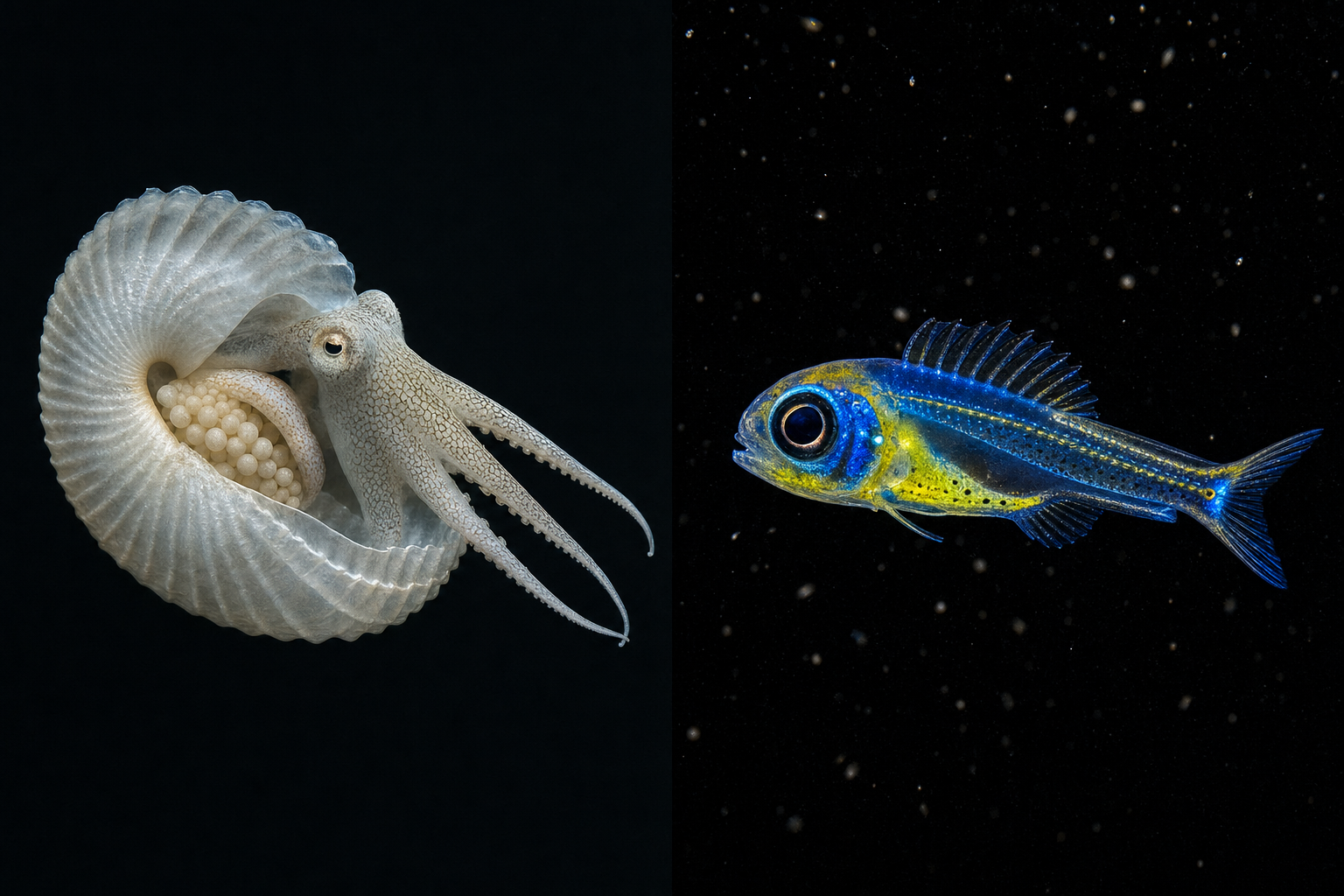
The headline group. Larval and juvenile octopuses, squid, and cuttlefish are abundant in the open water at night and almost never seen elsewhere. The most famous subject is the paper nautilus (genus Argonauta), a small pelagic octopus where the female builds a fragile, beautiful spiral shell to brood her eggs in. Argonauts are not nautiluses despite the name; they're octopuses with a unique shell-building behaviour, and a healthy adult female with eggs visible in the shell is one of the most photographed subjects in black water diving. We see them through most of the year in Lembeh's deep channel and off the coast of Bali.
Other cephalopod regulars: the diamond squid (long-finned squid juveniles in their transparent post-larval stage), pelagic octopus (genus Tremoctopus, the blanket octopus, where the female unfurls a metres-long iridescent web when threatened), flying squid larvae, cuttlefish juveniles in the size range one to four centimetres long, often with pigment cells that pulse and change in your beam. The cephalopod density of Lembeh black water on a productive night is genuinely difficult to overstate; we've had divers come back with twenty unique cephalopod species from a single ninety-minute dive. The fauna is part of the broader Coral Triangle ecosystem, the world's richest marine biodiversity zone, and Indonesia sits squarely at its centre.
Larval Fish
The other major category. Almost every reef fish you've ever seen as an adult began life as a planktonic larva in the open ocean, and the larval forms are often unrecognisable: a juvenile flying gurnard with extended pectoral fins like glass wings, a larval flounder still swimming upright before metamorphosis, larval billfish (sailfish, marlin) with disproportionate bills, larval eels (the leptocephalus stage, transparent ribbon-like creatures up to twenty centimetres long), larval frogfish with their adult ambush colours already visible, larval lionfish trailing finning ribbons twice their body length.
The single most photographed larval fish in Indonesian black water is the larval mahi mahi: a bright iridescent yellow-and-blue juvenile two to four centimetres long, with the dorsal fin already present and the body shape unmistakable. We see them most reliably from August through November in Lembeh.
Pelagic Invertebrates
The gelatinous category, often overlooked because the photography is harder. Salps (transparent barrel-shaped tunicates that form chains up to several metres long), siphonophores (colonial cnidarians in chains, the open-ocean cousins of the Portuguese man-o'-war), jellyfish in dozens of unfamiliar species, comb jellies (ctenophores) with iridescent rows of cilia that pulse rainbow colours in your beam, pelagic nudibranchs (genus Phyllirhoe, transparent and graceful), pteropods (sea butterflies, swimming snails with translucent wings), and the occasional pelagic worm or chaetognath arrow worm.
Photographically these are demanding, almost everything is transparent and you need either back-lighting or careful strobe placement to make the shape visible at all. But for a serious underwater photographer the gelatinous category is where the most original images come from.
The Headline Encounters
What most divers actually come for. In rough order of frequency:
- The argonaut (paper nautilus), most consistent subject in Indonesia, year-round in Lembeh.
- The blanket octopus, rarer and seasonal, but the holy grail for black water photographers when one shows up with the iridescent web deployed.
- Larval mahi mahi and other pelagic predator larvae.
- The leptocephalus eel larvae, often a metre long and graceful as ribbons.
- Juvenile flying gurnards, photogenic and approachable.
- Juvenile lionfish, dramatic against black water.
- The occasional larval billfish or bigger pelagic juvenile.
- Mass salp chains, several metres of transparent links.
- Bioluminescent invertebrates if your dive happens during a productive bloom.
The hit rate matters. On a productive Lembeh black water night you'll see fifteen to thirty distinct species, with at least one or two genuinely rare ones. On a slow night you'll see five to ten and feel slightly underwhelmed. The variance is part of the experience: every black water dive is, structurally, a sample of what happened to be in the water column at that exact place at that exact moment. You do four nights of black water and the species list builds; you do one night and you've taken a single sample.
The Best Black Water Sites in Indonesia
Black water diving in Indonesia is concentrated in three regions: the Lembeh Strait in North Sulawesi, several spots around Bali, and Ambon Bay in the Maluku archipelago. A handful of operators run black water dives in other regions on request, but the genuine product is in those three, and we'll explain why.
Lembeh Strait, the Indonesian Capital
Lembeh is to black water diving what it is to muck diving: the global benchmark, the place every other site is measured against, the operator depth and the bottom topology are both ideal. The Strait sits between mainland North Sulawesi and Lembeh Island, and the channel that runs down its centre drops to over four hundred metres in places, with deeper water just outside the entrances. Boats run black water dives from the major Lembeh resorts five to six nights a week year-round, and the operator pool is calibrated: most dive guides have run hundreds of black water dives, the downline rigs are professional, and the species log over the past decade has built a reputation among black water photographers worldwide.
The standard Lembeh black water happens in the deep channel south of the resort strip, with the boat drifting over four hundred to seven hundred metres of water. The downline goes down fifteen to twenty metres with three to five lights spaced along it. Dive duration is sixty to ninety minutes; cost is typically fifty to eighty US dollars on top of a regular dive package; rebooking is easy. The species list on a productive night includes argonauts, larval cephalopods, larval fish across multiple families, and the gelatinous community in abundance.
If you're going to do black water diving in Indonesia and you can only pick one place, Lembeh is the answer. The full Lembeh Strait diving guide is here; the macro day-diving in Lembeh is also world-class and the trip pays for itself even without the black water nights.
Bali, the Accessible Alternative
Bali has black water diving in two distinct configurations. The first is off Tulamben on the northeast coast, where the seafloor drops steeply away from the famous USS Liberty wreck and the boat can sit in a hundred-plus metres of water within a few minutes of the shore. Tulamben black water tends to be quieter, less crowded, and a useful add-on if you're already doing day-diving the Liberty and the local muck sites. Tulamben is covered in the Bali dive sites guide here.
The second Bali configuration is the channel between Nusa Penida and the mainland, where the deep current-fed channel drops to five hundred metres in the middle. Operators based at Padang Bai or Sanur run nightly black water dives in the channel during the calmer months, and the species list includes both the standard tropical migratory fauna and the occasional cool-water visitor washed in by the south-flowing Indonesian Throughflow current. The mola mola dive is in the same general area; the Crystal Bay mola guide here covers the broader Penida geography.
Bali black water is a strong choice for divers who don't have the time or budget for a full Lembeh trip but want one or two nights of the experience. The flight from most Asian gateways to Bali is shorter than the flight to Manado, and you can build black water nights into a Bali-and-Komodo trip easily.
Ambon Bay, the Bonfire-Style Option
Ambon Bay's black water offering is structurally closer to bonfire diving than to true offshore black water: the bay drops to one hundred to one hundred and fifty metres in places, the boats run on a short tether close to shore, and the dive happens in the lit zone between the boat lights and the deeper water. The species list overlaps with Lembeh's but tends towards the larval reef-fish end of the spectrum rather than the deep-water cephalopods.
Ambon's value is that it sits at the start of the Banda Sea cruising window, so the black water nights work as a pre-cruise add-on for divers heading out on a Banda Sea liveaboard. The Ambon diving guide here covers the broader macro and bonfire programme, including which resorts run the lights and when.
Komodo, an Underrated Option
Komodo's black water diving is a relatively recent development and remains less commercially run than Lembeh or Bali. The deep channels around Padar, Sebayur, and the strait between Komodo Island and Rinca produce strong currents that drop to two hundred-plus metres in places, and a handful of dedicated photographers have been running black water nights from anchored liveaboards in the area for the past few seasons. The species list is promising, with healthy cephalopod populations and the same general migratory fauna as the rest of Indonesia, but the operator depth is shallow: most cruises don't offer black water as a standard product, and the dives have to be organised in advance with a captain who knows the right anchorages and the right currents.
If your itinerary includes Komodo and you want to add black water, the right move is to book with an operator who's experienced specifically in Komodo black water and who has surface support arrangements in place. We've run black water nights on a few of our Komodo cruises by request; the Komodo Sea Dragon vessel page has the most current information on which trips support it.
Where It Doesn't Work, Yet
Two regions where serious black water photographers sometimes ask about and where the answer is mostly no, at least for now.
Raja Ampat, despite its other diving riches, is a poor black water destination. The water in most of the cruising area is too sheltered, the channels are too shallow (often under fifty metres), and the open-ocean migration that black water diving relies on doesn't reach the Dampier Strait or the Misool inland passages in any concentration. There are operators experimenting with black water in the deep water off Wayag and the western edge of the Misool reefs, but the product isn't established and we wouldn't recommend booking a trip around it. Raja Ampat's strengths are covered in the dive sites guide here.
The Banda Sea has the depth (the Banda Trench drops to nearly seven thousand metres) but the surface conditions are usually too rough for stable downline rigs, and the cruising operators don't routinely run black water dives. We expect this to change in the next few years as the dive product evolves; for now, Banda Sea cruises are about hammerheads, volcanoes, and pelagic walls. The Banda Sea guide here.
Best Time of Year for Black Water in Indonesia
The seasonal calendar is more nuanced than for regular diving. Three factors matter: the regional dry season (because surface conditions need to be calm enough to rig a downline safely), the lunar phase (because moonlight competes with your downline lights), and the productivity windows for specific subjects.
The Regional Dry-Season Windows
Black water diving works best when surface conditions are calm enough that the downline drifts predictably and the boat can hold position without rolling. That means you want the dry season for the region you're diving.
Lembeh dives black water year-round, but the most reliable conditions are March through November, with August and September the peak. The brief wet season (December through February) brings stronger surface winds and the operators occasionally cancel black water nights when the swell builds.
Bali is dive-able most of the year, but the calmest black water windows are April through November on the Tulamben side, and June through October in the Penida channel. The wet season can produce strong current and reduced visibility in both areas.
Ambon and Komodo follow the eastern Indonesian dry-season pattern: April through November is the working window, with peak conditions in July, August, and September.
The full Indonesian seasonal calendar covering all the diving regions is here; for black water specifically, July through October is the country-wide sweet spot.
The Lunar Cycle, Why Moon Phase Matters
The single most underestimated factor in black water diving. Your downline lights compete with whatever ambient light is in the water column, and the difference between a new-moon dive and a full-moon dive is genuinely large. New-moon nights produce the highest density of subjects (because the open-ocean fauna is most strongly attracted to the only bright light in the water column) and the cleanest photography (because the contrast is highest). Full-moon nights produce more diffuse subjects and a more general-luminance background.
Most experienced black water photographers plan their trips around the new moon. We'd recommend booking your Lembeh resort or your Bali dive base for the four nights either side of a new moon, ideally with the new moon falling in the middle of the trip. If you're planning the trip months ahead and don't have flex on dates, the day-after-new-moon and the day-before-new-moon are still excellent. Avoid full moon if you can.
Coordinating With a Cruise Itinerary
If you're combining black water diving with a Komodo or Raja Ampat liveaboard, the calendar gets more complicated. The cruise dates are fixed by departure and return logistics, and you can't usually plan the cruise around new moon. The right move is to put the black water nights at the front or back of the trip (Lembeh add-on, Bali add-on) and pick the cruise dates that put your shoulder-trip nights on the productive lunar window.
Example: a Komodo cruise from August 4 to August 11, with Lembeh black water nights from July 30 to August 3 (the four nights leading up to the new moon on August 4). The cruise itself is regular daytime diving; the black water happens before, in Manado, on the productive lunar phase.
Conditions, Safety, and What Certification You Need
Black water diving has a higher cognitive load than regular night diving, and the safety considerations are different from a reef night dive. The actual risk profile, when run by a competent operator, is comparable to any technical-leaning recreational dive: the shallow depth means decompression is not the issue, but disorientation, separation from the line, and surface traffic are real concerns that the operator has to manage actively.
Required Certifications and Experience
The minimum standards we'd recommend (and the ones most reputable Indonesian operators apply, though enforcement varies):
- Open Water certification minimum, with at least twenty-five logged dives total before the first black water night. Some operators require Advanced Open Water; some don't, but the experience floor matters more than the certification card.
- Night diving experience, at least five logged night dives before the first black water dive. The disorientation is similar; experience helps.
- Buoyancy proficiency, the single most important skill. You'll be hovering for sixty to ninety minutes at fifteen-to-twenty metre depth in mid-water with no spatial reference except the downline. If your buoyancy drifts up and down, you'll spend the dive fighting your BCD instead of looking at subjects, and you'll burn through your air. The Lembeh operators won't take divers who can't hold a stationary hover with two-finger trim.
- Comfort with mid-water orientation, the harder skill to assess in advance. Some divers find black water disorienting in a way they can't predict from prior experience: the absence of any reef, wall, or substrate triggers a kind of low-grade vertigo for the first ten or fifteen minutes. Most divers adjust within the first dive; a few don't, and a small number find the experience genuinely uncomfortable. If you've never done open-water mid-water hovers, an introductory bonfire dive is a useful first step before committing to a true black water night. Our first-time liveaboard guide covers the broader skill prep and pre-trip mindset for divers stepping up from resort day-diving.
Some operators advertise black water as "all welcome" because they're running it as a bonfire-style close-shore dive. The genuine offshore black water dive in Lembeh or Bali is properly experience-gated.
The Buddy System, Tether Protocols, the Downline
The key safety mechanism is the downline itself: a fifteen-to-twenty-metre weighted line with multiple lights, descending from the drifting boat. Divers stay within visual range of the line throughout the dive. The standard technique is to clip a short safety reel to the downline (or to your buddy's harness, with the buddy on the line) and use that as your tether. If you drift slightly, you reel back. If you separate, the tether catches you.
Some operators run a strict no-buddy black water programme where every diver is solo on a personal tether to the line, no buddy pairs. This works for experienced divers but it changes the rules: if your buddy drifts off, the operator has built that into the protocol, you stay on the line. Other operators run conventional buddy pairs with the buddy team tethered to each other rather than to the line. Both work; the operator should brief which model they're using before the dive.
The line itself has its own protocols. Lights are positioned along the line so the upper light is at five metres (the safety stop position), the middle lights at ten and fifteen metres, the deepest light at the bottom. You orient by which lights are above and below you. The boat surface watch keeps a torch on the line throughout the dive; if a diver loses the line, the surface light is the secondary reference.
Disorientation, Depth Control, and the Surface Watch
The disorientation question deserves its own paragraph. With no reef and no substrate visible, your depth gauge becomes your only depth reference. Most divers don't realise how much they rely on visual depth cues until they don't have them, and the natural drift is to slowly ascend or descend without noticing. A two-or-three-metre drift either way isn't dangerous at fifteen metres, but it can carry you out of the lit zone or into a different current pattern. The discipline is to check your depth gauge every two to three minutes and re-establish your position relative to the downline lights.
The surface watch is the third safety layer. A second crew member in a small skiff, or on the back of the dive boat, monitors the dive throughout. They watch the bubbles, count the divers' surface flares if used, and have a recall signal (a sharp rap on the downline that transmits through the water) if they need divers up. Marine traffic is a real concern in Indonesian waters, fishing boats run nightly with their own lights and may not see a small dive boat, and the surface watch is the divers' eyes for traffic. If your operator's surface support is unclear, find a different operator.
Marine Traffic and the Support Skiff
One specific failure mode worth describing because it's the one we worry about most. A dive boat sits over deep water with the engine off, drifting with the current, while a downline hangs below and divers work the line. A fishing boat, running its own night lights at speed, doesn't see the dive boat in time. The result is bad: the fishing boat hits the dive boat or, worse, runs over the downline area with divers below.
The mitigation is multi-layered. The dive boat keeps its navigation lights on. A flashing strobe on the downline buoy marks the line on the surface. A second skiff on station within twenty to fifty metres of the dive boat acts as visual mass for incoming traffic. The operator should be able to describe all three. If the operator is running solo on a single anchored boat with no support skiff, that's the model to avoid for true offshore black water. The Lembeh and Bali operators we recommend run multi-boat support as standard.
The Camera Setup, Black Water Photography
Black water photography is the highest-skill genre in underwater photography. Subjects are small (one to fifteen centimetres typically), often transparent, often in motion, with no fixed substrate to focus against, in pure black water with high-contrast lighting. The kit and the technique both matter. The full Indonesia photography pillar covers wide-angle and macro across every region; this section covers the black water specifics.
Body and Lens, Why 60mm and 100mm Macro Work
The standard black water lens choice on a full-frame mirrorless or DSLR body is a 60mm or 105/100mm macro. Both have advantages.
The 60mm macro is the more flexible choice. The wider field of view lets you frame larger subjects (juvenile flying gurnards, larval mahi mahi, salp chains) and the lens is easier to focus in low light. The minimum focus distance is short, so you can get close on the small cephalopods. We'd recommend a 60mm if it's your only black water lens, particularly for a first trip.
The 100mm or 105mm macro is the better choice for the very small and very rare subjects (millimetre-scale larval fish, juvenile cephalopods at one or two centimetres, the smallest gelatinous animals). The longer focal length gives you more working distance, which matters because some subjects are skittish, and the magnification is higher for the smallest critters. The downside is the narrow field of view: a six-centimetre subject barely fits the frame, and you can't shoot the larger animals on the same lens.
If you're a working photographer with two camera bodies, the optimal black water setup is one body with 60mm and one with 100mm, switching between dives. Most photographers don't carry two bodies and pick one lens per night, biasing towards the 60mm for the first night to learn the conditions and the 100mm for subsequent nights when you know what's running.
Wide-angle lenses (16-35mm zooms, 14mm primes, fisheyes) are not used in black water. The subjects are too small and the lighting geometry doesn't support a wide field of view.
Strobes, Focus Lights, and Snoots
The lighting is where black water photography differs most from reef macro. The water is pure black, so any light you use shows up as the entirety of the illumination on the subject. Two strobes are standard, positioned slightly forward of the housing and angled inward to fully light the subject without lighting the water column behind it (which would produce backscatter from any plankton in the beam). Strobe power is medium to low; you don't need much, because the working distance is short and the subjects are small.
A focus light is essential. Black water subjects are too small to autofocus on without a continuous light source illuminating them, and standard reef-diving focus torches are usually too bright for the working distance. Most experienced black water photographers carry a dedicated low-power focus light with a red filter (red light doesn't startle most cephalopods or fish in the way white light does) and a switch to white when the strobes fire.
Snoots, the funnel-like attachments that narrow a strobe beam to a tight circle, are useful for the more dramatic black water images, isolating a single subject against pure black water. The setup takes practice; the snoot has to be aimed precisely, and small subject movement will move the lit circle off the subject. We'd recommend learning the snoot on regular muck dives in Lembeh during the day before trying it in black water at night.
Shooting Larval Subjects vs. Gelatinous Animals
The two categories require different approaches.
For larval cephalopods and fish, the subjects are opaque and the standard two-strobe forward setup works directly. Aim for crisp focus on the eye, expose for the subject (the background goes black naturally), and shoot at moderate aperture (f/16-f/22 for adequate depth of field on the millimetre-scale subjects).
For gelatinous animals, salps, jellies, siphonophores, comb jellies, the subjects are transparent or translucent, and direct front-lighting produces a flat, washed-out image. The technique is back-lighting or side-lighting: position one strobe behind the subject (or one to the side) so the gelatinous body is illuminated from behind, making the structure visible. The other strobe provides fill on the front. Some photographers use a single back-light only for the most ethereal images. Practice with comb jellies first, the iridescent cilia rows are forgiving subjects. If you can extend the trip with day-diving in Lembeh, the macro substrate work there is excellent practice for snoot technique before you take it to the deep channel at night.
Pre-Dive Camera Checklist
Before stepping off the boat, every black water photographer should run through:
- Housing seal check, including all port o-rings and the back door seal.
- Strobe sync test, both strobes firing on every shutter trigger.
- Focus light battery (full charge, not nearly-full).
- Camera battery (full charge, with at least one spare in your dive bag for the next night).
- Memory card with at least 64GB free, more if shooting raw plus JPEG or video.
- Lens hood removed if applicable, the hood reduces working distance and increases backscatter risk.
- Strobe positioning calibrated for the working distance you intend to shoot at.
- Manual mode set with starting exposure (most experienced black water shooters use 1/160 or 1/200 shutter, f/16-f/22 aperture, ISO 200-400, adjusting from there).
- Backup torch in your BCD pocket in case your focus light fails.
The single most common photography mistake we watch is photographers who treat black water like reef macro and don't recalibrate their exposure. The pure-black background means you're shooting against zero ambient light, which sounds like it should make exposure easy but actually produces aggressively overexposed subjects if you bring reef-macro settings unchanged. Test the first frame, check the histogram, recalibrate before you commit a full memory card to the wrong exposure.
Combining Black Water With a Liveaboard Itinerary
Most international divers booking Indonesia want to combine black water with a liveaboard cruise rather than a pure resort trip. The geography supports several efficient combinations.
Lembeh Resort + Cruise Extension
The classic photographer's two-stop. You fly into Manado, base at one of the Lembeh Strait resorts for four to six nights of muck diving and black water nights, then transfer (Manado-Bali, then Bali-Labuan Bajo or Bali-Sorong) to your liveaboard. The Lembeh portion gives you the macro and the black water; the cruise gives you the wide-angle. Total trip length is fourteen to eighteen nights typically.
The strongest version of this trip in 2026 calendar terms is mid-August: Lembeh from August 6-12 (Friday to Friday, hitting the new moon on August 9), then transfer to Labuan Bajo on August 13, then a six-or-seven-night Komodo cruise from August 14-20 (the standard Komodo itinerary options are here). Komodo Sea Dragon and Neptune One both run Komodo cruises in this window.
Komodo Cruise + Lembeh Add-On
The reverse order. Cruise first, then Lembeh on the back end. This works if you want to be fresh for the cruise (the long-haul flight to Indonesia followed by a long boat ride is taxing) and the muck diving plus black water as the wind-down. The transfer from Labuan Bajo to Manado runs Bali, Manado, two flights with a connection in Denpasar.
For some photographers this order works better because the cruise produces wide-angle reef material first, then Lembeh produces the macro and black water material that completes the portfolio. We'd recommend this order if you're a working photographer building a portfolio, and the Lembeh-first order if you're a recreational diver who wants the gentler dive ramp.
Bali-Plus Combinations
Bali black water as a one-or-two-night add-on works either before or after a Komodo cruise. The flight from Bali to Labuan Bajo is short, the resorts in Tulamben and Sanur run black water on request, and you can often do it on a single overnight stop without a full multi-day Bali extension. We'd recommend two nights minimum (one black water dive night plus one buffer day) if you're going to add Bali to a Komodo trip.
What Our Three Vessels Offer
Black water diving is not a standard service on our cruises, but we run it on request when the itinerary supports it.
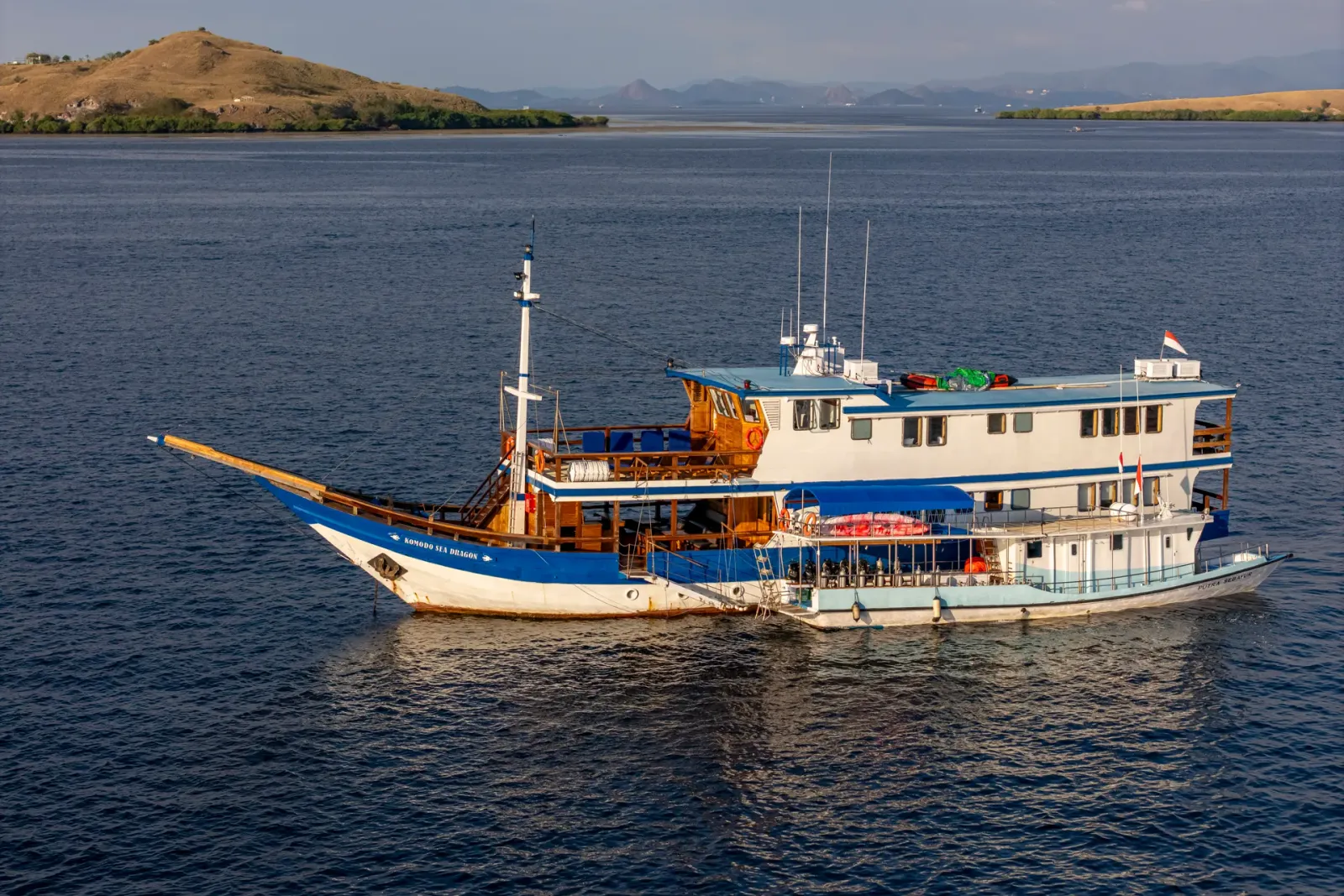
Komodo Sea Dragon can run black water nights in the deep channels around Padar and the Sumba Strait, on cruises where the captain has the authority to add the night and the guest list is up for it. The setup is closer to bonfire than true offshore black water, the waters are not as deep as Lembeh's. We're honest about that. Vessel page here.
Neptune One can run bonfire-style night dives during anchored Komodo nights but does not run dedicated offshore black water. The boat's set up for reef and pelagic diving, not for tethered open-water photography work. Vessel page here.
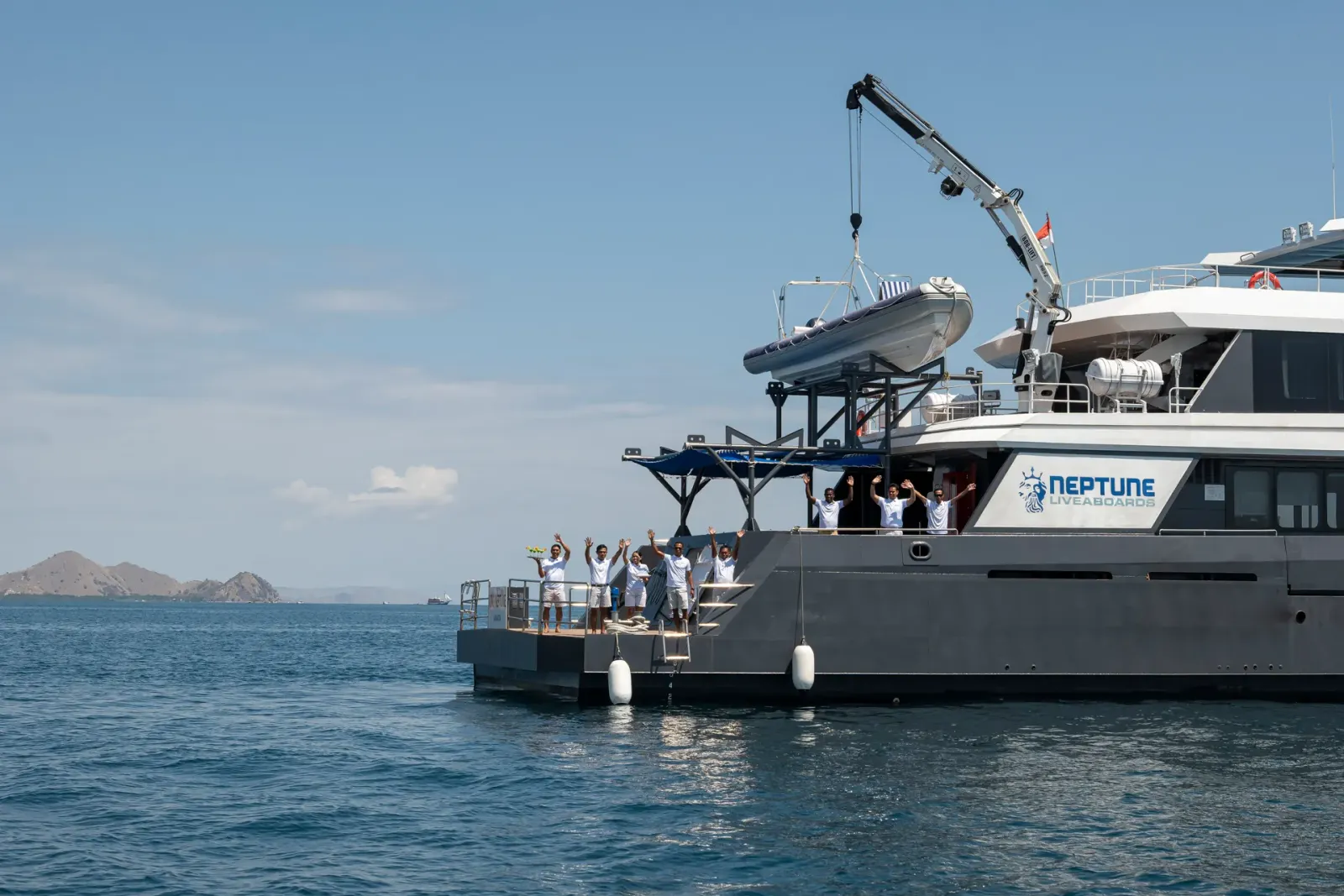
King Neptune on Banda Sea and Halmahera cruises runs occasional bonfire-style nights from the larger tender; the longer-range itineraries put us over genuinely deep water, but the surface conditions vary and we won't run the dive if the swell isn't right. Vessel page here.
For dedicated black water diving, the honest recommendation remains the Lembeh-resort-plus-cruise combination, with the resort handling the black water programme and the liveaboard handling the day diving. The dive safari article here covers the broader logic of combining resort and cruise stays into a single Indonesian trip.
Practical Logistics and the First-Night Briefing
The first time you do a black water dive, the briefing is longer than for a regular night dive and the operator should walk through the specifics carefully. If they don't, push back, the briefing is the operator's responsibility, not the divers' homework.
What the Boat Needs
The functional kit list for a properly run black water dive (separate from the diver's own kit, which we cover in our Indonesia liveaboard packing list):
- A primary dive boat with adequate deck space for divers to gear up and the engine running for position-holding.
- A weighted downline of fifteen to twenty metres with three to five high-intensity lights spaced along it.
- A surface support skiff on station within fifty metres throughout the dive.
- A flashing surface marker (strobe or beacon) on the downline buoy.
- Working radios on both boats, with the captain on continuous traffic-watch listening.
- Dive lights for every diver (primary plus backup).
- Surface marker buoys for each diver, deployable from the safety stop.
The kit list is not negotiable. If you book black water and arrive at the dock to find one boat with one captain and a single dropped weight, that's not the operator to dive with. Walk away politely and ask for a refund.
The First-Night Briefing
The operator should cover, in this order:
- Site description, where the boat is going, depth of water below, distance from shore.
- Entry and descent, where divers enter the water, how to find the downline.
- Working depth and position, the depth range to stay in, the radius from the line.
- Tether protocol, are you tethered to the line or to a buddy.
- Light protocol, when to use focus lights, when to use strobes, what's the minimum.
- Communication signals, the standard hand signals plus the line-rap recall and the surface flare.
- Lost-line procedure, what to do if you separate from the downline (typically: ascend slowly to five metres, deploy SMB, surface signal).
- Buddy separation, what to do if you lose your buddy.
- Emergency ascent, the protocol for any rapid surface return.
- Surface recovery, where the boats will pick you up.
If the briefing is shorter than ten minutes, the operator hasn't covered enough. If it's longer than twenty, the operator is being thorough, which is what you want for a first-night dive.
Drift Speeds and How to Recover
The boat drifts with the surface current; the downline drifts with the boat; you drift with the line. The system is in equilibrium most of the time. The thing that breaks it is current shear: the surface current and the deeper current can run in different directions, and a downline rigged from a drifting surface boat can swing horizontally in a way that's not always predictable.
The standard fix is to come up the line as soon as you notice the line is no longer vertical. If the downline is leaning, the boat is drifting in a different direction than the line is swinging, and you want to be near the upper light (where you can see the boat) rather than the lower light (where you can lose visual on the boat entirely). On a long dive in heavy current shear, expect to do most of the work in the upper third of the line.
Common Mistakes, the Operator Watch List
The five most common first-time black water failures we watch from the deck:
1. Bringing reef-macro exposure settings unchanged. The pure-black background tricks new black water photographers into shooting at reef-macro settings (f/8-f/11, ISO 800-1600), which produces overexposed subjects with ugly halos. Stop down to f/16-f/22, drop ISO to 200-400, and let the strobes do the work.
2. Hovering too close to the line. The temptation on the first dive is to stay within two metres of the downline lights for security. The problem is that the line lights are bright and they're at fixed angles, so close-line shooters end up with backscatter from plankton in the beam plus rim-lighting on every subject. Stay six to ten metres from the line, the brighter zone of attractant is in the middle of the lit volume, not directly under the lights.
3. Chasing fast subjects. Some larval fish are quick; the natural instinct is to fin after them and reposition. This is a losing strategy: you'll burn air, push the subject further, and lose your position relative to the line. The right move is to hold position, let the subject come back if it will, and accept that you won't catch every photo opportunity.
4. Underestimating the cognitive fatigue. Ninety minutes of focused, mid-water hovering with constant line-checking, light management, and subject tracking is genuinely tiring in a way reef diving isn't. New black water divers commonly want to do three nights in a row and find themselves underperforming on night three. Two-on-one-off is a better rhythm for most divers; three nights with a rest night between for the hardcore.
5. Booking against the moon. The single most expensive mistake. A photographer who's flown halfway around the world for black water diving and arrives during the full moon is going to have a frustrating week. Always plan around the lunar phase. New moon, new moon, new moon.
Bringing It Together
Black water diving is the strangest, most photogenic, most genuinely rare-encounter dive type that exists in recreational diving today, and Indonesia is one of the two best countries on earth for it. The combination of Lembeh's deep channel, Bali's accessible alternatives, and the scope to add Komodo or Banda Sea cruise extensions makes the country a complete black water destination, not just a single-site one.
The shape of the trip we'd actually book for a photographer who said "I want to come to Indonesia for black water and want to build a serious portfolio": six nights at a Lembeh resort across a new-moon week (with three to four black water dives plus daily muck dives), then a two-day Bali stop with one Tulamben black water night and one Liberty wreck dive, then a one-week Komodo cruise on Komodo Sea Dragon for the Komodo wide-angle headline sites and the dragons themselves. Total trip length is fifteen to seventeen days; species log on the black water portion is conservatively forty to seventy distinct subjects; portfolio output is four to six magazine-quality images per night for an experienced shooter.
For a recreational diver who's never done black water and wants one or two nights of the experience as part of a wider trip, the Bali version is the right entry: fly into Bali, book a single Tulamben black water night with a competent local operator, then carry on with a Komodo cruise for the rest of the holiday. The Bali night gives you the experience of a true offshore black water dive without committing the full Lembeh trip cost.
For divers who want to be honest with themselves: black water is harder than it looks. The disorientation is real, the photography is the highest-skill genre in underwater imaging, and the hit rate is variable. A first-night photographer who comes back with two strong frames has done well. The reward is the species you'll see nowhere else on the planet and the kind of dive memory that stays vivid years later.
If you want help putting a black water-focused Indonesia trip together (Lembeh resort selection, lunar-window cruise dates, the right itinerary for your camera kit and skill level), contact us with your dates and what you're hoping to shoot and we'll put a real plan together. The right trip is a quietly extraordinary thing, and the wrong one is just a damp night in dark water. We'd rather build the right one with you.