Last updated: March 2026.
The mola mola is one of the strangest large fish in the ocean. Adult animals grow to more than three metres tall, weigh north of two thousand kilograms, and look like a fish that someone forgot to finish drawing, a tall, flattened oval with no proper tail, two giant fins top and bottom, and a small expressive face stuck on the front. Most of their lives are spent in cold water below 200 metres, hunting deep-sea jellies and salps. They surface in cold-water upwellings to be cleaned of parasites by reef fish, and that surface phase, in a small handful of places worldwide, is when divers get to see them.
Indonesia has the most reliable mola encounter in the world. From roughly July to October, cold-water upwelling along the Indian-Ocean side of Nusa Penida pushes the species up out of the deep onto a single named cleaning station, Crystal Bay, where they hold mid-water at twenty to thirty metres for divers to watch. No other site on earth gets the consistency. This is the trip that European, Australian, and American divers fly to Bali specifically to do.
This guide walks you through it as an operator. We cover the species (yes, there is a species question, what most divers call "mola mola" in Bali is actually Mola alexandrini, a different sunfish), the sites, the season, the dive conditions, the cert and gear requirements, and how to plan a Bali trip around mola without sacrificing the rest of the island's diving. We also cover the rare but real opportunities to see mola elsewhere in the country, the Banda Sea, southern Komodo, for the divers who want a deep-cut answer to "where else?"
How to Read This Guide
This is a multi-region guide, but Bali dominates. Roughly nine in ten of our guests' confirmed mola encounters happen at Crystal Bay (Nusa Penida) between mid-July and the end of October. The remaining one in ten are opportunistic sightings on the Banda Sea cruise or off the south coast of Komodo, and they are not what we would advise anyone to plan a trip around. The honest answer to "where do I go to see a mola in Indonesia?" is "Bali, in mola season, with at least three diving days at Penida." Everything else in this guide supports or qualifies that core answer.
If you have not yet planned the Bali side of the trip, our Bali dive guide covers the rest of the island, Tulamben for the USS Liberty wreck, Menjangan for healthy reef walls, Amed and Padang Bai for shore diving, and is the natural companion to this article. Most divers who come for mola end up doing seven to ten days on the island and split their time between Penida and the east-coast Bali sites.
The Two Sunfish in Indonesian Waters
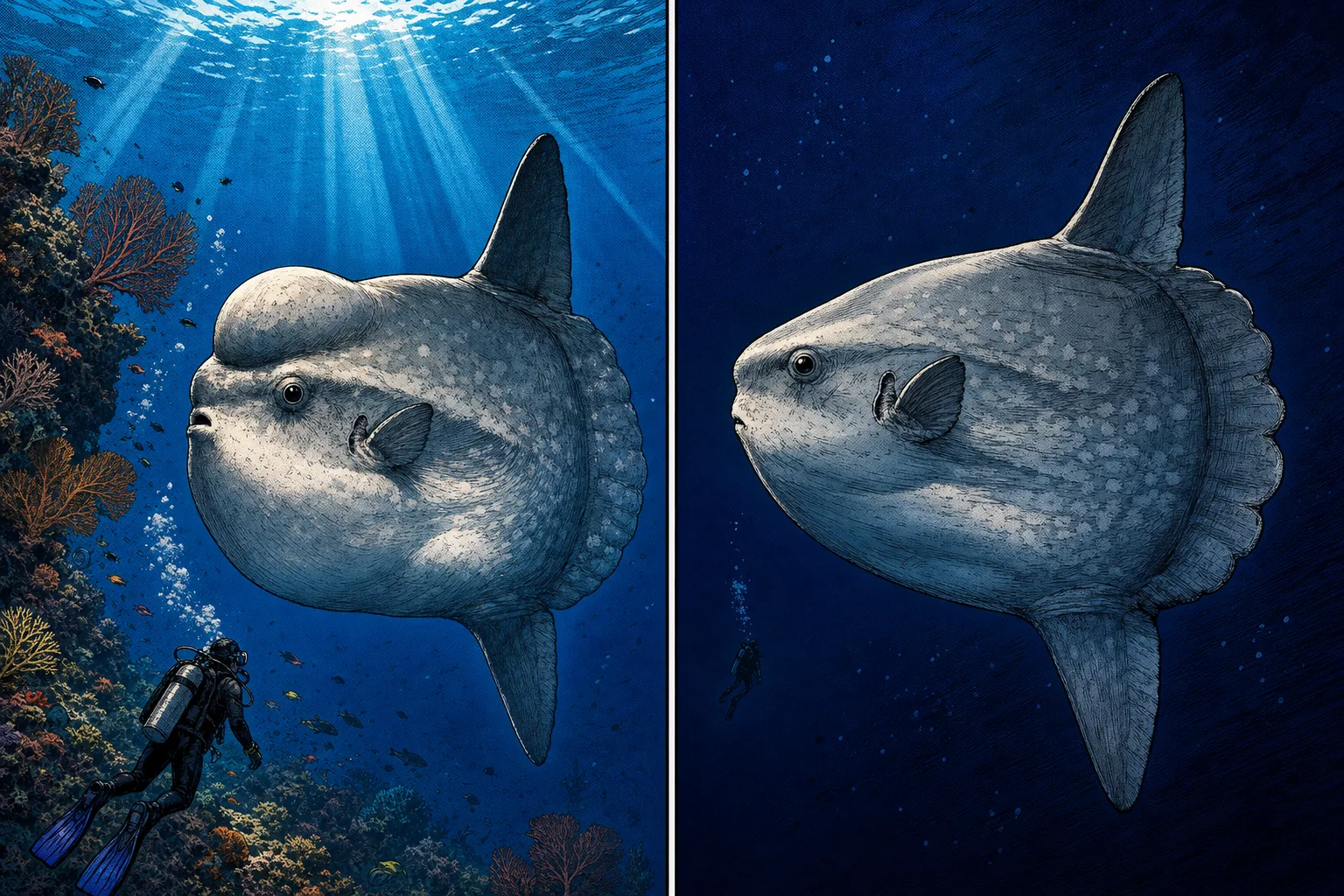
"Mola mola" has become a brand name in dive travel. It is what shows up on T-shirts, dive-shop banners, and the side of speedboats running out to Crystal Bay. The species name is real, Mola mola, the common ocean sunfish, the fish in the photograph that goes around the internet every two years showing a sunfish next to a scuba diver for scale. But it is almost certainly not the species you are diving with at Penida.
The fish that hangs at Crystal Bay's cleaning stations from July to October is Mola alexandrini, the bumphead sunfish, also known as the southern ocean sunfish. The species was formally described in its current form in 2017 by an Australian-Japanese genetics team, and the Penida population has been confirmed through fin-clip DNA sampling. Until that 2017 paper, M. alexandrini was lumped into a different species (Mola ramsayi), and before that it was simply called M. mola like all sunfish. So three different scientific names, all the same animal, and the dive industry settled on the catchiest one. None of this makes any difference to your dive, the encounter is the same, the etiquette is the same, the photograph is the same, but it is worth knowing if you read the marine-biology literature.
The visual difference: M. alexandrini has a distinct bulge on its forehead above the eyes (the "bumphead"), a more rounded body, and a broader chin. M. mola, the cosmopolitan true ocean sunfish, has a smoother forehead and a less rounded body shape. Adults of both species are enormous, three metres top to bottom, two thousand kilograms, but M. alexandrini is the one currently on record as the world's heaviest bony fish at 2,744 kg, set by a specimen recovered off the Azores in 2021.
The true Mola mola is occasionally seen in Indonesian waters, there are scattered reports from the Banda Sea and southern Komodo, but the dominant sunfish species in coastal Indonesian dive sites is M. alexandrini. We refer to "mola" or "sunfish" through the rest of this guide for readability.
Why Sunfish Visit Cleaning Stations
Mola spend most of their lives between 200 and 800 metres deep, in cold dark water, eating jellyfish and salps that contain very little energy per kilogram. They are a slow species, they grow slowly, breathe slowly, and tolerate cold remarkably well. The trade-off for that lifestyle is that they accumulate parasites at extraordinary rates. Cymothoid isopods, copepods, and tapeworms colonise the skin, the gills, and the inside of the mouth. A heavily parasitised mola is a sluggish mola, and a sluggish mola is in trouble.
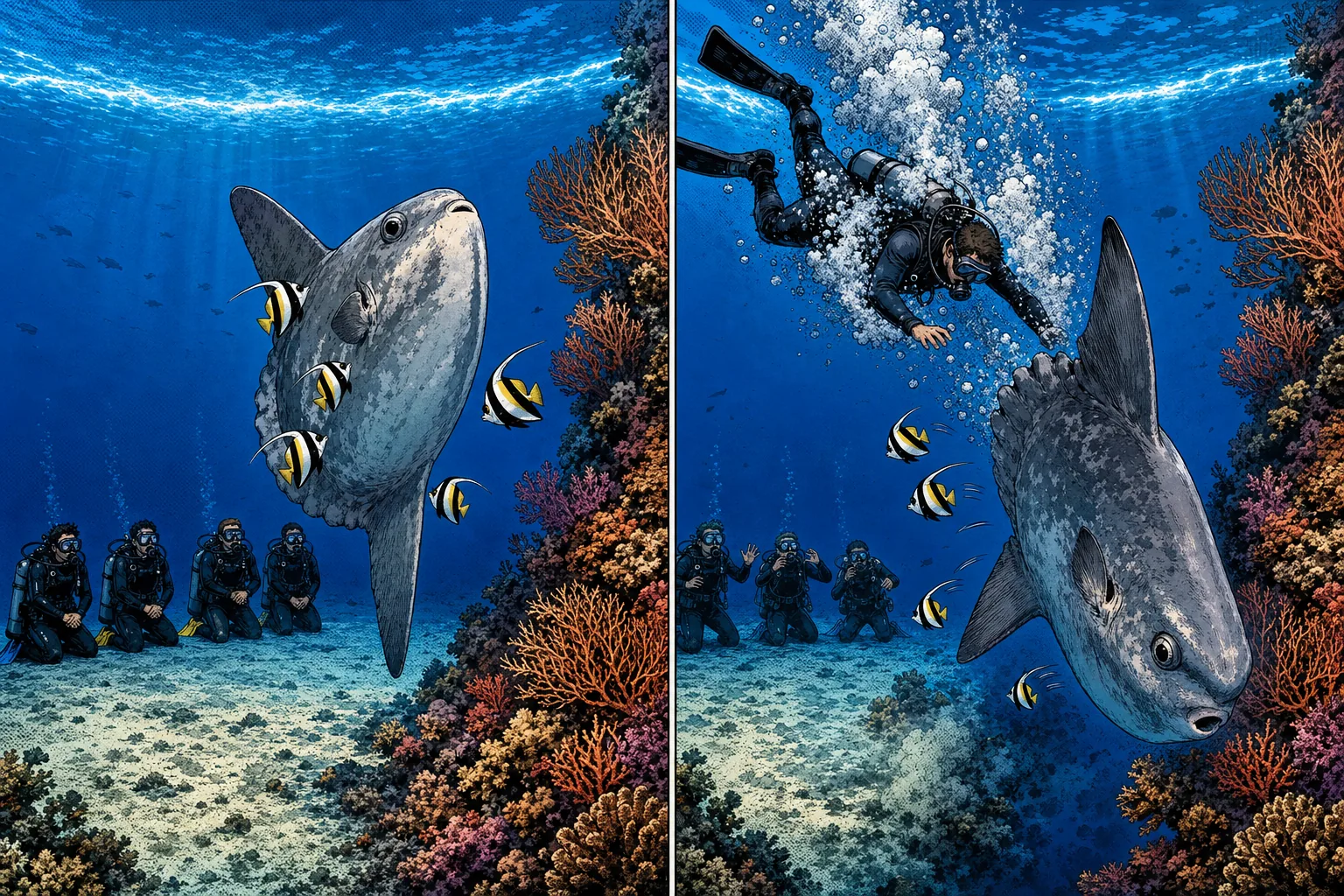
The fix is the cleaning station. Mola surface into shallower water, typically twenty to forty metres in the tropics, and hover almost motionless above a coral patch where bannerfish (Heniochus spp.), butterflyfish, angelfish, and cleaner wrasse take the parasites off. The mola tilts vertically with one fin up so the cleaners can reach the gill covers and the mouth. The whole process takes ten to thirty minutes per visit. They are vulnerable while they do it, they are slow, they are visible, and they do not see well behind them. The bargain works because the cleaning stations are predictable.
Crystal Bay at Nusa Penida is one of the world's most reliable cleaning stations for the species. Cold upwelling on the channel between Nusa Penida and Lombok Strait pushes deep water up onto the wall, the cleaners are there year-round on the cleaning station, and during peak upwelling, July to October, sunfish ride the cold layer up out of the deep and queue for service. The whole dive industry on Bali's south-east coast exists to take divers to that one cleaning station.
Crystal Bay, Nusa Penida, The World's Most Reliable Mola Site
Crystal Bay sits on the north-west tip of Nusa Penida, facing across the channel to Nusa Lembongan. The dive site is a wall of soft coral and gorgonians on the bay's western entrance, dropping from five metres at the top to a sand floor at thirty-eight metres. The mola cleaning station is a single coral patch at twenty-five metres on the wall, marked by a permanent gathering of bannerfish and pyramid butterflyfish that act as the cleaning crew.
The dive plan in mola season is simple and disciplined. The boat moors at the bay entrance. The dive guide drops the group at the wall, swims them down to twenty-five metres, and parks the group on a horizontal sand shelf about three metres back from the cleaning patch. The group does not approach the patch. The mola comes to the patch, hangs vertically above it for ten to twenty minutes, gets cleaned, and leaves the way it came. Repeat for as long as the dive computer allows.
The reason this site works is that the cleaning fish are habituated to divers but the mola is not. Sunfish are cautious animals. They will abandon a station if a diver approaches from above (which to a mola is the silhouette of an attacking shark), or if the bubble rate from a regulator is too aggressive, or if a diver enters the cleaning patch and disrupts the cleaner-fish formation. Crystal Bay's encounter quality has held up over twenty years because the local guides police the etiquette ruthlessly. Approach from above and you will get shouted at underwater. Get within three metres of the patch and your guide will physically pull you back. This is the right way to run the site.
Conditions: Cold, Current, and Why Crystal Bay Demands Respect
Crystal Bay is not a beginner site. Three things make it serious diving.
Cold. The cold-water upwelling that brings the mola also brings the temperature down. Surface water in mola season sits around twenty-six to twenty-seven degrees Celsius. A thermocline starts to appear around eighteen metres, and below it the water is sixteen to eighteen degrees Celsius. Some days the cold layer reaches up to ten metres. Twenty minutes at twenty-five metres in eighteen-degree water in a 3mm tropical wetsuit is a miserable, focus-breaking dive, and you do not want focus broken when a 2,000-kilogram fish is hanging in front of you. Bring a 5mm full-length wetsuit, hood, and gloves. Some operators rent these on Bali; bringing your own is more reliable.
Down-currents. Crystal Bay is famous in dive-instructor circles for unpredictable down-currents that pull a careless diver from twenty-five metres to fifty in a few seconds. The currents are caused by the same cold upwelling that brings the mola, and they are strongest at the bay entrance where the wall meets the open channel. A guide who reads the bay reliably is essential. A diver who panics in a down-current and bolts for the surface is the most common Crystal Bay accident. The protocol is: stay close to the wall, kick out and up at forty-five degrees, let the down-current pass. Do not chase the surface.
Vis variability. Most days at Crystal Bay are twenty-metre visibility or better. On a bad day, usually following a strong upwelling pulse, the cold layer is full of plankton and visibility at twenty-five metres can drop to eight metres. Mola show up better on plankton-rich days, ironically, because the colder water is exactly what brings them up.
Required certification: we run Crystal Bay as Advanced-only with thirty logged dives. Open Water with twenty logged dives can dive Crystal Bay outside mola season (when there is no cold layer and no down-current pulse) and we are happy to run that, but the site is not the same dive without the upwelling. Read our notes on cert level and dive readiness in the first-time liveaboard guide; the same logic applies to first-time Penida divers.
What an Encounter Actually Looks Like
The first time you see a mola alexandrini, the scale will surprise you. They are bigger than the photographs suggest, and they hang motionless in mid-water in a way that the photographs cannot convey. The animal arrives slowly out of the deeper blue. It tilts to one side or fully vertical. The cleaning crew leaves the cleaning patch and surrounds it. The bannerfish work the body and the cephalic fin, the butterflyfish work the gills, and a small angelfish or two work the mouth. The mola does not move. The whole encounter is almost meditative, there is no chasing, no thrashing, no current-fighting. You hover three metres back, you breathe slowly, and you watch.
The encounters last from three minutes to thirty. A short encounter happens when something spooks the mola, a careless diver, a passing kayak overhead, a sudden current change. A long encounter happens when nothing spoils it. We have had guests log forty-minute mola dives at Crystal Bay where the same animal stayed at the cleaning station for the whole bottom time. Those are the trips people remember for the rest of their diving lives.
You will commonly see two to four animals per dive in peak season. Crystal Bay has multiple sub-stations along the wall, and the cleaning patch we describe above is the easiest to access but not the only one. Experienced guides will move the group laterally along the wall if a mola moves to a different station. Resist the urge to swim ahead, the guide is reading the cleaning-fish behaviour to track the animal, and you are not.
Blue Corner and Manta Bay, Bali's Other Mola Sites
Crystal Bay is not the only place in Bali where mola turn up. Two other sites in the Penida-Lembongan complex see them often enough to be worth knowing about, particularly if you are running a multi-day Penida trip and want to vary the dive plan.
Blue Corner is on the north coast of Nusa Lembongan, ten minutes by boat from Crystal Bay. The site is a wall and pinnacle structure on a strong drift, and mola occasionally come up here in mola season, typically in the same weeks Crystal Bay is producing. Encounters at Blue Corner are less reliable but often more dramatic, because the strong current means the mola is moving rather than parking at a cleaning station, and you see them in profile against the open blue. Blue Corner also has the highest density of grey reef sharks and eagle rays in the south-east Bali region, so an unsuccessful Blue Corner mola dive is still a strong dive.
Manta Bay and Manta Point on the south-west tip of Nusa Penida are primarily manta sites, the year-round cleaning stations covered in our Indonesia manta guide, but mola sometimes appear here in late August and September. The mola encounters at Manta Bay are unusual: the water is warmer, the upwelling is weaker, and the mola appear in mid-water without going to a cleaning station. They are often passing through rather than visiting. Coming up on a mola at Manta Bay while you are watching mantas is the kind of double-encounter that makes Penida dive trips legendary.
Toyapakeh and SD Point on Nusa Penida's north coast complete the rotation. Toyapakeh has fast drift conditions over a coral plateau; SD Point is a wall dive close to a school of bumphead parrotfish. Mola at either site are bonus rather than expectation, you go for the broader Penida experience and you accept that the cold-upwelling timing is different on the north coast than at Crystal Bay.
The smart Penida dive plan in mola season is two morning dives at Crystal Bay followed by an afternoon dive at Manta Point, repeated for two or three days. That sequence gives the highest probability of a mola plus a near-certain manta encounter plus the soft-coral and reef-fish content of the rest of the island chain. Nusa Penida is one of the most concentrated diving areas in Indonesia for the day's-worth of variety.
Beyond Bali, Banda Sea and Komodo Long-Range Possibilities
The honest version of the answer to "where else can I see mola in Indonesia?" is short: nowhere reliably. We will list the long-range possibilities below for completeness, but no diver should plan a trip around them. If you want a mola encounter, fly to Bali in mola season and dive Crystal Bay.
Banda Sea, Suanggi and Hatta. Suanggi is a remote pinnacle in the Banda Sea, about half a day's sail from Banda Neira. The wall on the south-east side drops to over a thousand metres, and cold-water upwelling at the pinnacle has produced multiple confirmed sunfish sightings over the years, both M. alexandrini and what appears to be M. mola, photographed deep on the wall. Hatta in the Banda group occasionally produces sightings on its outer wall. We see one or two a season at most, and our standing rule is that a Banda Sea cruise is a hammerhead-and-fish-soup trip, not a mola trip. A mola is a bonus. For more on what to expect from this region, see our Banda Sea diving guide.
Komodo South, Castle Rock, Crystal Rock, and Manta Alley. Komodo's south coast experiences a cold-water upwelling roughly equivalent to Penida's but on a different calendar, peak cold runs July to September. Sunfish have been photographed at Castle Rock and Crystal Rock in those weeks, and there are unconfirmed sightings at Manta Alley itself. The currents at all three sites are far more demanding than Crystal Bay, and the encounters are very rare, perhaps three to five confirmed sightings per season across our entire Komodo schedule. If you happen to be on a Komodo cruise in August and the south-coast conditions align, the guides will run a Castle Rock dive looking for one. Don't pick the cruise for the chance. See our notes on Komodo south-coast conditions in the Komodo dive sites guide.
The Forgotten Islands and Saumlaki. Indonesia's south-east frontier, the chain of islands running from Damar through Babar to the Tanimbar group, produces occasional sunfish sightings on the south-facing pelagic walls. These are exceedingly remote trips, two-week cruises out of Saumlaki or Tual, and the mola is one possibility among many on a frontier ocean dive. The guests who pick the Forgotten Islands trip do so for the deep-cut destination experience covered in our Forgotten Islands guide; mola is not the trip's headline.
When to Dive, Mola Season Month-by-Month
Mola season in Bali is the cold-water upwelling season on the southern Indian-Ocean side of Penida. The upwelling itself is driven by the south-east monsoon and the way it pushes the surface water mass across the channel. The result is a remarkably consistent calendar that has held up for decades.
April to mid-June, pre-season. Cold water is starting to appear at depth but not consistently in the twenty-five-metre cleaning-station band. Sightings happen but are rare, perhaps one in five Crystal Bay dives produces a mola in this window. The upside is that the rest of Penida diving (mantas, drift sites, coral walls) is at its best, and the boats and cleaning stations are uncrowded.
Mid-June to early July, season opening. Cold-water reliability picks up week by week. By the first week of July, Crystal Bay is producing daily sightings on most boats running the site. Water temperature at twenty-five metres drops to about twenty degrees Celsius. The crowds start arriving from this week onward.
August, peak month. Highest density of sightings in the calendar year. Daily encounters at Crystal Bay are essentially guaranteed if the dive plan is competently run. Expect two to four animals per dive and multiple encounters per dive day if you do a two- or three-tank rotation. Water temperature at depth bottoms out at sixteen to eighteen degrees Celsius. The crowds are maximum, Crystal Bay can host four to six dive boats at once on busy days, and the etiquette pressure on the cleaning station is high. Pick a small operator running early-morning departures (07:00 boat from Sanur is the right plan) to get there before the crowd.
September, equal peak. Many guides will tell you September is actually a better month than August because the crowds thin slightly while the upwelling holds at peak. Water temperature is the same. We agree, if you have flexibility, book September over August.
October, late peak. Reliability is still excellent through the first three weeks. By the last week of October, the cold layer is starting to retreat and the encounters become less consistent. Water temperatures rise slightly. The crowds drop substantially.
November, shoulder. Encounters happen but are unreliable. Roughly one in three Crystal Bay dives produces a sighting in early November, dropping to one in five by the end of the month. The water is warming, the cleaning stations are quieter, and the broader Penida diving (mantas, drift sites) remains excellent. November is the right month for a Bali dive trip that is not about mola.
December to March, off-season for mola. Encounters are very rare. The Indonesian wet-season pattern reverses the surface currents in the channel, the cold upwelling is suppressed, and the mola stay in the deep. We do not run dive trips marketed around mola in this window. Bali itself is still a strong dive destination through the wet season, visibility on the east coast at Tulamben and Padang Bai often peaks in the wet months, but Penida is not the right use of your dive days. For broader season planning across Indonesia, see our Indonesia liveaboard seasons guide.
How Many Days Should I Plan at Penida?
The pessimistic-but-realistic answer is three diving days. One day is too few; the upwelling can be off on any given day, and a single missed-mola dive does not justify the trip. Two days is borderline, you have one buffer day if the conditions are off the first day. Three days is the safe number, even in a soft week, three days at Crystal Bay will produce at least one strong encounter.
Five to seven days at Penida is the ideal trip for divers who fly long-haul to Bali specifically for mola. The marginal cost of a longer trip is small (the flights are the expensive part), and the marginal benefit is huge, five days at peak season with a competent operator will produce ten to twenty mola encounters, plus the manta and drift content as a bonus. The other side of the seven-day trip is the rest of Bali (Tulamben, Menjangan, Amed) which most divers fold into the same Bali base.
Diving Conditions, Gear, and Cert Requirements
Diving Crystal Bay in mola season is more demanding than most tropical diving. The combination of cold thermocline, depth, and current means that gear that works fine in Lembeh or Wakatobi will leave you cold and uncomfortable here. Below is what we tell guests to bring and what we provide as rental.
Wetsuit and Exposure Protection
A 5mm full-length wetsuit is the minimum we recommend for mola dives at Crystal Bay. Many of our guests wear a 5mm with a hooded vest underneath; some experienced cold-water divers go to a 7mm. The skin diver in your group who flew over from California with a 3mm tropical suit will be the one cutting the dive short at twenty minutes. Do not be that diver.
Hood: yes, bring one, especially if you are sensitive to cold. The cold thermocline at twenty metres is what bites, surface conditions at twenty-six to twenty-seven degrees feel tropical, and you forget that the bottom is fifteen degrees colder.
Gloves: yes, allowed in Bali (unlike Komodo, where they are banned to discourage reef-touching). Five-mil neoprene gloves keep the hands warm enough to operate camera buttons and inflator buttons reliably.
Cylinders and Bottom Time
Standard 12-litre aluminium cylinders are what most operators run. A fit average diver will get forty to fifty minutes at twenty-five metres on a 12-litre, depending on breathing rate and exertion. The cold layer increases air consumption noticeably, most divers go through ten to fifteen percent more gas at Crystal Bay than at the same depth in warm water.
Some operators run 15-litre cylinders or twin sets for guests who want longer bottom time. We are happy to arrange this on request, but for most guests the dive is limited by no-deco time at twenty-five metres rather than gas, and a longer cylinder does not extend the dive.
Nitrox is widely available on Bali. EAN32 at twenty-five metres extends no-deco time meaningfully and is the right choice for guests who want maximum bottom time at the cleaning station. Bring your nitrox cert; we cannot fill nitrox without it.
Cert Level and Logged Dives
We run Crystal Bay in mola season as Advanced Open Water with thirty logged dives. The reasons are the cold, the current, and the depth, twenty-five metres is below recreational Open Water depth, and the cold thermocline plus the current pulse risks combine in a way that benefits from a more experienced diver. Open Water-only divers can dive Crystal Bay outside mola season at shallower depths, but they cannot reach the cleaning station, and the dive plan is materially different.
Our internal threshold for taking a guest to the deeper Crystal Bay cleaning station is: Advanced certification, thirty logged dives, at least three of those dives in the last twelve months, and a check-out dive at Tulamben or Padang Bai before the Penida day. We are happy to run the check-out dive on day one of a Bali trip and the Penida day on day two, that is the standard schedule we book for guests who want the mola dive without a refresher.
Encounter Etiquette and Photography
Mola encounter etiquette is simpler than manta etiquette, because the rules collapse into a single principle: do not approach. The mola has chosen the cleaning station; you approach the station's edge and stay there. The mola, the cleaning fish, and your dive all benefit. Below is the operator-grade version of the rule set.
The Three Rules
Stay three metres back from the cleaning patch. The patch is identifiable by the cleaner-fish swarm. Position yourself at three metres horizontal distance and at the same depth or slightly lower. Do not approach from above. Do not enter the patch. Stay still.
Control your bubbles. Mola are sensitive to bubble noise and to the rhythm of regulator exhausts. Long, slow, deep breathing keeps the bubble rate low and reduces the sound signature. Photographers who hold their breath to time a shot to a bubble-free moment will get a longer encounter. Hold your breath only at constant depth and never on ascent.
Do not chase. If the mola leaves the station, do not pursue. They will sometimes move to a sub-station ten metres along the wall; your guide will move the group laterally if so, and you follow the guide. Chasing terminates the encounter for the entire boat behind you, and it is considered a serious etiquette violation in the Penida operator community. Boats and individual divers known for chasing get blacklisted at the cleaning stations by other guides.
Photography
The Crystal Bay mola dive is one of the great wide-angle photographic opportunities in dive travel. The animal is huge, the encounter is calm, the visibility is usually good, and the cleaning-fish action around the body adds detail and life that a static portrait would lack.
Lens choice: a 16-35mm full-frame zoom or a 12-24mm crop equivalent is the workhorse. 8-15mm fisheye works for the close encounter but will show your dome port and your gloves at three-metre distance. We tell our photography guests to set up for 16mm if they have to choose one focal length, and to crop tighter on lucky frames in post.
Strobe use: minimal. The encounter is in deep blue water at twenty-five metres on ambient light, and most strobe shots come back over-lit on the mola's pale belly with no detail in the background. Drop strobe power, expose for the blue, and let the mola fall into the silhouette range. The classic Crystal Bay shot is a high-contrast silhouette of the mola against deep blue with the cleaning fish picking at the gills. A strobe that fires at one-quarter power for a touch of fill on the cleaning fish is the right approach.
Buoyancy and trim: the cold thermocline plays havoc with neutral buoyancy if you move between layers without adjusting BCD volume. The cold layer compresses the wetsuit and changes lift. Re-trim aggressively when you cross the thermocline and check trim every three or four minutes during the encounter. A photographer who dumps onto the cleaning patch because their BCD is mistuned has just terminated the encounter for everyone behind them.
Conservation, A Vulnerable Giant in a Recovering Sanctuary
Mola alexandrini and M. mola are both classified as Vulnerable on the IUCN Red List. Population trends are difficult to measure because the species is solitary and pelagic for most of its life, but the assessments are based on three pressures.
Bycatch. Mola are caught accidentally in tuna and swordfish long-line fisheries across the Pacific and Indian Oceans, and historically were caught in driftnets at high rates. Modern long-line fishing remains the largest single source of mola mortality. The Indonesian fleet has reduced bycatch from peak 1990s levels but is still considered a significant pressure on the species across the wider Indian Ocean.
Plastic ingestion. Mola eat jellyfish and salps as their primary food source. Plastic bags drifting in mid-water are mistaken for jellyfish at remarkable rates, necropsies of stranded mola routinely find plastic bag fragments occupying twenty to forty percent of stomach volume. The species is one of the canonical examples used in the marine plastics literature for this exact reason.
Habitat disturbance. Cleaning-station harassment by recreational divers is a real but small pressure compared to bycatch and plastic. The data are clear that habituated mola at well-managed stations like Crystal Bay continue to use them year after year, disturbance affects encounter quality and encounter duration but does not push animals out of the system. The risk is locally meaningful at a single site over a single season; it is not a species-level threat at any scale we measure today.
The Nusa Penida Marine Protected Area was established in 2010 and covers roughly twenty thousand hectares around Penida and Lembongan. It is a multi-use MPA with no-take zones at specific dive sites including Crystal Bay and the manta cleaning stations. The MPA does not extend offshore where mola spend most of their lives, but it does protect the inshore cleaning-station habitat that the dive industry depends on. Operator-level support for the MPA, paying the entry fees that fund management, respecting the no-anchor zones, briefing every dive group on cleaning-station etiquette, is the most direct contribution divers and operators can make.
How to Plan a Mola-Focused Indonesia Trip
The headline plan is short: fly to Bali in mola season, base in Sanur or on Nusa Lembongan, and dive Crystal Bay over multiple days. Below is the operator-grade detail.
Where to Base
Three reasonable options.
Sanur or south Bali. Most divers fly to Bali, taxi to Sanur (forty minutes from Denpasar airport), and base at a Sanur hotel for the duration. The boat to Crystal Bay leaves Sanur at 07:00 and returns by 14:00, so the dive day is short and the rest of the day is yours. Sanur has the right hotel density for a non-diving partner. The trade-off is that the boat ride to Penida is sixty to ninety minutes each way, roughly two and a half hours of boat time per dive day, which gets old over a week.
Padang Bai or East Bali. A shorter boat ride (forty-five minutes to Penida) and direct access to the Tulamben USS Liberty wreck and the Amed coastal sites. Smaller hotel selection. This is what we recommend for divers who want to combine mola with the rest of the east-coast Bali diving across one trip. The Tulamben wreck is in our broader Bali sites guide; combining it with Penida is the standard "complete Bali" trip plan.
Nusa Lembongan or Nusa Penida itself. Stay on the islands. The boat to Crystal Bay is fifteen minutes; you can run a three-tank dive day and be back at the hotel by lunch. The trade-off is that Lembongan is a small island, the food and hotel scene is more limited than Sanur or Tulamben, and the rest of Bali is a fast-boat ride away. Best for the diver who is in Bali specifically for Penida and is doing only Penida.
Trip Length
The minimum useful trip for mola is five days on the island, three of those at Penida. Most of our guests book seven to ten days for a real Bali trip with Penida as the centrepiece. Long-haul guests from Europe or North America commonly book ten to fourteen days; for them, the marginal cost of three extra days of diving is small compared to the flight cost, and the marginal benefit is high.
Combining Mola With the Rest of Indonesia
Bali is well-positioned for combination trips with the rest of Indonesia, especially during the inverse seasons.
Mola season (July to October) overlaps with peak Komodo season. A common multi-region trip is Bali first (mola plus east-coast diving), then a fly-and-dive transfer to Labuan Bajo (the Komodo gateway) for a four to seven night liveaboard. Together that is a two-week Indonesia diving fortnight covering both regions. Komodo is an Advanced-cert operation; if you have the cert level for Crystal Bay, you have the cert level for Komodo. Our Komodo liveaboard itineraries guide covers the trip-planning side in detail.
Mola season also overlaps with the start of Banda Sea cruise season. Guests who want a frontier Indonesian dive trip combine Bali with a Banda cruise in late September or October, when the short Banda season is under way and Penida is finishing. Bali to Ambon is a single connecting flight via Makassar.
What does not work well as a combination is mola plus Raja Ampat in the same trip. Raja Ampat's main season is November to March, the inverse of mola season. You can do both regions in one calendar year but not in one trip. Our Raja Ampat vs Komodo seasonality comparison covers the broader point about Indonesian regional seasons.
Bringing It Together
The mola at Nusa Penida is one of the small handful of large-animal encounters in dive travel that actually delivers on the marketing. The species is huge, the encounters are calm and prolonged, and the site is reliable enough that a competently-run trip in the right season is essentially a guaranteed encounter. Few large-animal dives in the world meet that bar; the only direct comparisons in Indonesia are Manta Sandy in Raja Ampat (year-round, consistent), Manta Alley in Komodo (peak-season consistent), and the manta-and-sunfish double-hit at Manta Point Penida itself in the right late-August conditions.
The right way to plan the trip is to anchor on the Penida diving days and let the rest of Bali fill the rest of the week. Fly into Denpasar in late July, August, or September. Base in Sanur for the easy logistics or in East Bali for the sites variety. Run three to five days at Crystal Bay early in the trip while you are fresh and well-acclimatised. Add the rest of Bali, Tulamben for the wreck, Amed for the macro, Menjangan for the wall, for the second half of the trip. Keep one rest day in the middle of the schedule. Drink the cold-pressed coconut water at the dive shop after each dive day. The rest takes care of itself.
If you want help putting that itinerary together, with the right boat, the right cert-level briefings, the right thermal setup, and the right combination of Penida and East Bali days, we book the trip. Contact us with your travel window and we will put together the plan.