Thirty metres down, with a regulator in your mouth and a manta circling overhead, you cannot say a word. Every diver becomes briefly mute the moment they descend, and yet dive teams manage to discuss air supplies, point out camouflaged octopuses, negotiate depth changes and, occasionally, save each other's lives, all with their hands. Hand signals are the shared language of scuba diving, and like any language, fluency changes the experience. A diver who signals clearly dives calmer, gets shown more by their guide, and handles small problems before they grow teeth.
This guide covers the signals that matter: the universal core every certified diver is expected to know, the numbers system for air checks, the emergency signals you hope never to use, the marine-life vocabulary that makes guided diving in places like Indonesia so much richer, and the current-diving signals that get added to briefings on an Indonesia liveaboard. We have also included the mistakes we see most often from our own dive decks, one of which reliably ends dives early for no reason at all.
Why divers use hand signals, and why they are (mostly) universal
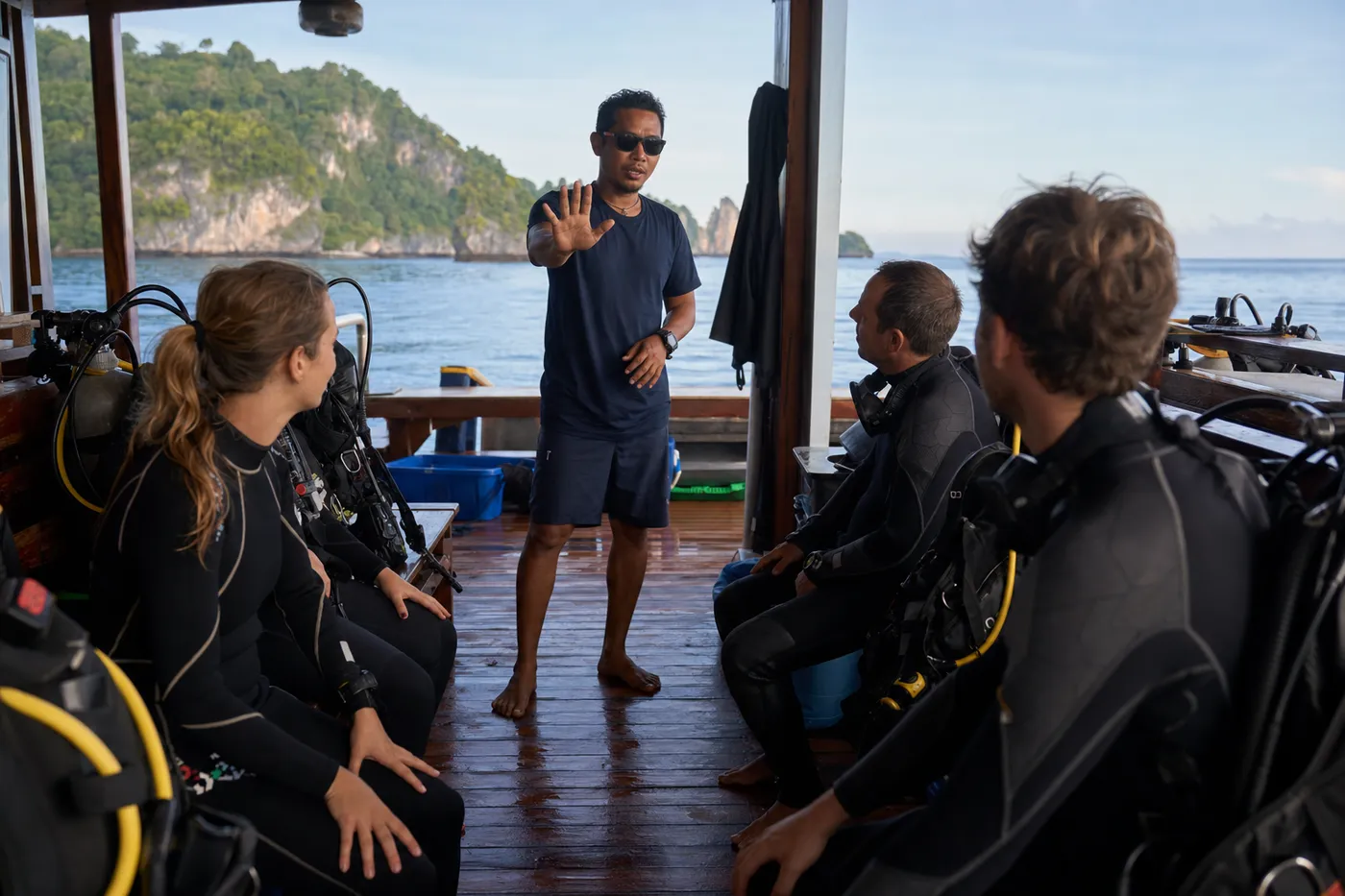
Recreational diving inherited its core signals from a mix of military and early sport-diving practice, and they were formalised decades ago by the Recreational Scuba Training Council so that agencies like PADI, SSI and NAUI would all teach roughly the same vocabulary. That standardisation mostly worked. A diver certified in Germany can buddy up with a diver certified in Japan and both will understand OK, problem, up, down and out-of-air without a word exchanged on the surface. Mostly, though, is doing some work in that sentence: regional habits, operator quirks and a handful of signals with two competing versions mean the pre-dive briefing still matters. Good guides run through their signals before the first dive of every trip, and good divers actually watch.
Two principles make the whole system work. First, signals are questions as well as statements: when a guide flashes you the OK sign, it is a query, and you are expected to answer, either with the same sign or with the signal for whatever is wrong. Silence is not an acceptable reply underwater. Second, important signals get confirmed. You signal going up, your buddy repeats going up, and only then do you both ascend. That echo habit, drilled in every entry-level course, is what keeps a two-person team from quietly becoming two solo divers.
The core signals every diver must know
These are the non-negotiables, the ones your instructor made you demonstrate before ever letting you near open water. If any feel rusty, rehearse them on the boat; nobody has ever looked foolish practising signals on a dive deck.
- OK: thumb and index finger form a circle, remaining fingers up. Both question and answer. On the surface at distance, it becomes both arms curved overhead touching, or one hand tapping the top of the head.
- Something is wrong: flat hand, palm down, rocked side to side, followed by pointing at the problem (ear, mask, stomach). Not an emergency by itself; a request for attention.
- Up / end the dive: thumb pointing up. This means "let us ascend", nothing else. More on the trouble this causes below.
- Down: thumb pointing down, meaning descend or continue descending.
- Stop: flat palm facing your buddy, exactly like a traffic officer. Hold position until released.
- Slow down: flat hand, palm down, pressed downward gently a few times. Guides use this constantly with excited new divers.
- Look: two fingers pointed at your own eyes, then at the thing worth looking at.
- Buddy up / stay together: two index fingers held side by side.
- Level off / stay at this depth: flat hand, palm down, moved slowly side to side at the depth you mean.
Nine signals, and they carry most dives from descent to safety stop. Notice what they have in common: big, slow, deliberate shapes. Underwater, fast hand movements read as agitation or simply blur into the water; the divers who communicate best move their hands the way news presenters speak, slower and more clearly than feels natural.
The thumbs-up problem
The single most common signalling mistake in recreational diving, by a wide margin, is using a thumbs-up to mean "great!". On land it means exactly that, which is the whole problem. Underwater, a thumb pointed at the surface means one thing only: this dive is over, we are going up. Every new-diver cohort produces someone who sees their first turtle, beams, gives the guide an enthusiastic double thumbs-up, and cannot understand why the group is suddenly preparing to ascend.
The thumbs-up is the signal newly certified divers get wrong most often, and the mistake is worth naming because it is so easy to make. Underwater a thumb means one thing only: end the dive, we are going up. It does not mean this is great, however natural that feels on land. A diver who thumbs a site nine minutes in because they are delighted will find the guide confirming the signal, as he must, and the whole group ascending in some confusion, and there is no taking it back at depth. If you want to say something is wonderful underwater, the OK sign does the job, and many divers add a little hand-on-heart pat or simply wide eyes behind the mask. Save the thumb for when you mean it, and if you receive one, confirm and ascend; a thumbs-up is never overruled underwater, whatever you suspect the sender actually meant. The dive can always be discussed on the surface. An ignored ascent signal cannot.
Talking numbers: air checks underwater
Sooner or later on every dive, a guide will point two fingers at their palm, or make a T with both hands, or tap their gauge: all versions of the same question, how much air do you have? Answering requires the numbers system, and there are two in common use, which is why briefings cover it. The first method signals each digit separately: fingers held up vertically count one to five, and fingers held horizontally add six to nine (index finger sideways is six, index and middle is seven, and so on). One hundred forty bar becomes: one, four, zero, flashed as separate digits.
The second method, common across much of Asia and on many liveaboards including ours, splits the tank in halves and quarters: a T made with both hands means half a tank, a fist on top of a flat palm signals reserve pressure, and divers round to the nearest convenient marker. Neither system is wrong. What is wrong is answering with a shrug, or worse, flashing your gauge at a buddy who is four metres away and cannot possibly read it. Know your pressure before you are asked; the divers who check their gauge every few minutes answer instantly, and instant answers are one of the quiet markers guides use to judge who they can take on the more ambitious sites.
Emergency signals: the ones you drill and hope to retire unused
Emergency signals are deliberately unmistakable, big, and taught identically across agencies. Out of air is a flat hand slashing across the throat, and it demands an immediate response: the receiving diver presents their alternate air source, the out-of-air diver secures it, and the pair ascend together. Share air, sometimes signalled separately, is a hand moving between mouth and open air, though in practice the throat slash triggers the whole donation sequence by itself. Help at the surface is one arm waved in a wide arc, and it means genuine distress, which is why waving hello to the boat from the water is a habit worth breaking on day one; wave at a dive boat and someone will start the engine.
Cramp is a fist opening and closing, usually followed by pointing at the calf, and the standard response is your buddy holding your fin tip while you stretch the muscle out. Cold is arms wrapped around yourself, shivering pantomime included, and it is a signal worth actually using: cold divers burn through air and make slow, clumsy decisions, and no reasonable guide resents ending a dive a few minutes early for it. Ear problem is a finger pointed at the ear, which tells your buddy to pause the descent while you work on equalising. None of these signals are difficult. The drill is making them automatic enough that they surface through adrenaline, which is what pool refreshers are for after a long dry spell. The ear signal in particular is one to act on rather than push through, for the reasons our guide to barotrauma in scuba diving explains.
The fun part: marine life signals
Once the safety vocabulary is settled, divers get to the signals that make guided reef diving feel like a shared joke: the animal names. There is no single official dictionary here, and regional dialects flourish, but a core set is understood at dive sites from the Red Sea to Raja Ampat. Shark is a flat hand vertical on the forehead, a fin. Turtle is two fists stacked with thumbs paddling, or two flat hands making a swimming motion, depending on who taught your guide. Manta ray is both arms sweeping slowly like wings, one of the loveliest signals in the repertoire and impossible to mistake. Octopus is a hand held palm-down with fingers rippling like tentacles. Lionfish is fingers interlaced and spread like spines; moray eel is a hand opening and closing like jaws; lobster flicks two bent fingers like antennae; nudibranch, beloved of macro guides everywhere, is often two fingers wiggled on the back of the opposite hand, imitating the rhinophores.
Indonesian guides add local specialities. Ours signal pygmy seahorse with a pinched thumb and forefinger held close to the eye (something tiny, look carefully), wobbegong with a flat hand pressed over the mouth like a moustache, and mola mola, in season, with a flat vertical hand wobbling forward, which sounds absurd and is understood instantly at 25 metres. Do not worry about memorising the exotic ones. The guide will demonstrate the likely cast of characters at the briefing, and half the pleasure of a liveaboard week is watching the group's shared vocabulary grow dive by dive until whole anecdotes are being mimed at the safety stop.
Current diving: the signals Indonesia adds to the briefing
Dive somewhere with real water movement, Komodo especially, and the briefing acquires a second vocabulary. Hook in is one curved finger of one hand latched into the curved finger of the other: deploy your reef hook at the next suitable spot. Hold position is the standard stop palm, but held longer and often with eye contact down the line of divers. Drift is a flat hand pushed along with the current, palm following the flow: stop finning, let the water carry you. Stay close to the reef is a hand pressed downward toward the coral, meaning get into the friction zone where the current is weakest. Turn around is a raised index finger drawing a slow circle, and on a current dive it usually means the plan is changing with the water, not that anything is wrong.
These signals get used at closer quarters and higher stakes than reef-pointing, which is why guides in current destinations insist on confirmation more firmly than anywhere else. When a Komodo guide signals hold, the difference between a diver who confirms and holds and a diver who half-notices and drifts three metres further is the difference between a group and a search pattern. If you are new to current diving, our guides will pair the signals with a thorough surface walk-through, and the system quickly becomes second nature.
Night dives: signalling with a torch
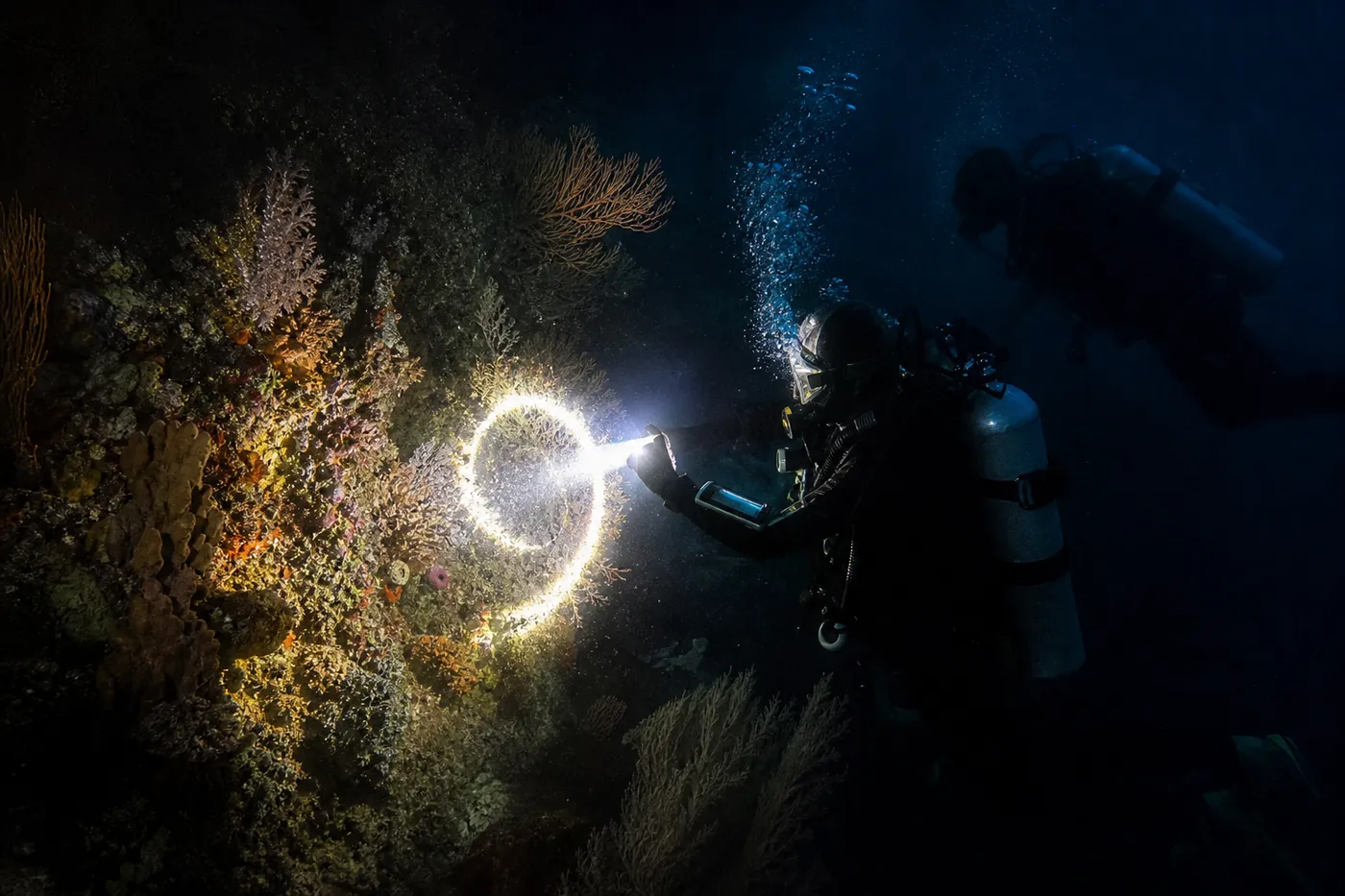
At night the hands disappear and the torch becomes the voice. The two essentials: OK is the torch beam drawn in a slow circle on the reef or seabed in front of your buddy, and attention / something is wrong is the beam waved slowly side to side. Larger, faster movements escalate the urgency. The cardinal sin of night diving is pointing your torch into another diver's eyes, which costs them several minutes of night vision and earns you a reputation; signal against the bottom or a wall, never against a face. For hand signals that still need to be given at night (air checks, for instance), shine your torch onto your own signalling hand from the side, so the shape is lit without blinding anyone. It feels awkward for exactly one dive, and then it does not.
Quick reference: the signals that end up mattering most
For revision purposes, the short list we would want every guest to know cold before the first backward roll, with what each one demands of you when received:
| Signal | How it looks | Your response |
|---|---|---|
| OK? | Thumb and finger circle | Answer: OK back, or signal the problem |
| Something wrong | Flat hand rocking | Move closer, identify, assist |
| Up / dive over | Thumb up | Confirm and ascend, no debate |
| Stop | Palm out | Hold position until released |
| Out of air | Slash across throat | Donate alternate air source immediately |
| Air check | Fingers to palm / T-sign | Signal your pressure in digits or fractions |
| Safety stop | Flat hand over three fingers | Hold 5 metres for 3 minutes |
| Surface help | Arm waving overhead | Alert crew, respond, this is real |
Print it, screenshot it, or simply run through it on the flight over. Eight shapes, learned once, understood on every dive boat on earth.
Surface signals: talking to the boat
The dive is not over at the surface, and neither is the signalling. Boats are loud, distances are long, and a bobbing head is hard to read from a hundred metres, so surface signals are deliberately oversized. The two that matter: the large OK, both arms raised in a circle touching overhead (or one arm curved to the head if the other is holding something), which tells the crew you are up and fine; and the distress wave, one arm swept repeatedly in a wide arc, which tells them the opposite and starts an immediate response. Give the big OK as a habit every time you surface away from the boat, before you are asked. Crews watch for it, and the difference between a group that signals on surfacing and a group that has to be squinted at is real, particularly at dusk or in chop.
In current country, add the delayed surface marker buoy to the vocabulary. An SMB sent up from depth tells the boat where you are and that your group is ascending normally; on drift dives in Komodo it is not optional equipment, it is the sentence "we are here, come get us" written in two metres of orange plastic. Learn to deploy one on a calm dive before you need it on a moving one, because inflating an SMB gracefully mid-water is a skill with a genuine learning curve, and a tangled reel at five metres teaches it the hard way. And in most years someone asks: yes, the whistle on your BCD works, and no, nobody thinks it is dramatic to use it. Sound carries over water far better than a shout.
Diving with a stranger: the instabuddy briefing
Liveaboards and day boats routinely pair solo travellers, and signalling is where unfamiliar buddy teams either click or scrape. Certifications differ, agencies differ slightly, and someone taught in cold-water Britain may signal air pressure differently from someone certified on a Thai beach. The fix costs three minutes: before the first dive together, run your signals at each other on the deck. How will you ask for air? Digits or fractions? What is your turn-pressure? Which side is your alternate on? It feels faintly formal, and it prevents the underwater misunderstanding where one diver is asking a question and the other is admiring what they assume is a new kind of wave. We quietly watch new pairs do this on day one, and it predicts smooth teams better than logged dive counts do, roughly speaking. The best buddy you can be assigned is not the most experienced one; it is the one whose signals you have already seen.
Habits that make you a diver guides trust
Signals are vocabulary; what separates fluent divers is grammar, the habits around the signs. Answer every question signal, always, even when the answer is just OK; a guide who has to chase acknowledgements burns attention they should be spending on navigation and the group. Confirm the big ones by repeating them. Keep your signals in your buddy's line of sight rather than at your hip, and pair them with eye contact, because a perfect signal nobody saw communicates nothing. Get your buddy's attention first (a gentle tank tap with a pointer, a wave in their peripheral vision) rather than signalling into the void. And when you do not understand a signal, say so: the signal for "I do not understand" is an open shrug, and using it is a mark of a careful diver, not a slow one. In our experience the divers who shrug early and often have far fewer surface misunderstandings than the ones who nod along underwater.
It is also worth saying that fluency compounds with repetition, like everything in diving. A liveaboard week, with its three to four dives a day and its stable cast of guides and buddies, builds signalling habits faster than a year of scattered day boats; by day three the group is chatting in shapes, and by day six whole dive plans get amended mid-water with a few gestures and nods. If your signals feel rusty, the schedule itself is the refresher course, and our article on liveaboards for beginner divers covers how the first days are structured to rebuild exactly these fundamentals.
Before your next trip
Hand signals are one of those skills, like tying knots or reversing a trailer, where a small investment of deliberate practice pays out for decades. Run the core nine and the emergency set with your buddy on the surface until they are automatic. Watch the briefing signals demonstration even if you have three hundred dives, because that is where the operator's dialect lives. Keep the thumb holstered unless you mean it. And then forget about all of it and enjoy the diving, which is the point of the whole silent language in the first place. Somewhere out there is a guide with a flat hand wobbling forward at you, and a three-metre sunfish behind the gesture. You will want to know what they are saying.