The Banda Sea is the dive region in Indonesia that most divers visit last and remember longest. It is not the easiest to reach, the season is short, the crossings between island groups are open ocean rather than protected straits, and the diving demands a slightly higher level of comfort with current and depth than Komodo or Raja Ampat. The reward is a list of dive sites that you cannot replicate anywhere else: the lava-flow regrowth on the slope of an active volcano, a single small island where banded sea kraits aggregate by the dozen, hammerhead schools on submerged seamounts in the middle of nowhere, and a coral coverage on the volcanic walls that a marine biologist friend of ours described, half-jokingly, as "what the rest of the Coral Triangle aspired to before climate change". The wider Banda Sea destination guide covers the route as a whole; this article is the operator-side answer to a more focused question, which is which specific sites are worth planning your trip around.
The structural reason the Banda Sea diving is what it is comes down to geography and history. The sea sits between the Banda Arc volcanic ridge in the west, the Seram Sea to the north, and the Forgotten Islands chain to the south, and the seabed plunges to over 6,000 metres in places. Cold deep water rises along the edges of the underwater seamounts and the volcanic islands, feeding plankton blooms that draw the pelagic schools and the apex predators. The historical layer matters too: the Banda Islands were the world's only source of nutmeg until the late 18th century, the spice trade made the islands one of the wealthiest places on Earth in the 17th century, and the colonial-era forts and merchant houses are still there in Banda Naira. The combination of an active volcano, the spice-trade history, and the dive-site quality is unique in Indonesia. We run dedicated Banda Sea liveaboards roughly 6 months of the year; the Banda Sea liveaboard page covers the route options and the scheduled departures.
The headline summary, before we get into the individual sites, is this. The Banda Sea has roughly 25 named dive sites that operators visit on a typical itinerary, and another 15 or so that require longer crossings or specific weather windows. The strongest 8 sites span three sub-regions: the central Banda Islands (Banda Naira, Lava Flow, Pulau Hatta), the offshore seamounts (Pulau Manuk, Suanggi, Nil Desperandum), and the Forgotten Islands chain in the south (Lucipara, Penyu). A standard 11 to 14 night Banda Sea liveaboard hits most of these on a single trip; longer itineraries add Koon to the east and the Saumlaki transit to the southeast. The rest of this article walks each of these sites in detail.
Banda Sea geography and what makes the sites work
Three geographic features drive the diving in this region, and a brief look at them makes the rest of the article easier to follow.
The first is the volcanic arc. Gunung Api in the central Banda group is an active stratovolcano that last erupted in May 1988, depositing a fresh lava flow on the western slope of the island that is now one of Indonesia's most-cited examples of accelerated coral regrowth. The water temperature near the volcano runs slightly warmer than the surrounding sea (28 to 30 degrees in season), and the volcanic substrate appears to support faster coral growth than the limestone reefs further north. The same volcanic geology produces the seamounts that draw the pelagic life: Manuk, Suanggi, Nil Desperandum and the Lucipara/Penyu group are all submerged or partly emergent volcanic structures with water-column upwelling on their flanks.
The second is the deep-water bathymetry. The Banda Sea floor sits between 4,500 and 6,000 metres deep across most of its area, and the dive sites are mostly on isolated structures that rise from those depths to within 5 to 30 metres of the surface. This is unlike Komodo or Raja Ampat, where the diving happens on a continuous reef shelf. In the Banda Sea, the dive sites are points, edges or small islands; the surrounding sea is mostly empty water. The practical implication is that the diving is more pelagic in character: you are diving on the edge of a feature, with deep water below and beside you, and the schools come to feed at the edge.
The third is the wind and current pattern. The Banda Sea is reachable comfortably during two windows in 2026: March to early May (the inter-monsoon period before the SE trade winds set up) and September to early November (the inter-monsoon period before the NW monsoon establishes). Outside those windows, the open-water crossings between the Banda Islands and the Forgotten Islands are exposed to 1.5 to 3 metre seas, and most operators do not run scheduled itineraries. The current at the dive sites varies enormously: the Banda Islands sites are mostly calm to mild, the Manuk/Suanggi seamounts can run 1.5 to 3 knots on the wrong tide, and the Lucipara/Penyu sites can produce strong downwellings. A good operator briefs every dive carefully and adjusts plans on the day; this is not a region for autonomous unguided diving.
One more practical note. The Banda Sea diving overlaps strongly with the wider Banda Sea diving overview and with the Forgotten Islands route. This article focuses specifically on the individual dive sites within those routes; the overview pieces cover the trip as a whole, the seasons, and the typical guest profile. For the itinerary-level question of when to go and which boat fits the route, the Indonesia liveaboard seasons guide covers the cross-region timing in detail.
The central Banda Islands: where the route starts and ends
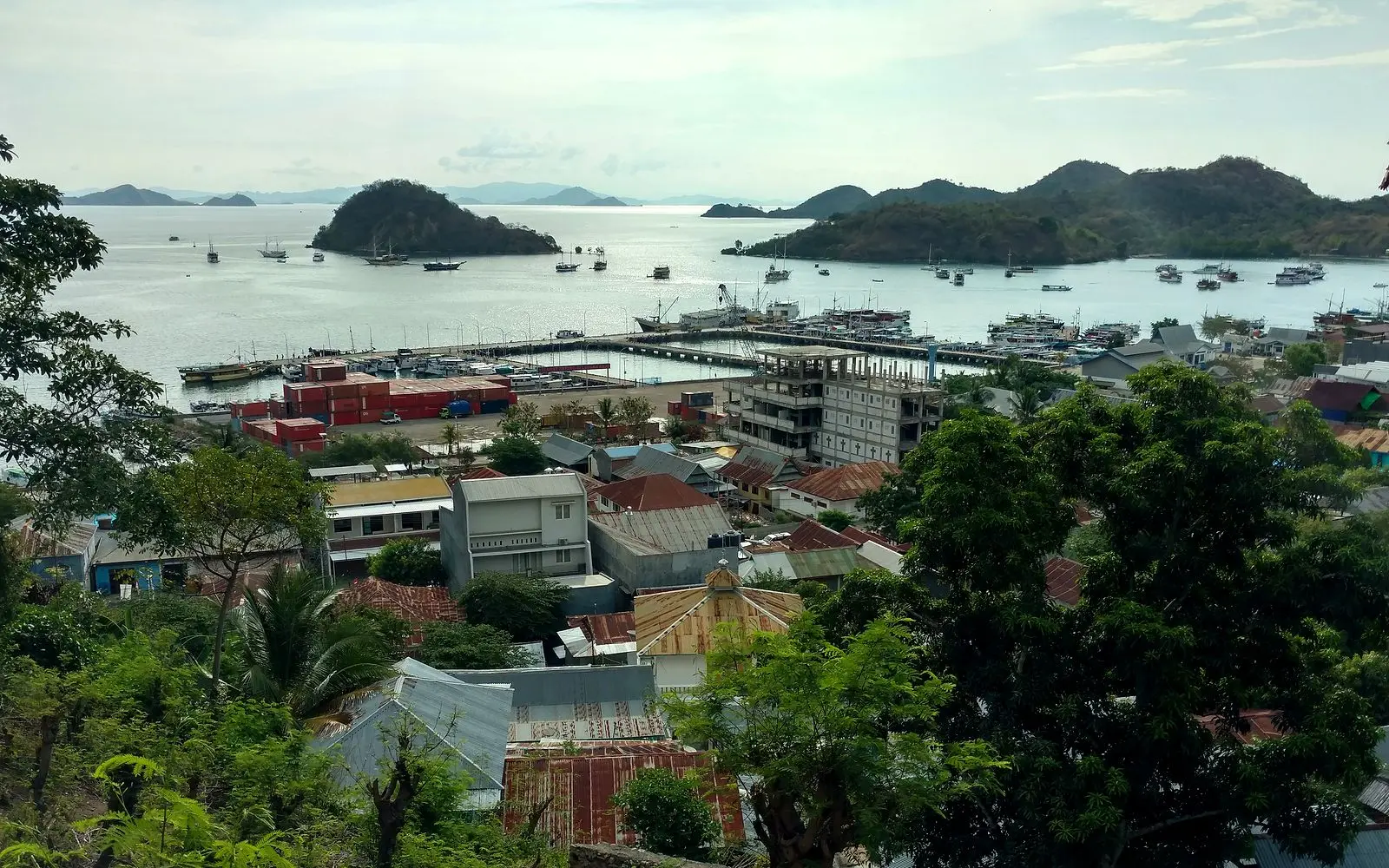
The Banda Islands proper are the cluster of seven small volcanic islands at the centre of the Banda Sea, with Banda Naira as the historical capital and Gunung Api as the active volcano on its northern edge. Most Banda Sea liveaboards either start or end at Banda Naira, and the local diving is the gentlest in the region: shallow walls, mild current, exceptional coral coverage, and the bonus of a half-day shore excursion to the spice-trade forts and the nutmeg plantations.
1. Lava Flow (Pohon Miring), Gunung Api
The single most photographed dive site in the Banda Sea, and one of the most-cited examples in the marine-biology literature of how quickly tropical coral can recolonise volcanic substrate. The 1988 lava flow on the western slope of Gunung Api covered roughly 2 kilometres of coastline with fresh basalt; within 4 years, the first hard corals had settled, and within 15 years the substrate was indistinguishable from a mature reef in coral coverage. Today, three and a half decades after the eruption, the slope hosts a continuous wall of plate corals from 5 to 30 metres, dense soft-coral patches, and a fish life that suggests the regrowth has accelerated rather than plateaued.
The dive itself is straightforward. Roll-in is at the surface roughly 30 metres off the lava-flow slope, descent is to 18 to 25 metres along the dropping reef, and the dive runs as a slow drift along the wall in mild current. Visibility is consistently 25 to 35 metres, water temperature 28 to 30, and the bottom time can stretch to 75 minutes for a careful air consumer. The species list includes the standard Coral Triangle fish life plus several pygmy seahorse colonies on the deeper Muricella fans, regular passing trevally and dogtooth tuna, and the occasional turtle on the shallow shelf. Pohon Miring is the name we use; some operators call the same site Lava Flow or Lava Slope. They are interchangeable.
2. Pulau Hatta (Hatta Drift)
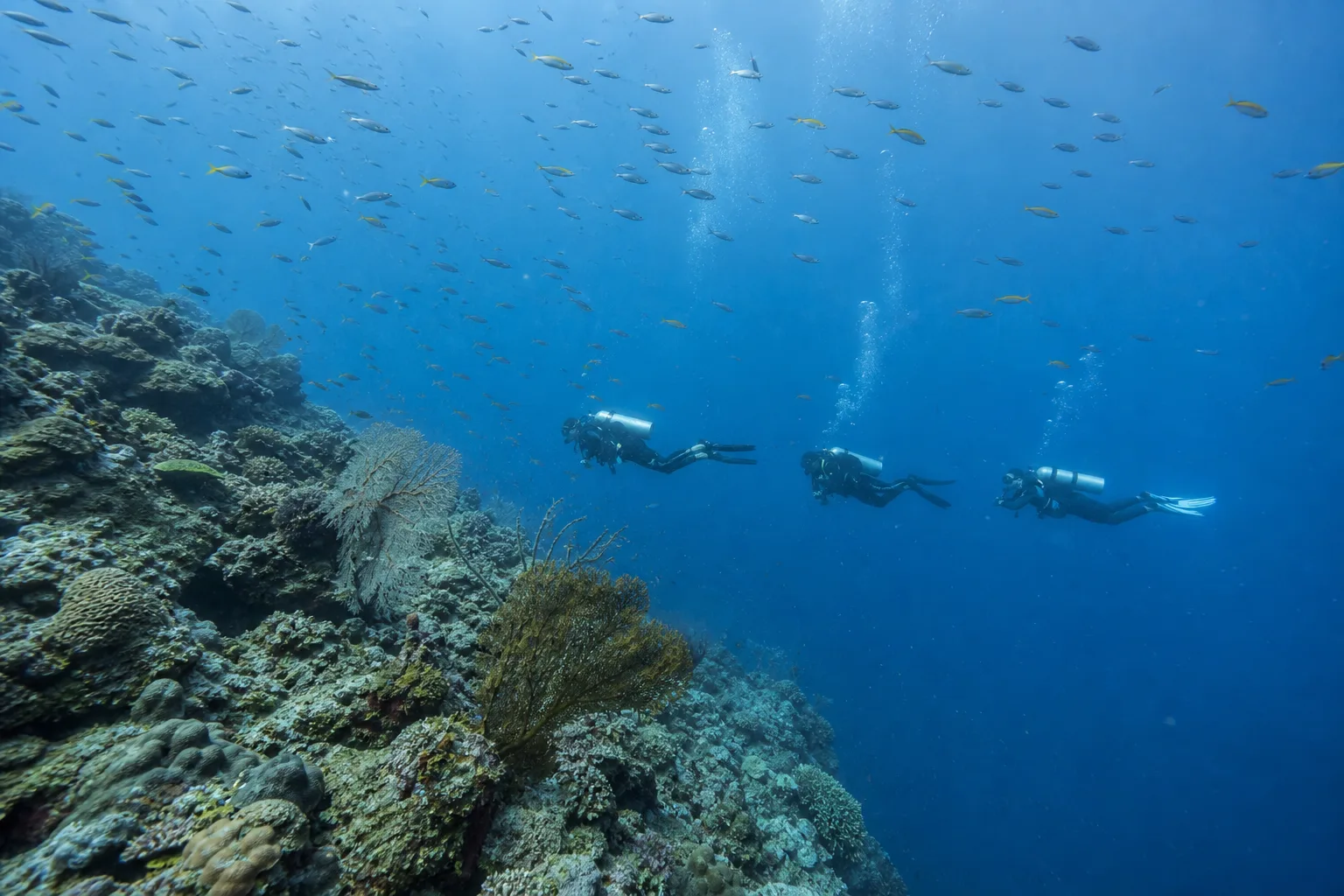
Hatta is the easternmost of the Banda Islands, and the dive site that consistently produces the best pelagic encounters within the central group. The dive is a drift along the eastern wall of the island, with the deep-water current pushing along the wall and the predator action concentrating at the northeastern point. Dogtooth tuna in singles or pairs are essentially guaranteed, schooling jacks and rainbow runners appear in roughly 70 per cent of dives, and the hammerhead encounters that the Banda Sea is known for happen on this site more often than any other in the central group. We have seen scalloped hammerheads (Sphyrna lewini) at Hatta in February, March, April, October and November, with February through April being the strongest window.
The wall itself runs from 8 metres to roughly 50 metres before the slope eases out, and the diving plan is usually a 30 to 35 metre maximum depth on a 60-minute dive, drifting along the wall and ascending to the shallow shelf for the safety stop. The current can be moderate to strong (up to 2 knots on the wrong tide) and a current hook is helpful but not essential. The visibility is usually 30 metres, occasionally more.
3. Karang Hatta (Hatta Reef)
A separate site from the wall above, Karang Hatta is a submerged seamount roughly half a kilometre off the southern point of Hatta Island. It tops out at 12 metres and drops to over 60 metres on its flanks. The site works as a fish-cleaning station: schools of jacks, rainbow runners and surgeons accumulate over the seamount, and the predators come up to feed. The dive plan is a slow circuit of the seamount at 18 to 25 metres, holding position on the upcurrent side to watch the schools form. The site is more weather-dependent than the Hatta wall (the seamount sits in open water and the surface chop can make the descent and ascent rough on a windier day), but on a calm day it is one of the strongest pelagic sites in the central Banda group.
4. Banda Naira house reef and Pulau Ai
The shallow reefs around Banda Naira itself and the neighbouring Pulau Ai are the gentle macro-and-coral dives that bookend most Banda Sea liveaboards. They are not the marquee sites, but they are the right answer for the first or last dive of a long trip: 12 to 18 metre depth, calm water, dense Acropora coral coverage, and a long species list that includes mandarinfish at dusk on a specific Banda Naira pier site, ghostpipefish in the shallow seagrass, and the standard Coral Triangle reef life. The cultural shore excursion to Fort Belgica and the nutmeg plantations is normally scheduled in the long surface interval between the morning and afternoon dives on Banda Naira.
The offshore seamounts: where the Banda Sea earns its reputation
The seamounts are what most divers come to the Banda Sea for, and they are also the sites that most clearly differentiate the region from the rest of Indonesia. Three of them deserve individual treatment.
5. Pulau Manuk: the snake island
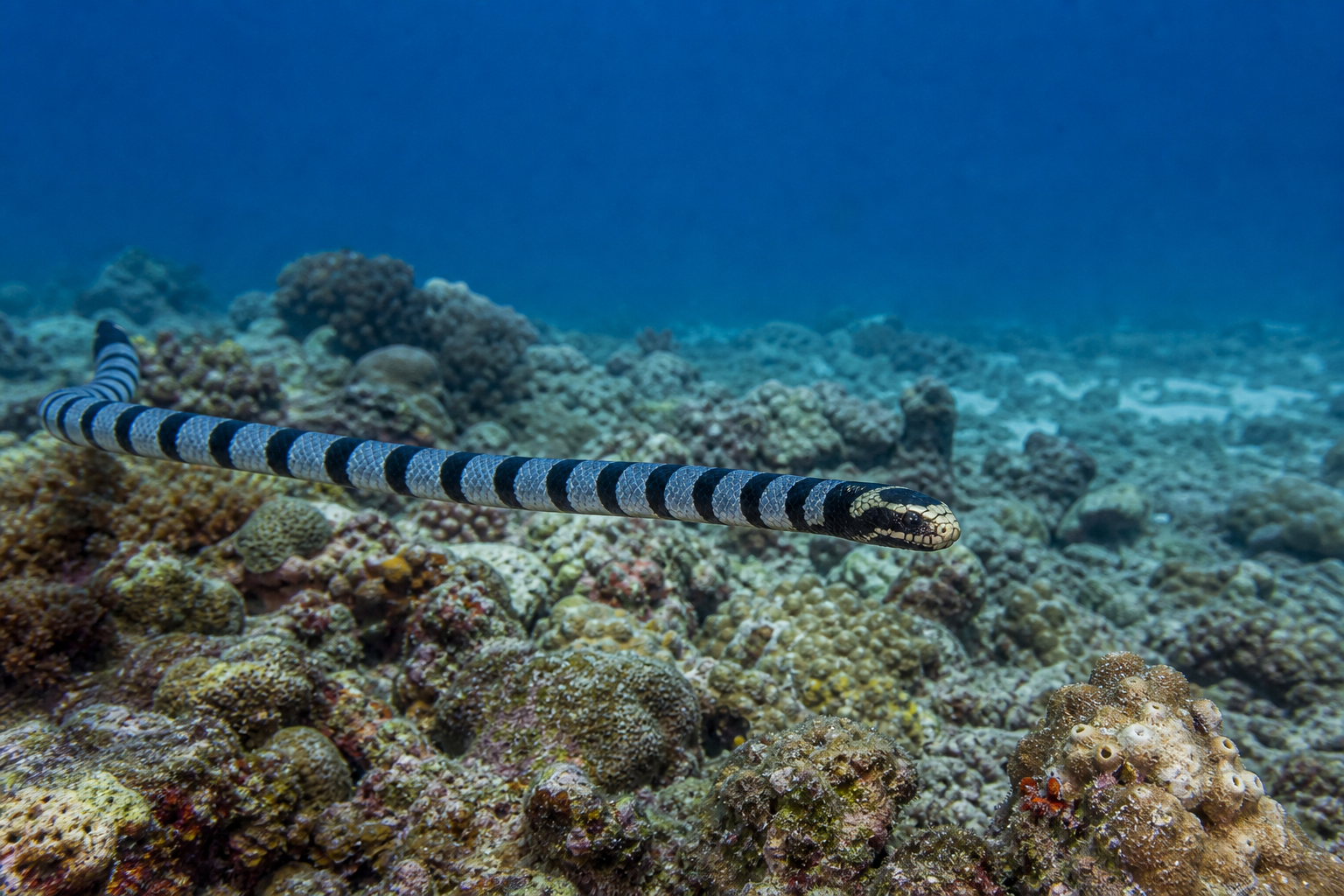
Manuk is a small, partly emergent volcanic seamount about 66 nautical miles (122 km) south-southeast of Banda Neira. The island is uninhabited, the water that surrounds it goes to 4,000 metres deep, and the diving works because the seamount creates an upwelling that draws the entire local food chain to a single point. The site is most famous, though, for the banded sea kraits (Laticauda colubrina) that aggregate on the rocky shore and hunt on the surrounding reef. Eight to 25 sea snakes per dive is the typical count; in the strongest weeks we have seen 40 to 50 individuals on a single dive. The kraits are venomous but not aggressive, the bite incidence on divers is essentially zero, and the photographic opportunity is unique in Indonesia. There is no other dive site in Indonesian waters where sea snakes occur in these numbers reliably.
Beyond the snakes, Manuk produces the pelagic action you would expect from a seamount: dogtooth tuna at the corner, occasional grey reef sharks on the deeper edges, schooling barracuda overhead, and the constant possibility of a passing oceanic predator. The dive plan is a wall drift on either the northern or southern side of the island depending on current, with a maximum depth of 30 metres and bottom time of 60 minutes. Visibility is 25 to 35 metres on a normal day. Manuk is included on essentially every Banda Sea itinerary that runs in the calm-water windows; the boat anchors offshore overnight, runs three dives the next day, and continues either north back to Banda Naira or south to the Forgotten Islands.
6. Suanggi: the lone seamount
Suanggi is a single rocky pinnacle that emerges from the open Banda Sea roughly 70 nautical miles northwest of Banda Naira. Like Manuk it is uninhabited, like Manuk it sits in 4,000+ metre water, and like Manuk the diving is built around the upwelling. Where Manuk specialises in sea snakes, Suanggi specialises in schooling pelagic fish: rainbow runners, jacks, dogtooth tuna, and the occasional hammerhead school in the right season. The pinnacle itself runs from 5 metres at the top to a steep wall down to 50 metres, with a small overhang on the eastern side that often hosts a school of bigeye trevally hovering against the current. Suanggi is harder to reach than Manuk (the crossing from Banda Naira is roughly 6 hours of open water) and is therefore included on a smaller subset of itineraries; when it is included, it is often the second-best diving day of the trip.
The Forgotten Islands chain: hammerheads in deep water
The Forgotten Islands are a chain of small uninhabited islands and submerged seamounts that runs roughly 200 nautical miles south-southeast from the Banda Islands toward Tanimbar and the Saumlaki port. The chain takes its name from the simple fact that almost no one visits it: the islands have no permanent population, no scheduled transport, no resorts, no fishing fleet of any size. The diving on the chain is the most pelagic in Indonesia, and the sites that work are the seamounts that rise from the deep open water rather than the islands themselves.
7. Lucipara Atoll and the Penyu group
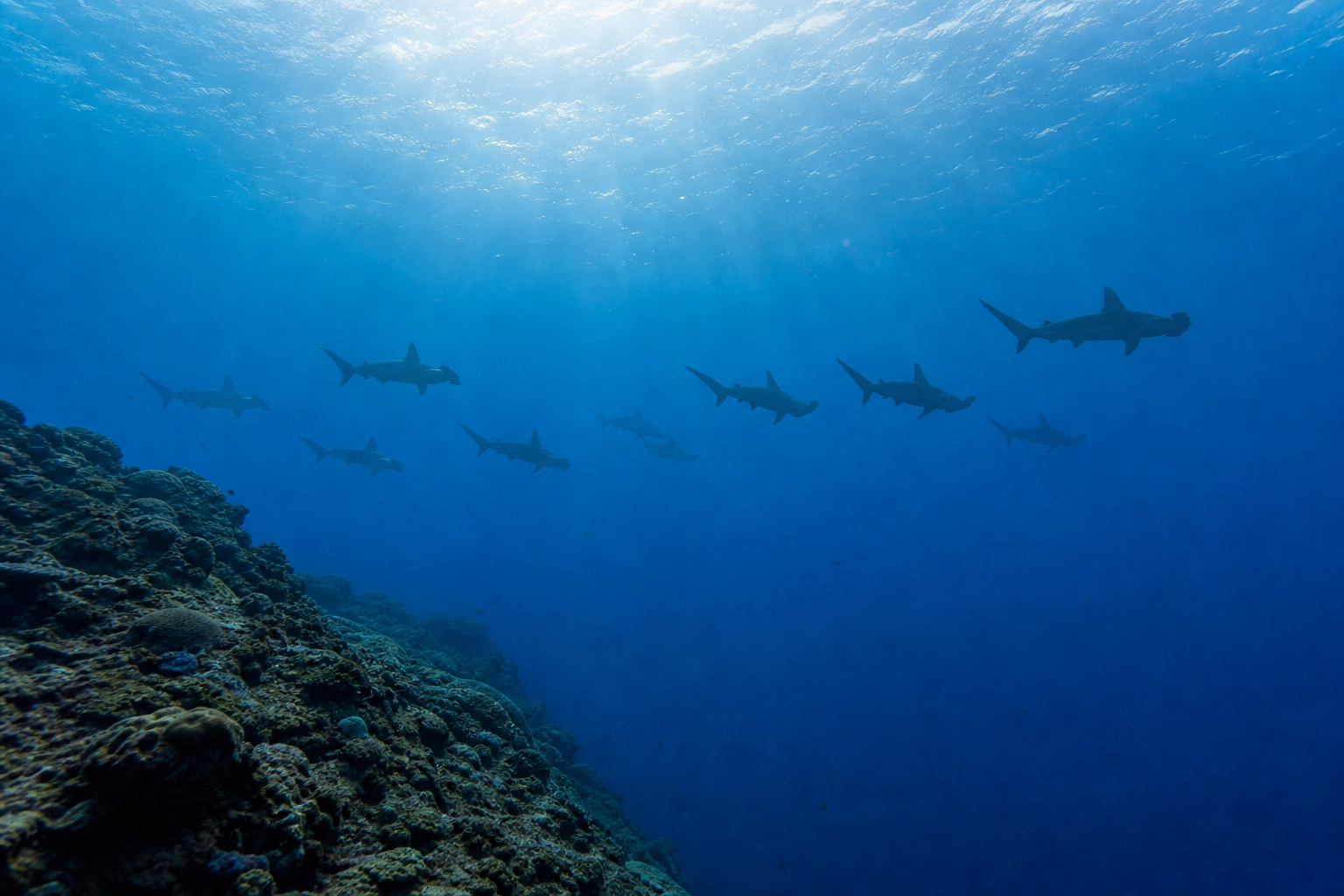
Lucipara is the headline site of the Forgotten Islands chain. It is a small atoll-like reef structure with two emergent sand cays and a series of submerged outer walls, sitting roughly 130 nautical miles south of Banda Naira. The walls drop from 5 metres at the top to over 50 metres, and the dive plan is usually a single deep dive at 35 to 40 metres followed by a slow shallow ascent. The marquee species is the scalloped hammerhead, and the reliable encounter pattern at Lucipara is a single school of 8 to 30 individuals passing along the outer wall in the early morning, ideally on the first dive of the day before 09:00. We have logged hammerhead schools at Lucipara in February, March, April, September, October and November; February to early April is the consistent peak.
Beyond the hammerheads, Lucipara delivers the broader Banda Sea pelagic list: dogtooth tuna in numbers, schooling jacks, the occasional silvertip shark on the deeper edges, and a coral coverage on the shallow reef top that ranks among the best in Indonesia. The closely related Penyu group sits a few miles further south and offers similar diving with smaller hammerhead numbers but better turtle aggregations (the Penyu name itself means "turtle" in Indonesian). Most operators run Lucipara and Penyu as a two-day pair, with the boat anchoring overnight at Lucipara and shifting to Penyu on the morning of the second day.
The honest practical note on Lucipara is that the diving is more demanding than the rest of the Banda Sea route. The 35 to 40 metre depth, the deep open-water position, the variable current and the early-morning schedule all combine to make this a route segment that suits experienced divers rather than first-timers. Operators that include Lucipara typically require a minimum of 50 logged dives and recent deep-diving experience. The reward, on a good day, is a hammerhead encounter that compares directly with the best-known sites in Cocos and Galapagos, at a fraction of the price and with a tenth of the boat traffic. The wider shark diving in Indonesia guide covers the species side of these encounters in more detail.
8. Nil Desperandum
Nil Desperandum is a single submerged pinnacle in the southern stretch of the Forgotten Islands chain, equidistant from Lucipara and the Tanimbar group. The site is essentially a rock in the middle of the open ocean, with no nearby land and a 50-metre depth on the surrounding seabed. The diving is similar to Suanggi in character: schooling pelagics on the upcurrent side, occasional shark sightings on the deeper edges, and visibility that consistently runs 35 metres or more. Nil Desperandum is included only on the longer 14-night Banda Sea itineraries that connect through to Saumlaki; on shorter routes it is typically skipped in favour of a second day at Lucipara.
The eastern extension: Koon and the Misool transit
For divers booking the longer 14 to 16 night liveaboard routes that cross the Banda Sea diagonally, two additional regions deserve mention: Koon Island in the east, and the optional Misool transit on routes that connect to Raja Ampat.
9. Koon Island: too many fish
Koon is a small island off the southeastern tip of Seram, technically outside the Banda Sea proper but always included on the eastern Banda Sea routes that loop through Ambon and the Banda group. The signature dive site on Koon is called "Too Many Fish" by everyone who has dived it, and the name is accurate. A single point of the island concentrates a fast tidal current that carries vast schools of fusiliers, surgeons and snapper across a coral-covered slope; the predators (sharks, jacks, dogtooth tuna) come to feed on the schools, and the diving is essentially a controlled drift through a constantly-moving fish soup. The current is the limiting factor: on the wrong tide the dive is unsafe and operators wait for the slack. On the right tide, it is the highest fish biomass per unit reef that we know in Indonesia.
10. The Misool transit
Banda Sea liveaboards that cross diagonally from Ambon to Sorong (or vice versa) sometimes route through the southern Misool islands rather than directly across the Seram Sea. Misool is technically part of Raja Ampat rather than the Banda Sea, and the diving is a different category (soft-coral walls, manta cleaning stations, wide-angle work rather than pelagic seamounts), but the transit dives at Misool can be a strong addition to a Banda Sea trip. The full Raja Ampat destination guide covers this side of the route.
Banda Sea dive sites that are not on most itineraries
The 10 sites above cover roughly 80 per cent of the diving on a typical Banda Sea liveaboard. For completeness, four more sites are worth mentioning, though most divers will not visit them on a first trip.
Pulau Run. The historical site (this is the island that the Dutch traded to the British for Manhattan in 1667) and the diving features macro-rich walls on the southern side. The site lacks the pelagic action of the seamounts but rewards a slow critter dive.
Pulau Babi. A small island in the Forgotten Islands chain with a steep wall on the western side. Strong fish life but variable conditions.
Saumlaki house reef. The Tanimbar Islands at the southeastern end of the route. Mediocre as a dive site relative to the Banda Sea seamounts but functions as a final dive before the long crossing back or before the disembarkation at Saumlaki port.
Pulau Tukang Besi. Occasionally included on routes that loop east toward Wakatobi from the Banda Sea. The site itself is more of a Wakatobi-style wall than a Banda Sea seamount, and the more usual recommendation is to either choose a dedicated Wakatobi trip or a dedicated Banda Sea trip rather than splitting the time.
For divers who already know the central Banda Islands and the Forgotten Islands and are looking for a second-trip itinerary, the cross-region option that we recommend most often is to combine a Banda Sea route with a few days at Ambon Bay before or after for the muck diving. The Ambon Bay diving guide covers that side; macro photographers in particular benefit from the combination, and the broader Indonesian macro diving guide sets the wider context for Lembeh-Ambon-Banda combinations.
How to put a Banda Sea itinerary together
The dive-site list above is the menu; the question that decides the trip is which subset of those sites to visit on a single itinerary, and the answer depends on trip length, departure port, and the diver's tolerance for open-water crossings.
The standard Banda Sea liveaboard runs 11 nights from Ambon to Banda Naira and back, with the route covering the central Banda Islands (Lava Flow, Hatta, Karang Hatta, Banda Naira), the Manuk seamount (one or two days), Suanggi on a longer crossing, and a return through Banda Naira. This route is the one we recommend to most first-time Banda Sea guests: it covers 7 of the top 10 sites on the list, the open-water crossings are 4 to 8 hours rather than overnight, and the diving demand is moderate rather than serious. Roughly 70 per cent of the cabin charters we book in this region are on the 11-night Ambon round-trip.
The 14-night one-way route from Ambon to Saumlaki adds the Forgotten Islands chain (Lucipara, Penyu, Nil Desperandum) and an extra day at Manuk. This route is the right answer for divers chasing the hammerhead encounter and for divers comfortable with longer open-water crossings. The Saumlaki disembarkation requires a less-convenient flight back through Ambon to Jakarta, which adds a half-day of travel at the end of the trip but is well worth it for the extra diving.
The 16-night cross-region route from Ambon to Sorong (or Sorong to Ambon, depending on the season) adds Koon Island in the east, an optional Misool transit, and a final stretch into Raja Ampat. This is the longest and most expensive Banda Sea option, suits experienced repeat-visit divers, and is most often booked as a full-yacht charter rather than a cabin charter. The combination of Banda Sea pelagic diving and Raja Ampat wide-angle diving in a single trip is a distinctive offering that the Indonesian market is uniquely positioned to provide; the wider luxury liveaboard category covers the boats most likely to run this length of trip.
When to go: the two practical windows in 2026
The Banda Sea has a short operating season, and timing the trip correctly is more important here than in any other Indonesian region. The two reliable windows are March to early May and September to early November. Both are inter-monsoon periods between the NW monsoon (which dominates from December through February) and the SE trade winds (which dominate from May through August).
Within those windows, the small differences matter. February to early April is the strongest window for hammerheads at Lucipara and at Hatta, and the strongest period for the dogtooth tuna and pelagic schools at Manuk and Suanggi. September to early November is the calmer window in terms of sea state, with marginally lower hammerhead numbers but better visibility on average and the most reliable Lava Flow conditions. October specifically is the month most photographers prefer because the visibility, the calm water, and the still-active pelagic life all stack up. May, June, July and August are unsuitable for the open-water crossings; almost no operators run scheduled trips. December and January are suitable for short Ambon-only trips but the Banda Sea proper is rough.
Common mistakes Banda Sea divers make
Five mistakes recur on Banda Sea trips, often enough that we mention them on the welcome briefing of every itinerary.
Underestimating the depth requirements. Lucipara, Suanggi and Manuk all have dives that work best at 30 to 40 metres, and divers who do not have recent deep-diving experience can find themselves missing the marquee encounters. Recent advanced or deep-diver certification within the last 12 months is the right preparation.
Overestimating the visibility. Banda Sea visibility is good, not extraordinary. 25 to 35 metres is the typical range, occasionally 40 metres on the seamounts. Divers arriving with Maldives or Galapagos expectations of 45-metre crystal viz are usually not disappointed, but they sometimes plan their photography around the wrong assumptions.
Skipping the dawn dives. The hammerhead encounters at Lucipara, the Hatta drift, and the seamount upwellings all peak in the first dive of the day, before 09:00. Divers who treat the dawn dive as optional miss roughly 60 per cent of the marquee species action across a typical week.
Bringing only macro gear. The Banda Sea is a wide-angle region. The macro work is good in places (Banda Naira, Pulau Ai, Pulau Run) but the trip is not the right one for a dedicated macro photographer. The right macro destinations are Lembeh and Ambon, with Banda as the wide-angle complement.
Treating the cultural shore time as a chore. The Banda Naira fort visit and the nutmeg plantation walk are some of the most distinctive cultural experiences on any Indonesian dive trip. Divers who skip them to read in their cabin miss the layer that makes the Banda Sea a different category of trip from the rest of Indonesia.
What separates a good Banda Sea operator
The seamount diving here rewards local knowledge and flexible planning far more than it rewards any operator’s published schedule, and that is the most useful thing to understand before you book. Lucipara and Manuk do not run to a timetable. A school of hammerheads that fails to show on the second morning may well be there on the third dive of the same day, and whether you get that second attempt depends entirely on whether the captain is reading the wind and the tide or simply running the brochure. The good boats adjust. They will move a dive, propose an unscheduled second attempt when the forecast supports it, and build the safety case around it, often by using a shallow coral dive earlier in the day to leave enough nitrogen budget for a repeat descent on the outer wall. The less-good ones sail the printed itinerary and hope. When you are comparing operators, ask how often they change the plan mid-cruise and what triggers it. The answer tells you most of what you need to know.
How to book and what to ask
Banda Sea liveaboards book further in advance than Komodo trips because the operating season is shorter and the inventory is genuinely scarce. For 2026 March-April departures, book by October 2025; for September-November departures, book by April 2025. The popular weeks (the first two weeks of March and the last two weeks of October) sell out 9 to 12 months ahead in most years.
The questions worth asking before booking, beyond the standard cabin and food questions, are: which specific dive sites are scheduled on this departure (operators sometimes substitute weather-dependent sites without disclosure); what the deep-diving certification requirement is for Lucipara (some operators waive the requirement, which is not always to the customer's benefit); whether the boat carries nitrox at no surcharge; and what the contingency plan is if the SE winds arrive early. A good operator answers all four directly. To start that conversation, the contact page reaches our reservations team, and the King Neptune, Neptune One and Komodo Sea Dragon pages cover the boats themselves.