There is a rock in the middle of the Banda Sea with no people on it, no harbour, no shelter and no reason to stop, and a lot of experienced divers will tell you it is the strangest dive they have ever done. Manuk is an active volcano roughly 122 kilometres from the nearest inhabited island. The water around it holds sea snakes in numbers that most divers have never seen anywhere else, and the air above it is full of frigatebirds.
It is also one of the few genuinely hard-to-reach dive sites left in Indonesia. You cannot get there on a day trip, there is no resort, and only a subset of Banda Sea liveaboard itineraries include it at all. The boats that do go are there for the season's real headline, the scalloped hammerhead migration that aggregates on these offshore volcanoes every year, and the long crossings in between are some of the best whale watching in Indonesia. This guide covers where Manuk actually is, why the snakes gather there in those numbers, whether they are dangerous, what the diving is like, and how to get on a boat that stops.
Where Manuk is, and why almost nobody dives it
Manuk sits at 5°32'S, 130°18'E, alone in open water. It is the easternmost volcanic island of the Banda Arc, a truncated andesitic stratovolcano that breaks the surface at 282 metres and rises around 3,000 metres from the sea floor. What you see is the top of a mountain. There are no confirmed historical eruptions, but the island is not dormant in any sense that matters underwater: geothermal vents bubble through the seabed on the shallow slopes, some of the rocks are warm to the touch, and boats approaching downwind usually smell sulphur before anyone sees the steam.
The whole island is about one square kilometre. It has been a protected wildlife sanctuary, Suaka Margasatwa Pulau Manuk, since 21 May 1981, gazetted primarily for its seabird colonies rather than for anything underwater. The name gives that away. Manuk means bird in a number of Austronesian languages, so the island most divers call Snake Island is officially Bird Island, and both names are earned.
The numbers that matter
| Position | 5°32'S, 130°18'E, Central Maluku Regency |
|---|---|
| Distance from Banda Neira | About 122 km, or 66 nautical miles, bearing roughly south-southeast |
| Crossing time | 8 to 10 hours, normally run overnight |
| Island | Around 1 km², uninhabited, 282 m high, rising about 3,000 m from the sea floor |
| Protection | Pulau Manuk Wildlife Sanctuary, gazetted 21 May 1981 |
| Access | Liveaboard only. No jetty, no anchorage in bad weather, no facilities |
| Typical depths | 5 to 30 m, average around 18 m, deeper on the ridges |
| Water temperature | 27 to 29 degrees at the surface, colder below the thermocline |
| Visibility | Anywhere from 5 to 30 m, and it changes fast |
| Current | Mild to strong, and unpredictable rather than tidal in the usual sense |
| Level | Intermediate and up. Not a place to be sorting out your buoyancy |
| Season | The two Banda crossing windows, roughly March to May and September to November |
Why it stays empty
Three things keep Manuk off most itineraries, and they are worth understanding before you book a trip hoping to dive it.
The first is simply the distance. An overnight crossing each way costs a boat two nights and most of a day, and that day has to be paid for out of an itinerary that could otherwise be spent on sites nearer Banda Neira. Operators running shorter Banda loops often cannot justify it.
The second is that there is nowhere to hide. Manuk has no bay, no lee worth the name, and nothing resembling a sheltered anchorage. Boats hold position offshore, and if the swell gets up overnight the captain's only real option is to leave. Skipping Manuk because the weather turned is a normal outcome rather than a failure of planning, and any operator who guarantees the stop is telling you something about their honesty rather than their schedule.
The third is that the Banda Sea only opens twice a year. The crossing windows fall roughly in March to May and again from September to November, and outside those months the open water between Ambon and the southern arc is not somewhere a liveaboard wants to be. That leaves a narrow calendar into which every Banda itinerary in the country has to fit.
The upshot is that Manuk gets a few hundred divers a year at most, which is roughly what a single popular site in Komodo handles in a fortnight. Nobody has built anything there, nobody is selling anything, and the reef has never had to absorb a crowd.
The snakes, and why they are here in these numbers
Divers arriving at Manuk usually expect one species and find two. Both are sea kraits, genus Laticauda, and both are common on the same dive.
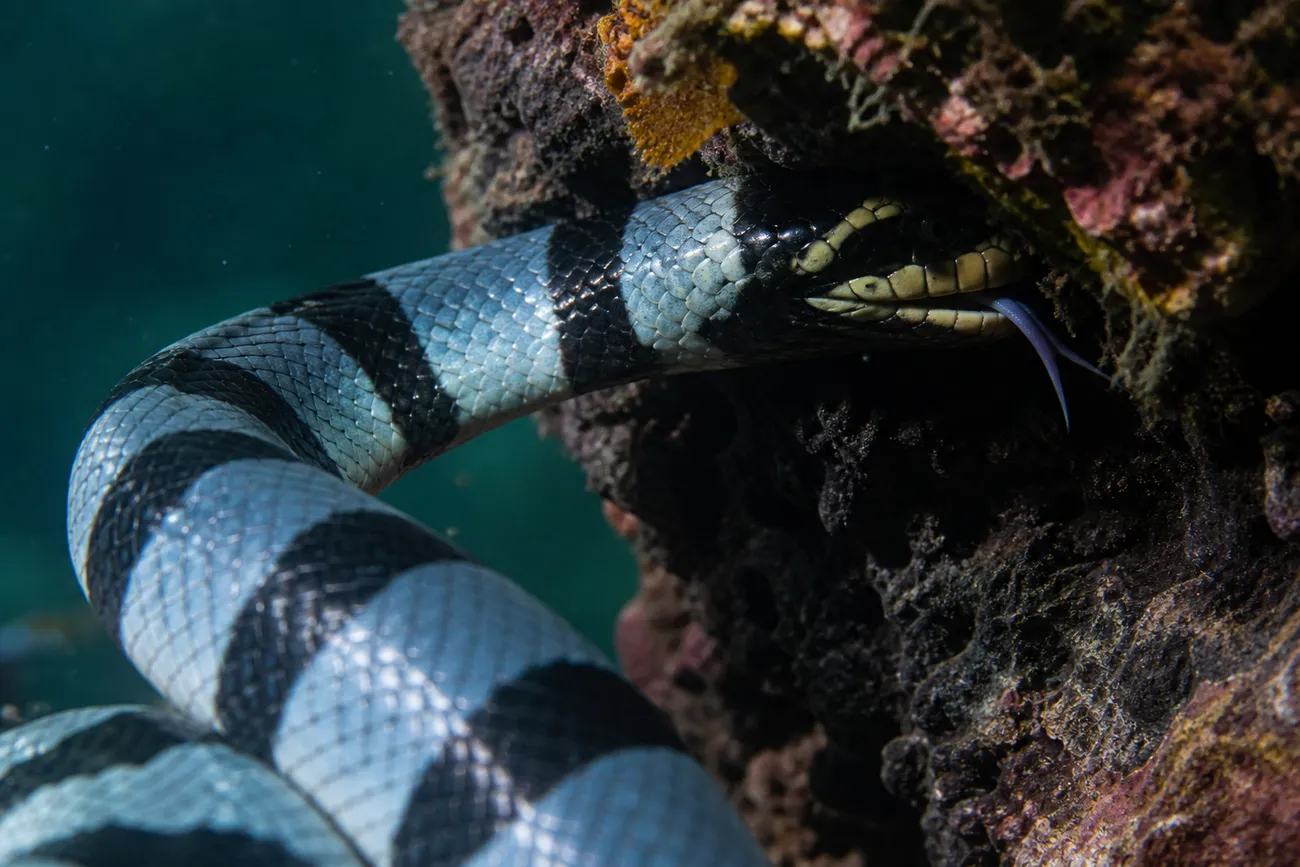
- The yellow-lipped sea krait, Laticauda colubrina, is the one in every photograph: pale blue-grey with clean black bands, a yellow upper lip and snout, a paddle tail, usually somewhere between a metre and a metre and a half long.
- The Chinese sea krait, Laticauda semifasciata, also called the black-banded sea krait or erabu, is heavier through the body with a blunter head and less contrast in the banding. It is the more interesting of the two to watch, for reasons that become clear below.
On a good dive you will see dozens across the depth range, moving between the reef and the surface, apparently indifferent to divers. They are not gathering to breed in front of you and they are not being fed. They live here.
Why an island with nobody on it is the whole point
The thing that separates sea kraits from true sea snakes is that kraits are only half marine. They keep the broad belly scales of a land snake, they lay eggs rather than bearing live young, and they have to come ashore roughly every ten days, usually at night, to digest what they have eaten, court, breed, shed their skin and drink fresh water. A sea krait that cannot reach land will die.
That single fact explains Manuk. What a krait population needs is a piece of land next to good reef, with fresh water, warm rock, crevices to shelter in and, above all, nothing on it that eats snakes or kills them on sight. Almost everywhere in Indonesia that fits the first half of that description has people on it. Manuk does not, and has not for as long as anyone has been counting. Add the geothermal warmth, which suits a cold-blooded animal that has to regulate its temperature, and you get an island functioning as a krait colony rather than a reef that happens to have snakes on it.
It is the same reason Gunung Api, back in the Banda Islands, holds its own famous aggregation, and the two are frequently confused. Gunung Api is easy to reach, sits beside Banda Neira and appears on nearly every itinerary. Manuk is a hundred and twenty kilometres out in open water and appears on some. If a trip description promises sea snakes, check which island it means.
What they are actually doing down there
Sea kraits are eel specialists to an almost absurd degree. Morays, congers and snake eels make up nearly the entire diet, and roughly sixty million years of evolution have shaped the animal around getting into a crevice after one. The hunting is not dramatic. A krait works along the reef pushing its narrow head into hole after hole, flicking its tongue to pick up scent, then strikes inside the crack where the eel has nowhere to go. Watching it is closer to watching a search than a hunt.
The Chinese sea kraits do something considerably stranger. They form hunting alliances with yellow goatfish and bluefin trevally, sometimes in groups running to the hundreds, with the snakes flushing prey out of crevices that the fish cannot reach and the fish taking whatever bolts into open water. Very few divers get to see a coordinated multi-species hunt of any kind. This one involves a venomous reptile working with two unrelated fish, and Manuk is one of the handful of places on earth where you might.
The other behaviour worth watching for is the breath. Kraits have a single elongated lung running most of the body length, which lets them stay down anywhere from fifteen or thirty minutes to a couple of hours, and dive to sixty metres or more. But they are air breathers, and eventually every one of them has to go up. The ascent is unhurried and vertical, the snake reaches the surface film, takes one breath, and comes straight back down, often following the same stretch of wall it went up. If you position yourself well and stay still, that is the sequence to watch, and it is the one most divers miss because they are busy chasing snakes along the reef.
Are sea snakes dangerous to divers?
The short answer is that sea kraits are among the most venomous animals in the sea and among the least dangerous to a diver who leaves them alone, and both halves of that sentence are true at the same time. It is worth understanding why, because the guidance that follows from it is not obvious.
The venom is genuinely serious
Sea krait venom is roughly ten times more toxic than a Western diamondback rattlesnake's. It is both neurotoxic and myotoxic, meaning it interferes with the signal between nerve and muscle and breaks muscle tissue down at the same time. Serious envenomation produces muscle pain, drooping eyelids, difficulty swallowing and, in the worst cases, paralysis, kidney injury from the products of muscle breakdown, and respiratory failure. Symptoms can be delayed by hours, which is part of what makes it dangerous. An animal this size carries around 10 to 15 milligrams of venom and only a fraction of that is a lethal dose.
And the actual risk to you is very low
Now the other half. Sea kraits are docile to a degree that is hard to overstate. They have small fangs, they do not defend territory, they have no interest in anything that is not an eel, and a large share of defensive bites deliver no venom at all. Essentially every recorded sea snake bite worldwide involves handling: fishermen clearing nets, someone picking one up, someone grabbing at one in the water. There is no recorded case of a diver being killed by Laticauda colubrina in the medical literature, despite the fact that thousands of divers share water with them every year.
The risk, in other words, is almost entirely under your control. It is not a question of luck.
The protocol, which is four things
- Keep your hands to yourself. No touching, no herding with a pointer, no picking one up for a photograph. This is the whole of the risk, and everything else is detail.
- Hold still and let them come. Kraits are curious and will investigate a diver, sometimes closely, sometimes running the length of an arm or across a mask. It is unnerving the first time. It is also completely benign, and the correct response is to stay put and let it finish.
- Never block the route to the surface. This is the one people get wrong. The animal has to breathe, and a diver hovering in its way, or a line of divers between it and the surface, turns a calm ascent into a cornered one. If a krait starts going up, get out of the way.
- Be more careful at night. Bites are more likely in low light, kraits are more active after dark, and a night dive at a site like this needs a briefing rather than an assumption.
If someone is bitten, treat it seriously regardless of how minor it looks, because the fangs are small and the bite is often close to painless. Current first aid is a pressure immobilisation bandage over the limb with the limb splinted, keeping the casualty as still as possible, and evacuation to definitive care with antivenom. That last part is exactly why this matters more at Manuk than it would in Thailand. You are eight to ten hours from Banda Neira and considerably further from a hospital that can help. Ask your operator what their evacuation plan actually is before the dive rather than after it, and make sure your insurance covers it. Our guide to what certification you need for an Indonesian liveaboard covers the cover question in more detail.
The diving itself
Take the snakes away and Manuk would still be a good dive, which is not something you can say about every novelty site.
What the site is like
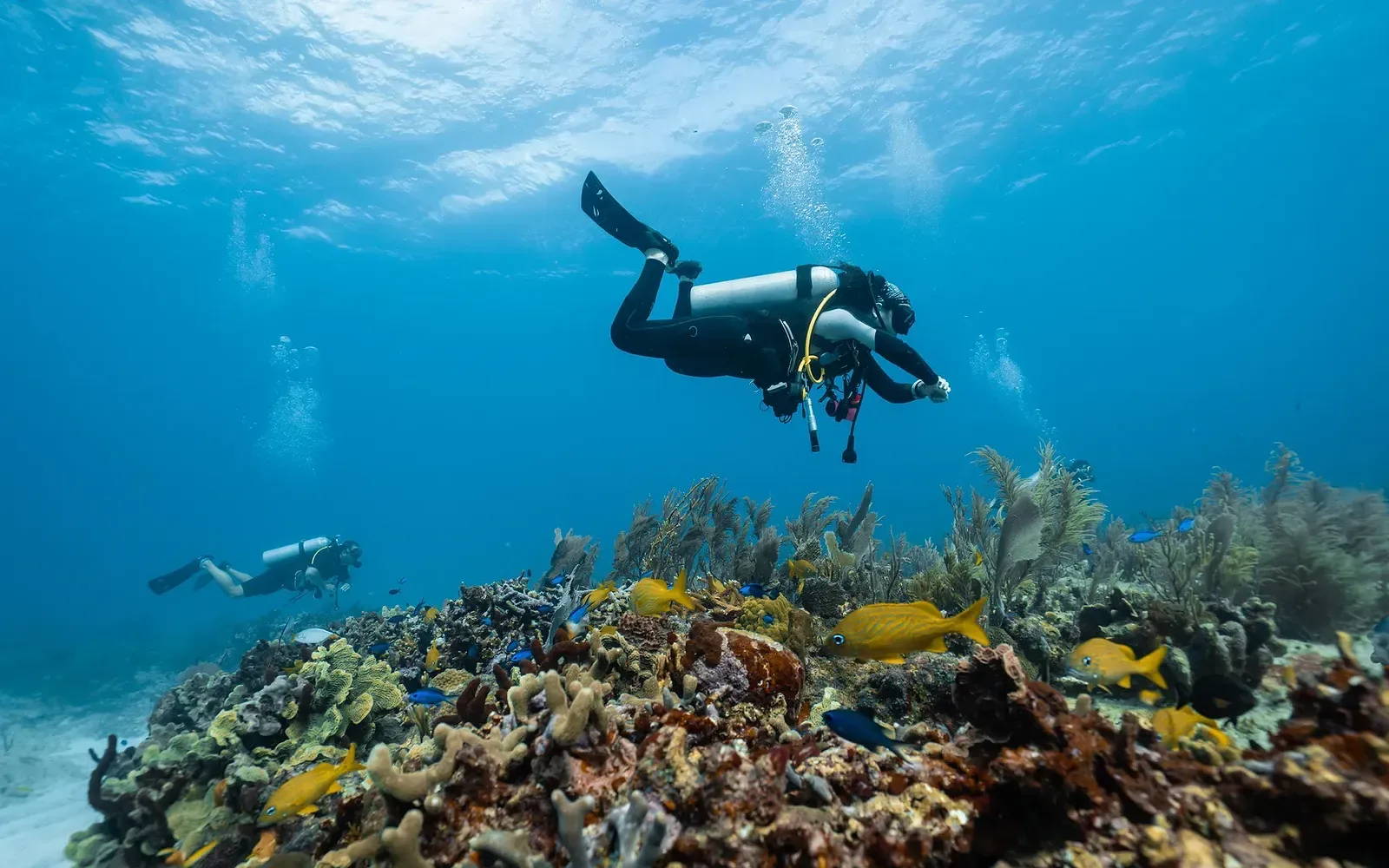
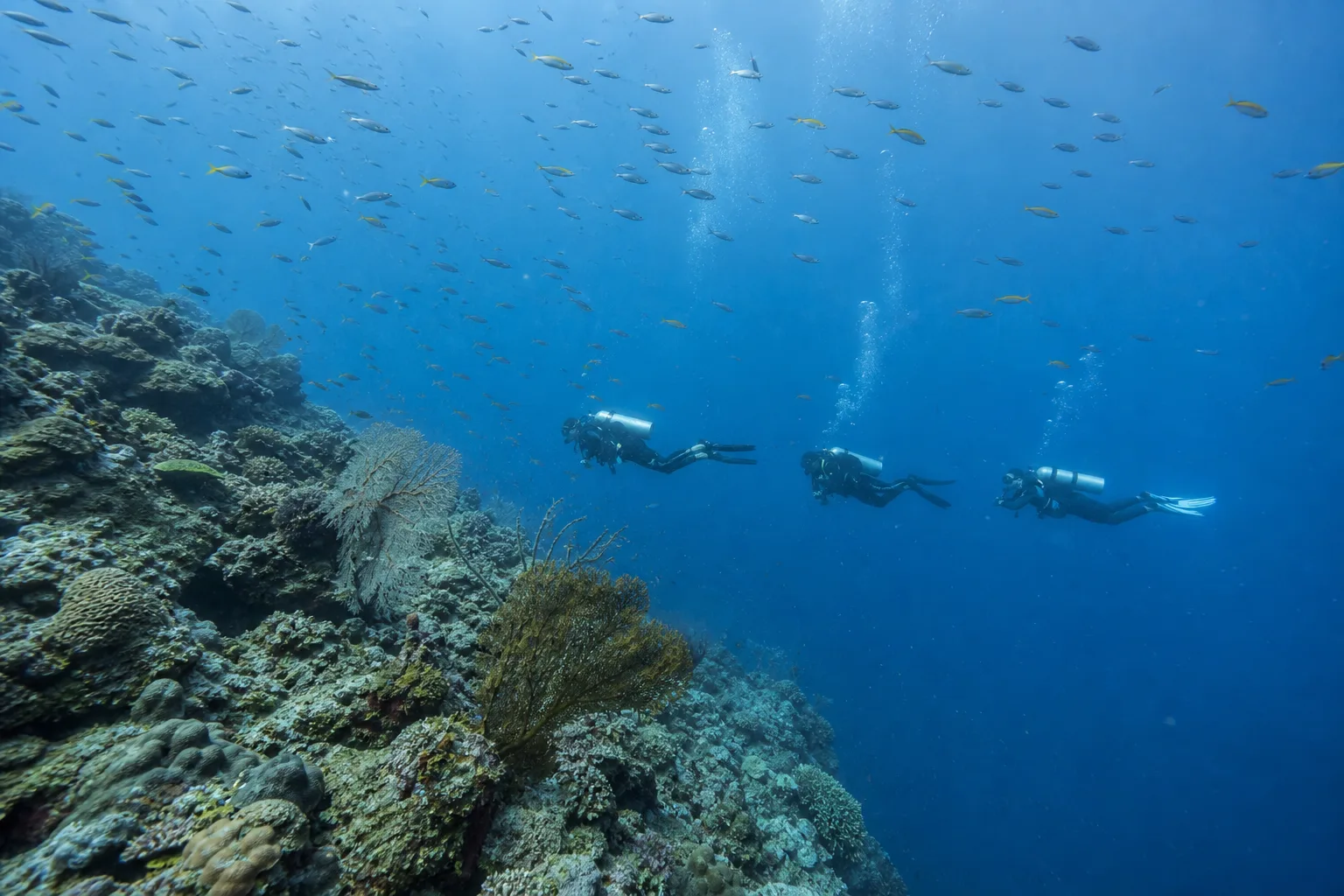
The island drops straight into deep water, so everything happens on a fairly narrow shelf before the bottom goes away. You are diving a mix of black volcanic sand slopes, hard coral reef in genuinely good condition, and volcanic ridges running out from the island hung with gorgonians and barrel sponges. In the shallows there are vents, and this is the part people remember: streams of gas bubbling up out of the seabed, patches of sand that are warm through a glove, and the occasional rock hot enough that you notice.
Depths are moderate for the Banda Sea. Most of the diving works between 5 and 30 metres with an average around 18, and while the ridges run deeper, the good material is not down there. Currents are the main variable and they are not particularly predictable, running anywhere from a gentle push to something that wants a negative entry and a tight plan. Visibility swings just as widely, from about 5 metres when the water is full of life to 30 when it is not.
The hammerhead migration, which is why the season exists
The sea snakes are what makes Manuk unlike anywhere else, but they are not why the Banda season is built the way it is. That is the hammerheads, and they are the headline of the whole crossing.
Scalloped hammerheads are a highly migratory species, and every year they move through the Banda Arc and aggregate on the seamounts and offshore volcanoes, which they appear to use for navigation, cleaning and probably mating. Manuk is one of those aggregation points. It sits alone in deep water with upwelling on its flanks, which is precisely the structure the sharks are looking for, and in a good season the schools come. In a quieter one you get singles and pairs cruising past on the deeper edge. Anyone who tells you which of those you are going to get has no way of knowing.
The peak is short. Late September through November is the strongest window, with October the month most operators would pick if they only had one, and there is a second run in roughly March to April. Encounters usually happen below thirty metres against blue water, so this is advanced diving with a real need for good gas planning. The technique matters more than people expect: hammerheads are shy, they read a diver swimming towards them exactly as you would expect, and the divers who see the most are the ones who pick a spot on the reef, hold still, keep their breathing slow and let the school come to them. Bubbles push them away. Patience pulls them in.
Manuk is not the only site on the route that does this, and a well-built itinerary will not ask it to be. Serua, Nil Desperandum and Suanggi are the other aggregation sites, and most of the fourteen-night routes string several of them together precisely so that no single day has to carry the trip. Our guide to shark diving in Indonesia goes into the species and the seasons in more depth.
Whales, and why the crossings are not dead time
The other thing people underestimate about this itinerary is what happens between the dives. The Banda Sea is a deep basin sitting on a major cetacean corridor, and the long open-water legs that make the route feel like a chore are also the best whale watching most divers will ever get from a dive boat.
Short-finned pilot whales travel in large pods and are the most commonly seen. Spinner dolphins are close to routine, often riding the bow for miles. Sperm whales pass through seasonally, melon-headed whales turn up in big groups, and blue whales and pygmy blue whales, the largest animals that have ever lived, use the deep trench system on migration. Orcas are recorded too, though rarely. October and November are the strongest months, which is the same window as the hammerhead peak, and that overlap is the single best argument for booking the late season rather than the March run.
None of it is guaranteed and none of it can be dived on demand. What it means in practice is that the crossing to and from Manuk deserves someone on deck. Blows on the horizon and distant surface activity are common enough that boats will alter course for them, and the difference between a guest who saw whales on this trip and one who did not is usually just where they spent their surface intervals.
The rest of the fish, and the birds above them
A seamount alone in open water collects everything else as well. Fusiliers school in enormous numbers over the ridges, Spanish mackerel and dogtooth tuna come through on the corners, barracuda hang above the reef, and mobula and eagle rays turn up often enough to be worth watching the blue for. Grey reef sharks work the deeper edges and silvertips are seen on the deep walls.
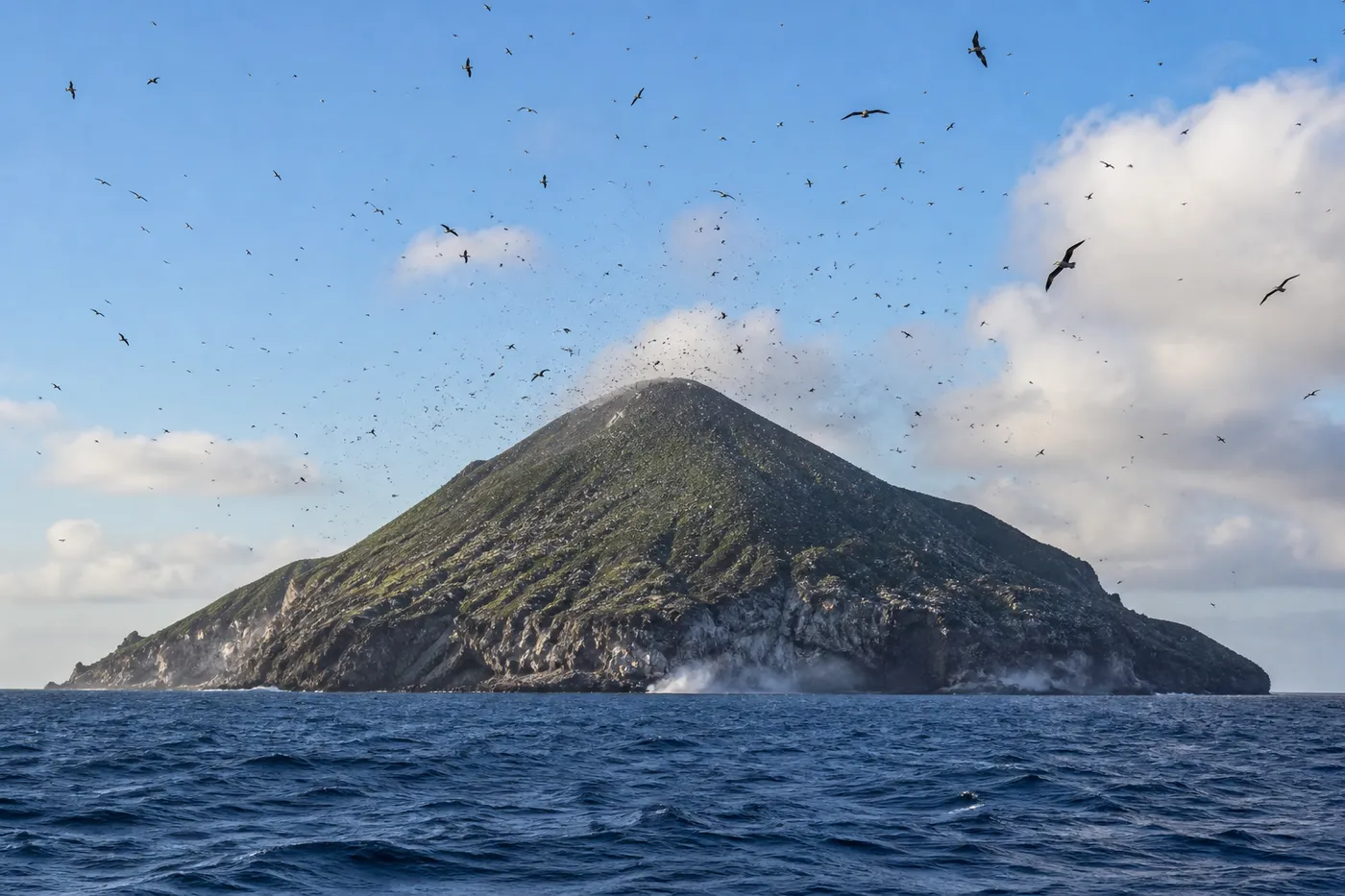
The island is a major seabird colony and the sanctuary was created for exactly that. Frigatebirds wheel over the summit in the thousands, red-footed boobies nest on the cliffs, and white-bellied sea eagles work the shoreline. Coming up from a dive full of sea snakes to a sky full of frigatebirds is the part of Manuk that people describe when they get home, and it is easy to miss if you go straight below to change a battery. Landing is not appropriate given the sanctuary status and the nesting birds, so the island is experienced from the water and from the deck, which is enough.
Getting on a boat that stops there, and whether it is worth it
Manuk is not a destination you book. It is a line item on an itinerary, and the practical task is picking a route that includes it and an operator honest about whether they will make it.
Which itineraries include Manuk
| Route | Length | How Manuk fits |
|---|---|---|
| Ambon round trip via Banda Neira | 11 nights | The standard Banda loop. Usually one full day at Manuk, sometimes two, weather permitting |
| Ambon to Saumlaki, one way | 14 nights | Adds the Forgotten Islands chain and normally an extra day at Manuk. The strongest option if Manuk is the priority |
| Saumlaki to Ambon, the reverse | 14 nights | Same sites in the other direction, and often cheaper depending on repositioning |
| Ambon to Sorong | 14 nights | A cross-region repositioning route taking in the Bandas, Manuk, Halmahera and finishing in Raja Ampat |
| Ambon to Kaimana | 14 nights | The Bandas, Manuk, the Forgotten Islands and then Triton Bay |
The pattern is that the longer one-way crossings give Manuk more room than the round trips do, because they are not trying to get back to where they started. If you want the best chance of two days there rather than one, the fourteen-night routes are the ones to look at. Our overview of the Forgotten Islands covers what else those itineraries pick up along the way, and the wider Banda Sea dive site guide puts Manuk in context with Suanggi, Hatta and Lucipara.
When to go
There are two windows and no third option. Roughly March to May, and roughly September to November. Both are hammerhead seasons across the region, both are when the open crossings are workable, and every Banda liveaboard in Indonesia is trying to fit into them, which means the good boats sell out a long way ahead. Twelve months is not an unreasonable lead time for a specific fourteen-night departure.
Between those windows the Banda Sea is not a place for this kind of trip. Boats reposition to Komodo or Raja Ampat, and anyone offering you a Manuk itinerary in January is either mistaken or hoping.
Questions worth asking before you book
- Is Manuk scheduled, and what happens if the weather closes it? A good answer describes the alternative and admits the stop is conditional. A guaranteed Manuk is not a thing anyone can sell you.
- How many dives at Manuk, and over how many days? One day of three dives is normal. Two days is better and exists on the longer routes.
- What is the evacuation plan from open water in the southern Banda Sea? Ask specifically. The nearest hyperbaric facilities are a very long way off, and the answer tells you a great deal about the operation.
- What is the guide-to-diver ratio in current? Manuk can run hard and there is nothing downstream of it.
- Is nitrox included? On repetitive deep-ish diving across a fortnight it matters more than usual. We have written separately on whether nitrox is worth it on a liveaboard.
What to bring that you might not think of
Exposure protection is the main one. The surface water sits at 27 to 29 degrees, which sounds like board shorts, but the Banda Sea produces upwellings and a thermocline below twenty metres or so can take several degrees off very abruptly. Divers who packed for Komodo in October regularly find the deep dives on this itinerary the coldest of their trip. A 5mm suit, or a 3mm with a hooded vest, is the sensible call, and our Indonesia liveaboard packing list goes through the rest.
Beyond that: a surface marker buoy you can actually deploy in current, a torch even for day dives because the crevices are where the interesting behaviour happens, and a camera set up for wide angle rather than macro. Snakes photograph badly with a macro lens because they never stop moving and they are longer than the working distance allows.
Is Manuk worth building a trip around?
Not on its own, and nobody sells it that way. What you are buying is a fourteen-night crossing of one of the emptiest stretches of diveable water in Indonesia, on which Manuk is the day that does not resemble anything else.
Be clear-eyed about the trade. This is expedition diving. The crossings are long, the weather makes decisions for you, there is no chamber within any comfortable distance, several of the best sites want you comfortable at thirty metres in current, and there is a real chance the boat will not reach Manuk at all. Against that, the reef is in the condition reefs used to be in, the fish behave as though they have never been fished, you will not see another dive boat, and the specific thing Manuk offers, a working sea krait colony around a live volcano with a seabird city on top of it, does not have a substitute somewhere more convenient.
Booked in the right window it is a rare combination. The hammerhead migration is the reason the season exists and Manuk is one of the volcanoes the schools aggregate on, the crossings either side of it run through a cetacean corridor where pilot whales, sperm whales and blue whales are all on the table, and in the middle of it sits a day that no other dive site in the world can offer you. Go in October if you can, when the sharks and the whales overlap. Then spend one afternoon hanging in the blue off a live volcano, watching a venomous reptile rise slowly past you, take a single breath at the surface and go back to work.