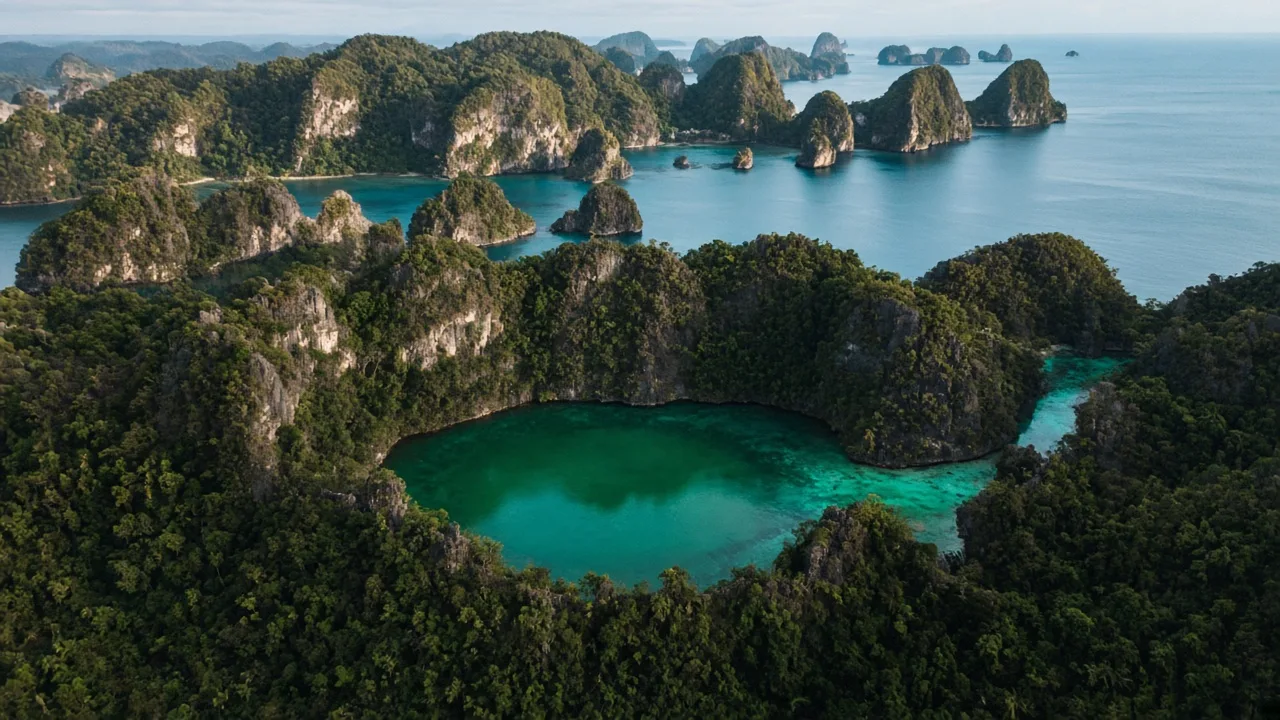
Every region gets one photograph that does the marketing for it. For Raja Ampat, it is the view from the top of Piaynemo: a scatter of green karst islets rising out of turquoise lagoons, arranged so perfectly that first-time visitors often assume the image has been retouched. It has not. The mounds of jungle-covered limestone really are that green, the water really does shift from pale jade over the sand to deep ultramarine in the channels, and the whole scene sits about 60 kilometres west of Waisai in a quiet corner of the Fam Islands, waiting at the top of a wooden staircase.
Almost every guest we carry through the Fam group asks the same two questions before we drop anchor: how hard is the climb, and is it actually worth it after seeing the photo a hundred times online? This guide answers both, then goes further, because Piaynemo is not just a viewpoint. It sits in the middle of some of the finest shallow reef diving on the planet, the sort of sites that headline a Raja Ampat liveaboard itinerary in their own right. We cover the viewpoint and the famous Star Lagoon next door, the four dive sites within a few minutes of the jetty, the fees and logistics for 2026, and the timing tricks that put you on the platform when it is empty rather than shoulder to shoulder with three day boats.
What Piaynemo Actually Is
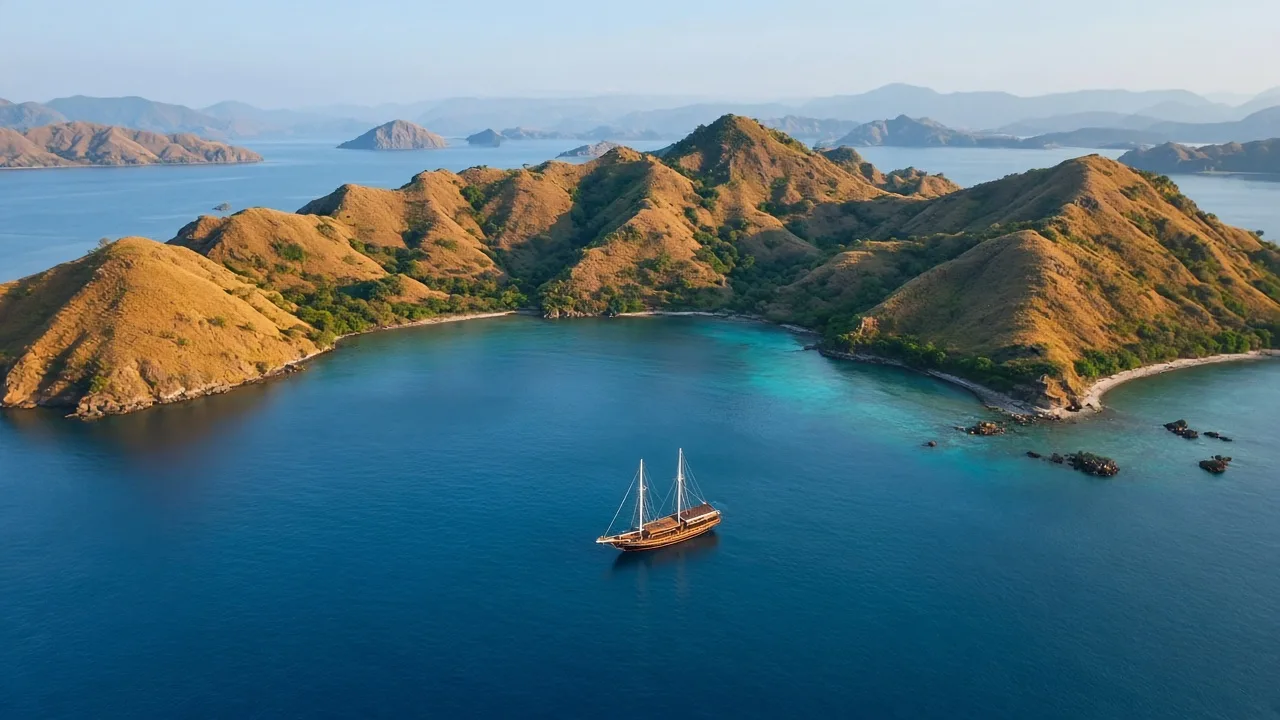
Start with the name, because the maps disagree. Piaynemo is the local spelling of the island that older charts mark as Penemu, and you will still see Pianemo, Painemo and Penemu used interchangeably by operators and government offices. All of them refer to the same place: the largest island in the Fam group, a small archipelago of karst islands and reefs in West Waigeo, roughly halfway between the Dampier Strait and the remote northwestern edge of Raja Ampat. The Fam Islands spread across several hundred square kilometres of protected water, most of it uninhabited, with one small village and a couple of homestays as the only permanent presence.
The geology is the same story written across the whole of Raja Ampat, just unusually well arranged here. These islands are old reef limestone, lifted above the sea and then dissolved by rain over hundreds of thousands of years into steep, mushroom-shaped islets with undercut bases and razor-edged summits. Where the sea flooded the low ground between them, it left a maze of shallow lagoons in colours that look artificial from above. At Piaynemo the karst happens to cluster into a compact bay, called Hidden Bay on some charts, that can be taken in from a single hilltop. That accident of arrangement is the entire reason the viewpoint exists.
Locals sometimes call Piaynemo the little Wayag, and the comparison is fair. Wayag, far to the north, offers a bigger, wilder version of the same seascape, but reaching it means a long passage that only extended itineraries make, and its viewpoints are proper scrambles up sharp rock. Piaynemo delivers perhaps 80 percent of the drama for a fraction of the effort, which is why nearly every liveaboard route through central Raja Ampat calls here, and why the island has become the most photographed place in the archipelago. If you are weighing the two, our honest advice is that they are not rivals. Do Piaynemo on any itinerary; treat Wayag as the bonus that justifies a longer trip north. Our guide to the Raja Ampat islands puts both in context.
What surprises most visitors is how much sits within ten minutes of the viewpoint jetty. The Star Lagoon, a five-pointed pool of impossible blue enclosed by karst walls, is a short ride around the corner. Melissa's Garden, one of the most celebrated dive sites in Indonesia, lies just offshore. There is a swim-through at Batu Rufus that opens into a sunlit bowl of sea fans, a seamount that gathers trevally and barracuda, and a homestay jetty where blacktip reef shark pups patrol the shallows at dusk. Piaynemo is less a single attraction than a small kingdom of them, and the boats that tie up for an hour, climb, photograph and leave are seeing a fraction of it.
It helps to know who keeps all this standing. The staircase, the decks and the jetty are built and maintained by the local community under the marine park authority, and the site fees fund exactly that: fresh timber after every wet season, patrols against illegal fishing, rubbish runs. The arrangement matters, because Piaynemo's popularity has grown roughly tenfold since the staircase replaced the old muddy scramble sometime around 2015, give or take, and the infrastructure has mostly kept pace. The village on the neighbouring island holds customary rights over these waters, a system called sasi that long predates the marine park, and the respect works both ways. Visit politely, pay what is asked, and you are participating in one of the better conservation bargains in Indonesia rather than just passing through it.
The Climb and the View
The climb begins at a wooden jetty on the island's sheltered side, where local families from the nearby village run a handful of stalls selling young coconuts, grilled snacks and carved souvenirs. From there a timber staircase switchbacks up through the forest to the summit ridge. Most sources say 300 steps and change; we have counted somewhere around 320, though we tend to lose track in the last stretch. Call it 15 minutes at an easy pace, 10 if you push, longer in the midday heat. The stairs are in good repair, with handrails most of the way and shaded rest platforms at intervals, and we have taken guests in their seventies up without drama. The two things that catch people out are humidity and footwear. This is equatorial rainforest at 90-odd percent humidity, so you will sweat regardless of fitness, and flip-flops that behave on the boat get slippery on damp timber. Proper sandals or trainers make a real difference.
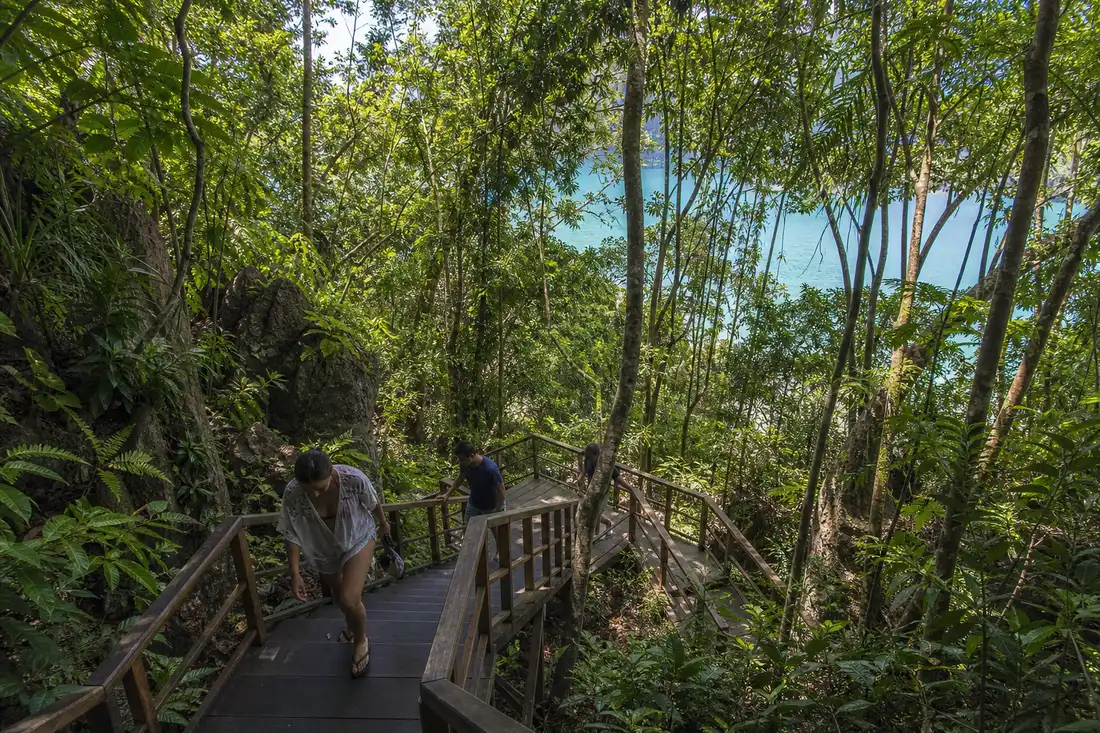
The top is a pair of wooden viewing decks built out over the ridgeline, and the reveal is genuinely abrupt. One moment you are in forest, the next the entire karst bay opens below you: a dozen or more cone-shaped islets, each wearing its skirt of undercut limestone, standing in lagoons that grade from clear jade to deep blue with the sand and coral beneath. Photographs flatten it. What the camera never quite carries is the scale, the birdsong, and the way light moves across the water as clouds pass. Early morning gives the calmest sea and the softest colour; late afternoon gives warmer light and, in most weeks, fewer people. The harsh hours either side of noon are the busiest and, for photography, usually the worst, though the water colours are at their most saturated when the sun is high, so there is a case for any hour. If a drone matters to you, ask your cruise director first; rules in the marine park have tightened over the years and the polite approach is to check locally rather than assume.
Timing is the whole game here. Day boats out of Waisai tend to arrive from mid-morning, and on a busy day in high season the decks can hold a genuine crowd for a couple of hours. Liveaboards have the run of the place at dawn and in the late afternoon, which is the single biggest practical advantage of seeing Piaynemo from a boat rather than on a day trip. Whenever the weather allows it we push the morning dive back and run the climb at around 6.40 am instead. It costs an hour of the dive schedule and it is consistently worth it: still air, soft light, the lagoons coming up out of shadow, and usually nobody else on the platform. Guests who arrive convinced they have already seen this view on Instagram are, in our experience, the ones who end up staying longest.
Telaga Bintang, the Star Lagoon
A few minutes by tender from the main jetty is Piaynemo's second act, Telaga Bintang, the Star Lagoon. It is a shallow pool enclosed by a ring of karst, and from the ridge above it takes the shape of a five-pointed star, one of those views that seems designed for an aerial photograph. Reaching the overlook is a different proposition from the main viewpoint: a short, sharp scramble up bare limestone rather than a built staircase. The rock is fossil reef, weathered into edges that will open skin on contact, so this one calls for real shoes, free hands and a bit of care. It takes perhaps five minutes and the reward is a view very nearly as famous as the main one. Guests with knee trouble or in sandals usually skip it, and that is the right call; the main deck is the essential stop, the star is the encore. Swimming inside the lagoon itself is generally discouraged to protect the shallow coral, and honestly the view is the point.
Back at sea level, save half an hour for the jetty itself. The mangrove shallows around the homestay hold juvenile blacktip reef sharks that cruise the sand in half a metre of water, utterly unbothered by observers standing on the boards above. Buy a coconut, watch the sharks, and put something into the village economy while you are at it. The stalls here are one of the few direct ways tourism money reaches Fam families, and the prices would not buy a coffee at home.
The Diving Around Piaynemo
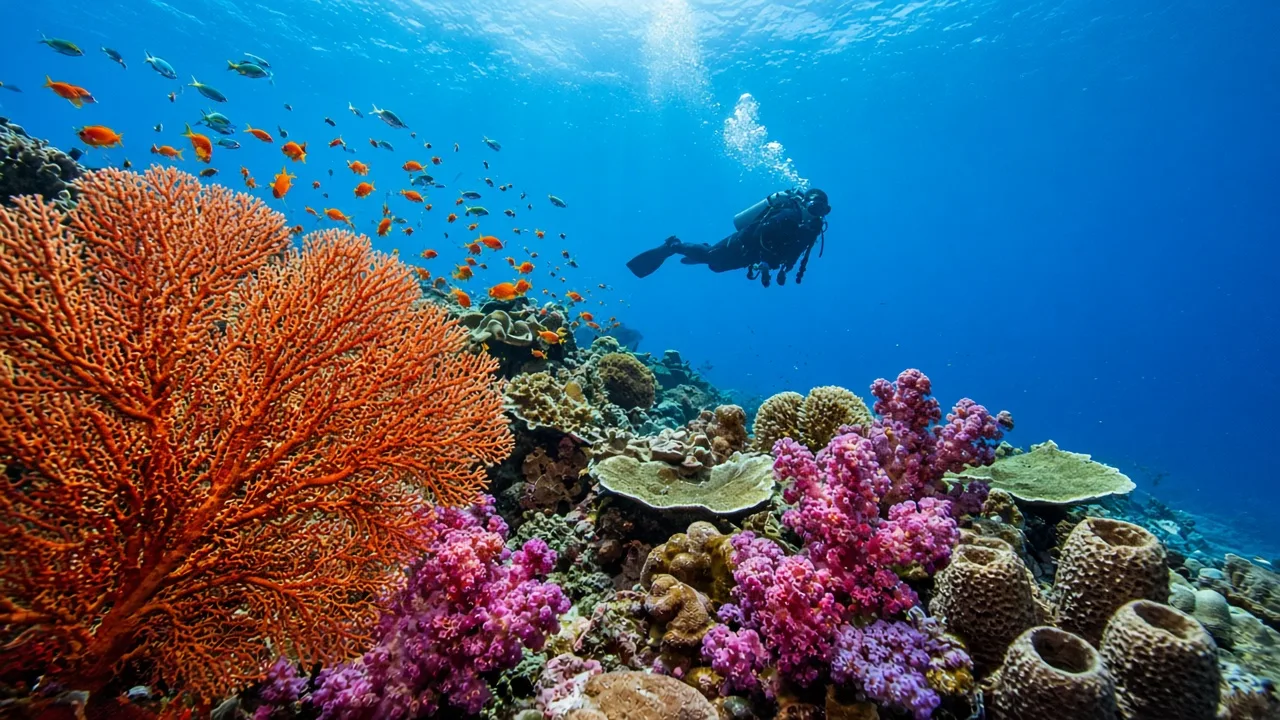
Here is the part the day-trip crowds miss entirely. The Fam Islands hold some of the healthiest hard coral on the planet, and four of the best sites in Raja Ampat sit within a few minutes' ride of the viewpoint jetty. For divers this is not a sightseeing stop with a dive bolted on. It is a full diving day, sometimes two, with the staircase slotted into a surface interval. Several of these sites appear in our rundown of the best dive sites in Raja Ampat, and Melissa's Garden alone would justify the detour west.
Melissa's Garden is the headline act, and for once the reputation undersells it. It is a broad, flat-topped reef between three islets, crowned by fields of hard coral so dense and so intact that experienced divers regularly call it the finest coral garden they have seen anywhere. The plateau sits shallow, roughly 5 to 18 metres, lit like a greenhouse on a sunny day, with anthias and damselfish rising off the acropora in clouds and fusiliers streaming through in their thousands. Look closer and the small stuff appears: pygmy seahorses on the fans at the edges, nudibranchs, and with some luck a tasselled wobbegong flattened under a table coral doing its rug impression. We wrote a whole piece on wobbegong sharks in Indonesia, and this is one of the more reliable places to meet one. Currents are usually gentle to moderate; when they run, the fish density roughly doubles.
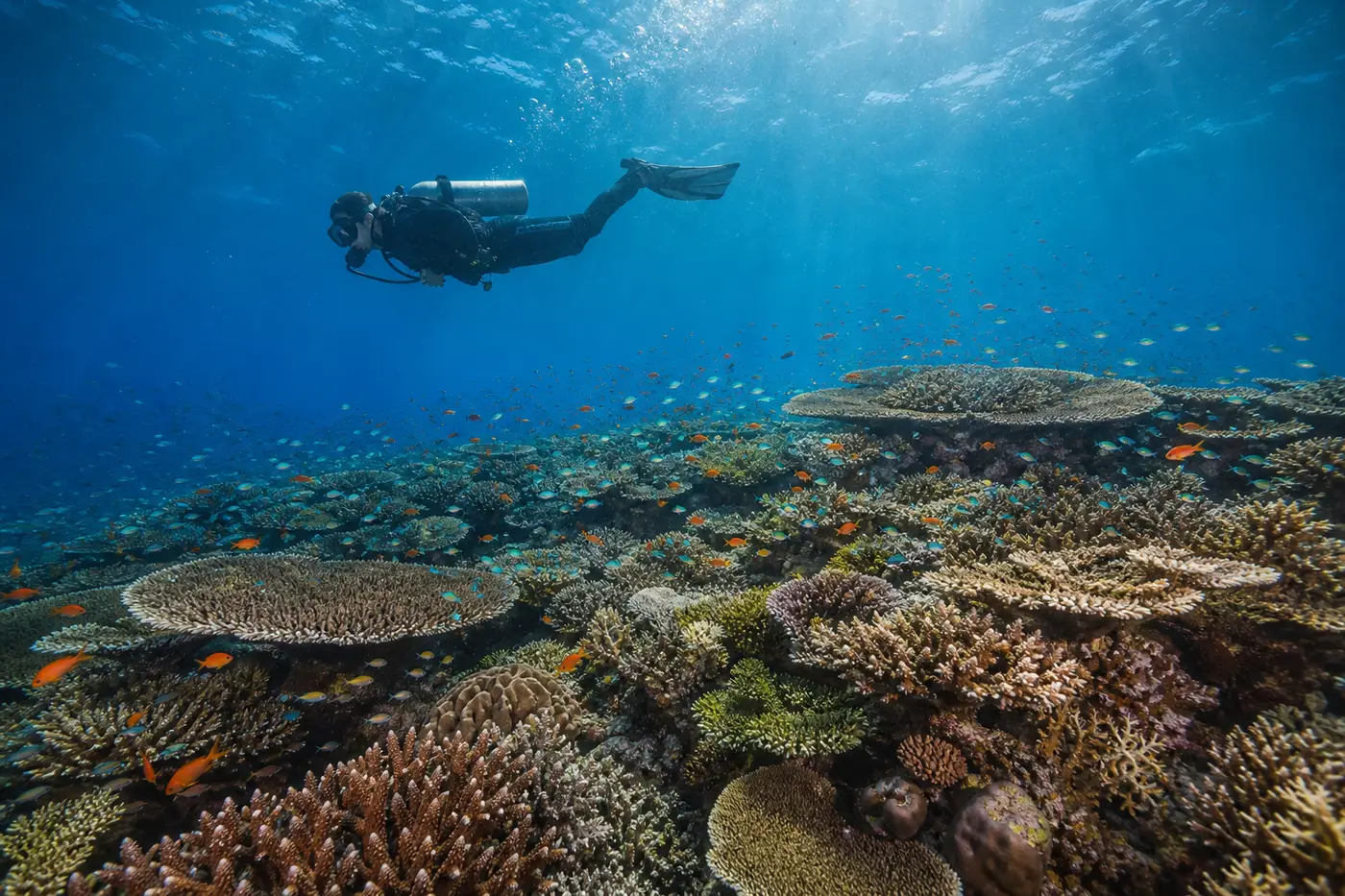
Batu Rufus is the site guests talk about at dinner. The dive works through a shallow swim-through that opens into an enclosed, sunlit bowl lined with sea fans, a natural fishbowl in the middle of a karst islet, before dropping onto the outer wall. The wall itself carries soft corals, whips and giant barrel sponges, with blacktips and the occasional whitetip passing in the blue, and the fan-covered slopes are a pygmy seahorse stronghold; on a good day a sharp-eyed guide can find three or four species on a single tank. It is relatively shallow and forgiving, which makes it one of those rare sites that works equally for new divers and for photographers who have seen everything.
My Reef, a submerged seamount a short ride away, is the fishy one. This is where the Fam group shows its open-water side: pinjalo snappers and surgeonfish in packs, barracuda stacking up in the current, giant and bluefin trevally hunting through the lot, and tuna patrolling the reef front. Keruo Channel, between Piaynemo and neighbouring Keruo island, adds a sloping reef swept by tidal current, good for drifting past sea fans with the odd turtle and reef shark for company. And the epaulette shark, the famous walking shark of eastern Indonesia, turns up on night dives and late afternoons across the group, strolling between coral heads on its fins like a small spotted salamander that never got the memo about being a shark.
Conditions, in broad strokes: water sits around 28 to 30 degrees year round, visibility usually runs 15 to 30 metres, and most sites here are diveable for open water level divers when the current is slack. The Fam Islands sit inside the marine protected area, patrolled and no-take, which is a large part of why the coral looks the way it does. Snorkellers are not an afterthought either; Melissa's Garden's shallow crown and the Batu Rufus lagoon both work beautifully from the surface, which is worth knowing if you travel with a non-diving partner, something we covered at length in our guide for non-divers on an Indonesia liveaboard.
Getting There, Fees and When to Go
There is no shortcut to the Fam Islands, which is precisely why they still look the way they do. Every route starts with a flight to Sorong, the gateway city on the Papuan mainland, reached daily from Jakarta and Makassar and, in most seasons, from Bali via connections. From Sorong you have two realistic options: board a liveaboard that sails the Fam group as part of its route, or take the two-hour public ferry to Waisai on Waigeo and arrange a day trip from there. We walked through the full journey, ferries, flights and all, in our guide on how to get to Raja Ampat.
The day-trip option deserves an honest cost warning. Piaynemo lies about 60 kilometres west of Waisai, well beyond the cheap hops of the Dampier Strait, and a speedboat charter for the round trip generally runs in the region of IDR 5,000,000 to 6,000,000 per boat, fuel being the culprit. Shared tours from the Kri and Mansuar homestay areas come in lower per person, typically IDR 3,000,000 to 4,000,000 per boat split among the group, but they spend three hours or more in transit and reach the viewpoint exactly when everyone else does. A liveaboard simply sleeps there. You wake up at anchor under the karst, climb before the day boats leave Waisai, dive Melissa's Garden mid-morning and give the afternoon to Batu Rufus and the Star Lagoon. The difference in experience is not subtle, and it is most of the reason we route our own itineraries this way rather than positioning the Fam stop as a sprint.
On fees, the 2026 picture has two layers, and it pays to know them before someone at a jetty quotes you a number. Every visitor to Raja Ampat pays the marine park environmental service fee, IDR 700,000 for international guests (roughly IDR 425,000 for Indonesians), valid for twelve months, payable online in advance or at the Waisai counters. Separate from that is the newer visitor entry ticket of IDR 1,000,000 introduced under the regency's tourism scheme, which in practice most liveaboard operators fold into their park fee handling; ask yours what their trip price already covers, because practice still varies from operator to operator. At Piaynemo itself the village collects a small site and jetty contribution per boat, usually a few hundred thousand rupiah, which reputable operators absorb. Keep some cash rupiah for the stalls regardless. There are no card machines on a karst island, and there never will be.
As for timing, the kind season for the Fam Islands is roughly October through April, when seas are calm, visibility is at its best and crossings are comfortable, which is why it matches the classic Raja Ampat liveaboard season covered in our guide to the best time to visit Raja Ampat. The middle of the year brings stronger southeasterly winds and choppier passages; trips still run in the shoulder months, but the long ride from Waisai gets noticeably less pleasant. Within any given day, we keep coming back to the same advice: be on the steps before 8 am or after 3 pm, and you will share the deck with birdsong instead of a queue.
Is Piaynemo Worth It? A Few Honest Tips
Yes, and we say that as people with every commercial reason to talk up the underwater side instead. The view from the deck is one of a handful in Indonesia that outperforms its own photographs, and the combination with world-class diving in the same anchorage makes it, for our money, the single best value stop in central Raja Ampat. A few closing pointers, earned the slightly sweaty way:
- Wear real footwear for the climb, and absolutely for the Star Lagoon scramble. The karst is fossil reef and it cuts.
- Carry water and go early. The staircase is shaded but the humidity is not negotiable.
- Give the jetty its half hour: baby blacktips in the mangrove shallows, coconuts from the stalls, and your money going straight into the village.
- Divers: insist on Melissa's Garden and Batu Rufus in the plan. An hour at the viewpoint plus two dives here beats four rushed stops elsewhere.
- Photographers: dawn for calm reflections, mid-afternoon for saturated lagoon colour. Bring a polariser; it earns its place at Piaynemo more than anywhere else in the park.
Piaynemo pairs naturally with the rest of a central Raja Ampat route: the Dampier Strait's fish factories to the east, Arborek's jetty, and for those with more days, the lagoons of Wayag to the north or the marine lakes of Misool to the south, including the stingless jellyfish lake at Lenmakana, although its jellyfish numbers have fallen and the stop is now decided trip by trip (see our 2026 jellyfish lake update). Whichever way you assemble the route, put the staircase on it. Somewhere around step 280, when the forest opens and the lagoons appear, you will understand why one hilltop in the Fam Islands ended up carrying an entire region's reputation on its back.