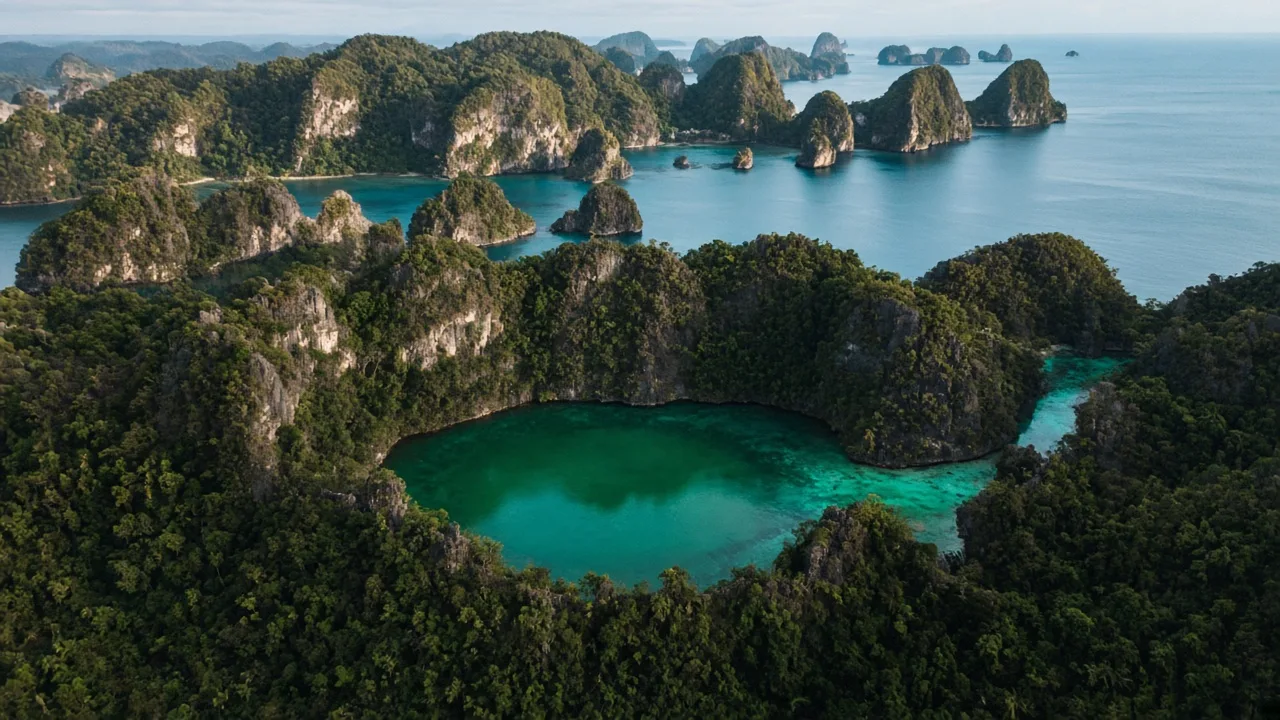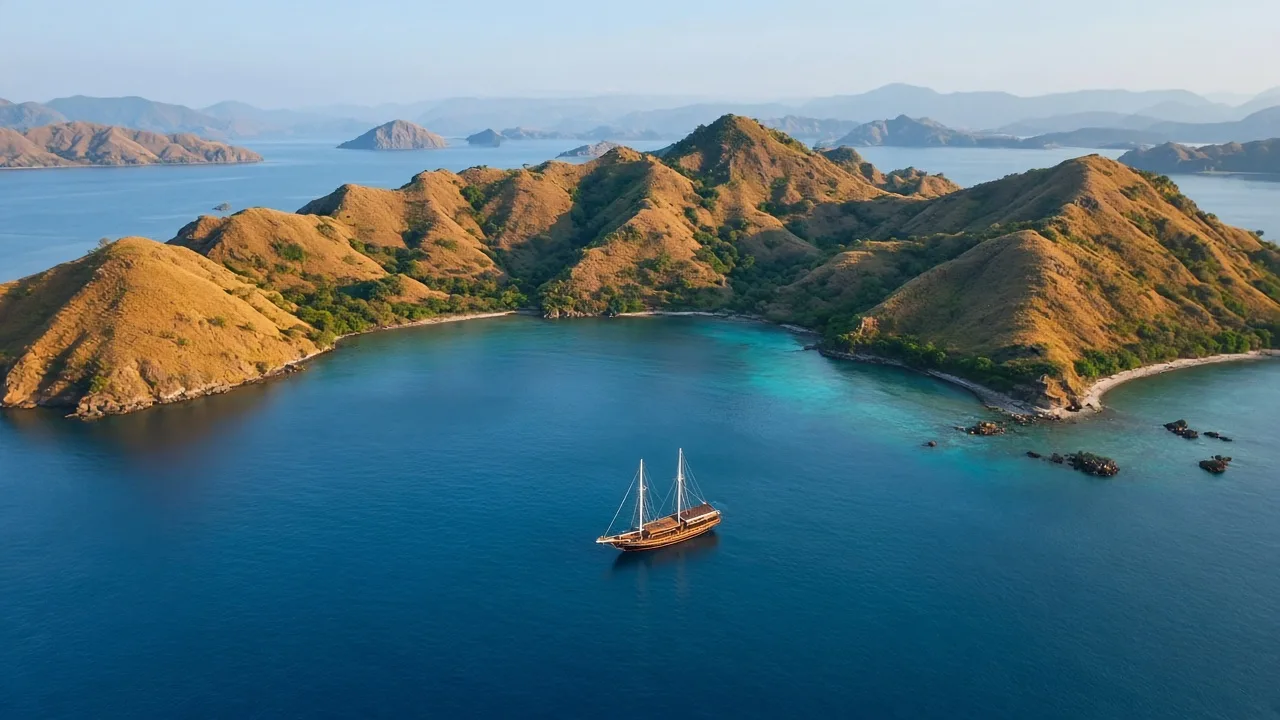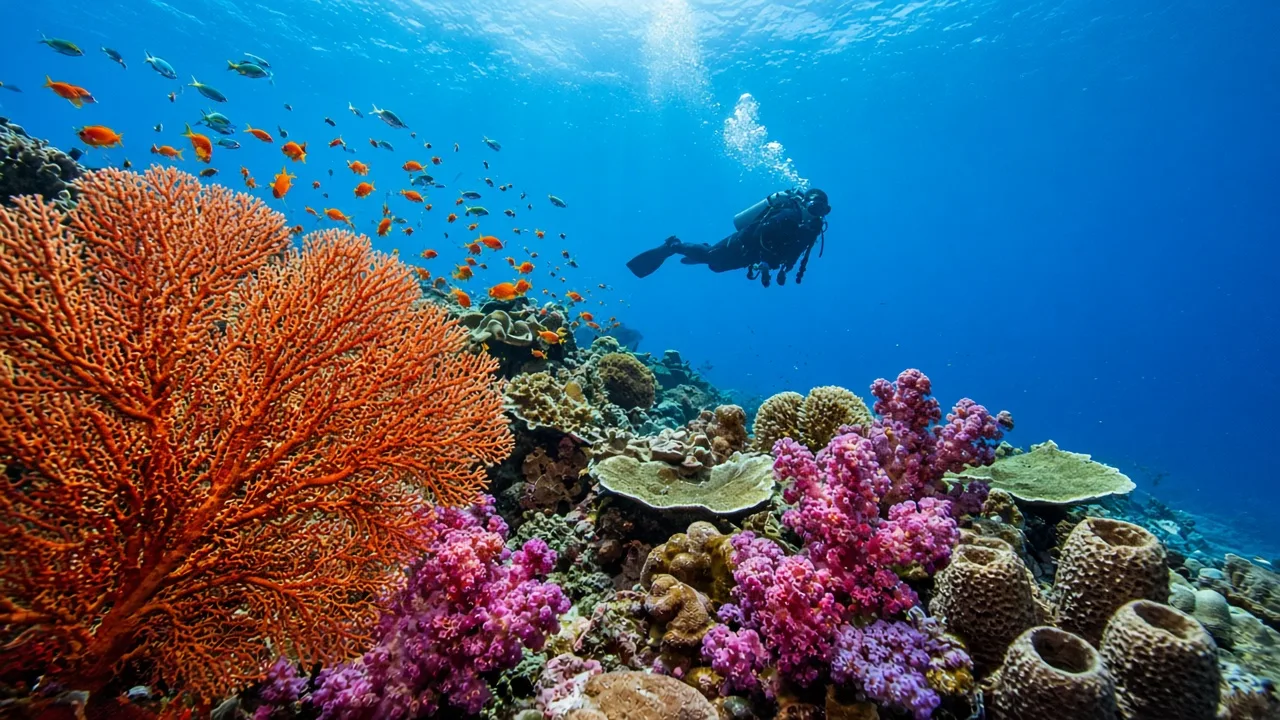
Wayag is the picture. When a magazine, a tourism board or an airline wants to show Raja Ampat in a single frame, they reach for the same aerial view: a wilderness of cone-shaped karst islands scattered across sapphire and turquoise lagoons in the far northwest of the archipelago, uninhabited, unspoiled and very nearly unreal. It is the seascape that made Raja Ampat famous, and for years the long passage north to reach it was the crowning leg of the most ambitious itineraries.
Which makes what we have to tell you all the more important, because most of what ranks in search results right now is out of date. Wayag has been closed to all visitors since July 2025, shut behind a customary-law blockade that, as of mid 2026, has not been lifted. No Raja Ampat liveaboard can legally or safely take you there at the moment, and any operator promising otherwise deserves hard questions. This guide covers the full story: what happened and why, what Wayag actually is, what visiting was like and should one day be like again, and, most usefully, the places in Raja Ampat that deliver a remarkably similar experience right now, one of which we would argue gives you 80 percent of Wayag for a tenth of the effort.
Why Wayag Is Closed in 2026
The short version: a mining dispute turned into a customary blockade, and the blockade has outlasted everyone's predictions. The longer version starts, oddly enough, with a conservation victory. In mid 2025, after widespread protests in Indonesia and a wave of international attention, the central government revoked four nickel mining permits in northern Raja Ampat, including the concession of PT Kawei Sejahtera Mining on Kawe island, less than 20 kilometres from Wayag. The legal and environmental case was strong. Mining sediment carried on the current smothers coral, and the thought of it drifting across the most photographed lagoons in Indonesia had alarmed just about everyone in the diving world.
But the revocation had a second-order effect that few outsiders saw coming. Some members of the Kawei indigenous community, who hold customary rights over Wayag and its surrounding waters and who had relied on mining-related income, responded by closing access to their ancestral territory entirely. From late July 2025, Wayag, along with Wofoh and Aljui Bay, was blockaded, in the literal, physical sense: access barred by the community that owns it under adat, the customary law that predates and in practice often outranks the marine park's paperwork. Thousands of would-be visitors have been turned back since.
A year on, the standoff continues. Indonesian regional media marked the first anniversary of the blockade in July 2026 with pointed criticism of the local government, describing negotiations as stalled, with no firm decisions and no concrete steps to restore access. There have been reconciliation efforts and periodic rumours of reopening, and we would genuinely love to report progress, but as of this writing there is no confirmed date. Anyone selling you a Wayag visit today is selling you a plan that may dissolve on arrival, or worse, a trip into a closure that the local community enforces in person. Respecting the blockade is not just prudent; it is the only defensible position for an industry that depends on the goodwill of Raja Ampat's customary owners.
For travellers, the closure arrived with almost no warning. Guests with northern itineraries booked for the 2025-26 season found Wayag quietly struck from route maps, sometimes weeks before departure, sometimes after boarding. The better operators rerouted openly and early, substituting extra days in the Fam Islands or Aljui Bay's neighbours and saying plainly why; a few less scrupulous listings kept Wayag in their marketing well into 2026, presumably on the theory that guests would forgive the omission once surrounded by everything else Raja Ampat offers. We think that theory insults the guest. If a trip is sold on a place, the seller should know whether the place can be visited, and the state of Wayag has not been a secret at any point. Ask the direct question before you book any northern route this year: does this itinerary still advertise Wayag, and what happens to those days now? The answer tells you a great deal about the operator, whatever it tells you about the islands.
It is worth being clear about what the closure is not. It is not a safety crisis, it does not affect the rest of Raja Ampat, and it has nothing to do with the reefs themselves. The Dampier Strait, the Fam Islands, Misool and everything in between remain fully open, fully protected and diving beautifully. The closure affects the far northwest corner only. Raja Ampat in 2026 is still, in most respects, the best liveaboard destination on earth; it has simply lost its most famous photo stop for the time being.
What Wayag Actually Is
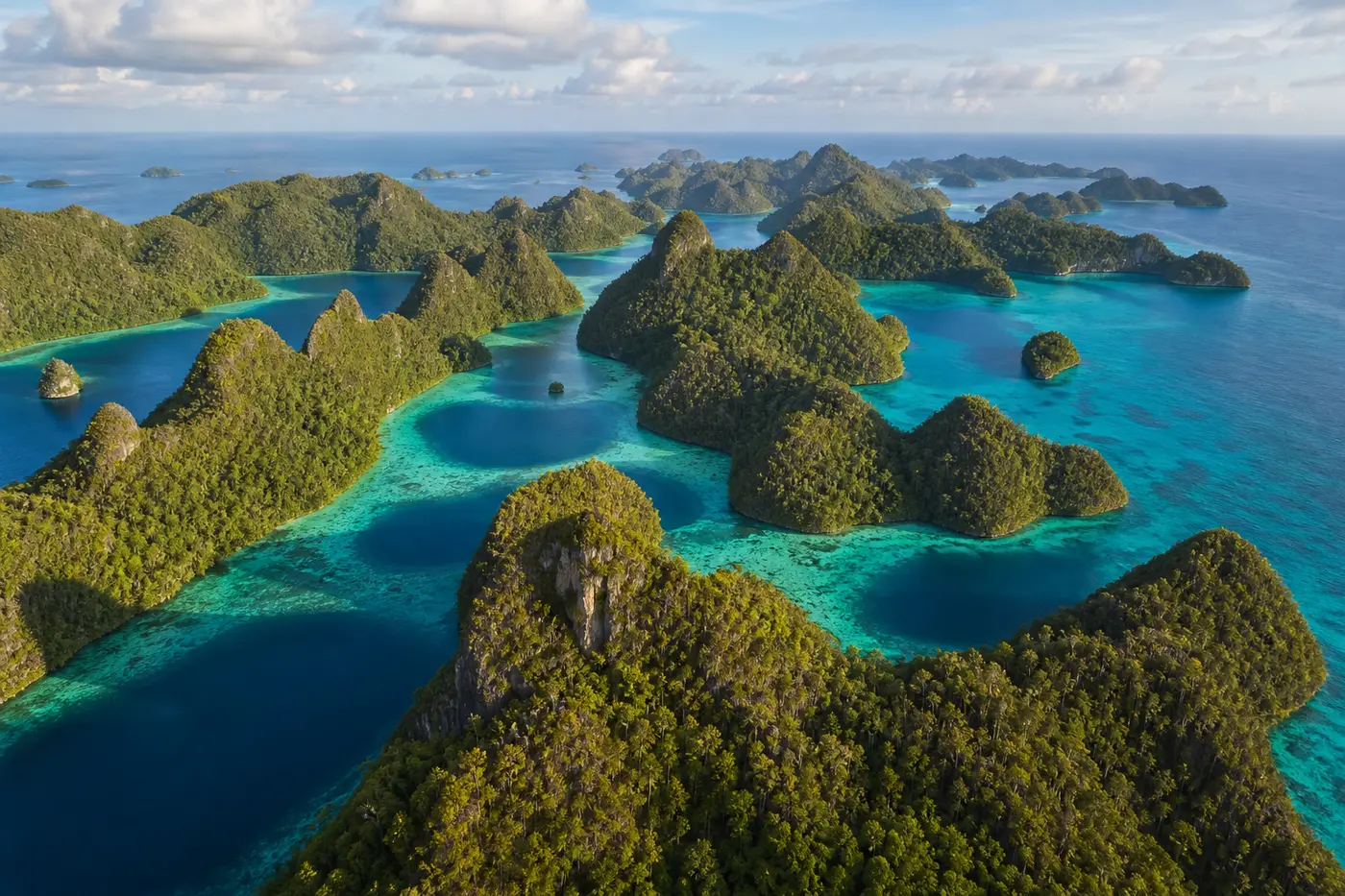
Wayag is a cluster of several dozen uninhabited limestone islands northwest of Waigeo, inside a marine protected area of roughly 155,000 hectares that also shelters some of the most important reefs in northern Raja Ampat. The islands are classic Raja Ampat karst taken to its extreme: steep cones and ridges of fossil reef, undercut at the waterline, wearing dense caps of jungle, standing in a maze of lagoons and channels that runs the full palette from pale jade over sand to deep blue in the passes. Nobody lives there. There are no homestays, no resorts, no jetty stalls, and that emptiness is a large part of the spell.
The geology is worth a moment, because it explains both the beauty and the bruises on anyone who climbs here. These cones are ancient reef limestone, laid down under the sea, lifted by the slow collision of the Australian and Pacific plates, and then carved for hundreds of thousands of years by tropical rain, which dissolves carbonate rock into exactly the sharp, fluted, knife-edged surfaces that make the scramble to the summits so memorable. The same process undercuts every island at the waterline, giving the cones their distinctive mushroom profile, and floods the low ground between them with the lagoons that supply the colour. It is the same story as Piaynemo, Kabui Bay, Misool and the karst of southern Thailand and Palawan, but nowhere else arranges the results across quite such a sweep of empty water. Geologists call it drowned tower karst; guests at the top of Wayag 1 tend to call it something shorter and less printable.
The scale surprises people who know it only from photographs. The Wayag group sprawls across kilometres of water, and a boat can spend half a day nosing through its channels without repeating itself. Its beaches are nesting grounds for green turtles. Its lagoons have long served as a nursery for blacktip reef sharks, which for years gathered in the shallows around the ranger post in water barely knee deep, one of those small spectacles that guests remembered as vividly as the famous view. Manta rays cruise the outer reefs, and the surrounding no-take zone means the fish life inside the lagoons is thick even by Raja Ampat standards.
The view everyone knows comes from the twin summits usually called Wayag 1 and Wayag 2, and honesty compels us to say the famous photograph is earned rather than given. There is no staircase here. The ascent is a proper scramble up bare, sharp karst, hands and feet both, roughly 30 to 45 minutes depending on conditions and nerve, and the fossil-reef limestone cuts skin on contact. Sturdy shoes are not a suggestion; some guides carry gloves. From the top, the reward is the full 360-degree sweep of cones and lagoons receding to the horizon, a view that makes even seasoned crew go quiet. It is, or was, the most spectacular hour in Raja Ampat, and the pictures never quite did it justice.
Underwater, Wayag never had the same fame as the Dampier Strait or Misool, which says more about Raja Ampat's standards than about the reefs. The outer walls and channel mouths carry healthy hard coral and the dense fish life you would expect of a long-standing no-take zone, with reef mantas working the cleaning stations on the seaward side and turtles everywhere the seagrass allows. Snorkelling inside the lagoons was, in some ways, the underrated highlight: warm, glassy, shallow water over coral bommies, with those juvenile blacktips circling in ankle-deep sand flats by the ranger post, an encounter that converted more than one confirmed non-swimmer in our experience. The area functioned as a nursery in the fullest sense, for sharks, for turtles, for reef fish, which is precisely why the surrounding waters were designated a marine protected area in the first place and why the customary owners guarded access long before any blockade made headlines.
Getting there was always an expedition. Wayag lies more than 150 kilometres from Waisai, a round trip of over 300 kilometres of open water. A chartered speedboat day trip meant six to eight hours of travel for a few hours on site, at a cost that commonly ran between IDR 8,000,000 and 15,000,000 per boat before the local access fee (IDR 1,000,000 per boat) and guide fee (roughly IDR 400,000) were added. There is no accommodation, so overnighting meant camping arrangements with local permission. In practice, the civilised way to see Wayag was always by liveaboard: sleep through the passage north, wake up inside the lagoons, climb early, and give the day to the sharks, the beaches and the channels. That is exactly how our own northern routes treated it, and how they will treat it again when the blockade lifts.
Where to Get the Wayag Experience Right Now
Here is the practical heart of this article. The karst-and-lagoon seascape that Wayag is famous for is not unique to Wayag; it is the signature landscape of the whole region, and two accessible places deliver versions of it good enough that plenty of guests, shown their own photographs a month later, struggle to say which island group they are looking at.
The first and best is Piaynemo, in the Fam Islands, roughly 60 kilometres west of Waisai and open, thriving and firmly on nearly every central Raja Ampat itinerary, ours included. Locals call it the little Wayag, and the nickname is accurate in every direction: the same cones, the same lagoons, the same impossible colours, arranged into a compact bay you take in from a proper wooden viewing deck at the top of roughly 300 built steps rather than a barehanded scramble. Ten minutes away is Telaga Bintang, a star-shaped lagoon with its own short climb. Around the corner is Melissa's Garden, one of the finest hard coral dive sites in Indonesia, plus the swim-through fishbowl of Batu Rufus and the fishy seamount of My Reef. We published a complete guide to Piaynemo covering the climb, the diving and the fees, and we would point every 2026 traveller mourning Wayag there first. The honest comparison: Wayag is bigger, wilder and emptier; Piaynemo is 80 percent of the spectacle with world-class diving attached and no six-hour crossing.
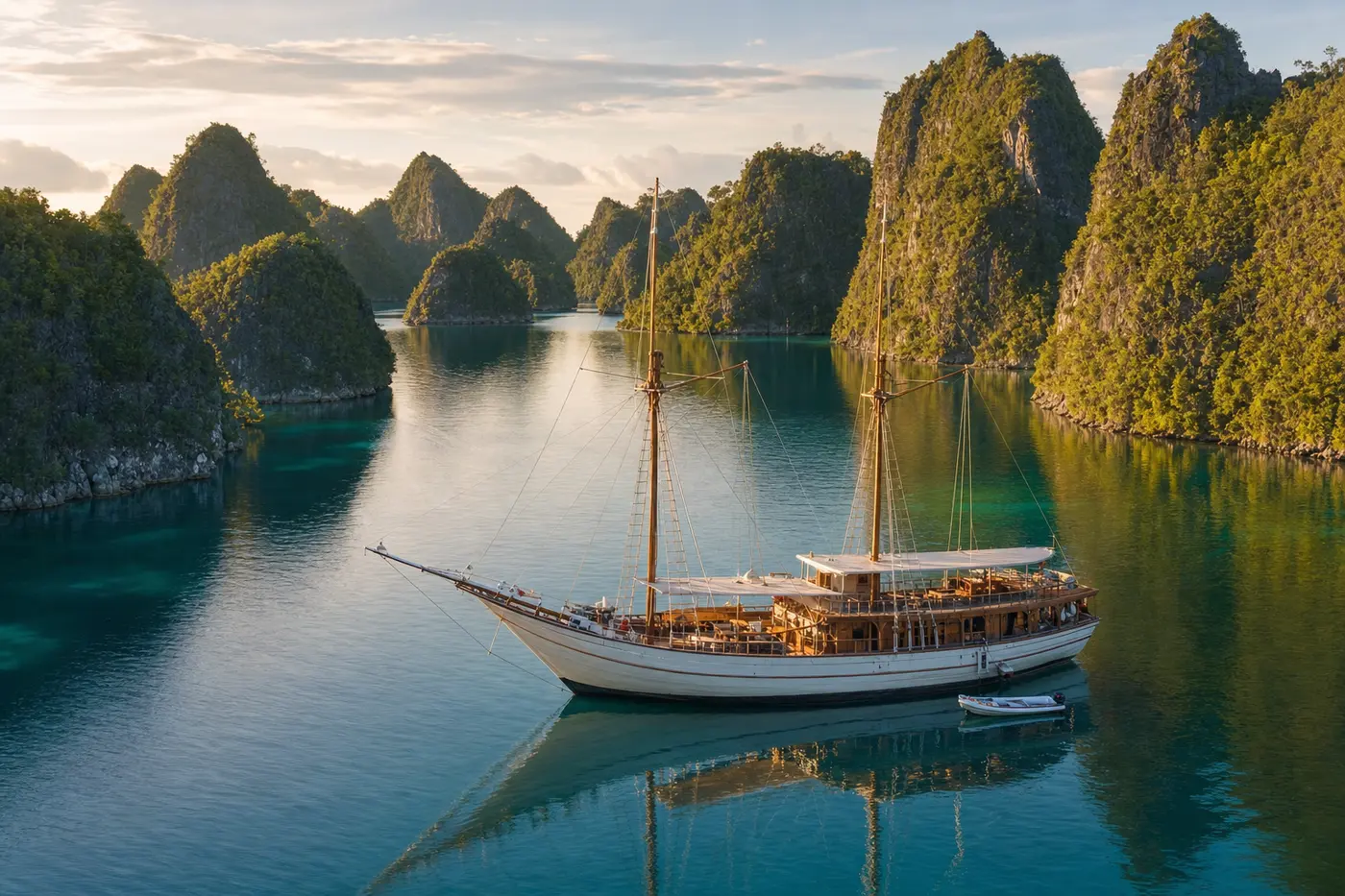
The second is Kabui Bay, only about 30 kilometres from Waisai, where the eastern arm of the bay holds a cluster of undercut karst cones draped in orchids, close to the celebrated Kabui Passage, the narrow river-like channel between Waigeo and Gam that divers drift through on the tide. Kabui lacks a single grand summit view, and it will not fool a Wayag veteran from the air, but at water level, gliding between the islets by tender or kayak in the late afternoon, the effect is much the same and the access could not be easier. Many itineraries thread it in as a sunset cruise after a day of diving the Dampier Strait, which is exactly how it shows best.
The substitution works better than it sounds on paper. Guests who booked specifically for the Wayag photograph, and who took the closure news badly when it broke between booking and boarding, tend to arrive braced for a lesser trip. What they get instead is a dawn climb at Piaynemo, an afternoon in the Star Lagoon and a sunset run through Kabui Bay with the drone up, and the disappointment usually evaporates somewhere around day two. We have seen that arc repeat often enough to state it with some confidence: the closure costs you one photograph, not the experience.
And if what draws you to Wayag is less the viewpoint than the wilderness, the emptiness and the sense of an untouched corner of the world, consider pointing the bow the other way entirely. Misool, in the far south, offers its own labyrinth of karst lagoons, rock art older than the pyramids, the jellyfish lake at Lenmakana, whose stingless population is shrinking, and arguably the richest soft coral reefs on the planet, all open, all protected, and all reachable on a southern itinerary in the October to April season.
Will Wayag Reopen, and How to Plan Around It
The honest answer is that nobody can promise a date, and we distrust anyone who does. The dispute is fundamentally about customary rights and compensation, not tourism policy, which means it will end when the Kawei community and the authorities reach terms, not when the marine park or the operators want it to. The ingredients for a resolution exist. The community has no quarrel with visitors as such, the local economy is losing badly from the standoff, regional media pressure on the government to settle it is growing, and reconciliation talks have been reported on and off through 2026. Standoffs of this kind in Indonesia usually do resolve, in our experience, though rarely on anyone's forecast schedule. We would not be astonished to see Wayag reopen within the coming year; we would also not book a flight around the assumption.
So how do you plan a northern Raja Ampat trip in this climate? A few grounded suggestions:
- Book the itinerary for what is open now, Dampier Strait, the Fam Islands and Piaynemo, Kabui Bay, and treat any Wayag reopening as a windfall rather than a promise.
- Ask your operator directly how they will handle it if access changes either way. A good one will have an answer ready; we adjust routes season by season and say so in writing.
- Check current status close to departure through your operator or the official Raja Ampat channels, rather than trusting blog posts and videos from before mid 2025, of which the internet holds an enormous, confidently wrong supply.
- If Wayag itself is non-negotiable for you, wait. It is not going anywhere. The karst has stood for a couple of million years and will comfortably outlast the negotiations.
A note on the information ecosystem, because it genuinely matters here. Wayag ranks among the most photographed places in Indonesia, so the internet is saturated with guides, reels and listicles describing a visit as if nothing had changed, many of them republished or algorithmically refreshed with 2026 dates on top of 2019 information. We have seen full itinerary pages, complete with booking buttons, for Wayag day trips that cannot currently run. Trust recency signals with care: a date stamp is not a fact check. The sources worth weighting are the operators who sail the region weekly, the official Raja Ampat channels, and Indonesian regional press, which has covered the blockade's anniversary in detail while most English-language content slept through it. When those three agree that boats are landing at Wayag again, believe it; until then, assume the picture in this article is the current one.
The standard Raja Ampat paperwork still applies everywhere else and is unaffected by the closure: the marine park environmental service fee of IDR 700,000 for international visitors, valid twelve months, plus the regency's visitor entry ticket of IDR 1,000,000, with registration through the official SIPARI system that most liveaboard operators handle on your behalf. Fee structures have shifted more than once in recent years, so treat any number, including these, as worth confirming when you book. The season logic is unchanged too: October through April brings the calm seas and peak visibility, as covered in our guide to the best time to visit Raja Ampat, and the crossings that make northern routes possible are far more comfortable inside that window.
The Bigger Picture
There is a way of reading the Wayag story that is, strangely, encouraging. The mining permits were revoked because enough people, Indonesian and foreign, insisted that these reefs matter more than nickel. The blockade exists because the customary owners of these islands hold real power over their own territory, power that has protected Raja Ampat for generations through sasi and adat long before the marine park existed. Both facts cut against tourism in the short term, and both are exactly why Raja Ampat still looks the way it does. A region where local communities could not close their waters would, in the long run, be a region with much less worth visiting.
Our position is simple: we respect the closure without reservation, we will return the moment Wayag's owners welcome visitors back, and in the meantime we will keep showing guests the versions of that seascape which remain gloriously open, the dawn deck at Piaynemo, the orchid-covered cones of Kabui Bay, the lagoons of Misool. Wayag earned its place as the face of Raja Ampat, but it was never the whole of it, and the archipelago has never needed one photograph to justify the journey. Twenty metres under the Dampier Strait, in the thickest fish soup on earth, you will not be thinking about a viewpoint.