Indonesia is the world's macro capital. The reason is straightforward: the archipelago sits in the heart of the Coral Triangle, the small patch of tropical Pacific that holds more marine biodiversity than anywhere else on the planet, and the macro photographers and critter hunters of the last forty years have built a global reputation around half a dozen Indonesian sites in particular. If you have ever watched a documentary featuring mimic octopus, hairy frogfish, blue-ringed octopus or Bargibanti pygmy seahorse, the footage was almost certainly shot here. Our boats run macro itineraries every season, and the species lists we hand to first-time guests at the start of a trip would be science fiction in most other parts of the world. For the wider context on what makes scuba diving in Indonesia singular, the country guide covers everything from beginner certification to the big-animal regions. This piece is the operator-side answer to a more specific question: where to go for macro, when, and what to expect on the bottom.
The first thing worth saying is that macro diving in Indonesia is not one experience. It is at least four. Lembeh Strait in North Sulawesi is the world's most famous muck-diving destination, a roughly thirteen-kilometre channel of black volcanic sand where the rare and the bizarre come to feed. Ambon Bay in Maluku is the second world capital of muck, less polished, more remote, and home to species still being formally described. Bali offers a different style: black-sand sites at Tulamben and Seraya alongside coral sites at Padangbai and Menjangan, easy to reach from a major international airport, and very forgiving for new macro photographers. And Misool in southern Raja Ampat, where most divers go for the wide-angle, conceals macro that quietly outscores anywhere else on the trip. We run dedicated macro weeks on Indonesian liveaboards when the season fits, and we slip macro days into our wide-angle schedules in Raja Ampat the rest of the year. The right destination depends on what you are after, and the choice is what most of this article walks through.
If you only ever read this far, the headline answer is this. For the absolute macro pilgrimage, choose Lembeh and Ambon together on a Banda Sea route and travel between July and October when the seas are calm and the visibility holds. For a softer first experience that mixes macro with reef diving, choose Tulamben in Bali on a land-based holiday or as the start of a longer Indonesian trip. For wide-angle divers who want a serious macro day, choose Misool inside a Raja Ampat liveaboard from January to March. We will get to the regions, the species, the seasons and the gear in the rest of the piece, but those three combinations cover roughly 80 per cent of the macro trips we book in a typical year.
What "macro diving" actually means in Indonesia
Macro is one of those words that everyone uses and almost no one defines. The rough industry definition is "diving where the subjects of interest are smaller than your hand", but inside Indonesia three subcategories sit under that umbrella. Knowing which one you are signing up for matters, because the dive sites and the dive conduct change between them.
The first is muck diving. Muck is the practice of diving on featureless black volcanic sand, away from coral reefs, looking for unusual life. The bottom looks dead at a glance: an empty plain of grey sand with the occasional bottle, beer can or rope. The point is that the species that live in this environment have evolved spectacular camouflage, mimicry and behaviour to survive on a featureless landscape, and once your eye learns to see them, the same patch of sand reveals one rarity after another. Lembeh and Ambon are the two undisputed muck capitals. Dauin in the southern Philippines is the only other Asian site that competes seriously, but the Indonesian sites are deeper, denser and more reliable for the rarest species. The diving itself is slow. A typical Lembeh dive runs 60 to 75 minutes, often shallower than 18 metres, and the dive plan is closer to a slow walk than a swim. Buoyancy matters more than usual, because hovering centimetres off black sand without kicking it up is half the skill.
The second is critter diving. Critter diving is muck-adjacent but it happens on coral or sponge substrates rather than bare sand. The signature species (frogfish, ghostpipefish, nudibranchs, pygmy seahorses) are the same, but you find them on healthy reef instead of black sand. Bali, Wakatobi, Bunaken and Misool are the strongest critter destinations. Visibility is usually better than on muck (15 to 25 metres versus 5 to 12 metres), and the diving feels closer to a regular reef dive than a muck dive does. For a primer on the wider underwater photography options in Indonesia, the photographer's guide pairs well with this article.
The third is small wide-angle, sometimes called fish-eye macro: shooting larger subjects (mantis shrimp, mandarinfish, cuttlefish, octopus) at very close working distance with a wide-angle wet lens. This is more an underwater photography technique than a destination, but the operators that specialise in it (Lembeh resorts, the Raja Ampat photo boats, Wakatobi) often advertise this as their offering. If you bring a Sony A7 and a 16 to 35 mm wide with a flat-port wet diopter, you are doing this style of work.
Most Indonesian macro itineraries blend two or all three. A two-week Banda Sea liveaboard might give you a Lembeh muck week and an Ambon Bay muck week. A Bali land-based week might give you Tulamben critter mornings, Seraya muck afternoons, and a Padangbai mandarinfish dusk dive. A Raja Ampat liveaboard might surprise you with a serious Misool macro day in the middle of an otherwise wide-angle itinerary.
Why Indonesia leads the world for macro
Three things make Indonesia uniquely strong for macro, and one of them is rarely talked about.
The first is biology. The Coral Triangle, the rough triangle bounded by the Philippines, Indonesia and the Solomon Islands, contains roughly 76 per cent of the world's coral species, more than 2,000 reef fish species, and species counts for nudibranchs, octopuses and frogfish that exceed any other tropical region by a wide margin. The Coral Triangle deep-dive covers the geology and the biogeography in more detail. Within that triangle, Indonesia covers the largest single area and the highest known biodiversity. The numbers are partly an artefact of where survey effort has concentrated, but the underlying fact (that the central Indonesia archipelago is genuinely the most species-rich tropical marine area on Earth) is well established. For macro, this matters because rarities are more likely. If you have a one in five thousand chance of seeing a specific nudibranch on any given Indonesian dive, you have a one in fifty thousand chance on a comparable Caribbean dive. It compounds.
The second is dive site density. Lembeh Strait contains roughly forty named dive sites in fewer than twelve kilometres of channel. Ambon Bay holds twenty-five sites in a similar footprint. Tulamben has eight major sites within a two-kilometre stretch of shore. This density is what makes a week-long muck holiday work: you can dive five sites in a day with no transit, return to a different five the next day, and burn through twenty unique sites in four days without ever leaving the same hotel. No other tropical region in the world matches this kind of density for muck and critter diving.
The third, and the under-recognised one, is the dive guide culture. Indonesian critter guides, especially the Lembeh and Ambon scouts, are the best in the world at finding small marine life. We have hosted guides who can spot a five-millimetre Pontohi pygmy seahorse on a Halimeda algae blade from a distance of two metres, in low visibility, against a current. The skill is partly local familiarity, since most senior guides have been working the same sites for fifteen to twenty years, and partly the product of a competitive macro guiding culture in North Sulawesi and Maluku that rewards finding rare species. A first-time macro diver in Indonesia will see roughly four times more rarities than a comparably skilled diver doing the same trip on their own. The guide is the multiplier, and choosing the right operator matters more on a macro trip than on almost any other style of diving.
The premier macro destinations
Six regions in Indonesia produce the macro photography that the global community recognises. We will go through each of them in roughly the order most divers should consider them, plus an honourable mention.
1. Lembeh Strait, North Sulawesi: the world capital of muck
Lembeh is where macro photography as a recognisable genre was born in the 1990s. The strait sits between mainland North Sulawesi and Lembeh Island, and a quick look at a chart explains why it works. The channel is roughly thirteen kilometres long, narrow, and protected from open-ocean swell, which produces calm water year-round. The bottom alternates between black volcanic sand from the nearby Tangkoko volcano, broken artificial structures (old jetties, fishing-net lines, abandoned boat hulls) and patches of seagrass. That combination of nutrient-rich black sand, structure, and shelter is what creates the muck diversity.
The species list is what people come for. The full Lembeh Strait diving guide goes through every site individually; for the macro shortlist, on a representative week we expect to see ornate, robust and halimeda ghostpipefish, hairy and giant frogfish at multiple sites, mimic and wonderpus octopus, blue-ringed octopus, flamboyant cuttlefish, mandarinfish at dusk, four to five rhinopias species across the season, harlequin shrimp, hairy squat lobster, bobbit worms (peeking out of their burrows), and roughly thirty to forty distinct nudibranch species. The rare ones (Halimeda crab carrying its garden, the wandering cowry, the ladybug amphipod) appear less predictably, but a careful guide and a slow pace turn them up across most weeks.
Visibility is moderate. Five to twelve metres is normal, occasionally fifteen on the cleaner sites near the channel mouth. Water temperature stays between 26 and 29 degrees Celsius year-round. The best window is May through October, when the dry season produces calm crossings and the cleanest water. Lembeh is land-based for most divers (resorts on the Lembeh side of the strait), but it slots beautifully into a Banda Sea liveaboard route as either the start or the end of a longer itinerary.
2. Ambon Bay, Maluku: the second world capital, with the rarities
Ambon is the city that most international divers fly into for the Banda Sea. The diving here, in the bay around the city itself, is a quietly extraordinary muck destination that often gets passed over as people transit through to the more famous Banda Islands. That is a mistake. Ambon Bay is to muck what Misool is to wide-angle: the connoisseur's choice. The species list overlaps with Lembeh, but Ambon produces rarer encounters per dive on average, and several species (the psychedelic frogfish Histiophryne psychedelica, described from this bay in 2009) are essentially Ambon-only.
The full Ambon diving guide covers the bay in detail. Three or four reliable muck sites in the bay, plus a handful of wall and slope sites on the outside, produce a week of diving that almost no other place on Earth can match for unusual species. The visibility runs slightly worse than Lembeh (4 to 10 metres in the bay sites), the water is the same temperature, and the dive conduct is identical: slow, deliberate, often shallow. We typically include two to three Ambon Bay days at the start of Banda Sea liveaboard itineraries, and dedicated Ambon-only weeks are an option in March-April and September-November.
3. Bali: the most accessible macro destination in Indonesia
Bali is where most macro photographers do their first Indonesian muck week, and the reasons are practical. The island has a major international airport, the dive infrastructure is excellent, the food is varied, and a non-diving partner has plenty to do. The macro diving itself is concentrated on the north and east coasts, and three areas matter.
Tulamben on the northeast coast is the best known. The USAT Liberty wreck is the marquee site (the biggest wreck dive in Bali) but the macro work happens on the dropping black sand reef just south of the wreck, on a site called Coral Garden, and at the neighbouring sites of Seraya Secrets and Drop Off. We see the full Indonesian muck list here in slightly lower densities than Lembeh: frogfish, ghostpipefish, mandarinfish, nudibranchs, mantis shrimp, and the sparkling pygmy seahorse colonies on the deeper Liberty wreck stretch. Padangbai, on the southeast coast, is where you go for blue-ringed octopus and the famous Padangbai mandarinfish dusk dive at Blue Lagoon. Menjangan, in the northwest national park, offers cleaner-water critter diving on coral-encrusted walls, with frogfish on sponges and the occasional pygmy seahorse colony.
The right Bali macro week is usually a base in Tulamben for four nights, a day-trip or two-night stop in Padangbai, and an optional Menjangan extension. The best dive sites in Bali guide covers each site in detail. Visibility is 15 to 25 metres on most sites, water temperature 26 to 28 degrees, and the season runs year-round with April to November the consistently calmest window.
4. Misool, southern Raja Ampat: macro inside the wide-angle
Misool is famous for soft coral walls, manta cleaning stations, and bird-of-paradise viewing. Most divers spend their week shooting wide-angle. What we tell our macro photographers is to bring two camera setups, or to dedicate one specific dive day to the close-focus work, because the macro on the Misool walls and slopes is genuinely world-class and far more relaxed than Lembeh-style muck.
The Misool macro is built around two species in particular. The Bargibanti pygmy seahorse, the most famous of the genus, lives on Muricella sea fans on Misool's deeper walls, and a careful Misool guide can usually find three or four colonies in a week. The Denise pygmy seahorse, smaller and harder to spot, lives on a different fan species and turns up on the same walls. Beyond the pygmies, Misool delivers serious wobbegong shark macro (resting on coral, often within a hand's width of your dome port), tasselled wobbegong egg cases tucked into crevices, and the full nudibranch range. The diving conditions are relaxed (visibility 25 to 35 metres, water 27 to 29 degrees, mild current most days), which makes Misool the easiest place in Indonesia to learn macro photography on healthy reef. We schedule Misool inside our Raja Ampat liveaboard itineraries from October through April; the wider Raja Ampat destination guide covers the surrounding wide-angle highlights for divers planning a longer trip.
5. Wakatobi, Southeast Sulawesi: wall macro and pygmy seahorses
Wakatobi is the easiest of the world-class Indonesian macro destinations to recommend to a first-timer with photography ambitions. The sites are walls and slopes (not muck), the visibility is consistently 30+ metres, the water is calm, and the resort and dive operation are unusually professional. The macro highlights are the pygmy seahorse colonies (Wakatobi has both Bargibanti and Denise on accessible reef walls), various ghostpipefish on coral, frogfish on sponges, and a strong nudibranch list. The trade-off compared with Lembeh and Ambon is that the rarest muck species (psychedelic frogfish, hairy octopus, Rhinopias eschmeyeri) are largely absent; the trade-off going the other way is that Wakatobi is gentler, prettier and more comfortable. The full Wakatobi guide covers the resort and the season.
6. Bunaken, North Sulawesi: a quiet alternative to Lembeh
Bunaken National Marine Park sits an hour's transfer from the same airport that serves Lembeh, and many photographers combine the two on a single trip. Bunaken itself is a wall-and-slope destination, very different in character from Lembeh's muck. The macro is strong but not on the muck level: pygmy seahorse colonies, ghostpipefish, mantis shrimp, occasional rhinopias, and a strong nudibranch list. We sometimes recommend Bunaken as a softer, less-crowded counterpoint to a Lembeh week, especially for divers who feel that pure muck diving is too taxing on the eyes after seven days.
Honourable mention: Cenderawasih Bay and Halmahera
For divers who want to combine macro with the rarest big-animal encounters, the eastern routes deserve a mention. Cenderawasih Bay in West Papua is the world's most reliable destination for whale shark interactions with bagan fishing platforms, but the muck diving in the same bay is a quieter side benefit that few visitors spend time on. Halmahera in North Maluku, similarly, offers a mix of wide-angle wall diving and unusual macro that the Halmahera-endemic walking shark (Hemiscyllium halmahera) and a small number of dedicated muck sites quietly support. Both are remote, both are usually accessed by liveaboard, and both reward divers who already have one or two of the more famous Indonesian macro destinations under their weight belt.
The macro species that draw the global community
If you are coming to Indonesia for macro, you are coming for specific species. We will not list everything (that would run several thousand species and be useless as a planning aid), but the eight families below cover roughly 90 per cent of the conversation we have with first-time macro guests on our boats.
Pygmy seahorses
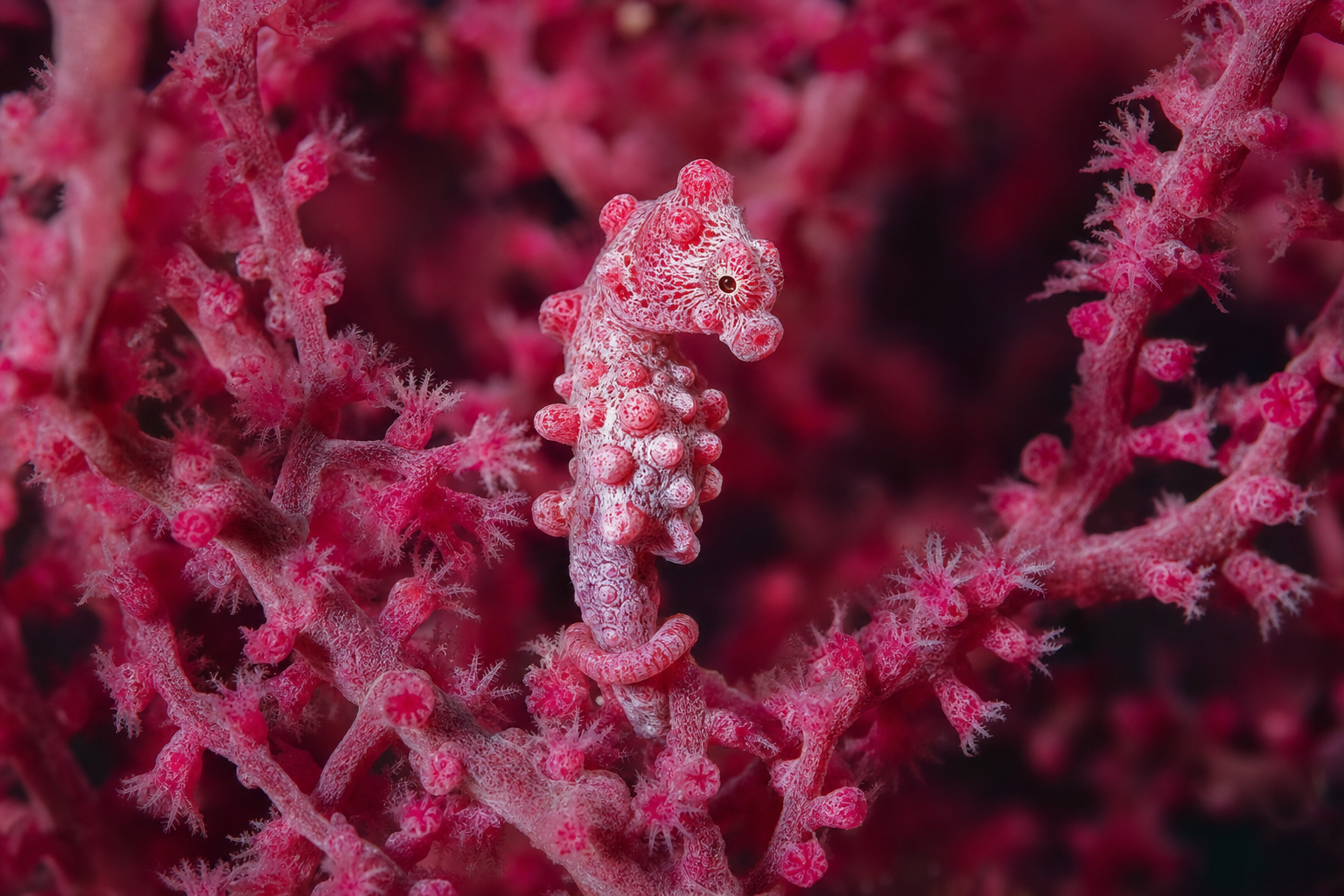
The Bargibanti (Hippocampus bargibanti), Denise (H. denise), Coleman (H. colemani), Pontohi (H. pontohi) and Severnsi (H. severnsi) pygmy seahorses are all found in Indonesia, and four of the five are found nowhere else in the world. They live on specific gorgonian sea fan species (Bargibanti on Muricella, Denise on Annella, Pontohi on Halimeda algae) and the colonies are stable, returning to the same fan year after year. Lembeh, Wakatobi, Bunaken and Misool are the four most reliable destinations, and a careful guide will produce two or three colonies on a typical week. The Pontohi is the smallest at five to seven millimetres adult length, and it lives on algae rather than gorgonians. Spotting the Pontohi yourself is the macro photographer's rite of passage in Indonesia.
Frogfish
Indonesia has the highest known frogfish diversity in the world. The species we expect to see across a Lembeh week include the giant frogfish (Antennarius commerson), the painted frogfish (A. pictus, in white, black, yellow and orange morphs), the warty frogfish (A. maculatus), the hairy frogfish (A. striatus, the unicorn of the Coral Triangle), the ocellated frogfish (Nudiantennarius subteres) and the psychedelic frogfish (H. psychedelica, Ambon-specific). Hairy frogfish in particular are the species most photographers ask about by name, and Lembeh and Ambon both deliver them reliably across the year, with peaks in March-April and August-September.
Nudibranchs and sea slugs
The nudibranch list runs into the thousands. The famous targets include the chromodoris family (white-and-blue with red borders, like the Chromodoris annae and the Chromodoris elisabethina that appear in countless coffee-table books), the dorid family, the aeolids (with their feathery cerata exposed for breathing), and the sap-sucking sea slugs (the leaf-shaped Costasiella and the lettuce-leaf Elysia). On a single Lembeh dive a careful diver expects to see five to ten species; across a week the count usually runs into thirty or forty distinct species. The rarest are the solar-powered Phyllodesmium and the Halgerda and the various Berghia, but the variety is the real reason to chase nudibranchs in Indonesia rather than any specific target.
Cephalopods: mimic, wonderpus, blue-ringed and flamboyant
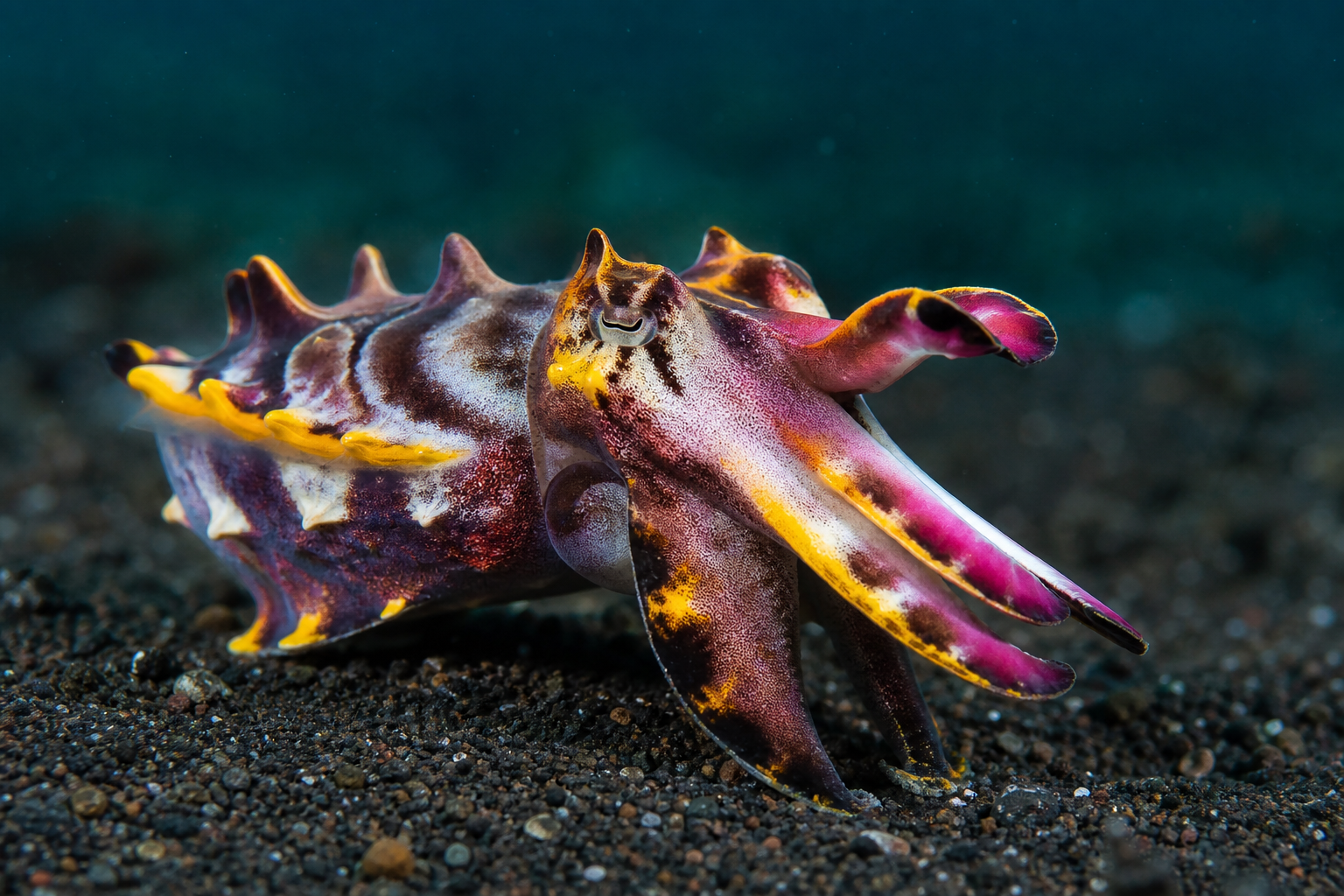
The Indonesian cephalopod list is the most charismatic part of any macro trip. Mimic octopus (Thaumoctopus mimicus), known for impersonating sea snakes, lionfish and flounders depending on the perceived threat, is a Lembeh signature species. Wonderpus (Wunderpus photogenicus, named more or less for what it is) is its more decorative cousin and lives on the same sand. Blue-ringed octopus (Hapalochlaena, three to four species in Indonesian waters) shows the warning iridescence when threatened and is the most photographed venomous animal in the country. And the flamboyant cuttlefish (Metasepia pfefferi) walks across muck on modified arms in technicolour, mostly in the late afternoon. We see all four reliably in Lembeh and Ambon, and three of the four (everyone but the flamboyant) on Bali macro days.
Rhinopias and ghostpipefish
The Rhinopias group of weedy scorpionfish (R. frondosa, R. eschmeyeri, R. paradoxus) is the macro photographer's serious target. Heavily camouflaged, slow-moving, with the disturbed habit of standing perfectly still under provocation, they are a guide's species: you find one because someone with twenty years of muck experience knows where it last sat. Ghostpipefish (the ornate Solenostomus paradoxus, the robust S. cyanopterus and the Halimeda S. halimeda) are gentler subjects, often found in pairs hovering above coral or against a Halimeda algae background. They appear seasonally; the Lembeh peak is typically October to December.
Mandarinfish
The mandarinfish dusk dive is one of the easiest macro experiences to arrange and one of the most rewarding photographically. Mandarinfish (Synchiropus splendidus) gather in small staghorn coral patches at dusk to mate, with males chasing females in a slow ritual that lasts roughly thirty minutes around sunset. Padangbai in Bali is the classic site, but Lembeh, Bunaken, Cabilao in the Philippines and even the Komodo straits all offer reliable mandarinfish. The dive is usually timed so divers descend at 17:30 and surface at 18:30, and most operators allow strobes and focus lights only briefly to avoid disrupting the spawning behaviour.
Smaller targets that draw repeat trips
The hairy squat lobster (Lauriea siagiani) lives inside giant barrel sponges and is a five-millimetre subject that rewards patience. The harlequin shrimp (Hymenocera elegans) hunts sea stars in pairs and is one of the most photogenic small subjects in Indonesia. The bobbit worm (Eunice aphroditois) hides in the sand with only the jaws visible, and the night dives in Lembeh that produce bobbit worm strikes are the most adrenaline-rich muck dives in the country. For divers who want to push night macro a step further, black-water diving in Indonesia is the natural next step on the same operator's-side learning curve. Skeleton shrimp colonies (Caprellidae), feather-duster worms and the sea-grass Halimeda crab round out the list of subjects that experienced macro shooters return for.
The macro shooting day
A muck day in Lembeh is structured very differently from a typical reef-diving day, and divers arriving from the Caribbean or the Red Sea sometimes find the cadence slow at first. Here is what the day looks like.
The boat leaves the resort at 07:30 for the first dive at 08:00. The roll-in is gentle (Lembeh boats are wooden, slow and stable) and the descent is to between 12 and 22 metres on black sand. The dive guide leads, and you are expected to follow within visual range, hovering rather than swimming. The dive runs 60 to 75 minutes. The guide spots subjects every two to four minutes on a productive dive, taps the tank to call attention, points to the subject, and then floats off to find the next one while you frame your shot. Two divers per guide is the standard ratio in Lembeh; one to one is available at most resorts at a small surcharge and is the right choice for serious photographers.
Surface intervals are long (90 to 120 minutes) and usually back at the resort, so cameras can be downloaded, batteries swapped, and ports cleaned. The second dive of the day is at 11:00 to 12:30, the third at 14:30, and the dusk mandarinfish or night dive is from 17:30 to 18:30 or 18:30 to 19:45. A serious shooter does three to four dives a day across a six- to seven-day week, which is roughly 25 to 28 dives. That is the pace at which the rarities accumulate.
Camera setup that actually works in Indonesia
You can shoot Indonesian macro on almost any system, but the gear that consistently produces the magazine-quality images falls into a narrow band. The mainstream choices are a full-frame mirrorless body (Sony A7-series, Canon R-series, Nikon Z-series) or a high-end micro four-thirds (Olympus OM-1, Panasonic GH series) in a dedicated macro housing. The lens is almost always a true 1:1 macro: 90 mm or 100 mm full-frame, or 60 mm M43. Pair this with two strobes (Inon Z-330, Retra Pro X, or Sea & Sea YS-D3 are the workhorses) on long arms, and a focus light bright enough to hold lock at 30 centimetres in low ambient light.
The detail that separates good macro divers from frustrated ones is buoyancy gear, not camera gear. A macro photographer hovers within centimetres of the bottom for 60 minutes at a time without disturbing the substrate. That requires a dialled-in BCD trim, the right amount of weight (most divers in Lembeh end up two to three kilograms heavier than on a coral reef because the slow pace and the small breaths require more ballast), good fin technique (the helicopter turn and the back-kick are essential), and patience. Divers who arrive with brand-new cameras and old buoyancy habits rarely get the photographs they came for. Divers who arrive with modest cameras and a hundred dives of patient buoyancy practice almost always do.
Best season for macro by destination
Most macro destinations in Indonesia are technically year-round, but the calmer-water windows produce better visibility, fewer cancelled crossings, and easier photography. Here is the practical month-by-month picture.
Lembeh Strait is calm year-round because the channel is sheltered, but May through October produces the cleanest water. November to April still works, with slightly worse visibility on the rainiest weeks (December and January) and the occasional surface chop. We send macro photographers to Lembeh whenever they can travel; the seasonal effect is small.
Ambon Bay works best March to May and September to November. The peak rarities (psychedelic frogfish, Rhinopias eschmeyeri) are most reliable in those windows. June to August is also good, with the dry-season visibility marginally better. December to February has more rain but the muck quality is unaffected.
Bali macro runs year-round on the east coast (Tulamben, Padangbai). April to November is the consistently calmest window with the best surface conditions. December to March is rainier and occasionally produces rougher entries at Tulamben, but the diving itself is unaffected. The Menjangan northwest sites are best May to October.
Misool macro inside a Raja Ampat liveaboard runs October to April. February is the technical sweet spot for visibility and calm water. May to September the SE trade winds make Misool largely unreachable, as the broader Raja Ampat best-time-to-visit guide covers in detail.
Wakatobi and Bunaken are both year-round destinations with March to November as the most consistent window. Wakatobi closes between February and early March some years for housekeeping; the dive operation is unusually professional about communicating these dates in advance.
The cross-destination logic that most macro photographers eventually adopt is simple: combine Lembeh with Bunaken on a single North Sulawesi trip in May to October, or combine Lembeh with Ambon and the Banda Sea on a longer liveaboard in March to April or September to November. Both combinations produce roughly 14 days of diving, cover the world's two best muck destinations, and leave the wide-angle for a separate Raja Ampat trip later.
Liveaboard versus resort: which is right for macro?
Resorts win on price, comfort, photo facilities and total dive count per week, and they are the right answer for divers who want to commit to a single muck destination for seven to ten days. The Lembeh resorts have purpose-built camera rooms, in-house guides who know the sites by heart, and the option of one-to-one guiding. Bali resorts have the most diverse macro options under a single base. If macro is the entire purpose of the trip and you have already booked a separate Indonesian liveaboard for the wide-angle, choose a resort.
Liveaboards win when you want to combine destinations. The Banda Sea liveaboard route from Ambon to Saumlaki, or from Maumere to Ambon, can string together Lembeh, Ambon, the Banda Islands, and a handful of cleaner-water sites that are not reachable from any land base. Our own boats run these itineraries on dedicated macro and shoulder weeks; the same fleet relocates to Komodo for the May to September inverse season, which is when most of our macro guests choose between an Indonesian critter trip and a Komodo wide-angle trip. The trade-off is that the diving is structured around the boat schedule rather than your photography, and surface intervals are spent at sea or on a remote anchorage rather than at a desk with a fast internet connection. A liveaboard is the right answer if you want to mix muck with pelagic, or if a fourteen-day macro week sounds repetitive to a non-photographer travelling with you.
For a broader read on the liveaboard category in Indonesia, the Indonesia liveaboard diving guide covers the main routes and the price ranges. For the seasons themselves, the Indonesia liveaboard seasons guide goes through which boat goes where in which months.
What experienced macro divers tell first-timers
The observation we hear most often from photographers arriving from elsewhere in Asia is about the guides rather than the species list. Divers who have shot macro in Jeju, or across the Philippines, tend to notice within a few days that something is different. Indonesian guides do not simply spot rare animals; they read behaviour. They know when a wonderpus is about to come out of its hole. They know which side of a harlequin shrimp pair to approach for the head shot. They know when a mandarinfish pair is committing to a spawning rise rather than a false start. The pointing stick finds the subject, but the valuable part is the judgement about what the animal is going to do in the next thirty seconds.
The corollary is that listening to the guide pays. A common mistake we see from photographers who have shot macro elsewhere is to override the guide's cadence: spending too long on one subject and missing two more, or moving in too quickly on a skittish animal that the guide is approaching deliberately slowly. The two-tap-on-tank signal is not just "look here", it often means "I have set this up for you, take the shot now". Trust the choreography and the productive dives multiply.
Common mistakes that hold macro divers back
Five mistakes recur often enough that we mention them at the dive briefing on the first day of every macro trip we host.
- Over-finning. A standard flutter kick over black sand kicks up a cloud that ruins your photo and the photo of the diver behind you. Frog kick, helicopter turn and back-kick are mandatory. If you do not have these, take a peak-performance buoyancy refresher before the trip.
- Over-flashing the subject. Frogfish, ghostpipefish and seahorses can be photographed for forty-five minutes without obvious distress, but if you put twenty consecutive flash bursts at maximum power onto a five-centimetre frogfish, it will move, and the next photographer in the queue gets nothing. Keep strobes at half power. Move on after eight to ten frames per subject.
- Rushing. The temptation on the first dive of a Lembeh week is to swim to find more subjects. Resist this. The guide will find more subjects than you can shoot. Hover, set up, frame slowly. The pace that produces magazine images is a quarter of normal reef-diving pace.
- Bringing the wrong lens. A 16 to 35 mm wide-angle on a Lembeh dive will leave you frustrated. A 90 or 100 mm macro is mandatory. If you only have one camera and one lens, leave the wide at home for a Lembeh week. Bring a +5 wet diopter on your strobes if you want to push close-focus work.
- Skipping the dusk and night dives. The mandarinfish, the bobbit worms, the hunting octopus and the sleeping parrotfish that the night dives produce are unrepeatable on a daytime schedule. Plan for at least two dusk dives and two full night dives across a Lembeh week.
Pricing, logistics and how to book
Land-based macro weeks in Lembeh, Ambon and Bali run roughly 1,800 to 3,200 USD per person for seven nights including dives, full board, and transfers, depending on the resort tier and the season. Liveaboard macro itineraries in the Banda Sea run 4,200 to 7,500 USD per person for ten to fourteen nights including all dives, meals and transfers between the boat and the airport. Camera rental is available at most resorts (a Sony A7 with macro lens and housing usually 60 to 90 USD per day) but most serious photographers travel with their own kit.
Flights into Manado (for Lembeh and Bunaken) connect via Jakarta or Singapore. Flights into Ambon connect via Jakarta. Bali is reached directly from most Asian and Australian gateways and via Jakarta or Singapore from Europe. The transfer from Manado airport to Lembeh is a 90-minute drive plus a 15-minute boat crossing; the transfer from Ambon airport to the dive resorts in the bay is 45 minutes; Bali transfers depend on the resort but are typically 90 to 150 minutes from the airport.
Booking lead times are similar to the rest of our calendar. Land-based macro in the high season (Lembeh August to October, for example) wants 4 to 6 months. Banda Sea liveaboard macro weeks want 6 to 9 months for the popular March-April and September-November windows. To check availability or talk through which combination fits your dates and your photographic goals, the contact page reaches our reservations team directly.