If you ask a hundred divers where the best place in the world is to encounter manta rays, the answer almost always lands on Indonesia. The reason is straightforward. Indonesia became the world's largest manta sanctuary in 2014, when the government banned all hunting and trade of manta rays across the entire 5.8-million-square-kilometre archipelago. Both manta species, the smaller reef manta (Mobula alfredi) and the gigantic oceanic manta (Mobula birostris), live and feed inside Indonesian waters, and several of the country's reef systems run year-round cleaning stations and current-fed feeding aggregations that operate like clockwork.
What this guide does is map the actual sites you can dive to find them, organised by region and by the kind of encounter each delivers. Manta diving is not one experience. A cleaning station in calm shallow water where a single reef manta hovers above a coral bommie is a fundamentally different dive from a five-knot drift through a sandy pass with a feeding train of fifteen mantas funnelling plankton in line astern. Both are extraordinary, but they ask different things of the diver, sit in different parts of the country, and peak at different times of the year.
This article is written from operator perspective. It draws on the manta-focused dives our liveaboards run in Komodo, Raja Ampat, and Bali, and the patterns we see across hundreds of trips per season. The aim is to be specific about where each site is, when it works, what difficulty level it actually demands, and how to combine sites and regions into a trip that maximises your manta time.
How to Read This Guide
The sites in this guide are organised by region (Raja Ampat north and south, Komodo north and south, Bali) and within each region by the encounter type. Some sites are cleaning stations, where mantas come in slowly to be cleaned by wrasse and angelfish, hovering nearly motionless above a specific patch of coral while divers wait at a polite distance. Other sites are feeding aggregations, where current pushes a plume of plankton across a known geographic feature and mantas line up to eat it. A third category is the flyby, where mantas pass through a site on their daily commute between cleaning and feeding zones; flybys are by definition harder to time but produce striking images when they happen.
For each site we give you the basics that determine whether the dive will work: where it sits, when its high season runs, what the typical conditions are (depth, current, water temperature), and the certification level we actually require to put a guest on it. We also note whether the site sits inside a single-region itinerary or whether you need a longer cruise or a regional combination to reach it. The closing section ties it all together with concrete trip-planning advice.
Manta Behaviour Basics Every Diver Should Understand
A short briefing on manta behaviour saves a dive. Mantas are large, intelligent, and curious, and how a group of divers behaves changes how the encounter unfolds. The four points below are what we cover before every manta dive on our boats.
Cleaning stations are calm, keep it that way
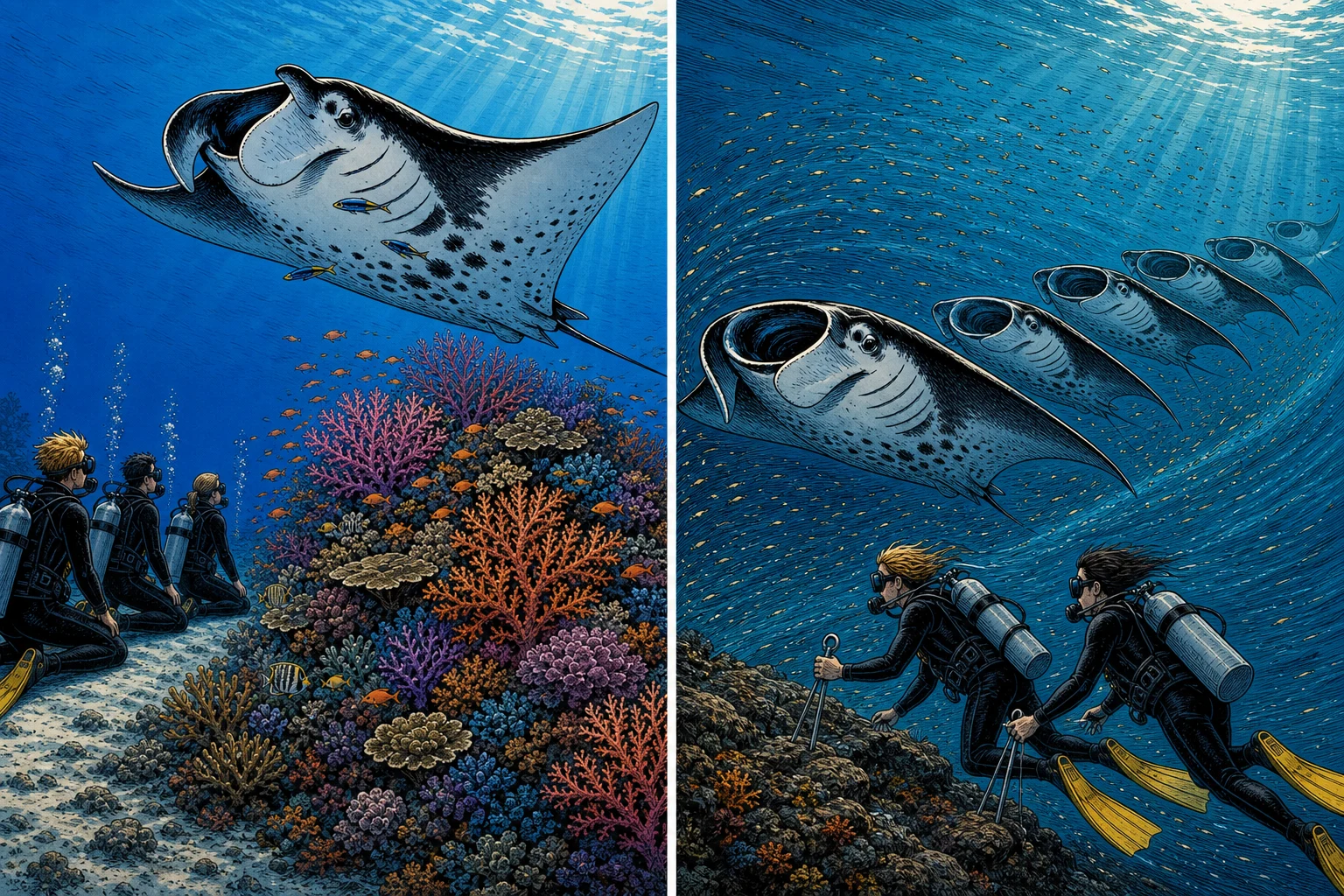
A cleaning station is a coral feature, often a single bommie, where mantas come for parasite removal by wrasse and butterflyfish. The station works because it is predictable and undisturbed. Mantas approach slowly, hover head-up over the cleaners, and rotate their pectoral fins to expose the surfaces they want cleaned. They will hold position for two to ten minutes if the dive group sits still and stays low. They will leave inside thirty seconds if anyone swims into the station, kicks up sand, or flashes a strobe in their face. The protocol is to settle on the sand or rocks downstream of the station, three to five metres back, low silhouette, breathing controlled, hands at sides. The mantas will come over the top of the line. Stay there.
Feeding aggregations are about current, not approach
A feeding event is a current-driven phenomenon. Plankton-rich water funnels through a geographic feature, a pass, a reef edge, a current line, and mantas line up to eat. At feeding sites the diver is essentially a piece of furniture in the current, holding station with a reef hook or kneeling on rubble while the mantas work the food line. The mantas know the diver is there; they simply do not care, because the food is the point. Feeding sites produce the highest manta counts (a dozen or more in a single dive is normal at the best Komodo and Misool sites in season) and the most photogenic surface-feeding behaviour, including barrel-rolling, chain-feeding, and somersault feeding.
Don't touch, don't chase, and the science is on your side
Beyond the obvious ethical reasons, there is a practical one: manta skin is covered in a mucous layer that protects against bacterial infection, and human contact damages it. Chasing causes the same thing every fish does when chased, it leaves. Cleaning stations that get harassed get abandoned. The stations on Indonesia's most-visited sites have remained productive for decades precisely because operators and dive guides enforce no-touch and no-chase rules. Stay three metres back, do not approach from above, do not block the manta's exit path. Most encounters last longer than divers expect when nobody breaks these rules.
Black mantas are not a different species
About 10 to 30 percent of the reef mantas you see in Indonesia are melanistic, solid black on both dorsal and ventral surfaces, with only small white markings along the throat. They are the same species as the more common chevron-pattern mantas; the colour difference is a single recessive gene. Black mantas show up at every major Indonesian site to varying degrees: Manta Sandy in Raja Ampat sees them often, Manta Alley in Komodo has resident black individuals, and Penida produces several known black animals. Photographers who plan a manta-focused trip should expect a mix.
Manta Sandy and Manta Ridge, Raja Ampat's Cleaning Station Belt
Where: Mansuar Island, Dampier Strait, central Raja Ampat. About forty minutes by speedboat from most liveaboard mooring spots in the Dampier corridor and effectively unmissable on any northern Raja Ampat itinerary.
When: Manta Sandy works year-round but the high-density season is October to April, peaking December to March when plankton density climbs and the resident reef manta population aggregates around the station. From June to September the site goes quieter, still productive, but not the every-dive experience it is in the wet season.
Conditions: Manta Sandy is one of the easiest manta dives in Indonesia. It is a sandy bottom at fourteen to eighteen metres with a series of low coral bommies acting as cleaning stations. Current is light to medium, water is warm (28–30°C), and the dive is bottom-time-limited rather than gas-limited. Open Water divers with a few dozen dives are comfortable here. Visibility is typically ten to twenty metres; rain-season runoff can reduce it.
The encounter: Reef mantas, mostly. The Dampier population is well-studied, and individual animals are tracked by their unique ventral spot patterns through the Manta Trust ID database. On a good rising tide you will see two to seven mantas at the station, with longer hovers as multiple cleaners work different parts of each animal. The Mansuar group includes both chevron-pattern and melanistic individuals, and the contrast in a single frame against the white sand makes for unusually clean photography.
Site etiquette: Manta Sandy is one of the most strictly managed sites in Raja Ampat. There is a kneeling line marked by small rocks roughly three metres downstream of the main bommie. Divers settle on the sand at or behind that line, low silhouette, no exceptions. Approaching the bommie or the mantas is a permanent mark against the diver and the operator. Park rangers monitor from the surface during peak season; this is the working compromise that has kept the site productive for fifteen years.
Manta Ridge: A slightly deeper companion site twenty minutes away in the same Dampier complex, working the same animal population but on a current-fed ridge rather than a sandy bottom. Manta Ridge sees more flyby behaviour, fewer extended hovers, and demands stronger current-handling skills (light reef hook recommended). It is a strong second site to pair with Manta Sandy on the same trip and gives you a different angle on the same individuals.
Both sites sit on standard Dampier itineraries. Our seven-night Raja Ampat trips in season hit Manta Sandy at least twice, including one early-morning slack-tide dive timed for the cleaning station's most reliable productive window. Detailed dive-by-dive coverage of Dampier is in our Best Dive Sites in Raja Ampat guide, and the season planning details are in the Raja Ampat liveaboard guide.
Magic Mountain and Eagle Rock, Misool's Oceanic Manta Hotspot
Where: Misool, southern Raja Ampat. Magic Mountain (also called Shadow Reef) is an open-water seamount roughly an hour by tender from the central Misool moorings; Eagle Rock sits in the same general system slightly closer to shore. Misool is a separate region from Dampier and demands either a longer Raja Ampat itinerary (10–11 nights, north and south combined) or a dedicated southern itinerary launching from Sorong with a full transit day each way.
When: Misool's diving window is November to April. Outside that window the southwest monsoon makes the open-water transits to Magic Mountain sketchy at best, and most operators do not run Misool itineraries from May to September. Inside the window the manta activity peaks in January through March, when plankton density is highest and the seamount becomes a working cleaning and feeding zone for both species.
Conditions: Magic Mountain is a more technical dive than the Dampier cleaning stations. The pinnacle tops out around eight metres and drops to forty-plus, with strong current at the summit and cooler water on the downcurrent side. Visibility is generally good (twenty-plus metres) but the site demands confident current handling, comfort with reef hooks, and good buoyancy at depth on a moving wall. We require Advanced Open Water and a minimum of fifty logged dives, and we pull divers off the briefing if the daily current call exceeds operator threshold. It is not a beginner site.
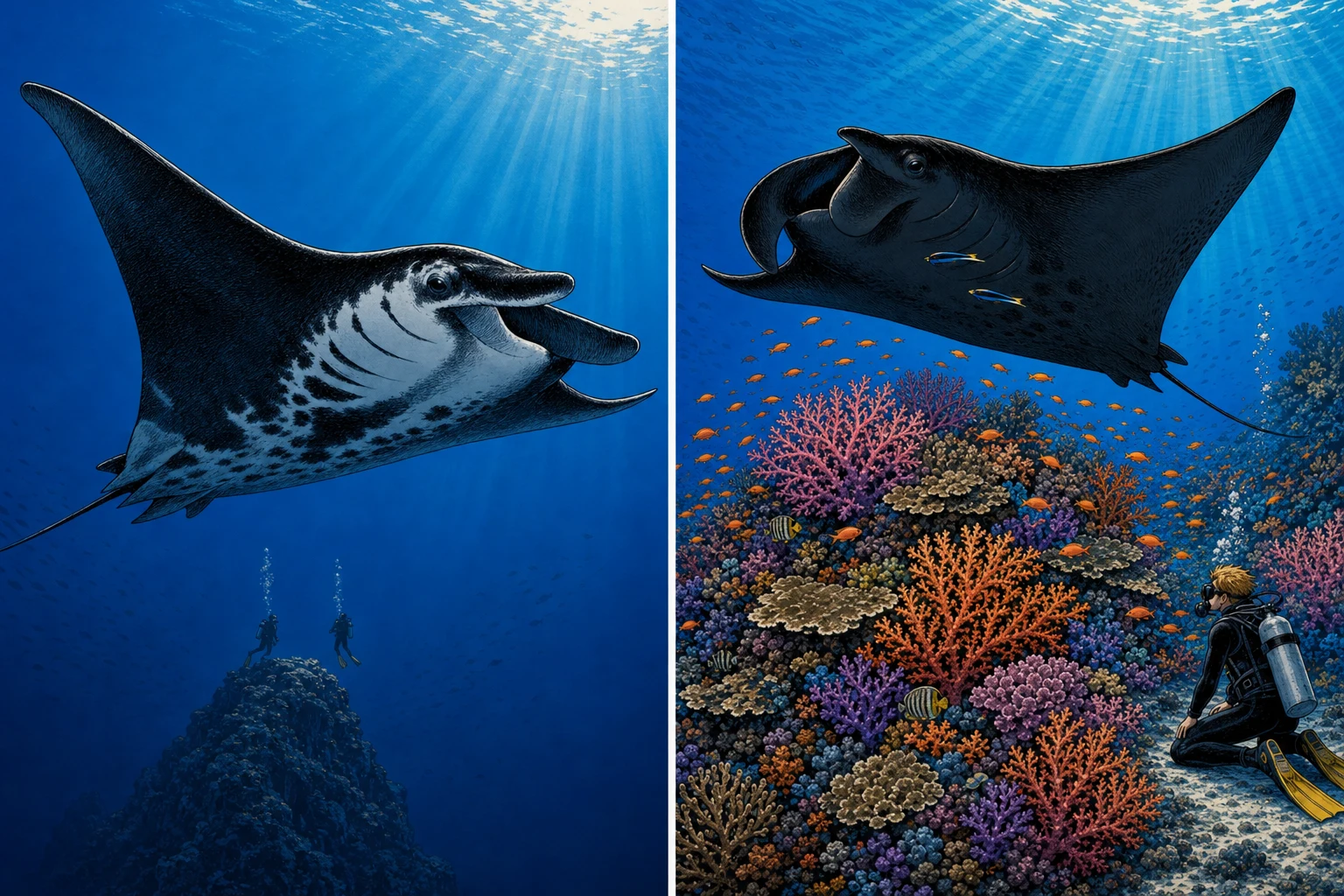
The encounter, and why it matters: Magic Mountain is one of the only sites in Indonesia where you can reliably see the oceanic manta (Mobula birostris), the species that grows to a seven-metre wingspan and lives largely in open ocean. Most of Indonesia's manta diving is reef manta diving (Mobula alfredi, three to four metres typical wingspan), and oceanic mantas are wide-ranging, harder to predict, and significantly larger. At Magic Mountain a productive month can produce both species on the same dive: oceanic mantas cruising the deep blue side of the pinnacle, reef mantas working the cleaning bommies on the summit. The size contrast in the same frame is dramatic and unique to Misool.
Eagle Rock: A complementary site that sits closer in and runs more reef-manta-dominant cleaning behaviour, with shallower depth profile and milder current than Magic Mountain. Eagle Rock is a strong "warm-up" dive on the morning of a Magic Mountain afternoon dive, you get cleaning-station behaviour from the resident reef manta population at lower workload before the more demanding seamount in the afternoon.
Trip pattern: Misool needs commitment. A single Misool day on a hybrid itinerary will rarely deliver the right tide window for Magic Mountain and rarely justifies the transit. The right play is either a full eleven-night north-and-south Raja Ampat trip in season, or a dedicated Misool itinerary with three to four full days in the southern region. Both options are detailed in the Best Dive Sites in Raja Ampat guide, with a focus on which Misool moorings put you within range of Magic Mountain on the productive hours.
Manta Alley, Komodo's Cold-Water Aggregation
Where: Southern Komodo National Park, in the channel between the southern tip of Komodo Island and the Padar coast. Roughly a forty-minute speedboat run from southern moorings; out of reach of any "Komodo day-trip" boat, only liveaboards on a full park itinerary or southern-focused trips reach it.
When: April to November is the south-Komodo dive season, peaking July through September when the southeast trade winds drive the cold-water upwelling that powers the aggregation. This is the inverse of Raja Ampat: when Raja's manta diving is in its low season (June to September), Komodo's is at peak. Plankton density at the alley climbs into August, and so does the manta count.
Conditions: Manta Alley is the most physical manta dive in Indonesia. Water temperatures drop to 22–24°C in the peak window, a five-millimetre wetsuit is the realistic floor; many divers run 7mm in August. Surge inside the alley is significant because the site is a narrow channel between rock walls that funnels swell from the south. Current can be strong on the entry and exit. Visibility is typically eight to fifteen metres in the alley itself, sometimes less when the upwelling is most aggressive. We require Advanced Open Water and demonstrated cold-water comfort. The dive is not technically deep, the working depth is twelve to twenty metres, but the conditions add up.
The encounter: The Manta Alley aggregation is the highest-density reef-manta site we work in Indonesia. Counts of fifteen to thirty mantas in a single dive are common in peak season, with cleaning behaviour at multiple stations along the channel and feeding behaviour where the upwelled water funnels into the entrance. The aggregation includes a high proportion of melanistic individuals, Komodo's resident black mantas are some of the most photographed in Asia, and several individuals have been tracked through ID databases for over a decade. Encounters are extended (the cold water keeps the dive bottom-time generous because depths are shallow), and the surge gives the encounter a wild feeling that the calmer Raja Ampat sites do not have.
Manta Alley is one of the four or five sites that defines the southern half of Komodo National Park, alongside Cannibal Rock, Yellow Wall, and Boulders. Detailed coverage of how it sits in a southern Komodo itinerary, what to pair it with on a single trip, and the full Komodo dive site map is in our Best Dive Sites in Komodo guide.
Karang Makassar, Komodo's Drift Pass
Where: On the eastern side of Komodo island, in the channel between Komodo and the Tatawa islands, in the central zone of the park. Often called Manta Point Komodo, sometimes Makassar Reef. About thirty minutes from central Komodo moorings, accessible on virtually any liveaboard itinerary.
When: Year-round, because these are resident animals. Numbers peak in the wet season, roughly December to February, when plankton concentrates the mantas to feed; June to September gives smaller groups in the clearest water of the year, and the shoulders in April to May and October to November are the best all-round balance. The site works whenever current is running, which depending on tide phase is most of the day; the question is direction, not presence.
Conditions: Karang Makassar is a drift dive over a long plateau of sand and coral rubble at five to fifteen metres depth. Current is usually mild to moderate and only occasionally strong on big spring tides, which is what makes this one of the more forgiving big-name sites in the park. It does still require drift-diving discipline: stay in the group, watch the guide, do not try to fight the current to hold over a single feature. Surface conditions can be choppy on south-wind days. Open Water with confident drift skills is the working minimum.
The encounter: Karang Makassar works as both a cleaning station and a feeding ground, and which one you get depends on the tide. On cleaning tides the mantas hover almost stationary above isolated coral bommies while cleaner wrasse work their gills, sometimes for twenty minutes at a stretch. On feeding tides the current pushes plankton along the plateau and the animals cruise through it open-mouthed, occasionally falling into the loose single file that guides call a feeding train, which on strong days can run ten or fifteen animals long. Total dive time is usually forty-five minutes to an hour, and because the site is shallow, cold rather than air or no-decompression time is what tends to end it.
Karang Makassar pairs naturally with Manta Alley on a Komodo trip. The two sites sit at opposite ends of the manta-encounter spectrum, flyby drift versus cold-water aggregation, and together they cover the full range of what reef-manta diving in Komodo offers in a single itinerary.
Manta Point Nusa Penida, Bali's Year-Round Cleaning Station
Where: Southwest coast of Nusa Penida, Bali. About forty-five minutes by speedboat from Sanur or Lembongan, well within reach of day trips out of mainland Bali. This is the most accessible reliable manta site in Indonesia.
When: Year-round. The reef manta population resident to the southwest Penida cleaning stations is stable across seasons, and there is no real "off month" for manta diving here. Conditions are best in the dry season (April to November) when surface conditions on the open Penida coast are calmer; January to March can be choppier on the surface but the underwater encounter is unchanged.
Conditions: Manta Point Penida is a shallow bay with a sandy bottom at eight to fifteen metres, with two main cleaning stations in the bay's protected interior. Water temperature drops sharply at Penida, the same Lombok Strait current that delivers mola mola in the cool season also pulls cool water across the south coast year-round, and 24°C is normal at depth even in the dry season. A 5mm wetsuit is the working standard. Surge at the bay is the dominant condition challenge; the entrance is exposed to the south swell, and on big-swell days the dive becomes a wash-machine experience that strains buoyancy. Currents inside the bay are mild. Open Water certification with confident buoyancy is sufficient; the surge handling is what matters more than the certification level.
The encounter: The Penida population is reef mantas with a high proportion of females, including several individually identified animals that return reliably to the same cleaning bommies year after year. Counts of three to seven mantas across a forty-five minute dive are normal; on best days you will see ten or more. The cleaning behaviour is calm and extended. Penida is the strongest "first manta dive" of the country: low certification bar, year-round availability, and a near-guaranteed encounter inside a single-day trip.
Penida sits on virtually every Bali day-dive operator's schedule and is covered in detail, alongside Crystal Bay, Toya Pakeh, and the rest of the Penida belt, in our Best Dive Sites in Bali guide.
How to Plan a Manta-Focused Indonesia Trip
Once you know the sites, the planning question is how to combine them. The country's manta seasons are not synchronised, Raja Ampat peaks October through April, Komodo peaks April through November, and Bali runs year-round. This means a single trip can comfortably cover only two of the three regions in their peak windows, and the calendar drives which two.
Single-region focus, when one is enough
If your trip is strictly about mantas and you have a fixed week in either December or August, single-region commitment makes sense. December gets you into Raja Ampat's high season, with two or three Manta Sandy dives plus the Misool oceanic-manta opportunity if you stretch to ten or eleven nights. August puts you in Komodo's peak with multiple Manta Alley dives plus the Karang Makassar drift; a seven-night Komodo cruise easily delivers eight-plus manta dives. Either trip in its respective season produces more manta diving in a week than most divers see in a lifetime.
Bali plus Komodo, the dry-season combo
The most popular manta-focused itinerary we run is Bali land start plus Komodo liveaboard, in the May-to-October window. The pattern: two to three days in Tulamben and Nusa Penida (Liberty wreck plus Manta Point plus a mola mola attempt at Crystal Bay if it is the season), then fly to Labuan Bajo and board a Komodo liveaboard for seven nights. The Bali leg gets you year-round Penida mantas plus the wreck and the seasonal mola mola; the Komodo leg gets you Manta Alley's cold-water aggregation plus the rest of the central park. Two regions, three to four manta sites, one trip.
Bali plus Raja Ampat, the wet-season combo
The wet-season equivalent is Bali plus Raja Ampat, in the November-to-March window. Bali's diving runs year-round, so the front-end leg is unchanged; the second leg is a seven-night Dampier-focused Raja Ampat liveaboard, or eleven nights if you want Misool included. This combination gives you year-round Penida mantas plus Manta Sandy plus, on the longer trip, Magic Mountain's oceanic encounters. It is the higher-effort option (Raja Ampat sits a long way east of Bali), but the three-region biodiversity contrast is unmatched.
Photography boats versus generalist boats
If photography is the primary purpose of the trip, the boat matters as much as the itinerary. Photography-focused liveaboards run smaller groups (typically eight to twelve guests rather than sixteen to twenty), prioritise dawn and slack-tide entries to maximise calm-water station conditions, and carry rinse and dry stations sized for serious housings. Generalist boats run more dives per day, mix manta sites with other targets, and put out faster sequences with less attention to the timing windows that turn a good frame into a great one. We run both styles on different trips through the year. The trade-off is mostly group size and dive timing; the regions and sites are the same.
Cross-region timing patterns and the practicalities of stitching multi-region itineraries together, including transit days, internal flights, and the dive-day rest rules around them, are covered in detail in our Indonesia Liveaboard Seasons guide. For divers choosing between just one of Komodo or Raja Ampat, the trade-off analysis is in Raja Ampat vs. Komodo.
Conservation and Ethics, What Operators Should Be Doing
Indonesia's 2014 manta sanctuary made the country the largest manta-protected sea area in the world, and the protection is real, manta fishing has effectively ceased inside the archipelago, populations on the major dive sites are stable or growing, and the cleaning stations that anchored this guide remain productive. The risk to that picture is no longer fishing pressure. It is dive-tourism pressure on the sites themselves.
The operator practices that matter are mostly site-level. Mooring use over anchoring protects the coral around cleaning bommies; anchored boats break the bommies that hold the stations. Briefing and enforcement on every manta dive, every time, including the no-touch and no-chase rules and the kneeling-line discipline at managed sites, fatigue makes guides skip the briefing on dive ten of the trip, and the resulting bad behaviour from one diver can shut down a station for an hour. Group-size discipline: more than ten or twelve divers at a cleaning station tips the encounter from observation into disturbance. ID photography contributions: ventral-spot photographs of individual mantas, contributed to Manta Trust or Project Manta databases, build the population science that justifies the protection.
What divers can do directly is short and concrete: pick operators who run the practices above, do not break the rules at managed sites, and contribute photographs if you are shooting. Indonesia's manta sanctuary is the best legal protection any country has given the species. Keeping the underwater experience that goes with it intact is now an operator and diver responsibility.
Bringing It Together
Indonesia is the best country in the world to dive with manta rays because of geography, protection, and infrastructure in equal measure. The Coral Triangle puts both species inside one country's waters, the 2014 sanctuary keeps them there, and the operator network spread across Bali, Komodo, and Raja Ampat means you can build a trip around almost any manta-encounter style, calm cleaning station, current-fed feeding train, oceanic giants on a seamount, or shallow surge bay close to shore. The right trip for any given diver depends on the calendar more than on the budget. Pick your week, see which region is in season, and let that decide the itinerary.
Our liveaboards run all three regions across the year. If you have a target window and a target encounter type, the planning team can match it to a specific itinerary; if you have flexibility, the calendar will tell us which combination produces the most dives at the lowest workload. Either way, the country delivers, manta-focused trips here remain among the most reliable wildlife experiences in marine tourism, and the sites in this guide are the working engine of that.
Coverage of Indonesia's broader marine biodiversity, including the science of why the Coral Triangle produces these encounters in the first place, is in our Indonesia Coral Triangle guide. Itinerary patterns by region and season are in the Indonesia Liveaboard Diving Guide.