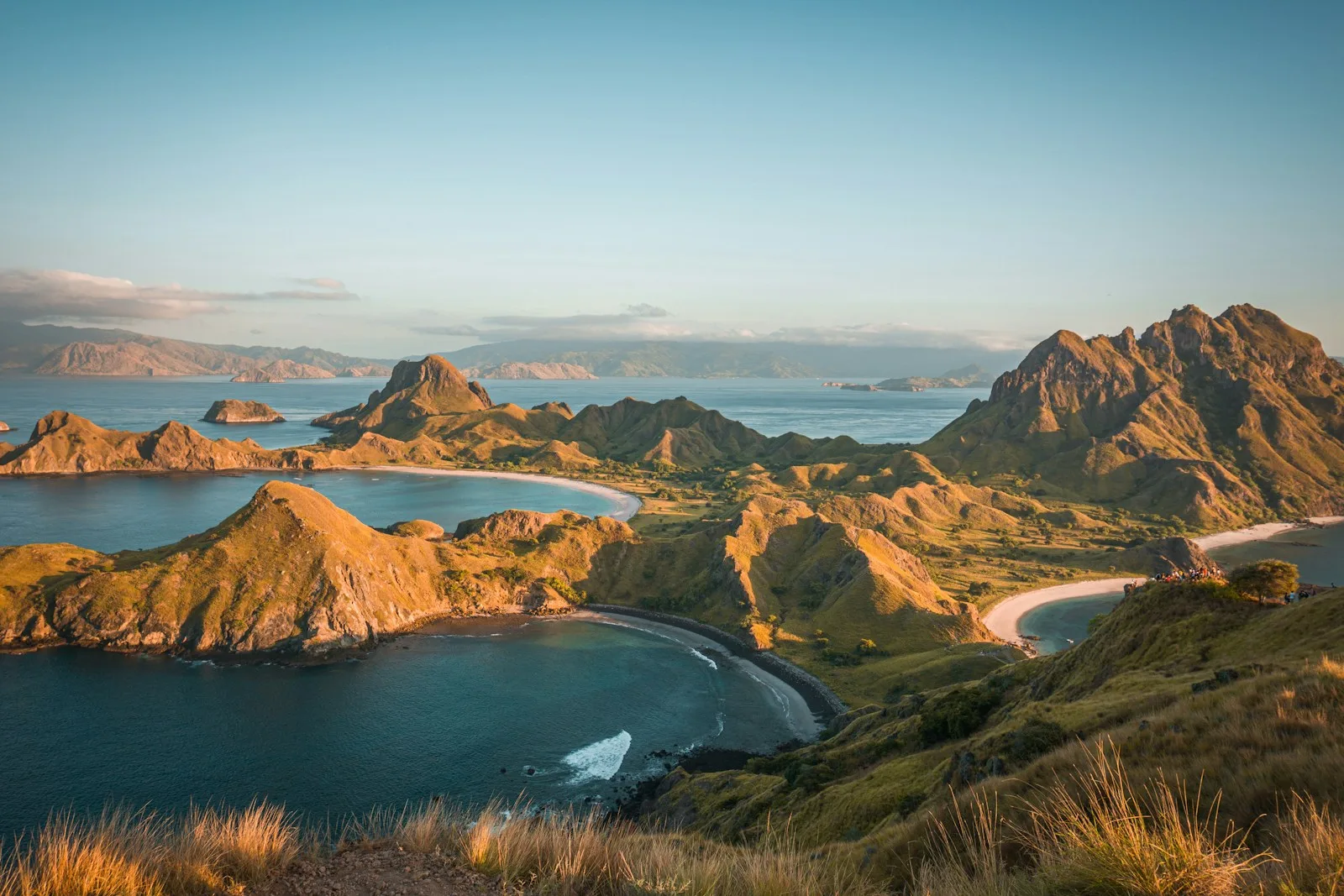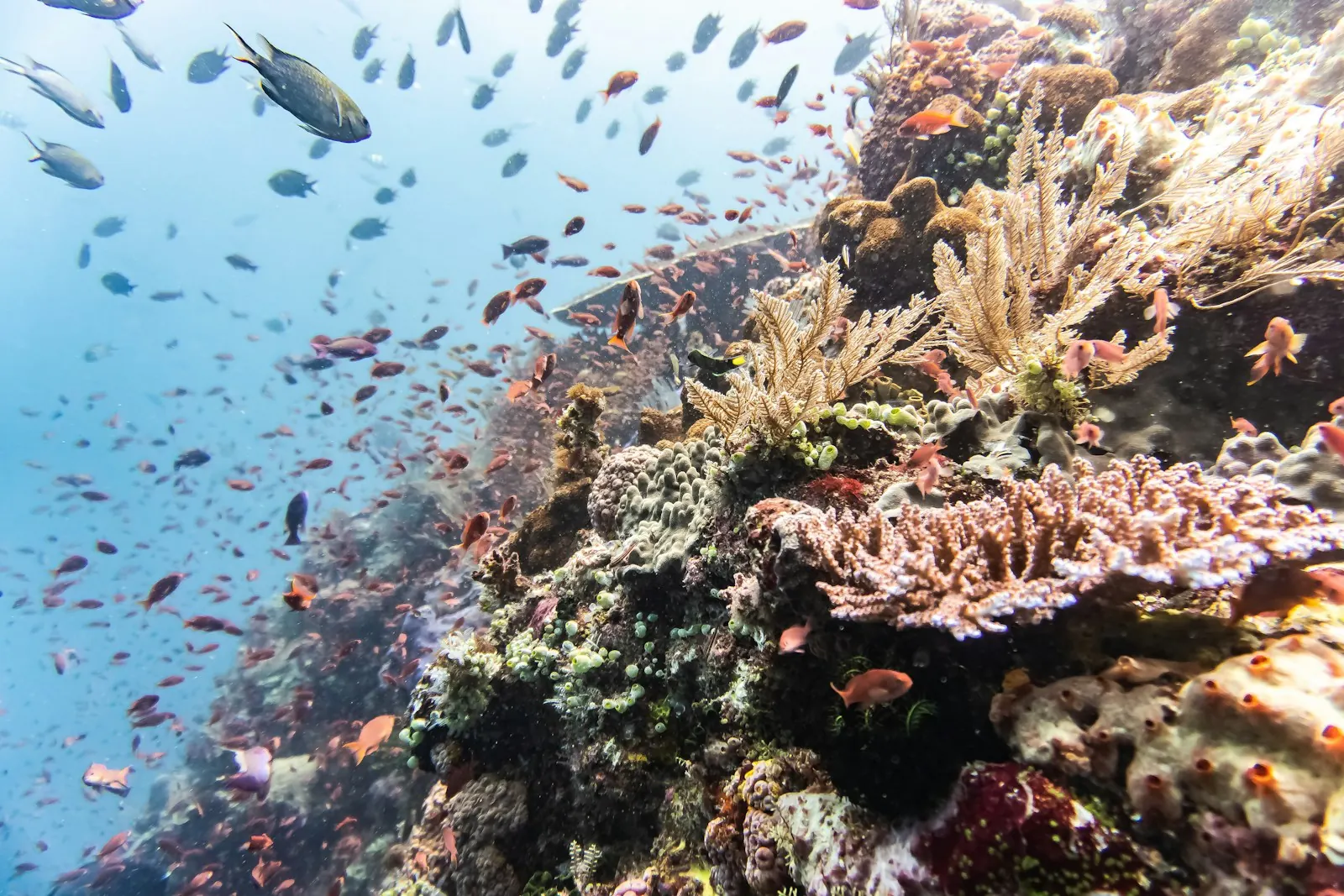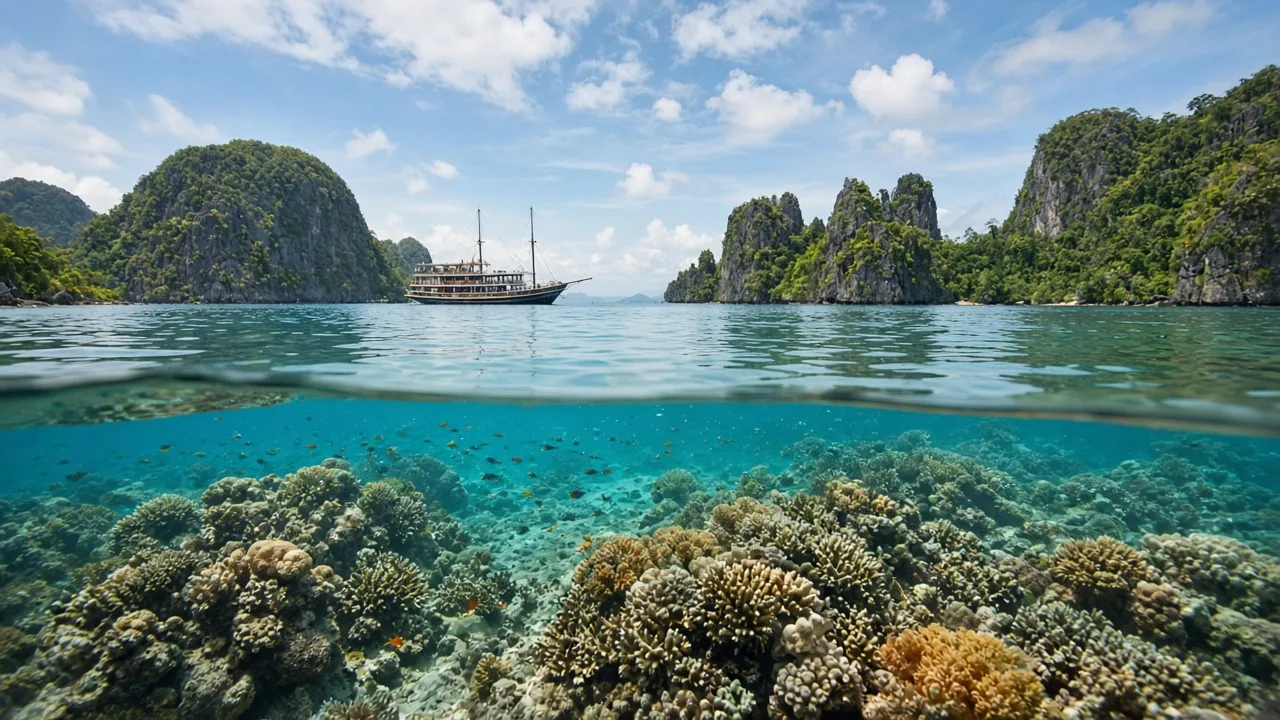
Most people who fly to Raja Ampat spend every daylight hour underwater, and that is fair enough, because the reefs here hold more recorded fish and coral species than anywhere else on the planet. But two of the most memorable hours of a week in the Dampier Strait can happen on land, or at least in fresh water: a swim in a cold, glass-clear spring on Waigeo called Kali Biru, and a morning in Arborek, the small island village where children in bark-cloth costumes and white body paint dance the old life of the Betew people at the jetty.
Both visits can be arranged on a Raja Ampat liveaboard, and neither needs any diving experience. A surface interval at Arborek fits neatly between morning dives at Manta Sandy and Arborek Jetty. Kali Biru takes longer, roughly half a day, because the spring sits up a river in the Waigeo rainforest, well away from any dive site.
Neither is a museum piece. Kali Biru is a working village attraction with an entry fee and a time limit, and the Arborek dance is a performance the community books, rehearses and gets paid for. Knowing that in advance makes both visits better, not worse.
What is Kali Biru?
Kali Biru is a spring-fed freshwater pool in the rainforest of Waigeo, Raja Ampat, whose blue, glass-clear water draws swimmers to Warsambin village on Mayalibit Bay.
- Cold limestone spring water
- Pools 1.5 to 5 metres deep
- A short river and forest walk
- A village-managed entry fee
It is the one freshwater swim most visitors to the islands take, a contrast to a week in 29°C salt water.
You reach it in one of three ways:
- A half-day excursion arranged from a Raja Ampat liveaboard
- A day trip by speedboat from a Gam or Kri homestay
- A one-hour drive from Waisai, then a local boat
In short: Kali Biru is Raja Ampat's blue river, a cold spring you swim in, not dive.
Why is Kali Biru so blue, and so cold?
The name means "blue river" in Indonesian. Locally it goes by Warabiae, or Waiyal, which Indonesian reporters translate as "the water that knows what happens tomorrow"; the story goes that warriors bathed here before going into battle. The colour is not a dye, an algae or a trick of a phone filter. It comes from three things working together.
First, the water is spring water. It rises from an underground limestone aquifer and pushes the warmer, brackish river water out of the pool, so the basin is constantly being flushed with water that has spent a long time filtering through rock. Very little sediment, very little plankton. Visibility is often quoted at 15 metres or more, which in a pool only five metres deep means you can see every pebble on the bottom from the bank. Second, the bed is pale limestone gravel and sand. Clear water absorbs red and yellow light first and scatters blue, and a pale bottom bounces that blue straight back up at you. Third, the canopy. Where the sun breaks through the trees onto the pool, usually from mid-morning, the blue turns almost electric; under cloud it fades to a deep green-blue.
The temperature is the part most visitors are not ready for. Indonesian travel writers put it at 10 to 20°C, and honestly we think the low end of that range is an exaggeration for a tropical spring at sea level. It does not matter much. After a week in Raja Ampat water that sits at 28 to 30°C, anything in the low twenties feels icy, and the first jump in usually produces a yelp. Near the river mouth you can feel distinct layers, cold where the spring water dominates and warmer where the sun has been on the surface for hours.
Rain is the open question. Some guides insist the spring stays clear all year; others describe the river running cloudy and high after a heavy downpour, which mostly affects the boat ride and the wade in rather than the pool itself. Raja Ampat gets rain in every month of the year, so it is a gamble rather than a seasonal rule, and it is one reason we treat Kali Biru as an option to confirm during the week rather than a fixed stop.
Swimming has not always been allowed. The village kept the pool closed to bathing for conservation reasons until around 2016, and opened it with conditions: visitors swim in the pool itself, for around 30 minutes each, with no lotion, sunscreen or repellent on their skin, and take everything they brought back out with them. The wider river system and the mangroves of Mayalibit Bay are saltwater crocodile habitat. The spring pool itself is considered safe for swimming, by adults and children alike, but nobody should wander downstream for a swim on their own.
How a Kali Biru visit works
Warsambin sits on the southern shore of Mayalibit Bay, the long inlet that almost cuts Waigeo in two. That puts the spring on the opposite side of the island from the Dampier Strait sites most Raja Ampat routes are built around, and it is why a visit costs more of the day than a beach landing does. The sequence is the same whoever organises it.
1. Getting to Warsambin
Independent travellers drive about an hour north from Waisai, the regency capital where the public ferry from Sorong arrives, on a good sealed road. Homestay guests on Gam and Kri come by speedboat, which takes roughly an hour and a half. From a liveaboard the crew arrange the transfer around the boat's position that day, and the plan is fixed with the cruise director once we know the route, the tides and the weather.
2. The village boat
At the Warsambin jetty, villagers run small wooden boats that carry up to six or seven people up the river. The ride takes about 15 minutes, out across a corner of the bay and then into a narrowing channel with forest on both banks. Hornbills are common here, and in the early morning you often hear them before you see them.
3. The walk in
Where the boat can go no further, you walk. Depending on the water level the walk is anything from 5 to 30 minutes, partly on a forest path and partly wading up the riverbed over smooth stones. A local guide goes with every group, and the fee for that is part of the entry charge. Water shoes or reef booties are far better than sandals, and long trousers are a mistake, because you will be in the river up to your knees at least once.
4. The swim
The village limits swimming to about 30 minutes per visitor, so groups do not stack up at the pool, and lotions of any kind are banned in the water. There are gazebos for shade and a basic toilet. The deepest part is about five metres and the edges shelve from 1.5 to 3 metres, so confident swimmers can duck-dive to the bottom on a breath and everyone else can float at the surface with a mask. A mask is worth bringing; the view down onto the gravel and sunken branches is the best part. Fins are not needed and are awkward on the walk. There is no scuba diving in the pool.
5. Back to the boat
The return is the same route in reverse, and the whole outing from the Warsambin jetty and back usually runs two to three hours. Add the transfer either side and you are looking at roughly half a day.
A worked example, using the figures independent travellers report paying in 2026. The village entry fee is IDR 100,000 per person, about USD 5.50 at the 18,100 rupiah to the dollar we use on our price pages; Indonesian travel press has also reported IDR 250,000 a head, so take cash with some margin. The local boat from Warsambin runs around IDR 500,000 for up to four people. A full day trip arranged by a homestay on Gam is about IDR 2,000,000 per boat, shared by up to six. On a Raja Ampat trip with us, the village and boat fees are paid locally in rupiah, and we confirm the current amount when the visit is booked, because it is set by Warsambin and not by us. You also need the Raja Ampat marine park card (IDR 700,000) and the regency visitor levy (IDR 1,000,000), but every guest on a Raja Ampat itinerary needs those anyway, so they add nothing to the cost of the swim itself. Our guide to Indonesian park fees and visas keeps the current figures.
The real cost is time. A half day at Kali Biru typically replaces one or two dives. On a seven-night route with three or four dives a day, most guests are happy to make that trade once; on a five-night trip it is a harder call.
Arborek village: who lives there and why it matters
Arborek is tiny. The island covers about seven hectares, you can walk its sandy main street end to end in ten minutes, and the population is around 200 people (published counts range from 197 to 217, in roughly 40 to 48 families). It sits in the Dampier Strait between Mansuar and Gam, right on the route between Waisai and the karst lagoons of Piaynemo, which is why so many boats pass it every day.
The people of Arborek are Betew, a seafaring group whose ancestors fished, free-dived and sailed these waters long before anyone came here with scuba tanks. Older villagers talk about molo, breath-hold diving for sea cucumbers, and about meeting mantas on the reef behind the island decades before the spot was given the name Manta Sandy. For most of the twentieth century Arborek, like many Raja Ampat villages, also fished sharks and turtles and occasionally took mantas. That changed with tourism.
The village became an official kampung wisata, a government-recognised tourism village, in about 2008 or 2009, and it won the title of best tourism village in West Papua in 2015. What makes it a good place to visit is not the award but what the community did with it. Arborek has become a model for community-run marine conservation in Raja Ampat: villagers act as manta rangers, the reef around the jetty is protected, and the homestays (there are around eight to ten now) are owned by local families rather than outside investors. When you spend money here, it stays on the island.
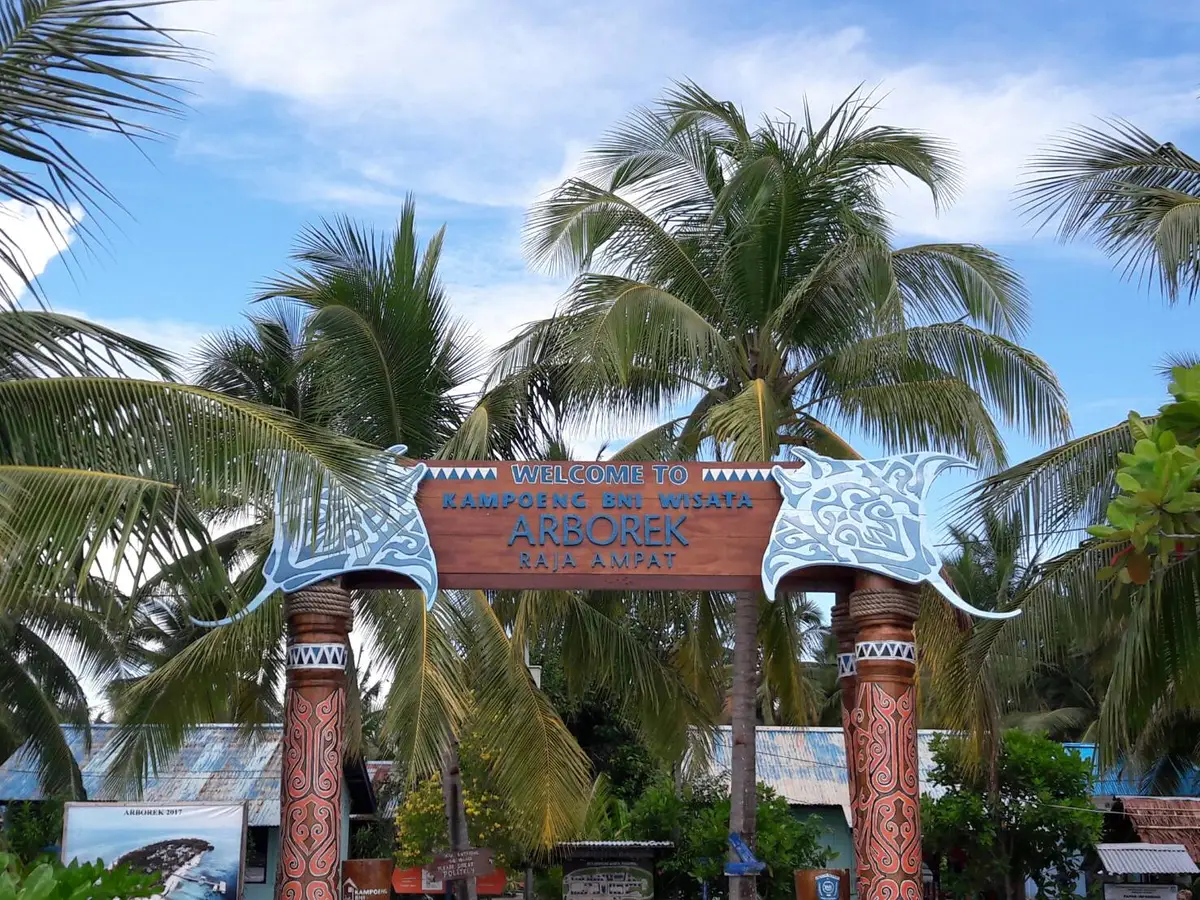
The women of Arborek are known across the regency for weaving. They make noken, the netted and woven bags carried all over Papua, along with baskets, mats and hats from sea pandanus leaves dyed with natural colours. The design visitors buy most is a hat shaped like a manta ray, which the weavers started making only in the 2010s as Manta Sandy became famous. Expect to pay IDR 200,000 to 300,000 for a hat or a bag, which is little for something that takes days to weave. Weaving and dance lessons can be arranged with enough notice.
The Arborek welcome dance, body paint and bark-cloth dress
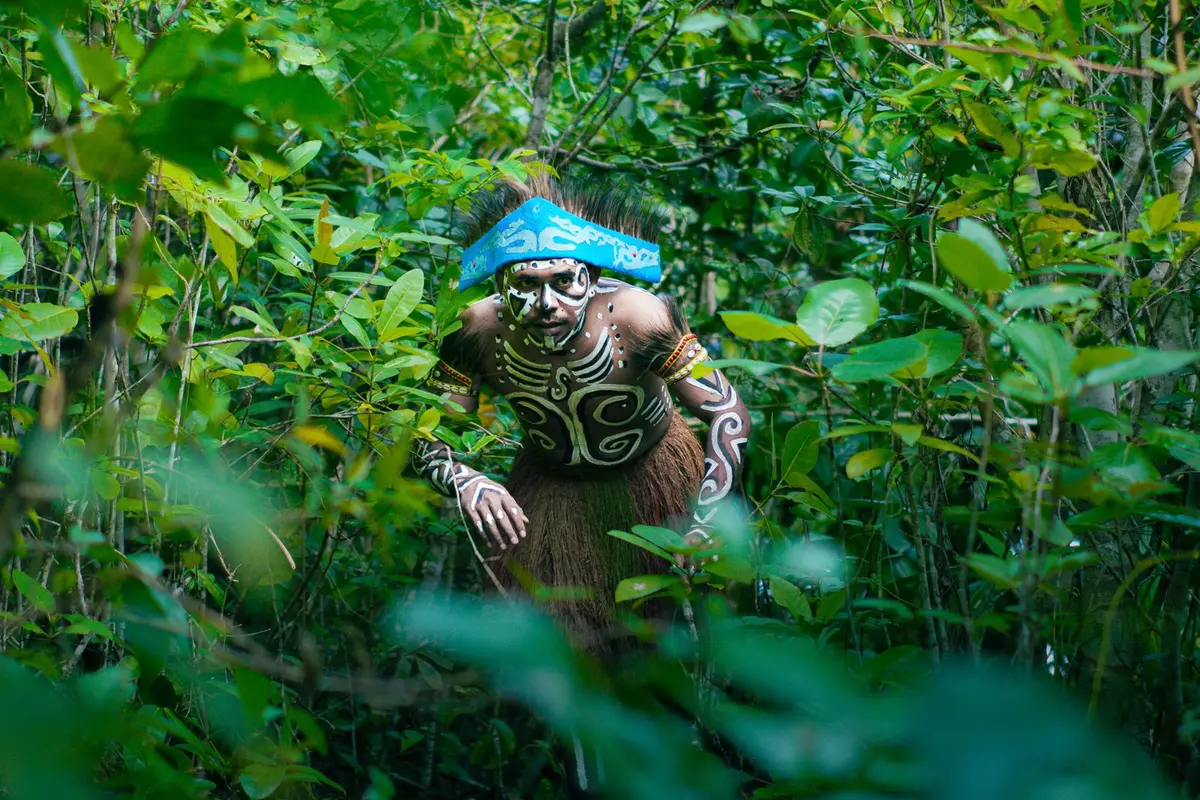
This is the scene that ends up on postcards. A boat pulls up to the long wooden jetty, drums start, and a line of children, usually around a dozen of them from the village primary school, comes down the pier in skirts and headdresses made from tree bark and palm leaf. Their faces, arms and chests are painted with white patterns. The boys carry small bows and arrows. Five or so adults play the drums and sing.
The dance itself tells a story, and it is worth knowing it before you watch. It shows how the people of Raja Ampat lived before outboard motors and fish markets: paddling from island to island to feed their families, fishing from canoes, and hunting birds in the forest with bows. Watch the movements and you can follow it, the rowing strokes, the casting and hauling, the archers creeping and drawing. It ends with the visitors being welcomed onto the island, sometimes by being pulled into the dance.
Be clear about what you are watching. Nobody in Arborek dresses like this day to day; in daily life people wear T-shirts and shorts like anywhere else in Indonesia, and the village is a Christian community with a church at its centre. The bark cloth and body paint are ceremonial dress, the kind still worn across Papua for festivals, weddings and welcoming important guests, and the performance is a staged version of that tradition put on for visitors who book it. That does not make it fake. It is the community choosing to keep the costumes, songs and steps alive by teaching them to its children and earning a living from them, which is how a lot of living culture survives in small places.
The practical points matter. The dance is not performed on demand; Indonesia's tourism ministry lists it as an attraction for groups who have booked in advance, and we arrange it through the village ahead of the day. The fee goes to the dance group and the village. The last figure published in the Indonesian press was IDR 2.5 million per group in 2018, roughly USD 140 at today's rate, and it is likely higher now. Shared across a full boat it comes to very little per person. The dancers are schoolchildren, so the time is agreed with the village rather than chosen by us.
On photography, ask first and follow the lead of the adults. Some groups have been asked not to film during the dance itself and to take photographs afterwards, when the children are happy to pose. A sign on the pier asks visitors to dress politely and not to fish from the jetty. Coming straight off a dive in a swimsuit is common, but a T-shirt and sarong or shorts over the top is what the village prefers once you walk past the jetty into the street.
Wor, Yospan and Bintaki: the traditions behind the performance
The children's dance at Arborek is one local expression of a much older and wider set of traditions. Raja Ampat sits at the meeting point of two worlds, Melanesian Papua and Austronesian eastern Indonesia, and its culture is a mix of both.
Seafarers from Biak, an island off Papua's north coast, were reaching Raja Ampat perhaps 2,500 years ago, setting up seasonal fishing camps long before they settled for good. They brought the Wor, a dance and song cycle originally performed to welcome visiting kings and nobles to a village. Its descendants are the welcome dances you see on jetties across the regency today, Arborek's included. Another dance, the Bintaki, comes from Kabare in North Waigeo and mimics the movements of fishermen. Its origin story involves a man who heard Bintaki songs coming from the forest while he was fishing with poisonous Bore root, and joined in.
The Yospan is different again. Short for Yosim Pancar, it combines two Papuan folk dances into a fast, cheerful social dance for young men and women, the kind performed at weddings and festivals rather than ceremonies. Waisai hosts the Festival Pesona Raja Ampat each year, usually in October, which reached its tenth edition in 2024, where village groups compete in Yospan in costume and body paint. If your dates happen to line up, it is the one time of year you will see many villages' dance groups together.
The name Raja Ampat itself comes from a founding story. In the version told on Waigeo, a woman found seven eggs; four hatched into the kings of Waigeo, Salawati, Batanta and Misool, giving the islands their name, "four kings". The village of Wawiyai on Waigeo keeps sacred objects and ancestral burial sites linked to the old kingdoms, and Misool has cliff paintings of hands, fish and animals that are thought to be several thousand years old. Some are painted on karst walls right at the waterline and are seen from a small boat.
Body paint, for what it is worth, has a long history across Papua and is not specific to Raja Ampat. White clay or lime is the most common pigment, applied in lines and dots, sometimes with red ochre and charcoal black. The patterns vary between groups and occasions. What you see at Arborek is a simplified version, painted on children in a few minutes before the boats arrive.
Sasi and Manta Sandy: how Arborek protects its reef
If the welcome dance is what visitors photograph, sasi is what visitors should understand. Sasi is a customary law found across Maluku and Papua under which a community closes an area of reef, or bans the harvest of a species, for a set period. It is declared in a ceremony, enforced by the village and the church, and lifted when stocks have recovered. Arborek uses it to protect sea cucumbers, lobster, reef fish and coral, and the rich shallows around the jetty are the result.
Manta Sandy is the clearest example of what happens when a village takes control. The cleaning station sits in 8 to 15 metres of water between Arborek and Mansuar, inside the village's customary waters. As Raja Ampat diving boomed, the site became overcrowded; Indonesian reporting from 2017 describes up to 50 divers at once, some chasing and touching the mantas, and the animals starting to stay away. In 2016 a manta working group was formed with the regency, conservation organisations and local villages, and from June 2017 new rules applied. Every group now registers at the manta post before entering the water, the rangers (many of them from Arborek) check the marine park card, and no more than 20 divers may be at the site in any one hour. Divers kneel behind a line of markers and wait for the mantas to come to them.
We follow those rules on every dive there, and on most mornings in season the mantas turn up. Our article on the best dive sites in Raja Ampat covers Manta Sandy and Arborek Jetty from a diver's point of view. The point here is simpler. When a village welcomes you with a dance and then asks you to kneel behind a line and keep your hands to yourself, it is the same community and the same idea: the sea is theirs, and they have decided to share it on their terms.
Other villages and the red bird of paradise
Arborek is the best known of the Dampier Strait villages, but not the only one open to visitors. Sawinggrai, on the southern tip of Gam a short boat ride away, is famous for two things: the reef fish that crowd under its jetty, and the red bird of paradise (Paradisaea rubra) that displays in the forest behind the village. The red bird lives only on Waigeo, Batanta and neighbouring Gam. Males gather in display trees at first light, and seeing them means a walk of 20 to 40 minutes uphill in the dark with a village guide, arriving before about 6 am. Wilson's bird of paradise, smaller and absurdly colourful, is found on Waigeo and Batanta and is harder to see.
Yenbuba, near Kri, is a quieter landing with a white beach. Religion varies across the regency: many communities on Misool and parts of Salawati are Muslim, while most villages in the Dampier Strait are Christian, a pattern that goes back to the old ties with the Tidore sultanate and the missionaries who came later. Arborek's own church, GKI Ebenhaezer, traces its congregation to 1942, when the first evangelists reached the island; a monument by the church marks it.
These visits are not part of every itinerary, and the bird walk in particular depends on where the boat is anchored the night before. If any of them matter to you, tell us when you book rather than on board, so the cruise director can plan the route around them. Our guide to a liveaboard for non-divers and snorkellers covers the other topside options across Indonesia.
What to check before a village visit or a Kali Biru swim
None of this is complicated, but most of the friction we see on village visits comes from small things nobody mentioned in advance.
1. Cash in small notes
Do not count on card payments in Warsambin or Arborek, and the nearest ATMs are in Waisai. Village fees, crafts and drinks are paid in rupiah. Carry IDR 50,000 and 100,000 notes; change for a IDR 100,000 note can be hard to find on a small island.
2. What to wear
For Kali Biru, a swimsuit under quick-dry clothes, water shoes or booties, and no long trousers. For Arborek and other villages, cover shoulders and knees once you leave the jetty. A sarong solves both problems and dries fast.
3. Sunscreen and the spring
Kali Biru bans lotions in the water, and that includes sunscreen and insect repellent. Put both on after the swim, not before, and cover up with a hat and a rash vest for the walk instead.
4. Photographs of people, especially children
Ask before photographing anyone up close. During the welcome dance, follow whatever the adults running it ask; if they ask for no filming during the performance, put the phone away. Children in costume are usually happy to pose afterwards. Drones need the village's permission and, in practice, are best left on the boat.
5. Sundays
Sunday is church day in Christian villages. Morning services often run for a couple of hours, the village goes quiet, and the dance group is usually not available. A visit on Sunday afternoon is fine; a booked dance on a Sunday morning usually is not.
6. The weather and the river
Heavy rain raises the river and makes the wade harder and slower. We decide on the day, and we would rather move the visit or drop it than send guests up a swollen river.
7. What to buy, and what not to
Woven noken, manta hats and pandanus baskets are made on the island and the money goes straight to the weavers. Do not buy shells, coral or anything made from turtle shell; it is illegal to export, and buying it is exactly the harvest that sasi exists to stop.
Kali Biru, Arborek or both: how to choose
Arborek is the easy one. It sits beside two of the Dampier Strait's regular dive sites, so a village visit fits into a surface interval of an hour or so and costs you nothing in dives. Kali Biru is a bigger commitment, and whether it is worth it depends mostly on how much diving you want and how long you are staying.
| Visit | Time needed | Typical cost | Best for | Limits |
|---|---|---|---|---|
| Arborek village walk | About 1 hour | Crafts only | Everyone on Dampier Strait days | Quiet on Sunday mornings |
| Arborek welcome dance | About 1 hour | Group fee, shared | Families, photographers, culture | Must be booked ahead |
| Kali Biru swim | About half a day | IDR 100,000 entry plus boat | Non-divers, longer trips | Costs one or two dives |
| Sawinggrai birds | Dawn, 2 to 3 hours | Guide fee | Birders, early risers | Depends on anchorage |
Divers on a first Raja Ampat trip usually want every dive they can get, and for them Arborek alone is the right call. Returning divers who have already done the central sites several times tend to be keener on Kali Biru, and so do non-diving partners, for whom a half day in the forest is a highlight of the week rather than a cost. Families with children almost always want the dance.
Route matters too. Our Raja Ampat departures run from Sorong between November and April, and the north and central and south and central routes both spend time in the Dampier Strait, so Arborek fits either. Kali Biru is easier on routes that spend time around Waigeo. If the timing of your trip is still open, our guide to the best time to visit Raja Ampat lays out the months and conditions, and how to get to Raja Ampat covers flights into Sorong and the ferry to Waisai.
Who these visits are for, and who they are not for
Two of our boats sail Raja Ampat each season. King Neptune, our largest boat at 46 metres with ten cabins and nitrox included, and Neptune One, a 38 metre phinisi taking 16 guests in eight cabins, both run seven-night routes out of Sorong from November to April. On either boat, an Arborek visit or the welcome dance and a Kali Biru excursion can be arranged; the earlier you ask, the easier the route is to plan around it.
These visits suit non-diving partners, families, photographers and divers on a second or third trip who want to see more of the place than the reef. They suit anyone curious about how a Papuan island community lives and protects its sea. They also suit divers who want a day off between dives without the boat leaving the area.
They are not for everyone. If you have saved for years for one week of maximum diving in Raja Ampat, skip Kali Biru; the half day costs dives you will not get back, and the Arborek jetty dive gives you a look at the village from the water anyway. Kali Biru is also a poor fit for anyone with limited mobility, since the walk involves wading over loose, slippery stones with no handrails. And if you want a "traditional" village untouched by tourism, Arborek is the wrong place to look for it; it is a proud, well-organised tourism village, and that is exactly what makes it a good one to visit.
If you are comparing routes, our Raja Ampat liveaboard trips page lists the itineraries, and scuba diving in Raja Ampat covers the diving side in more depth.
Key takeaways
- Kali Biru is a cold, spring-fed blue pool up a river at Warsambin, on Waigeo's Mayalibit Bay, that you swim in rather than dive.
- A Kali Biru visit takes about half a day; budget IDR 100,000 entry per person plus the village boat, in cash.
- Arborek's welcome dance, in bark-cloth dress and white body paint, is a staged ceremonial tradition and must be booked in advance.
- Arborek's sasi rules and the Manta Sandy limit of 20 divers an hour are why the reef there is still so rich.
- Dress modestly in villages, carry small rupiah notes, skip sunscreen in the spring and avoid Sunday mornings.
- Both visits can be arranged on King Neptune and Neptune One between November and April; ask when you book.