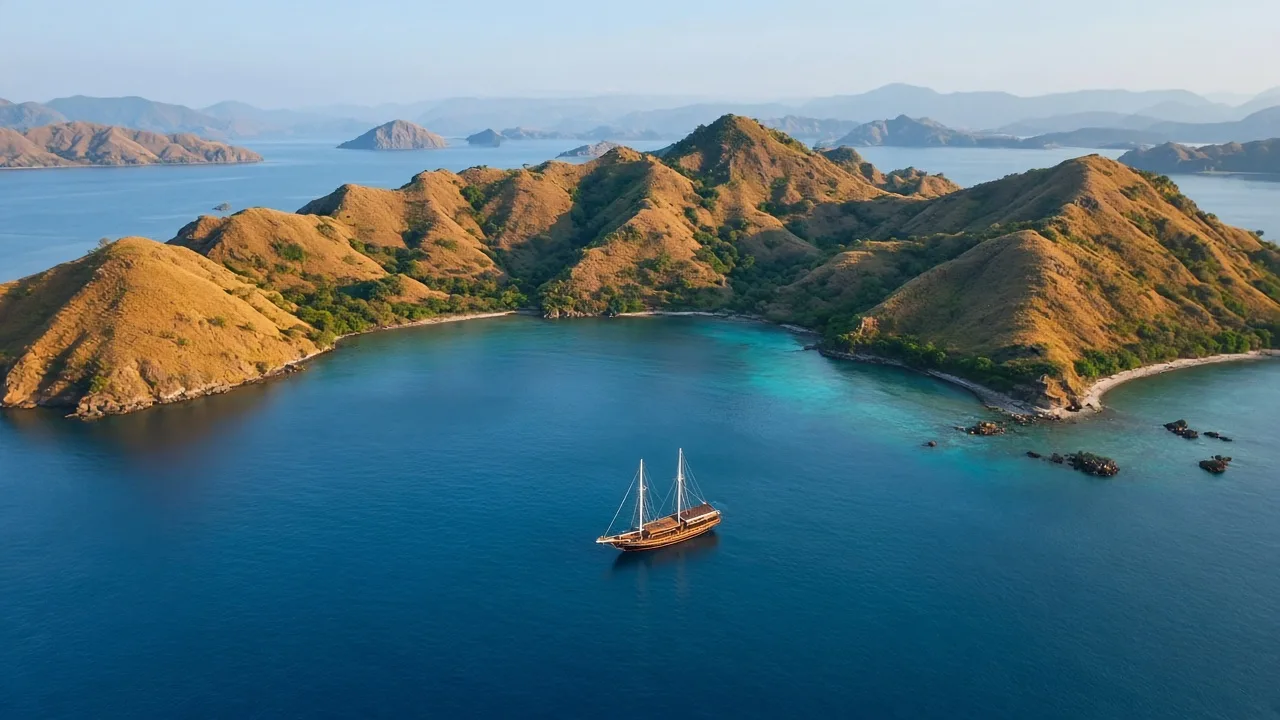
Stand on the bow of a boat crossing from Manado and you can see the whole story of Bunaken before you get wet. Five islands scattered across a deep blue bowl, a dormant volcano rising out of the sea, and a shoreline that drops from knee-deep coral gardens into water more than a kilometre deep within a few boat lengths. That drop is the point. Bunaken National Marine Park, established in 1991 and covering roughly 89,000 hectares off North Sulawesi, is Indonesia's great wall-diving destination, a place where the reef does not slope away politely but falls off a cliff, and where green turtles are so common that guides stop pointing them out somewhere around the seventh one.
Most divers researching scuba diving in Indonesia hear about Raja Ampat, Komodo and Lembeh long before anyone mentions Bunaken, which is odd, because Bunaken was famous first. Through the 1990s it was the name that put Indonesian diving on the world map. It then spent two decades being quietly overshadowed by newer, flashier destinations. The reefs did not get the memo. The walls of Lekuan are still draped in sponges and soft coral, the visibility still stretches past 30 metres on a good day, and the logistics are still among the easiest in the country: an international airport 45 minutes from the jetty, no domestic connection required if you fly in via Singapore. This guide covers the park, the sites, the critters of Manado Bay next door, and how Bunaken fits into a North Sulawesi liveaboard route.
What Makes Bunaken Different
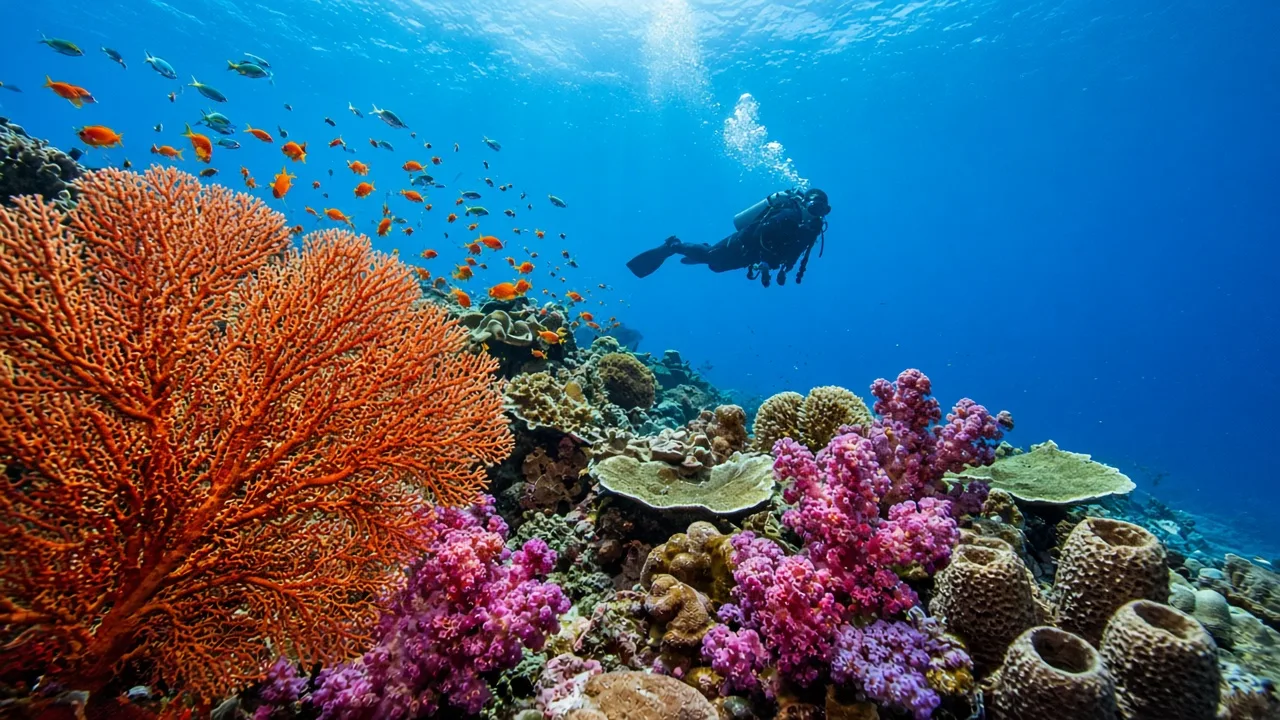
Plenty of places in Indonesia have walls. Bunaken has walls the way Komodo has current, as the defining fact of the destination rather than an occasional feature. The five islands of the park, Bunaken itself, the volcano cone of Manado Tua, low-lying Siladen, Mantehage and Nain, all sit on the rim of an underwater shelf that plunges into the 1,500-metre depths of the Celebes Sea. When you roll off the boat at a site like Lekuan II you descend over a metre or two of reef flat and then the bottom simply vanishes. What replaces it is a vertical face of hard coral, barrel sponges the size of bathtubs, sea fans, and crevices stuffed with life, continuing down far beyond anything your dive computer will let you visit.
Wall diving rewards a different rhythm to reef diving. You hang. You drift slowly along the face, usually with a gentle current doing the work, and the wall scrolls past like a mural. Turtles are the headline act here, and the numbers are honestly a little absurd. The park's green and hawksbill turtle population is one of the densest in Indonesia, and a single dive along Lekuan or Fukui might produce fifteen or twenty of them, wedged into sponge-lined notches, dozing on ledges, or paddling up the face to breathe. We have seen guests stop photographing them halfway through a dive, which almost never happens anywhere else.
The other thing worth understanding is the water itself. Bunaken sits in the flow of deep, clear oceanic water moving through the Sulawesi Sea, which is why visibility here is usually generous, often 25 to 35 metres, and why the walls host such dense filter-feeding growth. The same depth that gives the park its drama also brings occasional visitors from the open sea. Blacktip and whitetip reef sharks patrol the faces, eagle rays pass in the blue, and in most years there are a handful of encounters with something bigger, a thresher, a passing mola, once in a while even dugongs in the shallow seagrass around Siladen and Nain. Nobody should book Bunaken for pelagics. You book it for the walls, the turtles and the ease, and treat anything large as a bonus.
The park also carries real historical weight in Indonesian conservation. Bunaken was one of the country's first marine national parks, and through the 1990s it became the test case for an idea that now sounds obvious: charge visitors a fee, hand a meaningful share of the money to the villages inside the park, and let the people who live on the reef become its wardens. The system wobbled at times, fee collection lapsed in some years and enforcement budgets came and went, but the bones of it held. Today roughly 30,000 people live within the park's boundaries across a couple of dozen villages, patrol boats funded by entrance fees work the no-take zones, and destructive fishing, which scarred sections of reef in the 1980s and early 1990s, has largely disappeared from the core dive areas. The reef flats on top of the walls, the part snorkellers see, have visibly recovered over the past two decades. None of this makes Bunaken pristine, because no reef with a city of 400,000 people on the horizon is pristine. It makes it something arguably more interesting: proof that a heavily used reef system, managed imperfectly but persistently, can keep world-class diving alive for 35 years and counting.
The Dive Sites: Lekuan Walls, Fukui and Manado Tua
The park holds somewhere around 20 regularly dived sites, most of them strung along the southern and western rim of Bunaken Island and the flanks of Manado Tua. Conditions decide the day's plan. Currents in the park are usually mild to moderate, but the deep water close by means the occasional downwelling on the walls, so guides watch the bubbles and keep groups tight against the face when the water starts moving downhill.
Lekuan I, II and III
The Lekuan sites are the classics, three adjoining stretches of the same immense wall on Bunaken's south coast, and if you only had one day in the park this is where your guide would take you. Lekuan II is the crowd-pleaser: a gentle descent onto a face carpeted in hard coral and giant barrel sponges, with turtles essentially guaranteed. Lekuan III adds chimneys and cuts in the wall, and a slightly higher chance of reef sharks off the face. Depths are whatever you make of them. The wall keeps going long after the fun stops, so most dives ride the 18 to 25 metre band and finish in the shallow coral gardens on top, which are superb in their own right.
Fukui Point
Fukui, on Bunaken's western side, breaks the pattern. Instead of a sheer face it is a sloping terrace of ridges and sandy channels, with a small fleet of giant clams, some of them close to a metre across, arranged along the reef like parked cars. Schooling fish gather here in numbers, midnight snappers, batfish, barracuda in loose spirals, and because the topography is gentler it is a favourite for photographers who want reef scenes rather than wall panoramas.
Sachiko Point, Mandolin and the East Side
Sachiko Point, named in the early days for a Japanese guest and never renamed, is the connoisseur's wall on Bunaken's northeast corner. It runs deeper and wilder than Lekuan, with overhangs, big gorgonian fans and a better-than-average chance of eagle rays cruising the drop-off. Mandolin, nearby, is the site guides pick when the current runs, because moving water switches on the whole face: pyramid butterflyfish in clouds, redtooth triggerfish flickering in and out of the wall like static, and turtles somehow asleep through all of it. Muka Kampung, in front of the village on the island's south side, is an easy, pretty dive that doubles as one of the park's most reliable spots for banded sea kraits. None of these sites will appear on a one-day itinerary. They are the reason to give the park three or four days rather than one, and the difference between ticking Bunaken off and actually knowing it.
Manado Tua and Siladen
Manado Tua, the old volcano that dominates every sunset photo taken in the park, offers the steepest and wildest diving. Sites like Tanjung Kopi and Negeri pull a bit more current than the Bunaken walls and reward it with denser fish action, dogtooth tuna and jacks hunting off the point, and the park's better odds of hammerhead rumours coming true, though we would gently file those under folklore until you see one yourself. Siladen, the small island northeast of Bunaken, has a soft, pretty wall that catches afternoon light beautifully and makes a relaxed third dive. The northern islands, Mantehage and Nain, see far fewer boats; their mangrove channels and seagrass flats are where the park's dugong stories usually come from.
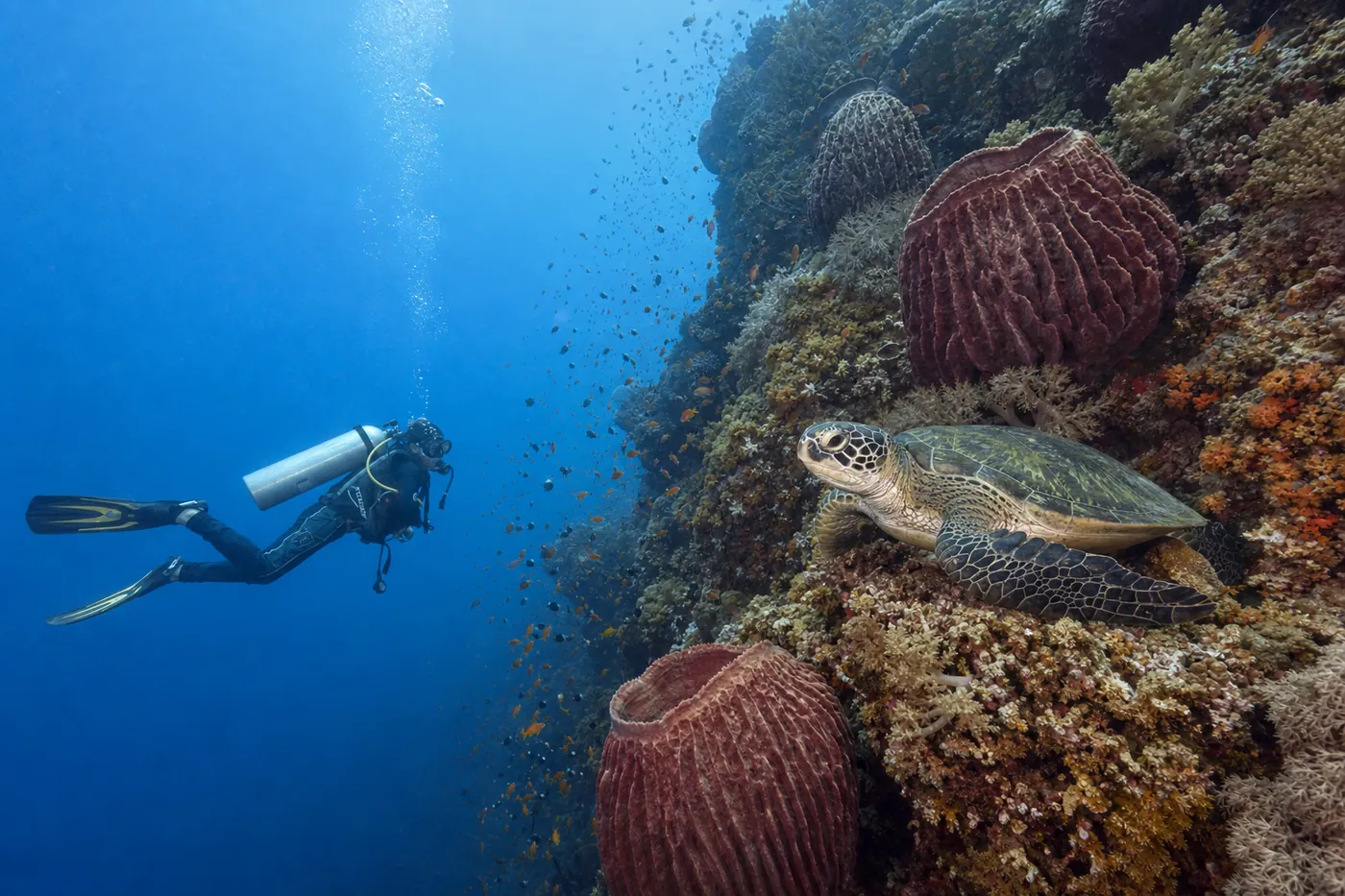
One dive from our own log, for honesty's sake. On a crossing trip that paused in the park a couple of Octobers back, two of our guests started a private competition at Lekuan II: first to twenty turtles buys the sundowners. They both hit twenty. On the same dive. The count stopped at 27 because the guide, who had been dragged into adjudicating, needed his slate back for an actual briefing note. We have run trips in most corners of Indonesia and there is nowhere else we would have believed that number.
Manado Bay Muck and the North Sulawesi Circuit
Here is the part most first-time visitors miss. The mainland coast facing the park, the stretch of dark sand between Manado city and the airport, is a legitimate muck diving destination in its own right. Manado Bay does not have Lembeh's fame and does not quite have Lembeh's density either, but on its volcanic slopes you can reasonably expect frogfish, seahorses, snake eels, flamboyant cuttlefish in season, and the occasional mimic octopus, usually with no other dive boat in sight. Resorts on the coast dive it as an afternoon alternative when guests want a break from the boat ride into the park, and photographers who allow a day for it rarely regret the decision.
Zoom out and Bunaken sits at the western corner of what might be the most efficient dive triangle in Indonesia. Ninety minutes by road gets you across the peninsula to Bitung and the Lembeh Strait, the world's muck diving capital. An hour north by boat from Lembeh brings you to Bangka Island, whose current-swept pinnacles are upholstered in soft coral so dense you cannot see the rock underneath. Wall diving, muck diving and soft coral wilderness, all within a two-hour radius, connected by decent roads and one airport. No other region in the country packs three such different underwater worlds so close together, and a ten-day trip that splits time between them covers more biological range than some entire countries offer.
The comparison with Lembeh deserves one more sentence, because divers planning a North Sulawesi trip usually ask which to prioritise. They are opposites. Bunaken is big scenery, clear water and animals measured in tens of centimetres to a metre; Lembeh is black sand, ten-metre visibility and animals measured in millimetres. Photographers pack a wide lens for one and a macro lens for the other, and the divers who love both tend to love them for entirely different reasons. If your logbook is short on either experience, do both. That is what the geography is for.
A note for the surface half of a travelling couple, or for anyone bringing a snorkel instead of a regulator: Bunaken is one of the few world-class dive parks where snorkellers get close to the full show. The walls start at the surface. The reef flats on top sit in one to three metres of gin-clear water, the turtles come up to breathe regardless of who is watching, and the drop-off itself, that dizzying view straight down a coral cliff into deep blue, reads even better from above than from 20 metres down. Guests who have snorkelled both told us the only comparable easy-access spectacle in Indonesia is the shallow coral at Wakatobi. Families and mixed diver and non-diver groups should keep the park high on their shortlist for exactly this reason.
Photographers, a word on lenses. Bunaken punishes indecision. The walls beg for the widest glass you own, rectilinear or fisheye, with sun balls, sponges and turtle silhouettes as the staple compositions, and in most years the water is clear enough to make ambitious reefscapes actually work. But the wall crevices also hide pygmy seahorses, orangutan crabs and nudibranchs in genuinely good numbers, and Manado Bay next door is a pure macro venue. If you own two camera setups, bring both. If you must choose one, we would say wide for the park and rent a second body for the bay, though roughly half the photographers we host argue the opposite with equal conviction.
Planning Your Trip: Access, Fees and Seasons
Bunaken's logistics are, by remote-Indonesia standards, refreshingly boring. The gateway is Sam Ratulangi International Airport (MDC) in Manado, served by multiple daily flights from Jakarta and Makassar plus direct regional connections from Singapore, which for many travellers removes the domestic-hop headache entirely. From the airport it is 30 to 45 minutes by car to the harbours, and 30 to 60 minutes by boat to the islands depending on where you are staying. A public boat runs from Manado's Calaca harbour to Bunaken village most afternoons for about IDR 70,000, though nearly all divers use their resort's or operator's transfer instead.
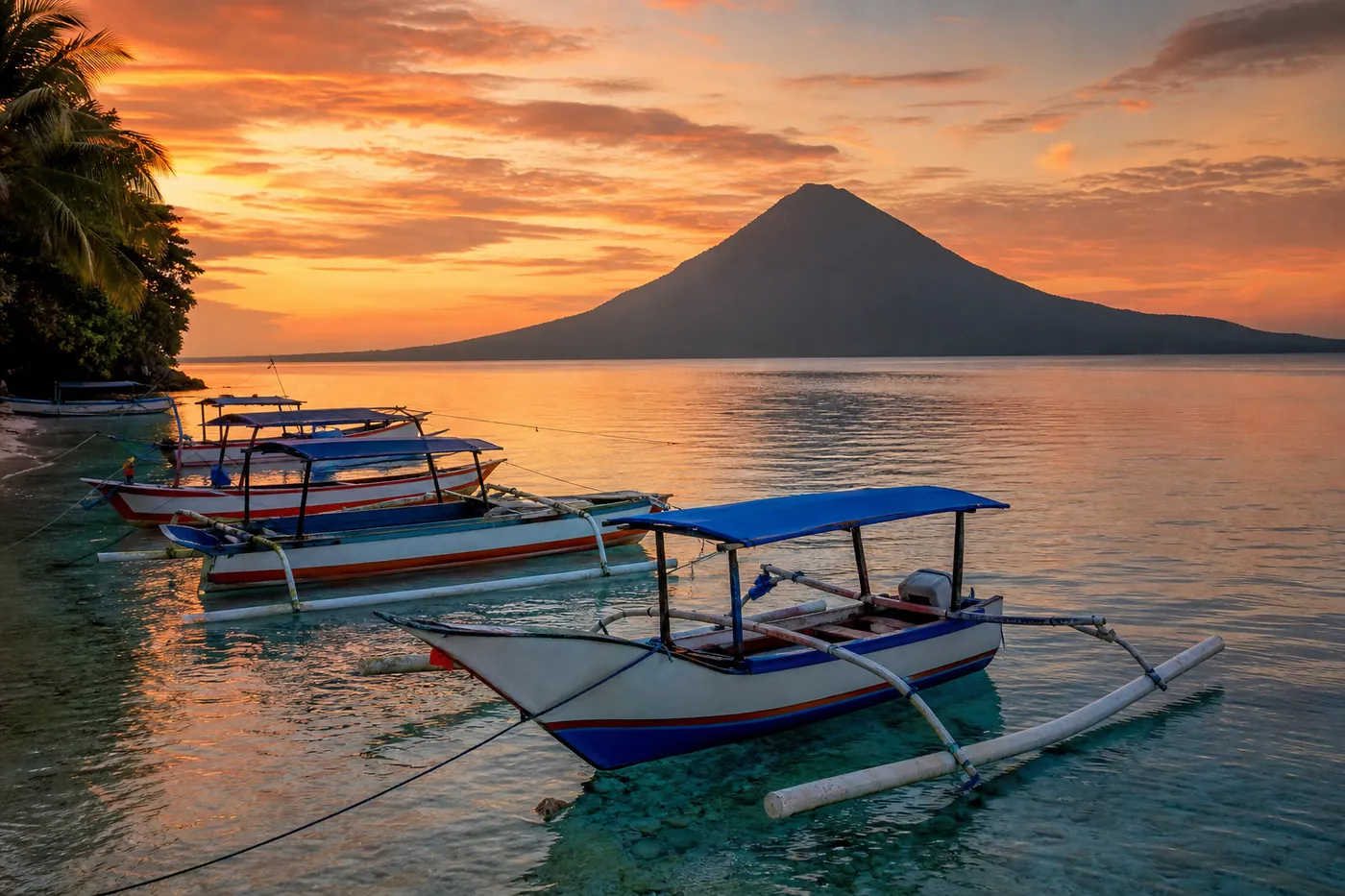
The practical notes, in brief:
- Park fee. Foreign visitors pay an entrance fee of IDR 150,000 per person per day (roughly USD 9 to 10), set under the 2024 tariff regulation. Diving carries a small additional activity tariff. Most operators arrange the tickets for you; keep the proof of payment handy as patrols do check.
- Season. The dry season, May through October, brings the calmest seas and the famous 30-metre visibility. The wet season from roughly November to April is still very diveable, with warmer, planktonic water and rain that tends to arrive in short bursts. We would call March to May and September to October the sweet spots.
- Water. Warm, usually 27 to 29 degrees Celsius. A 3 mm suit is plenty for most people; there are no Komodo-style thermoclines here.
- Experience level. Genuinely beginner-friendly. The walls have no bottom to crash into, which sounds alarming but actually means easy multilevel profiles, and currents are usually gentle. Newer divers should stay close to the wall and their guide in case of downwellings, which is standard briefing material at every operator.
- Where to stay. Three choices: resorts on Bunaken or Siladen island (in the park, shortest boat rides), dive resorts on the Manado coast (more comfort options, easy access to the bay's muck sites), or a liveaboard passing through.
The rhythm of a diving day here is gentle by Indonesian standards. Boats leave after a proper breakfast rather than at dawn, because the sites are ten to forty minutes away rather than two hours. Two morning dives on the walls, a surface interval spent drifting past Manado Tua with coffee and fried bananas, then either a third dive after lunch or an afternoon crossing to the mainland for a muck dive in the bay. Night dives happen off the island jetties, where Spanish dancers and hunting free-swimming morays are the usual entertainment. Compare that with the four-dives-a-day sprint of a Komodo or Banda Sea itinerary and Bunaken starts to look like what it quietly is: a recovery destination, the trip you take when you want superb diving without the logistics or the fatigue, or the soft landing you schedule before or after something more demanding. More than a few of our guests have sandwiched a Raja Ampat liveaboard between Bunaken days on either side, using Manado's Singapore flights as the back door in and out of eastern Indonesia, and rated the quiet bookends as highly as the main event.
Bunaken by Liveaboard: Where It Fits on a Route
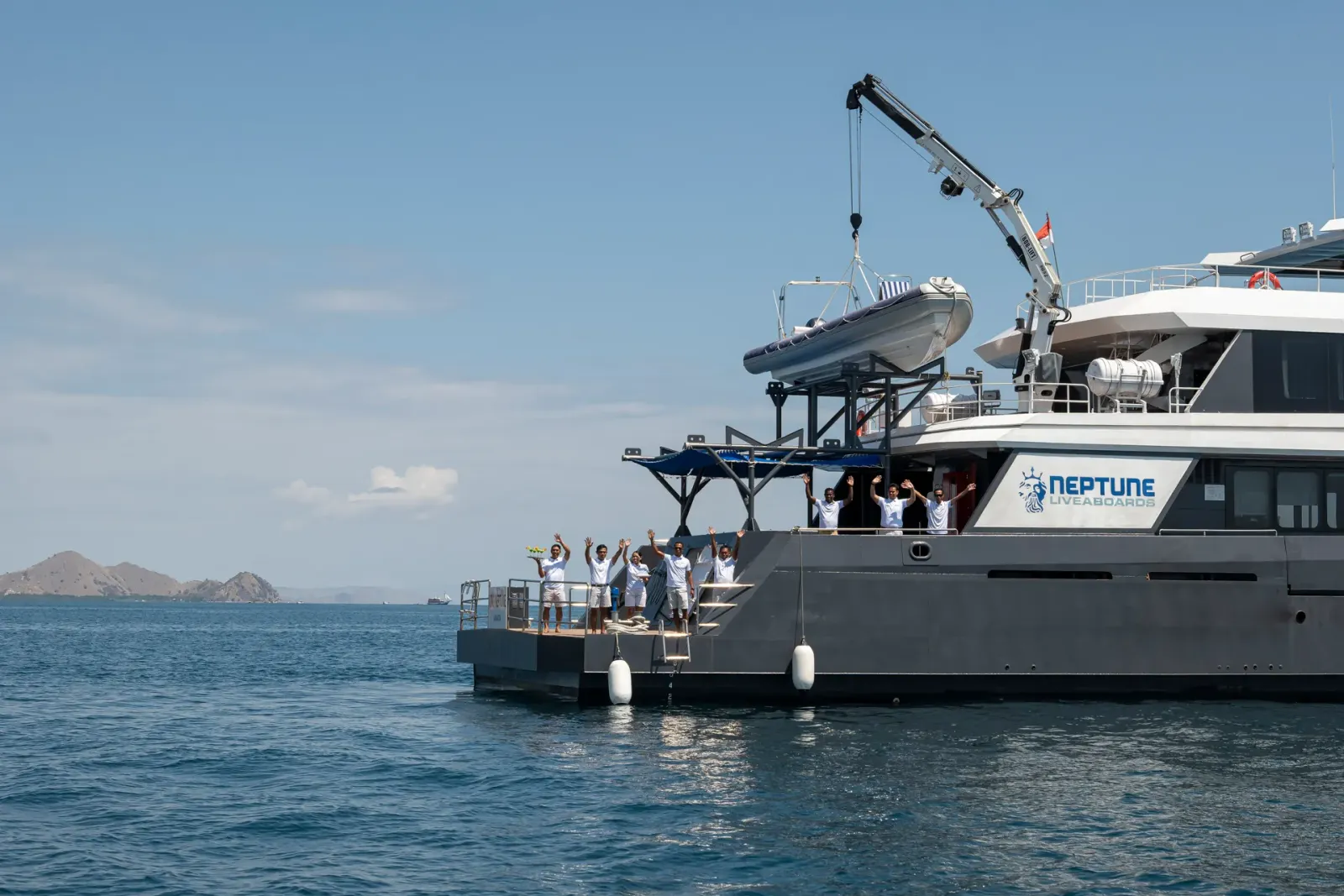
Bunaken is unusual among Indonesia's marquee destinations in that a liveaboard is not required. Land-based diving here works perfectly well, and for a focused week of walls plus Manado Bay critters a resort is arguably the more sensible purchase. So where does a boat come in? Routes. North Sulawesi is the hinge between two of Indonesia's great crossing corridors, and that is where Indonesia liveaboard itineraries earn their keep.
In the transition months, boats repositioning between the Komodo season and the Raja Ampat season thread through the northern arc of the archipelago, and the better itineraries string Bunaken, Bangka and Lembeh together with the remote reefs of Halmahera before dropping south toward Sorong. A trip like that gives you the walls of the park, the soft coral pinnacles of Bangka, a night or two of world-class muck in Lembeh, and then days of reefs that see perhaps a few hundred divers a year, all without repacking a bag. It is the kind of route that makes the case for liveaboard diving better than any brochure: not one destination, but the connective tissue between several.
Timing matters if the crossing idea appeals. These repositioning itineraries cluster in the shoulder months, roughly October to November heading east toward Raja Ampat and April to May heading back west, and each departure runs once, in one direction, with cabins that do not come around again for a year. They also tend to be priced kindly relative to the peak-season Raja Ampat weeks, since operators would rather sail the crossing with guests than without. The trade-off is unpredictability: a route through Halmahera and the Molucca Sea is weather-dependent, sites get swapped, and the schedule bends around conditions in a way a fixed Komodo loop never does. Divers who need certainty should book the resort. Divers who collect stories should book the crossing.
There is also a quieter argument for visiting sooner rather than later. Bunaken's story over three decades is one of a park that survived its own fame, weathered crown-of-thorns outbreaks, bleaching seasons and boat traffic, and still delivers dives that hold up against anywhere in the Coral Triangle. The entrance fees now visibly fund patrols and reef monitoring, village cooperatives run much of the tourism, and the turtle numbers keep climbing. In most years it is the least crowded famous dive destination in Indonesia. That is a strange sentence to write, and we suggest taking advantage of it while it stays true.
If a North Sulawesi crossing appeals, or you want help deciding between a Bunaken resort week and a liveaboard route that includes the park, talk to our team. We have dived these walls, counted the turtles, and lost the sundowner bet, and we are happy to share the honest version of what each option buys you.