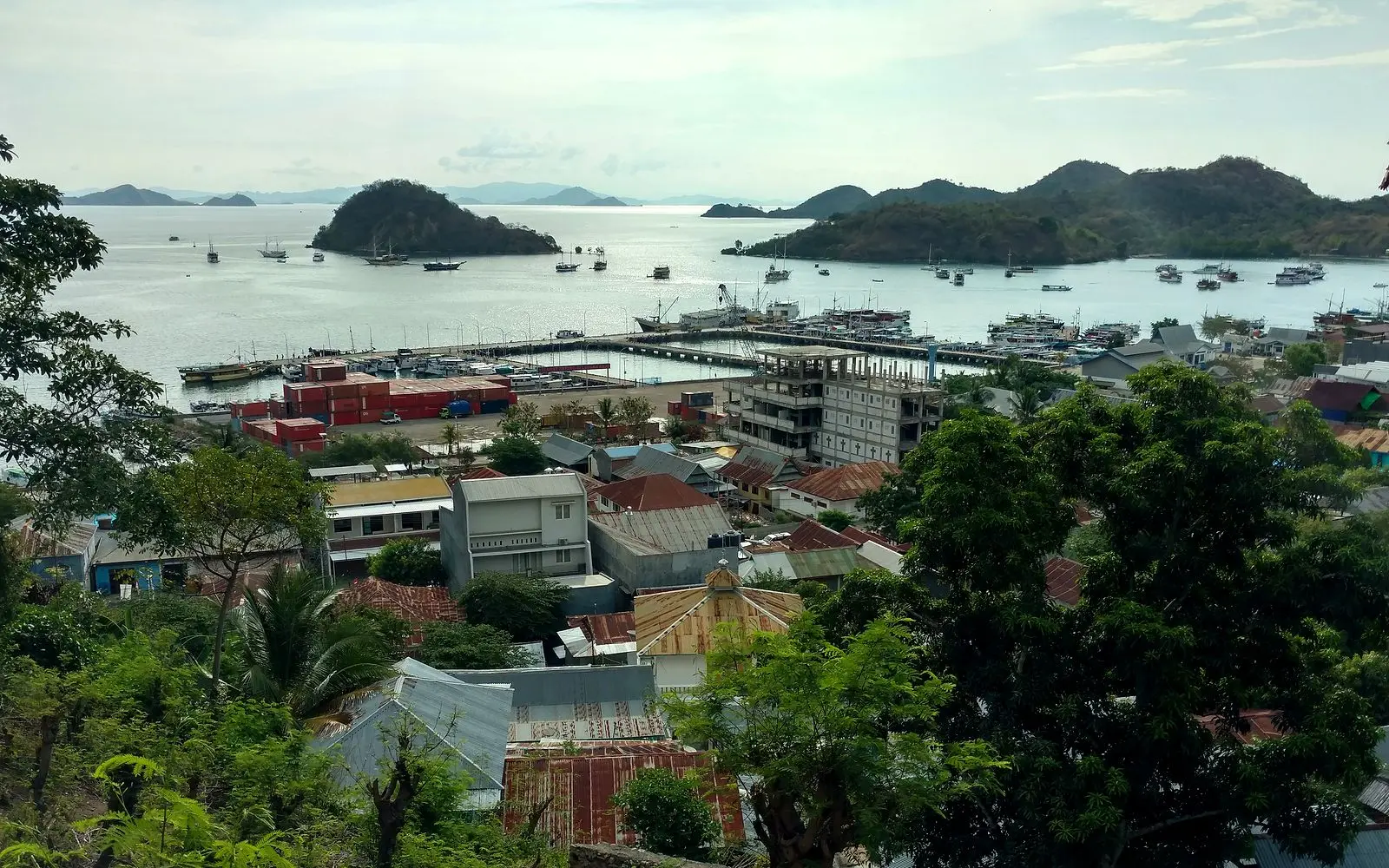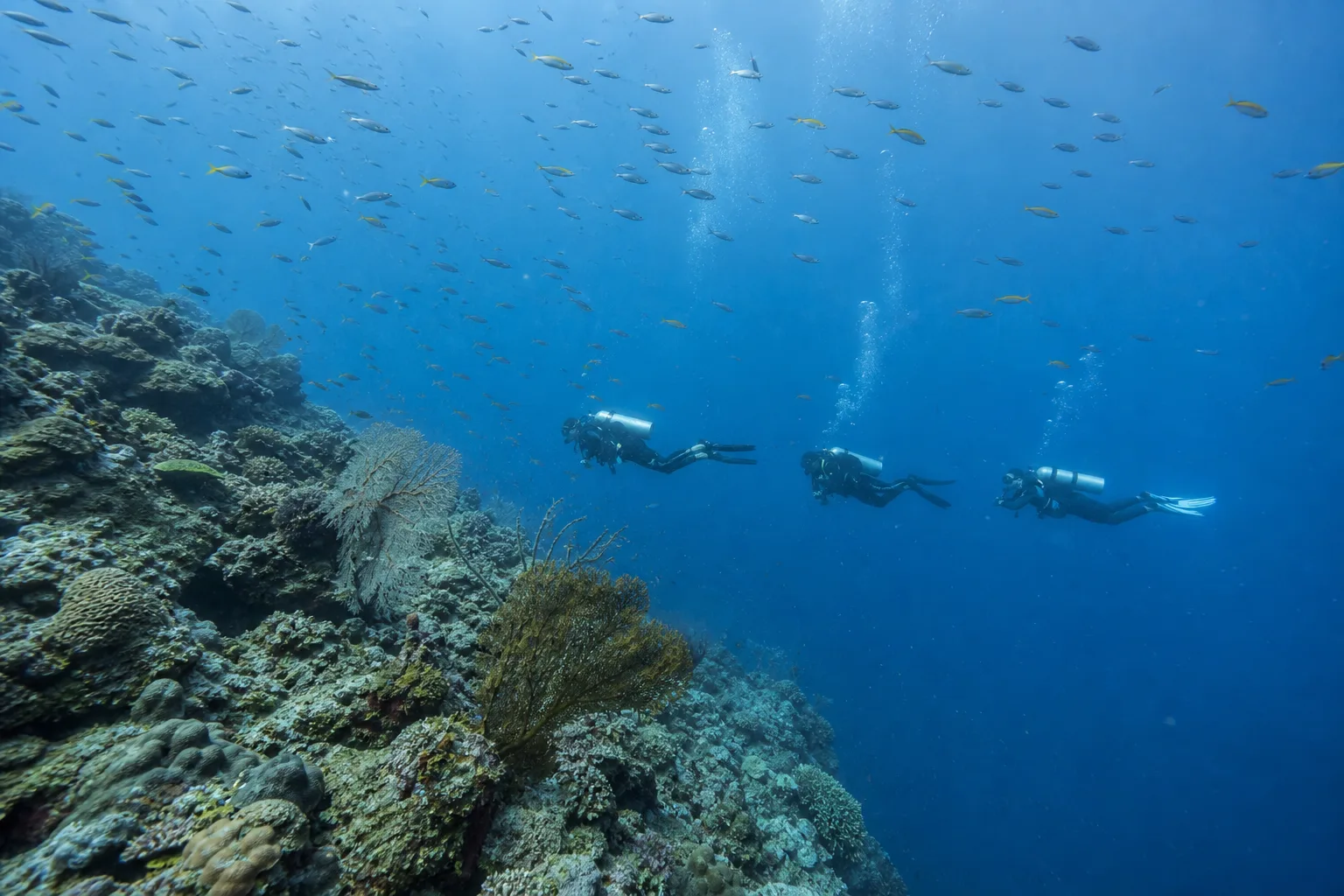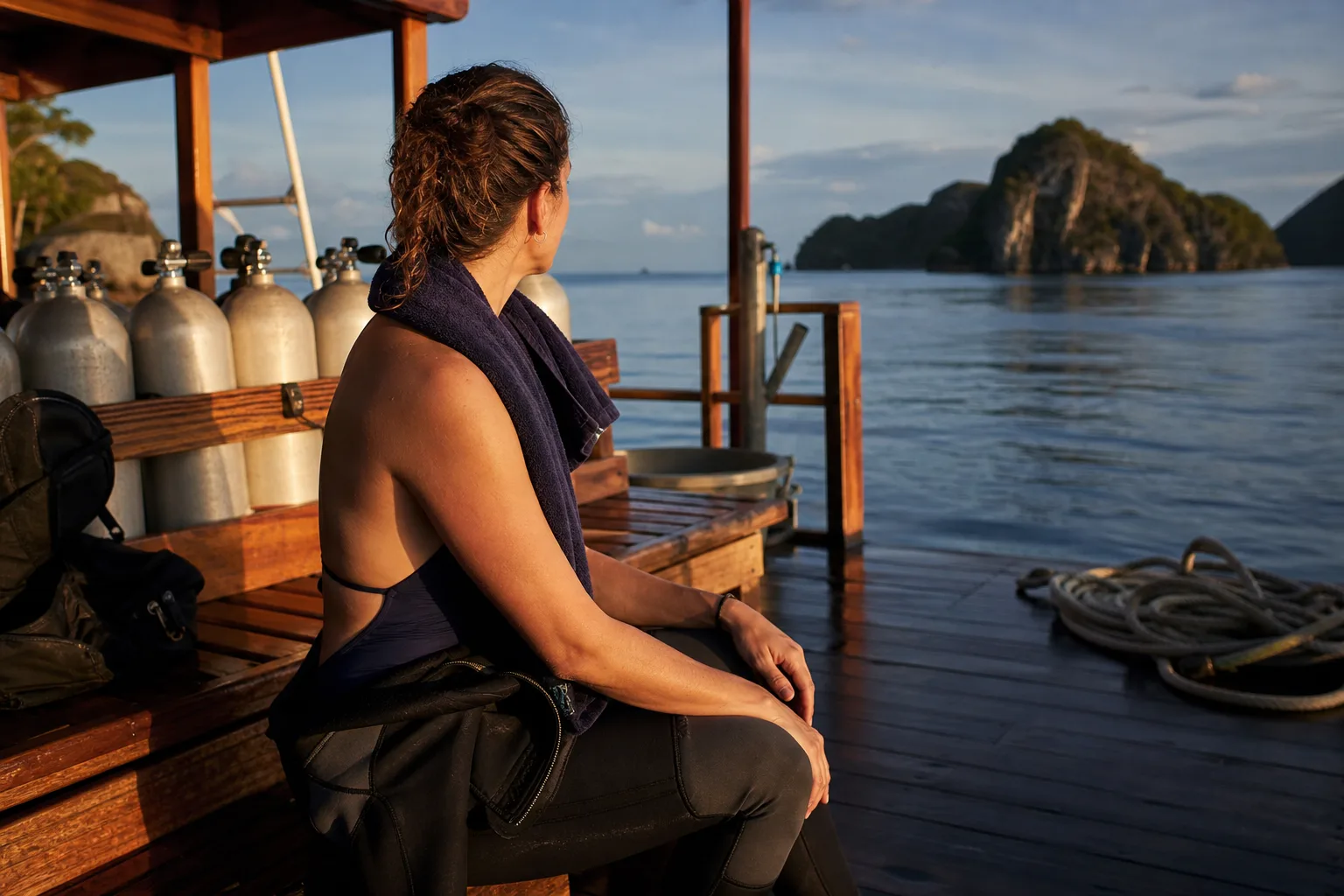
If you stand on a ridge above Loloda Bay at sunrise, you can see four active or recently active volcanoes from a single vantage point. The geography is what most divers notice first about Halmahera, the K-shaped main island of North Maluku that sprawls across 18,000 square kilometres of rainforest, mangrove and chain-of-volcanoes coastline. The geography also turns out to be the reason the diving works the way it does, and the reason we keep recommending Halmahera to repeat Indonesia guests as the next destination after Raja Ampat or Komodo. The deep oceanic trenches just offshore, the upwelling that wraps around the volcanic flanks, the absence of significant coastal development, and the presence of a recently re-designated marine reserve at the southern end (the Widi Islands) combine to produce a diving region with the species count of Raja Ampat, the wide-angle scenery of the Banda Sea and the wreck history of the Solomon Islands, all on the same itinerary. The full Halmahera destination guide covers the surface logistics; this article is the operator-side answer to the more focused question, which is what specifically makes Halmahera worth the trip and which 10 dive sites deserve to be on the must-do list for a 2026 visit.
The headline summary, before we dive into the regional breakdown, is that Halmahera is one of the very few Indonesian destinations where you can plausibly tick off four genuinely distinct diving experiences in the same week: schooling pelagics on a deep volcanic seamount (Goraichi), an intact WWII Pacific Theatre wreck site (Morotai), a recently protected pristine atoll system (Widi), and a high-density macro reef on volcanic rubble (Hailolo and Patani). The species side reads similarly. Halmahera hosts at least three endemic walking shark species (Hemiscyllium halmahera was formally described from these waters in 2013), the most reliable manta cleaning stations in northern Indonesia outside Komodo, the easternmost confirmed sightings of the elusive Indo-Pacific dugong, and a hammerhead aggregation site that operators are still in the process of charting. The wider Indonesia scuba diving authority page gives the cross-regional context; for Halmahera specifically, the rest of this article walks the geography, the four sub-regions and the 10 strongest dive sites in the order most liveaboards visit them.
Halmahera was, until very recently, the kind of destination operators talked about as up-and-coming for a decade without anyone actually running scheduled trips. That changed in 2022 with the formal designation of the Widi Reserve, the relaunch of dedicated Halmahera itineraries from Ternate and Sorong, and the publication of a usable bathymetric chart for the eastern bays by the Indonesian Hydrographic Office. The diving in 2026 is what Raja Ampat diving was in 2008, with the obvious difference that we already know what species are here and roughly how the seasons work. Most operators run between four and ten Halmahera-dedicated departures per year. Inventory is genuinely scarce in the strongest weeks (October through early December especially), and we have started recommending guests book Halmahera 12 months out for the first time. The upside of the scarcity is the diving itself, which is consistently quieter than the comparable Raja Ampat sites and still feels like working through an unsolved problem rather than re-running a known itinerary.
Halmahera geography: four sub-regions and what each one delivers
Halmahera divides naturally into four diving sub-regions, and the typical 11-night liveaboard route hits all four in sequence. A brief look at each makes the rest of this article easier to follow.
The northern group centres on Morotai Island and the Tanjung Wayabula peninsula. Morotai was an Allied airbase during the Pacific campaign and the seabed off its western beaches still holds aircraft wreckage from October 1944 through the end of the war: at least one B-25 Mitchell bomber, a Bristol Beaufighter, two anti-aircraft batteries that were tipped off the deck of a Liberty ship during evacuation, and a scattering of jeeps, bulldozers and ammunition crates. The wreck diving is the headline draw of the northern group, and the surrounding reefs (Mitita Wall, Pulau Dodola sandbar, Goro-Goro patch reef) round out the wide-angle programme. Visibility in this group is usually 25 to 35 metres in the dry season, and the water is calmer than the central or eastern groups because the Morotai shelf shelters most of the dive sites.
The central-eastern group centres on Loloda Atoll, the only true coral-atoll formation in the central Halmahera waters, plus the surrounding Goraichi Seamount and the smaller submerged pinnacles south of Tobelo. This is the wide-angle and pelagic core of a Halmahera trip. The Loloda outer wall is one of the longest continuous coral walls in Indonesia (roughly 9 kilometres of unbroken hard-and-soft coral cover), the inner lagoon is a manta cleaning station that operators are still figuring out how to access reliably, and Goraichi Seamount produces hammerhead encounters in the right tide window. The diving here demands current management and recent advanced certification.
The eastern bays are the macro-and-muck side of Halmahera. Patani Bay, Hailolo Bay and the smaller inlets along the eastern coast of the southern arm of the K are the species-density sites: walking sharks, mandarin fish, blue-ring octopus, the various ghostpipefish (Halimeda, ornate, robust), pygmy seahorses on the deeper Muricella fans, and the macro photographers' return list of nudibranch species. The diving here is technically easier than the central group (less current, shallower mean depth, more shelter), and the night dives produce a higher species count than any other part of Halmahera.
The southern Widi group is the recently protected atoll system at the southern tip of the southern arm. The Widi Islands were leased to a private development company in the late 2010s, the lease was contested by the local government and the Indonesian conservation authority, and the formal Widi Reserve designation in 2022 returned the islands to protected status. The diving in Widi is what Raja Ampat looked like before the operator buildout: roughly 70 named islands, a mostly intact reef system, and an outer atoll wall that drops to 1,500 metres on the southern flank. Operators have so far charted about 25 dive sites in the reserve. The most consistently impressive are the outer atoll wall on the southern face, the manta cleaning station at Pulau Daga, and the soft-coral pinnacles on the western edge.
One operating-side note before the site list. The four sub-regions are connected by overnight crossings of 4 to 8 hours each. The northern group sits closest to Ternate; the southern Widi group sits closest to Sorong. The standard 11-night Halmahera itinerary either runs north-to-south (Ternate to Sorong) or south-to-north (Sorong to Ternate), with the transit timings driven by the moon-and-tide window for the central group's pelagic sites. Trying to do all four sub-regions in fewer than 9 nights compresses the experience to the point where most divers come away feeling rushed; we typically recommend the full 11-night route to first-time Halmahera guests. The wider Indonesia liveaboard seasons guide covers the cross-regional timing in detail.
The Morotai wrecks: where Halmahera's WWII history meets the diving
The wrecks off Morotai are the most distinctive single feature of Halmahera diving, and the reason a meaningful share of our Halmahera bookings come from divers who have never been to Indonesia before. The history is straightforward. Morotai Island was captured by Allied forces in September 1944, converted into the most forward operational airbase in the Southwest Pacific theatre, and used as the main staging ground for the Philippines campaign and ultimately the assault on Japan itself. By the war's end, more than 60,000 personnel were stationed on the island and the surrounding seabed had collected a substantial inventory of aircraft, vehicles and equipment, partly through combat losses, partly through the post-war evacuation programme that pushed obsolete material off the deck of departing ships rather than transport it home. The seabed has held the wreckage well, the volcanic substrate is mostly stable, and the fish life has gradually colonised the structures over eight decades.
1. The B-25 Mitchell bomber wreck (Tanjung Sangowo)
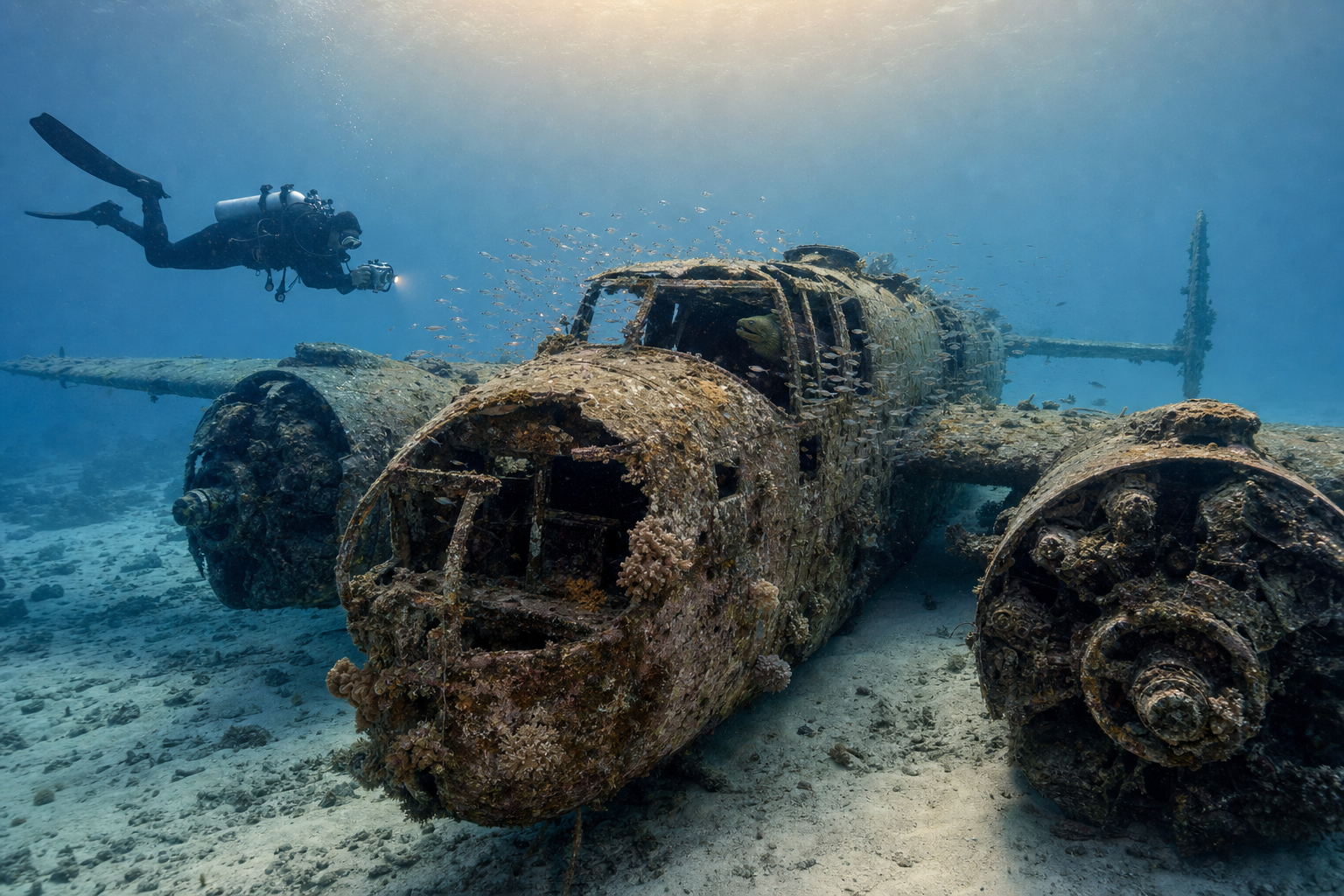
The most photographed wreck of the Morotai cluster. A North American B-25 Mitchell medium bomber sits upright on a sand flat at 22 metres depth, roughly 400 metres off the western beach at Tanjung Sangowo. The aircraft is largely intact: both engines are recognisable, the cockpit canopy is partially open, the bomb-bay doors have rusted off but the bay itself is clear, and the tail assembly is missing only the rudders. The fuselage hosts a resident school of glassfish and the cockpit is occupied by a moray eel that has been documented in the same position by photographers since at least 2018. The dive plan is conservative: descent to 22 metres along the upcurrent flank, slow circumnavigation of the wreck, ascent along the line. Bottom time 35 to 45 minutes depending on air consumption. The historical context is part of the briefing on every dive, and the recovery permit is held jointly by the Indonesian Cultural Heritage Office and the Australian War Graves Commission, so divers are asked not to enter the cockpit or remove any artefacts.
2. The Bristol Beaufighter wreck
Less photographed but technically the more interesting wreck of the cluster. A Bristol Beaufighter Mk. X long-range fighter sits at 28 metres depth, two miles north of the B-25 site, in a small natural bowl on the sand. The Beaufighter is more broken up than the B-25 (the impact angle was steeper and the airframe split on the underside) but the four-cannon nose section is recognisable, the radial Hercules engines are upright, and the tail assembly is still attached. The species side is excellent: a resident Napoleon wrasse, several blue-spotted stingrays, and the most reliable sighting of leaf scorpionfish in the Morotai cluster. Maximum recreational depth 30 metres for the dive. Visibility is typically 25 to 35 metres, with the best clarity in the September-to-November window.
3. The anti-aircraft battery dive (Pulau Zum-Zum)
The most unusual dive of the Morotai cluster. Two complete 40-millimetre Bofors anti-aircraft batteries, originally mounted on the deck of an unidentified Liberty ship, were tipped overboard during the post-war evacuation and now sit at 18 metres depth in shallow water just off Pulau Zum-Zum. The barrels are still trained skyward, the ammunition feed mechanisms are partly visible, and the surrounding sand has accumulated several rusted ammunition crates and a single Willys MB jeep that was apparently pushed off the same deck. The diving is shallow, current-free and forgiving, and Pulau Zum-Zum often serves as the second-day morning dive of a Morotai cluster visit. The historical curiosity factor is high; the marine life is moderate (anthias, fusiliers, the occasional barracuda passing offshore).
The northern reefs: wide-angle scenery beyond the wrecks
Three reef sites in the northern cluster deserve detailed treatment alongside the wrecks.
4. Mitita Wall
The eastern face of Pulau Mitita drops in a continuous coral wall from 6 metres at the surface to 50 metres on the deeper edge. The diving is the cluster's strongest wide-angle reef site: the wall is hung with massive Muricella and Melithaea soft-coral fans, the upper reef has a soft-coral garden in the 8-to-12-metre band that pulses on the right current, and the corner at the southern end of the wall produces schooling barracuda and the occasional grey reef shark. Mitita is current-dependent (the briefing on the day determines the entry point), and the maximum recreational depth is 30 metres. The wider Indonesia shark diving guide covers the species side; for Mitita specifically, the grey reef encounters are roughly 40 per cent of dives in the strong window.
5. Pulau Dodola sandbar
Pulau Dodola is the iconic surface scenery of Halmahera: two small mushroom-shaped islands connected by a 600-metre crescent of brilliant white sand that emerges only at low tide. The diving here is quite different from the rest of the northern group. The sand flat on the eastern side of the connecting bar slopes gently to 22 metres and hosts a high density of garden eels, juvenile reef fish, and the occasional eagle ray passing along the edge. The diving is easy (no current, sandy entry, shallow recreational profile) and is often used as a check-out dive on the first morning of a Morotai cluster visit. The surface scenery is the reason this site appears on every itinerary; the diving itself is the cluster's most relaxed.
6. Goro-Goro Reef
A submerged horseshoe reef twelve nautical miles east of Morotai, sitting in open water with no surface marker. Goro-Goro is the cluster's strongest pelagic reef: schooling fusiliers and snapper hold position on the upcurrent point in numbers that turn the water dark when they pass overhead, dogtooth tuna patrol the deeper edges, and the resident school of bigeye trevally has been logged at over 200 individuals in the strongest weeks. The dive is a slow drift along the curve of the horseshoe in whatever direction the current is running on the day. Maximum recreational depth 30 metres. Goro-Goro Reef is included on roughly 80 per cent of Halmahera itineraries, and the missed itineraries are usually weather-related (the open-water position makes the boat work harder than the sheltered Morotai sites).
The central group: Loloda, Goraichi and the pelagic core
The central-eastern sub-region is where Halmahera diving moves from "interesting" to "competitive with the best of Indonesia." Three sites in particular deserve detailed treatment.
7. Loloda Atoll outer wall
The single longest continuous coral wall in Halmahera. The outer face of Loloda Atoll runs roughly nine kilometres in a north-south arc, with the wall starting at 5 metres at the surface and dropping to over 1,000 metres on the deepest section. Operators typically dive three or four points along the wall on a Loloda day, and the geography rewards repetition: each section has a different soft-coral colouration and a different current pattern. The two strongest points are the southern corner (Tanjung Layar, with the deepest hard-coral plate-coral coverage and consistent grey reef encounters) and the central pinnacle (Batu Layar, with a school of bigeye trevally that has held position on the upcurrent face for at least the last three seasons). Visibility is consistently 30 to 40 metres in the dry season, and the soft-coral pulsing on the upper reef in the right tide is comparable to the best of Misool.
8. Goraichi Seamount
The most distinctive single dive in Halmahera and the site that converts wide-angle photographers into Halmahera repeat customers. Goraichi is a submerged seamount roughly 18 nautical miles east of Loloda, sitting in open water on the edge of the Halmahera Sea trench. The seamount tops out at 14 metres and drops to 60-plus metres on the outer flank, with a shoulder at 22 metres that hosts the schooling action and a lower terrace at 40 metres that is occasionally visited by hammerhead schools in the strongest tide windows. The hammerhead encounters are documented but not yet reliable: roughly one in three dives in the September-to-November window produces a confirmed sighting, and the single-encounter range is 6 to 30 individuals depending on the day. This is the dive most operators schedule for the strongest tide of the trip, and the briefing covers current management, deep-diving discipline and the safety case for the descent. Maximum recreational depth 30 metres for the standard plan. The wider Indonesian manta ray guide covers a species we do not list at Goraichi but which appears at the inner Loloda manta cleaning station, ten miles to the west.
The eastern bays: the macro side of Halmahera
The eastern coast of the southern arm of Halmahera is the species-density side of the trip and the part that surprises divers who came for the wrecks and the wall. Two bays in particular deserve detailed treatment.
9. Patani Bay (and Hailolo Bay)
The macro core of Halmahera. Patani and Hailolo are two adjacent bays on the eastern coast, both fronted by a black volcanic-sand slope that drops gently from the shoreline to 25 metres. The substrate hosts the species list that brings macro photographers to this corner of Indonesia: at least three Hemiscyllium walking shark species (H. halmahera, H. galei and H. henryi all confirmed in these bays), mandarin fish in resident populations on the shallow rubble, blue-ring octopus on the deeper sand patches, the various ghostpipefish (Halimeda, ornate and robust all logged in the same week), pygmy seahorses on the deeper Muricella fans, and the highest density of nudibranch species we have catalogued anywhere outside Lembeh. The diving is technically easy (shallow, no current, sandy bottom), and a 70-minute night dive at Patani routinely produces 30-plus species sightings for an attentive macro photographer. The wider Indonesia macro diving guide covers the species side in detail.
The southern Widi group: Indonesia's quietest atoll system
10. Widi Atoll outer wall (Pulau Daga)
The headline dive of the southern Widi group, and the site that most divers rank as the strongest scenery of the trip. The Widi Islands form a recently-protected atoll system at the southern tip of Halmahera, with roughly 70 small islands arranged in a rough oval around a central lagoon. The outer wall on the southern face of Pulau Daga drops from 5 metres at the surface to over 1,500 metres on the deepest edge, with the photogenic soft-coral coverage concentrated in the 8-to-18-metre band where the surface light still reaches and the upcurrent feeds. The reef is structurally what the Misool Fiabacet pinnacles look like, with the difference that Widi has a fraction of the boat traffic and the surface scenery (white-sand beaches, mushroom-shaped limestone islands rising from turquoise lagoons) is genuinely different from Misool's. The manta cleaning station at Pulau Daga is the southern Widi group's headline draw beyond the wall itself: roughly 40 per cent of dives in the strong window produce a reef manta sighting, with multi-individual encounters on roughly one dive in five.
The Widi Reserve operates under a stricter permit regime than the rest of Halmahera. The reserve boundary is monitored by patrol boats from the Indonesian Maritime Affairs Ministry, the entry tag is checked on arrival at the reserve, and operators are required to register each diver by name and certification level before the first dive. The fee structure (in 2026) is 750,000 Indonesian rupiah per person for the entry tag, payable at embarkation. Operators handle the permit collection.
Marine life beyond the named sites
Beyond the 10 named sites, four species or species groups are reliable enough across Halmahera that they deserve individual mention.
The walking sharks
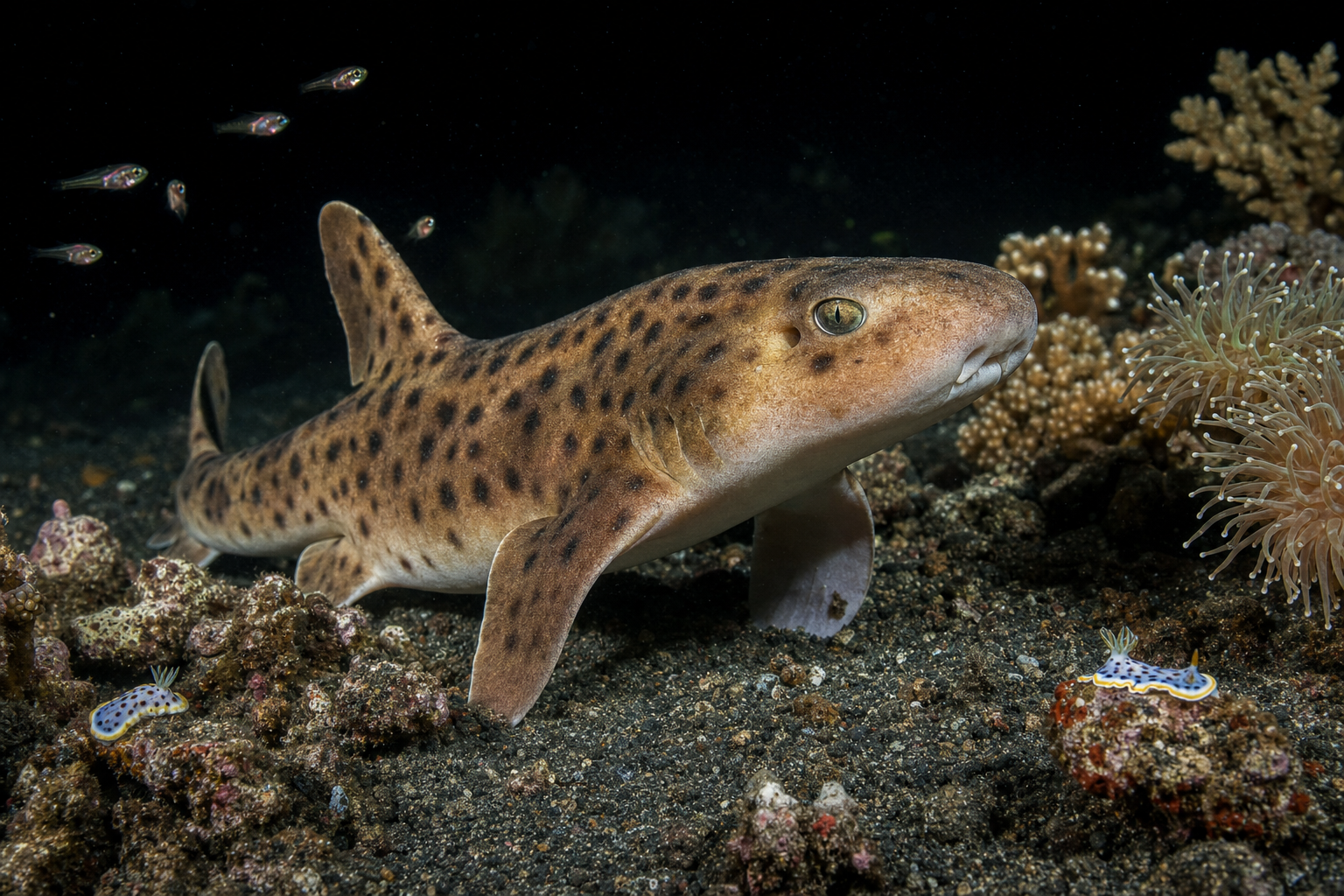
Halmahera is the only sub-region in Indonesia where you can find three different Hemiscyllium walking shark species on the same trip. Hemiscyllium halmahera, formally described from these waters in 2013 by the Indonesian Institute of Sciences and the Western Australian Museum, is the most commonly encountered species and is endemic to the eastern bays and the Loloda area. H. galei and H. henryi, both more widely distributed across the Maluku and West Papua region, also appear in numbers in the same bays. A 60-minute night dive at Patani Bay routinely produces 4 to 8 walking shark sightings, and the shallow rubble substrate makes them comparatively easy to photograph. Standard etiquette applies: do not handle, do not chase, give space and let the shark continue its hunt.
The reef mantas of Loloda and Widi
Halmahera hosts at least three confirmed reef manta cleaning stations: the inner Loloda lagoon station, Pulau Daga in the Widi Reserve, and a smaller seasonal station at the northern end of Tobelo. The reef manta (Mobula alfredi) is the resident species at all three sites. Encounter rates are below the Misool Magic Mountain peak (Loloda is the strongest at roughly 60 per cent of dives in season) but the diving is consistently quieter, and a typical Halmahera trip produces 8 to 15 manta sightings across 11 nights.
The coastal dugongs of Morotai
The most distinctive single mammal sighting in Halmahera. The shallow seagrass beds along the western beaches of Morotai host a small, resident population of Indo-Pacific dugongs (Dugong dugon), and the occasional encounter (roughly two per Halmahera trip on average) is the most distinctive single mammal sighting in the region. Dugong sightings are essentially impossible to plan for; they happen when they happen. The standard etiquette is the strictest of any species we encounter: maintain a 15-metre distance, do not pursue, and surface immediately if the animal shows any sign of stress.
The macro-and-muck of the eastern bays
The species count in the eastern bays is below Lembeh's but the wide-angle-and-macro combination is unique to Halmahera: a single dive at Patani can produce a school of bigeye trevally on the deeper edge and a Bargibanti pygmy seahorse on the same dive, and a 11-night Halmahera itinerary regularly catalogues 200-plus distinct macro species for an attentive photographer. The wider Indonesian underwater photography guide covers gear and lens choices.
When to dive Halmahera: the operating windows in 2026
Halmahera has two reliable operating windows, separated by a more variable transition period. Timing the trip well matters more here than in Komodo, where the boats run most of the year, because Halmahera operators only schedule departures during the windows when the open-water crossings between sub-regions are reliably calm.
The strong window: October through early December. This is the cleanest window of the year and the one we steer first-time Halmahera guests toward. The northwest monsoon has not yet set up, the southeast trade winds have eased, and the open-water crossings between Morotai, Loloda and the Widi Reserve are typically calm. Visibility peaks at 30 to 40 metres, the manta cleaning stations at Loloda and Widi work on roughly 60 per cent of dives, and the Goraichi Seamount hammerhead probability is at its annual peak (one in three dives produces a sighting). Water temperature is 28 to 30 degrees, and the rainfall on shore is at its minimum. Boat traffic is at its lowest of the year because the operators that run Halmahera also run Raja Ampat and many of them have not yet repositioned south for the November Misool window.
The secondary window: late February through April. The second reliable window is the post-NW-monsoon shoulder season. The southeast trade winds have not yet reasserted, the northwest monsoon has eased, and visibility is in the 25-to-35-metre range. Manta and hammerhead activity is moderate. The standout feature of this window is the soft-coral pulsing at Loloda and Widi: the warmer water (29 to 31 degrees) drives the strongest soft-coral expansion of the year, and the wide-angle photography in this window is genuinely different from October-November. Some operators do not run scheduled Halmahera trips in this window because the demand is concentrated in the October-December peak; it is the easier window to book at short notice for that reason.
The variable window: late December through mid-February. The northwest monsoon brings rain and intermittently rough seas to the central Halmahera waters. Some operators run Halmahera in this window with route adjustments (a Morotai-only northern route, for example, that stays sheltered behind the island), but the full four-sub-region itinerary is rarely possible. We recommend avoiding this window for first-time Halmahera guests.
The closed window: May through September. The southeast trade winds make the open-water crossings to the Widi Reserve unreliable to dangerous, and the wreck diving off Morotai becomes uncomfortable on the surface. Almost no operators run scheduled Halmahera trips in this window. The wider Indonesia liveaboard seasons guide covers the cross-region timing in more detail; the short version is that Halmahera's operating windows are narrower than Komodo's but as predictable as Raja Ampat's.
How to put a Halmahera itinerary together
Halmahera liveaboard itineraries are typically structured around one of three departure ports, and the choice meaningfully affects the trip experience.
Ternate departure (most common, 8 to 11 nights). Ternate is the regional capital of North Maluku and the most accessible port for international travellers (daily flights from Jakarta via Garuda Indonesia, with 4 to 5 hour flight time). The standard 8-night Ternate round trip covers the northern group (Morotai, Mitita, Pulau Dodola, Goro-Goro) and the central group (Loloda, Goraichi). The 11-night Ternate round trip adds the eastern bays (Patani, Hailolo) and is the route we recommend most often. Some operators extend to 14 nights to include the Widi Reserve, but the additional crossing times make this less practical from Ternate than from Sorong.
Sorong departure (cross-region with Raja Ampat, 11 to 14 nights). Sorong is the gateway to Raja Ampat and the most efficient departure port for the Widi Reserve specifically. The 11-night Sorong-to-Sorong route covers Widi, the eastern bays, and Loloda, before returning to Sorong. The 14-night cross-region route runs Sorong to Ternate (or vice versa) and combines Widi, Loloda, the eastern bays and the northern Morotai group in a single one-way itinerary. For divers who want to combine Halmahera with a Raja Ampat trip, the Sorong cross-region route is the cleanest answer.
Ambon departure (cross-region with the Banda Sea, 11 to 14 nights). Less common but the right answer for divers who want to combine Halmahera with a Banda Sea route. The 14-night Ambon-to-Sorong cross-region itinerary covers the central Banda Islands, Pulau Manuk, the eastern bays of Halmahera and the Widi Reserve, and finishes at Sorong. The diving is genuinely different from a single-region route, and the route is the most efficient way to dive both Halmahera and the Banda Sea on a single trip. The wider Banda Sea diving guide covers the southern half of this combination.
Permits, fees and the marine reserve framework
Halmahera diving requires three distinct permits in 2026, all of which are handled by the operator at embarkation.
First, the North Maluku regional dive permit (200,000 Indonesian rupiah per person, roughly 13 USD), which covers all sites outside the Widi Reserve. Second, the Widi Reserve entry tag (750,000 Indonesian rupiah per person, roughly 50 USD), which covers diving inside the Widi Marine Reserve and is checked by patrol boats at the reserve boundary. Third, the Morotai Wreck Heritage permit (free, but requires registration with the Cultural Heritage Office at least 14 days before the trip), which is required for any of the WWII wreck dives.
The total permit cost for a full 11-night Halmahera trip including Widi is roughly 65 USD per person. That used to be line for line with Raja Ampat, but Raja Ampat's charges rose in January 2026 and a foreign visitor there now pays IDR 1,700,000, about 105 USD, across two separate fees. Halmahera is therefore meaningfully cheaper to enter than it was relative to its better-known neighbour. Operators handle the documentation and the registration; divers just need to provide passport photographs and certification details at the booking stage.
Common mistakes Halmahera divers make
Five mistakes recur on Halmahera trips, often enough that we cover them on the welcome briefing of every itinerary.
Trying to compress all four sub-regions into a 7-night route. The 7-night route is too short. Operators that sell a 7-night Halmahera itinerary almost always skip either the Widi Reserve or the eastern bays, and the trip ends up missing a significant portion of what makes Halmahera distinctive. We recommend the 11-night minimum for first-time guests, and the 14-night cross-region route for divers who want the full atoll system.
Booking the secondary window without realising it. The February-to-April secondary window is excellent for soft-coral wide-angle work but produces fewer hammerhead encounters at Goraichi and lower manta probability at Loloda. Divers who book this window expecting the October peak's pelagic action can come away mildly disappointed. Both windows are good Halmahera windows; they just deliver different things.
Underestimating the Goraichi current. Goraichi Seamount runs 1.5 to 2.5 knots on the wrong tide, and the descent in open water demands recent advanced certification and disciplined buoyancy. Operators typically require 50 logged dives and a recent advanced or current-experienced rating; some will not schedule Goraichi for guests who do not meet the threshold, which is the right call.
Skipping the night dives in the eastern bays. The walking sharks, the mandarin fish at dusk, the blue-ring octopus, and the various nudibranch species that drive the Halmahera macro reputation all appear primarily on the night dives at Patani and Hailolo. Divers who treat the night dives as optional miss roughly 40 per cent of the species action across a typical week.
Not engaging with the wreck history at Morotai. The Morotai wrecks are interesting purely as dives, but the dive becomes meaningfully better when you have read enough of the WWII context beforehand to know what you are looking at. The dive briefings on most Halmahera operators cover the historical context, but the divers who arrive having read independently about the Morotai campaign consistently report the wrecks as the highlight of the trip.
Why the wrecks reward preparation
Halmahera rewards research and engagement with the history more than any other Indonesian destination, and the gap between a good wreck dive here and a forgettable one is usually created on the surface rather than at depth. The Morotai aircraft are not spectacular in the way a large steel wreck is. A B-25 sitting in clear water is a modest thing to look at unless you know what you are looking at: the squadron it flew with, the date it went down, the strike it was returning from. Operators who understand this brief accordingly, bringing a slate down with the serial number and the loss date on it, and giving guests something to read over the surface interval. Thirty-five minutes on a small airframe becomes the most personally meaningful dive of somebody’s trip when that context is there, and an unremarkable swim-around when it is not. If the wrecks are your reason for coming, ask what the briefing actually covers before you book.
How to book and what to ask
Halmahera liveaboards book further in advance than Raja Ampat or Komodo because the operating window is shorter and the inventory is genuinely scarce. For 2026 October-to-November departures, book by April 2025 if at all possible; for the secondary February-to-April window, book by August 2025. Charter and small-group bookings are easier to fit at short notice than scheduled departures because Halmahera operators are usually willing to add a charter window in the shoulder season.
The questions worth asking before booking, beyond the standard cabin and food questions, are: how many of the 10 strongest sites are scheduled on this departure (operators sometimes substitute weather-dependent sites without disclosure); whether the boat carries the Morotai Wreck Heritage permit and is registered with the Cultural Heritage Office; whether the boat carries nitrox at no surcharge for the deeper Goraichi and Loloda days; what the contingency plan is for the Widi crossing if the southerly wind comes up; and whether the boat has a dedicated wreck-trained dive guide for the Morotai cluster (not all do). A good operator answers all five directly. To start that conversation, the contact page reaches our reservations team, and the King Neptune, Neptune One and Komodo Sea Dragon pages cover the boats themselves. The Indonesia liveaboard category page covers the route options across the country, and the general Halmahera diving overview is the broader-context companion to this site-specific guide. For divers weighing Halmahera against the more popular destinations, the Raja Ampat vs Komodo comparison provides the wider Indonesian context, and the Indonesia liveaboard diving guide covers the cross-regional decision factors.