The phrase "luxury liveaboard" gets used loosely. A yacht with one decent espresso machine and white tablecloths can be marketed as luxury, and frequently is. The reality, from inside the industry, is that the meaningful luxury indicators are mostly invisible from the photos: crew-to-guest ratio, dive-deck design, the chef's range, the fleet's seasonal cruising plan. We have spent the last decade building boats that aim at the genuinely luxury end of the Indonesian market, and the gap between marketed luxury and actual luxury has never been wider than it is in 2026, simply because more operators are using the word and fewer customers are auditing what it actually means. This article is the operator-side answer to that gap. The category page for our luxury liveaboard fleet covers the boats themselves; this guide is about the underlying definitions and the questions to ask before paying.
The honest framing is this. Indonesian liveaboard luxury falls into three rough tiers, with significant overlap. Tier one is what we will call "above-standard": new boats, professional crew, decent dive deck, comfortable cabins, mid-range chef. The word "luxury" does appear in this tier's marketing, but the experience tracks closer to "high-quality standard". Tier two is the genuinely luxury middle: 1-to-1 crew ratios or close, hotel-grade chefs, full dive-deck individual stations, in-house photo support, custom itineraries. Tier three is the ultra-luxury end: full-yacht charter only, 1.3-to-1 or better crew ratios, multiple chefs and sommeliers, on-call helicopter access in some cases. Roughly 70 per cent of the boats branded "luxury" sit in tier one, perhaps 25 per cent in tier two, and a handful in tier three. Most of our work as operators is in tier two and three, and most of this article is about what genuinely separates those tiers from tier-one marketing. For the commercial-charter side of the question, the Komodo yacht charter page is the operator-side complement to this guide.
The headline answer for the impatient reader is simple. The five reliable luxury indicators, in priority order, are: crew-to-guest ratio (1.2-to-1 or better), the existence of an above-deck master suite with a private bathroom and exterior windows, an individual dive-deck station per guest with personalised gear handling, an in-house chef rather than a rotating cook, and the option to charter the entire vessel. If a yacht has all five of those, the rest of the luxury features (espresso machines, deck Jacuzzis, private guides) tend to come along with them. If a yacht claims luxury but lacks two or more of the five, you are in tier one regardless of the marketing photographs. The rest of this article unpacks each of those five indicators, plus the supporting ones that matter on specific routes and for specific traveller profiles.
The phinisi heritage and why it matters for luxury
The luxury Indonesian liveaboard category is built on a single boat-building tradition: the phinisi. Phinisi are the wooden, two-masted gaff-rigged schooners that originated with the Buginese and Konjo people of South Sulawesi in the 17th century, and that the Indonesian government formally recognised as a UNESCO Intangible Cultural Heritage tradition in 2017. Modern dive yachts in this category are not literally cargo phinisi; they are phinisi-style yachts, built to the same hull profile and sail rigging by the same boat-builders in Bira and Tana Beru on the south coast of Sulawesi, but adapted for guest accommodation, dive operation, modern propulsion and contemporary safety standards. The result is a category of yacht that does not exist anywhere else in the world. A 40-metre Indonesian phinisi-style yacht can carry 16 guests in genuinely spacious cabins, run a full dive deck, support a chef-led galley, and at the same time look and sail like a heritage tall-ship. That combination of wooden-yacht aesthetics, scale and dive utility is the structural reason luxury liveaboard travel in Indonesia is competitive on its own terms with anywhere in the world.
The practical implication for guests is that the Indonesian luxury yacht is not the same product as a steel motor-yacht in the Maldives or a fibreglass catamaran in the Caribbean. The expected aesthetic is wood, brass and cotton; the expected service style is the relaxed-but-polished Asian hospitality model rather than the European white-glove model; the expected cruising character is sail-assisted motor power across protected straits rather than trans-ocean motoring. None of that is a downside, but it is worth knowing in advance. Guests who arrive expecting a Mediterranean motor-yacht get a different boat. Guests who arrive expecting a phinisi tend to fall in love with the boats in roughly the first 24 hours.
One more historical note matters. The luxury phinisi category in its current form is roughly 20 years old. The first dedicated luxury dive phinisi launched in the early 2000s, the second wave came in the late 2000s, and the current generation of yachts (most of the boats marketed as luxury in 2026) launched between 2014 and 2024. This means the category is mature enough that there are now established operator standards, and young enough that the boats themselves are mostly less than a decade old. The "old wood, modern systems" combination is a category strength, not a weakness, but only if the operator has invested in the systems. The places where corners get cut tend to be visible in the dive deck and the galley first, which is why those are two of the five reliable luxury indicators above.
The crew-to-guest ratio: the single most reliable luxury indicator
If you only ever audit one number before booking, audit this one. A standard Indonesian liveaboard runs at roughly 0.6 to 0.8 crew per guest, meaning a 16-guest boat with 10 to 13 crew. A genuinely luxury liveaboard runs at 1.0 to 1.4 crew per guest, meaning the same 16-guest boat with 16 to 22 crew. Our own boats run at the upper end of that range. The difference shows up in everything: how long it takes for someone to take a wet camera off you when you climb back on board, how reliably the chef remembers a dietary restriction without you reminding him, whether a private dive briefing is offered when half the boat is doing a different dive plan, whether room turn-down happens silently while you are at lunch.
The crew-ratio question is also the cheapest luxury indicator to audit before booking. Ask the operator how many crew the boat carries on a typical cruise. The number is independent of marketing photographs and yacht age, it is a hard operating cost (more crew means more wages, food, accommodation), and a tier-one operator who is bidding luxury prices on a non-luxury crew base will quote a number that gives them away. A genuinely luxury operator will quote a crew count that, when divided by maximum guest capacity, lands at 1.0 or better. The 1.2 to 1.4 boats are where the experience is unambiguously luxury; below 1.0 you are paying luxury prices for tier-one staffing.
One operator-side detail. The crew count includes the dive guides, the deck crew, the galley team, the engineer, the captain, the cabin attendants and the photo assistants where present. A boat that quotes a high crew number but where most of those crew are deckhands has different luxury characteristics than a boat with the same total number where the staffing is weighted toward chefs, photo assistants and dive instructors. Asking for the breakdown by role is a fair question and a luxury operator will answer it without hesitation.
Cabin tiers explained: master suite, above-deck twin, below-deck twin
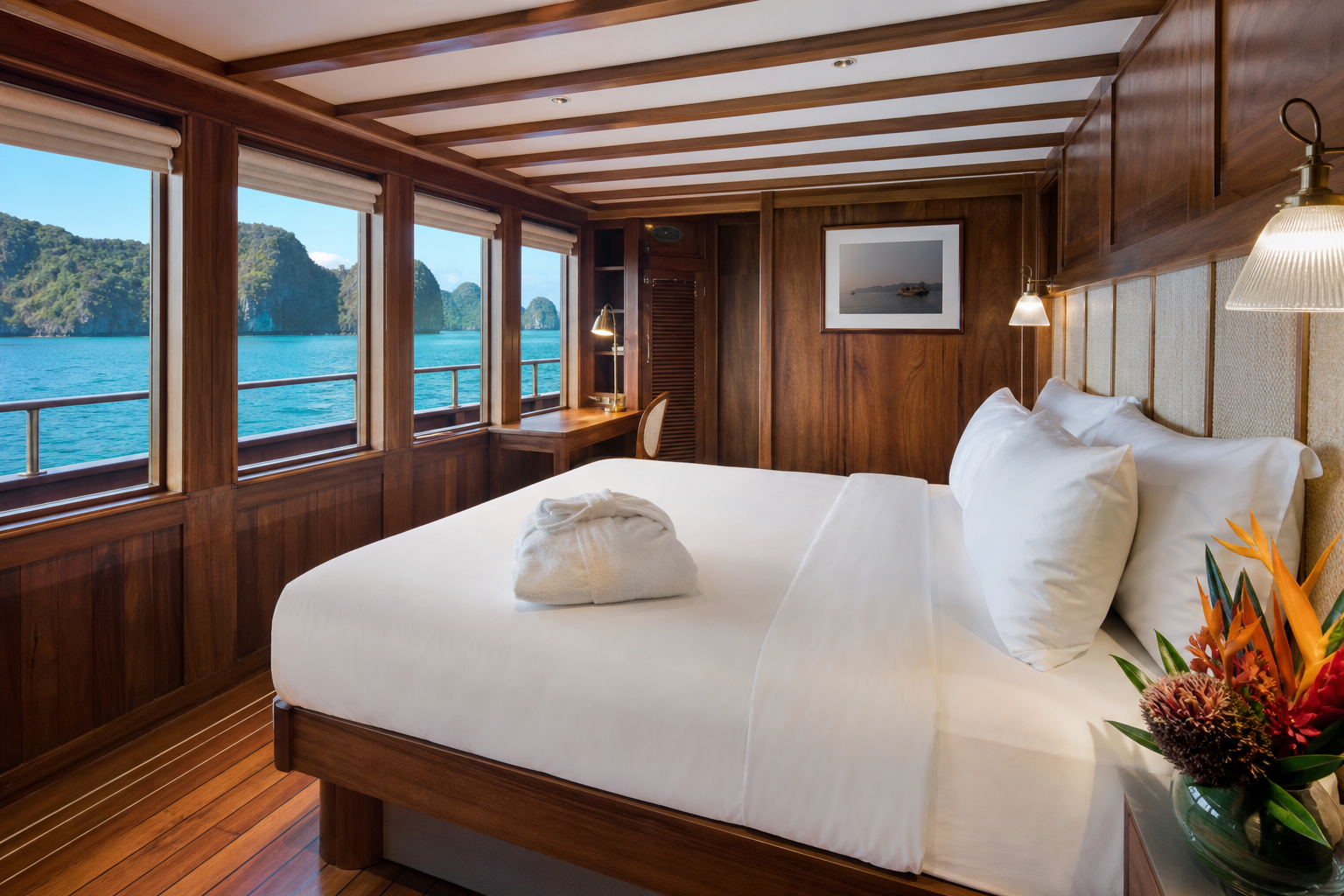
Phinisi-style yachts are built around a hull that is wider and deeper than typical sailing yachts of comparable length, which gives them the volume to support meaningful cabin tiers. A 40-metre Indonesian luxury yacht typically has three cabin classes, and understanding which class you have booked is essential to setting the right expectations.
The master suite is the headline cabin. It is invariably above the main deck rather than below, has its own private exterior windows, and is roughly 24 to 32 square metres including the bathroom. The master suite usually has a king bed, a private writing desk or sofa, a walk-in shower, occasional double sinks, and a small private terrace or balcony on the more recent yachts. Master suites command a 35 to 60 per cent premium over standard above-deck cabins on the same boat, and they sell out first on every popular departure.
Above-deck twin and double cabins (sometimes called main-deck cabins) are the standard luxury booking. They are 14 to 20 square metres, have exterior windows, en-suite bathrooms with showers, and either two single beds or a queen bed convertible to twins. They sit at deck level and have natural light. A genuinely luxury yacht has only above-deck cabins, or at worst a small handful of below-deck cabins for the dive crew rather than for guests.
Below-deck twin cabins are the budget tier on yachts that include them. They are 10 to 14 square metres, have either a small porthole or no exterior window, en-suite bathrooms (usually compact), and the same bed configuration as above-deck cabins. Below-deck cabins can be perfectly comfortable, but they are not luxury cabins regardless of the marketing language. If a yacht describes its standard cabins as luxury and they turn out to be below-deck, the marketing is misleading and the rest of the operator's claims should be audited similarly.
The honest cabin-class advice we give first-time luxury liveaboard guests is to book above-deck on the cheaper end before booking master-suite on the more expensive end of the same yacht. Two above-deck cabins on a tier-two yacht (for two couples travelling together) deliver a better experience than a single master suite on a tier-one yacht. Cabin tier matters less than yacht tier.
Dining: the chef as luxury indicator, not the dining room
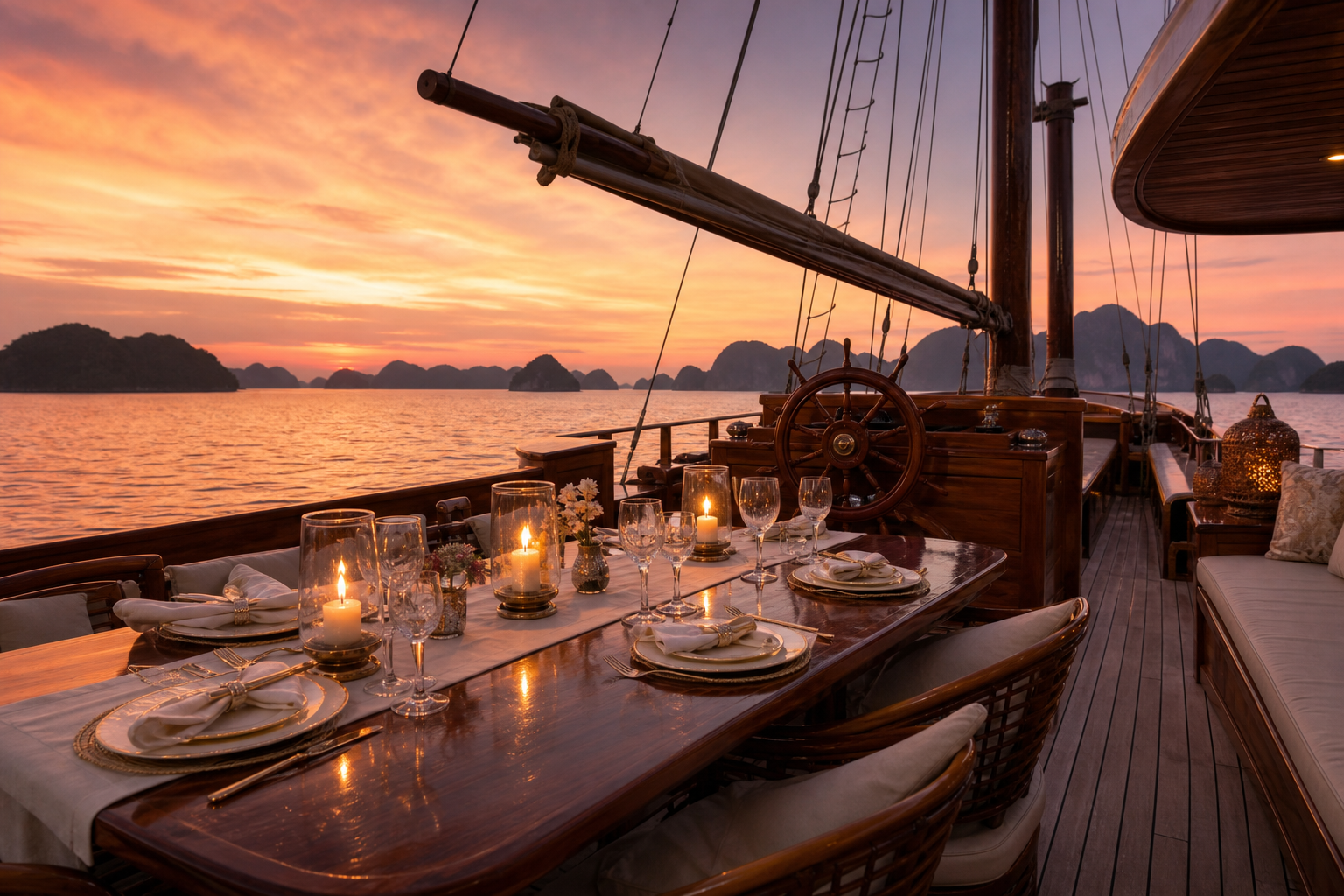
The dining room itself is rarely the bottleneck on a luxury Indonesian yacht. Most yachts in this category have a polished saloon with linen, decent glass, and a covered alfresco deck for breakfast and lunch. The genuine indicator is the kitchen and the person running it.
A tier-one boat runs a rotating cook from a hotel agency. The food is fine. Three meals a day, a soup, a starch, a protein, a salad, a vegetable, two desserts on a special evening. Dietary restrictions get accommodated by removing items rather than substituting them. Guest preferences are not learned over the course of a trip. This is what most "luxury" Indonesian boats actually serve.
A tier-two boat runs a permanent chef who is on the boat for at least six months of the year, with a galley team of two or three. The menus rotate weekly rather than daily, are written by the chef rather than imported from a head office, and incorporate the seasonal seafood and produce that the boat sources locally at each anchorage. Dietary restrictions are accommodated by substitution rather than subtraction, and a vegan or gluten-free guest gets a separate menu rather than a stripped-down version of the standard menu. By the third day of a trip, the chef knows that you skip breakfast and prefer fish over red meat, and the menu starts adapting silently. This is the genuine luxury middle, and it is what we aim to deliver.
A tier-three boat layers two more things on top: a proper wine list with provenance and pairing notes, and an alcohol service style that matches the rest of the experience. The wine question is genuinely difficult in Indonesia (importing wine to a yacht-based service is administratively complex and expensive) and most boats either skip it or run a token list. A tier-three operator runs a list of 30 to 60 bottles selected for the cuisine, refreshed seasonally, and a sommelier-trained crew member to serve them. This is the level at which a couple's anniversary dinner or a small group's celebration trip becomes meaningfully comparable to a destination Michelin restaurant on land. Few yachts deliver this; the ones that do publish their wine programmes openly.
The dive deck: the working core of a luxury yacht
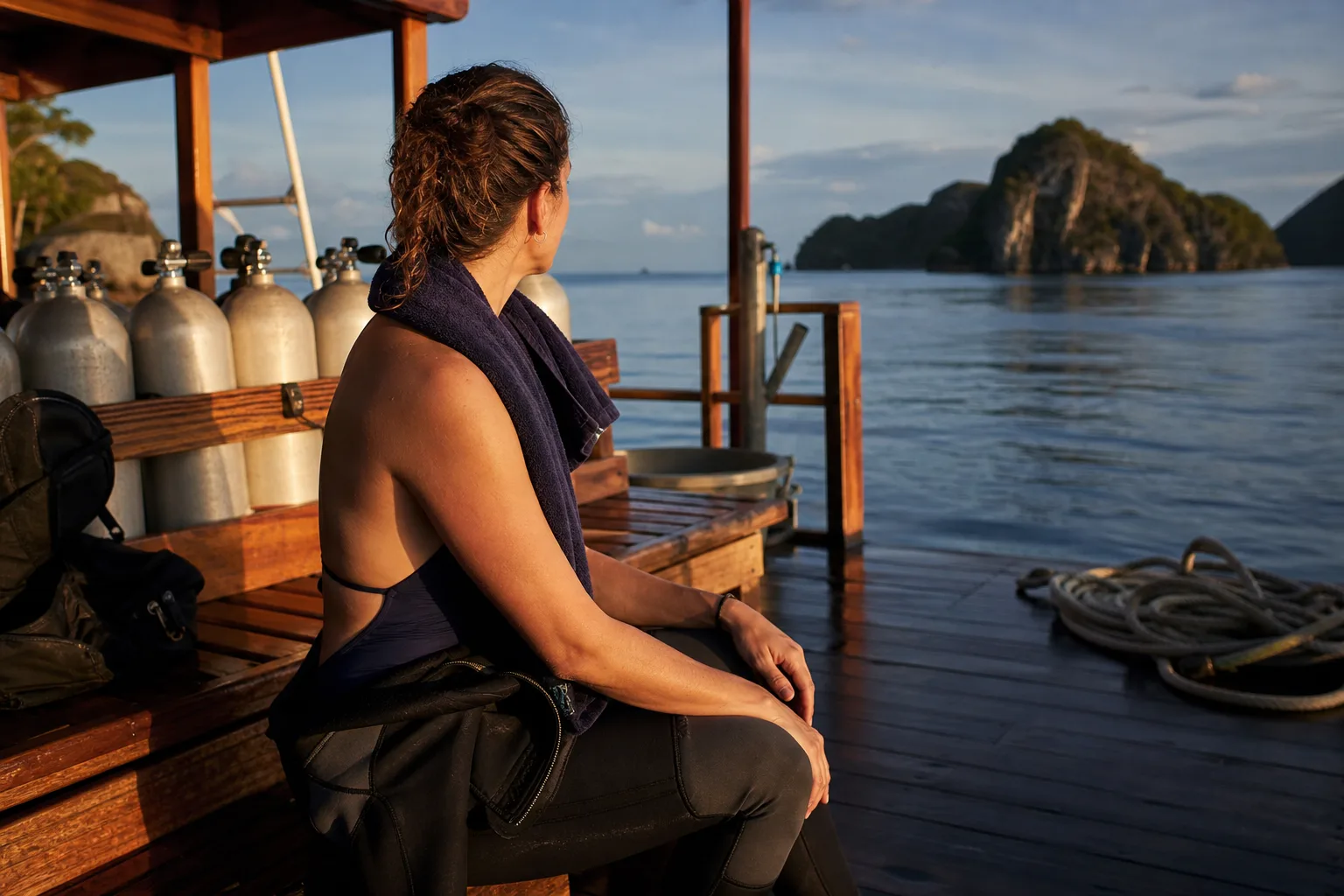
The dive deck is where most luxury yachts give themselves away as tier one or tier two. The differences are practical and visible, and the photographic marketing rarely captures them honestly.
A tier-one dive deck assigns a numbered space along a bench to each diver. You hang your BCD on a peg, lay your fins under the bench, and put your mask in a basket on a shelf. Crew help you suit up at the start of each dive, but the gear handling is largely self-service in between dives. There may or may not be camera tables; if present, they are shared. Tank changes happen between dives and you are expected to know which tank is yours.
A tier-two dive deck assigns a permanent station to each diver with a personal locker for accessories, a vertical mount for the BCD with the tank already attached, a personal mask cubby, a personal fin slot, an above-bench dryer for wetsuits, and an individual camera table with foam padding and a freshwater rinse beside the station. Crew dress you and undress you between dives without being asked. Tank changes happen between dives and crew handle the assignment without involving the diver. Your gear is in the same place at the same temperature every time you arrive on the dive deck. This is what distinguishes a luxury dive operation from a "standard with luxury accommodation" operation.
A tier-three dive deck adds a dedicated camera room, sometimes climate-controlled and sometimes with a freshwater rinse table; private dive guide ratios (1-to-2 or 1-to-3 instead of 1-to-4); the option of personalised dive plans (your buddy team gets a different site than the rest of the boat for the morning); and the routine availability of nitrox to all guests at no surcharge. Many tier-two and tier-three boats also offer technical diving on request, with helium and rebreather support, although this is operator-specific and worth asking about before booking. A long-form view on the wider underwater photography setup is in our underwater photography in Indonesia guide; the dive-deck question this section covers is a precondition for that work but distinct from it.
Right yacht for the right route: matching the boat to the cruising plan
Not every luxury yacht is the right yacht for every Indonesian itinerary. The four main cruising regions (Komodo, Raja Ampat, Banda Sea, and the longer multi-region routes) place different demands on the boat, and the operator-side intuition for which yacht fits which route is the kind of thing that does not show up in a marketing brochure.
Komodo: comfort over crossings
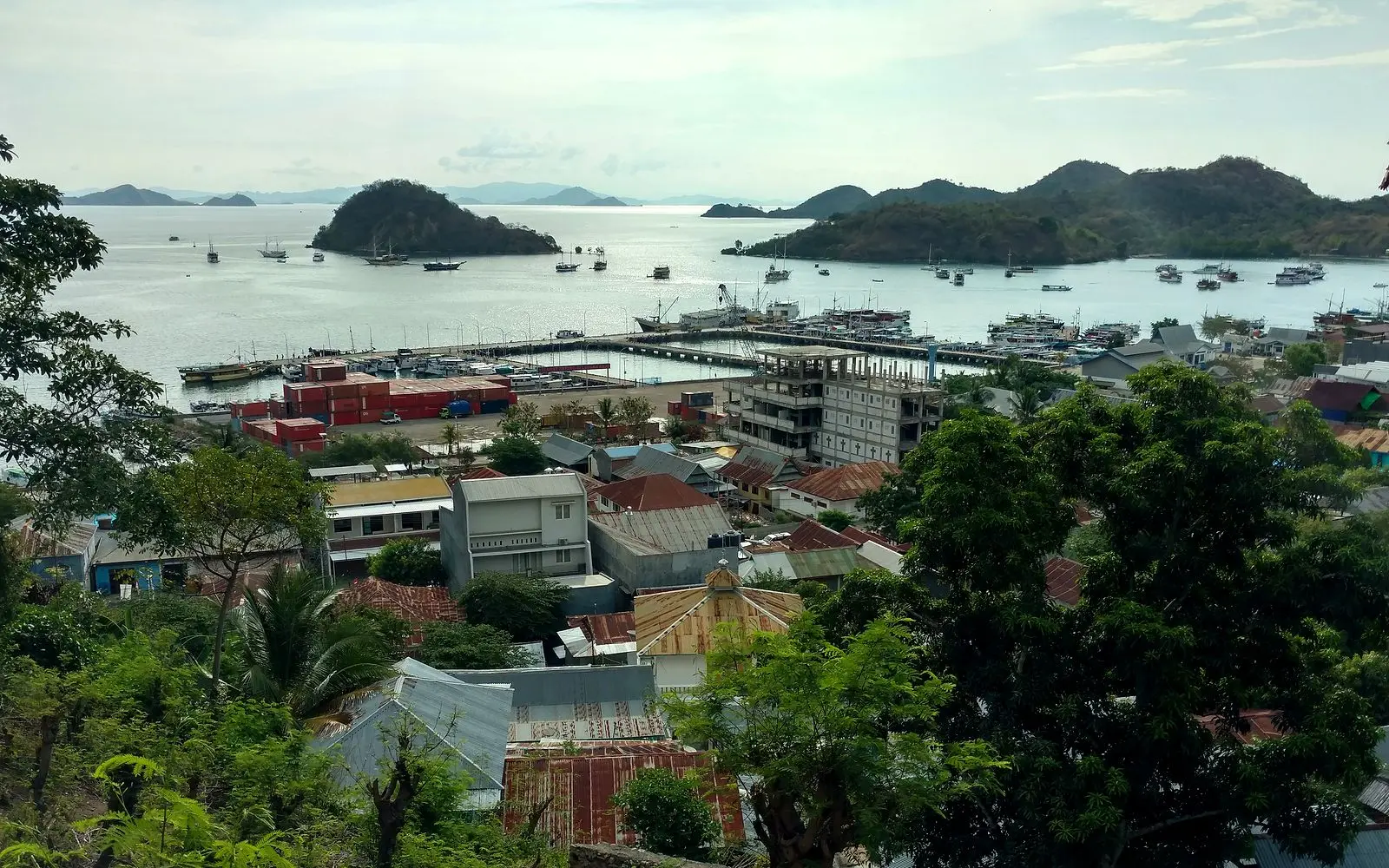
Komodo is the easiest cruising region in Indonesia for any yacht. The distances between sites are short (the entire park is roughly 30 nautical miles end to end), the channels are protected, the weather window is wide (May to early November), and the diving is mostly shallower than 25 metres. A yacht that can handle Komodo well does not have to handle anything especially difficult; the differentiator on this route is not seakeeping but interior comfort and dive-deck efficiency, because guests spend more time on the boat between sites than they do crossing. The Komodo charter market is the largest in Indonesia for this reason: the routes are easy, the fleet is large, the price competition is real, and the differentiating factor is the on-board experience. The full Komodo destination guide covers the dive sites and the seasonal pattern; for the chartered side specifically, the Komodo yacht charter page is the operator-side complement, and the Komodo liveaboard itineraries guide walks through the standard route options.
Raja Ampat: stability and range
Raja Ampat is harder. The distances are longer (a one-way Misool itinerary covers roughly 200 nautical miles), the open-water crossings between Dampier Strait, Misool, and Wayag are exposed to swell, and the season is shorter (October to April for serious cruising). The right yacht for Raja Ampat is a yacht with good seakeeping, generous range, a stable platform for night-time anchorage in tight bays, and a tender programme that can handle the longer beach excursions to the bird-of-paradise hides. Tier-two and tier-three boats handle Raja Ampat well; tier-one boats can struggle with the Misool crossings in early or late season. For the seasonal context, the Raja Ampat best time to visit guide walks through the month-by-month picture; for the route, the Raja Ampat destination guide covers the underlying geography, and the Raja Ampat yacht charter page covers the chartered side.
Banda Sea: range and self-sufficiency
The Banda Sea is the demanding route. A 12-night Ambon to Saumlaki crossing covers roughly 600 nautical miles, the boat is at sea (not at anchor) for 30 to 40 per cent of the trip, the open-water passages between island groups are 6 to 14 hours each, and the resupply opportunities are limited. The right yacht for the Banda Sea is a yacht with serious range, ample fresh-water capacity, a chef-led galley that can produce restaurant-quality meals at sea, and a crew rotation system that keeps the deck fresh on the long passages. This is the route where tier-two and tier-three operations differentiate most sharply from tier one. A boat that runs a 12-night Banda Sea route at full luxury standard is genuinely a different category of operation than a boat that runs week-long Komodo charters; we run both, and the boat assignments differ. The Banda Sea diving guide covers the dive side of this route in detail.
Charter versus cabin charter: who picks which
The two ways to book a luxury Indonesian liveaboard are full-yacht charter (you take the entire boat, set the itinerary, and bring your own party) and cabin charter (you book one or two cabins on a fixed-itinerary departure that other guests are also booked on). The right answer depends on group size, budget tier and the desired control over the itinerary.
Full-yacht charter is the right answer when you have at least 6 paying guests, when you want a custom itinerary, when you have a specific occasion (anniversary, milestone birthday, family reunion, corporate offsite), or when privacy is the dominant requirement. The cost of a full yacht for a week ranges from roughly 35,000 USD for a smaller boat in the off-season to 180,000 USD for the top-tier yachts in peak Komodo or Raja Ampat. On a per-guest basis, this lands at 3,000 to 11,000 USD per person per week for the typical 12-to-16 guest charter. Full charter is almost always cheaper per person than booking the same yacht as cabin charter on a 1-to-1 basis, because the operator will discount a full-boat booking compared with the published cabin rate.
Cabin charter is the right answer when you are travelling as a couple or a small party and you want to access a luxury yacht without booking the whole vessel. Cabin rates on tier-two and tier-three boats range from 4,500 USD per person for a week on a value-tier boat in the off-season to 18,000 USD per person for a master suite on a top-tier boat in peak season. The trade-off is that you share the boat with other guests, the itinerary is set by the operator, and the social dynamic depends on who else is on board that week. A well-run cabin-charter departure is fully luxury for the booking guest; a poorly managed one feels like a hotel that happens to float. The boat and the operator both matter; ask for the typical guest demographic on the specific departure you are considering.
One specific recommendation: for first-time luxury liveaboard guests, a cabin-charter trip on a boat we trust is almost always the right way to start. Chartering a 16-guest boat for two before knowing what you actually want from a luxury liveaboard is an expensive way to find out you wanted a smaller yacht with fewer guests, or that you wanted Banda Sea instead of Komodo, or that you wanted three weeks rather than one. A first cabin-charter trip teaches you what your second trip should look like, and the operators we recommend will offer credit toward a future charter for guests who book a cabin first.
What the price actually buys you
Indonesian luxury liveaboard pricing is opaque enough that it deserves its own paragraph. The 2026 price ranges, on a per-guest per-week basis, run roughly as follows. Tier-one "luxury" cabin charter: 3,500 to 5,500 USD. Tier-two cabin charter (the genuine luxury middle): 5,500 to 9,500 USD. Tier-three cabin charter (ultra-luxury, mostly master suites or full charter equivalents): 9,500 to 18,000 USD. For full-yacht charter, divide the boat charter rate by the number of paying guests and add the operating expenses (fuel, port fees, park entry fees, dive-instructor surcharges, alcohol consumption above the included programme). The headline boat rate is typically 60 to 75 per cent of the all-in cost; the remaining 25 to 40 per cent is operating add-ons. A tier-two or tier-three operator will quote both the boat rate and the typical operating-cost range up front; a tier-one operator who is bidding luxury prices will sometimes quote only the boat rate and reveal the operating add-ons after the booking is confirmed.
What is included at the genuinely luxury end: all dives, all gear (including dive computer, weights, tanks), all meals, all soft drinks, all coffee and tea, all park and conservation fees, transfers between the airport and the boat, and the in-house dive-guide service. At tier two: nitrox and basic alcohol (beer and house wine) are usually included; premium spirits and wine pairings are extras. At tier three: alcohol is fully included up to a generous limit and the boat operates an open-bar policy; nitrox is included as standard; the photo support and the in-house cinematographer are included. What is rarely included at any tier: international flights, dive insurance, gratuities (typically 5 to 10 per cent of the boat rate, paid in cash to the captain at the end of the trip), and the personal sundries that one would expect to pay for at any hotel.
Common myths about luxury Indonesian liveaboards
Five recurring misconceptions are worth correcting, because they cause guests to book the wrong yacht and then feel disappointed for reasons that the marketing did not prepare them for.
Myth one: bigger is always better. The luxury sweet spot in the Indonesian fleet is 35 to 42 metres carrying 12 to 16 guests. Boats above 50 metres exist and are impressive, but they often carry 20 to 24 guests, which lowers the staffing ratio if the crew has not scaled in proportion. A 38-metre yacht with 14 guests and 18 crew is a more luxurious experience than a 55-metre yacht with 22 guests and 20 crew. Length is a poor proxy for luxury; staffing ratio is the better one.
Myth two: the master suite is always worth the upgrade. Sometimes it is, sometimes it is not. On a tier-two yacht with strong above-deck cabins, the upgrade from above-deck to master suite is roughly 40 per cent of the cabin rate for an experience that is incrementally better but not transformative. On a tier-one yacht where the standard cabins are below-deck, the upgrade to master suite is often the only way to get a luxury cabin experience on that boat. Audit the standard cabin first; the master-suite question follows from that.
Myth three: the most expensive yacht is the most luxurious. Indonesian luxury pricing is correlated with luxury but not perfectly. Some yachts price aggressively because they hold a brand reputation that exceeds their current operating standard; others under-price because they are newer to the market or because the operator chooses to compete on value. The honest reputation network among Indonesian dive operators is reasonably efficient, and asking your dive shop or your booking agent for off-the-record opinions on a specific yacht is fair and usually informative.
Myth four: longer trips are better than shorter trips. A 14-night luxury trip is not 100 per cent more luxurious than a 7-night luxury trip. The marginal day cost remains the same and the experience often plateaus around day 9 or 10. The right length is the length your itinerary requires (Banda Sea wants 11 to 14 nights; Komodo can be 5 to 7; Raja Ampat is 9 to 12) rather than the longest one your budget allows.
Myth five: luxury is about the boat. Luxury is mostly about the people. The chef, the dive guides, the cabin attendants, the captain. A good crew on an above-standard boat delivers a better experience than a mediocre crew on a flagship yacht. We have seen this play out repeatedly, and it remains the single most common feedback theme from our return-guest interviews.
Crew, not boat, drives the experience
The layered-service model that defines the better operations is almost invisible at the point of booking, which is why published cabin categories mislead so consistently. Someone comparing a marketed master suite on one yacht against an above-deck double on a boat two metres shorter will read that as a downgrade, and on the brochure it is. What the brochure does not show is the crew-to-guest ratio, the chef’s background, the dive-deck layout, or whether anybody on board has the initiative to set up a private dinner on the foredeck for an anniversary without being asked. Those are the things guests actually remember afterwards, and every one of them is a staffing decision rather than a hull decision. It is why we push people towards a crew-ratio audit and a straight conversation about who is on board before they fixate on cabin names. A boat nominally one tier below the one you were looking at can very easily deliver the better week.
Booking lead times and how to time the year
Luxury Indonesian liveaboards book further in advance than standard boats, because the inventory is genuinely scarce and the popular weeks (Christmas, New Year, Chinese New Year, Easter, late February to early March in Raja Ampat, late August in Komodo) sell out 12 to 18 months ahead. The practical rule of thumb is the following.
For 2026 high-season Raja Ampat (December to February): book by July 2025 for cabin charter, by April 2025 for full-yacht charter. The most popular Misool itineraries are now waitlisted 14 months out. For 2026 high-season Komodo (June to early September): book by December 2025 for cabin charter, by September 2025 for full-yacht charter. For 2026 Banda Sea (March-April or October-November): book by November 2025; full-yacht charter on the Saumlaki route specifically is essentially sold out for 2026 already. For shoulder weeks at all destinations, the lead time drops to roughly four to six months and the price flexibility opens up: discounts of 10 to 20 per cent on cabin rates are common in the genuine shoulders (early October or late April Raja Ampat; late May or November Komodo; March or November Banda Sea).
For the planning side of trip selection (when to go, which destination first, how to combine destinations), the wider Indonesia liveaboard diving guide covers the cross-destination logic, and the Indonesia liveaboard seasons guide covers which boat goes where in which months. For first-time guests, the first-time liveaboard guide covers the practical questions that come up before a booking decision; for couples specifically, the honeymoon liveaboard guide walks through the questions that matter on a celebration trip.
How we work with luxury liveaboard guests
The booking conversation we have with luxury-tier guests is different from the conversation we have with first-time standard-tier guests, and we have written this article partly to make that conversation more productive. The questions we expect to discuss before a booking are: dietary restrictions and a chef briefing; preferred cabin tier and a boat recommendation that fits the rest of the criteria; itinerary preferences and any non-diving days the group wants built in (a private chef-led picnic on a Komodo beach, a sunrise viewpoint excursion, a private bird-of-paradise hide morning); photographic and videographic support requirements; alcohol and wine programme preferences; transfer logistics into and out of the embarkation port; and any celebration-occasion requirements that the operator can quietly arrange. None of these is a special request on a tier-two or tier-three yacht; all of them are part of the standard conversation. To start that conversation directly, the contact page reaches our reservations team. The fleet pages for our individual yachts (King Neptune, Neptune One, Komodo Sea Dragon) cover the boats themselves and the cabin tiers we offer.