Somewhere between choosing a cabin and paying the deposit, almost every guest asks us the same quiet question: "What is the WiFi actually like?" Some are hoping the answer is "excellent" because a job travels with them. Others are hoping the answer is "nonexistent" because they want a licence to disappear for a week. The truthful answer for an Indonesia liveaboard in 2026 sits in the middle, and it varies enormously by route, by boat, and by day of the itinerary. This guide maps it all out: where your phone works, where it goes dark, what Starlink has changed, and whether you can genuinely work from the top deck of a phinisi.
We will be specific, because vague reassurance is useless when you are deciding whether to book a trip or whether to warn your team you will be offline. The connectivity picture while scuba diving in Indonesia splits into three layers: the mobile signal your own phone picks up along the route, the boat's own internet (increasingly satellite-based), and the emergency communications every proper vessel carries regardless. Each layer behaves differently in Komodo, in Raja Ampat, and out in the Banda Sea, so we will take them route by route.
The short answer, for people who book trips between meetings
Komodo: usable signal on more days than not, and boats with Starlink are effectively online all week. Raja Ampat: patchy to poor mobile coverage away from Sorong and Waisai, so the boat's satellite connection is the only link that matters. Banda Sea and the remote crossings: assume nothing from your phone for days at a time, and plan around the boat's system entirely. On any route, video calls are possible on a Starlink boat and unrealistic on a boat relying on mobile-network WiFi. That is the whole article in five sentences. The detail, and the tricks that make the difference between a workable week and a stressful one, take a little longer.
What your phone will and will not do, route by route
Indonesian mobile coverage is better than most first-time visitors expect, with one enormous caveat: it clings to towns and inhabited islands, and a dive itinerary spends most of its time deliberately far from both. Telkomsel is the only network worth having on a boat trip; its coverage in eastern Indonesia is not merely better than the competitors', it is often the only signal present at all. A local SIM or eSIM with a big data bundle costs a fraction of international roaming and works noticeably better, because roaming phones sometimes attach to weaker partner networks. Which one to buy, what registration requires and the ninety day IMEI rule are set out in our guide to Indonesian SIM cards and eSIMs.
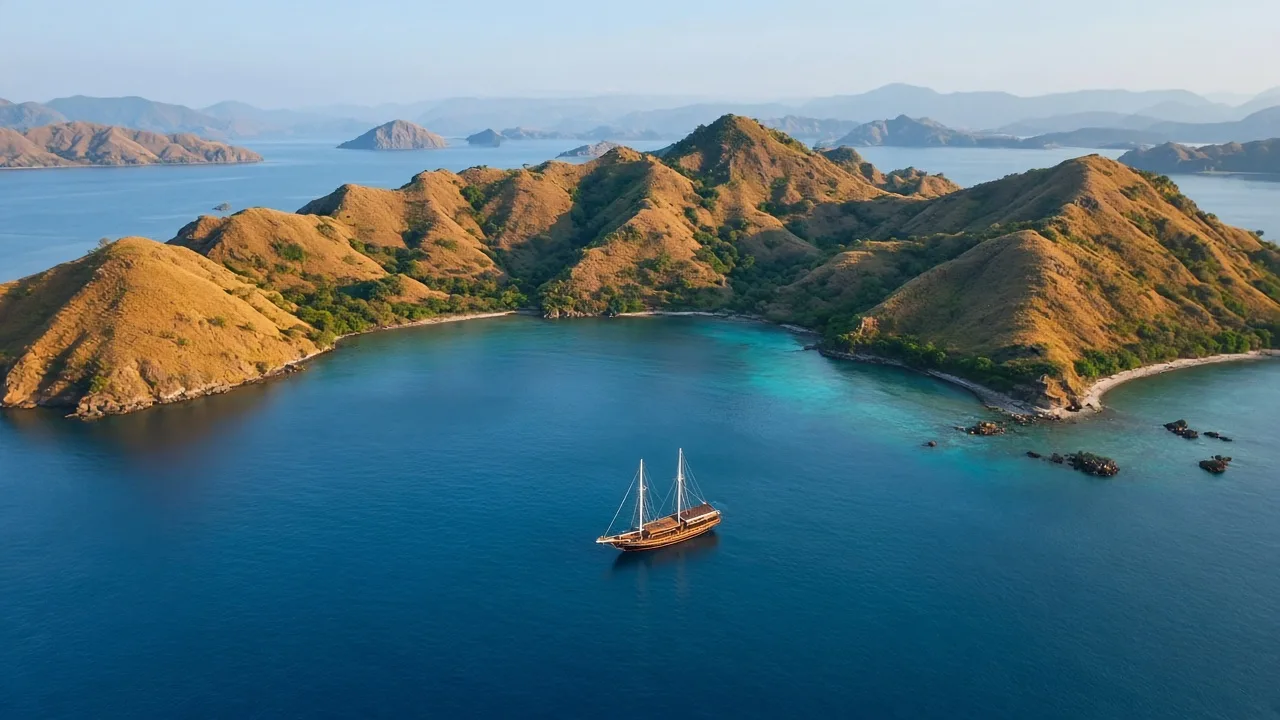
In Komodo National Park, the signal follows the ranger stations and the port. Expect solid 4G around Labuan Bajo and for the first hour of sailing, workable bars near Rinca and the busier central anchorages, and dead air in the park's south, around Manta Alley and the wilder western bays. The famous viewpoint climb on Padar, oddly, has decent reception at the top; more than one guest has taken a work call up there at sunrise, to the amusement of everyone photographing the three bays below. North Komodo sites like Castle Rock sit in a grey zone where a message might crawl out if you hold the phone high and believe.
Raja Ampat is a different animal. Sorong, the departure port, has proper city 4G. Waisai and the Dampier Strait villages give you intermittent bars, enough for WhatsApp text if not photos. Beyond that, the map goes quiet fast: the Fam islands are marginal, Wayag is effectively dark, and Misool in the south is a multi-day signal desert where even the crew's phones sleep in a drawer. Anyone who tells you they answered email reliably from a mooring in southern Raja Ampat on mobile signal alone is misremembering their trip.
The Banda Sea, Forgotten Islands, and the long crossings between them are exactly what the names suggest. On our Banda season repositioning trips, the gap between one working signal and the next has run to four days, give or take. Guests know this in advance; it is in the pre-departure notes twice, in bold, because someone is always surprised anyway.
Starlink changed everything, but not evenly
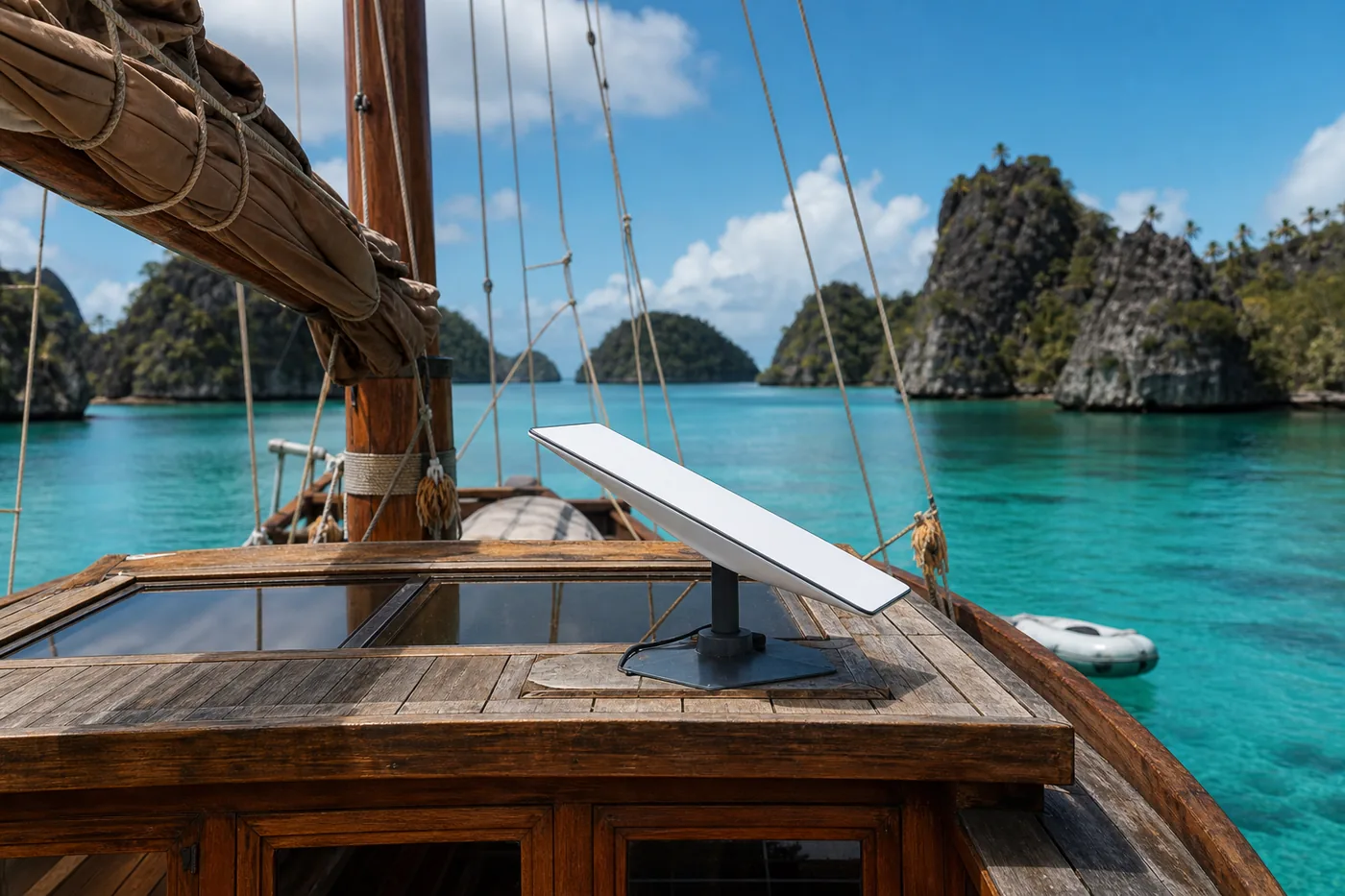
Until roughly 2023, "liveaboard WiFi" in Indonesia meant a router wired to a cellular antenna on the mast, which is to say it meant WiFi whenever the boat happened to be near a tower, which is to say not much. Starlink's maritime arrival rewired the entire conversation. A dish the size of a serving tray, a clear view of the sky, and a boat in the middle of the Dampier Strait suddenly has faster internet than many hotels in Jakarta. We were sceptical when the first units appeared on the fleet; the scepticism did not survive the first season. Speeds on a well-mounted unit run comfortably into tens of megabits, latency is low enough for video calls, and the connection holds while the boat is underway, not just at anchor.
But the rollout across the Indonesian fleet is uneven, and this is where a booking question becomes essential. As of early 2026, most premium and mid-range boats on the Komodo and Raja Ampat circuits carry Starlink or an equivalent; many budget boats still rely on the old cellular-router setup or offer nothing. "The boat has WiFi" on a listing can mean either. Ask the operator three precise questions: Is the internet satellite-based or mobile-based? Is it available to guests all day or only in scheduled windows? Is it included or charged, and if charged, at what price per day or per gigabyte? The answers sort the fleet cleanly, and any operator who cannot answer them plainly is telling you something too.
Even Starlink has honest limits at sea, and it is fair to name them. Heavy tropical rain squalls can degrade or briefly drop the link, usually for minutes rather than hours. A dish shadowed by the mast, the flybridge, or a cliff-side anchorage loses satellites; good boats mount the dish high and clear, but the perfect spot on a traditional gaff-rigged phinisi involves compromise with 30 metres of ironwood and rigging. And bandwidth is shared: sixteen guests synchronising photo libraries at sunset will make everyone's video call wobble. Crews manage this with fair-use settings or a simple request at the briefing, and in most weeks it never becomes an issue.
Can you actually work remotely from a liveaboard?
Yes, with the right boat and the right expectations, and we say that having hosted software engineers on sprint deadlines, a fund manager who traded two mornings from the saloon, and one memorable author who filed a manuscript from a mooring off Misool at 11pm the night it was due. The pattern among the ones who made it work was identical: they confirmed the boat had satellite internet before booking, they front-loaded meetings into the timezone overlap that suited them, and they treated the connection as good-but-not-guaranteed, downloading anything critical in advance.
Timezones, unexpectedly, are the remote worker's best friend here. Komodo and Raja Ampat run on Central and Eastern Indonesian time (GMT+8 and GMT+9). For anyone serving European clients, the working morning in London begins at your mid-afternoon, which slots neatly after the day's second dive; you can do three dives and still make a 15:00 call that is 08:00 in Berlin. Australians barely shift at all. The brutal one is the US East Coast, whose 09:00 is your 21:00 or 22:00; night owls manage, everyone else suffers. Our guide to Indonesia's three timezones untangles the details.
A few practical notes from watching people try. The saloon is air-conditioned and has the most reliable power sockets, but the top deck at 07:00, before the heat builds, is the best office view you will ever have. Indonesian boats run 220V with European two-pin sockets, so bring the adapter and a small power strip since cabin sockets are few. Laptops and salt spray are enemies; a dry bag for the commute between deck levels sounds paranoid until the day it is not. And book a cabin near the router if constant connectivity genuinely matters, because signal through two decks of dense ironwood is a physics problem no router fully wins.
A signal diary from an actual Komodo week
Abstractions only help so much, so here is what connectivity actually looked like on one of our six-night Komodo departures last October, reconstructed from the trip log and one guest's cheerful complaints. This was a boat with Starlink plus whatever Telkomsel the guests' own phones could find. Treat it as representative rather than guaranteed; the sea does not sign contracts.
Day one, Labuan Bajo to the central park: full 4G for the first ninety minutes, guests posting departure photos from the bow. Phone signal faded to one flickering bar by the Rinca anchorage; the boat WiFi carried the evening without anyone noticing the handover. Day two, central sites and Padar: phones useless at the morning dive sites, two bars on the Padar summit at 05:45 (one guest took a call, wind noise and all), dark again by breakfast. Starlink solid all day, one four-minute dropout during an afternoon squall. Day three, north to Castle Rock and Crystal Rock: no phone signal at all, boat WiFi fine, a German guest ran a 40-minute video standup from the saloon between dives one and two, and the only complaint came from her colleagues about the view behind her.
Day four, Manta Alley in the south: nothing on any phone, all day, and this is the stretch where cellular-only boats go fully dark. Starlink held except during the biggest rain cell of the week, which cost about twenty minutes around 15:00. Day five, drifting back through the central park: intermittent single bars near the ranger stations, boat WiFi busy at sunset with five days of photo backlogs, crawling for everyone until the crew asked the table, politely, whether the turtle videos could wait until 22:00. They could. Day six, the sail home: 4G returned an hour out of Labuan Bajo, sixty-three messages arrived on one phone with a sound like a slot machine paying out, and the guest who owned it looked at the screen, laughed, and put it back in the dry box until the dock.
Swap the route for Raja Ampat and the diary shifts one notch darker on the phone column: Sorong and Waisai give you the day-one bars, the Dampier Strait villages offer occasional scraps, and from Fam southward the phones sleep until the return leg. The boat system becomes the whole story, which is exactly why the satellite-or-cellular question belongs at the top of your booking checklist rather than the bottom.
The digital detox case: booking the dark zone on purpose
Here is the counter-intuitive trend from the last few seasons: a growing share of guests ask us which itinerary has the least connectivity. The request comes from burnt-out professionals, couples negotiating phone-free holidays, and parents staging an intervention for a teenager. For them the Banda Sea crossing or a southern Raja Ampat route is not a communications problem, it is the entire product. There is something clarifying about a week where the outside world physically cannot reach you, and the ocean enforces what willpower could not.
If that is what you want, the recipe is simple: pick a remote route, decline the boat WiFi password at the briefing (the crew will keep it for genuine emergencies), and tell your people the honest truth, that you are reachable through the operator's shore office for anything urgent. We have watched guests visibly decompress on day two when the last bar of signal slips below the horizon somewhere east of Alor. The same guests are usually the ones asking to borrow the password by day five to check on the dog. Both halves of that arc are completely normal.
Safety communications: what the boat carries when everything else fails
Guest WiFi is a comfort question. Marine communications are a safety question, and the two run on entirely separate systems, which is worth understanding before you worry about either. Every serious liveaboard in Indonesia carries marine VHF radio for line-of-sight traffic with other vessels, ranger stations, and harbourmasters; most carry a satellite phone entirely independent of the guest internet; and boats working the remote routes add tracking beacons and, increasingly, a second satellite system as redundancy. When we cross the Banda Sea, the boat is never actually out of contact, even when every guest phone on board has been showing "No Service" for three days.
This separation matters for one practical reason: families at home sometimes panic when a guest goes quiet mid-trip. The fix is expectation-setting, not technology. Before departure, tell the people who worry that messages may pause for a few days, give them the operator's office contact, and agree that no news is good news. Our shore team relays genuinely urgent messages to any boat in the fleet within hours, through channels that have nothing to do with whether the saloon WiFi is having a good day. In fifteen-plus years of operating, the system has never failed to reach a boat; the same cannot be said of guest phones.
Divers have one more channel to know about. Emergency evacuation coordination in the parks runs through the operator, the rangers, and hyperbaric facilities in Bali and increasingly Labuan Bajo; the communications for that are the boat's problem, not yours, and they are drilled. If you are the kind of diver who checks these things before booking, and you should be, ask the operator where the nearest chamber is on your route and how evacuation is coordinated. A crisp answer is a good sign about everything else on the boat.
Photos, uploads, and the sunset bandwidth rush
The single heaviest demand on a liveaboard's internet is not work. It is photography. Sixteen guests surface from a manta dive, and by 18:00 sixteen phone libraries and four GoPro rolls are trying to reach sixteen clouds simultaneously through one dish. The connection that handled a morning video call perfectly well grinds, and the guest who needs to send one urgent email at 18:15 concludes the WiFi is broken. It is not; it is queueing.
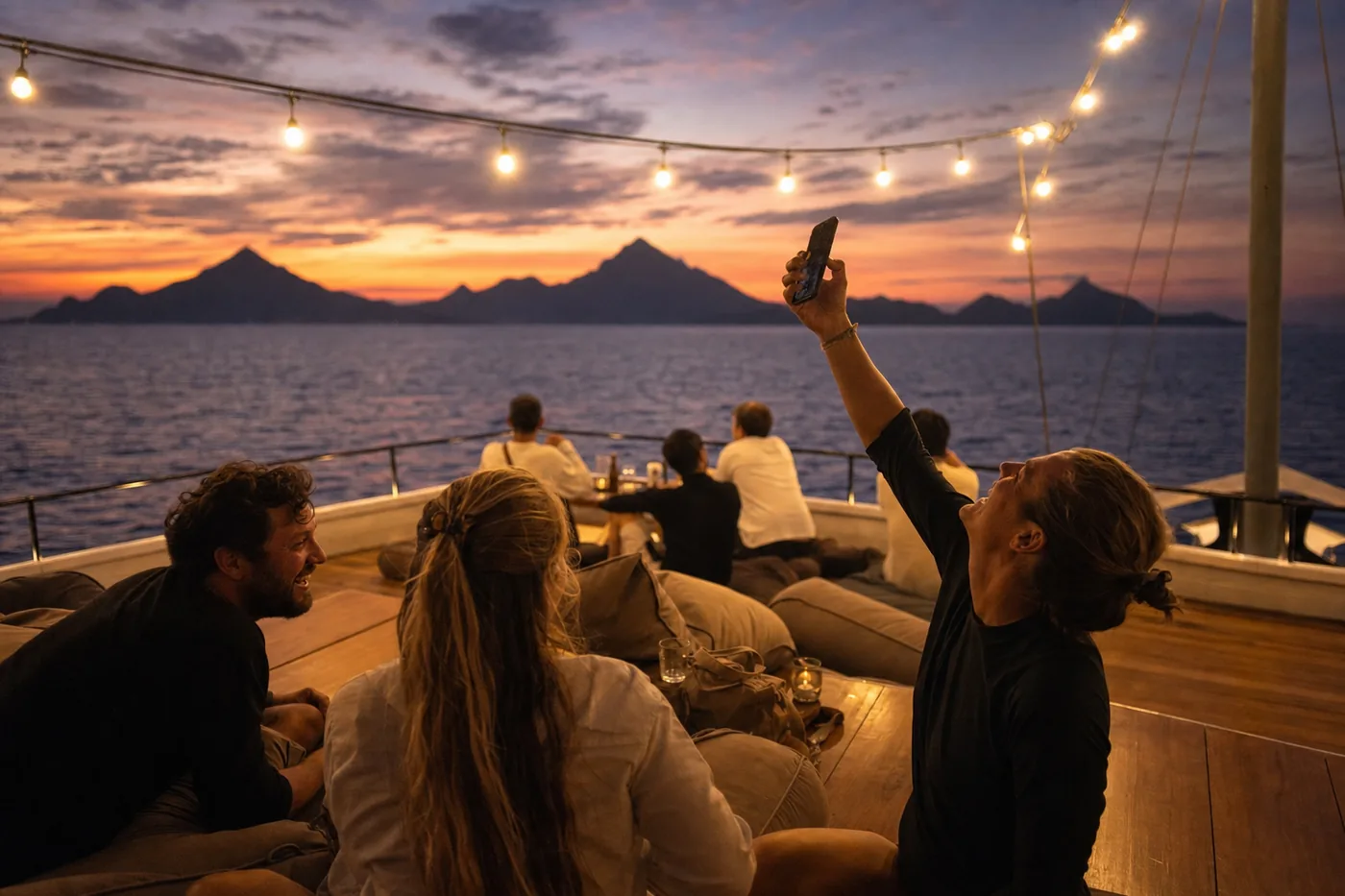
A few habits fix most of it. Upload overnight instead: satellite bandwidth at 02:00 is gloriously empty, and a phone left plugged in with the upload running finishes by breakfast. Cull before you upload, because nobody needs all nine near-identical frames of the same turtle, and raw GoPro footage is the bandwidth equivalent of a house fire. Set video backups to WiFi-plus-charging only, so they do not silently start mid-afternoon. And accept that the truly enormous files, the 4K reels, the day's raw camera cards, are a task for the hotel in Labuan Bajo or Sorong on the last day, not for the middle of the Dampier Strait. Underwater photographers travelling with serious rigs already know this rhythm; our underwater photography guide covers the workflow side in more depth.
What it costs, when it costs anything
Pricing across the fleet has been converging as Starlink spreads, but three models persist. Most premium boats now fold unlimited-but-fair-use satellite WiFi into the trip price, treating it like drinking water; this is the direction the whole market is drifting. A second group, mostly mid-range, charges a flat fee in the range of USD 5 to 15 per day or sells data packages by the gigabyte, commonly USD 10 to 25 for a few gigabytes; fine for messaging, punishing for video. The third group, budget boats and some older schooners, still offers only whatever mobile signal the mast antenna catches, free and worth every penny of that. None of these models is wrong, but you want to know which one you are buying before you are two days from the nearest tower. The question costs nothing at enquiry stage and, unlike almost everything else on a boat, the answer fits in one line.
A connectivity checklist for the week before departure
Everything above compresses into a short pre-trip routine. Buy a Telkomsel SIM or eSIM on arrival in Bali or Jakarta, with the biggest data bundle they will sell you; it is cheap and it makes the airport transfer, the Labuan Bajo hotel night, and the near-shore hours of the trip effortless. Download offline everything before boarding: maps of the region, the week's reading, playlists, the shows the kids will demand, and any work files you would otherwise need to pull down through shared bandwidth. Confirm the boat's internet model in writing, satellite or cellular, included or paid. Set an out-of-office that names dates rather than promising responses. Tell the worriers at home about the quiet days on the route, and give them the operator's office number. Pack the two-pin adapter, a power strip, and a dry bag for the laptop if the laptop must come. The whole list is an hour of admin, and it buys a week where connectivity is a choice rather than a surprise. Our guide to Indonesian SIM cards and eSIMs covers the gateway-by-gateway detail, including why a travel eSIM from an international brand may not put you on Telkomsel at all.
The honest summary, boat by boat and route by route
If you remember nothing else, remember the two-by-two. A Starlink boat in Komodo is, for practical purposes, online all week: work happens, calls happen, the season finale streams at anchor. A Starlink boat on a remote route is online too, with weather-shaped exceptions that reward flexibility. A cellular-only boat in Komodo is intermittently connected, enough for messages most days, not enough to promise anyone a meeting. And a cellular-only boat in the Banda Sea is a beautiful, wooden, fully-catered offline retreat, which is either the problem or the entire point, depending on what you came for.
Both kinds of guest, the one who must stay connected and the one desperate not to be, end up equally happy when the boat matches the need. That match is made at booking time with two or three direct questions, not discovered on day two. Tell us which kind of week you want, and which route is calling you, and we will tell you plainly which of our departures fits, including, when it is the honest answer, that the trip you are eyeing is the wrong one for the job you are carrying. The mantas do not care whether your inbox is at zero. That, in the end, is rather the point of the whole thing.