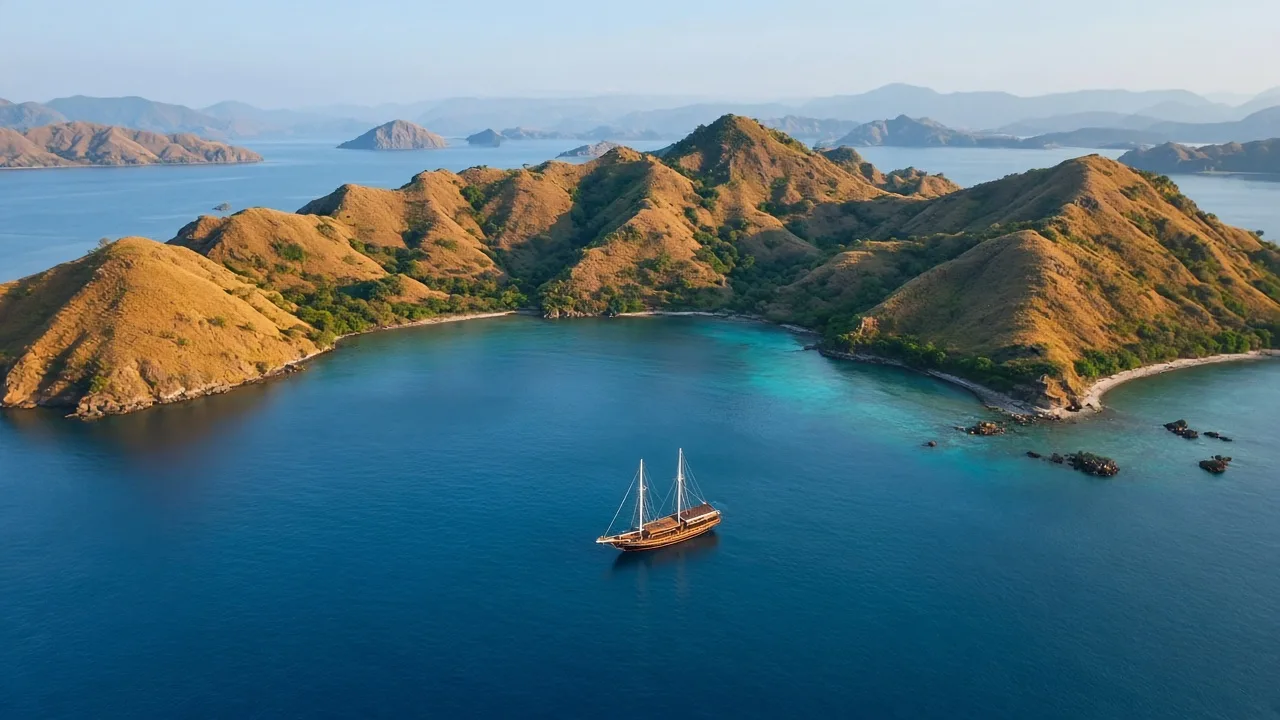
Kakaban is the island that looks wrong on the map, in the best way. From the air it is a green ring of jungle around a lake, an uplifted coral atoll off East Kalimantan whose centre filled with brackish water thousands of years ago and then evolved in isolation, like an aquarium the sea forgot. That lake, all 390-odd hectares of it, holds four species of jellyfish that lost their sting, and for two decades it was one of Indonesia's most surreal swims. Then, in December 2023, the jellyfish began disappearing, the government closed the lake, and one of the country's most famous natural attractions went quiet while scientists worked out what had gone wrong.
This guide gives you the full 2026 picture, because most of what ranks in search results is out of date. The short version: the island has reopened, the jellyfish have recovered, and swimming in the lake is still banned. The longer version includes what you can actually do at Kakaban now, why the surrounding Derawan archipelago remains one of the best dive regions in the country regardless (mantas, an eleven-out-of-ten turtle count, whale sharks), how to get to this genuinely remote corner of Borneo, and where in Indonesia you can still swim with stingless jellyfish legally, a question that, for anyone planning an Indonesia liveaboard, has a rather satisfying answer in Raja Ampat.
What Makes Kakaban's Lake So Strange
Marine lakes are rare. Proper jellyfish lakes, the kind where the resident jellyfish have evolved away their sting, are rarer still, a few dozen worldwide, with Palau's famous lake and a small cluster in Indonesia making up most of the list anyone can visit. Kakaban is the giant of the family. The lake covers around 390 hectares, most of the island's interior, making it one of the largest marine lakes on earth, and it connects to the surrounding sea only through fissures and channels in the old atoll's limestone rim. Rain, groundwater and slow tidal seepage keep the water brackish, warmer and murkier-green than the ocean outside, and the whole system runs on its own rules.
Cut off from turtles and other predators, the lake's jellyfish gradually stopped investing in venom. Four stingless species share the water: the golden jellyfish that pulse through the open lake in their thousands, moon jellies drifting like slow parachutes, upside-down Cassiopeia lying on the bottom with their frilly arms raised to farm sunlight, and a small box jellyfish, a phrase that would be alarming anywhere else on the planet and here describes something harmless the size of a thumbnail. Around them lives a supporting cast found almost nowhere else, anemones that eat jellyfish, gobies, cardinalfish and a carpet of Halimeda algae that gives the lakebed its strange pale-green colour. Biologists have compared the lake's scientific value to the Galapagos, and for once the comparison is not marketing. It is a sealed evolutionary experiment, still running, with a viewing deck.
The geology deserves a paragraph, because it explains everything else. Kakaban began as an ordinary coral atoll, a ring of reef around a sinking volcanic island, the same story as a thousand Pacific atolls. Then, somewhere in the last couple of million years, tectonic movement did something unusual: instead of sinking, the atoll rose. The reef rim lifted as much as 50 metres above sea level, jungle colonised the limestone, and the lagoon in the middle, cut off from the open sea, became a trapped body of water topped up by rain and connected to the ocean only by slow seepage through the porous rock. The lake's salinity settled at brackish, its temperature runs a degree or two warmer than the sea, its water stains green with tannins and algae, and everything that happened to be inside when the door closed either adapted or vanished. The jellyfish adapted, spectacularly. Local Bajau people knew the lake for generations (Kakaban roughly means "hugged", the island hugging its lake), but the outside world only paid attention from the 1990s onward, when divers exploring the archipelago realised that the strange green lake on the uninhabited island held the largest stingless jellyfish population anyone had documented.
The islands around it are worth the journey on their own. Kakaban sits in the Derawan archipelago, a scatter of reefs, atolls and sand cays off the Berau coast of East Kalimantan, and its neighbours divide up the underwater spectacle between them: Sangalaki takes the manta rays, Maratua takes the big schooling fish, Derawan takes the turtles, and the mainland coast at Talisayan adds whale sharks at dawn. We will get to all of them, because the honest 2026 advice is that the diving is now the main event and the lake is the remarkable side trip, rather than the other way round.
The Closure, the Recovery and the 2026 Rules
For years, Kakaban ran as a classic mass-tourism attraction. Day boats from Derawan and Maratua unloaded swimmers by the dozen, and on busy holiday weekends the lake absorbed hundreds of people slick with sunscreen, insect repellent and make-up. The jellyfish paid for it. Through late 2023 the golden jellyfish, the lake's headline species, stopped appearing at the surface in their usual numbers, and on 28 December 2023 the authorities closed the whole island to visitors. Laboratory work that followed pointed at chemical contamination, with sunscreen residue singled out, as a driver of the decline. Palau's lake had already taught the world that these systems can crash; Kakaban taught Indonesia that lesson locally, and the response was blunt.
The island reopened on 16 February 2025 with the swimming ban still in place, and that is where things stand in 2026. The news from the lake itself is genuinely good. Monitoring through 2025 and 2026 found the population stable again, with officials reporting thousands of jellyfish in the lake as of April 2026, sometimes congregating away from the old jetty where visitors expect them, but very much alive. The rules, though, have not relaxed: no swimming, no fins near the water, no sunscreen or lotions around the lake, clean equipment only, local guides mandatory. Visits run under a quality-tourism model with a daily carrying capacity of roughly 100 people, and the entrance fee is expected to settle around IDR 100,000 for domestic and IDR 150,000 for foreign visitors as the new management arrangement between Berau and the province beds in. Numbers like these tend to move; treat them as indicative and let your operator confirm the current figure.
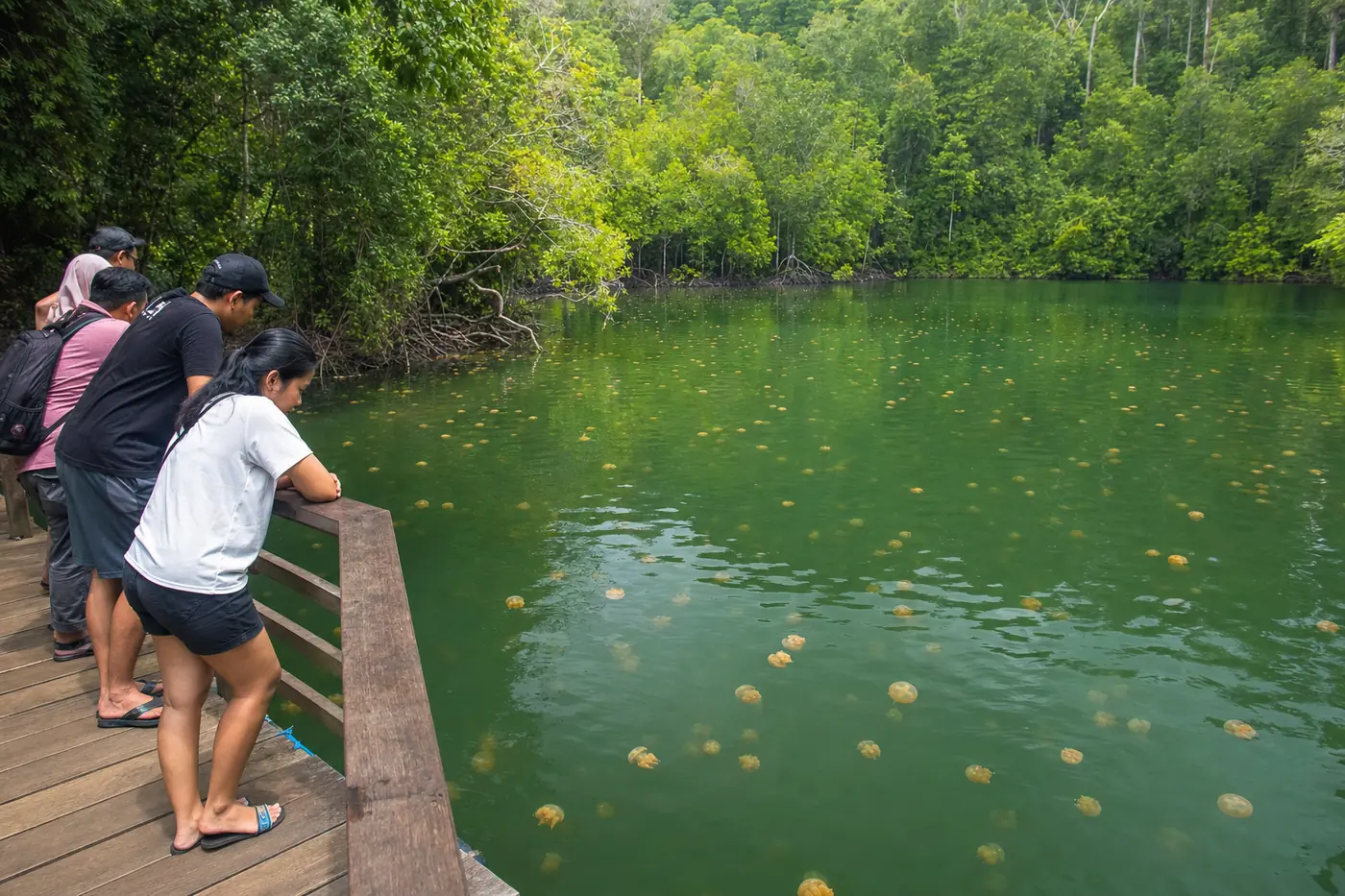
What you get instead of a swim is better than it sounds. A boardwalk of more than two kilometres, built during the closure, now crosses the island's old-growth forest and mangrove to the lakeshore, and from the viewing decks you can watch golden jellyfish pulsing below in their hundreds, photograph them in the tannin-green water, and have the strange experience of standing inside a sealed ecosystem without touching it. Guides talk through the lake's biology, and on a quiet morning, with the forest noise behind you and the water dimpling with jellyfish, the place has recovered some of the atmosphere the crowded years took away. Whether swimming ever resumes is an open question. Officials have hinted that a controlled, protocol-heavy version could return if monitoring stays positive, and trial protocols were tested in 2025, but nobody responsible is promising dates, and we would plan any 2026 trip on the assumption that you will not get in the water.
The Palau comparison is instructive on both ends. Palau's Jellyfish Lake lost nearly its entire golden jellyfish population in the 2016 El Nino drought, closed to swimmers, and then staged a full recovery once conditions turned and visitation resumed under a tightened permit system. Kakaban's crash had a different cause, people rather than climate, which is in one sense encouraging: the pressure that broke it can be managed, and the recovery since 2024 suggests the lake wants to heal. The pessimistic reading is that Kakaban's former traffic, hundreds of swimmers on a peak day against Palau's carefully metered flow, is exactly what a 100-person daily cap is designed never to allow again. Anyone hoping the old free-for-all returns will be waiting a long time, and honestly, should be.
Which raises the obvious question for divers who had the swim on their list: is there anywhere in Indonesia you still can? Yes. Indonesia has dozens of marine lakes, and a handful with stingless populations are open to careful snorkelling, the best known being Lenmakana in Misool, Raja Ampat, where small liveaboard groups snorkel (never dive) under a strict code of conduct: no fins, no sunscreen, slow horizontal swimming, half-hour caps. Lenmakana sees a tiny fraction of Kakaban's former traffic, which is exactly why it still works, and the rules exist precisely so it never repeats Kakaban's 2023. If swimming among golden jellyfish is the dream, that is where the dream currently lives.
Diving Derawan: Mantas, Turtles and the Channel
Strip the lake out of the story entirely and the Derawan archipelago would still deserve a week of anyone's diving life. The islands sit where the Sulawesi Sea meets the Makassar Strait, fed by the same deep-water conveyor that enriches the whole eastern Indonesian triangle, and each island specialises.
Sangalaki: the manta island
Sangalaki is a tiny sand cay with an outsized reputation, ringed by shallow plankton-rich flats where reef mantas feed in trains, often a dozen or more animals looping through the same patch of water. Unlike the cleaning-station encounters of Komodo or Raja Ampat, Sangalaki's mantas are usually feeding on the move near the surface, which makes for long, close passes and superb snorkelling as well as diving. The island is also one of Indonesia's most important green turtle nesting beaches, patrolled and monitored year round, and night landings are restricted accordingly. On a fair-weather day with the plankton running, we would put a Sangalaki manta session against almost any big-animal dive in the country.
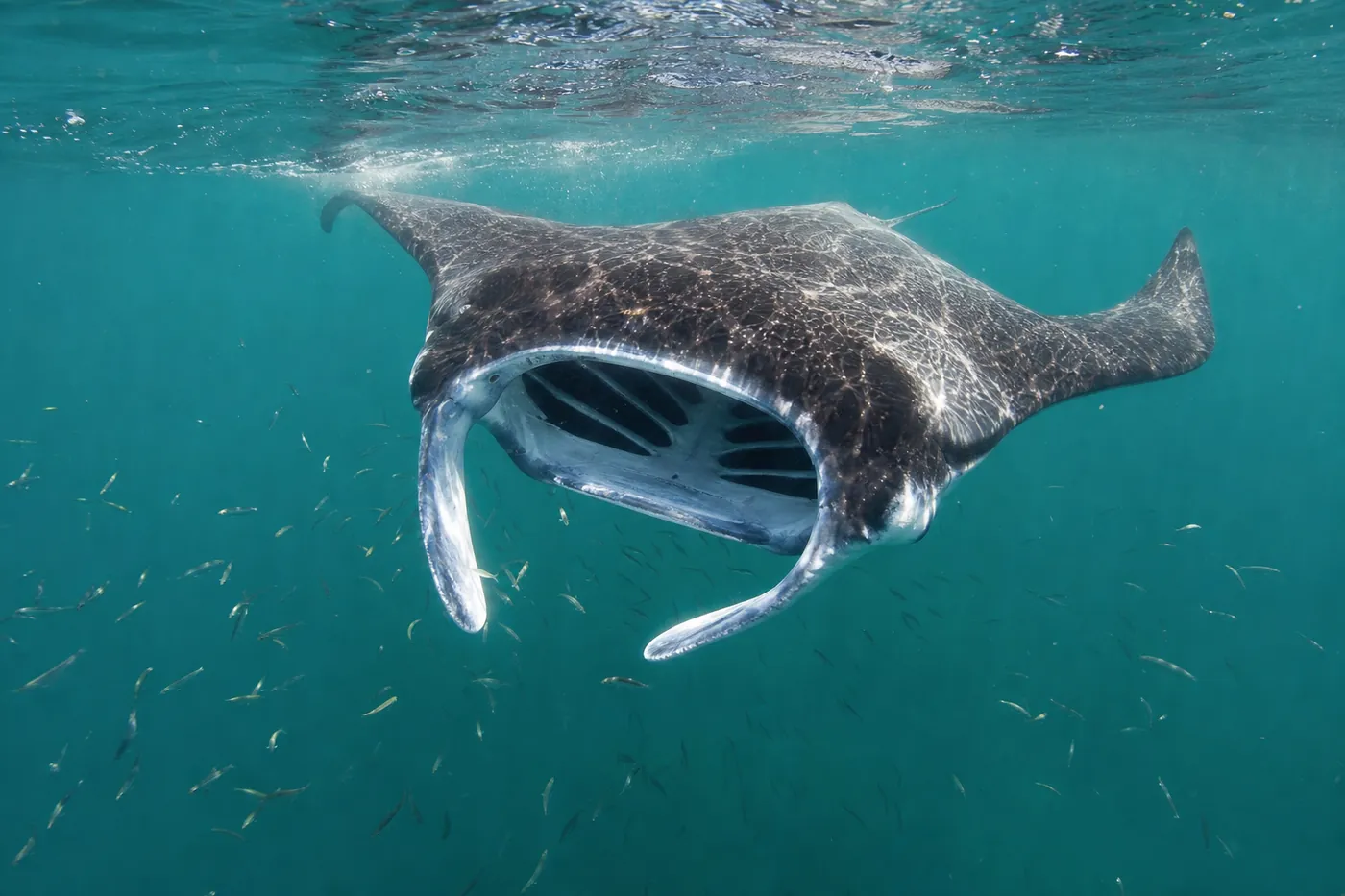
Maratua: the channel and the schools
Maratua, the big lagoon atoll next door, owns the adrenaline. Its famous site, known simply as The Channel (locals sometimes say Big Fish Country, which tells you what to expect), is a pass in the atoll rim where outgoing tide funnels the lagoon into open sea. Time it right and the pass fills with the archipelago's greatest hits: a resident barracuda school that coils into a tornado when the current runs, grey and whitetip reef sharks stacked in the flow, eagle rays, snapper walls and dogtooth tuna hunting the edges. It is a hook-in-and-watch dive in the Komodo tradition, and like all such dives it is entirely about tide timing, so a good local operator matters more here than anywhere else in the region.
Derawan, Kakaban's outer wall and the whale sharks
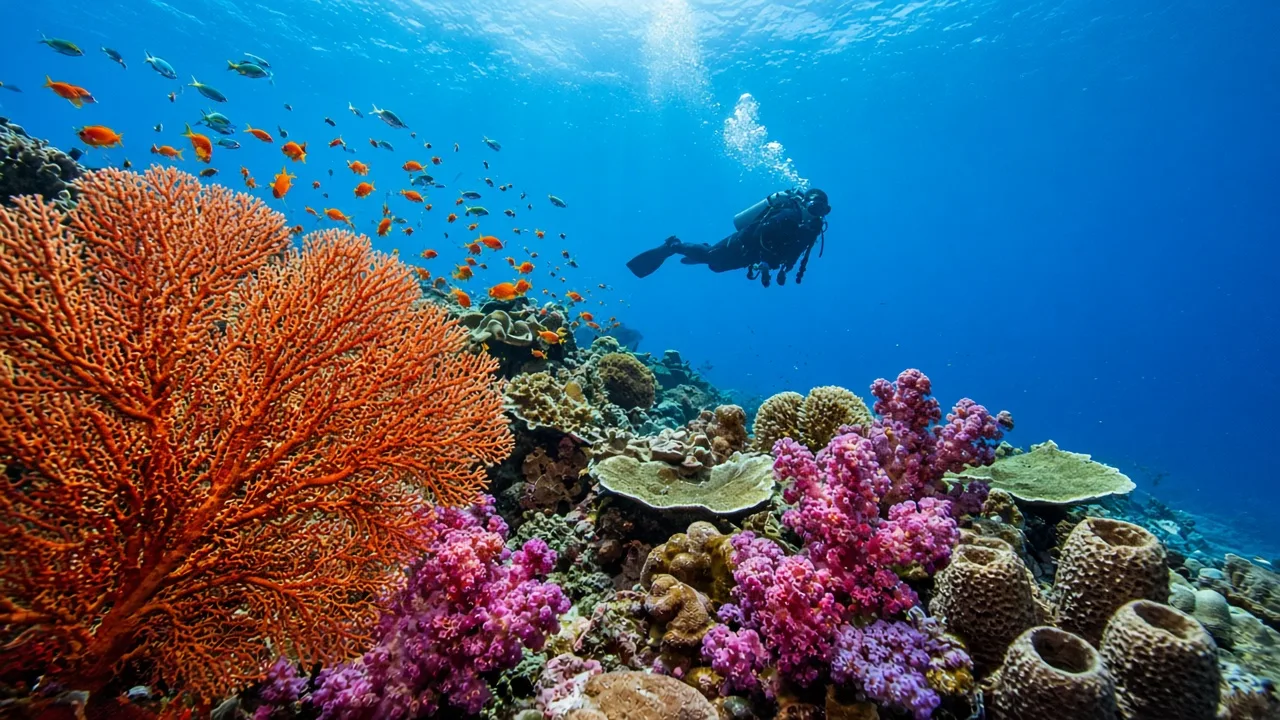
Derawan island itself is the gentle one, a stilt-village island with easy reefs where green turtles are so abundant that the local joke counts dives in turtles per minute rather than the reverse. Kakaban's own outer wall, often skipped in the lake conversation, drops steeply into blue water with sea fans, anemone fields and passing pelagics, and makes an excellent consolation for the closed lake fifty metres above it. And on the mainland coast at Talisayan, a couple of hours away by boat, whale sharks gather at dawn around the bagan fishing platforms to siphon baitfish from the nets, a reliable, regulated encounter in most months that adds the biggest fish in the sea to an already absurd species list. In the space of three days here you can reasonably log feeding mantas, a barracuda tornado, a whale shark and more turtles than you will bother counting.
A typical day on the water shows how the pieces fit. Boats leave Derawan or Maratua after breakfast and run the triangle: a morning manta session at Sangalaki while the light is low and the plankton is up, a second dive on Sangalaki's coral gardens or Kakaban's outer wall, then the Kakaban boardwalk during the midday lull, when the lake's golden jellyfish ride highest in the water column and the viewing decks give you the show the swimmers used to get. The afternoon belongs to the tide tables. If the Maratua channel is running, you finish there hooked into the rubble rim watching barracuda coil; if it is slack, you fall back to a turtle-saturated reef off Derawan and end the day counting hawksbills at five metres while the sun drops. Photographers should note the region is quietly excellent for macro too, with pygmy seahorses on the Maratua fans, ghost pipefish in the rubble and, around the full moons, coconut octopus working the Derawan sand flats. It is not Lembeh, but nothing is, and the wide-angle subjects here are better company.
Getting There and Planning the Trip
Derawan's remoteness is the filter that keeps it quiet, and it is real. There is no direct international route; every itinerary funnels through Kalimantan.
- The standard route. Fly to Kalimarau Airport in Berau (BEJ) via Jakarta or Balikpapan, then drive roughly two and a half hours to the jetty at Tanjung Batu, then take a 30 to 45 minute speedboat to Derawan or onward to Maratua. It sounds like a slog and it mostly is; it is also half the reason the reefs are in the state they are.
- The Maratua shortcut. Maratua has its own airstrip with limited connections from Balikpapan and Tarakan on small aircraft. Schedules are thin and change often, so build a buffer day rather than trusting a tight connection.
- Season. The region dives year round, with the driest, calmest window usually running March to October. Manta activity at Sangalaki follows plankton rather than a strict calendar, and in most years the wet season months still deliver perfectly good diving between showers.
- Water and gear. Warm, 28 to 30 degrees Celsius, with mild currents everywhere except the Maratua pass. A 3 mm suit, a reef hook for the channel, and closed shoes for the Kakaban boardwalk cover the specialist kit.
- Where to stay. Simple guesthouses on Derawan, a handful of resorts on Maratua including overwater options, and dive operators on both islands running day boats to Sangalaki and Kakaban. There is no luxury infrastructure here in the Bali sense, and regular liveaboard coverage is thin, mostly occasional expedition-style visits rather than fixed seasonal routes.
- Budget. Once you have absorbed the flights, Derawan is one of the cheaper world-class dive regions in Indonesia. Guesthouse beds run from around USD 20 a night, three-dive day trips sit well under what a comparable Komodo day costs, and the biggest single line item is usually the private speedboat transfer, worth splitting with other travellers if you can coordinate arrival days.
The confusion is understandable, and it reaches our booking desk more often than any other question about this region. Video of the Kakaban lake swim from 2019 through to 2022 is still circulating, still sitting near the top of the search results, and nothing about it announces that it is out of date. People plan around it, book flights into Balikpapan, and only then find the swimming ban. So it is worth being blunt about the three separate decisions hiding inside what used to be one trip. The lake is still worth seeing from the boardwalk. The diving around Derawan, Sangalaki and Maratua is world class and underrated on its own merits. And if swimming with stingless jellyfish is the non-negotiable centrepiece of the holiday, the trip to book in 2026 is a South Misool liveaboard with Lenmakana on the itinerary. All three are good reasons to travel. They are simply no longer the same booking.
Kakaban, Lenmakana and Where Derawan Fits
There is a bigger lesson folded into the Kakaban story, and it applies to every fragile site in this country. The lake did not close because of one villain; it closed because ten thousand small, individually harmless decisions, one more group, one more layer of sunscreen, one more busy Sunday, compounded into a system failure that took a two-year shutdown to reverse. Every rule that now frustrates a visitor at Kakaban, and every rule that governs the swim at Lenmakana, exists because somewhere a version of this already happened. We tell our guests the same thing before every marine lake visit and every manta dive: the sites that still feel miraculous in 2026 are the ones where somebody said no early enough. Being on the receiving end of a "no" occasionally is the price of there being anything left worth flying across the world for, and in most years the divers who grumble at the briefing are the same ones evangelising the rules by the farewell dinner.
Here is how we would frame the choice for a diver planning eastern Indonesia over the next couple of years. Derawan is a destination for a focused, land-based dive week: mantas, the channel, turtles, whale sharks, and the lake as a viewing-deck curiosity, reached through Kalimantan's slow logistics and rewarded with reefs that see a fraction of the traffic of anywhere comparably good. It combines poorly with other regions in a single trip, because the access runs through a different corner of the country, and that isolation is part of its character.
The jellyfish experience, meanwhile, has moved east. Lenmakana and the marine lakes of Misool sit inside the standard southern Raja Ampat liveaboard circuit, wrapped in the richest reef diving on the planet, and a Raja Ampat liveaboard in the October to April season delivers the swim Kakaban no longer offers alongside a week of diving that needs no consolation framing whatsoever. Divers with time for one trip usually take that answer and run. Divers with time for both discover what East Kalimantan's regulars have known for years: that the quiet archipelago off Berau was never really about the lake.
If the Misool route appeals, or you want honest advice on sequencing the two regions, talk to our team. We keep track of the Kakaban rules season by season, we run the boats that visit Lenmakana, and we would rather set expectations straight before you book flights than after.